Ankara Ecz. Fak. Derg.
31 (1) 13-19,2002 J. Fac. Pharm, Ankara 31 (1) 13-19,2002
FATTY A C I D P R O F I L E OF F R E S H A N D D R I E D B A N A N A (MUSA SAPIENTUM L. VAR. CAVENDISHII Lamb.) P E E L OILS
T A Z E ve K U R U T U L M U Ş M U Z (Musa sapientum L. var. cavendishii Lamb.) KABUK Y A Ğ L A R I N I N YAĞ ASİTİ PROFİLİ
İlkay ORHAN * Şenay KÜSMENOĞLU Bilge ŞENER
Department of Pharmacognosy, Faculty of Pharmacy, Gazi University, 06330 Ankara-Turkey
A B S T R A C T
Fatty acid compositions of the fixed oils obtained from the dried and fresh fruit peels of Musa sapientum var. cavendishii (Musaceae) were examined by capillary GC-MS. Both of the oils were found to contain palmitic acid as the major saturated fatty acid along with linoleic and linolenic acids as the mean unsaturated components, which are key fatty acids for human health, as well as the other saturated fatty acids, namely caprylic, capric, lauric, myristic, stearic, and arachidic acids in minor amounts.
Keywords: Musa sapientum, Musaceae, banana, fixed oil, fatty acid, GC-MS
Ö Z E T
Musa sapientum var. cavendishii''nin (Musaceae) kurutulmuş ve taze meyve kabuklarından elde edilen sabit yağların yağ asiti kompozisyonları kapiller GC-MS ile incelendi. Yağların her ikisinin de, minör miktarlarda kaprilik, kaprik, laurik, miristik, stearik ve araşidik asitlerin yanısıra, majör doymuş yağ asidi olarak palmitik asit ile başlıca doymamış bileşenler olarak insan sağlığı için anahtar yağ asitleri olan linoleik ve linolenik asitleri içerdiği bulundu.
Anahtar kelimeler: Musa sapientum, Musaceae, muz, sabit yağ, yağ asiti, GC-MS
INTRODUCTION
The genus Musa (Musaceae) is one of the interesting tropical plants which have been consumed by humans and animals as a delicious and nutritious food since centuries. Musa species have been so far reported to exhibit a number of biological activities such as
antiulcerogenic, antidiabetic, antiatherogenic, antidiarrheic, antitumoral, and antimutagenic (1-7). The fruits are rich in starch, chlorophyls, carotenoids, flavonoids and coumarins (2).
Modern nutritional science is now developing new insights into the relation between food intake and health, and interest in the role of diet. In the search for means to improve human health, fatty acids have been promoted as valuable dietary compounds. As the major natural sources of essential fatty acids such as evening primrose oil and borage oil, plant oils contain high amounts of linoleic and y-linolenic acids, which are converted in the body to dihomo-y-linolenic acid and subsequently to arachidonic acid. This may explain the beneficial effect of plant oils rich in n-6 fatty acids in cardiovascular diseases (8). Dietary consumption of some plant and fish oils is also known to modulate the balance of lipid inflammatory mediators and, therefore, is valuable in treatment of inflammatory skin disorders (9, 10).
To exemplify the fatty acid containing preparations, Exorex , originally derived from the fatty acids of banana peels, was developed in South Africa against psoriasis and seborrhetic dermatitis. In 1993, Linotar (sold under the trade name Exorex® in the U.S.A., Canada, U.K., Holland and Austria) was registered with South African Medicines Control Council by Meyer Zall Laboratories (11-13). This preparation consists of three fatty acid derivatives, namely ethyl oleate, ethyl linoleate, and ethyl linolenate. In this study, we have aimed to investigate the fatty acid compositions of the fixed oils of the dried and fresh fruit peels of M. sapientum var. cavendishii by capillary gas chromatography- mass spectrometry (GC-MS) as to see the differences in the dried and fresh banana peels. There has been so far a few studies on the aromatic content of banana fruits previously (14,15). Conversely, only one report on the fatty acid esters of banana peels has been found to date, species name of the banana used in that study was not indicated (16). Therefore, this is the first report on the fatty acid content of the peels of M. sapientum var. cavendishii.
M A T E R I A L AND M E T H O D Plant material
Musa sapientum. L. var. cavendishii fruits were purchased from an outdoor market in Ankara. A voucher specimen has been kept in the authors' laboratory in the Faculty of Pharmacy, Gazi University, Ankara, Turkey.
Ankara Ecz. Fak. Derg., 31 (1) 13-19, 2002 15
General experimental procedures
Chromatographic analysis was carried out with an Hewlett Packard Model 6890/5972 gas
chromatograph-mass spectrometry (GC-MS). The capillary column used was an HP-5MS (5 %
phenyl methylsiloxane, 0.25 m film thickness, 30 m x 250 m, i.d., model no. HP
190915-433). The analytical conditions for GC-MS were set as follows: carrier gas: helium (lmL/min),
flow rate: 1 mL/min, detector temperature: 250 °C, column temperature: 250 °C, injector
temperature: 250 °C, split ratio: 1/20, split flow: 20 mL/min, average velocity: 36 cm/sec, run
time: 30.83 min, pressure: 7.6 psi. Initial temperature was 40 °C for 2 min after injection, then
increased to 250 °C (8 °C/min) with a final hold at 250 °C for 10 min. MS operating parameters
were: ionization voltage: 70 eV, ion source temperature: 250 °C, mass range (m/z): 20-440.
Extraction and methylation of the fatty acids
Musa sapientum L. var. cavendishii fruits were peeled off and divided into two portions. The
first portion (46.27 g) was air-dried and powdered with anhydrous sodium sulfate. The second
portion (130.66 g) was used freshly to obtain the fixed oil. Both of the dried and fresh banana
peels were extracted with petroleum ether in a Soxhlet apparatus. Dried and fresh banana peels,
which were dark yellow in color, yielded 1.49 g (3.22 %) and 0.98 g (0.75 %) of fixed oils,
respectively. The oils were saponified with 0.5 N NaOH solution and free fatty acids were
converted to their methyl ester forms with boron trifluoride-methanol complex (20 %, Merck)
reagent according to Morrison's method (17). The methyl esters of fatty acids were dissolved in
CHCI3 and applied to GC-MS at 0.2 1 of injection volume.
RESULTS AND DISCUSSION
A total of 8 saturated (caprylic, capric, lauric, myristic, palmitic, stearic, arachidic, and
behenic acids) and 3 unsaturated fatty acids (palmitoleic, linoleic, and linolenic acids) were
identified by relative retention times compared to those of standards using a comprehensive
bank of Wiley library. According to our results, fixed oils obtained from the dried and fresh
fruit peels of M. sapientum var. cavendishii have been shown to be particularly rich in linoleic
and linolenic acids, which are two key essential unsaturated fatty acids that human body needs,
as well as palmitic acid as the main saturated fatty acid (Figure 1 and 2). When compared the
fixed oils of fresh and dried banana, some of the saturated fatty acids (caprylic, capric and
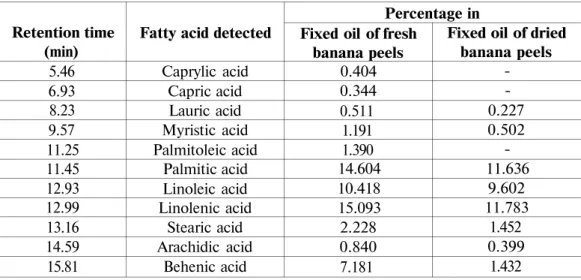
palmitoleic acids) in fresh banana oil have not been detected in dried banana oil (Table 1).
Besides, percentages of all fatty acids detected in the fresh banana peel oil have been found to
be higher than those detected in the dried banana peel oil.
Therefore, we conclude that the fixed oils of the dried and fresh fruit peels of M.
sapientum var. cavendishii have a remarkable nutritious value due to their rich fatty acid
contents. Although the banana peels are not edible, they can be evaluated as a new natural
source for obtaining essential fatty acids. To the best of our knowledge, this is the first
comparative report on fatty acid composition of the fresh and dried peel oils of M. sapientum
var. cavendishii.
Ankara Ecz. Fak. Derg., 31 (1) 13-19,2002
Figure 2. GC-MS chromatogram of the fresh banana peel oil.
Table 1. Fatty acid contents of the oils obtained from the fresh and dried banana peels of
M. sapientum var. cavendishii.
Retention time
(min)
5.46
6.93
8.23
9.57
11.25
11.45
12.93
12.99
13.16
14.59
15.81
Fatty acid detected
Caprylic acid
Capric acid
Lauric acid
Myristic acid
Palmitoleic acid
Palmitic acid
Linoleic acid
Linolenic acid
Stearic acid
Arachidic acid
Behenic acid
Percentage in
Fixed oil of fresh
banana peels
0.404
0.344
0.511
1.191
1.390
14.604
10.418
15.093
2.228
0.840
7.181
Fixed oil of dried
banana peels
-0.227
0.502
-11.636
9.602
11.783
1.452
0.399
1.432
REFERENCES
1. Best, R., Lewis, D.A., Nasser, N. "The antiulcerogenic activity of the unripe plantain
banana {Musa species)" Br. J. Pharmacol, 82, 107-116 (1984).
2. Botting, K.J., Young, M.M., Pearson, A.E., Harris, P.J., Ferguson, L.R. "Antimutagens
in food plants eaten by Polynesians: micronutrients, phytochemicals and protection against
bacterial mutagenicity of the heterocyclic amine 2-amino-3-methylimidazo[4,5-f]quinoline"
Food Chem. Toxicol, 37, 95-103 (1999).
3. Emery, E.A., Ahmad, S., Koethe, J.D., Skipper, A., Perlmutter, S., Paskin, D.L.
"Banana flakes control diarrhea in enterally fed patients" Nutr. Clin. Pract., 12, 72-75
(1997).
4. Usha, V., Vijayammal, P.L., Kurup, P.A. "Aortic glycosaminoglycans in atherogenic
action of dietary fiber from unripe banana (Musa paradisiaca)" Indian J. Med. Res., 94,
143-146(1991).
5. Lohsoonthorn, P., Danvivat, D. "Colorectal cancer risk factors: a case-control study in
Bangkok" Asia Pac. J. Public Health, 8, 118-122 (1995).
6. Hoover-Plow, J., Savesky, J., Dailey, G. "The glycaemic response to meals with six
different fruits in insulin-dependent diabetics using a home blood glucose monitoring
system" Am . J. Clin. Nutr., 45, 92-97 (1987).
Ankara Ecz. Fak. Derg., 31 (1) 13-19, 2002 19