Journal of Neurological Sciences [Turkish] 33:(1)# 47; 030-037, 2016
http://www.jns.dergisi.org/text.php3?id=947 Research Article
A New Apraxia Test for Turkish Elderly; DEKODa
Ahmet EVLİCE1, Pınar KURT2, Gül KAYSERİLİ3, Pembe KESKİNOĞLU4, Reyhan UÇKU4, Görsev YENER5
1
Cukurova University, Faculty of Medicine, Department of Neurology, Adana, Turkey 2
Istanbul Arel University, Faculty of Psychology, Istanbul, Turkey 3Narlidere Nursing Home, Elderly Care and Rehabilitation Center, Department of Psychology, Izmir, Turkey 4Dokuz Eylul University, Faculty of Medicine, Department of Public Health, Izmir, Turkey 5Dokuz
Eylul University, Faculty of Medicine, Department of Neurology, Izmir, Turkey
Summary
Introduction Apraxia refers to inability to perform skilled or learned acts, which cannot be explained by primary motor, sensory or comprehension impairments. The currently used foreign apraxia batteries are quite complex, lengthy and not compatible for uneducated people. This study aimed to develop a new, simple and short apraxia test for uneducated people. Method Subjects with Alzheimer's disease (AD) (n:38 ), mild cognitive impairment (MCI) (n:39) and healthy control group (n:263) participated to study. All participants were administered neuropsychological battery which included Yesavage geriatric depression scale, Barthel index, mini-mental status examination (MMSE), and DEKODa apraxia test (DEKODa). SPSS 20.0 was used to make comparisons of groups. Results The Yesavage geriatric depression scale, Barthel Index, MMSE and DEKODa were different from each other in almost all groups (p<0.001). In the comparison of MMSE and DEKODa scores used the Pearson correlation analysis, a significant correlation was found between each of the groups (p< 0.05). The cut-off value of DEKODa score was determined as 10, any score at or below 10 was indicating as Alzheimer's disease, and its sensitivity and specificity values were76.3% and 75% respectively. Discussion We described a new battery for apraxia, named as DEKODa, derived form a community based study designed for Turkish speaking elderly population. Lower scores of DEKODa than 10 points indicated AD. The scores for MCI subjects were similar to healthy elderly controls and different than AD. These finding imply that DEKODa can be useful for detecting AD diagnosis in elderly population.
Key words: Apraxia, Alzheimer, Mild Cognitive Impairment
Türk Yaşlıları İçin Yeni Bir Apraksi Testi; DEKODa Özet
Giriş Apraksi; motor, duyusal veya anlama kusuru olmaksızın bilinen amaçlı bir hareketin yapılamamasına denir. Günümüzde kullanılan apraksi bataryaları oldukça kompleks, uzun ve eğitimsiz insanlar için uygulanımı zor olan testlerdir. Bu çalışmada basit, kısa ve eğitimsiz insanlar için uygulanımı kolay yeni bir apraksi testinin geliştirilmesi amaçlanmıştır. Metod Çalışmaya; Alzheimer hastalığı (AH) (n:38), hafif kognitif bozukluk (MCI) (n:39) ve sağlıklı kontrol grubu (n:263) olmak üzere 3 grup alınmıştır. Tüm olgulara Yesavage geriatrik depresyon skalası (YGDS) , Barthel indeksi (BI) , mini-mental durum testi (MMSE) ve DEKODa apraksi testini (DEKODa) içeren nöropsikolojik batarya uygulanmıştır. Tüm skorlar SPSS 20.0 programı kullanılarak karşılaştırılmış, istatistiksel olarak p<0.05 anlamlı
kabul edilmiştir. Bulgular Ortalama eğitim süresi tüm gruplarda beş yılın altında saptanmıştır. YDGS, BI, MMSE ve DEKODa skorlarının ortalamaları hemen hemen tüm gruplar arasında birbirinden farklı saptanmıştır (p<0.001). MMSE ve DEKODa skorlarının korelasyonu Pearson korelasyon analizi ile değerlendirilmiş ve tüm gruplarda anlamlı korelasyon gözlenmiştir (p< 0.05). ROC analizinde anlamlı praksi skoru 10 puan olarak belirlenmiş, 10 ya da altında puan alan olgular 76.3% duyarlılıkla ve %75 spesifiteyle AH olarak kabul edilmiştir. Sonuç Bu çalışmada; Türkçe konuşan yaşlı nüfus için tasarlanmış yeni bir apraksi bataryası tanımlanmıştır. Test skoru 10 puan ve altında olanlarda AH gözlenmiştir. Test skoru hafif kognitif bozukluk olanlarda ve sağlıklı kontrol grubunda benzer saptanırken, AH grubunda diğer gruplara göre düşük saptanmıştır. Bu bulgular; yaşlı Alzheimer hastalarının tanısında DEKODa apraksi testinin faydalı olabileceğini göstermiştir.
Anahtar Kelimeler: Apraksi, Alzheimer, Hafif Kognitif Bozukluk
INTRODUCTION
Apraxia refers to inability to perform skilled or learned acts, which cannot be explained by primary motor, sensory, attention, comprehension or cooperation impairments(18). Individuals with apraxia may encounter a number of difficulties when attempting to participate in basic, instrumental activities of daily living(13). Apraxia can lead to severe disabilities in daily life(2,5,16).While apraxia is mostly seen in stroke patients, it is also found in patients with Alzheimer's disease (AD)(19,20), cortico-basal degeneration(14)
and Huntington's disease(17).
Apraxia involves a disruption of the praxis network(8), which is responsible for the cognitive formulation of movement intentions and plans, selection of goals and anticipation of end results. This network also provides the basis for effective interaction with the environment(7). The currently used apraxia batteries are quite complex, lengthy and not compatible for uneducated people(22,23). Because of the considerably high rate of illiteracy in Turkish population, especially in individuals older than 65 years of age, a new apraxia test is needed for older population in Turkey. This study aimed to develop a new, simple and short apraxia test that is compatible for uneducated people.
MATERIAL AND METHODS
Subjects with Alzheimer's disease (AD) and mild cognitive impairment (MCI) from the Neurology Department of a university hospital participated in the study. The healthy control group consisted of community dwelling individuals who participated in a door-to-door survey in Narlıdere district of Izmir.
All subjects were aged 65 or older, Turkish speaking, and free of neuropsychiatric or other medical conditions that could affect cognition. All AD and MCI subjects were evaluated according to the medical history provided by the subjects' caregivers or guardians. Diagnoses of the subjects were performed by two neurologists specialized in the area of dementia. AD subjects were diagnosed with probable or possible AD using the National Institute of Neurological and Communication Disorders and Stroke/Alzheimer's Disease and Related Disorders Association (NINCDS-ADRDA) guidelines(15). The diagnosis of MCI was made using the criteria established by Petersen and colleagues(21). The validated Turkish version of the mini-mental status examination (MMSE) was used to evaluate the cognitive status(10).
The subjects making up the control group were evaluated at their homes in a door-to-door survey. Resident addresses used in the door-to-door survey were assigned by the Turkish Government Statistical Institution
according to the socio-economic and cultural background of the residents. The Narlıdere district in the province of Izmir in western Turkey was determined to be representative of the Turkish population. All subject participants underwent neurological examination and were administered neuropsychological battery, which included Yesavage geriatric depression scale (YGDS)(25), clinical dementia rating scale(1), Dokuz Eylül Cognitive State Neurocognitive Test
Battery(12), Barthel index (BI)(24), MMSE(10), and DEKOD apraxia test (DEKODa).
AT scores were acquired by applying the following question format, ‘'show me, how do you ………..?'' (Table 1). The item points were then totaled.
The local ethical committee approved the study, and all subjects (or legal guardians) gave informed consent prior to testing.
Table1: The Parameters of DEKOD
Movement Tasks (Point) Points of Right Hand Points of Left Hand
Say Bye With Your Hands (2) 1 1
Open The Door With A Key (2) 1 1
Comb Your Hair (2) 1 1
Drive The Nail With Hammer (2) 1 1
Light A Box Match (2) 1 1
Peel Fruit With A Knife (2) 1 1
Blow Out A Candle (1) 1
Statistical Analysis
SPSS 20.0 was used for statistical analyses. Categorical measurements were summarized as numbers and percentages. Quantitative measurements were summarized as mean (minimum - maximum) and standard deviation. The Chi-square test was used to make
comparisons between the categorical measurements of groups, the Kolmogorov-Smirnov test to quantify and compare sample population distribution and normal distribution, the one-way ANOVA to compare the quantitative measurements of groups and the Bonferroni, Scheffe and Tamhane tests to determine whether there
was intra-group homogeneity of variance. The Pearson and Spearman correlation coefficients were used to analyze the interaction between praxis scores and other numerical measurements, and ROC Curve analysis was used to determine the cut-off value of praxis score in the dementia group and the control group. The level of statistical significance was set at 0.05 in all tests.
RESULTS
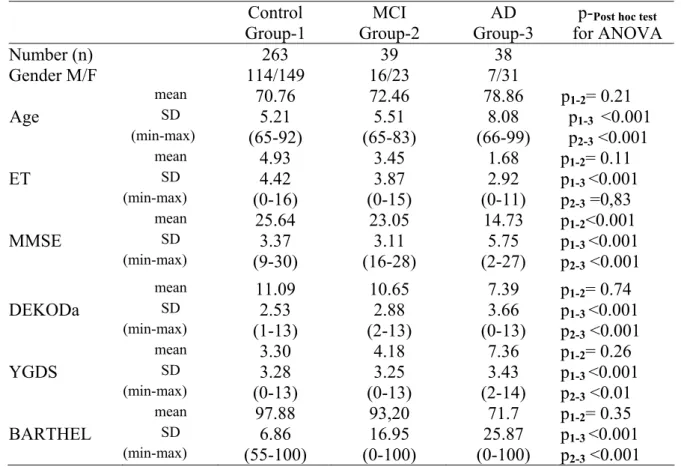
A total of 340 subjects were included in this study, 263 healthy elderly controls, 39 subjects with MCI and 38 subjects with AD (Table 2). Mean age was 70.76 ± 5.21 92) in control group, 72.46 ± 5.51 (65-83) in MCI group and 78.86 ± 8.08 (66-99) in AD group. As clearly seen, the AD subjects were older than the subjects in the other two groups (p.0<001) (Table 2). Mean time of education were 4.93±4.42 (0-16) years in control group, 3.45±3.87 (0-15) years in MCI group and 1.68±2.92 (0-11) years in AD group. AD patients were more uneducated than the control group (p<0.001) (Table 2). Mean Yesavage geriatric depression scale scores were 3.30±3.28 (0-13) in control group, 4.18±3.25 (0-13) in MCI group and 7.36±3.43 (2-14) in AD group. Mean Blessed 1 scores were 0.23±0.77 (0-8) in control group, 0.84±1.09 (0-3) in MCI group and 8.19±4.72 (0-16) in AD group. Mean Blessed 2 scores were 0.03±0.27 (0-3) in control group, 0.09±0.39 (0-2) in MCI group and 1.27±1.92 (0-6) in AD group. Mean Barthel index scores were 97.88±6.86 (55-100) in control group, 93.20±16.95 (0-100) in MCI group and 71.7±25.87 (0-100) in AD group. The Yesavage geriatric depression scale
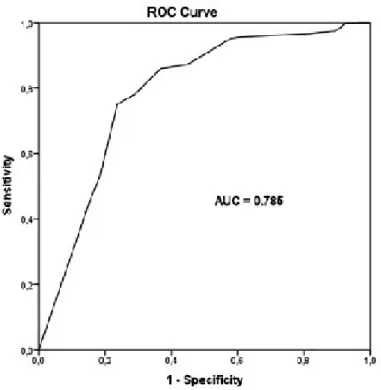
Blessed 1, Blessed 2, and Barthel Index were different from each other in almost all groups (p<0.001). Mean MMSE score out of possible 30 points was 25.64±3.37 (9-30) in control group, 23.05±3.11 (16-28) in MCI group and 14.73±5.75 (2-27) in AD group. Mean DEKOD scores were 11.09±2.53 (1-13) in control group, 10.65±2.88 (2-13) in MCI group and 7.39±3.66 (0-13) in AD group. (Table 2). MMSE and DEKODa scores were different from each other in almost all groups (p<0.001). In the comparison of MMSE and DEKODa scores using the Pearson correlation analysis, a significant correlation was found between each of the groups [Control (p< 0.001), MCI (p: 0.006), AD (p: 0.002)] (Table 4). In AD group and control group, the cut-off value of DEKODa score was determined as 10, the optimal diagnostic value for sensitivity and specificity. Any score at or below 10 was accepted as AD, and its sensitivity value was found to be 76.3%. Any score greater than 10 was accepted as control group, and its specificity value was found to be 75% (Table 3, Graphic 1).
When DEKODa scores' application compliance assessed in each group; it was found the value of consistency (Cronbach's alpha) 0.863 in all groups, 0.827 in control group, 0.854 in MCI group, 0.873 in AD group. Upper 50% patients of AD group and nearby 20% to 30% patients of the other groups failed at some applications as ''peel fruit with a knife'' (on right and left hand), ''comb your hair'' (on right and left hand), ''drive the nail with hammer'' (on left hand), ''say bye with your hands'' (on left hand).
Table 2: The data of all groups Control Group-1 MCI Group-2 AD Group-3
p-Post hoc test for ANOVA Number (n) 263 39 38 Gender M/F 114/149 16/23 7/31 mean p1-2= 0.21 SD p1-3 <0.001 Age (min-max) 70.76 5.21 (65-92) 72.46 5.51 (65-83) 78.86 8.08 (66-99) p2-3 <0.001 mean 4.93 3.45 1.68 p1-2= 0.11 ET SD 4.42 3.87 2.92 p1-3 <0.001 (min-max) (0-16) (0-15) (0-11) p2-3 =0,83 mean 25.64 23.05 14.73 p1-2<0.001 MMSE SD 3.37 3.11 5.75 p1-3 <0.001 (min-max) (9-30) (16-28) (2-27) p2-3 <0.001 mean 11.09 10.65 7.39 p1-2= 0.74 DEKODa SD 2.53 2.88 3.66 p1-3 <0.001 (min-max) (1-13) (2-13) (0-13) p2-3 <0.001 mean 3.30 4.18 7.36 p1-2= 0.26 YGDS SD 3.28 3.25 3.43 p1-3 <0.001 (min-max) (0-13) (0-13) (2-14) p2-3 <0.01 mean 97.88 93,20 71.7 p1-2= 0.35 BARTHEL SD 6.86 16.95 25.87 p1-3 <0.001 (min-max) (55-100) (0-100) (0-100) p2-3 <0.001 Abbreviations:
MCI: Mild Cognitive Impairment AD: Alzheimer Disease
Gender M/F: Gender Male/Female ET: Education Time (Number of Years) MMSE: Mini-Mental Status Examination DEKODa: DEKOD Apraxia Test Score YGDS: Yesavage Geriatric Depression Scale BARTHEL: Barthel index
Table 3: ROC Curve Analysis Between AD Group and Control Group
Praxia Score AUC (Area Under Curve)
P 95% CI for
AUC Sensitivity Specificity Score ≤ 10 0.785 <0.001 0.697-0.874 76.3 75
Table 4: Correlations between MMSE and DEKOD
Groups MMSE – DEKOD
Correlation Coefficient (p)
AD 0.446 (<0.001)
MCI 0.436 (0.006)
Control 0.495 (0.002)
DISCUSSION
This study is the first apraxia study performed in a community-based Turkish speaking population in a door-to-door survey. As apraxia is a well-recognized diagnostic sign in AD, with wide frequency range of 33% to 77%(4,6), we developed a new battery for apraxia named as DEKODa for elderly people. The test score was significantly lower in subjects with AD compared to other groups (control and MCI), the test values at or below 10 points may support the diagnosis of AD,
and its value of sensitivity was found to be 76.3% (Table 3, Figure 1), its value of consistency (Cronbach's alpha) was found 0.863 in all groups and 0.873 in AD group. Also, the DEKODa score was found associated with overall cognitive status assessed by the MMSE in all groups (Table 4). Therefore we think that DEKODa can be use for screening AD. However, it must be kept in mind that this test is only a quick screening test and it cannot be used for absolute diagnosis.
When the parameters of DEKODa were evaluated in detail, we observed that at upper 50% subjects of AD group failed at some applications as ''peel fruit with a knife'' (on right and left hand), ''comb your hair'' (on right and left hand), ''drive the nail with hammer'' (on left hand), ''say bye with your hands'' (on left hand). Subjects of the other groups failed nearby 20% at same applications. Since the majority of subjects were right-handed dominant, inability of left hand could be an expected situation. But the AD subjects failed at some applications (''peel fruit with a knife'' and ''comb your hair'') with their both left and right hands. In support of these findings, if the examiner does not have time for an apraxia test, subitems of DEKODa such as ''peel fruit with a knife'' and ''comb your hair'' can be used for quick screening. But it must be kept in mind that these parts of test could not be used for diagnosis, these can give only an idea about apraxia.
In this study, the scores for MCI subjects were similar to healthy elderly controls and different than AD. This finding implies that DEKODa apraxia test can be useful for detecting conversion form MCI to AD in elderly population (Table 2). Similarly, in a small sized study, MCI patients compared with age-matched healthy population, it was reported that there was no significant difference in the frequency of apraxia in MCI(3). Retrospective analyses have shown that only MCI patients who subsequently proceeded to a clinical diagnosis of AD were significantly slower than controls in completing sequential movement tasks despite unimpaired performance(3). Therefore absence of apraxia in the presence of memory failure can be a predictor for the diagnosis of MCI, whereas developing apraxia in a MCI subject may herald conversion to AD.
Until now few studies have been published from Turkey about apraxia tests(9,11). In one study an apraxia test was applied
comparatively to Turkish and American patient groups which included AD. But the number of AD patients' was only two from Turkey, and the method of apraxia test was very complex(11). In the other study, an apraxia test was applied in cerebrovascular disease patients, the term of diagnosis was different from our study, and also the method of apraxia test was more complex than DEKODa(9).
Certain limitations may have an impact on the results of this study, including the lack of age and level of education uniformity among all patient groups. The limitations of this study include the older age and less education in AD group (Table 2). These factors may have an effect on our results, however the differences between groups are small and our sample size is larger than many studies in the literature. Moreover, data in this study were gathered from a door-to-door survey study among elderly people over the age of 65.
Acknowledgements This study was
supported by TÜBİTAK 106S131 project grant. We thank to İlker Ünal (PhD, from Cukurova University, Faculty of Medicine, Department of Biostatistics) for the statistical analysis of this study.
Conflict of interest The authors declare no
conflict of interest in relation to this manuscript.
Informed consent Informed consent was
obtained from subject and subjects' caregivers or guardians.
Correspondence to:
Ahmet Evlice
E-mail: [email protected]
Received by: 24 June 2015 Revised by: 07 January 2016 Accepted: 14 January 2016
The Online Journal of Neurological Sciences (Turkish) 1984-2016
This e-journal is run by Ege University Faculty of Medicine,
Dept. of Neurological Surgery, Bornova, Izmir-35100TR
as part of the Ege Neurological Surgery World Wide Web service.
Comments and feedback: E-mail: [email protected] URL: http://www.jns.dergisi.org
Journal of Neurological Sciences (Turkish) Abbr: J. Neurol. Sci.[Turk]
ISSNe 1302-1664
REFERENCES
1. Berg L. Clinical Dementia Rating (CDR). Psychopharmacol Bull 1988; 24:637–639. 2. Bjorneby ER, Reinvang IR. Acquiring and
maintaining self-care skills after stroke. The predictive value of apraxia. Scand J Rehabil Med 1985; 17: 75_/80.
3. Crutch SJ, Rossor MN, Warrington EK. A novel technique for the quantitative assessment of apraxic deficits: application to individuals with mild cognitive impairment. J Neuropsychol. 2007;1:237–257.
4. Della Sala S, Lucchelli F, Spinnler H. Ideomotor apraxia in patients with dementia of Alzheimer type. J Neurol. 1987;234:91–93. 5. De Renzi E. Apraxia. In: Boller F, Grafman J
eds. Handbook of neuropsychology, Volume 2. Amsterdam: Elsevier Science Publishers, 1989. 6. Derouesné C, Lagha-Pierucci S, Thibault S,
Baudouin-Madec V, Lacomblez L. Apraxic disturbances in patients with mild to moderate Alzheimer's disease. Neuropsychologia. 2000;38:1760–1769.
7. Golisz KM, Toglia JP. Perception and cognition. In: Crepeau EB, Cohn ES, Schell BB, editors. Occupational therapy, 10th ed. Philadelphia: Lippincott Williams & Wilkins; 2003. p. 395-416.
8. Herbert D, Roy E. Limp apraxia: A clinical perspective. Geriatrics & Aging. 2002;/5:/15-21.
9. Kaya K, Unsal-Delialioglu S, Kurt M, Altinok N, Ozel S. Evaluation of ideomotor apraxia in patients with stroke: a study of reliability and validity. J Rehabil Med. 2006 Mar;38(2):108-12.
10. Keskinoglu P, Ucku R, Yener G, Yaka E, Kurt P, Tunca Z. Reliability and validity of revised Turkish version of Mini Mental State Examination (rMMSE-T) in community-dwelling educated and uneducated elderly. Int J Geriatr Psychiatry. 2009;24:1242–1250.
11. Kokmen E, Ozekmekci FS, Cha RH, O'Brien PJ. Testing for apraxia in neurological patients: a descriptive study in two diverse cultures. Eur J Neurol 1998; 5: 175-180. 12. Kurt P, Keskinoglu P, Yaka E, Uçku R, Yener
G. A Composite score for Dokuz Eylül Cognitive State Neurocognitive Test Battery: A door-to-door survey study with illiterate, low and high educated elderly in Turkey. Türk Geriatri Derg. 2014;17,2:143-151.
13. Landry J, Spaulding S. Assessment and intervention with clients with apraxia: Contributions from the literature. Can J Occup Ther. 1998;/66:/52-61.
14. Leiguarda R, Lees AJ, Merello M, Starkstein S, Marsden CD. The nature of apraxia in corticobasal degeneration. J Neurol Neurosurg Psychiatry 1994; 57: 455-59.
15. McKhann G, Drachman D, Folstein M, Katzman R, Price D, Stadlan E. Clinical diagnosis of Alzheimer's disease: report of the NINCDSADRDA Work Group under the auspices of Department of Health and Human Services Task Force on Alzheimer's Disease. Neurology 1984;34:939–944.
16. Rothi LJG, Heilman KM. Apraxia: the neuropsychology of action . Hove: Psychology Press,1997.
17. Shelton PA, Knopman DS. Ideomotor apraxia in Huntington's disease. Arch Neurol 1991; 48: 35-41.
18. Tate RL, McDonald S. What is apraxia? The clinician's dilemma. Neuropsychol Rehabil. 1995;/5:/273-97.
19. Taylor R. Motor Apraxia in dementia. Percept Motor Skills 1994; 79: 523-28.
20. Ochipa C, Gonzalez-Rothi LJ, Heilman KM. Conceptual apraxia in Alzheimers disease. Brain 1992; 115: 1061-71.
21. Petersen RC, Doody R, Kurz A, Mohs RC, Morris JC, Rabins PV, Ritchie K, Rossor M, Thal L, Winblad B.Current concepts in mild cognitive impairment. Arch Neurol. 2001;58:1985–1992.
22. Power E, Code C, Croot K, Sheard C, Gonzalez Rothi LJ. Florida Apraxia Battery-Extended and revised Sydney (FABERS): design, description, and a healthy control sample. J Clin Exp Neuropsychol. 2010 Jan;32(1):1-18 23. Vanbellingen T, Kersten B, Van de Winckel A,
Bellion M, Baronti F, Müri R, Bohlhalter S.A new bedside test of gestures in stroke: the apraxia screen of TULIA (AST). Neurol Neurosurg Psychiatry. 2011;82:389–392. 24. Wolfe CD, Taub NA, Woodrow EJ, Burney PG.
Assessment of scales of disability and handicap for stroke patients. Stroke. 1991 Oct;22(10):1242-4.
25. Yesavage JA. Geriatric depression scale: consistency of depressive symptoms over time. Percept Mot Skills. 1991 Dec;73(3 Pt 1):1032.