A New Triple Band Antenna Design for GPS/ WLAN/ WIMAX
Applications
Ilkin IBRAHIMLI
1, Hemrah HIVEHCHI
1, Saeid KARAMZADEH
1.2ABSTRACT
Abstract- In this work, a novel CPW antenna for wireless communication is proposed. Three practical frequency bands are achieved by three rectangular slots on the patch and a pair of L-shaped slots and rectangular slots on the ground. The proposed antenna size is 30×25×0.8 mm3. Simulated results show that the presented antenna can cover
three separated impedance bandwidths of 600 MHz (1.2–1.8 GHz), 400 MHz (2.2–2.6 GHz), and 2000 MHz (4.5–6.5 GHz), which are well applied for WLAN, WIVAX and GPS applications.
Keywords: multiband antenna; CPW; GPS; WLAN; WIMAX
Introduction
Depending on the rapid progress in communications systems, there is an increasing demand of internal multiband antennas. Many of wireless communication applications like Wireless Local Area Network (WLAN) and Worldwide
Interoperability for Microwave Access (WiMAX) technology are required to operate together for use in GPS and Wi-Fi and another protocols. Recently, several works have appeared regarding the development of multiband and low-profile antennas for many applications in addition to GPS, WLAN and WIMAX applications [16-21]. Literature review of multiband antenna design could be summarized as: coplanar waveguide-fed L-loaded printed Inverted-F antennas [1], shorting pins of the loop antenna [3], L- and U-shaped slots [4], such as using three simple circular-arc-shaped strips [5], Inverted-F strips, S-circular-arc-shaped and a meandered strip [8], defected ground structure (DGS) and dual inverted L-shaped strips [9] and complementary split-ring resonator [10]. Besides, global positioning system (GPS) band is a critical operating frequency band that should be supported by internal multiband antennas of mobile devices.
1. Antenna Design
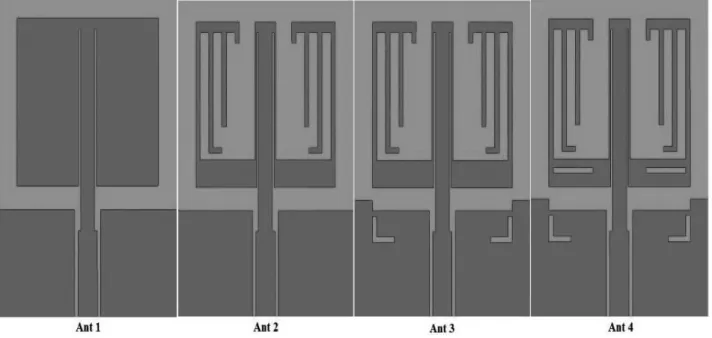
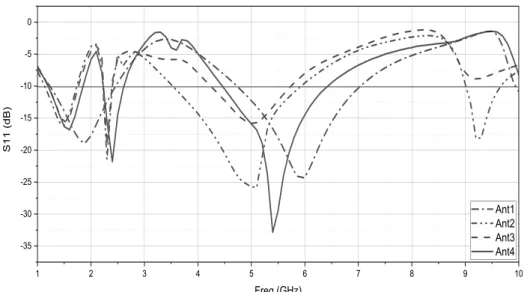
In this section four steps have been followed for obtaining the multiband antenna. Simulation results for each step were analyzed. For designs and finding the improved parameters, Ansoft high frequency structure simulator software (HFSS, ver.16) was used. The proposed antenna is designed on a low cost and low profile FR4 substrate material with 0.8 mm thickness. Figure 1 shows the antenna designing steps. Ant. 1 includes only a feed line connected to rectangular plane and ground plane where just two resonances in 1.2 - 2.45 and 4.7 – 7 is achieved;
Ant. 2 includes rectangular slots, after creating the slots on the patch we could obtain three resonances (1.15-175, 2.2-2.4 and 3.5-5.85) improved. In Ant. 3 by cutting top of the ground and creating two L shape slots, we tried to more resonance and fine response but we achieved these frequencies 1.2-1.78 2.2 2.4 4.2-5.78. In Ant. 4 and final design creating two rectangular slots on the down of the patch, we achieved good results and obtained three resonances in 1.5, 2.4 and 5.5 GHz, as shown in figure 2.
1 2 3 4 5 6 7 8 9 10 -35 -30 -25 -20 -15 -10 -5 0 S11 (d B) Freq (GHz) Ant1 Ant2 Ant3 Ant4
Figure 2: Simulated S11 for antennas (1-4)
1.1 RESULTS AND DISCUSSION
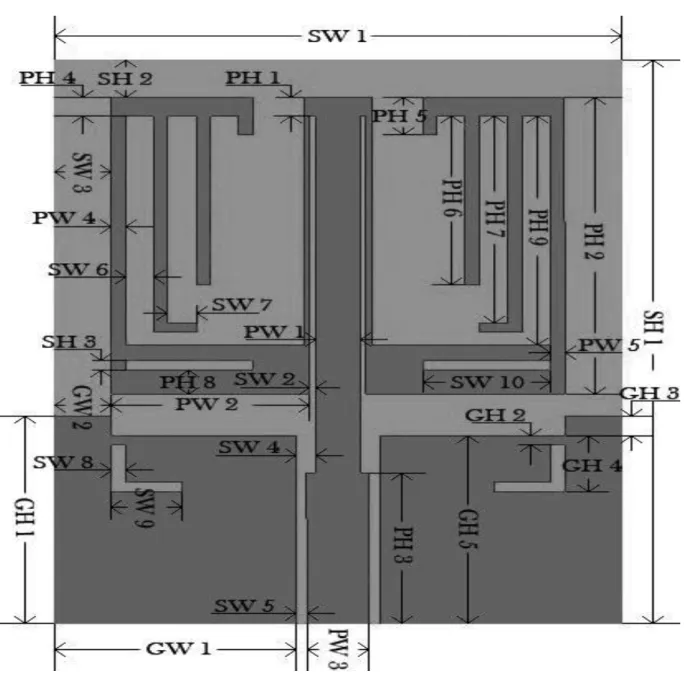
Figure 3 shows the geometry of the proposed multiband antenna. For simplification in the antenna design SH1 30.0
mm, SW1 20 mm, h = 0.8 mm were already selected. The rectangular radiating patch has been cut by rectangular slots and a pair of L-shaped slots in the ground. The impedance matching is improved by the tapered 50 Ω CPW feeding
line. Dimensions of rectangular slots and L-shaped slots, has been adjusted for creating the three different resonant frequencies. The final dimensions of the proposed antenna are as follows (all dimensions are in millimeters): SW1 20, SW2 0.2, SW3 2.0, SW4 0.7, SW5 0.4, SW6 1.0, SW7 1.0, SW8 0.5, SW9 2.5, SW10 4.5, SH1 30.0, SH2 2.0, SH3 0.5, PH1 1.0, PH2 15.8, PH3 8.0, PH4 1.0, PH5 2.0, PH6 9.0, PH7 11.0, PH8 1.3,PH9 12.2, PW1 1.6, PW2 7.0, PW3 2.2, PW4 0.5, PW5 0.5, GH1 10.0, GH2 0.5, GH3 1.0, GH4 3.0,GH5 10.0, GW1 8.5, GW2 2.0.
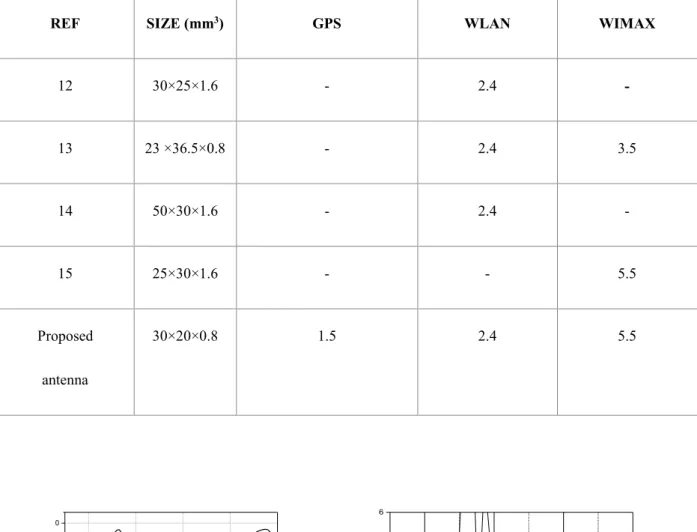
Proposed antenna compared with the characteristics of some antennas is shown in table 1.
Table 1. Comparison of the simulated characteristics of some antennas with the proposed work
REF SIZE (mm3) GPS WLAN WIMAX
12 30×25×1.6 - 2.4 - 13 23 ×36.5×0.8 - 2.4 3.5 14 50×30×1.6 - 2.4 - 15 25×30×1.6 - - 5.5 Proposed antenna 30×20×0.8 1.5 2.4 5.5 -30 -25 -20 -15 -10 -5 0 S11 ( dB) 2 4 6 VS WR
(a) (b)
(c)
(a) (b)
2. Conclusion
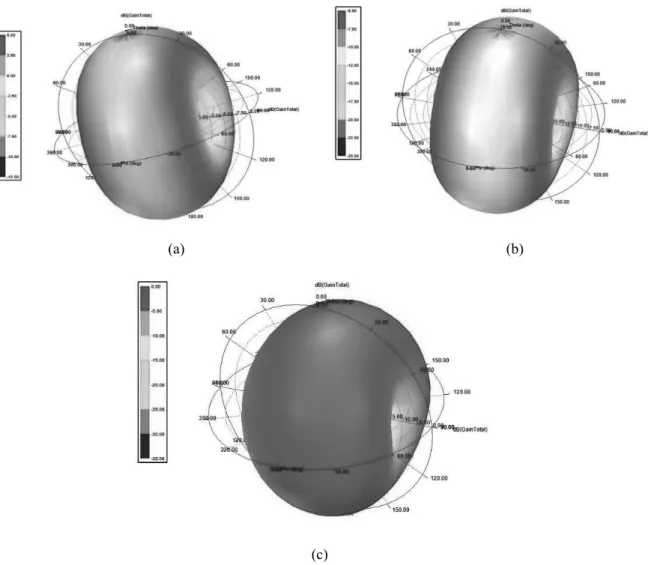
In this paper, a new multiband antenna is proposed for GPS, WLAN, and WiMAX applications. In the presented antenna, rectangular slots on the patch and L-shaped slot on the ground are used for getting multiband frequency ranges. Radiation performance of the antenna is acceptable too. In addition to the multiband frequencies, the compact planar size structure, low cost and easy fabrication are other advantages of the proposed antenna.
REFERENCES
[1] D.M. Elsheakh and E.A. Abdallah: “Compact multiband multifoldedslot antenna loaded with printed-IFA”, IEEE Antennas Wireless Propag Lett 11 (2012), 1478–1481.
[2] S.L. Ma and J.S. Row: “Design of single-feed dual-frequency patch antenna for GPS and WLAN applications”, IEEE Trans Antennas Propag 59 (2011), 3433–3436.
[3] Y. Li, Z.J. Zhang, J.F. Zheng, and Z.F. Fen: “Compact heptaband reconfigurable loop antenna for mobile handset”, IEEE Antennas Wireless Propag Lett 10 (2011), 1162–1165.
[4] M. Moosazadeh and S. Kharkovsky: “Compact and small planar monopole antenna with symmetrical L- and U-shaped slots for WLAN/WiMAX applications”, IEEE Antennas Wireless Propag Lett 13 (2014), 388–391.
[5] H.Q. Zhai, Z.H. Ma, Y. Han, and C.H. Liang: “A compact printed antenna for triple-band WLAN/WiMAX applications”, IEEE Antennas Wireless Propag Lett 12 (2013), 65–68.
[6] H.S. Tae, K.S. Oh, W.I. Son, W.G. Lim, and J.W. Yu “Design of compact dual-band quadruple inverted-F/L antenna for GPS L1/L2 band”, IEEE Trans Antennas Propag 61 (2013), 2276–2279.
[7] V. Pathak, S. Thornwall, M. Krier, S. Rowson, G. Poilasne, and L. Desclos: “Mobile handset system performance comparison of a linearly polarized GPS internal antenna with a circularly polarized antenna”, Proceedings of IEEE Antennas and Propagation Soceity International Symposium, Columbus, OH, 2003, pp. 666–669.
[8] T. Zhang, R.L. Li, G.P. Jin, G. Wei, and M. Tentzeris: “A novel multiband planar antenna for GSM/UMTS/LTE/Zigbee/RFID mobile devices”, IEEE Trans Antennas Propag 59 (2011), 4209–4214.
[9] W.C. Liu, C.M. Wu, and Y. Dai: “Design of triple-frequency microstrip- fed monopole antenna using defected ground structure”, IEEE Trans Antennas Propag 59 (2011), 2457–2463.
[11] R.L. Li, B. Pan, J. Laskar, and M.M. Tentzeris: “A compact broadband planar antenna for GPS, DCS-1800, IMT-2000, and WLAN applications”, IEEE Antennas Wireless Propag Lett 6 (2007), 25–27.
[12] W. C. Liu, C. M. Wu, and N. C. Chu: “A compact CPW-fed slotted patch antenna for dual-band operation”, IEEE
Antennas Wireless Propag. Lett., vol. 9, pp. 110–113, 2010.
[13] P. Liu,Y. Zou, B.Xie, X. Liu, andB.Sun: “CompactCPW-fed tri-band printed antenna with meandering split-ring slot for WLAN/WiMAX applications”, IEEE Antennas Wireless Propag. Lett., vol. 11, pp. 1242–1244, 2012. [14] C.-Y. Huang and E.-Z. Yu: “A slot-monopole antenna for dual-band WLAN applications”, IEEE Antennas
Wireless Propag. Lett., vol. 10, pp. 500–502, 2011.
[15] J.-H. Lu and B.-J. Huang: “Planar multi-band monopole antenna with L-shaped parasitic strip for WiMAX application”, Electron. Lett., vol. 47, no. 12, pp. 671–672, May 2010.
[16] Saeid Karamzadeh, Cansu Büyükhan, Umut Eskiçırak, Tarık Akyol: “OPTIMAL SIGNAL PROCESSING METHODS IN GPR”. Internatıonal Journal ff Electronics, Mechanıcal And Mechatronics Engineerıng IJEMME, 01/2014; 3(3).
[17] Saeid KARAMZADEH and Mesut Kartal. "UWB Radar In Hidden Human Detection." Internatıonal Journal ff Electronics, Mechanıcal And Mechatronics Engineerıng IJEMME, 3.2 (2013): 579-583.
[18] Saeid Karamzadeh, Oğuz Furkan Kiliç, Ahmet Said Hepbiçer, Fatih Demirbaş "Bow Tie Antenna Design for GPR Applications." IJEMME (2016): 1187-1194. DOI:10.17932/IAU.IJEMME.m.21460604.2016.6/2.1187-1194. [19] Saeid Karamzadeh, Fatih Demirbaş, Oğuz Furkan Kılıç, Ahmet Said Hepbiçer. "Semi-Fractal Bow Tie Antenna Design for GPR Applications", URSI-TÜRKİYE’2016 VIII. Bilimsel Kongresi, Ankara; 09/2016.
[20] Saeid Karamzadeh, Oğuz Furkan Kılıç, Fatih Demirbaş, Ahmed Said Hepbiçer,. "Frequency Independent Self Complementary Bow Tie Antenna Design For Gpr Applications." Anadolu University Journal Of Science And