Kafkas Univ Vet Fak Derg
18 (Suppl-A): A13-A16, 2012
Summary
The sampling studies were carried out to determine parasitic isopod species of Boops boops (Linnaeus, 1758) from Antalya Gulf between September 2006 - May 2007. At the end of study five parasitic isopod species [Ceratothoa parallela (Otto, 1828), Ceratothoa oestroides (Risso, 1826), Ceratothoa capri (Trilles, 1964), Anilocra frontalis Milne-Edwards, 1840 and Anilocra physodes (Linnaeus, 1758)] were recorded. Two (C. parallela and C. capri) of these species were new records for the Isopoda fauna at the Mediterranean coast of Turkey. Prevelance and intensity of infection have been obtained.
Keywords: Cymothoidae, Bogue, Boops boops, Mediterranean, Turkey
Antalya Körfezi’nde (Türkiye) Kupesin [Boops boops (Linnaeus,
1758)] Parazitik İsopodları
Özet
Antalya Körfezi’nde Boops boops (Linnaeus, 1758) türünün parazit isopod türlerini tespit edebilmek için Eylül 2006- Mayıs 2007 tarihlerinde örnekleme çalışmaları düzenlenmiştir. Çalışma sonucunda 5 parazitik isopod türü [Ceratothoa parallela (Otto, 1828), Ceratothoa oestroides (Risso, 1826), Ceratothoa capri (Trilles, 1964), Anilocra frontalis Milne-Edwards, 1840 ve Anilocra physodes (Linnaeus, 1758)] tespit edilmiş, bunlardan ikisinin (C. parallela ve C. capri) Türkiye’nin Akdeniz Kıyıları için yeni kayıt oldukları belirlenmiştir. Enfeksiyonun yoğunluğu ve prevalansı tespit edilmiştir.
Anahtar sözcükler: Cymothoidae, Kupes, Boops boops, Akdeniz, Türkiye
Parasitic Isopods of Bogue [Boops boops (Linnaeus, 1758)]
from the Antalya Gulf (Turkey)
Deniz INNAL *
Fevzi KIRKIM **
*
** Department of Biology, Faculty of Art and Science, Mehmet Akif Ersoy University, TR-15030 Burdur - TURKEYDepartment of Hydrobiology, Fisheries Faculty, Ege University, TR-35100 Izmir - TURKEY
Makale Kodu (Article Code): KVFD-2011-5122
Cymothoids (Crustacea, Isopoda) are ectoparasites of marine and freshwater teleost fishes 1. Cymothoids
are blood-feeding; several species settle in the buccal cavity of fish, others live in the gill chamber or on the body surface including the fins 2. They parasitize
numerous marine species of commercial importance, including members of the families Mugilidae, Atherinidae, Serranidae, Carangidae, Sciaenidae, Embiotocidae, Bothidae, Clupeidae, Pleuronectidae, Scombridae and Haemulidae 3.
The Cymothoid fauna of the coast of Turkey is still poorly known. Previous studies suggest the presence of a
significant number of species in the region4-17.
Interactions of bogue [Boops boops (Linnaeus, 1758)] with parasitic isopods is little studied. Bogue were known to be host of 6 parasitic isopod species [Ceratothoa oestroides (Risso, 1826), Ceratothoa capri (Trilles, 1964), Emetha audouini (Milne-Edwards, 1840) 9; Anilocra physodes
(Linnaeus, 1758), Ceratothoa parallela (Otto, 1828) 7,8;
Anilocra frontalis Milne-Edwards, 1840 17].
The aim of the study is to determine of parasitic isopods of bogue from Antalya Gulf (Turkey). Prevelance and intensity of infection have been obtained and compared with other studies.
INTRODUCTION
İletişim (Correspondence) +90 248 2133045
[email protected]
A14
Parasitic Isopods of Bogue ...
MATERIAL and METHODS
This study was conducted to determine parasitic isopods species of Bogue [Boops boops (Linnaeus, 1758)] from Antalya Gulf (Turkey) coasts between September 2006 - May 2007.
Two stations (Name of stations: 1- Kundu; 2- Manavgat) were selected and samplings were carried out by trawling nets. The two stations surveyed were located 4 to 7 km off the coast, at depths ranging from 40 to 80 m. The speciemens of B. boops were examined for the presence of parasitic isopods immediately after being taken from the sea. After removal from the host, parasitic isopods were immediately fixed in 70% ethanol and placed in a labelled tube for later study. Species of isopod was determined in the laboratory using a dissecting microscope according to studies 9,18,19. Species of Ceratothoa were photographed
with a Olympus C 5050. They are now deposited at the Ege University Fisheries Labaratory. Prevalence (percent of hosts infected) and intensity (number of parasites per infected host) were calculated in the field.
RESULTS
Out of 272 individuals (27 immature, 110 males and 135 females) of bogue were caught with trawling nets and 26 (9.56%) individuals were infested with parasitic isopods. Individuals of bogue, caught from Antalya Gulf, were found to be parasitized by five species of Cymothoid isopods; C. oestroides, C. parallela, C. capri, A. frontalis and A. physodes. Three Ceratothoa species were found in the buccal cavity of host speciemens. A. frontalis and A. physodes were collected from body surface of B. boops.
The two Anilocra were distinguished using two criteria: 1) The anterior end of the head is truncated in A. physodes and rounded in A. frontalis, 2) Endopodits of uropods slightly surpass the distal part of the pleotelson in A. physodes but distinctly surpass in A. frontalis. The three Ceratothoa were distinguished using this criteria: posterior edge of the pleotelson is slightly pointed in C. parallela, angled in C. capri and rounded in C. oestroides. Dorsal and ventral view of C. capri and C. parallela are given in Fig. 1a, 1b, 2a, 2b.
Fig 2. a and b: Dorsal and ventral view of C. parallela Şekil 2. a ve b: C. parallela’nın dorsal ve ventral görünümü Fig 1. a and b: Dorsal and ventral view of C. capri Şekil 1. a ve b: C. capri’nin dorsal ve ventral görünümü
A15 INNAL, KIRKIM
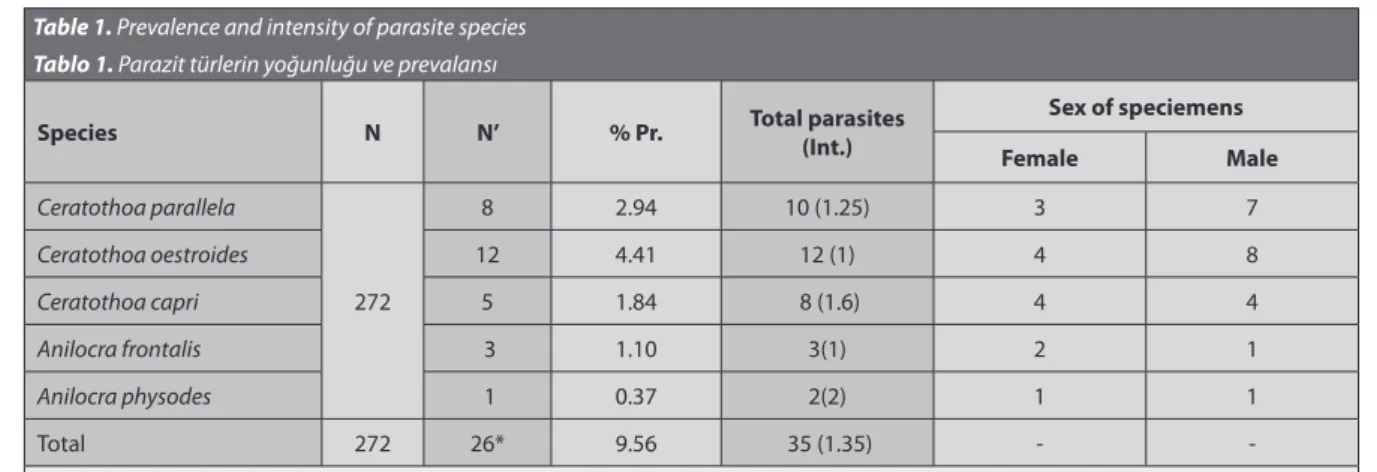
Prevalence and intensity of parasite species are given in Table 1.
Prevalence of Isopoda species ranged from 0.37% to 4.41%. C. oestroides was the most prevalent parasite species. Out of 272 potential hosts, 12 (4.41%) were infected with C. oestroides.
A total of 35 isopods was obtained from the 26 parasitized B. boops. Mean intensity of parasitic isopods was recorded 1.35 and with a range that varied from 1 to 2 isopods per host. Single isopods occurrences were recorded in 17 (65.38%) of the 26 parasitized fishes, whereas multiple infestations were found in the remaining 9 (34.62%) fishes.
DISCUSSION
In this study, five Cymothoid species were observed in Boops boops (Linnaeus, 1758) from Antalya Gulf (Turkey). These isopod species are not host specific and were described from a number of hosts worldwide 2,12,16,20,21.
The distribution of parasitic isopods is closely related to the occurence and ecology of their hosts. Three (C. oestroides, A. physodes and A. frontalis) out of five Cymothoid species have previously been recorded from Mediterrenean Coast of Turkey. Although C. parallela was reported from Marmara and Aegean Coasts of Turkey, C. capri was reported only from Aegean Coast of Turkey 10,16. This is the first record of
the C. parallela and C. capri for the Mediterranean coast of Turkey.
The difference in the prevalence and intensity of five species in B. boops may depend on variability of life history of parasite species and host resistance. The occurence of Cymothoids in natural populations is patchy and levels of prevelance are extremely variable 3,22. The infection
prevelance (Pr) of Ceratothoa species in previous studies of host populations was as follows: C. oestroides for B. boops, Pr = 12.82% and for Spicara smaris, Pr = 10.43%
from Northern Adriatic 19; for B. boops, Pr = 7.9%, for Spicara
smaris, Pr = 12%, for Pagellus acarne, Pr = 4.54% and for Trachurus trachurus, Pr = 0.92% from Gulf of Bejaia 2; for
Pomatomus saltatrix, Pr = 25% from Aegean Sea 12. C.
parallela for B. boops, Pr = 8.60 %, for Spicara smaris, Pr = 4%, for Trachurus trachurus, Pr = 2.75 % from Gulf of Bejaia 2.
The infection prevelance of Ceratothoa species of B. boops in present study is lower than previous studies. Prevelance of infection is variable and depends on size, sex, age, host condition and other environmental factors 23.
Marine fish parasitology is a rapidly developing field of aquatic science. Parasitic isopods are fairly common Crustacean infestations of wild marine fish species of Turkey 10. This study revealed for the first time the presence
of two Ceratothoa species from Mediterrenean Coast of Turkey. Out of 272 potential hosts, 8 (2.94%) were infected with C. parallela and 5 (1.84%) were infected with C. capri.
Further studies are desirable on the biology of these parasites in a wide spectrum of potential hosts.
REFERENCES
1. Ferri J, Petric M, Matic-Skoko S, Dulcic J: New host record, black scorpionfish Scorpaena porcus (Pisces, Scorpaenidae) for Nerocila orbigny and Ceratothoa parallela (Crustacea, Isopoda, Cymothoidae). Acta Adriat, 49 (3): 255-258, 2008.
2. Ramdane Z, Bensouilah MA, Trilles JP: The Cymothoidae (Crustacea, Isopoda), parasites on marine fishes, from Algerian fauna. Belg J Zool, 137 (1): 67-74, 2007.
3. Brusca RC: A monograph on the Isopoda Cymothoidae (Crustacea) of the Eastern Pacific. Zool J Linnean Society, 73, 117-199, 1981.
4. Demir M: The Benthic invertebrates of the Bosphorus and Islands Coast. IU Sci Fac Hydrobiology, 3 (A): 362-363, 1952.
5. Geldiay R, Kocatas A: Isopods collected in Izmir Bay, Aegean Sea.
Crustaceana, 3, 19-30, 1972.
6. Akmirza A: The parasites of chub mackerel (Scomber japonicus). EU J
Fish Aqua Sci, 14 (1-2): 173-181, 1997.
7. Akmirza A: Parasites in bogue (Boops boops L., 1758). EU J Fish Aqua Sci, 15 (3-4): 183-198, 1998.
8. Akmirza A: Seasonal distribution of parasites detected in fish belonging to the Sparidae family found near Gökceada. Acta Parasit Turc,
Table 1. Prevalence and intensity of parasite species Tablo 1. Parazit türlerin yoğunluğu ve prevalansı
Species N N’ % Pr. Total parasites (Int.) Sex of speciemens Female Male Ceratothoa parallela 272 8 2.94 10 (1.25) 3 7 Ceratothoa oestroides 12 4.41 12 (1) 4 8 Ceratothoa capri 5 1.84 8 (1.6) 4 4 Anilocra frontalis 3 1.10 3(1) 2 1 Anilocra physodes 1 0.37 2(2) 1 1 Total 272 26* 9.56 35 (1.35) -
-N: Total fish individuals, N’: Infected fish individuals, Pr: Prevalence (percent of hosts infested), Int: Intensity (number of parasites per
infested host). * Total of infected individuals are 26, Single isopods occurrences were recorded in 17 of the 26 parasitized fishes, multiple infestations were found in the remaining 9 fishes
A16
Parasitic Isopods of Bogue ...
24 (1): 435-441, 2000.
9. Kirkim F: Investigations on the systematics and ecology of the Aegean Sea Isopoda (Crustacea) fauna. PhD Thesis, Ege University, Inst Sci, Izmir. 1998.
10. Oktener A, Trilles JP: Report on Cymothoids (Crustacea, Isopoda) collected from Marine fishes in Turkey. Acta Adriat, 45 (2): 145-154, 2004. 11. Trilles JP, Oktener A: Livoneca sinuata (Crustacea: Isopoda: Cymothoidae) on Loligo vulgaris from Turkey, and unusual cymothoid associations. Dis Aqua Org, 61, 235-240, 2004.
12. Trilles JP, Oktener A: New Host Records for Ceratothoa oestroides and Anilocra physodes (Isopoda, Cymothoidae) in Turkish Waters. Kafkas Univ Vet Fak Derg, 15 (3): 469-471, 2009.
13. Kirkim F, Kocatas A, Katagan T, Sezgin M: Contribution to the knowledge of the Free Living Isopods of the Aegean Sea Coast of Turkey.
Turk J Zool, 30, 361-372, 2006.
14. Oguz MC, Oktener A: Four parasitic Crustacean species from marine fishes of Turkey. Acta Parasit Turc, 31 (1): 79-83, 2007.
15. Kirkim F, Kocatas A, Katagan T, Sezgin M: A Report on parasitic Isopods (Crustacea) from marine fishes and Decapods collected from the Aegean Sea (Turkey). Acta Parasit Turc, 32 (4): 382-385, 2008.
16. Oktener A, Torcu Koc H, Erdogan Z, Trilles JP: Scuba diving photography: A useful method for taxonomic and ecologic studies on fish
parasites (Cymothoidae) J Mar Anim and Ecol, 3 (2): 3-9, 2010.
17. Innal D, Kirkim F, Erk’akan F: The parasitic isopods, Anilocra frontalis and Anilocra physodes (Crustacea; Isopoda) on some marine fish in Antalya Gulf, Turkey. Bull Eur Assoc Fish Path, 27 (6): 239- 241, 2007. 18. Trilles JP: Sur deux espèces d’Anilocres (Isopodes, Cymothoidae) mal connues Anilocra physodes L. et Anilocra frontalis (Milne edwards). Ann
Parasit Hum Comp, 40 (5): 575-594, 1965.
19. Williams LB, Williams EH: Nine new species of Anilocra (Crustacea: Isopoda: Cymothoidae) external parasites of West Indian coral reef fishes.
Proc Biol Soc Wash, 94 (4): 1005-1047, 1981.
20. Matasin Z, Vucinic S: Ceratothoa oestroides (Risso, 1826) in bogue (Boops boops L.) and picarel (Spicara smaris L.) from the Velebit channel in the Northern Adriatic. Vet Arhiv, 78 (4): 363-367, 2008.
21. Gokpinar S, Ozgen EK, Yildiz K: [Ceratothoa oestroides (Risso, 1826)] (Isopoda: Cymothoidae) in black seabream from the Northern Aegean Sea. Acta Parasit Turc, 33 (2): 188-190, 2009.
22. Horton T, Diamant A, Galil BS: Ceratothoa steindachneri (Isopoda, Cymothoidae): An unusual record from the Mediterranean. Crustaceana, 77 (9): 1145-1148, 2004.
23. Quinnell R, Graffen A, Woolhouse E: Changes in parasite aggregation with age: A decrease infection model, Parasitology, 111, 635- 644, 1995.