ENERGY MANAGEMENT IN PLUG-IN
HYBRID ELECTRIC VEHICLE
PENETRATED NETWORKS
a dissertation submitted to
the graduate school of engineering and science
of bilkent university
in partial fulfillment of the requirements for
the degree of
doctor of philosophy
in
industrial engineering
By
Okan Arslan
April 2016
ENERGY MANAGEMENT IN PLUG-IN HYBRID ELECTRIC VEHICLE PENETRATED NETWORKS
By Okan Arslan April 2016
We certify that we have read this dissertation and that in our opinion it is fully adequate, in scope and in quality, as a dissertation for the degree of Doctor of Philosophy.
Oya Kara¸san (Advisor)
Selim Akt¨urk
Meral Azizo˘glu
Alper S¸en
Hakan G¨ultekin
Approved for the Graduate School of Engineering and Science:
Levent Onural
ABSTRACT
ENERGY MANAGEMENT IN PLUG-IN HYBRID
ELECTRIC VEHICLE PENETRATED NETWORKS
Okan Arslan
Ph.D. in Industrial Engineering Advisor: Oya Kara¸san
April 2016
With the introduction of electric vehicles (EVs) and plug-in hybrid electric ve-hicles (PHEVs) into the transportation system, a new line of research has emerged in the literature that reconsiders existing problems from the electrified transporta-tion point of view. In this context, our objective is to understand the challenges that arise with the emergence of PHEV technology through a series of essays.
Due to their ability to use electricity and gasoline as sources of energy with di↵erent cost structures and limitations, PHEVs stand as both a challenge and an opportunity for the existing transportation systems. They provide transportation cost reductions by utilizing less gasoline, which in turn contribute to the environ-mental benefits. In this context, we addressed a practically important problem: ‘finding the minimum cost path for PHEVs’. We formally present this problem, show that it is NP-Complete and propose exact and heuristic solution techniques. Using these techniques, we investigate impacts of battery characteristics, driver preferences and road network features on travel costs of a PHEV for long-distance trips. Through this analysis, the location of charging stations is identified as one of the critical factors a↵ecting the costs. In this regard, we introduce another practically important problem: ‘Hybrid charging station location’. Di↵erent than existing approaches to the charging station location problems, we also consider PHEVs when locating stations. We propose a Benders Decomposition algorithm as an exact solution methodology, and accelerate the implementation by generating nondominated cuts. Finally, we analyze the cost and emission impacts of PHEV penetration into electricity networks with widespread adoption of distributed en-ergy resources.
iv
Approaching PHEVs from a long-distance point of view, we introduced new problems and solution approaches to the literature. Our results show that by establishing an adequate level of the intercity charging station infrastructure, well-studied benefits of electrified transportation in urban regions can be extended to long-distance trips.
Keywords: Plug-in hybrid electric vehicles, energy management, charging station location, virtual power plant, Benders decomposition, dynamic programming.
¨
OZET
ELEKTR˙IKL˙I H˙IBR˙IT ARAC
¸ LARIN BULUNDU ˘
GU
A ˘
GLARDA ENERJ˙I Y ¨
ONET˙IM˙I
Okan Arslan
End¨ustri M¨uhendisli˘gi, Doktora Tez Danı¸smanı: Oya Kara¸san
Nisan 2016
Elektrikli Ara¸cların (EA) ve Hibrit Elektrikli Ara¸cların (HEA) ula¸stırma sistem-ine duhˆul¨u ile birlikte, literat¨urde bulunan mevcut ula¸stırma problemlerini elek-trikli ara¸c bakı¸s a¸cısı ile yeniden de˘gerlendiren bir ara¸stırma ¸cizgisi ortaya ¸cıktı. Bu kapsamda amacımız bir dizi makale vasıtasıyla HEA teknolojisinin ortaya ¸cıkı¸sı ile birlikte v¨ucut bulan zorlukları anlamaktır.
Farklı maliyet yapıları ve kısıtları olan elektrik ve benzin enerji kayna˘gını kul-lanabildi˘ginden ¨ot¨ur¨u, HEA’lar mevcut ula¸stırma sistemleri i¸cin hem zorluklar hem de fırsatlar sunuyor. Daha az benzin kullanarak ula¸stırma maliyetlerini azal-tan HEA’lar, aynı zamanda dolaylı olarak do˘gaya fayda sa˘glıyor. Bu kapsamda, pratik olarak ¨onem arz eden “HEA’lar i¸cin en ucuz yolun bulunması” problemine de˘giniyoruz. Formal olarak problemi tanıtıyor, NP-Tam k¨umesine ait oldu˘gunu g¨osteriyor ve tam ve sezgisel ¸c¨oz¨um teknikleri ¨oneriyoruz. Bu teknikleri kulla-narak, batarya karakteristikleri, s¨ur¨uc¨u tercihleri ve yol a˘gı ¨ozelliklerinin uzun mesafe yolculuklarında HEA ula¸stırma maliyetleri ¨uzerindeki etkilerini inceliyoruz. Bu analiz ile, ¸sarj istasyonlarının konumlarının maliyetleri etkileyen ¨onemli bir fakt¨or oldu˘gunu tespit ediyoruz. Bu kapsamda, bir di˘ger pratik olarak ¨onemli problem olan “Hibrit ¸sarj istasyonu konumlandırması” problemini tanımlıyoruz. S¸arj istasyonu yerle¸stirme problemine mevcut yakla¸sımlardan farklı olarak, istasy-onları konumlandırırken aynı zamanda HEA’ları da dikkate alıyoruz. Tam ¸c¨oz¨um tekni˘gi olarak Benders Ayrı¸stırma Algoritması ¨oneriyor ve domine edilmemi¸s ke-siler ¨ureterek uygulamayı hızlandırıyoruz. Son olarak, HEA’ların yaygın bir ¸sekile da˘gıtık enerji kaynaklarının kullanıldı˘gı elektrik a˘glarına dahil olmaları ile olu¸san maliyet ve emisyon etkilerini inceliyoruz.
vi
HEA’lara uzun mesafe bakı¸s a¸cısı ile yakla¸sarak, literat¨ure yeni problemler ve ¸c¨oz¨um teknikleri tanıtıyoruz. Sonu¸clarımız g¨ostermektedir ki, yeterli seviyede ¸sehirlerarası ¸sarj istasyonu altyapısının kurulması ile, elektrikli ula¸stırmanın iyi de˘gerlendirilmi¸s olan ¸sehir i¸ci faydaları, uzun mesafeli yolculuklar i¸cin de ge¸cerli olacaktır.
Anahtar s¨ozc¨ukler : Hibrit elektrikli ara¸clar, enerji y¨onetimi, ¸sarj istasyonu yerle¸stirmesi, sanal elektrik santrali, Benders ayrı¸sımı, dinamik programlama.
vii
Acknowledgement
I would like to express my special appreciation and thanks to my advisor Pro-fessor Oya Kara¸san, you have been a tremendous mentor for me. I would like to thank you for encouraging me in every endeavor to help me grow as a researcher. Your advice has always been invaluable for me and being your student has been the best thing that could ever happen at Bilkent.
I would like to thank my Doctoral Supervisory Committee members, Assoc.Prof. Alper S¸en and Assoc.Prof. Hakan G¨ultekin for taking their time o↵ from their busy schedule every now and then to read and comment on several aspects of my thesis work. Your valuable comments and suggestions have contributed to this work significantly. I also owe a big thank-you to Prof. Selim Akt¨urk as both our department chair and my Dissertation Committee member and to Prof. Meral Azizo˘glu for serving as my Dissertation Committee member.
I express my sincere gratitude to The Scientific and Technological Research Council of Turkey (T ¨UB˙ITAK) for financially supporting me with grant 2211, and this thesis work as part of the research grant 214M211.
I would like to thank to my colleagues at the Scientific Decision Support Branch of the Turkish Air Force for enduring my absence during this long endeavor. I especially want to thank Ahmet Kandako˘glu who has been a great friend to me and with whom I shared a lot during the last 7 years.
It was a dream for me to study at Bilkent, and I would like to thank each and every faculty member and sta↵ of the Industrial Engineering Department for providing this valuable opportunity for me. Special thanks to you Prof. Hande Yaman, Prof. Bahar Yeti¸s Kara, Prof. Mustafa C. Pinar, Prof. ¨Ulk¨u G¨urler, late Prof. Barbaros Tansel and Assoc.Prof. Osman O˘guz for providing a high-quality education for us.
I would love to thank each of my peers in the department. Thank you for sharing good-times at Bilkent Burak Pac, Can Taylan Sarı, Ece Zeliha Demirci, Esra Koca, Gizem ¨Ozbaygın, Hatice C¸ alık, Kamyar Kargar, Meltem Peker, Nihal Berkta¸s, Okan D¨ukkancı and Ramez Kian. Particularly, I would like to thank Ba¸sak Yazar
ix
for having me as a colleague in her research. During my life at Bilkent, I have always seen Vedat Bayram and T¨urker Tanerg¨u¸cl¨u as my foregoers. Thank you for being a great support to me. And Barı¸s, your friendship has been invaluable for me throughout this experience. Spending time with you has always helped me cope with hard moments. I sincerely wish our brotherhood will last ever.
I am indebted to my parents: mom and dad. You have gone through lots of hardships to raise me as a person. Words cannot express my gratitude to you. I also express my deepest appreciation to my sister, sister-in-law, and father-in-law for their invaluable support.
God has given us a gift in 2014. Our baby-girl Asya has brought joy and hap-piness to our family. Her existence makes it all worthwhile. Finally, my wife, my life. You have given me the power and the will to complete yet another challenge. Leave alone this dissertation - or anything for that matter - I would be incomplete without you.
Contents
1 Introduction 1
1.1 Motivation 3
1.2 Literature Review 6
1.2.1 Finding the Optimal Path for a PHEV 7 1.2.2 PHEV Economics in Long-distance Trips 8 1.2.3 Charging Station Location in Intercity Road Network 10 1.2.4 Virtual Power Plant Formation in PHEV Penetrated Networks 13
1.3 Contributions 15
2 Minimum Cost Path for Plug-in Hybrid Electric Vehicles 18
2.1 Problem Definition 18
2.1.1 NP-Completeness 21
2.1.2 Extensions 23
2.2 Solution Techniques 25
2.2.1 E-MCPP-PHEV Mathematical Model 25 2.2.2 Handling Non-simple Paths in the Model 29 2.2.3 Discrete Approximation Dynamic Programming Heuristic 32 2.2.4 Enhancing the DH Heuristic (DHE) 36 2.2.5 Shortest Path Heuristic (SP) 37
2.3 Computational Study 37
2.3.1 Data 38
2.3.2 Performances of the Solution Techniques 39 2.3.3 California Road Network 40
CONTENTS xi
2.4 Summary 44
3 Impacts of Battery, Driver and Road Characteristics on Long
Distance Travel Costs of PHEVs 46
3.1 Problem Definition 46
3.2 Material and methods 48
3.2.1 Data 49
3.2.2 Road Network Features 49
3.2.3 Driver Preferences 52
3.2.4 Battery Characteristics 53
3.2.5 Experimental Design 54
3.2.6 Cost Metrics 55
3.3 Results and Discussion 56
3.3.1 Driving Pattern Analysis 56 3.3.2 Levelized Cost Per Mile (LCPM) Component Breakdown 58 3.3.3 E↵ects of Experimental Factors on LCPM 60 3.3.4 Stopping Tolerance and Deployment Level Sensitivity 62 3.3.5 Electricity and Gasoline Price Sensitivity 64 3.3.6 Battery cost impacts on LCPM 65
3.3.7 Environmental Impacts 66
3.3.8 Discussion 66
3.4 Policy Implications 69
4 Hybrid Charging Station Location Problem 71
4.1 Problem Definition 71
4.1.1 Common Sense in Charging Logic 71 4.1.2 Hybrid Charging Station Location Problem 73
4.1.3 Complexity 74
4.2 Mathematical Model 74
4.2.1 Variable Relaxation 76
4.2.2 Variable Elimination 77
CONTENTS xii
4.3.1 Benders Subproblem 79
4.3.2 Benders Master Problem 80
4.3.3 Subproblem Solution 81
4.3.4 Benders Cut Characterization 83 4.3.5 Cut Selection Scheme 1: Single Cut 86 4.3.6 Cut Selection Scheme 2: Multicut 87 4.3.7 Cut Selection Scheme 3: Pareto-optimal Cut 89 4.3.8 Magnanti-Wong Problem Solution 91
4.4 Computational Study 96
4.4.1 25-node Road Network 97
4.4.2 California Road Network 101
4.5 Summary 108
5 Virtual Power Plant Formation in PHEV-penetrated Networks 110
5.1 Problem Definition 110
5.2 Modeling the Problem 111
5.2.1 VPP Energy Management Model 112 5.2.2 Modeling the Battery Degradation Cost 116
5.3 Case Study 119
5.3.1 Data 119
5.3.2 Value of VPP and PHEVs 123 5.3.3 Sensitivity to Gasoline Prices 126 5.3.4 Sensitivity to Battery Prices 126 5.3.5 Sensitivity to Energy Prices 127 5.3.6 Sensitivity to Generation Capacity 128 5.3.7 Sensitivity to Hourly Energy Availability 128
5.4 Summary 129
List of Figures
1.1 Energy scheduling process 14
2.1 Graph transformation for MCPP-PHEV 19 2.2 Graph transformation to show NP-Completeness 22 2.3 Cycle life of PHEV batteries as a function of DoD 24
2.4 Non-simple path examples 30
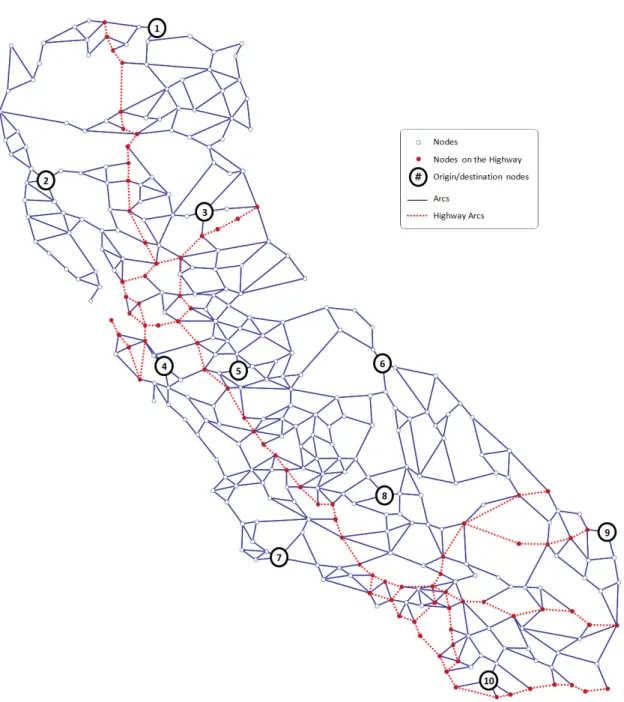
2.5 California network with 339 nodes and 1234 arcs 42 2.6 Cost per mile values for 45 run results in California dataset 43
3.1 California road data with 1046 nodes and 3312 arcs 50 3.2 Travel distance distribution 51 3.3 Quadratic and linear battery degradation cost functions for di↵erent
DoD values 54
3.4 Levelized cost per mile change with increasing deployment levels 59 3.5 Breakdown of LCPM components for di↵erent vehicle types 59 3.6 CD and CS mode drive percentages versus deployment level 60 3.7 Spearman’s rank correlation coefficients between each experimental
factor and LCPM 61
3.8 Stopping tolerance versus LCPM for 0% and 100% deployment levels 63 3.9 Battery Cost Impacts on LCPM 65 3.10 CO2e Emissions per mile for vehicle types and di↵erent deployment
levels 67
LIST OF FIGURES xiv
4.1 25-node road network 98
4.2 California state road network 98 4.3 Optimal charging station locations for California road network 107
5.1 Cycle life of PHEV batteries as a function of DoD 117 5.2 Battery degradation cost function and approximating functions 118 5.3 Hourly maximum and minimum TIE load data 120 5.4 Average number of PHEVs on road versus time periods 120 5.5 E1, E6, E7 and E9 tari↵s of PG&E 122
List of Tables
1.1 Recent literature related to PHEV economics 8
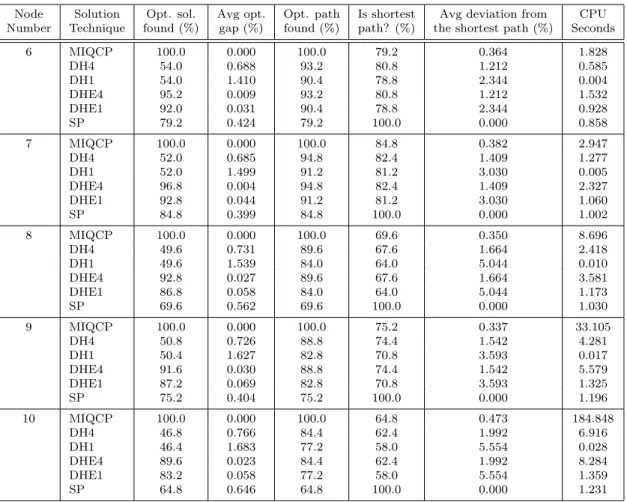
2.1 Computational results 40
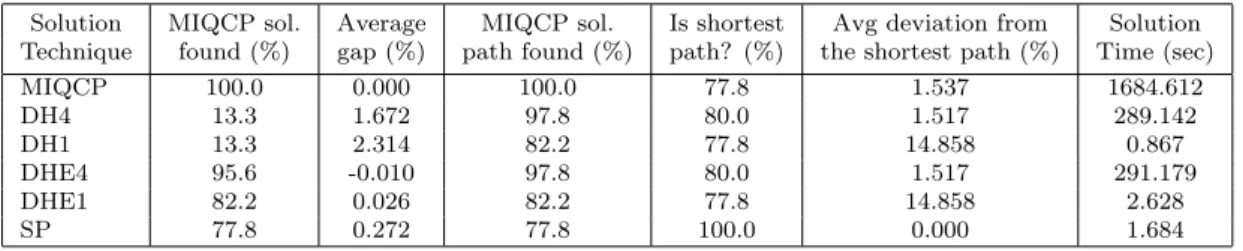
2.2 Computational results for California road network 41
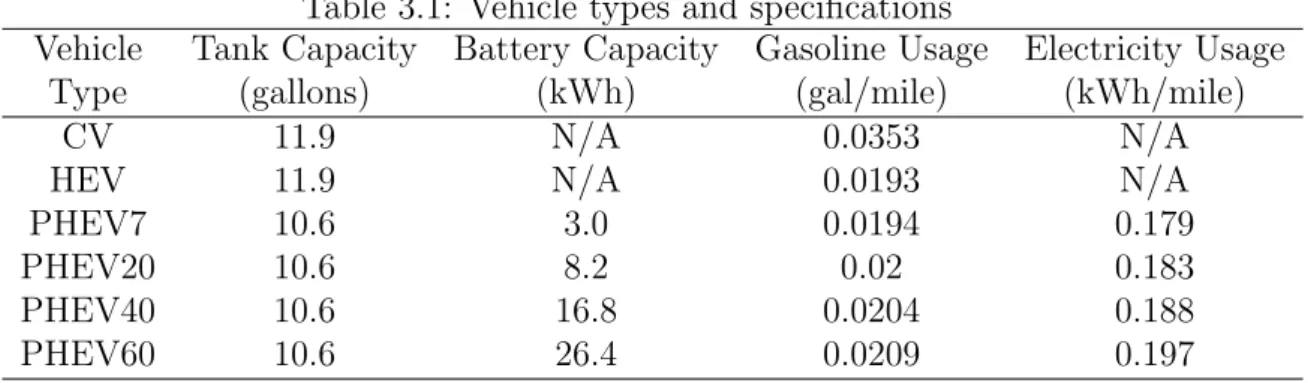
3.1 Vehicle types and specifications 49 3.2 Experimental factors and their levels to measure the impacts on
PHEV travel costs 55
3.3 Average deviation from the shortest paths versus deployment level for di↵erent stopping tolerances 57 3.4 Levelized cost per mile for di↵erent price settings 64
4.1 Road network features 97
4.2 25-node road network results 100
4.3 EV sales 101
4.4 PHEV sales 101
4.5 California road network results 102 4.6 Summary of computational results 103 4.7 California road network results with demand doubled 105 4.8 Optimal charging station locations for California road network 106
5.1 Vehicle type specifications 121
5.2 EP data 122
5.3 Emission data 123
LIST OF TABLES xvi
5.5 Daily average generation, distance, cost and emission breakdowns 125 5.6 Sensitivity of daily average cost and emission to gasoline prices 126 5.7 Sensitivity of daily average cost and emission to battery prices 127 5.8 Sensitivity of daily average cost and emission to DER prices 128 5.9 Sensitivity of daily average cost and emission to DER total capacity 128
Chapter 1
Introduction
Volatile gasoline prices, security concerns associated with oil and increasing envi-ronmental consciousness have fostered cheaper and greener transportation through the emergence of several new transportation technologies. One such technology, the electric transportation, is an emerging challenge for the transportation sector and an opportunity in logistics operations from the environmental and cost per-spectives. Electric vehicles (EVs) and their variants such as hybrid electric vehicles (HEVs) or Plug-in Hybrid Electric Vehicles (PHEVs) appeal to more customers worldwide and a proliferation of these vehicles has been observed on the roads [1].
An EV has an electricity motor and uses its battery as the only source of energy. An HEV has both an electricity motor and a regular internal combustion engine (ICE), benefiting from the electricity to increase the efficiency and reduce the gasoline usage. Another technology that combines the advantages of EVs and conventional vehicles (CVs) is the PHEV. It has an electric motor and an ICE as its power sources. Di↵erent from an HEV, a PHEV can be plugged-in be charge. It provides reduction in both transportation costs and greenhouse gas emissions with respect to a comparable CV [2]. It has the capabilities of an EV such as charging from a regular power outlet and the convenience of a gasoline powered
CV such as long-distance trips. PHEVs operate in either charge depleting (CD) mode or charge sustaining (CS) mode. On CD mode, the electric motor generates the required power and the PHEV uses its batteries as the energy supply. Once a minimum state-of-charge is reached, the PHEV switches to CS mode, and the power that propels the vehicle is mainly generated by the ICE using gasoline as the energy source. Thus, the di↵erence between an EV and a PHEV is the CS mode drive flexibility of the latter [3–8]. PHEVs can be refueled at regular gasoline stations similar to CVs, or can be charged en-route in charging stations similar to EVs [9]. As such, with its unique capabilities, PHEV technology stands as a major milestone on the road to ‘electrification of the automobile’ [10].
Several parties benefit from the introduction of PHEVs into the transportation sector. This new technology results in various new opportunities; with increasing gasoline prices, drivers are more drawn to electric-drive transportation. From the individual drivers’ perspective, they are an efficient way of reducing the trans-portation costs. A reduction in gasoline usage is also a benefit for oil-importing governments because it implies less foreign dependency and governments are en-couraging fuel provider fleets to implement petroleum-reduction measures [11]. Using electricity as an energy source also significantly reduces greenhouse gas (GHG) emissions [12–14]. In addition, investment opportunities emerge with the introduction of PHEVs into the transportation system; vehicle manufacturers and infrastructure investors alike may benefit from this new technology. New fast charging station facilities are being established to provide more charging opportu-nities. The transportation sector is undergoing a profound transformation. Our objective in this dissertation is to understand the impacts of PHEV penetration into the transportation system, identify possible problems and propose solution approaches. In this context, we concentrate on the long-distance travel of PHEVs. There are three major problems that are inter-related. Initially, we address the problem of finding the least cost path for PHEVs in long-distance trips. Then, we investigate the impacts of battery, driver and road characteristics on the travel
costs of PHEVs in these trips. The third problem we deal with is the optimal loca-tion of charging staloca-tions in intercity road network. In a di↵erent context, we also investigate the cost and emission impacts of virtual power plant (VPP) formation in PHEV-penetrated electricity networks. With increasing interest in alternative energy resources and technologies, widespread utilization of distributed energy re-sources (DERs) are anticipated in the near future. As an aggregation unit, the VPP is introduced for load management and resource scheduling. As part of our dissertation, we also develop an energy management model for VPPs and ana-lyze the cost and emission impacts of VPP formation and PHEV penetration into electricity network.
1.1
Motivation
Identification of the minimum cost path problem for PHEVs (MCPP-PHEV) is a fundamental problem for long-distance PHEV trips that possibly require several refueling/charging stops. As one of the initial steps of renewable energy revolution in transportation, benefits and shortcomings of PHEVs for the urban (short dis-tance) trips are well appreciated and investigated. However, as we review in the related literature below, the long-distance use of PHEVs is not well studied. From the economic and environmental perspectives, long-distance travel is certainly an important subject when the potential benefits of these vehicles are considered, and focusing solely on the short range usage would fail to achieve a complete treatment of the topic. According to the National Household Travel Survey by the U.S. De-partment of Transportation [15], the trips by personally owned vehicles that are longer than 50 miles added up to 575 billion miles in the U.S. in 2009. The role of the long-distance trips is even more prominent in the logistics. This work is aimed to be a first attempt to study the long-distance PHEV trips that require several refueling/charging stops.
first and the foremost subjects of interest are the personal PHEV drivers. A recent study by Turrentine and Kurani [16] reports that personal vehicle drivers lack the basic building blocks of knowledge related to transportation costs. When it comes to PHEVs, the cost components get much more complicated compared to single energy source vehicles, and decision-support models are needed both for the routing and refueling/charging decisions. In this respect, this study o↵ers personal PHEV drivers the possibility of understanding the PHEV economics more clearly. Furthermore, navigation devices might implement the methodologies in this study to o↵er a valuable decision support tool for the PHEV drivers.
The second major interest group is the logistics firms with a green logistics per-spective. Alternative fuel vehicles, and PHEVs in particular, are primarily used by individuals for personal transportation purposes. Nevertheless, a PHEV, with its comparatively long driving-range with respect to an EV, is a promising alternative to be used in logistics. There are di↵erent studies directed towards exploring the possible usage of EVs and PHEVs in the future transportation fleets [17–20]. U.S. Department of Energy [21] also prepared a handbook for fleet managers on the guidelines of incorporating EVs and PHEVs into their fleets. Navigant Research [22] estimates that fleet purchases of EVs and PHEVs will be more than 291,000 in 2020 worldwide. Production of light, medium and heavy-duty PHEV trucks by several companies [23–28] is a strong indication of the expected proliferation of PHEVs in logistics fleets highlighting the practical significance of the problem investigated in this study.
Thirdly, MCPP-PHEV is also an interesting problem for the governments and infrastructure investors. With economic, security and environmental motivations, governments take an active role in promoting EV and PHEV usage. They provide several incentives and subsidize investments in the infrastructure such as charg-ing stations. Moreover, new incentives started to emerge targetcharg-ing specifically the business use of PHEVs [29–31]. Investigating the long-distance transportation costs of PHEVs, MCPP-PHEV is a significant tool for the governments to bet-ter direct their incentive programs and for businesses to assess the opportunities
and risks regarding their investment decisions. In summary, MCPP-PHEV is an interesting problem for:
• Personal PHEV drivers who want to learn about the travel costs,
• Firms which want to o↵er navigation systems tailored for PHEV drivers, • PHEV truck/van fleets that want to minimize the transportation costs, • Policy makers from both the auto industries and the governments that decide
on the infrastructure establishment incentives,
• Policy makers that decide on the subsidy schemes for PHEVs.
With its electric motor and charging capability, a PHEV o↵ers unique oppor-tunities to decrease the travel costs and GHG emissions. However, various param-eters, such as battery characteristics, availability of charging stations and driver preferences a↵ect the magnitude of these improvements. This motivates the anal-yses carried out to understand the impacts of these parameters for long-distance travel costs of PHEVs.
Along with the optimal-path finding problem lies another critical problem: find-ing the optimal sitfind-ing of chargfind-ing stations. As the EVs are infamous for their rather limited range, their increasing numbers naturally raise the problem of insufficient charging stations. Lack of enough infrastructure has been identified as one of the barriers for the adoption of alternative fuel vehicles [32–36]. However, hybrid vehi-cles are not embedded into location decisions. Since they also use the same set of charging stations in long-distance trips, their e↵ect need to be taken into account as well.
Finally, a PHEV’s battery can also be seen as an energy source from the elec-tricity network’s point of view. In other words, PHEVs are also regarded as DERs due to their ability to provide energy for the grid. Mass penetration of PHEVs
into the electricity grid and widespread utilization of DERs such as microturbines, fuel cells, photovoltaic systems and wind systems complicate the energy resource scheduling problem, and aggregating several di↵erent generation units further com-pounds this challenge. With these changes, energy scheduling is another emerging subject in the literature.
1.2
Literature Review
Green transportation is an emerging research topic that has made its debut in the literature in recent years. There are di↵erent studies taking into account the green perspective in transportation problems such as pollution-routing problem [37–42], green vehicle routing problem [43–46], optimal routing problems [44, 47–49], green supply chains [50–53] and location optimization of alternative fuel stations [54– 60]. The main common objective of these studies is to establish the environmental and cost impacts of alternative fuel vehicles (EVs in particular) from the logistics perspective. In this respect, Pelletier et al. [61] cover possible research perspectives for the goods distribution with electrified transportation.
On the PHEV side, several articles deal with PHEV-related subjects, includ-ing, but not limited to, range requirement analyses [62, 63], PHEV impacts on the electricity network [64–72], battery capacity analyses [73–75], environmental impacts [76–78], market analyses [79–82], demand analyses [83–86] and charging infrastructure [87, 88]. Limiting our literature survey to the problems that we deal with in this study, the following four sections introduce the optimal path search literature, PHEV economics literature, charging station location literature and the virtual power plant literature with the given order.
1.2.1
Finding the Optimal Path for a PHEV
In the first part of this research e↵ort, we approach PHEVs from a routing per-spective and investigate their travel costs. A driver of a vehicle may prefer to minimize total travel distance, total travel time or total travel cost of a trip, and these problems can basically be modeled as variants of the shortest path problem. In terms of cost, there are various studies that separately investigate the minimum cost path problem for CVs (MCPP-CV) and for EVs (MCPP-EV) as we review below, and polynomial time algorithms are proposed for both problems. We for-mally present the minimum cost path problem for PHEVs (MCPP-PHEV) and its solution methodologies.
Several articles address the MCPP-CV in the literature [89–100]. Mixed Integer Programming (MIP) formulations, heuristic techniques and linear-time algorithms with dynamic programming approach are proposed as solution methodologies for both fixed and non-fixed path assumptions. [101] provides interesting complexity results about several variants of MCPP-CV. On the EV side, the problem of en-ergy efficient routing of EVs has been addressed in the literature by considering limited cruising range and regenerative breaking capabilities of EVs [102–104] and polynomial time algorithms have been developed. These problems only consider routing in a network without charging facilities. [105] and [106] further include battery charging stations in their models and propose heuristic techniques as solu-tion methodologies. Note that assuming the electricity as a commodity similar to gasoline, the algorithms mentioned above for MCPP-CV can also be used as so-lution methodologies for MCPP-EV. Routing in a network with battery switching stations is also considered in the literature [107]. Even though it is presented in a di↵erent context, Laporte and Pascoal [108] present a methodology that can also be customized to solve the MCPP-EV problem in a network with battery switch-ing stations. In the existswitch-ing MCPP-EV studies, battery degradation costs are not considered. Furthermore, all the aforementioned studies consider a single energy source, either gasoline or electricity. Thus, their solution methodologies cannot be
directly used for the solution of MCPP-PHEV.
An important problem related to the minimum cost path problems is the short-est weight-constrained path problem (SWCPP) which is known to be NP-complete [109, 110]. In SWCPP, there are typically two independent measures such as cost and time associated with a path (e.g. 111, 112). It can efficiently be solved by a shortest path algorithm (i.e. polynomial-time solution algorithms exist) if one of the measures is disregarded or the two measures are consistent.
1.2.2
PHEV Economics in Long-distance Trips
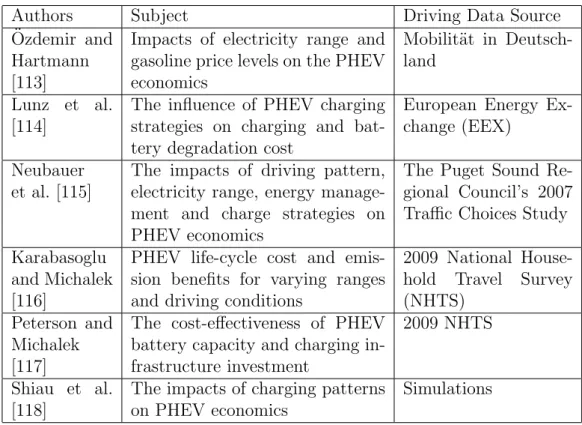
Table 1.1: Recent literature related to PHEV economics
Authors Subject Driving Data Source ¨
Ozdemir and Hartmann [113]
Impacts of electricity range and gasoline price levels on the PHEV economics
Mobilit¨at in Deutsch-land
Lunz et al. [114]
The influence of PHEV charging strategies on charging and bat-tery degradation cost
European Energy Ex-change (EEX)
Neubauer et al. [115]
The impacts of driving pattern, electricity range, energy manage-ment and charge strategies on PHEV economics
The Puget Sound Re-gional Council’s 2007 Traffic Choices Study
Karabasoglu and Michalek [116]
PHEV life-cycle cost and emis-sion benefits for varying ranges and driving conditions
2009 National House-hold Travel Survey (NHTS)
Peterson and Michalek [117]
The cost-e↵ectiveness of PHEV battery capacity and charging in-frastructure investment
2009 NHTS
Shiau et al. [118]
The impacts of charging patterns on PHEV economics
Simulations
A summary of recent studies in the literature related to the economics of PHEVs is presented in Table 1.1. In particular, ¨Ozdemir and Hartmann [113] put forward that battery prices have a significant e↵ect on PHEV economics. The authors
analyze how the PHEV electricity range and gasoline price levels a↵ect PHEV economics. The driving data for their study is obtained from Mobilit¨at in Deutsch-land. Predicting future use, the authors estimate the driving ranges and battery sizes for varying oil prices and report the estimated mobility costs and GHG emis-sions per vehicle kilometer for the year 2030. They conclude that battery prices have a significant e↵ect on PHEV economics and that an electric-drive range of 12 to 32 kilometers is the optimum value. In a di↵erent study, Lunz et al. [114] investigate the influence of PHEV charging strategies on charging and battery degradation cost by taking into account the interaction of a distribution grid with PHEV batteries. Driving data is obtained from the European Energy Exchange (EEX). Several researchers identify driving patterns as a significant factor in PHEV economics and analyze their impacts. In this respect, Neubauer et al. [115] inves-tigate the impacts of driving pattern, electricity range, energy management and charge strategies utilizing the Battery Ownership Model developed by the U.S. National Renewable Energy Laboratory (NREL). Driving data is obtained from the Puget Sound Regional Council’s 2007 Traffic Choices Study. The authors show that the key parameters a↵ecting PHEV economics are driving patterns. Neubauer et al. [119] conduct a similar study for EVs. Karabasoglu and Michalek [116] investigate PHEV life-cycle cost and emission benefits for varying ranges and driving conditions, utilizing the Powertrain Systems Analysis Toolkit (PSAT) de-veloped by Argonne National Laboratory. Trip data for their study is obtained from the 2009 National Household Travel Survey (NHTS) conducted by the U.S. Department of Transportation. The authors argue that fuel economy labels make an optimistic estimate on the mileage per gallon and customers typically observe lower fuel economies in reality. They report that driving conditions have a sig-nificant impact on PHEV economics and environmental benefits, and conclude that under urban driving conditions, plug-in vehicles cut GHGs up to 60% and costs up to 20%. Along these lines, another interesting article is presented by Shiau et al. [118], who investigate the impacts of charging patterns on PHEV economics. The authors consider PHEV charging frequencies and investigate the results with respect to how often the vehicles must stop in order to charge their
batteries. They argue that the best battery capacity choice for PHEVs depends on this charging frequency and PHEV economics depend largely on charging pat-terns of the driver. In a di↵erent article, Peterson and Michalek [117] study the cost-e↵ectiveness of PHEV battery capacity and charging infrastructure invest-ment for reducing U.S. gasoline consumption. The authors obtain driving pattern data from the 2009 NHTS and utilize the Department of Energy’s Greenhouse Gases, Regulated Emissions, and Energy Use in Transportation (GREET) model. In their study, they analyze three types of charging infrastructure: home charging only, home and work charging and all stops charging. The authors conclude that increased PHEV battery capacity results in higher gasoline savings than charging infrastructure.
Most the aforementioned articles assume exogenous data corresponding to trips originally traveled by CVs. Some also consider driving data that were actually traveled by a limited number of PHEVs in experimental surveys. They carry out analyses by generalizing these results. Davies and Kurani [120] report that these assumptions may not reflect the real world and must be cautiously made. This finding has a significant bearing on the point of origin of the current study.
1.2.3
Charging Station Location in Intercity Road
Net-work
As the EVs are infamous for their rather limited range, their increasing num-bers naturally raise the problem of insufficient charging stations. Lack of enough infrastructure has been identified as one of the barriers for the adoption of alter-native fuel vehicles in a more general setting [32–36]. In this respect, the refueling station location problem has been touted in the recent literature. There are two mainstream approaches in AFV refueling station location: maximum-coverage and set-covering. The cover-maximization approach for refueling station problem has been considered by Kuby and Lim [34] with the flow refueling location problem
(FRLP). The objective of the FRLP is to locate p stations in order to maximize the flow volume that can be refueled respecting the range limitations of the vehicles. A demand is assumed to be the vehicle flow driving on the shortest path between an origin and destination (OD) pair on a roundtrip. Satisfying a demand, or in other words, refueling a flow requires locating stations at a subset of the nodes on the path such that the vehicles never run out of fuel. Kuby and Lim [34] pregenerate minimal feasible combinations of facilities to be able to refuel a path, and then build a mixed integer linear programming (MILP) problem to solve the FRLP. There are applications of the problem in the literature [121, 122] and di↵erent ex-tensions to the original problem are considered such as capacitated stations [123], driver deviations from the shortest paths [124, 125] and locating stations on arcs [126]. Di↵erent than other studies on FRLM, Kuby et al. [121] consider maximiz-ing the vehicle-miles-traveled (VMT) on alternative fuel rather than maximizmaximiz-ing the flow volume. The authors use FRLM for the location decisions of hydrogen stations in Florida, and build a decision support system to investigate strategies for setting up an initial refueling infrastructure in the metropolitan Orlando and statewide. Since the pregeneration phase of the method by Kuby and Lim [34] requires extensive memory and time, several solution enhancements have been proposed [127–131]. In particular, MirHassani and Ebrazi [130] present an inno-vative graph transformation and Capar et al. [131] propose a novel modeling logic for the FRLP problem, depending on the notion of arc-coverage, both of which in-crease the solution efficiency of the FRLP drastically. In the set-covering approach to the refueling station location problem, the objective is to minimize the number of stations while covering every possible demand in the network [55, 60, 130, 132].
FRLM and flow covering problems in general have recently been referred to as viable solution techniques and used to locate charging stations [55, 133–137]. Chung and Kwon [133] extended FRLM to model the multi-period charging sta-tion locasta-tion problem, and a case study for Korean Expressways is carried out. The authors proposed a model based on the network transformation by MirHas-sani and Ebrazi [130] and two heuristics to solve their model. Jochem et al. [134]
investigated the optimal fast charging station locations in the German autobahn with a focus on the states Baden-W¨urttemberg and Bavaria. They applied the formulation proposed by Capar et al. [131]. Hosseini and MirHassani [135] investi-gated the refueling station location problem for AFVs under uncertainty and used a modified version of their previous solution technique in MirHassani and Ebrazi [130] to solve it. They also indicate that their model can also be used for electric vehicles by using Level 3 fast charging technology. Wang and Lin [55] proposed a flow-based set covering model for optimally locating refueling stations, such as battery exchange or hydrogen refueling stations. Later, Wang and Lin [136] gen-eralized the same formulation with the characteristics of maximum covering and set covering to locate multiple types of charging stations. Along with the ideas behind all these applications of flow based models to the charging station location problem, Nie and Ghamami [138] identified Level 3 fast charging as necessary to achieve a reasonable level of service in intercity charging station location. A similar result is also attained in Lin and Greene [139] using the National Household Travel Survey. Therefore, similar to aforementioned studies, we assume that the charging stations to be located provide Level 3 service. There are also applications with a flow based set covering formulation to locate slow charging stations for electric scooters [137].
In this study, our objective is to embed the PHEVs into the charging station lo-cation problem. All of the aforementioned studies related to refueling or charging station location consider single-type-fueled vehicles. However, using dual sources of energy, PHEVs utilize electricity as well as gasoline for transportation and they have comparable sales numbers with respect to EVs. According to Center for Sustainable Energy [140], 66,813 EV rebates and 48,733 PHEV rebates have been claimed in California State only between March 2010 and August 2015. Simi-lar to the approach by Kuby et al. [121], we maximize the VMT on electricity which minimizes the total cost of transportation under the existing cost structure between electricity and gasoline. Even though maximizing the AFV numbers in long-distance trips brings environmental benefits, maximizing VMT brings along
additional value from an environmental point of view; and in essence, it is also equivalent to minimizing the e↵ects of greenhouse gases. With our approach to the charging station location problem, the cost and environmental benefits of charging station location are fully exploited by considering VMT and additionally taking the PHEVs into account.
1.2.4
Virtual Power Plant Formation in PHEV Penetrated
Networks
Several electricity suppliers and DERs can be brought together to satisfy the de-mand load. The VPP, a newly introduced aggregation unit, is responsible for load management and resource scheduling. It obtains energy from the DERs, and con-tracts with the consumers in order to supply energy to their PHEVs and residential loads. To this end, it creates economies of scale in a whole new way [141]. VPPs minimize the total cost while ensuring that the energy generated by the DERs is efficiently used. They have no large-scale infrastructure requirements and can interact with the smallest DERs with higher efficiencies and more flexibility [142]. This new technology is usually referred to as the ‘Internet of energy’ [141]. Some real-world examples of VPPs are presented by Nikonowicz and Milewski [143].
The terms VPP and microgrid are usually used interchangeably with a slight di↵erence that the microgrid can be ‘islanded’ from the grid whereas the VPP must be connected to the grid [141]. The aggregator centrally controls energy distribution to a set of consumers with time-elastic (TE) and time-inelastic (TIE) loads. The latter, such as refrigeration or heating, must be satisfied as soon as demanded, whereas the former, such as PHEVs, can be scheduled as desired during the connection period. For instance, the PHEV owner connects the vehicle to the electricity grid after returning from work in the evening and needs the battery fully charged by morning. If needed, the aggregator can discharge energy from the PHEV at any time during the night as long as the battery has reached its
demanded level by morning.
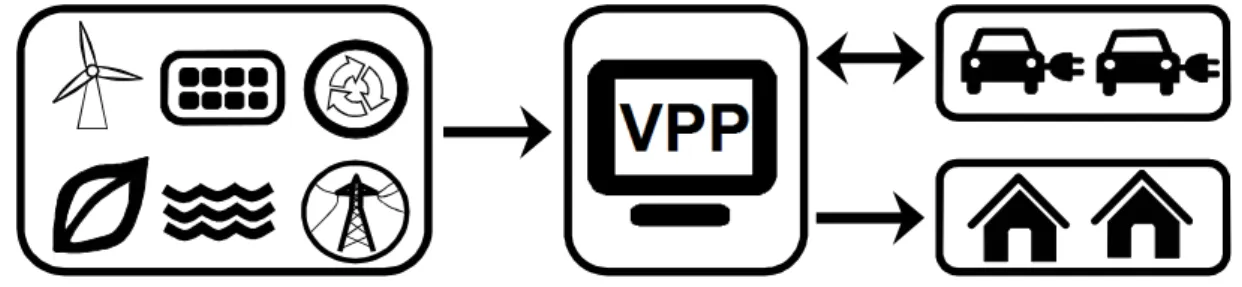
Figure 1.1: Energy scheduling process
Figure 1.1 depicts VPP energy scheduling process. The electricity suppliers and DERs are referred to as energy providers (EPs) within the context of this study. Energy transfers between EPs, VPP, the PHEVs and houses, i.e., TIE loads, are depicted by the arrows.
The problem of microgrid energy scheduling for a forecast load with the objec-tive of cost minimization is addressed from several di↵erent aspects in the recent literature [144–160]. Aside from the microgrid energy scheduling literature, di↵er-ent papers address the energy scheduling problem in PHEV-penetrated networks [161–168]. Future trends of PHEVs [169–173] and emission impacts [174–176] are also considered. Even though an energy management methodology and/or market analysis models are presented, the common drawback is that the cost and emis-sion impacts are not explicitly put forward. Sioshansi and Denholm [177] analyze the value of PHEVs as grid resources and model the charge scheduling of PHEV batteries. This is a unit commitment model of the Electricity Reliability Council of Texas (ERCOT) electric power system, formulated as a Mixed Integer Linear Program (MILP). The objective of the model is to minimize the total system cost, which consists of conventional generator costs and PHEV operation costs. The study considers the cost and emission impacts in the grid domain, but DERs and VPP are not considered in this study. A later study by Sioshansi [178] uses the same model and includes another model to make driving and charging decisions for
the PHEV owner. Combining the two, the paper examines the incentives for indi-vidual drivers with di↵erent electricity tari↵s. However, the ability to use PHEV batteries as storage is not included in the model. Sousa et al. [179] address the problem of energy scheduling from the VPP perspective, also considering technical constraints such as bus voltage magnitude and angle limits. The authors schedule PHEV battery charging and discharging by aggregating PHEVs into units of ten. The objective function of the model is defined to be cost minimization, but the charging price for PHEVs is added to the objective function with a negative co-efficient. Therefore, the model actually minimizes the cost less the income, which implies profit maximization. Due to this representation, the objective function ac-tually drives the solution to schedule PHEV charging at time intervals with higher costs. The presented objective value is always positive in this study because the income from TIE loads is not included in the objective function.
1.3
Contributions
We initially introduce a practically important and theoretically challenging prob-lem: finding the minimum cost path for PHEVs in a network with refueling and charging stations, considering electricity and gasoline as sources of energy with dif-ferent cost structures and limitations. We show that this problem is NP-complete even though its electric vehicle and conventional vehicle special cases are poly-nomially solvable. We propose three solution techniques: (1) a mixed integer quadratically constrained program that incorporates non-fuel costs such as vehi-cle depreciation, battery degradation and stopping, (2) a dynamic programming based heuristic and (3) a shortest path heuristic. Our study is the first that ad-dresses the battery degradation in the MCPP context. We conduct extensive com-putational experiments using both real world road network data and artificially generated road networks of various sizes. Practical applications of the problem in transportation and logistics, considering specifically the long-distance trips, are discussed in detail.
Next, we analyze long-distance travel costs of PHEVs in terms of real-world dynamics on three groups of independent factors: battery characteristics, often-overlooked driver preferences and road network features and compare the results with hybrid electric and conventional vehicles. We investigate the interactions of these factors, and rank the contribution of each level of these factors to the total cost. This analysis provides critical managerial insights which are extremely rele-vant in shaping future investment decisions about PHEVs and their infrastructure. In particular, our findings show that increasing the number of charging stations may not be enough to overcome the range anxiety of the drivers. In addition to the charging infrastructure availability, a driver’s stopping tolerance arises as another critical factor a↵ecting the transportation costs. Ultimately, our findings lead to critical information for policy makers, governments and investors who would like to fully exploit the opportunities o↵ered by the game changing PHEV technology.
We then introduce the hybrid charging station location problem (HCSLP) as a generalization of the flow refueling location problem by Kuby and Lim [34]. To our knowledge, this is the first study to consider the PHEVs in intercity charging station location decisions. Our objective is to maximize the vehicle-miles-traveled (VMT) using electricity and thereby minimize the total cost of transportation under the existing cost structure between electricity and gasoline. This is also indirectly equivalent to maximizing the environmental benefits. We also address the topic of multi-class vehicles with di↵erent ranges in our formulations. For the exact solution of this practically important and theoretically challenging problem, we present an arc-cover model. To enhance the solution process, we propose a Benders Decomposition algorithm. We construct subproblem solutions in closed form expressions to accelerate the algorithm. Furthermore, three di↵erent cut gen-eration schemes are proposed: singlecut, multicut and Pareto-optimal cut. Using the special structure of the subproblem and its dual, we construct these three types of cuts as closed form expressions without having to solve any LPs. The compu-tational gains with the Pareto-optimal cut generation scheme are significant and the efficiency of the decomposition algorithm is increased by orders of magnitude.
The results of the computational studies show that the proposed algorithm both accelerates the solution process and e↵ectively handles instances of realistic size.
Finally, we investigate the cost and emission impacts of VPP formation in PHEV-penetrated networks. We propose a new model that minimizes the total cost from the VPP viewpoint and we present an integer linear representation of the model. We conduct a sensitivity analysis on the battery price, the gasoline price, DER price and capacities, and present extensive insightful results.
In the following chapter, we start o↵ by introducing the minimum cost path problem for PHEVs. Using the solution methodology, we analyze long-distance travel costs of PHEVs in Chapter 3. The Hybrid Charging Station Problem and its solution techniques are introduced in Chapter 4. The VPP Formation in PHEV-penetrated networks and its impacts on cost and emissions are investigated in Chapter 5. Finally, we conclude our study in Chapter 6.
Chapter 2
Minimum Cost Path for Plug-in
Hybrid Electric Vehicles
1
2.1
Problem Definition
We provide the basic definitions and assumptions necessary for the formalization of MCPP-PHEV. Consider a directed transportation graph G = (N, A) and a PHEV traveling from an origin node s2 N to a destination node t 2 N. Refueling and/or charging stations are located at some of the nodes of the graph and pricing may vary between nodes. Therefore, a PHEV can reduce its travel costs by a proper choice of refueling and/or charging stations.
Proposition 1. If a PHEV does not refuel or charge its battery when traveling from node i 2 N to node j 2 N, then the minimum cost path is the shortest path between nodes i and j.
1An extended version of this chapter is authored by Okan Arslan, Barı¸s Yıldız and Oya
Ekin Kara¸san and is published in Transportation Research Part E: Logistics and Transportation Review, 80:123 141, 2015 [48].
The proof of Proposition 1 is straightforward. Next, we introduce a graph transformation which will be useful for the solution methodologies. A similar construction in a completely di↵erent application setting is provided in [180–182].
Definition 1. Given a weighted graph G = (N, A): let bN = {s, t} [ {i 2 N : i has a charging and/or refueling station} and bA = {(i, j) : i, j 2 bN and j is reachable from i if a PHEV at node i with a full tank of gasoline and fully charged battery can reach node j along a shortest path in G}. Arc (i, j) 2 bA has a distance equal to the shortest path distance, say d?
ij, from i to j in G. The graph bG = ( bN , bA)
is called the meta-network of G.
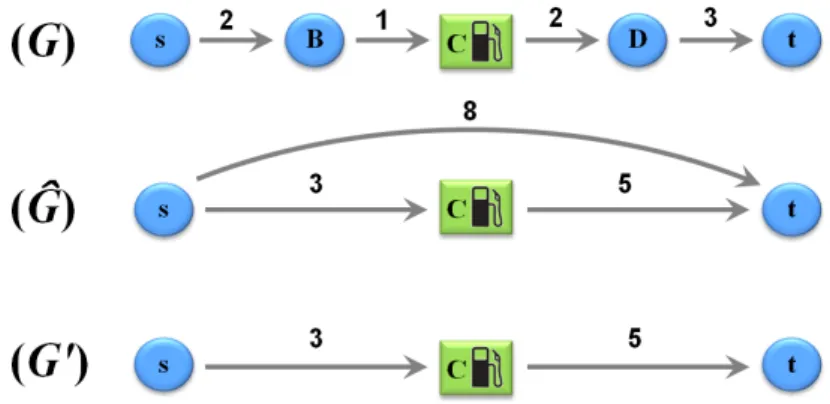
Proposition 1 implies that an optimal solution of a MCPP on a given graph can also be obtained by solving the same MCPP instance on its meta-network. Now, consider nodes B, C and D in graph G in Figure 2.1. Only node C has a refueling station. The meta-network bG is also shown in the same figure. Observe that the arc from s to t is redundant and corresponds to traveling on the path s! C ! t. Since the shortest path from s to t contains a node with a refueling station in the original graph G, arc (s, t) can be omitted.
Figure 2.1: Graph transformation for MCPP-PHEV
Meta-networks can be very dense due to the combined CD and CS mode ranges. The size of the graph is a burden on the solution efficiency, and thus it is useful
to omit the redundant arcs in the meta-network. We refer to the graph formed by the omission of redundant arcs as the reduced meta-network denoted by G0 in
Figure 2.1. In particular, the arcs that are present in the reduced meta-network G0
correspond to shortest paths in the original graph G that contain no intermediate nodes with refueling or charging stations.
Definition 2. A vehicle instance (vehicle) is a vector with 6 entries: hP , P , G, G, ", ⇢i where P and P are the battery maximum and minimum energy capacities, respectively (kWh), G and G are the maximum and minimum tank ca-pacities, respectively (gallons), " is the average electricity usage (kWh/mile) and ⇢ is the average gasoline usage (gallon/mile).
Definition 3. A network instance (network) is a 7-tuple: hN, A, se, sg, ce, cg, di
where N , A are the sets of nodes and arcs, se : N ! {0, 1} and sg : N ! {0, 1}
are functions indicating whether a charging or refueling station is located at a node, respectively, ce : N ! R+ is the electricity price function (¢/kWh), cg : N ! R+
is the gasoline price function (¢/gallon) and d : A ! R+ is the length function
(miles).
Definition 4. The Minimum Cost Path Problem for PHEV (MCPP-PHEV) is defined as finding a path for a vehicle V from a departure node s to a destination node t in a network, and deciding on how much to refuel and where to charge its battery on the path. More formally, the decision version of the problem is:
INSTANCE: hV, X, s, t, Ps, Gs, Pt, Gti where V is a vehicle instance, X is a
network instance, nodes s and t are departure and destination nodes, Psand Gsare
the initial electricity and gasoline storages at node s, Pt and Gt are the minimum
final electricity and gasoline storage requirements at node t, respectively, and a positive number C.
QUESTION: Is there a path from s to t in network X that can be traveled by vehicle V with initial electricity and gasoline levels of Psand Gsand final electricity
The solution of the MCPP-PHEV is a tripleth#, e+, g+i where # is the incidence
vector of the optimal path, e+ and g+ are vectors of size |N| representing the
electricity and gasoline purchases that are transferred to PHEV at each node, respectively.
2.1.1
NP-Completeness
Consider the shortest weight-constrained path problem (SWCPP) for directed graphs which is known to be NP-Complete [183]:
INSTANCE: A directed graph G = (N, A) with length lij 2 Z+ and weight
wij 2 Z+ for each (i, j) 2 A, specified nodes s, t 2 N and positive integers K and
W .
QUESTION: Is there a path in G from s to t with total length K or less and total weight W or less?
First, note that multiplying both W and wij 8(i, j) 2 A by a positive constant
does not change the solution in SWCPP, and the question in the original instance has a YES answer if and only if the modified instance has a YES answer.
Theorem 1. The MCPP-PHEV is NP-complete.
Proof. Observe that the MCPP-PHEV is in NP: given a solution and a value C, one can verify in polynomial time if the solution is feasible and the associated cost is at most C. Given an instancehG, l, w, s, t, K, W i to SWCPP, let lmin = min
(i,j)2Alij,
lmax= max
(i,j)2Alij, wmax = max(i,j)2Awij, =
lmin
2⇥ lmax⇥ wmax > 0, ˆW = ⇥W
and ˆwij = ⇥ wij 8(i, j) 2 A. Now, consider an equivalent SWCPP instance
hG, l, ˆw, s, t, K, ˆWi.
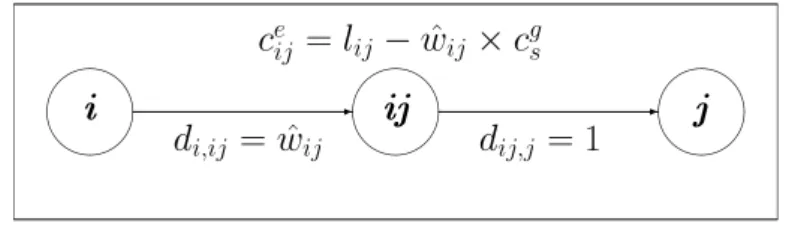
We now transform this SWCPP instance into an MCPP-PHEV instance by the following polynomial time transformation: we add a node, say node ij, on each arc
- -&% '$ &% '$ &% '$ ceij = lij wˆij⇥ cgs i ij j di,ij = ˆwij dij,j = 1 1
Figure 2.2: Graph transformation to show NP-Completeness
(i, j)2 A as shown in Figure 2.2. Let N0 be the set of newly added nodes, A 1 be
the set of arcs from node i to node ij,8(i, j) 2 A with distance equal to ˆwij and A2
be the set of arcs from node ij to node j,8(i, j) 2 A with distance equal to 1 mile. The graph is then transformed into G0 = (N [ N0, A
1[ A2). In the transformed
graph, no gasoline or charging station is located at node i 2 N/{s}. We locate only a refueling station at the source node and the cost of gasoline at this node is cgs = lmax. We also locate a charging station, but no refueling station, at every node
ij 2 N0and the cost of electricity at node ij is ce
ij = lij wˆij⇥cgs = lij ⇥wij⇥lmax.
Replacing , we get cg
s > ceij > 0 for all nodes ij 2 N0so that traveling on electricity
is always preferable to traveling on gasoline. Let X be this transformed network. Let V be the vehicle h1, 0, ˆW , 0, 1, 1i. That is, PHEV V has 1 mile of CD mode range and ˆW miles of CS mode range.
Consider the MCPP-PHEV instance hV, X, s, t, 0, 0, 0, 0i, i.e. a PHEV V trav-els from node s to node t in network X with zero initial and final gasoline and electricity levels. Let K be the associated cost input. In Figure 2.2, V at node i with minimum electricity level needs to spend ˆwij units of gasoline in order to
arrive at node ij. Since electricity is preferable to gasoline, it charges its battery fully at node ij and travels to node j on the CD mode. At node j, its battery depletes and it starts running on CS mode again. The cost of electricity at node ij and the distance between nodes ij and j are such that the total cost of traversing this arc is lij wˆij ⇥ cgs cents. Observe that the vehicle needs to buy the required
node i to node j.
Now, it is easy to observe that V has a path from node s to t with cost at most K if and only if the SWCPP has a path from s to t with length at most K and weight at most ˆW .
2.1.2
Extensions
In order to model real world more closely, non-fuel costs such as vehicle depre-ciation and/or stopping costs need to be taken into account [94]. To this end, we extend the MCPP-PHEV from three aspects and refer to this problem as the Extended MCPP-PHEV (E-MCPP-PHEV). The first extension is vehicle de-preciation cost. A PHEV incurs electricity and gasoline costs while traveling. Furthermore, it loses its value with increasing mileage. Therefore, it incurs a vehi-cle depreciation cost for every mile traveled. Unless depreciation cost is included in the objective function, an optimal path might get much longer than the shortest path which cannot be tolerated even for the most cost averse driver. Therefore, we indirectly avoid long trip distances by including the depreciation cost in the model. In a sense, the depreciation cost can be considered as the cost of tolerating longer distances, and high depreciation costs would force the E-MCPP-PHEV solutions to follow the shortest path.
Another cost component of a vehicle trip is the stopping cost. This cost component can be a measure of the tolerance for stops on the route. That is, for high enough stopping costs, the optimal solution would be the one with the least number of stops. Note that by including the stopping cost, we avoid excessive number of stops on the optimal path which is not tolerable even for the most cost averse driver.
The battery of a PHEV has a limited lifespan, and its life shortens at each cycle. Thus, apart from the electricity purchase cost, PHEV owners also incur battery
1,000 10,000 100,000 1,000,000 0 20 40 60 80 100 % Depth of Discharge Nu m b er o f Cy cl es ( ti m es ) 0.0 0.5 1.0 1.5 Ba tt er y D eg ra d at io n C os t ($ )
Number of Cycles Battery Degradation Cost
Figure 2.3: Cycle life of PHEV batteries as a function of DoD
degradation cost for each battery charge/discharge cycle. The number of cycles is a nonlinear function of depth of discharge (DoD) as reported by [184] and [185]. A sample cycle life function is presented in Figure 2.3 by dashed lines. The more the battery is discharged, the less the number of cycles is. For instance, consider a battery worth$2650 being discharged to 40% DoD throughout its lifetime. The expected number of cycles at this DoD is approximately 10000. Therefore each discharging costs the PHEV owner 26.5¢ ($2650 ⇥ 1/10000). A sample degrada-tion cost funcdegrada-tion for a $2650 battery is presented in Figure 2.3. In our study, we assume that a cycle is completed each time a battery is charged at a station and a PHEV owner incurs a battery degradation cost depending on the DoD level upon arrival to a charging station. We determine this cost by evaluating a quadratic function of DoD. To the best of our knowledge, [177] are the first to include battery degradation cost in their energy management model.
Within this context, the cost components of a PHEV trip are the gasoline cost, the electricity cost, the battery degradation cost, the vehicle depreciation cost and the stopping cost. For simplicity in representing an E-MCPP-PHEV instance, we use the MCPP-PHEV instance representation and assume that all cost components are embedded in the corresponding network instance.
2.2
Solution Techniques
In this section, we provide a mathematical formulation for the E-MCPP-PHEV. Then we present a dynamic programming approximation heuristic along with its extension and a shortest path heuristic.
2.2.1
E-MCPP-PHEV Mathematical Model
The parameters and variables to be used in the formulation of the E-MCPP-PHEV are presented below. We assume that the parameters are known with certainty, and the routing decisions are based on the known pricing of electricity and gasoline at every node of the network.
• P arameters
N, A : Sets of nodes and arcs
s, t : Source and destination nodes se
i, s g
i : 1 if there is an electricity or refueling station, respectively, at node i, and
0 otherwise
P , P : Battery maximum and minimum energy capacities, respectively (kWh) G, G : Maximum and minimum tank capacities, respectively (gallons)
Ps, Pt : Initial and final energy stored in battery of the PHEV (kWh),
respectively
Gs, Gt : Initial and final gasoline stored in tank of the PHEV (gallons),
respectively
" : Average electricity usage of the PHEV (kWh/mile) ⇢ : Average gasoline usage of the PHEV (gallon/mile) dij : Length of arc (i, j) (miles)
ce
i : Price of electricity at node i (¢/kWh)
cst
i : Stopping cost at node i (¢)
cdep : Depreciation cost of traveling for a mile (¢/miles)
• V ariables
e↵
i, ei : Charge level at node i at arrival and departure, respectively (kWh)
e+i : Net electric energy change at node i (kWh) g↵
i , gi : Gasoline level at node i at arrival and departure, respectively (gallons)
gi+ : Gasoline transferred to the PHEV at node i (gallons) #ij : 1 if arc (i, j) is on the minimum cost path, 0 otherwise
vi : 1 if the PHEV charges battery at node i, and 0 otherwise
ui : 1 if the PHEV refuels and/or charges battery at node i, and 0 otherwise i : Depth of Discharge (DoD) at node i at arrival
cbat(
i) : Degradation cost of the PHEV battery at node i
We assume the expected battery replacement cost as a quadratic function of DoD , i.e., cbat( ) = a⇥ 2+ b⇥ where a and b are
coefficients for a given battery type dcd
ij, dcsij : Travel distance in charge-depleting (CD) and charge-sustaining (CS)
mode while traveling on arc (i, j), respectively (miles)
The formulation is as follows:
minimizeX i2N cei ⇥ e+i +X i2N cgi ⇥ gi++X i2N cbat( i) + X (i,j)2A dij⇥ cdep⇥ #ij+ X i2N csti ⇥ ui (2.1) subject to X j:(i,j)2A #ij X j:(j,i)2A #ji= 8 > > > < > > > : 1, i = s 1, i = t 0, 8i 2 N/{s, t} (2.2) ei = e↵i + sei ⇥ e+i 8i 2 N (2.3) M⇥ (#ij 1) e↵j ei + "⇥ dcdij M ⇥ (1 #ij) 8(i, j) 2 A (2.4)
P e↵i P 8i 2 N (2.5) P ei P 8i 2 N (2.6) e+i vi⇥ P 8i 2 N (2.7) vi ui 8i 2 N (2.8) e↵s = Ps (2.9) e↵t Pt (2.10) i = e+i P 8i 2 N (2.11) cbat( i) a⇥ ( i)2+ b⇥ i M ⇥ (1 vi) 8i 2 N (2.12) gi = gi↵+ sgi ⇥ gi+ 8i 2 N (2.13) M⇥ (#ij 1) gj↵ gi + ⇢⇥ dcsij M ⇥ (1 #ij) 8(i, j) 2 A (2.14) G gi↵ G 8i 2 N (2.15) G gi G 8i 2 N (2.16) g+i ui⇥ G 8i 2 N (2.17) g↵s = Gs (2.18) g↵t Gt (2.19) dcsij + dcdij = dij 8(i, j) 2 A (2.20) #ij, vk, uk2 {0, 1}; dijcd, dcsij, e↵k, ek, ek+, gk↵, gk, gk+, k↵, cbatk 0 8k 2 N, 8(i, j) 2 A (2.21)
The objective function minimizes the cost of traveling. The cost components are the cost of obtaining electricity and gasoline, the battery degradation cost, the depreciation cost and the stopping cost. Constraints (2.2) enforce the solution to be a path from s to t. Constraints (2.3) are the electricity balance equations for nodes. The level of electricity upon leaving node i equals the entering electricity level plus the electricity obtained at node i. Similarly, Constraints (2.4) are the electricity balance equations for those arcs that are on the path. For the non-path arcs, the constraints are relaxed with appropriate big-M values. Constraints (2.5)-(2.6) set the upper and lower bounds for the electricity level when entering
or leaving a node. Constraints (2.7) assign binary vi variable a value of 1 if battery
is charged at node i. Constraints (2.8) require that ui is set to 1 if vi equals 1 and
therefore a stopping cost is incurred in the objective function if the PHEV stops to charge its battery. Constraints (2.9)-(2.10) set the electricity level at nodes s and t, respectively. Constraints (2.11) assign proper depth of discharge values and Constraints (2.12) calculate the battery degradation for each node if battery is charged. Constraints (2.13)-(2.19) are the counterparts of constraints (2.3)-(2.9) for the gasoline case. Constraints (2.20) ensure that the sum of the distances on CS and CD modes is equal to the arc length if the arc is on the path. Constraints (2.21) are the domain requirements.
Observe that one can easily extract the following information from the outputs of the model: the path to travel from node s to node t, how many miles to travel on CD and CS modes on each arc, where to stop to refuel or charge battery, and how much to refuel at each refueling stop.
The following lemma presents a valid inequality for the E-MCPP-PHEV for-mulation. Lemma 1. ⇣ X i2N e+i + Ps Pt ⌘ " +⇣ X i2N gi++ Gs Gt ⌘ ⇢ X (i,j)2A #ij ⇥ dij is a valid inequality to (2.2)-(2.21).
Proof. The inequality simply states that we need to have enough electricity and gasoline to travel the trip distance.
Computational studies show that the above cut is very e↵ective in improving the relaxation bound.
2.2.2
Handling Non-simple Paths in the Model
A directed path is an alternating sequence of nodes (n0, n1, n2, ..., nk) with
(ni, ni+1)2 A, 8i = 0, . . . , k 1. A directed path is a non-simple path if it repeats
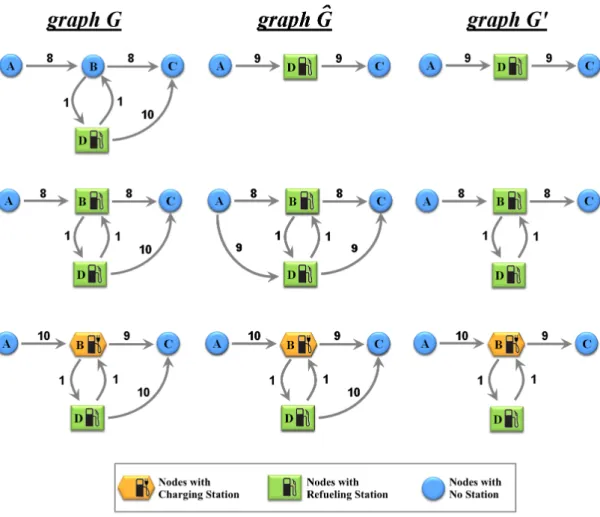
nodes and simple path otherwise. Non-simple paths can occur in transportation networks and as solutions to the E-MCPP-PHEV. The presented MIQCP formu-lation constructs a simple path in the input network G = (N, A). The input network can be the original transportation network, the meta-network or the re-duced meta network, depending on how the non-simple paths are handled. By choosing G as the meta-network or as the reduced meta-network of the input transportation network, a wide group of non-simple paths as potential solutions can be handled by this formulation. All non-simple path occurrences, including extremely rare ones, can be taken into account by duplicating the nodes in G and taking its meta-network at the expense of computational inefficiency. In this part, we demonstrate examples of non-simple paths that might appear as the optimal solutions of the E-MCPP-PHEV problem and present methods to handle these non-simple paths by the mathematical model.
First, note that all of the non-simple paths can be handled by duplicating every node in the graph G (as many times as the drivers are willing to revisit the same node in the same trip or as the number of nodes in the worst case). But this implies a much larger graph size and brings along computational burden. Thus, we first present ways to handle those cases by modifying the input graph for the MIQCP model before resorting to the costly node duplication.
Problem Instance
• We consider the vehicle Instance V = hP = 1, P = 0, G = 9, G = 0, " = 1, ⇢ = 1i. Thus the gasoline range of a PHEV is 9 miles and the electricity range is 1 mile.
Figure 2.4: Non-simple path examples
the three examples (Figure 2.4). In all three networks, nodes A, B and C are points on the highway.
• The problem instance is given as hV, X, A, C, 1, 9, 0, 0i where X is the input network instance. For the sake of simplicity, we also assume that battery degradation, vehicle depreciation and stopping costs are all zero.
Case-1: Detour from the highway to refuel
station just one mile away from the highway. Node B is deleted in the meta-network or reduced meta-network since it does not have a station. The optimal non-simple path from A to C in G is A ! B ! D ! B ! C and can be attained by using the reduced meta-network G0 as input to the MIQCP formulation.
Case-2: Detour from the highway to refuel in a cheaper station
The middle figure illustrates a detour from the highway. But this time, there is a refueling station on the highway (possibly with a more expensive gasoline price) at which the PHEV can detour and go to node D in order to refuel. In this case, MIQCP formulation can handle the optimal non-simple path A! B ! D ! B ! C by using meta-network ˆG as the input graph. Indeed, simple path A! D ! C in ˆG will correspond to this solution.
Case-3: Refuel twice in the same station
Now, consider the bottom figure. This time, node B has a charging station and node D has a refueling station. Observe that there is only one feasible solution for this problem: A ! B ! D ! B ! C. The PHEV charges battery at node B, travels to node D to refuel. Then it necessarily returns back to node B and charges its battery again in order to be able to reach to node C. In this example, the optimal path is a non-simple path in all three graph types and thus, MIQCP formulation can only handle such non-simple paths by a node duplication.
Note that this particular instance can be generalized so that more than two visits to the same node, and hence more than one duplication of the node set, is necessary. Note also that this is a rather rare occurrence. The emergence of such non-simple paths is not only due to price di↵erences, but also to range limitations as well. In the example, node B is reachable from node A, but node D is not. Considering the combined gasoline and electric range of existing PHEVs, this example is not very representative of the real network instances under our scope.