AIMS OF INTERNATIONAL PROSECUTION: DETERRENCE AND INTERNATIONAL CRIMINAL COURT
A Master’s Thesis
by DENİZ ÇİL
Department of International Relations Bilkent University
Ankara June 2010
AIMS OF INTERNATIONAL PROSECUTION: DETERRENCE AND INTERNATIONAL CRIMINAL COURT
The Institute of Economics and Social Sciences Of
Bilkent University
By
DENIZ ÇİL
In Partial Fulfillment of the Requirements for the Degree of MASTER OF ARTS
In
THE DEPARTMENT OF INTERNATIONAL RELATIONS BILKENT UNIVERSITY
ANKARA June 2010
I certify that I have read this thesis and have found that it is fully adequate, in scope and in quality, as a thesis for the degree of Master of Arts in International Relations.
Prof. Yüksel İnan Supervisor
I certify that I have read this thesis and have found that it is fully adequate, in scope and in quality, as a thesis for the degree of Master of Arts in International Relations.
Assoc. Prof. Tuğrul Katoğlu Examining Committee Member
I certify that I have read this thesis and have found that it is fully adequate, in scope and in quality, as a thesis for the degree of Master of Arts in International Relations.
Asst. Prof. Nil S. Satana Examining Committee Member
Approval of the Institute of Economics and Social Sciences
Prof. Erdal Erel Director
ABSTRACT
AIM OF INTERNATIONAL PROSECUTION: DETERRENCE AND INTERNATIONAL CRIMINAL COURT
Çil, Deniz
M.A., Department of International Relations Supervisor: Prof. Dr. Yüksel İnan
June 2010
International community while establishing international mechanisms to prosecute and punish perpetrators of war crimes, crimes against humanity and the crime of genocide assumed that international prosecution would have a deterrent effect on potential perpetrators. Thus, this thesis aims to analyze the extent of contribution by international justice mechanisms to the prevention of grave human rights violations in an ongoing conflict. In other words, this thesis tries to figure out whether the predetermined purpose of deterring future crimes is realized or not by international criminal courts. After examining the scope of international criminal justice system and deterrence theory in criminology literature, a discussion on the applicability of deterrence theory to the international context is provided. The main argument of this thesis is that if an international criminal court gets actively involved in a conflict, it would have deterrent effect on potential perpetrators. In order to test this hypothesis a case study on the conflict in Democratic Republic of Congo and the involvement of International Criminal Court is conducted.
Keywords: International Criminal Court, International Humanitarian Law, International Criminal Law, Criminology, Deterrence Theory, Armed Conflict, Democratic Republic of Congo
ÖZET
ULUSLARARASI KOVUŞTURMANIN AMACI: CAYDIRICILIK VE ULUSLARARASI CEZA MAHKEMESİ
Çil, Deniz
Yüksek Lisans, Uluslararası İlişkiler Bölümü Tez Yöneticisi: Prof. Dr. Yüksel İnan
Haziran 2010
Uluslararası toplum savaş suçları, insanlığa karşı işlenen suçlar ve soykırım suçu faillerini kovuşturmak ve cezalandırmak için uluslararası mekanizmalar kurduğu sırada, uluslararası kovuşturmanın muhtemel failler üzerinde de caydırıcı bir etkisi olacağını öngörmüştü. Bu nedenle, bu tez uluslararsı adli mekanizmalarin devam etmekte olan çatışmalardaki insan hakları ihallerini önlemekteki katkısını incelemeyi amaçlamaktadır. Bir başka deyişle, bu tez önceden belirlenmiş caydırıcılık amacının uluslararası ceza mahkemelerince gerçekleştirilip gerçekleştirilmediği ortaya koymaya çalışmaktadır. Uluslararası ceza sisteminin kapsamını ve kriminoloji literatüründeki caydırıcılık teorisini incelendikten sonra, caydırıcılık teorisinin uluslararası bağlamda uygulanabilirliği üzerine bir tartışma sunulmaktadır. Bu tezdeki ana argüman eğer bir uluslararası ceza mahkemesi bir çatışmaya aktif olarak müdahale ederse, muhtemel failler üzerinde caydırıcı bir etkisinin olacağı yönündedir. Bu hipotezi test etmek için Uluslararası Ceza Mahkemesi’nin Demokratik Kongo Cumhuriyeti’ndeki çatışmaya müdahelesi incelenmektedir.
Anahtar Kelimeler: Uluslararası Ceza Mahkemesi, Uluslararası İnsancıl Hukuk, Uluslararası Ceza Hukuku, Kriminoloji, Caydırıcılık Teorisi, Silahlı Çatışma, Demokratik Kongo Cumhuriyeti
ACKNOWLEDGMENTS
First and foremost I would like to express my deepest gratitude to Prof. Dr. Yüksel İnan who has not only supervised my thesis with his invaluable comments and suggestions but also supported me throughout my undergraduate and graduate studies. With his warm attitude and recommendations I spend my thesis writing period without any stress. I would also like to thank Asst. Prof. Nil S. Şatana for allocating her precious time to review and enhance my thesis as well as for her support during my graduate studies and future career plans. I also owe thanks to Assoc. Prof. Tuğrul Katoğlu who have accepted to read my thesis and joined my defense committee with his constructive comments.
I am indebted to my mother Handan Çil and to my father Mehmer Çil for their support throughout my entire life. I could not accomplish my achievements in my career path without their endless support.
I would like to express my thanks to my friends and colleagues B. Toygar Halistoprak, Seçkin Köstem, Filiz Akgün, Çiğdem Akın and B. Nazlı Üstünes for their friendship throughout my graduate studies. In addition, I would like to thank Pınar Kılıçhan Şener and B. Yasemin Özbek for their patience in answering my questions about administrative processes and for their help in performing my departmental duties.
Finally, because of the scholarship that helped me to finance my graduate studies, I would like to express my thanks to TUBİTAK for providing me such an opportunity.
TABLE OF CONTENTS
ABSTRACT... iii ÖZET ... iv ACKNOWLEDGMENTS ... v TABLE OF CONTENTS... viLIST OF FIGURES ... viii
LIST OF ABBREVIATIONS... ix
CHAPTER I INTRODUCTION ... 1
CHAPTER II THE INTERNATIONAL CRIMINAL JUSTICE SYSTEM... 7
2.1. Laws of Armed Conflict and International Humanitarian Law ...8
2.2. International Humanitarian Law and International Human Rights Law...10
2.3. Sources of International Humanitarian Law ...11
2.3.1. International Conventions Establishing Rules Recognized by States...12
2.3.2. International Custom as Evidence of a General Practice Accepted as Law...25
2.4. Enforcement of International Humanitarian Law ...31
2.4.1. National Enforcement ...33
2.4.2. International Enforcement...36
CHAPTER III THEORY OF DETERRENCE ... 45
3.1. Classical Theory of Deterrence...46
3.2. Re-conceptualization of the Theory...48
3.3. Testing Theory of Deterrence ...57
CHAPTER IV APPLICATION OF THE THEORY TO THE INTERNATIONAL CRIMINAL JUSTICE SYSTEM... 67
4.1. Divergent Views on the Deterrent Effect of International Criminal Justice System ...68
4.2. The Applicable Premises of Deterrence Theory ...76
4.3. Conceptualization, Operationalization and Hypotheses ...80
4.4. Methodology and Case Selection...83
5.1. Democratic Republic of Congo (DRC)...86
5.1.1 History of the Conflict in DRC ...89
5.1.2. ICC’s Involvement in DRC...97
5.1.2.1. 2004 – 2006: Passive Involvement ...97
5.1.2.2. 2006 Onwards: Active Involvement ...101
5.2. Analysis of the Case...115
CHAPTER IV CONCLUSION ... 121 SELECT BIBLIOGRAPHY ... 126 APPENDICES ... 135 APPENDIX A ... 136 APPENDIX B ... 137 APPENDIX C ... 139 APPENDIX D ... 140 APPENDIX E ... 141
LIST OF FIGURES
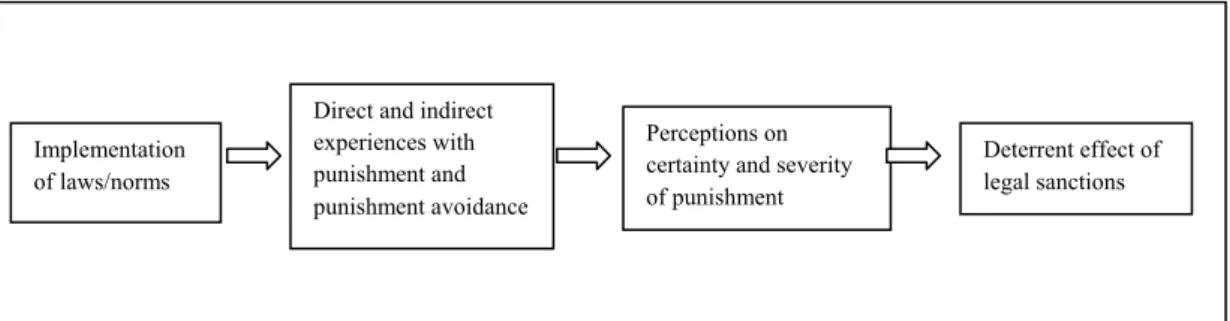
1) Relation between the implementation of laws and deterrent effect of legal
LIST OF ABBREVIATIONS
ADFL Alliance des Forces Démocratiques pour la Libération du Congo
(Alliance of Democratic Forces for Liberation)
CNDP Congres National pour la Défense du Peuple (National Congress for
the Defense of People)
DRC Democratic Republic of Congo
FADCR Forces Armées de la République Démocratique du Congo
(Democtaric Republic of Congo Armed Forces)
FAR Forces Armées Rwandaises (Rwandan Armed Forces)
FAZ Forces Armées Zairoises (Zairian Armed Forces)
FDLR Forces Démocratique de Libération du Rwnada (Democratic Forces
for the Liberation of Rwanda)
FNI Front des nationalists et integrationnistes (Nationalist and
Integrationist Front)
FPLC Forces Patriotiques pour la Libération du Congo (Patriotic Forces for
the Liberation of Congo
FRPI Force de résistance patriotique en Ituri (Patriotic resistance force in
Ituri)
HRW Human Rights Watch
ICG International Crisis Group
ICISS International Commission on Intervention and State Sovereignty
ICRC International Committee of the Red Cross
ICTR International Criminal Tribunal for Rwanda
ICTY International Criminal Tribunal for Former Yugoslavia
IDP Internally Displaced People
IMT International Military Tribunal
IISS International Institute for Strategic Studies
LRA Lord’s Resistance Army
MLC Mouvement de Libération du Congo (Congo Liberation Movement)
MONUC Mission des Nations Unies au Congo (United Nations Organization
Mission in DR Congo)
MRC Mouvement Révolutionnaire Congolais (Revolutionary Movement of
Congo)
NGO Non-governmental Organization
RCD Rassemblement Congolais pour la Démocratie (Rally for Congolese
Democracy)
RPF Rwandese Patriotic Front
CHAPTER I
INTRODUCTION
The history of international prosecutions of war crimes and crimes against humanity goes back to the end of the Second World War with the establishment of
ad hoc international military tribunals (IMT) in Nuremberg and Tokyo to try German
and Japanese war criminals of the Second World War. Especially the atrocities committed by the Nazi Germany in the European front of the war and the discovery of the detention camps established for Jewish citizens of Germany, which brought the genocide of Jewish people into light, triggered massive reactions in the international community. “Never again” was the motto of world politicians at those times. IMTs at Nuremberg and Tokyo were unprecedented in the sense that it was the first time that war criminals were being tried and punished by an international authority. This also underlined the understanding in the world community that war time atrocities and humanitarian law violations are topics of concern to the humanity. Prior to World War II, war criminals were to be tried and punished by either military or civil national courts. These had not attracted that much public attention because of the insignificant numbers and locality of prosecutions.
Right after the Second World War, there were also efforts initiated by the United Nations (UN) to establish an international criminal court, which proved
fruitless in the wake of political confrontation in the United Nations Security Council due to the Cold War. Therefore, approximately 50 years passed without any real incentive to establish an international court to prosecute international crimes, namely war crimes, crimes against humanity and genocide in particular. However, the end of the Cold War as well as the need to address the atrocities in the Former Yugoslavia and Rwanda paved the way of creating international criminal justice mechanisms. International Criminal Tribunal for Former Yugoslavia (ICTY) and International Criminal Tribunal for Rwanda (ICTR) could also be considered as unprecedented since they are different from IMTs of the Second World War. These were completely civil institutions involved in armed conflicts, which were not international. Especially in the case of ICTY, the Tribunal was established while the conflict was still going on in the territory of Former Yugoslavia with the assumption that prosecution of perpetrators would contribute to the restoration and maintenance of peace while ensuring that international humanitarian law violations were halted and redressed.
In addition to the establishment of ICTY and ICTR, hybrid courts such as the Special Court for Sierra Leone, the Ad hoc Human Rights Court for East Timor and Extraordinary Chambers in the Courts of Cambodia or Iraqi Special Tribunal are the recent examples of the developments in the execution of international humanitarian law. The proliferation in the numbers of international judicial bodies proves that the idea of individual accountability for grave human rights and humanitarian law violations has evolved potently in the international politics. Besides the issue of accountability, international criminal courts are currently considered in the peace making and peace building strategies for conflict torn societies. The logic behind the
establishment of these international criminal courts is that an international judicial body, even in a case of ineffectiveness or reluctance of domestic criminal courts of the countries concerned, would act as a deterrent for future crimes. The references to the deterrence argument could easily be observed in the documents that establish those courts especially the ones that were to be involved in an ongoing conflict.
Most recently and explicitly, in the preamble of Rome Statute of International Criminal Court, it is stated that the creation of an International Criminal Court would contribute to the termination of culture of impunity for the grave violations of human rights and to the prevention of such violations in the future. Some international lawyers and scholars also supported the deterrence argument in international criminal justice system and argued that the more perpetrators are prosecuted, the more they would establish precedents for others who would be deterred of committing such crimes because of the risk of prosecutions and trials by the international community. Moreover, the proponents of this idea suggest that since all the crimes punishable by international criminal justice system require planning and organization to some extent either committed by governments or by militias, prosecutions and trials would increase the risks and change the calculations of individuals before committing those crimes. Therefore, the prosecution of especially high profile perpetrators such as leaders, heads of states and commanders who bear the greatest responsibility of planning and commanding would set up a general deterrent effect.
The view of prevention of international crimes through the deterring impact of international criminal justice is widely supported among policy makers, international law scholars and human rights activists. Moreover, the report of the
International Commission on Intervention and State Sovereignty, entitled “the Responsibility to Protect”, states that legal measures could also be employed as a mean of direct prevention efforts and argues that the establishment of international criminal courts would lead the potential perpetrators of crimes against humanity, war crimes etc. to concentrate on the risks of international prosecutions (ICISS, 2001: 24). Nevertheless, there is limited work on the real impact of the international criminal tribunals on an ongoing conflict. Most literature on international and humanitarian law focuses on issues such as the legal basis of jurisdiction, the definition of crimes, or the applicability of international humanitarian and criminal law rules to certain cases. On the other hand, the literature on civil conflict mainly focuses on the interventions in the form of military interventions, economic assistance, and peace operations. Nevertheless it does not pay sufficient attention to the involvement of international criminal justice mechanisms and their effect on the course of the conflict. In that sense, this research intends to make a contribution first to the international law literature by focusing on the impact of the practices of international criminal courts on an ongoing conflict instead of discussing jurisdictional and definitional matters, and secondly to the literature on civil conflict by examining involvement of justice mechanisms. Therefore, this research tries to answer the question of “how do the activities of international criminal justice mechanism contribute the prevention of grave human rights violations in an ongoing conflict?” In addition, the activities of international criminal tribunals in the scope of this research are categorized under two headings, passive involvement and active involvement. The former is defined by the referral of a case to the tribunal and opening of investigations by the Office of Prosecutor. Regarding the latter, for an
international criminal court to be considered as actively involved in a conflict there is also a need to secure the custody of indictees and commence trails. Bearing in mind the two types of involvement, the main methodology of this research in examining the impact of international criminal tribunals on conflicts is a single case study with a comparison of the passive involvement of ICC in DRC between 2004 and 2006 and the active involvement 2006 onwards. Although probably it is not the best way to make generalizations, a single case study seems to be the most suitable one when the scope of this research and available data are considered.
Since deterring future crimes and ending atrocities as well as the culture of impunity are predetermined aims in establishing international criminal courts, this research intends to examine whether international criminal justice mechanisms will contribute to the prevention of atrocities through deterring violations of humanitarian law in ongoing conflict situations. Therefore, the second chapter of this thesis aims to scrutinize the extent of the international criminal justice system, its evolution and enforcement with references to the sources of international humanitarian law and examples of national and international enforcement mechanisms as well as the aims of prosecutions. The Chapter 3 examines deterrence theory in criminology literature for domestic criminal systems since the deterrence argument in international criminal justice system is incorporated from the criminology literature. Therefore, the third chapter, while explaining the classical deterrence theory and its assumptions also focuses on the recent deterrence theories as well as the studies that test the validity of deterrence theory. The fourth chapter provides a merger of the two former chapters on international criminal justice and theory of deterrence and discusses the applicability of deterrence theory to the international context. This chapter also
presents divergent views on the applicability of deterrence theory to the international criminal justice system as well as the main assumptions in this research. The fifth chapter analyzes the case of the Democratic Republic of Congo (DRC) where currently the International Criminal Court (ICC) is involved with an aim to reveal the impact of the ICC’s activities in the conflict in this country. This analysis also includes a brief history of the conflict. Finally, the last chapter presents the concluding remarks of the research.
CHAPTER II
THE INTERNATIONAL CRIMINAL JUSTICE SYSTEM
The current chapter will provide a detailed analysis of the international criminal justice system. The aim of this analysis is to examine the scope, evolution and the enforcement of the international criminal justice system which is essential to scrutinize before any attempt to study the impact of the system through enforcement mechanisms in ongoing conflict situations.
International criminal justice system refers to the norms and rules of the international humanitarian law, human rights law and to the mechanisms that are empowered to execute these norms and rules. However, the substantive element of law in international criminal justice system mainly stems from the international humanitarian law in which international crimes are mostly determined. “International Humanitarian Law is […] concerned with international crimes and includes genocide and crimes against humanity, whether committed in times of war or in times of peace [and] also concerned with the trial and the punishment of those who have committed such crimes” (Goldstone and Smith, 2009: 10). The crime of genocide, crimes against humanity and war crimes have been defined and codified by the international humanitarian law norms through several conventions and international agreements as well as by the statutes of international tribunals, and interpreted by the judgments of
those tribunals. Before proceeding with the criminal aspect of the system, the following section will try to analyze the substantive part of the international humanitarian law and its place in the laws of armed conflict and in international law in general.
2.1. Laws of Armed Conflict and International Humanitarian Law
The international humanitarian law is a branch of the laws of armed conflict which is concerned with the protection of the victims of armed conflicts who are not active in conflict due to injury, sickness, capture or who are civilians (McCoubrey, 1990: 1). The laws of armed conflict are an important part of public international law (Pictet, 1988: xix) and go back to the history of war aimed to maintain the control, disciple and efficiency of military forces and to limit the impact of violence and
destruction1 (Bouchet-Saulnier, 2007: 212). Although sometimes international
humanitarian law and laws of armed conflict are utilized interchangeably by many scholars, there is a widely acknowledged categorization of laws of armed conflict which divide the body of the rules governing armed conflict as jus ad bellum and jus
in bello.
Jus ad bellum is the term used for the body of rules that sets limits to the use
of armed forces as a means of conduct in international relations (McCoubrey and White, 1992: 1). This category deals with the use of force as a state practice, which is
1 The laws of war were existent even in the era of knights as chivalric codes. Examples can be given
from Thirty Years’ War and the Articles of War issued by Swedish King Gustavus Adolphus in 1621
or from 19th century’s Lieber Code released on 24 April 1893 by Abraham Lincoln which is officially
known as “the Instructions for the Government of Armies of the United States in the Field”. It is further possible to trace the humanitarian concerns in military doctrines far back to 500-200 BC, for example the Art of War, Chinese Classic on military strategy written in 500 BC by Sun Tzu and the
Indian Code of Manu developed between 200 BC and 200 AD (See, Goldstone and Smith, 2009: 15 –
prohibited by the Charter of the United Nations Article 2 paragraph 4.2 The only exception to use force in the UN Charter is “self-defence” that should be in accordance with Article 51 of the Charter, which states that:
Nothing in the present Charter shall impair the inherent right of individual or collective self-defence if an armed attack occurs against a Member of the United Nations, until the Security Council has taken measures necessary to maintain international peace and security. Measures taken by Members in the exercise of this right of self-defence shall be immediately reported to the Security Council and shall not in any way affect the authority and responsibility of the Security Council under the present Charter to take at any time such action as it deems necessary in order to maintain or restore international peace and security.
Therefore, jus ad bellum is applicable before an armed conflict is initiated and concerned with the legality of use of force which is beyond the scope of this research.
Jus in bello, on the other hand, refers to the rules and norms applicable during
an armed conflict and is not concerned with the nature or legality of war, rather aims to protect the victims of war (McCoubrey, 1990: 5). Jus in bello has also two sub-divisions which are generally known as the Hague Conventions of 1907 and the Geneva Conventions of 1929 and 1949. The appellation of the sub-divisions comes from the places that the international conventions were signed. Hague Conventions of 1907 govern and limit the means and methods of warfare, which include weapon types and usage, tactics and general operational conduct (McCoubrey and White, 1992: 189). Whereas, Geneva Conventions of 1949 have the purpose of protecting the victims of armed conflict or at least ameliorating their conditions (McCoubrey
2 Charter of the United Nations, June 26, 1945, art.2 para.4,
and White, 1992: 189). Initially, the term international humanitarian law used to refer the Geneva Conventions because of the humanitarian concerns of the provisions; however, it should be noted that the Hague Conventions have also humanitarian concerns. Likewise the Geneva Conventions have also provisions regarding the means and methods of warfare. Therefore, the distinction is not a straight one and the humanitarian law should include both (McCoubrey, 1990: 2). Especially after the adoption of the Protocol Additional to the Geneva Conventions of 12 August 1949, and relating to the Protection of Victims of International Armed Conflict, (Protocol I), which have provisions on the methods and means of warfare under Part III, the distinction between Geneva Conventions and Hague Conventions has blurred to a greater extent (Pictet, 1988: xx). Therefore, it is possible to argue that the current usage of international humanitarian law as a concept refers to the entire body of laws of armed conflict that become operational during the conflict (Meron, 2006: 1). While trying to define the international humanitarian law and its place in laws of armed conflict and international law in general, it would be better to make a reference to the body of international human rights law and its distinction from the humanitarian law to provide a more lucid understanding of the scope of international humanitarian law.
2.2. International Humanitarian Law and International Human Rights Law
Unlike human rights law, international humanitarian law does not establish universal rights applicable to all people in all times of either peace or war (Bouchet-Saulnier, 2007: 214). The Geneva Conventions, as the official names of the conventions also suggest, are protecting certain categories of people. There are 4
categories of people, which are wounded, sick, prisoners of war or civilians. On the other hand, human rights law aims to guarantee that all individuals benefit from basic rights and freedoms and deals with the relationship between the state and its own subjects as opposed to the humanitarian law which is regulating the relation between the state and enemy subjects (Pictet, 1988: xxi). Moreover, international humanitarian law tolerates the killing and wounding of innocents such as civilian victims of the lawful collateral damage, or permits certain deprivations of freedom without any judicial processes as in the case of prisoners of war, or allows limitations on appeal rights of detained persons which are, on the contrary, regarded as fundamental rights of people that should be protected under the human rights law (Meron, 2006: 8). Therefore, international human rights law and international humanitarian law are two distinct systems in regard to their applicability and fundamental principles but have interactions with each other.
2.3. Sources of International Humanitarian Law
The sources of international humanitarian law are several international conventions and the statutes of courts, tribunals, and special chambers etc. that have jurisdiction over war crimes, crimes against peace, crimes against humanity and genocide. However, the customary international law, general principles of law and judicial decisions that interpret and clarify the terms and scope of international humanitarian law should also be considered as legitimate sources, since the Statute of International Court of Justice lists all of them as the sources that shall be applied by the Court in an hierarchical manner while giving its decision. Therefore, I will try to
examine the sources of international humanitarian law abiding by the ordering of the International Court of Justice, which is:
1) International conventions, whether general or particular,
establishing rules recognized by […] states;
2) International custom, as evidence of a general practice
accepted as law;
3) The general principles of law recognized by civilized nations;
4) […] judicial decisions and the teachings of the most highly
qualified publicists of the various nations, as subsidiary means for determination of rules of law.3
2.3.1. International Conventions Establishing Rules Recognized by States
Besides the efforts to codify laws of armed conflict by individual states, the first international convention is the Convention for the Amelioration of the Condition of the Wounded in Armies in the Field signed on 22 August 1864 which is also
widely known as Geneva Convention of 1864.4 This convention was based on the
observations of Henry Dunant from the Battle of Solferino (Goldstone and Smith, 2008: 17). By accidentally arriving at the battlefield in the village of Solferino where forces of Napoleon III and Austria were confronting (Destexhe, 1996: 50), Henry Dunant witnessed the conditions of the wounded and wrote his memoires, which led to the adoption of the Geneva Convention of 1864 and the creation of today’s International Committee of Red Cross (Goldstone and Smith, 2008: 17). The Convention was predictably limited in scope when compared to its successors since it was dealing with the immediate issues arising from the Battle of Solferino however, it established the fundamental principles of neutrality of humanitarian aid
3Statute of the International Court of Justice, June 26, 1945, art. 38, ICJ Basic Documents,
http://www.icj-cij.org/documents/index.php?p1=4&p2=2&p3=0
4Convention for the Amelioration of the Condition of the Wounded in Armies in the Fields, August
22, 1864, International Committee of Red Cross (ICRC) Treaty Database,
(McCoubrey, 1990: 11-12). Geneva Convention of 1864, which can be argued as the first example of jus in bello regulating the conditions of victims of war, was followed by an international conference which produced the Declaration Renouncing the Use, in Time of War, of Explosive Projectiles Under 400 Grams Weight on 11 December
1868.5 Commonly referred as St. Petersburg Declaration, this declaration is
considered to be the first modern international humanitarian law since it aimed to prohibit certain means and methods of warfare with a purpose of limiting unnecessary suffering (Goldstone and Smith, 2008: 18). Although the declaration was concerned with a very specific context of arms limitation, the doctrine of “unnecessary suffering” has become a significant principle in the modern jus in bello (McCoubrey and White, 1992: 225). These two conventions were succeeded by several conventions on the issues of means and methods of warfare, naval and airfare, cultural property and victims of warfare. Some of them were adopted for
limited purposes such as the ones germane to asphyxiating gases6 or expanding
bullets,7 or such as the ones relative to the laying of automatic submarine contact
mine,8 whereas some others established more comprehensive rules of armed conflict.
There are over a hundred of international conventions forming the regime of the laws of armed conflict. However, the most important ones that are cited also in the statutes of the international tribunals are the Hague Conventions of 1907, particularly the Forth Hague Convention of 1907 regulating laws and customs of war on land and the
5Declaration Renouncing the Use, in Time of War, of Explosive Projectiles Under 400 Grams Weight,
December 11, 1868, ICRC Treaty Database, http://www.icrc.org/ihl.nsf/TOPICS?OpenView
[Hereinafter St.Petersburg Declaration].
6Declaration concerning the Asphyxiating Gases, July 29, 1899, ICRC Treaty Database,
http://www.icrc.org/ihl.nsf/FULL/165?OpenDocument
7Declaration concerning Expanding Bullets, July 29, 1899, ICRC Treaty Database,
http://www.icrc.org/ihl.nsf/FULL/170?OpenDocument
8Convention relative to the Laying of Automatic Submarine Contact Mines, October 18, 1907, ICRC
four Geneva Conventions of 1949 and two additional Protocols signed on 8 June 1977. The Forth Hague Convention on the Laws and Customs of War articulated the laws of armed conflict and set rules on the conduct of warfare in the annex to the
convention.9 The Forth Hague Convention of 1907 was adopted to substitute for an
earlier version of the Hague Convention of 1899, while it was stated that “the Convention of 1899 remained in force as between the Powers which signed it, and
which do not ratify the present Convention.” 10 On the date of codification, the
regulations set in the Forth Hague Convention of 1907 were envisaged to be applicable for the parties to the Convention and the violation of the regulations by a party would be liable to pay compensation for the acts committed by the personnel of its armed forces. 11 It is clear from the above cited articles of the Convention that the understanding of individual criminal responsibility was not present at the beginning of the 20th century, which evolved in time. In addition, in time the rules of the Forth Hague Convention of 1907 became a part of customary international law meaning that it is now considered to be binding for all states regardless of their status as a signatory or non-signatory to the Convention, which will be dealt in the following section.
On the other hand, Geneva Conventions of 1949 and the two additional Protocols of 1977 constitute a greater part of contemporary international humanitarian law in regard to the protection of victims of war, which deserves a
9Convention respecting the Laws and Customs of War on Land, October 18, 1907, ICRC Treaty
Database, http://www.icrc.org/ihl.nsf/FULL/195?OpenDocument [Hereinafter The Forth Hague
Convention of 1907].
10The Forth Hague Convention of 1907, art. 4.
detailed examination. The First Geneva Convention of 194912 is concerned with the protection of the wounded and sick in armed forces in the field whereas, the Second
Geneva Convention of 194913aims to protect wounded and sick in armed forces in
naval war. These two Conventions compile the rules and regulations on the condition
of wounded and sick that had been adopted by states back in the 19th century. In
addition to the category of wounded and sick as the victims of war, the Third Geneva Convention of 194914 delineate the rules regarding the treatment of prisoners of war, which is a more comprehensive and detailed Convention with 143 articles compared to other three Geneva Conventions of 1949. Finally, the Forth Geneva Convention of 1949 pertains to the protection of civilians in time of armed conflict. 15 The Forth Geneva Convention of 1949 has a significant place in the regime of international humanitarian law, in the sense that it is the first convention recognizing the civilians as the victims of war.
The scope and applicability of these four Geneva Conventions of 1949 are described in their 2nd and 3rd articles. Article 2 common to Geneva Conventions of 1949 states that the provisions shall be applicable “to all cases of declared war or of other armed conflict which may arise between two or more of the High Contracting Parties, even if the state of war is not recognized by one of them.” The key point in the Common Article 2 is the wording of the article about the applicable situations.
12Convention for the Amelioration of the Condition of the Wounded and Sick in Armed Forces in the
Field, August 12, 1949, 75 U.N.T.S. 31. [Hereinafter the First Geneva Convention of 1949].
13Convention for the Amelioration of the Condition of Wounded, Sick and Shipwrecked Members of
Armed Forces at Sea, August 12, 1949, 75 U.N.T.S. 85. [Hereinafter the Second Geneva Convention of 1949].
14Convention Relative to the Treatment of Prisoners of War, August 12, 1949, 75 U.N.T.S 135.
[Hereinafter the Third Geneva Convention of 1949].
15Convention Relative to the Protection of Civilian Persons in Time of War, August 12, 1949, 75
The compatibility of the provision with all cases of other armed conflict in addition to the cases of declared war certainly extended the scope of the international humanitarian law.
“Armed conflict” could be interpreted as any hostilities taking part between the parties to the Geneva Conventions of 1949 which brought a factual definition of war instead of a technical definition (McCoubrey, 1990: 24). The Kawasaki Kisen
Kabushiki Kaisa v. Bantham Steamship Company case is an illustration of how the
existence of war should be interpreted. This case is also significant in the sense that it shed light to the codification of provisions of Geneva Conventions of 1949 about the applicable situations. Bantham Steamship Company was a shipping company which hired one of its ships to a Japanese shipping company under the condition that the contract would be cancelled if a war breaks out involving Japan. After the invasion of Manchuria by Japan in 1937, the British Company sought to cancel the contract because of the outbreak of war between the Republic of China and the Japanese Empire. Although the Japanese Empire stated that the situation in China was indeterminate and there was no existent state of war, the English Court dealing with the case decided that the date of hostilities and acts should be the starting point in determining whether a state of war exists or not, instead of the words used by states or governments (McCoubrey and White, 191-192). Therefore, a declaration of war is not the only criteria to apply norms of international humanitarian law (McCoubrey and White, 1992: 192). The rules and norms of international humanitarian law applicable to international armed conflicts have been extended with the Additional
Protocol I to the four Geneva Conventions of 1949. 16 The Additional Protocol I “supplements the Geneva Conventions of […] 1949 for the protection of war victims [and applies to] the situations stated in Article 2 common to those Conventions.” 17 In addition, the Additional Protocol I further broadens the scope of international humanitarian law by incorporating “armed conflicts in which people are fighting against colonial domination and alien occupation and against racist regimes in the exercise of their right of self-determination. 18 The controversial issue of colonial wars’ status as wars of self-determination and the applicability of international humanitarian law to these situations have been resolved by the adoption of Additional Protocol I (McCoubrey, 1990: 25). Apparently, the Common Article 2 of the Geneva Conventions of 1949 is applicable for all armed conflicts which have an international character whereas the common Article 3 of Geneva Conventions of 1949 is applicable only to non-international armed conflicts.
Therefore, the common Article 3 of the Geneva Conventions declares that: In case of armed conflict not of an international character occurring in the territory of one of the High Contracting Parties, each Party to the conflict shall be bound to apply as a minimum, the following provisions:
1) Persons taking no active part in the hostilities, including the
members of armed forces who have laid down their arms and those placed hors de combat [unable to take further part in fighting] by sickness, wounds, detention, or any other cause, shall in all circumstances be treated humanely, without any adverse distinction founded on race, color, religion or faith, sex, birth or wealth, or any other, similar criteria. To this end the following acts are and shall remain prohibited at any time and in any place whatsoever with respect to the above-mentioned persons:
16Protocol Additional to the Geneva Conventions of 12 August 1949, and relating to the Protection of
Victims of International Armed Conflicts, June 8, 1977, 1125 U.N.T.S. 4. [Hereinafter Additional Protocol I].
17The Additional Protocol I, art.3.
a. Violence to life and person, in particular murder of all kinds, mutilation, cruel treatment and torture;
b. Taking hostages;
c. Outrages upon personal dignity, in particular humiliating and
degrading treatment;
d. The passing of sentences and carrying out of executions
without previous judgment pronounced by a regular constituted court, affording all the judicial guarantees which are recognized as indispensible by civilized peoples.
2) The wounded and sick shall be collected and cared for.
Common Article 3 is important since it is the first provision referring to internal armed conflicts. Common Article 3 is so significant that it is sometimes called as a “Convention in Conventions” or “a Convention in miniature” and its mere existence is a major step forward in the existing international humanitarian law regime (Abi-Saab, 1998: 221). The first paragraph of the article enumerates all the categories of the victims of armed conflict; wounded, sick, prisoners of war and civilians, who should be treated humanely in internal armed conflicts. However, the
Additional Protocol II to the Geneva Conventions of 194919 for the first time
codified the rules solely applicable to non-international armed conflict and provided a broader definition of armed conflict that is not international. By developing and supplementing the Common Article 3 of the Geneva Conventions of 1949, the Additional Protocol II applies to all armed conflicts, which are not in the scope of the Additional Protocol I and which are:
taking place in the territory of a High Contracting Party between its armed forces and dissident armed forces or other organized armed groups which, under responsible command, exercise such control over a part of its territory as to enable them to carry out sustained and concerted military operations. 20
19Protocol Additional to the Geneva Conventions of 12 August 1949, and relating to the Protection of
Victims of Non-International Armed Conflicts, June 8, 1977, 1125 U.N.T.S. 610. [Hereinafter Additional Protocol II].
In addition, Additional Protocol II further clarifies the cases by asserting that the provisions of the Protocol are not applicable to all “situations of internal disturbances and tensions, such as riots, isolated and sporadic acts of violence and other acts of similar nature”, which are not considered as armed conflict. 21
There are important interpretations on the definition and distinction of international armed conflict and non-international armed conflict, which were made by the ad hoc International Criminal Tribunals for Former Yugoslavia and for Rwanda as well as the International Court of Justice. Since those interpretations contributed to the clarification of Convention provisions, it is crucial to refer the related judgments in explaining the scope of the international humanitarian law.
In the Nicaragua vs. United States of America case held before the International Court of Justice, the Court in its judgment evaluated the applicability of international humanitarian law norms in non-international armed conflicts and stated in its final judgment that the conflict between the contras and the Nicaraguan Government have a character of non-international armed conflict, whereas the acts of United States in and against Nicaragua state is under the category of an international
armed conflict.22 However, the Court expressed its opinion that since the minimum
rules applicable to the international and non-international are identical; it is pointless to question whether the conflict should be considered according to one category or
the other. By referring to a previous decision on the Corfu Channel23 International
Court of Justice once more affirmed that the rules of the Geneva Conventions of
21The Additional Protocol II, art.1, para.2.
22Case Concerning the Military and Paramilitary Activities in and against Nicaragua, (Nicaragua v.
United States of America), 1986 I.C.J. 14 (June 27), para. 219. [Hereinafter the Nicaragua Case].
23The Corfu Channel Case, (United Kingdom of Great Britain v. Northern Ireland), 1949 I.C.J. 4
1949 establish “elementary considerations for humanity” regardless of the nature of the conflict as international or internal.24
Another significant interpretation of the scope of international humanitarian law in regard to the nature of the conflict was provided by the International Criminal Tribunal for Former Yugoslavia. The defendant, Dusko Tadic, brought the decision of the Trail Chamber II dated August 10, 1995 to the Appeal Chamber of International Criminal Tribunal for Former Yugoslavia. One of the reasons of the appeal was the lack of the subject-matter of jurisdiction of the Tribunal on the case.25 The Appellant claimed that even if the alleged crimes are proven, they were committed in the context of an internal armed conflict to which the jurisdiction of the Tribunal does not extend.26 However, instead of a literal interpretation of the related provisions in the Statute, the Tribunal had chosen to bring a teleological interpretation to the forefront with an aim to reveal purposes behind the enactment of the Statute of the Tribunal.27 After the evaluation of the nature of the conflict, which had both an international and internal nature even before the establishment of the Tribunal, the Tribunal concluded that the members of Security Council had considered both aspects of the conflict while adopting the Statute and intended to empower the Tribunal to adjudicate violations of international humanitarian law in either context.28 In addition to the teleological interpretation, the Tribunal further clarified the extent of the Statute by interpreting specific articles of the Statute and evaluating international customary law, and concluded that the Tribunal has
24The Nicaragua Case, para. 218.
25Decision on the Defence Motion for Interlocutory Appeal on Jurisdiction, (Prosecutor v. Dusko
Tadic a/k/a “Dule”), 1995 I.C.T.Y. (October 2) [Hereinafter the Tadic Case on Appeal ]
26The Tadic Case on Appeal, para. 65.
27The Tadic Case on Appeal, para. 71.
jurisdiction over violations of international humanitarian law, such as the acts alleged in the indictment for Dusko Tadic, despite the fact that either they occurred in internal or international armed conflict.29 Furthermore, the Tribunal went beyond the legal explanations and clarifications of the Statute and enumerated the reasons why the application of international humanitarian law should be in the concern of the international community. The Tribunal asserted that since civil wars became more frequent and increasingly cruel as well as protracted, the international community could not ignore the legal regime applicable to these conflicts. The destabilizing effects of these conflicts on regional and international peace and security due to the increasing interdependence of states are another reason of why the international community should be concerned with the legal regime of these conflicts, according to the Tribunal. In addition, violence of a great magnitude in these conflicts dwindled the difference between the international and internal armed conflict and when human beings are concerned, the distinction between two types of conflict further loses its value.30
Another court judgment on the scope and applicability of international humanitarian law norms is the judgment of the Appeals Chamber of the International
Criminal Tribunal for Former Yugoslavia, on the Mucic Case on Celebici Camp.31
The grounds of the appeal, like in the Tadic Case, were based on the nature of the conflict and the competence of the Tribunal to prosecute and punish individuals for alleged crimes. The Appeals Chamber upon the investigation of relevant parts of the Statute of the Tribunal and the scope of the international humanitarian law,
29The Tadic Case on Appeal, para. 137.
30The Tadic Case on Appeal, para. 97.
31Prosecutor v. Zejnil Delalic, Zdravko Mucic (a/k/a “Pavo”), Haz’m Delic and Esad Landzo (a/k/a
concluded that since the majority of conflicts in the contemporary world are internal, it is contrary to the nature of the Geneva Conventions of 1949 to make a distinction between the legal regimes applicable to international armed conflict and internal armed conflict, and between criminal consequences of these legal regimes. The main purpose of these Conventions is to protect the human dignity, which goes beyond any technical distinction between the nature of the conflicts.32
Instead of the above cited court judgments, there are many examples of interpretation again from the International Criminal Tribunal for Former Yugoslavia and from the International Criminal Tribunal for Rwanda, which could not be cited individually in the scope of this research. However, even the above examples prove that the body of international humanitarian law evolves and extends through the contribution of these legal mechanisms. In this sense, it is important to point out that these judicial decisions also constitute precedents for future cases, since they also accepted as the sources of international law by the Statute of the International Court of Justice, Article 38.
Under the sub-category of international conventions, agreements etc. as the sources of international humanitarian law, the Statutes of prior tribunals, either military or ad hoc, as well as the Rome Statute of the International Criminal Court which were enacted through international agreements are worth mentioning since they precisely codified the elements of international crimes that could be prosecuted and punished by those international enforcement mechanisms.
International Military Tribunal at Nuremberg was established upon the
London Agreement of August 8th, 1945 to try and punish the major war criminals of the European Axis in the Second World War and the charter of the Nuremberg
Tribunal was annexed to the London Agreement.33 In the following year, another
international military tribunal was established to try offenders of war crimes in the Pacific sphere of the Second World War. International Military Tribunal for Far East was established upon a special promulgation by the Supreme Commander of Allied Powers, General Douglas MacArthur, who acted in response to the directive of US State, War and Navy Coordinating Committee, which had been approved by all the occupying states later (Boister and Cryer, 2008: 22-25). Almost identically, two military tribunals were entitled to exercise jurisdiction over crimes against peace, war crimes and crimes against humanity in their charters, in Article 6 and Article 5 respectively. The same articles also enumerated which acts constitute these crimes. Since they are the first international mechanisms to prosecute and punish major war criminals, the definition of the crimes in their statutes became a source for the latter
ad hoc criminal tribunals.
The ad hoc International Criminal Tribunal for Former Yugoslavia and for Rwanda further clarified and extended the definition of the international crimes and
their elements. The International Criminal Tribunal for Former Yugoslavia34 has
jurisdiction over the grave breaches of the Geneva Conventions of 1949 (Article 2 of
33Agreement for the Prosecution and Punishment of the Major War Criminals of the European Axis,
and the Charter of the International Military Tribunal, August 8, 1945, ICRC Treaty Databse,
http://www.icrc.org/ihl.nsf/FULL/350?OpenDocument [Hereinafter the Charter of Nuremberg Tribunal].
34Statute of the International Tribunal for the Prosecution of Persons Responsible for Serious
Violations of International Humanitarian Law Committed in the Territory of the Former Yugoslavia since 1991, May 25, 1993, ICRC Treaty Database,
http://www.icrc.org/ihl.nsf/FULL/555?OpenDocument [Hereinafter the Statute of the Tribunal for Former Yugoslavia]
the Statute of the Tribunal for Former Yugoslavia), violations of the laws or customs of war (Article 3), genocide (Article 4), crimes against humanity (Article 5). Inspired by the definitions provided for the crimes against humanity and acts that violate customs and laws of war provided by the Statute of the Nuremberg Tribunal, the Statute of the Tribunal for Former Yugoslavia established a more comprehensive and inclusive set of definitions for each crime. In addition, the International Criminal
Tribunal for Rwanda35 was empowered with jurisdiction over the crime of genocide
(Article 2 of the Statute of the Tribunal for Rwanda), crimes against humanity (Article 3), and violations of Article 3 Common to the Geneva Conventions and Additional Protocol II (Article 4).
Instead of giving all the details about the elements of crimes defined in the statutes of the above mentioned international criminal tribunals, it would be logical to refer to the international crimes defined by the Rome Statute of the International
Criminal Court,36 since it is the first permanent enforcement mechanism of
international criminal law without any restriction on its jurisdiction ratione loci [in terms of the place –i.e. territorial jurisdiction] as opposed to ad hoc Tribunals. In addition, Rome Statute is a valuable source in the sense that it compiles all the definitions and elements of crimes and establishes a single system of modern international humanitarian law and international criminal law. Therefore, the crimes within the jurisdiction of the Rome Statute are the crime of genocide, crimes against
35Statute of the International Tribunal for the Prosecution of Persons Responsible for Genocide and
Other Serious Violations of International Humanitarian Law Committed in the Territory of Rwanda and Rwandan Citizens Responsible for Genocide and Other Such Violations Committed in the Territory of Neighboring States Between 1 January and 31 December 1994, November 8, 1994, ICRC
Treaty Database, http://www.icrc.org/ihl.nsf/FULL/565?OpenDocument [Hereinafter the Statute of
the Tribunal for Rwanda]
36 The Rome Statute of the International Criminal Court, July 17, 1998, 2187 U.N.T.S. 3. [Hereinafter
humanity, war crimes and the crime of aggression.37 Three major international crimes, crime of genocide, crimes against humanity and war crimes are no doubt defined under the light of international customary law in the sixth, seventh and eighth articles of the Rome Statute, respectively.
After explaining the primary sources of international humanitarian law, by respecting the ordering of Article 38 of the Statute of the International Court of Justice, the following section will analyze the customary rules in international humanitarian law.
2.3.2. International Custom as Evidence of a General Practice Accepted as Law International custom is used to refer to a comprehensive and uniform repetition of behavior for a long period of time with the belief that this behavior has become obligatory for all states (Verri, 1992: 38). Therefore, international customary law is the oldest source of international law because states in the international arena create norms not only by their expressions through international conventions but also
37Article 5, paragraph 1 of the Rome Statute enumerates the crimes within the jurisdiction of the
Court, however the second paragraph of the article explains that the Court will exercise jurisdiction once a provision is adopted about the definition of the crime of aggression. The crime of aggression could not be defined during the United Nations Diplomatic Conference Plenipotentiaries on the Establishment of an International Criminal Court which were concluded by the signature of the Rome Statute due to the divergence of views among states on the definition and elements of crimes that will fall under the concept.
“The Court shall exercise jurisdiction over the crime of aggression once a provision is adopted in accordance with the articles 121 and 123 defining the crime and setting out the conditions under which the Court shall exercise jurisdiction with respect to this crime. Such a provision shall be consistent with the relevant provisions of the Charter of the United Nations.” (Rome Statute, art. 5, para. 2).
With the adoption of the Resolution 6 as a result of the 13th plenary meeting on 11 June 2010, Crime of Aggression was defined by consensus in accordance with the article 5, paragraph 2 of the Rome Statute. The definition of crime of aggression and the exercise of the jurisdiction by the Court was inserted to the Rome Statute as articles 8 bis, 15 bis and 15 ter respectively. According to articles 15 bis and 15 ter “the Court shall exercise jurisdiction only with respect to crime of aggression committed one year after the ratification or acceptance of the amendments by thirty State Parties”. (ICC, Resolution RC. Res. 6, The Crime of Aggression, June 11, 2010.
by their repetitive and persistent conduct, eventually adding a legal ground to a certain type of conduct (Bouchet-Saulnier, 2007: 64). Consequently, the customary law has two features, which are general patterns of behavior, and general acceptance as law (Paust et al., 1996: 4). The reason of reliance on customary norms is either to clarify treaty provisions or to fill the gaps in these provisions (Cassese, 2003: 28).
When the issue comes to the customary international humanitarian law, the importance of customary rules becomes even more vital, since although there is a wide range of treaties, conventions or agreements that constitute the substantive element of humanitarian law comprehensively, there are still grave breaches of humanitarian law norms in many international and non-international armed conflicts. The general belief among the experts of international humanitarian law is that non-compliance with the norms does not drive from the inadequacy of written rules; instead the reasons are the unwillingness to respect the norms, ineffectiveness to enforce them and vagueness in certain provisions’ applicability (Henckaerts, 2005: 176). Especially, two important problems occur in the application of humanitarian law norms. The first one is the applicability of the conventions to solely signatory states that have ratified the conventions. This situation brings an ambiguity in implementation since different conventions might be operative in different conflicts in accordance with the states as parties to the conflict (Henckaerts, 2005: 177). The second impediment for the implementation of rules is the distinction between international and non-international armed conflict and the lack of adequate and detailed provisions for internal armed conflicts as opposed to international armed conflicts (Henckaerts, 2005:176). However, certain provisions of humanitarian law have universal concerns in terms of protecting the lives of individuals, and the
violations of them have consequences for all humanity which make humanitarian law a universal custom, binding for all states regardless of their ratification or non-ratification of a particular treaty or convention (Kasto, 1994: 40-41). Non-non-ratification or non-recognition of the rules of humanitarian law do not jeopardize the universally binding nature of them as being customary law norms accepted as law by the majority of states (Kasto, 1994: 42).
Since customary norms are believed to apply to all people and binding for all states even if a particular state is not a party to a convention, to delineate the scope of customary international humanitarian law is very essential to avoid any legal gap that would benefit the perpetrators of humanitarian law violations.
There are two features of customary international law, general pattern of behavior or state practice and general acceptance as law or opinio juris. In regard to customary humanitarian law, state practice could be determined by taking into account both physical and verbal acts of states. Battlefield behavior, use of certain weapons, treatment of different categories of people could be counted under physical acts, whereas verbal acts are military manuals, national legislation, instructions to security and armed forces, statements in the international fora, government positions on conventions and resolutions adopted by international organizations (Henckaerts, 2005: 179). General acceptance as law, or opino juris, on the other hand, is more intricate to determine compared to state practice especially in the area of humanitarian law. Many provisions of humanitarian law actually forbid certain conduct in warfare, and to claim that there is a general acceptance as law for these provisions, it should be proved that any avoidance from such prohibited acts is a
consequence of legal conviction instead of a coincidence (Henckaerts, 2005: 182). However, it should be noted that the importance of proving the existence of opino
juris diminishes when there is abundant uniform state practice. On the contrary, if
there is an ambiguity and inharmony in state practice, the existence of opino juris becomes vital to claim that certain conduct and prohibition of it is custom (Henckaerts, 2005: 182). The existence of general acceptance as law could be derived from several convention provisions and court judgments interpreting the scope of humanitarian law.
In the Preamble of the Second Hague Convention of 1899, it was stated that; Until a more complete code of the laws of war issued, the High Contracting Parties think it right to declare that in cases not included in the Regulations adopted by them, populations and belligerents remain under the protection and empire of the principles of international law, as they result from the usage established between civilized nations, from the laws of humanity, and the requirements of the public conscience38
This clause is also known as “the Martens Clause”, taking its name from the Russian Delegate to the Hague Peace Conference, jurist F.F. de Martens, who had proposed the inclusion of this clause in the convention (Meron, 2006: 17). The Clause is important in the sense that it aims to cover situations that are not provided in the Convention and to avoid undermining the customary law status of matters (Meron, 2006: 18). Especially in humanitarian law, it is highly significant to prevent any case in which a person could not benefit from protection and assistance of norms because of any omissions in the written law (Bouchet-Saulnier, 2007: 65). So the
38Convention with Respect to the Laws and Customs of War on Land and its annex: Regulations
concerning the Laws and Customs of War on Land, July 29, 1899, ICRC Treaty Database
http://www.icrc.org/ihl.nsf/FULL/150?OpenDocument [Hereinafter Second Hague Convention of 1899].
place and importance of customary international law is worth emphasizing repeatedly. The Martens Clause also included in the Forth Hague Convention of 1907 with only minor changes in its wording. Later, the fundamentals of Martens Clause, i.e. usages established among civilized people, the laws of humanity and the requirements of public conscience were adopted by the four Geneva Conventions of 1949. Article 63 of the First Geneva Convention of 1949 asserts that:
Each of the High Contracting Parties shall be at liberty to denounce the present Convention. […] The denunciation shall have effect only in respect of the denouncing Power. It shall in no way impair the obligations which the Parties to the conflict shall remain bound to fulfill by virtue of the principles of the laws of nations, as they result from the usages established among civilized peoples, from the laws of humanity and the dictates of the public conscience.39
The aim under the incorporation of the Martens Clause to the four Geneva Conventions of 1949 is to ensure that even if a party denounces the Conventions, it will still have duties and obligations according to the customary international law norms (Meron, 2006: 19). Therefore, the clause underlines the value of norms of humanitarian law as generally accepted rules and as a part of customary international law. A similar clause, emphasizing the principles of international law derived from established custom, from the principles of humanity and from the dictates of public conscience has been incorporated to the Additional Protocol I to the Geneva Conventions of 1949 to safeguard the protection of victims of warfare in cases not covered by the Protocol.40
In addition to the above convention articles, there are important court
39First Geneva Convention, art. 63. ; Second Geneva Convention, art. 62; Third Geneva Convention,
art. 142 and Forth Geneva Convention, art. 158.
judgments that shed light to the question of customary law status of international humanitarian law norms. The very first example is the judgment of the International
Military Tribunal in Nuremberg.41 While evaluating the law relating to war crimes
and crimes against humanity, contrary to the opposition by defense that Hague Conventions of 1907 and Geneva Conventions of 1929 are not applicable in German case because of the fact that the belligerents were not a party to these conventions, the Tribunal declared that “by 1939 these rules laid down in the Conventions were recognized by all civilized nations, and were regarded as being declaratory of the laws and customs of war.”
Another court interpretation of the customary status of humanitarian law is the decision of the Appeals Chamber of International Criminal Tribunal for Former Yugoslavia on Tadic case. The Tribunal asserted that many provisions of the Additional Protocol II to the Geneva Conventions of 1949 could be regarded “as declaratory of existing rules or as having crystallized emerging rules of customary law or else as having been strongly instrumental in their evolution as general
principles”.42 This decision is consequential in the sense that it acknowledges
customary rule status of many provisions of the Additional Protocol II, which is a relatively novel convention compared to the Geneva Conventions of 1949. Another example could be the judgment of the International Criminal Tribunal for Rwanda on Kayishema Case.43 The Tribunal asserted that the crime of genocide is considered as
41Judgment of the International Military Tribunal for the Trial of German Major War Criminals,
October 1, 1949, The Avalon Project http://avalon.law.yale.edu/subject_menus/judcont.asp
[Hereinafter Nuremberg Judgment].
42The Tadic Case on Appeal, para. 117.
43The Prosecutor v. Clement Kayishema and Obed Ruzindana, 1999 I.C.T.R. (May 21) [Hereinafter
part of customary international law and a norm of jus cogens44, meaning that any other international law inconsistent with prohibition of genocide will be void (Paust et al., 1996: 5). The last but not least example of a court decision confirming the customary law status of humanitarian law is the judgment of the International
Criminal Tribunal for Rwanda on Akayesu Case.45 The Tribunal argued that the
status of the common Article 3 of the Geneva Conventions of 1949 is accepted as customary international law by most states through citing the interpretation of International Criminal Tribunal for Former Yugoslavia in the Tadic Case.46
After delineating the scope of the international humanitarian law, in treaty law and in customary law, the following section will try to focus on the implementation and enforcement of the international humanitarian law norms and the criminal aspects of international law.
2.4. Enforcement of International Humanitarian Law
Enforcement refers to the criminal processes such as the prosecution, trial and punishment of individuals responsible for violations of international humanitarian law norms. Therefore, the enforcement of these norms falls under the category of international criminal law. Although there is not a plain distinction between international humanitarian law and international criminal law, and although these two concepts most of the time are used interchangeably, in the scope of this research, international criminal law is defined as follows;
44Kayishema Case, para. 88.
45The Prosecutor v. Jean-Paul Akeyasu, 1998 I.C.T.R. (September 2) [Hereinafter Akeyasu Case].
“International Criminal Law is a body of rules designed both to proscribe international crimes and to impose upon states the obligation to prosecute and punish at least some of those crimes. It also regulates international proceedings for prosecuting and trying persons accused of such crimes.” (Cassese, 2003: 15).
Throughout the evolution of the humanitarian law norms towards criminalization, the international criminal law emerged as a convergence of two disciplines; which are the international aspects of national criminal law and the penal aspects of international law (Paust et al., 1996: 3). International aspects of national criminal law are enforcement obligations assumed by individual states through customary law and international treaties. There are two options available to states to realize their obligations. They would either domesticate international legal provisions by ratifying conventions and then prosecute individuals and assist other states or directly incorporate international law for criminal proceedings to their national criminal system (Paust et al., 1996: 15). The penal aspects of international law, on the other hand includes the international crimes that are created by treaties and customary law and the enforcement of these rules directly by international mechanisms (Paust et al., 1996: 3). However, prosecution of violations of international humanitarian law requires individual criminal responsibility assigned to international crimes (Goldstone and Smith, 2009: 13). The early codification efforts on humanitarian law, i.e. the 1899 and 1907 Hague Conventions did not have any provision appointing individual criminal responsibility for the breaches of provisions (Wolfrum, 1995: 519). Although there were early examples of prosecution, the responsibility of individuals in those early prosecutions were not the same as the individual responsibility in today’s modern international criminal law. Prior to