Güden Triiodothyronine and Coronary Surgery
2002, VOL. 10, NO. 3 219 ASIAN CARDIOVASCULAR & THORACIC ANNALS
TURKEY
For reprint information contact:
Belhhan Akpınar, MD Tel: 90 212 224 4950 Fax: 90 212 239 8791 email: [email protected]
Department of Cardiovascular Surgery, Kadir Has University, Florence Nightingale Hospital, Abide-i Hürriyet Caddesi No. 290 S¸is¸li, Çag˘layan, Istanbul 80220, Turkey.
O
RIGINALC
ONTRIBUTIONEffects of Intravenous
Triiodothyronine During
Coronary Artery Bypass
Surgery
Mustafa Güden, MD, Belhhan Akpınar, MD,
Ertan Sag˘bas¸, MD, I˙lhan Sanisog˘lu, MD,
Emine Cakalı, MD
1, Osman Bayındır, MD
1Department of Cardiovascular Surgery
1Department of Anesthesia
Kadir Has University, Florence Nightingale Hospital Istanbul, Turkey
A
BSTRACTA prospective randomized and double-blind study was performed to evaluate whether perioperative triiodothyronine administration has any effect on cardiovascular performance after coronary artery bypass surgery. Sixty patients were assigned to 2 groups of 30 each. When crossclamping ended, group A received an intravenous bolus of triiodothyronine, followed by infusion for 6 hours. Group B received a placebo. Serum triiodothyronine levels and hemo-dynamic parameters were serially measured. Mean postoperative cardiac index was slightly, but not significantly, higher in group A, whereas systemic vascular resistance was significantly lower in group A. Compared with preoperative values, serum triiodothyronine levels dropped significantly in group B at the end of cardiopulmonary bypass and remained low 12 hours postoperatively, while levels rose significantly in group A. No significant differences were detected between the groups in the incidence of arrhythmia, the need for inotropic support, intensive care unit stay, mortality, and morbidity. Perioperative administration of triiodothyronine increased cardiac output slightly and decreased systemic vascular resistance, but it had no effect on operative outcome. Routine use after coronary surgery is thus not recommended.
(Asian Cardiovasc Thorac Ann 2002;10:219–22)
I
NTRODUCTIONThyroid hormone metabolism has been shown to be altered during cardiopulmonary bypass (CPB), resulting in the reduction of serum concentration of the hormone. This reduction may contribute to hemodynamic instability during the early postoperative period.1,2 It is unknown if reduced serum triiodothyronine (T3) levels contribute to ventricular dysfunction after open heart surgery or if intravenous T3 has acute inotropic effects in this setting. In a number of clinical studies, cardiac output increased
in patients undergoing coronary artery bypass grafting (CABG) who received intravenous T3, but no significant improvement in operative outcome was observed.1,3 Despite this, its use has been advocated in certain situations, such as prophylaxis of atrial fibrillation (AF) or to improve cardiac output in patients who are difficult to wean off CPB.4–6 The aim of this study was to determine whether intravenous T3 administration improves hemo-dynamics, the incidence of arrhythmia, and the outcome after CABG.
ASIAN CARDIOVASCULAR & THORACIC ANNALS 220 2002, VOL. 10, NO. 3
Triiodothyronine and Coronary Surgery Güden
P
ATIENTS ANDM
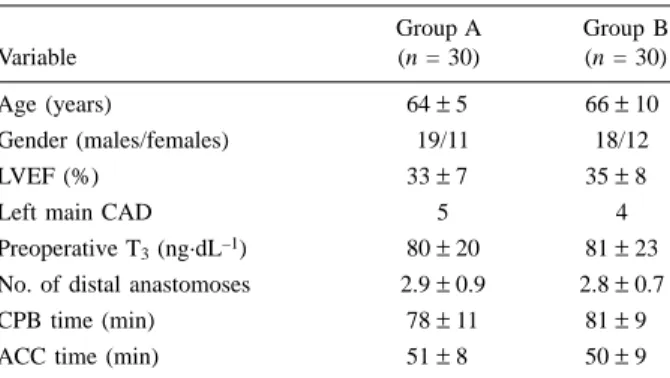
ETHODSBetween January 1998 and June 2001, 60 patients undergoing CABG were recruited for a prospective double-blind study, of which 30 received intravenous T3 (Thyrotardin-inject; N Hennig, Berlin, Germany) (group A) and the other 30 a placebo (group B). There were no differences between the groups in age, left ventricular function, and the number of bypasses made. Patients over 75 years of age, under thyroid hormone therapy, or undergoing reoperation, concomitant procedures, or emergency surgery were excluded. Informed consent was obtained from each patient. Demographic data are shown in Table 1.
All patients were operated by the same surgeon. Anesthesia was induced with 5 mg midazolam, 10 µg·kg–1 fentanyl citrate, and 0.1 mg·kg–1 vecuronium bromide and maintained with a combination of fentanyl citrate and vecuronium bromide. Diltiazem infusion was started with the induction of anesthesia and continued in the intensive care unit. Hemodynamic monitoring was conducted via a Swan-Ganz catheter. Myocardial protection was achieved by tepid antegrade and retrograde cardioplegia and the single-clamp technique. T3 levels were measured before and immediately after CPB was established.
After the crossclamp was removed, group A patients received an intravenous bolus of T3 of 0.8 µg·kg–1, followed by infusion of 0.113 µg·kg–1·h–1 for 6 hours postoperatively, while group B patients received a placebo. Hemodynamic and serum T3 measurements were made at the end of CPB and 6 and 12 hours postoperatively. Postoperative T3 measurements were made in 10 patients in each group because of cost. During weaning, when necessary, patients received a standard dose of epinephrine–norepinephrine infusion (0.01 to 0.05
µg·kg–1·min–1) for inotropic support. Operative data are shown in Table 1.
Two-sample t test was used to evaluate demographic, baseline, and time variables. Intergroup comparative variables were analyzed with chi-squared test or Fisher’s exact test. Two-tailed analysis of variance was used to compare continuous variables at multiple time points. A
p value < 0.05 is considered as significant. Mean values
are expressed as mean ± standard deviation.
R
ESULTSSerum T3 concentrations were normal in both groups before surgery (Table 1). However, they decreased significantly during surgery and remained low 12 hours postoperatively in group B. In group A, serum T3 rose beyond normal levels throughout T3 infusion and returned towards normal values 12 hours postoperatively (Table 2).
Although group A had a slightly higher mean postoperative cardiac index than group B at the end of CPB, the difference was not statistically significant. Systemic vascular resistance (SVR) in group A was significantly lower than in group B at the end of CPB. There were no significant differences between the groups in the heart rate, mean arterial pressure, central venous pressure, and pulmonary capillary wedge pressure (Table 2). Minimal inotropic support (0.01 to 0.03 µg·kg–1·min–1) was required by 75% of group A patients and 78% of group B patients during weaning off CPB, with no significant difference Table 1. Demographic and Operative Data
Group A Group B Variable (n = 30) (n = 30) Age (years) 64±5 66±10 Gender (males/females) 19/11 18/12
LVEF (%) 33±7 35±8
Left main CAD 5 4
Preoperative T3 (ng·dL–1) 80±20 81±23
No. of distal anastomoses 2.9±0.9 2.8±0.7 CPB time (min) 78±11 81±9 ACC time (min) 51±8 50±9 ACC = aortic crossclamp, CAD = coronary artery disease, CPB = cardiopulmonary bypass, LVEF = left ventricular ejection fraction.
Table 2. Hemodynamic Data and Serum T3 Levels
Post-CPB 6 Hours Later 12 Hours Later Group A Group B Group A Group B Group A Group B Variable (n = 30) (n = 30) (n = 30) (n = 30) (n = 30) (n = 30) HR (beats·min–1) 95±2 93±5 98±3 100±4 101±12 98±14 MAP (mm Hg) 80±10 82±8 79±6 80±8 80±7 82±6 CVP (mm Hg) 7±2 7±3 8±2 9±2 7±3 8±3 PCWP (mm Hg) 10±4 8±3 9±2 10±1 8±3 7±2 CI (L·m–2·min–1) 2.75±0.52 2.63±0.6 2.7±0.2 2.6±0.1 2.7±0.1 2.7±0.2 SVR (dyne·s·cm–5) 1,040±220† 1,350±420† 1,100±100 1,280±190 1,190±100 1,200±90 T3 (ng·dL–1)* 122±14 41±11 134±12 34±16 97±8 58±11
*Serum T3 concentration was measured in 10 patients in each group. †p < 0.001 (Fisher’s exact test). All other comparisons not significant.
CI = cardiac index, CPB = cardiopulmonary bypass, CVP = central venous pressure, HR = heart rate, MAP = mean arterial pressure, PCWP = pulmonary capillary wedge pressure, SVR = systemic vascular resistance, T3 = triiodothyronine.
Güden Triiodothyronine and Coronary Surgery
2002, VOL. 10, NO. 3 221 ASIAN CARDIOVASCULAR & THORACIC ANNALS between the groups. Six hours later in the intensive care
unit, 42% of group A patients and 46% of group B patients continued to receive inotropes. There was no significant difference in the incidence of arrhythmia between the groups: 3 patients in group A and 4 in group B had AF. The surgical course and clinical outcome did not differ between the groups. Postoperative outcome is summarized in Table 3.
D
ISCUSSIONPoor cardiac performance is a major cause of morbidity and death in patients who undergo open heart surgery, especially older patients and those with extensive disease and poor ventricular function.7,8 Improving perioperative management is thus vital. Because of recent evidence that CPB results in altered thyroid hormone metabolism, interest is focused on the relationship between decreased serum T3 levels and hemodynamics after CPB.9 The mechanism by which serum T3 concentrations decrease during CPB is not certain, but it is probably due to hypothermia, hemodilution, and the activation of inflammatory-response mediators.10,11
Similarities exist between hypothyroid patients and those undergoing cardiac surgery in that serum T3 levels and cardiac contractility decrease while peripheral vascular resistance increases. Although studies have shown that perioperative T3 treatment may improve outcome in patients with postoperative cardiac dysfunction, this is not a widely accepted therapy.3,6,12 Several largely uncontrolled studies found that T3 administration reduced perioperative mortality and the need for inotropic agents after CABG.2,12 The results of our trial, however, do not support these conclusions.
Our results, like many others, suggest that T3 may act acutely as a cardiotonic agent. It raises cardiac output and lowers SVR.13 However, whether this is related to its direct positive inotropic effect or to peripheral vasodilation is unknown.14 In our series, the fall in SVR was evident,
but a significant increase in cardiac output was not observed. T3 treatment did not lower the incidence of AF in our study, in contrast to the results of other series.6 Routine assessment of thyroid function before CPB has been proposed, but it has not gained wide acceptance. Nevertheless, some still support routine assessment in elderly female patients.15 As thyroid hormone affects the adrenergic system and since most CABG patients are treated with exogenous catecholamines, clinicians must be aware of patients with hyperthyroidism or thyroid storm.5
Despite promising experimental evidence, clinical trials have so far not demonstrated conclusively the benefits of T3 repletion in CABG patients. However, anecdotal evidence supports its use as a rescue agent in weaning off CPB or as a prophylactic for AF.5,13,16
In this study, the administration of T3 during cardiac surgery led to only negligible enhancement of cardio-vascular performance and no reduction in inotropic requirement or the incidence of arrhythmias. Neither was there any improvement in terms of intensive care unit stay, the duration of mechanical ventilation, hospital stay, mortality, and other major complications. Therefore, although T3 did not cause any adverse effects, our findings do not support the routine use of T3 during cardiac surgery.
R
EFERENCES1. Klemperer JD, Klein I, Gomez M, Helm RE, Ojamaa K, Thomas SJ, et al. Thyroid hormone treatment after coronary-artery bypass surgery. N Engl J Med 1995; 333:1522–7.
2. Novitzky D, Cooper DK, Barton CI, Greer A, Chaffin J, Grim J, et al. Triiodothyronine as an inotropic agent after open heart surgery. J Thorac Cardiovasc Surg 1989;98: 972–8.
3. Bennett-Guerrero E, Jimenez JL, White WD, D’Amico EB, Baldwin BI, Schwinn DA. Cardiovascular effects of intravenous triiodothyronine in patients undergoing coronary artery bypass graft surgery. A randomized, double-blind, placebo-controlled trial. Duke T3 study group. JAMA
1996;275:687–92.
4. Bojar RM. Manual of perioperative care in cardiac surgery. 3rd ed. Malden, MA: Blackwell Science, 1999. 5. Kaplan JA, editor. Cardiac anesthesia. 4th ed. Philadelphia:
Saunders, 1999.
6. Klemperer JD, Klein IL, Ojamaa K, Helm RE, Gomez M, Isom OW, et al. Triiodothyronine therapy lowers the incidence of atrial fibrillation after cardiac operations. Ann Thorac Surg 1996;61:1323–9.
7. Dyke CM, Yeh T Jr, Lehman JD, Abd-Elfattah A, Ding M, Wechsler AS, et al. Triiodothyronine-enhanced left ventricular function after ischemic injury. Ann Thorac Surg 1991;52:14–9.
8. Holland FW II, Brown PS Jr, Clark RE. Acute severe postischemic myocardial depression reversed by triiodothyronine. Ann Thorac Surg 1992;54:301–5. Table 3. Postoperative Outcome and Complications
Group A Group B Variable (n = 30) (n = 30) Intensive care unit stay (days) 1.7±0.5 1.9±0.3* Mechanical ventilation (hours) 11±7 12±6* Hospital stay (days) 8.1±1.2 8.2±1.5*
Mortality 0 0 Complications Pulmonary 1 2 Neurologic 0 0 Renal 0 0 Infection 1 1 Atrial fibrillation 3 4 Bleeding 2 3
ASIAN CARDIOVASCULAR & THORACIC ANNALS 222 2002, VOL. 10, NO. 3
Triiodothyronine and Coronary Surgery Güden
9. Reinhardt W, Mocker V, Jockenhovel F, Olbricht T, Reinwein D, Mann K, et al. Influence of coronary artery bypass surgery on thyroid hormone parameters. Horm Res 1997;47:1–8.
10. Holland FW II, Brown PS Jr, Weintraub BD, Clark RE. Cardiopulmonary bypass and thyroid function: a “euthyroid sick syndrome.” Ann Thorac Surg 1991;52:46–50. 11. Kupfer LE, Bilezikian JP, Robinson RB. Regulation of
alpha and beta adrenergic receptors by triiodothyronine in cultured rat myocardial cells. Naunyn Schmiedebergs Arch Pharmacol 1986;334:275–81.
12. Dyke CM, Ding M, Abd-Elfattah AS, Loesser K, Dignan RJ, Wechsler AS, et al. Effects of triiodothyronine supplementation after myocardial ischemia. Ann Thorac Surg 1993;56:215–22.
13. Gomberg-Maitland M, Frishman WH. Thyroid hormone and cardiovascular disease. Am Heart J 1998;135:187–96. 14. Leves GS. Catecholamine sensitivity, thyroid hormone and the heart: a reevaluation. Am J Med 1971;50:415–20. 15. Jones TH, Hunter SM, Price A, Angelini GD. Should thyroid function be assessed before cardiopulmonary bypass operations? Ann Thorac Surg 1994;58:434–6. 16. Broderick TJ, Wechsler AS. Triiodothyronine in cardiac