DO FED’s UNCONVENTIONAL MONETARY POLICY AND CBRT’s ROM FACILITY AFFECT TURKISH BANKS’ EXTERNAL BORROWING?
A THESIS SUBMITTED TO THE INSTITUTE OF SOCIAL SIENCES
OF
ANKARA YILDIRIM BEYAZIT UNIVERSITY
BY
BÜLENT YAMAN
IN PARTIAL FULFILLMENT OF THE REQUIREMENTS FOR
THE DEGREE OF DOCTOR OF PHILOSOPHY IN
THE DEPARTMENT OF BANKING AND FINANCE
ii Approval of the Institute of Social Sciences
________________________
Doç.Dr. Seyfullah Yıldırım
Manager of Institute I certify that this thesis satisfies all the requirements as a thesis for the degree of Doctor of Philosophy.
________________________
Prof.Dr. Ayhan Kapusuzoğlu
Head of Department
This is to certify that we have read this thesis and that in our opinion it is fully adequate, in scope and quality, as a thesis for the degree of Master of Science/Arts/Doctor of Philosophy.
________________________
Prof.Dr. Nildağ Başak Ceylan
Supervisor
Examining Committee Members (first name belongs to the chairperson of the jury and the second name belongs to supervisor)
Prof.Dr. Ramazan Aktaş (TOBB ETÜ, Management) ___________________
Prof.Dr. Nildağ Başak Ceylan (AYBU, Banking and Finance) ___________________
Prof.Dr. Mehmet Mete Doğanay (ÇU, Management) ___________________
Prof.Dr. Ayhan Kapusuzoğlu (AYBU, Banking and Finance) ___________________
iii
PLAGIARISMPAGE
I hereby declare that all information in this thesis has been obtained and presented in accordance with academic rules and ethical conduct. I also declare that, as required by these rules and conduct, I have fully cited and referenced all material and results that are not original to this work; otherwise I accept all legal responsibility.
Name, Last name : Bülent Yaman
iv ABSTRACT
DO FED’s UNCONVENTIONAL MONETARY POLICY AND CBRT’s ROM FACILITY AFFECT TURKISH BANKS’ EXTERNAL BORROWING?1
Yaman, Bülent
Ph.D., Department of Banking and Finance Supervisor: Prof. Dr. Nildağ Başak Ceylan
January 2019, 132 Pages
At the end of 2008, FED had to reduce its monetary policy interest rates to near zero level as a response to house market collapse. As this policy response was not find as enough, FED started to purchase papers, which resulted in an increase of its balance sheet to 4,5 trillion U.S. dollar. By large scale asset purchases, FED targeted to lower the yields on longer-term securities in order to increase the price of remaining securities and finally, to increase investment, demand for consumer durables and the prices of more risky assets. FED’s unconventional policy had some spillover effects on emerging markets who enjoyed cheap and abundant liquidity during that period. During same period, CBRT introduced ROM facility by which banks were able to use foreign exchange for their Turkish Lira reserve requirements.
The aim of this study is to demonstrate whether FED’s unconventional monetary policy and CBRT’s ROM facility affected Turkish banks’ external borrowings by using Event Study, Regression Analysis and VAR. The event study indicates that although FED’s unconventional monetary policy had significant effects on the external borrowings, the second phase had more impact. Regression analysis also indicates that FED’s and CBRT's policies affect banks’ external borrowing levels. Finally, the VAR system indicates that both FED’s and CBRT’s policies may have effects on the external borrowing but the CBRT’s effect lasts longer compared to FED’s.
As a result, both FED’s unconventional monetary policy and CBRT’s ROM facility have impacts on Turkish banks’ external borrowings. For the following study, the impacts of FED’s unconventional monetary policy and its effects on emerging countries would be studied by using panel data set.
Keyword: FED, QE, External Borrowing, Spillover, ROM, VAR, CBRT, Emerging Markets, Turkey
1 The views in this study belong to the author and cannot be associated with the Republic of the Central
v ÖZET
FED’İN GELENEKSEL OLMAYAN PARA POLİTİKASI İLE TCMB’NİN ROM UYGULAMASI TÜRK BANKALARININ YURTDIŞINDAN BORÇLANMALARINI
ETKİLER Mİ?2
Yaman, Bülent
Doktora, Bankacılık ve Finans Bölümü Tez Yöneticisi: Prof. Dr. Nildağ Başak Ceylan
Ocak 2019, 132 Sayfa
2008 sonunda, FED, ev piyasası çöküşüne bir yanıt olarak para politikası faiz oranlarını sıfıra yakın seviyeye düşürmek zorunda kaldı. Bu politika cevabı yeterli bulunmadığı için, FED, bilançolarını 4,5 trilyon ABD Doları'na çıkararak kâğıt satın almaya başladı. Büyük ölçekli varlık alımları ile FED, kalan menkul kıymetlerin fiyatını artırmak ve nihayet yatırımları, dayanıklı tüketim malları ve daha riskli varlıkların fiyatlarını artırmak amacıyla, uzun vadeli menkul kıymetlerdeki getirileri düşürmeyi hedeflemiştir. FED’in geleneksel olmayan politikasının, o dönemde ucuz ve bol likiditeye sahip olan gelişmekte olan piyasalar üzerinde bazı yayılma etkileri oldu. Aynı dönemde, TCMB, bankaların Türk lirası zorunlu karşılıklarına yönelik döviz kullanabildikleri ROM imkânını uygulamaya koymuştur.
Bu çalışmanın amacı, FED'in geleneksel olmayan para politikası ve TCMB'nin ROM uygulamasının, Olay İncelemesi, Regresyon Analizi ve VAR kullanarak Türk bankalarının dış borçlarını etkileyip etkilemediğini göstermektir. Olay çalışması, FED'in para politikasının dış borçlanma üzerinde önemli etkiye sahip olmasına rağmen, ikinci aşamada daha fazla etkiye sahip olduğunu göstermektedir. Regresyon analizi ise FED ve TCMB politikalarının bankaların dış borçlanmalarını etkilediğine işaret etmektedir. Son olarak, VAR sistemi, hem FED’nin hem de TCMB’nin politikalarının bankaların yurtdışından borçlanmaları üzerinde etkili olabileceğini, ancak TCMB’nin etkisinin FED’le kıyaslandığında daha uzun sürdüğünü göstermektedir.
Sonuç olarak, hem FED’in geleneksel olmayan para politikası hem de TCMB’nin ROM tesisi ile Türk bankalarının yurtdışından borçlanmaları arasında istatistiki bir ilişki olduğu ortaya konulmaktadır. Takip eden bir çalışmada, FED'in geleneksel olmayan para politikasının etkileri ve gelişmekte olan ülkeler üzerindeki etkileri, panel veri seti kullanılarak incelenecektir.
Anahtar Kelime: FED, QE, Yurtdışından Borçlanma, Yayılma Etkisi, ROM, TCMB, VAR, Gelişmekte Olan Ülkeler, Türkiye
vi
to ÇAĞHAN
to GÖKNİL
vii
ACKNOWLEDGMENTS
Başta tez danışmanım Prof. Dr. Nildağ Başak Ceylan olmak üzere, Tez İzleme Komitesi üyeleri Doç. Dr. Ayhan Kapusuzoğlu ve Doç. Dr. Yeliz Yalçın’a rehberlik ve
viii
TABLEOFCONTENTS
PLAGIARISM PAGE ... iii
ABSTRACT ... iv
ÖZET ... v
ACKNOWLEDGMENTS ... vii
TABLE OF CONTENTS ... viii
LIST OF TABLES ... xi
LIST OF FIGURES ... xii
LIST OF ABBREVIATIONS ... xiv
1 INTRODUCTION ... 1
2 FED’s UNCONVENTIONAL MONETARY POLICY ... 6
2.1 Introduction of Unconventional Monetary Policy ... 6
2.2 Main Components of the Unconventional Monetary Policy... 7
3 CBRT’S RESERVE OPTION MECHANISM ... 11
3.1 Framework of ROM ... 11
3.2 Balance Sheet Effects of ROM ... 12
4 LITERATURE REVIEW ... 15
4.1 Channels That FED’s Unconventional Monetary Policy Works Through ... 15
4.1.1 Portfolio Channel ... 15
4.1.2 Liquidity Channel ... 16
4.1.3 Signaling Channel ... 16
4.1.4 Interest Rate Channel ... 17
4.1.5 Risk Related Channel ... 17
ix
5 DO FED’S UNCONVENTIONAL MONETARY POLICY AND CBRT’S ROM
FACILITY AFFECT EXTERNAL BORROWING OF TURKISH BANKS? ... 44
5.1 Data Sources, Definitions and Used Studıes ... 44
5.1.1 External Barrowing ... 45
5.1.2 FED’s Unconventional Monetary Policy ... 47
5.1.3 Reserve Option Mechanism ... 49
5.1.4 Interest Rates ... 49
5.1.5 Foreign Exchange Rates ... 51
5.1.6 Global Risk Appetite ... 54
5.1.7 Domestic Risk Appetite ... 56
5.2 Model Free Results of the Selected Variables ... 60
5.3 Event Study ... 62
5.3.1 Events ... 63
5.3.2 Structure ... 65
5.3.3 Event Study Results ... 67
5.4 Regression Analysis ... 81 5.4.1 Regression Model ... 82 5.4.2 Regression Results ... 84 5.4.3 Main Findings ... 92 5.5 VAR ... 94 5.5.1 VECM or VAR ... 95 5.5.2 VAR System ... 97 5.5.3 VAR Results ... 101
5.5.4 Impulse Responses with Level Data ... 106
x 6 CONCLUSION ... 108 REFERENCES ... 112 APPENDICES ... 120 A. CURRICULUM VITAE ... 121 B. TURKISH SUMMARY ... 126
xi
LISTOFTABLES
Table 1 FED’s Unconventional Monetary Program Actions ... 8
Table 2 FED’s Monetary Policy Actions and International Effects: Selected Literature Review ... 38
Table 3 Summary Statistics of All Variables ... 60
Table 4 Correlation Matrix ... 61
Table 5 FED’s Unconventional Monetary Policy Related Events ... 64
Table 6 Test Results of the Model ... 85
Table 7 Breusch-Godfrey Serial Correlation LM Test Results ... 87
Table 8 Heteroscedasticity Test: Breusch-Pagan-Godfrey ... 88
Table 9 Augmented Dickey-Fuller Test Statistics of Variables ... 88
Table 10 Breusch-Godfrey Serial Correlation LM Test Results ... 90
Table 11 Heteroscedasticity Test: Breusch-Pagan-Godfrey ... 90
Table 12 Augmented Dickey-Fuller Test Statistics of Residuals ... 90
Table 13 Regression Test Results of the Modified Model ... 91
Table 14 Johansen Co-integration Test Results of the Variables ... 96
Table 15 VAR Residual Serial Correlation ... 99
Table 16 Stability Condition Test of VAR* ... 99
Table 17 VAR Lag Order Selection Results ... 100
Table 18 Estimates of the VAR System* ... 101
xii
LISTOFFIGURES
Figure 1 Portfolio Flows to Emerging Countries (billion U.S. dollar) ... 2
Figure 2 U.S. Portfolio Investments (billion U.S. dollar) ... 3
Figure 3 Turkish Banks’ External Borrowings ... 4
Figure 4 FED’s Total Assets ... 9
Figure 5 FED's Securities Held Outright ... 10
Figure 6 Cost of Funding ... 12
Figure 7 Swap to ROM Transitivity ... 13
Figure 8 Turkish Bank’s External Borrowings and ROM Usage (billion U.S. dollar) ... 14
Figure 9 Turkish Banks’ External Borrowing and FED’s Balance Sheet (billion U.S. dollar) ... 47
Figure 10 Policy Rates and Differences ... 51
Figure 11 Nominal and REER Exchange Rates ... 53
Figure 12 VIX and FED’s Policy Rate ... 55
Figure 13 Turkey’s 5 Year CDS and Policy Rate Spread to FED ... 57
Figure 14 External Borrowing of Turkish Banks and EMBIs ... 59
Figure 15 Time Line Structure ... 66
Figure 16 Event 1 (25 11 2008) CAR/s(CAR) Results ... 68
Figure 17 Event 2 (01&16.12.2008) CAR/s(CAR) Results ... 69
Figure 18 Event 3 (18.03.2009) CAR/s(CAR) Results ... 70
Figure 19 Event 4 (10.08.2010) CAR/s(CAR) Results ... 71
Figure 20 Event 5 (03.11.2010) CAR/s(CAR) Results ... 72
Figure 21 Event 6 (21.09.2011) CAR/s(CAR) Results ... 73
Figure 22 Event 7 (13.09.2012) CAR/s(CAR) Results ... 74
Figure 23 Event 8. (12.12.2012) CAR/s(CAR) Results ... 75
Figure 24 Event 9 (22.05.2013) CAR/s(CAR) Results ... 76
Figure 25 All Event Comparisons per Indicator (CAR/s(CAR) Results) ... 77
Figure 26 Actual, OLS Fitted and Residuals ... 86
xiii
Figure 28 Residuals’ Jarque-Bera Test Results of Modified Model ... 89
Figure 29 Actual, OLS Fitted and Residuals ... 92
Figure 30 VAR System ... 97
Figure 31 Responses to FED’s Asset Purchases ... 103
Figure 32 Responses to CBRT’s ROM* ... 104
Figure 33 Variance Decomposition of External Borrowing of Turkish Banks ... 105
xiv
LISTOFABBREVIATIONS
BRSA Banking Regulation and Supervision Agency of Turkey BoE Bank of England
BoJ Bank of Japan
CBRT Central Bank of the Republic of Turkey CDS Credit Default Swap
CPI Consumer Price Index
CPIS Coordinated Portfolio Investment Survey DSGE Dynamic Stochastic General Equilibrium DTSM Dynamic Term Structure Models
ECB European Central Bank
EMBI JP Morgan’s Emerging Markets Bond Index IIF Institute of International Finance
MSCI Morgan Stanley Capital International
FA-VAR A Factor-Augmented Vector Autoregressive FED Federal Reserve Bank of the United States FOMC Federal Open Market Committee
FX Foreign Exchange
GARCH Generalized Autoregressive Conditional Heteroscedasticity GSE Government Sponsored Enterprise
GVECM Global Vector Error Correction Model IIF Institute of International Finance LIBOR London Interbank Offered Rates
MOVE Merrill Lynch Option Volatility Estimate OIS Overnight Index Swaps
xv
ROC Reserve Option Coefficient ROR Reserve Option Ratio QE Quantitative Easing PPP Purchasing Power Parity
ROM Reserve Option Mechanism of CBRT REER Real Effective Exchange Rate
S&P Standard & Poor’s
UIP Uncovered Interest Parity VAR Vector Autoregressive
VECM Vector Error Correction Model
1
1 INTRODUCTION
FED had to reduce its monetary policy interest rates to near zero levels as a response to house market collapse at the end of 2008. As the impact of the collapse could not be mitigated solely by conventional policies, FED, as a first reaction, started to purchase direct obligations and MBSs. However, as the initial stimulus plan was not enough to heal the economy, FED included the long-term Treasury securities in its purchase program. As a result of these large scale asset purchases, the balance sheet of the FED reached to 4,5 trillion U.S. dollar from 0,9 trillion U.S. dollar. Expansion of FED’s balance sheet by purchasing securities in large scales at the secondary market during the low level interest rates is called unconventional monetary policies. By purchasing assets in large scales, FED directly targeted to help the yields on longer-term securities to reduce, which would lead the price of remaining securities in the market to increase and thus finally, would lower the yields across a range of financial assets. The desired aim of the unconventional monetary policy purchases was to increase investment, purchases of consumer durables and the prices of more risky assets, such as equities.
The FED’s unconventional monetary policy had some spillover effects on emerging countries due to their high yielding assets. According to IMF (2013), unconventional monetary policies positively affected emerging countries at their early stages through higher global growth. Higher equity prices, lower costs of capital and borrowing rates were observed in emerging market countries during this period. Therefore, corporates situated in these emerging countries accessed to cheap and abundant liquidity from FED’s unconventional monetary policy. Most of the emerging countries’ financial institutions especially banking sectors due to their close linkages with external liquidity started to borrow these funds.
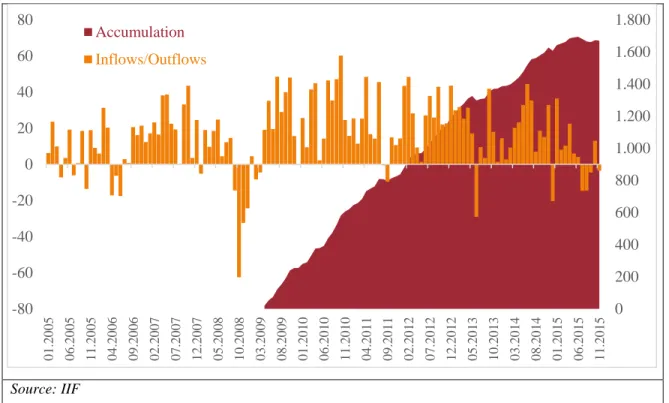
According to the Institute of International Finance (IIF), emerging market economies attracted about 1,7 trillion U.S. dollar in just portfolio inflows between May 2009 and November 2015 as presented Figure 1. Therefore, it can be said that some portion of the liquidity resulted from FED’s large scale asset purchases (roughly 3,5 trillion U.S. dollar) went to emerging countries. The fund inflows had impacts not only on other currencies but
2
also on the economies. Especially countries with current account deficits accessed this liquidity to finance their external deficits. As a result, external borrowings of the private sectors of these fund receiving countries increased to record high levels.
Source: IIF
Figure 1 Portfolio Flows to Emerging Countries (billion U.S. dollar)
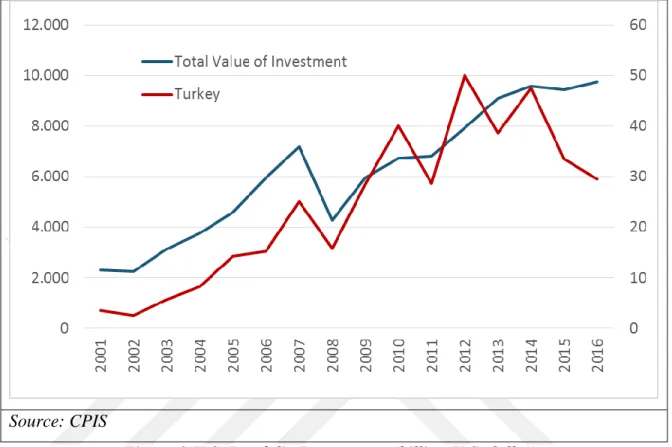
IMF’s Coordinated Portfolio Investment Survey (CPIS) demonstrates the flows from U.S. to other countries. According to the survey, U.S. has been the biggest investors of the world to other countries. U.S. investors and U.S. dollar held about 30% of the world's portfolio investment assets throughout and was involved in 89% of all currency transactions in 2009, respectively. According to the survey, it can be interpreted that FED’s monetary policy influences portfolio flows around the world. The survey also includes additional statistics related to Turkey. The survey indicates that there is a big jump in 2009 and 2011 in the investments to Turkey originated by U.S. as illustrated in Figure 2.
0 200 400 600 800 1.000 1.200 1.400 1.600 1.800 -80 -60 -40 -20 0 20 40 60 80 0 1 .2 0 0 5 0 6 .2 0 0 5 1 1 .2 0 0 5 0 4 .2 0 0 6 0 9 .2 0 0 6 0 2 .2 0 0 7 0 7 .2 0 0 7 1 2 .2 0 0 7 0 5 .2 0 0 8 1 0 .2 0 0 8 0 3 .2 0 0 9 0 8 .2 0 0 9 0 1 .2 0 1 0 0 6 .2 0 1 0 1 1 .2 0 1 0 0 4 .2 0 1 1 0 9 .2 0 1 1 0 2 .2 0 1 2 0 7 .2 0 1 2 1 2 .2 0 1 2 0 5 .2 0 1 3 1 0 .2 0 1 3 0 3 .2 0 1 4 0 8 .2 0 1 4 0 1 .2 0 1 5 0 6 .2 0 1 5 1 1 .2 0 1 5 Accumulation Inflows/Outflows
3
Source: CPIS
Figure 2 U.S. Portfolio Investments (billion U.S. dollar)
As being intermediators in the market by borrowing from abroad and lending in the domestic market, banks increased their external borrowing since then as they have generally easy access to global liquidity conditions compared to other private sectors. Turkish banks’ external borrowing levels in terms of maturity were increased as presented Figure 3. Although in general banks prefer to borrow in short term, they increased their long term borrowings as well. Therefore, it can be said that the liquidity conditions that changed according to the FED’s unconventional monetary policy may had highly effect the balance sheets of the banks in Turkey.
4
Source: CBRT
Figure 3 Turkish Banks’ External Borrowings
As presented in Figure 3, the level of external borrowing of Turkish banks was very stable until 2011. Since than especially the short term external borrowings of Turkish banks started to increase after 2011 when CBRT started its ROM facility. Therefore, some of the increase in 2011 in external borrowing of Turkish banks may had been driven by ROM.
Therefore, whether the FED’s unconventional monetary policy and CBRT’s ROM facility do affect Turkish banks’ external borrowing levels or not is measured in this study. The monetary policy actions of developed countries affect other countries mainly through portfolio, liquidity and signaling channels. Most of the literature on the effects of FED’s unconventional monetary policy have focused heavily on the announcement effects. However, in addition to the announcements, the balance sheet increase stemming from FED’s unconventional monetary policy operations have also real effects on the other countries. Therefore, one of the contributions of this study is to measure the effects of FED’s balance sheet changes on the Turkish banks’ external borrowing level instead of the portfolio inflows in the form of equity and bonds. Moreover, the related literature measures the effects of the policies by looking only equity return or the yield of the bonds.
5
In the following two parts, the general framework of FED’s unconventional monetary policy and CBRT’s ROM facility are presented. After related literature is reviewed in more detailed, the empirical methodologies are demonstrated at the fifth part in which Event Study, Regression Analysis and VAR model are used. Following results of the empirical analyses, the conclusion is presented at the end of the study.
6
2 FED’S UNCONVENTIONALMONETARYPOLICY3
Effective from the end of 2008, FED implemented almost zero interest rates as a monetary policy to stimulate economic activity in the United States. During these times, United States witnessed low aggregate demand and large output gap. As a reaction to the developments, FED reduced its policy rates substantially in order to achieve full employment and to meet its inflation target. On the other hand, near zero level policy rates with constraints on moving them significantly below zero, using conventional monetary tools were not accommodative. Therefore, FED started to employ unconventional monetary policies by injecting U.S. dollar liquidity to the market through asset purchases during this period.
2.1 INTRODUCTION OF UNCONVENTIONAL MONETARY POLICY
Interbank overnight interest rate is one of the main conventional tools of the central banks, by which central banks tries to affect directly the current and expected future path of the short term interest rates and by this way influence middle and longer term interest rates in the market. In addition to changing directly policy interest rates according to the market conditions, central banks employ open market operations to manage liquidity and thus the interest rates. On the other hand, it is not a common monetary policy to buy long term Treasury and/or private sector securities with large scales. Therefore, when policy rates are near zero levels, large scale asset purchases in the secondary market are considered as unconventional monetary policy actions. In this framework, FED directly targeted to force the yields on longer-term securities to decrease by large scale asset purchases. According to the portfolio balance channel, the asset purchases of the FED reduce the supply of long-term Treasury and agency securities in the market, which leads the price of remaining securities to increase and finally, lowers the yields across a range of financial assets. The final and desired result of the asset purchases is to reduce the interest rates among all maturities, stimulate investment, increase purchases of consumer durables and raise the prices of more risky assets.
3 All of the section information received from the official web page of FED.
7
2.2 M
AINC
OMPONENTS OF THEU
NCONVENTIONALM
ONETARYP
OLICYDuring the financial crisis, the FED used several unconventional monetary liquidity tools in key markets. The main tools that were employed are as follows;
The Money Market Investor Funding Facility (expired on October 30, 2009), The Asset-Backed Commercial Paper Money Market Mutual Fund Liquidity
Facility (ABCP MMMF) (closed on February 1, 2010),
The Commercial Paper Funding Facility (closed on February 1, 2010), The Primary Dealer Credit Facility (closed on February 1, 2010), The Term Securities Lending Facility (closed on February 1, 2010), The Term Auction Facility Auction (conducted on March 8, 2010), The Term Asset-Backed Securities Loan Facility (on June 30, 2010).
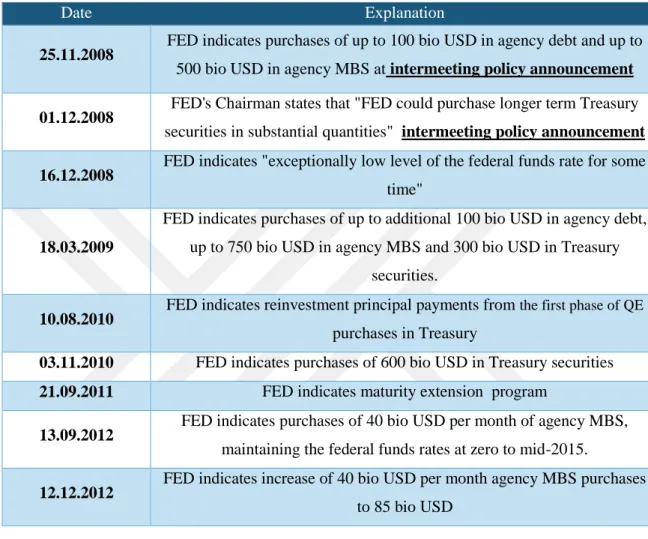
Large-Scale Asset Purchase Programs: The FED increased its holding of long-term securities through purchases in the secondary market to force longer-term interest rates to decrease and eventually support economic activity and employment. Between the end of 2008 and October 2014, FED took following steps;
175 billion U.S. dollar in direct obligations of Fannie Mae, Freddie Mac, and the Federal Home Loan Banks and 1,25 trillion U.S. dollar in MBS guaranteed by Fannie Mae, Freddie Mac, and Ginnie Mae between December 2008 and August 2010 to reduce the cost of home financing and increase the availability of mortgage for the purchase of houses.
300 billion U.S. dollar of long-term Treasury papers to improve the private credit market conditions. Moreover, it expanded its holdings by purchasing an additional $600 billion of longer-term Treasury securities. The FED started to buy long-term Treasury securities at a pace of $45 billion per month, following the completion of the maturity extension program in December 2012.
Additional MBS at a pace of $40 billion per month to further increase policy accommodation starting in September 2012.
8
Table 1 FED’s Unconventional Monetary Program Actions
Date Explanation
25.11.2008 FED indicates purchases of up to 100 bio USD in agency debt and up to
500 bio USD in agency MBS at intermeeting policy announcement
01.12.2008 FED's Chairman states that "FED could purchase longer term Treasury
securities in substantial quantities" intermeeting policy announcement
16.12.2008 FED indicates "exceptionally low level of the federal funds rate for some
time"
18.03.2009
FED indicates purchases of up to additional 100 bio USD in agency debt, up to 750 bio USD in agency MBS and 300 bio USD in Treasury
securities.
10.08.2010 FED indicates reinvestment principal payments from the first phase of QE
purchases in Treasury
03.11.2010 FED indicates purchases of 600 bio USD in Treasury securities
21.09.2011 FED indicates maturity extension program
13.09.2012 FED indicates purchases of 40 bio USD per month of agency MBS,
maintaining the federal funds rates at zero to mid-2015.
12.12.2012 FED indicates increase of 40 bio USD per month agency MBS purchases
to 85 bio USD
In addition to the large scale asset purchase program, FED launched Maturity
Extension Program to extend the average maturity of its Treasury security holdings to
reduce the longer-term interest rates and to support its unconventional monetary policy. The maturity extension program was conducted via open market operations as well.
The FED started to purchase 400 billion U.S. dollar of Treasury securities with remaining maturities of 6 years to 30 years and to sell with remaining maturities of 3 years or less at the end of June 2012.
The FED continued the maturity extension program through the end of 2012, resulting in the additional purchase of more than about 250 billion U.S. dollar in Treasury securities.
9
The FED established the Maturity Extension Program and Reinvestment Policy to additionally support the economic recovery from September 2011 through the end of 2012.
Source: FED
*All Liquidity Facilities include; Term Auction credit; primary credit; secondary credit; seasonal credit; Primary Dealer Credit Facility; Asset-Backed Commercial Paper Money Market Mutual Fund Liquidity Facility; Term Asset-Backed Securities Loan Facility; Commercial Paper Funding Facility; and central bank liquidity swaps.
**Support to Specific Institutions includes: Maiden Lane LLC; Maiden Lane II LLC; Maiden Lane III LLC; and support to AIG.
Figure 4 FED’s Total Assets
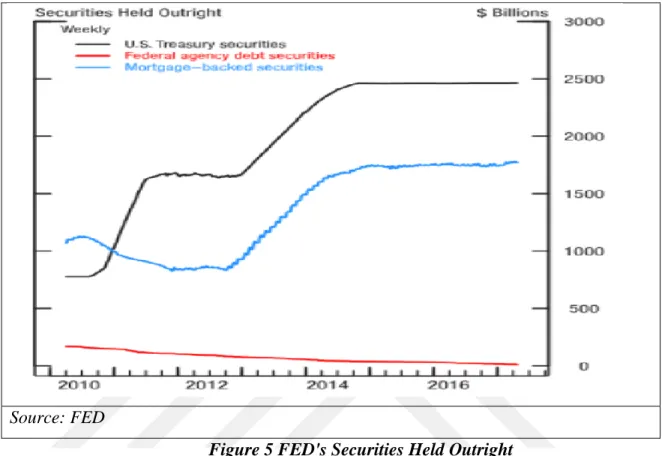
As a result of the unconventional monetary policy which is mainly composed of some variations of large scale asset purchases with near zero policy rates, the balance sheet of the FED expanded to record levels of 4,5 trillion U.S. dollar. As presented from Figure 4, the main component of balance sheet of the FED was Securities Held Outright. The component of the securities that were used during the unconventional monetary policy implementation of the FED are;
US Treasury Securities
Federal Agency Debt Securities
Mortgage Backed Securities (Guaranteed by Fannie Mae, Freddie Mac, and Ginnie Mae)
10
Source: FED
Figure 5 FED's Securities Held Outright
FED's outright asset purchases are presented at Figure 5. Although FED bought several securities at the secondary market, the large scale asset program’s main drivers were the purchases of U.S. Treasury Securities and Mortgage-Backed Security.
11
3 CBRT’SRESERVEOPTIONMECHANISM
In addition to FED’s quantitative easing, as a result of a change in legal framework, banks in Turkey started to be able to use foreign exchange for their Turkish Lira reserve requirements with certain ratios at the end of 2011. The facility was later called Reserve Option Mechanism (ROM). In this part, its mechanism, the utilization and the impacts on the banks’ balance sheet of the ROM is summarized.
3.1 FRAMEWORK OF ROM
Banks are able to keep a certain ratio of their Turkish lira reserve requirements in foreign exchange within the framework of ROM. In the system, the reserve option ratio (ROR) and the reserve option coefficient (ROC) are two main parameters that are used to calculate how much foreign exchange can be settled against Turkish Lira reserve requirements. ROR is used to set the fraction of Turkish lira required reserves that can be held in foreign exchange, whereas ROC is used to set the amount of foreign exchange that can be held per unit of Turkish lira.
Let’s suppose that Bank A has to hold 1.000 Turkish lira reserve requirements for its Turkish lira liabilities upon the upcoming reserve requirement period; ROR is 80%, ROC is 1,0000 (which means banks can hold 1,0000 Turkish lira equivalent of foreign exchange) per unit of Turkish lira reserve requirement) and finally foreign exchange rate of USDTRY is 4,0000.
In this case, Bank A may hold up to 200 U.S. dollar (Turkish lira requirements*ROR*ROC/USDTRY Rates= 1.000*0,80*1,00/4,0000) for its 1.000 Turkish lira reserve requirements in foreign exchange. In this case, Bank A is able to fulfill its reserve requirement by using 200 U.S. dollar plus 200 Turkish lira (as 80% of 1.000 Turkish lira partially matched FX in accordance with ROM) instead of using 1.000 Turkish lira. Therefore, ROM facility gives banks an alternative to fulfill main parts of their Turkish lira requirements in foreign exchange and use 800 Turkish lira for other purposes.
12
3.2 BALANCE SHEET EFFECTS OF ROM
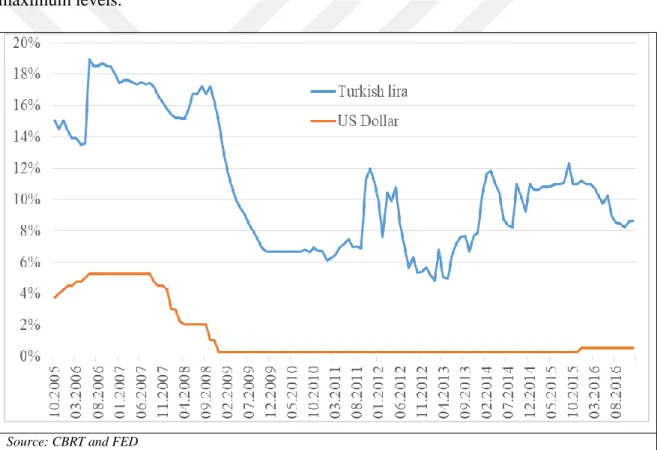
If the interest rates and the liquidity conditions are similar for foreign exchange (mainly U.S. dollar) and Turkish lira, the ROM facility is not expected to change banks’ balance sheet items. However, the cost of funding for Turkish lira and foreign exchange are different. As presented in Figure 6, the cost of Turkish lira funding is bigger compared to that of U.S. dollar especially during the FED’s unconventional monetary policy period. The difference between the costs of funding encourage banks to utilize ROM facility near the maximum levels.
Source: CBRT and FED
Figure 6 Cost of Funding
Therefore, the ROM facility substantially affected behavior of the banks in terms of foreign exchange items in their balance sheets. ROM can be considered as a kind of swap transaction by which banks are able to receive Turkish lira liquidity from CBRT by placing foreign exchange in CBRT as a Turkish lira reserve requirement. By this way, ROM indirectly encouraged banks to reduce their cross-currency swap positions. Having the option to match some part of their Turkish lira requirements in foreign exchange, banks substituted some of their cross currency swap positions with ROM. In fact, there has been a
13
significant reduction in cross currency swaps when ROM started to be implemented as presented in Figure 7.
Source: CBRT and BRSA
Figure 7 Swap to ROM Transitivity
As banks started to use ROM facility instead of swap transactions, their swap positions decreased at the beginning of the introduction of the ROM facility. Figure 7 demonstrates the transitivity between ROM and swap usages of the banks. According to the Figure 4, before the introduction of the ROM facility, banks’ foreign exchange swap positions and foreign exchange reserve requirements move together. On the other hand, since the introduction of the ROM, banks increased their foreign exchange holdings for reserve requirements and decreased their foreign exchange positions.
In addition to the swap effect, several other balance sheet items of the banks were affected as a result of the utilization of the ROM facility. However, one of other balance sheet items which may had been effected by the ROM facility as well was the external borrowing levels of Turkish banks. Figure 8 demonstrates banks’ external borrowings and the foreign exchange holdings as a reserve requirement mostly for the purpose of ROM. As
14
presented in Figure 8, the banks sharply increased their external borrowings at the end of 2011 when they started to utilize ROM facility.
Source: BRSA
Figure 8 Turkish Bank’s External Borrowings and ROM Usage (billion U.S. dollar) As presented in this section, ROM facility may had encouraged banks to use foreign exchange to meet their Turkish lira reserve requirements. However, as the resources of foreign exchange was limited inside of Turkey, the banks searched foreign exchange funds abroad. Therefore, Turkish banks started to borrow externally mainly in the U.S. dollar thanks to the low cost of foreign exchange funding in this period.
15
4 LITERATUREREVIEW
As the aim of the study is to test whether the FED’s unconventional monetary policy and CBRT’s ROM policy do affect the external borrowing behavior of Turkish banks or not, we separated the literature review section into two separate subsections. After giving theoretical information regarding the channels by which FED’s asset purchases affect other countries, we provide international effects of the FED’s policy actions. Unfortunately, there are not enough studies regarding CBRT’s ROM facility and its effects on banks’ balance sheets.
4.1 C
HANNELST
HATFED’
SU
NCONVENTIONALM
ONETARYP
OLICYW
ORKST
HROUGHBefore starting to analyze whether FED’s unconventional monetary policy do affect other countries or not, it is important to identify and describe the channels through which liquidity is expected to run internationally. Although there are several channels through which liquidity works internationally, five of them are explained in this study; portfolio (balance), liquidity, signaling, interest rate and risk channels.
4.1.1 Portfolio Channel
The first and the mostly approved channel can be considered as “Portfolio (Balance) Channel” as FED’s asset purchases decreased the level of available assets in the market (Bernanke, 2010). Although financial assets cannot be perfectly substituted due to their distinctive characteristics, FED’s asset purchases at the secondary market may had changed demand and price of other assets by which portfolio channel works. As indicated before, FED’s asset purchases included Government Sponsored Enterprises (GSE) and Treasury papers which in turn reduced the all available papers in the market. According to Lim et al. (2012), unmet risk appetite thus headed to other assets and so demand for the other risky papers’ increased. Therefore, it is expected that the portfolio balance channel can be defined by both in terms of higher demand for longer term papers and other countries’ papers, which can be identified as the investors rebalancing their portfolios. Lower prospective returns on papers that were purchased by FED encouraged investors to switch their portfolios into other
16
asset classes (Gagnon el al., 2010, 2011), which is described as portfolio balance channel. Moreover, Bauer and Neely (2014) state that the portfolio balance channel implies that the asset purchases of the central banks had huge impact in the term premium in long-term interest rates because of the imperfect substitution between assets of different maturities or classes.
4.1.2 Liquidity Channel
The other important channel that unconventional monetary policy works through is “Liquidity Channel” that affect asset prices (Krishnamurthy and Vissing-Jorgensen, 2011). As the FED’s large scale asset purchases increased the liquidity in a well-functioning market, the liquidity cost decreased in turn decreases the asset prices (Gagnon et al., 2011). Moreover, Glick and Leduc (2012) indicate that the active presence of central banks in the market may had improved the liquidity conditions in the market through decreasing liquidity premiums.
Moreover, Lim et al. (2012) indicate that the long-term assets purchased by FED through unconventional monetary policy operations were credited as increased reserves on the balance sheets of the banks. Since such reserves were more easily traded in secondary market than long-term private sectors’ papers, there was a decline in the liquidity premium in the market. Decreasing liquidity premium enabled previously liquidity-constrained banks to extend credit lines. This resulted in a decline in borrowing costs and increases overall bank lending to borrowers including developing countries. As a result of the large scale asset purchases of FED, the liquidity in the market increased and some part of the liquidity flowed to other countries through liquidity channel.
4.1.3 Signaling Channel
The other channel that FED’s asset purchases works through is “Signaling Channel”. FED’s monetary policy related announcements and purchases were interpreted as the rates in the future would be lower as stated by Bauer and Rudebusch (2013). Bauer and Neely (2016), Gagnon et al. (2011) and Woodford (2012) indicate that central banks’ announcements affected long-term interest rates via giving the market directly or indirectly a path for future rates. Asset purchases of FED served as a credible commitment that interest
17
rates would be near zero level for a long time as an early hike in interest rates implies a loss for the FED (Bauer and Rudebusch, 2013 and Clouse et al., 2003). Moreover, Beckworth and Hendrickson (2015) state that such signaling may had improved household and business sentiment by diminishing concerns about de risk. Due to the perception that FED would not increase the rates for a long time, the investors in the U.S. started to search higher yield assets such as assets of other countries.
4.1.4 Interest Rate Channel
Another channel in which FED’s unconventional monetary policy works is “Interest Rate Channel”. According to Chen et al (2011), as a result of large scale asset purchases, long term interest rates and thus real interest rates decreased. Moreover, lower interest rates encouraged households and firms to borrow more. According to Gagnon et al. (2011), FED’s long term assets purchases caused an increase in reserves of the balance sheets of private banks. As these reserves were more easily traded in secondary markets than long-term securities, the liquidity premium decreased. This decrease enabled previously liquidity-constrained banks to extend their credits to investors, which caused a decline in borrowing costs and an increase overall bank lending, including direct lending to developing countries, and perhaps more importantly, indirect lending via the carry trade.
4.1.5 Risk Related Channel
Although risk premia and risk taking channels are classified as different types of channels, in this study both of them are explained them together under the name of “Risk Related Channel”. According to Gagnon et al (2011) FED’s asset purchases work through to emerging countries via Risk Related Channel which is considered as the primary channel.
When FED purchased a particular asset class such as GSE or long term Treasury papers, investors displaced or reduced their holdings while private sector at the same time increased the amount of short-term risk free bank reserves. Another channel is called Risk Taking Channel through which FED’s asset purchases work. Bruno and Shin (2013) indicate that the focus of this channel is on managing market expectations. For influencing long term rates which are expected to affect consumption and investment, central banks place a route
18
for short term rates and communicate it with the market. Bruno and Shin (2013) measure the effects of FED’s unconventional policy on both domestic and international markets through risk-taking channel.
In this study, the main focus is on the portfolio and interest rates channels as the FED asset purchases would decrease the available assets for investors and lower the interest rates. FED's asset purchases in the secondary market forced investors to seek other high yielding assets to invest in. Therefore, investors who seek higher return started to invest in assets of other countries. This implies that the impacts of the FED asset purchases may had affected on the external borrowing level of banks in Turkey.
4.2 I
NTERNATIONALE
FFECTS OFFED’
SQ
UANTITATIVEE
ASINGP
OLICIESShortly after FED started to employ unconventional monetary policy by large scale asset purchases along with near zero policy interest rates, related literature started to emerge. In these studies, generally, the success of the FED’s unconventional monetary policy strategy itself and its effects on the assets classes and interest rates in the U.S. have been questioned and investigated. Most of these studies such as Kuttner (2001), Ehrmann and Fratzscher (2004) and Bernanke and Kuttner (2005) documented large and significant effects of FED’s unconventional monetary policy announcements on U.S. financial markets. However, especially since the second phase of the large scale asset purchases had started by including purchasing of Treasury papers, the effects on the other countries increased. In this part, only the strand of literature related to the international, spill over, effects of the FED’s unconventional monetary policy is presented.
Gagnon et al. (2010, 2011) searched the effectiveness of FED’s asset purchases on the domestic bond market by using an event study method. The results indicate that U.S. domestic bond yields were significantly affected by FED’s asset purchases in the secondary market. However, the authors claim that this reduction mainly stemmed from lower risk premiums rather than lower expectations of future interest rates. The results indicate that the risk channel is more effective than signaling channel. Gagnon et al. (2010, 2011) show that FED’s asset purchases cause reduction in the longer-term private sector borrowing rates.
19
Although the impacts were significant in mortgage market interest rates, the purchases also impact Treasury securities, corporate bonds and interest rate swaps. According to Hancock and Passmore (2011), FED’s MBS and agency security purchases forced to decrease the interest rates of the mortgage during the first phase of the QE. On the other hand, Treasury security purchases lead the economic activity to increase in the U.S. by increasing prices of the longer term Treasuries. FED’s asset purchases in private debt market resulted in 90-200 bps of 10 year U.S. Treasury paper yields (IMF, 2013). Therefore, it can be said that as a result the FED’s unconventional monetary policy seems to have significant effects on the U.S. economy.
Furthermore, the policy actions have some spillover effects on international markets. Therefore, at the next subsection, we try to demonstrate FED’s policy implications on other countries especially emerging countries. There is only a limited number of studies related to the unconventional monetary policy actions of developed countries’ central banks and their impacts on emerging countries. The study of Calvo et al. (1993) and Husted and Kitchen (1985) can be considered as one of the first papers on this issue long before the FED’s quantitative easing policy started in 2008. According to Calvo et al. (1993) and Husted and Kitchen (1985), the significant part of the total variance in real exchange rates in Latin America could be explained by external shocks during 1988 and 1991. Later, Ehrmann and Fratzscher (2002 and 2006), Faust et al. (2003), Canova (2005), Wongswan (2006), Andersen et al. (2007) and Mackowiak (2007) are considered as other early works on how FED’s policy surprises affect other countries before 2008 crises. For example, Mackowiak (2007) shows that FED’s policy shocks quickly affect the interest rates and foreign exchange rates of emerging countries. Generally, their findings indicate that the FED’s unconventional policy shocks quickly and significantly affect some asset classes in other countries.
Using large scale asset purchase programs along with near zero policy rates was not a common strategy and later called as “unconventional monetary policy”. Namely one of the first comprehensive studies, which include FED’s unconventional policies related to the impacts of FED’s quantitative easing on other countries after 2008 crises is done by Neely (2010). According to the author, FED’s announcements related to large scale asset purchases
20
had significant impacts on foreign exchange rates and Treasury security interest rates abroad through portfolio channel. Neely (2010) measures the change in 10-year Treasury yields and exchange rates by using a simple portfolio balance model and Uncovered Interest Parity (UIP)/Purchasing Power Parity (PPP) models. In his model, the U.S., Australian, Canadian, German, Japan and the United Kingdom data used for the period of January 1985-May 2010. According to their models’ results, FED’s asset purchase program affected both returns of MBS, agency debt and Treasury securities in the U.S. Moreover, expected real yields in the U.S. positively affected the Treasury yields of foreign countries. More specifically, Neely (2010) indicates that as a result of FED’s unconventional monetary policy; U.S. dollar depreciated against the currencies of Australia, Canada, Japan, Germany and the United Kingdom and 10-year Treasury yields of those countries significantly decreased. On the other hand, the author was not able to demonstrate any significant relationship with short term interest rates among U.S. and these countries. According to the results, during the first phase of FED’s asset purchase program, 10-Year U.S. Treasury yields decrease by 118 basis points when other developed countries’ Treasury bond yields decrease by only between 45-70 basis points. The event study results, performed by daily data suggest that the FED’s announcements related to unconventional monetary policy significantly reduce the yields of U.S. and foreign Treasury bonds and lead depreciation in U.S. dollar against those currencies. Intraday event study mostly supports the daily results.
In their studies, Ammer et al. (2010) analyze the effects of FED’s policy related announcements on the global equity prices during its unconventional monetary policy period. The study is focused on three main transmission channels; demand channel, credit channel and interest rate channel. The authors use a dataset of over 12.000 companies from 44 countries for the period from February 1994 to December 2006. Ammer et al. (2010) use the spread of announced and Federal Funds Rates as the policy surprise component and the returns of equity prices as dependent variable in their model. According to their base model’s results, the U.S. and foreign equity prices respond to FED’s 25 basis point tightening surprise by a decrease of 1.59% and 1.71%, respectively. When they include other variables to their base model in order to see how different channels work, the results does not change dramatically. In demand channel, the foreign firms which operate in more cyclical industries
21
and sell their majority of the products to abroad are more sensitive to FED’s monetary policies. In credit channel, the foreign firms which do not finance their capital expenditures with their operating cash flows and not pay dividends regularly are more sensitive to FED’s monetary policies. However, the evidence is weak. Finally, regarding interest rate channel, the foreign firms which are situated in countries where exchange rates pegged to U.S. dollar are more sensitive to FED’s monetary policy actions. Therefore, the results indicate that the impacts of FED’s monetary policy actions highly depend on the foreign exchange rate regime.
Chen et al. (2011) measure how unconventional monetary policies of advanced economies (US, UK, Japan and Euro Area) affect other countries’ economic indicators such as inflation and equity prices. After using event study method for this purpose, they use an estimated Global Vector Error Correction Model (GVECM) to explore the effects of FED’s unconventional monetary policy on the financials of other countries. Chen et al. (2011) use a dataset of 17 countries for the period of February 1990-December 2010. According to their event study results, FED’s asset purchases have sizeable effects on domestic markets with mostly equity prices through confidence, liquidity and bank lending channels. Their main finding is that although main purpose of the FED’s unconventional monetary policy is to stimulate the U.S. economy, it has also spillover effects on other countries where asset prices increase as well. Moreover, the effects of unconventional monetary policies of FED work through several channels such as interest rate, confidence and an endogenous monetary policy response. These effects on emerging countries are diverse and in some cases even stronger compare to that on the US. Their VECM model indicates that the impacts of FED’s unconventional policy actions on emerging countries are short or medium term depending on various variables such as their exchange rate regimes and financial linkages to the U.S.
Hausman and Wongswan (2011) measure the effects of FED’s unconventional policy surprises on the equity indexes, interest rates and foreign exchange rates in 49 countries. They use event study method with a daily data set for the period of November 2009-October 2010. Changes in the current target Federal Funds Rates and the revisions in the expected path of future monetary policy of FED are used as proxies for monetary policy surprises and
22
defined as target and path surprises, respectively. According to Hausman and Wongswan (2011), although global equity indexes are significantly affected by the target surprise; exchange rates and long-term interest rates are more affected by the path surprises. However, the impacts of FED’s monetary policy related announcement vary depending on exchange rate regimes of countries. FED’s monetary policy surprises are more effective in equity markets and interest rates in countries with less flexible exchange rate regime. In addition to foreign exchange rate regime, the results indicate that equity market capitalization ratio may be another determinant factor that cause differences in the equity market responses of the country at focus.
Morgan (2011) measures the impacts of FED’s quantitative easing policy on selected Asian countries. He uses event study method for the period of November 2009 to October 2010 as the base period. The author also compares the base period with first and second phases of FED’s unconventional monetary policy periods. According to the results, the value of capital outflows from the U.S. are estimated as about 32 billion U.S. dollar per quarter. Moreover, the U.S. monetary base increased about 40% during the first phase of unconventional monetary policy period. These corresponding figures are 74 billion U.S. dollar and 34% during the second phase of QE, respectively. Emerging Asia received 16 billion U.S. dollar and 9 billion U.S. dollar portfolio inflows per quarter during the first and second phases of QE, respectively. Moreover, Morgan (2011) investigates the impacts of FED’s unconventional monetary policy on domestic liquidity, foreign exchange rates and interest rates of emerging Asia countries. The author indicates that the FED’s unconventional monetary policy has significant effects on domestic liquidity in emerging Asia. The emerging Asia currencies generally appreciate against the U.S. dollar, however there are no significant impact on long term interest rates of these countries except for Indonesia during unconventional monetary policy period.
Hayo et al. (2012) study the effects of FED’s monetary policy announcements (more specifically the official target rate decisions) on selected emerging countries’ equity markets. The authors prefer to use both formal and informal communication channels such as speeches and announcements rather than just the balance sheet figures of the FED. Moreover,
23
they use a Generalized Autoregressive Conditional Heteroscedasticity Model (GARCH) with a daily dataset of 17 emerging countries for the period of January 1998 to December 2009. The control variables are Standard & Poor’s (S&P) index, emerging countries’ equity returns, corresponding Emerging Market Bond Index (EMBIG) and nominal exchange rates against to U.S. dollar. According to the empirical analysis, both monetary policy actions and communications significantly affect the equity returns of emerging countries. Although surprise FED’s policy rate changes are one of the most important drivers of the equity market returns of emerging countries, the returns are significantly affected by informal communications compared to target rate surprises. Furthermore, the equity returns of Latin American emerging countries are more sensitive to FED’s communications compared to non-Latin American emerging countries.
Glick and Leduc (2012) investigate the effects of FED’s asset purchases on global financial markets with the focus on long-term interest rates, exchange rates and commodity prices. They use event study method as empirical model with a daily dataset for the period of January 2004-July 2011. In addition to the event study, Glick and Leduc (2012) use regression analysis to verıfy their main findings. To identify policy surprises, unconventional monetary policy announcements are employed. In addition to long-term interest rates and foreign exchange rates, Glick and Leduc (2012) prefer to use global commodity prices to see the announcement effects on global markets. Study results demonstrate that 10 year U.S. Treasury yields generally decrease in response to FED’s policy announcements related to asset purchases because market participants consider these announcements as a signal for lower future economic growth in the US. As FED’s unconventional monetary policy is viewed by the market participants as a signal for lower future economic growth, U.S. dollar depreciates, the long term interest rates and commodity prices decrease. On the other hand, the effects differ according to the phases of the unconventional monetary policy of FED. Glick and Leduc (2012) claim that second phase of quantitative easing has larger effects on 10 year Treasury yields.
Aït-Sahalia et al. (2012) investigate the impact of the monetary policy related announcements on the economy and financial sectors in selected countries through interbank
24
credit and liquidity risk channels. Event study methodology is used with a daily dataset between June 1, 2007 and March 31, 2009. Aït-Sahalia et al. (2012) use the spread between London Interbank Offered Rates (LIBOR) and Overnight Index Swaps (OIS) and the U.S. dollar as a financial distress indicator which is a widely used measure of credit and liquidity risk premia in the global interbank markets. The results indicate that selected countries are affected by some of the policy announcements. According to the results of the event study, decrease in monetary policy rates has significant cross-country effects on other developed countries. Moreover, even a small scale monetary easing has significant and positive cross-country effects. FED’s announcements about the use of unconventional monetary policy lead reductions in interbank credit and liquidity risk in the U.S. and have positive international impacts on Japan and the Euro Area.
Fratzscher et al. (2012) use a factor model which includes two types of factors. These factors are a set of global factors and a set of domestic factors in order to measure both the global dynamics of capital flows and the heterogeneity in capital flows across countries during and around the 2007–08 financial crisis. They use a weekly dataset for 50 countries for the period of 12 October 2005-22 November 2010. Fratzscher et al. (2012) define equity and bond flows; policy announcements of FED; and VIX, U.S. 10 year Treasury yields and growth rates as dependent, main independent and control variables, respectively. Fratzscher et al. (2012) do not use directly FED’s asset purchases; instead they prefer other factors thought to be effected by FED’s policy actions. The results indicate that FED’s asset purchases are effective in raising equity prices and lowering Treasury yields. During the crises, global factors are main determinants of the global capital flow pattern and are primarily driven by risk-on flows. Moreover, according to Fratzscher et al. (2012), there is a large degree of heterogeneity among countries regarding the sensitivity to the same global shocks during and after crisis. The heterogeneity is largely explained by the institutional quality, country risk, the strength of macroeconomic fundamentals and policies in the model. Bruno and Shin (2013) measure the effects of FED’s unconventional monetary policy on both domestic and international markets through risk-taking channel. They prefer to use Vector Autoregressive (VAR) model in their empirical analysis with a quarterly data set for
25
the period of 1995-2012. When measuring the effects of FED’s unconventional policy actions on both domestic and international markets, the authors prefer to use the real Federal Funds Rates as an indicator for FED’s monetary policies. Moreover, VIX, leverage of banks and effective exchange rate of U.S. are used as control variables. According to the results, a decrease in the FED Fund Rates causes depreciation in the U.S. dollar after about 14 quarters, while an increase in leverage is followed by a depreciation in the U.S. dollar with a lag of 3 quarters. They indicate that the effect on the exchange rates works through leverage and VIX. In international context, cross-border capital inflows to the banking sector is decreased by a contractionary shock to FED’s monetary policy. Moreover, if there is an expected appreciation in a local currency, leverage level of the banks is expected to increase.
Moore et al. (2013) evaluate how FED’s unconventional monetary policy program reallocates liquidity from U.S. towards Treasury bonds of 10 developing countries including Turkey. They use event study, VAR and panel regression analysis with daily and quarterly dataset for the period of January 2004-November 2011. Domestic Treasury bond yields, foreign exchange rates against U.S. dollar, the differences in one-year interest rates and the difference between foreign exchange swap-implied interest rates are selected as yield related variables. The results suggest that a 10 bps decline in the 10-year U.S. Treasury yields associates with an increase in the foreign share in Treasury bond markets of the selected emerging countries by an average of 0.4%. However, the impacts of the FED’s unconventional monetary policy depends heavily on country specific conditions. These conditions are foreign exchange rate regime, degree of financial openness and financial linkage with the U.S. and the size of the local bond market. For example, the impacts on the countries with large bond markets are small. Therefore, Moore et al. (2013) conclude that the FED’s unconventional monetary policy has significant effects on the portfolio inflows to emerging countries mainly via Treasury bond markets.
IMF (2013a, 2013b) claims that in its early stage, FED’s unconventional monetary policy actions had beneficiary effects on the selected asset classes of many emerging countries. According to general equilibrium models, aggressive unconventional monetary policies used for mitigating the impact of negative shocks lead to higher global growth and
26
induce capital flows into high yielding emerging countries. Therefore, IMF (2013a, 2013b) employs a standard multi-country Dynamic Stochastic General Equilibrium (DSGE) model and an event study to see the spillover effects of unconventional monetary policy actions on 13 emerging countries plus the US, the EU and Japan. Although quantitative easing policy presented some financial instability, the effects were not significant or wide-spread. On the other hand, asset prices, corporate leverage ratio and foreign exchange exposure increased rapidly in many emerging countries due to FED’s unconventional monetary policy actions. More specifically, stock prices increased in China, Indonesia, Mexico, Russia, Thailand, and Turkey; credit level expanded in Brazil, China, and Turkey. Moreover, GDP in emerging countries returned to their potential levels faster than that of G3 countries. If fund inflows to emerging countries caused a reduction in corporate risk premium and cost of capital, effects of the firms in these countries on GDP are is larger. Furthermore, capital inflows leaded borrowing costs to decrease, currencies to become stronger and asset prices to increase.
Ahmed and Zlate (2013) try to reveal the main determining factors of the net private capital inflows to emerging countries. The authors prefer to use event study and a time series regression model with a quarterly dataset of 12 countries for the period of 2002-2013. They indicate that the behavior pattern of capital inflows are influenced by financial crises. Ahmed and Zlate (2013) firstly isolate the FED’s asset purchases and then examine its effects on the capital inflows to emerging markets. Authors indicate that since financial crises the banking lending and other investment have decreased in these countries. Ahmed and Zlate (2013) show that the main drivers to the capital inflows to emerging countries are the growth rate differentials, interest rate differences and global risk aversion in both pre- and post-crises periods. Since some countries had took several measures to limit the negative impacts of portfolio inflows to their countries in 2009, the model includes capital control measures as well. According to the results, capital controls have a negative and statistically significant impact on inflows to emerging countries. Moreover, Ahmed and Zlate (2013) indicate that before the global financial crisis the behavior of net inflows, especially portfolio inflows, show significant change due to the increasing sensitivity of such flows to interest rate differences compared to the post-crisis period. To measure the effects of FED’s unconventional policy actions on the capital inflows, Ahmed and Zlate (2014) use three
27
different dependent variables; policy announcements, 10 year U.S. Treasury bond yields and FED’s asset purchases. According to the regression results, although FED’s monetary policy related announcements have positive effects on net capital inflows to other countries, only portfolio flows are significantly affected. Moreover, when 10-year U.S. Treasury bond yields decrease, emerging countries receive more capital inflows but with certain lags.
Glick and Leduc (2013) examine how FED’s monetary policy announcements affect the value of the U.S. dollar against euro, Japanese yen, Canadian dollar, British pound. Authors use one minute high-frequency intraday data in their event study model. They identify monetary policy surprises from the changes in Federal Funds Rate futures around Federal Open Market Committee (FOMC) announcements to measure conventional policy surprises and 2, 5, 10 and 30-year U.S. Treasury bond interest rate futures to measure FED’s unconventional monetary policy surprises. The results indicate that monetary policy surprises have significant effects on the value of the U.S. dollar. During the unconventional monetary policy period, a one standard deviation surprise easing in monetary policy leads to around a 40 bps decline in the value of the U.S. dollar within 60 minutes. On the other hand, during the conventional monetary policy period, a roughly 6 bps decline in the value of the U.S. dollar within 60 minutes. Therefore, the results indicate that the currencies of other countries appreciate against U.S. dollar during the FED’s unconventional monetary policy period.
Dedola et al. (2013) focus on international effects of unconventional monetary policies of developed countries’ central banks. FED’s asset purchases is considered as a proxy for liquidity facility, which is described as loans that government providing directly to banks at FED’s policy rates. The credit condition of FED aggressively lower the fluctuations in spreads, which improves welfare and therefore capital stock. Dedola et al. (2013) argue that the more financial integration to global markets, the more powerful international transmission of a country specific shocks exists. Therefore, central banks who do not notice these transmission channels and their international effects may face an insufficient degree of stabilization in the face of adverse shocks.
28
Bauer and Neely (2014) investigate how FED’s large scale asset purchases during unconventional monetary policy period affect domestic and international bond yields through signaling and portfolio balance channels. For evaluating the international effects of the FED’s unconventional monetary policy, Dynamic Term Structure Models (DTSM) with a daily dataset for the period of 2 January 1995 - 30 September 2013 is used. In addition to the DTSM model, event study and regression analysis are employed as well. Bauer and Neely (2014) select U.S. Treasury bond yields with maturities of three and six months, 1 through 10 years, 15 years, and 20 years to demonstrate how signaling channel works. Moreover, to see international portfolio balance channel, Bauer and Neely (2014) use exchange rates of selected countries. The study can be considered as an augmented version of Neely (2010) by including relative importance of signaling and portfolio channels for international bond yields to the early research. According to the results, FED's announcements related to asset purchases are interpreted as the future short-term interest rates would decrease by investors, which reduces the expectation component of the long-term interest rates through signaling channel. However, prices of imperfectly substitutable assets would be affected by asset purchases through the portfolio balance channel. Results indicate a significant decline in the Treasury bond yields of selected countries’, which is led by both signaling and portfolio balance channels. Although Treasury bond yields of the U.S. and Canada show significant signaling effects, it is not the case for Australian and German Treasury bond yields. The results suggest that a change in the U.S. portfolio weight has the strongest portfolio balance effects on German and Australian Treasury bond yields and the weakest effects on Japanese Treasury yields. Therefore, in terms of portfolio balance effects Australian and German Treasury bond yields show more substantial effects. Generally, Bauer and Neely (2014) indicate that the asset purchase announcements related to FED's asset purchases lead a reduction in Treasury bond yields both in the U.S. and in selected developed countries.
Wei Ho et al (2014) measure the spillover effects of unexpected changes in FED’s monetary policy uncertainties on Chinese economy. Authors employ a Factor-Augmented Vector Autoregressive (FA-VAR) model with a monthly dataset of China's housing, equity, and loan market data for the period of January 2000 to February 2014. Wei Ho et al (2014)