HELLENISTIC AND ROMAN
UNGUENTARIA
FROM THE
NECROPOLIS OF TRALLEIS
Aslı SARAÇOĞLU*
Keywords: Tralleis • Necropolis • Unguentarium • Tomb
Abstract: The material discussed here was found in the western necropolis area during the 2007 excavation
cam-paign in Tralleis. According to the analysis of the findings, the western necropolis was in use from the late 4th century
B.C. until the second half of the 4th century A. D. The earliest unguentaria noted from the Tralleis dates from around
the third quarter of the 4th century B.C. The clay of the Tralleis unguentaria always contains some amount of mica. Clay
and slip colors vary between 2.5YR 7/4, 5YR 6/6 or 5YR 7/3-4 according to Munsell Catalogue. Form and work-manship reflect general characteristics of the Anatolian customs. Tralleis unguentaria are non-decorated and the majori-ty of them were not carefully made. All of them are handleless. Most of them have been found intact or only partially damaged. One of the most important forms in the classification is the fusiform unguentaria and they are similar to the western Anatolian examples with their characteristic features. Forms of these examples can also be compared with the finds from the other contemporary settlements and contexts. Most of them are similar to examples from the 1st and
2nd centuries B.C with their long, thin forms and spindle-shaped bodies. The second group consists of twelve bulbous
unguentaria. The majority of these samples have long necks, rounded bodies, and flat bases. In terms of technique and form, all of these examples are Roman products. This type of unguentarium was commonly found in most of the Medi-terranean cities.
TRALLEIS NEKROPOLÜNDEN HELLENİSTİK VE ROMA DÖNEMİ UNGUENTARIUMLARI Anahtar Kelimeler: Tralleis • Nekropolis • Unguentarium • Mezar
Özet: Burada ele alınan malzeme, Tralleis’de 2007 yılı kazı çalışmalarında batı nekropolis alanında bulunmuştur.
Ele geçen eserler ışığında, batı nekropolis alanının MÖ 4. yüzyıl sonlarından MS 4. yüzyılın ikinci yarısına kadar kullanıl-dığı anlaşılmaktadır. Tralleis’de bulunan en erken unguentariumlar yaklaşık olarak MÖ 4. yüzyılın üçüncü çeyreğine tarih-lenmektedir. Tralleis unguentariumlarının hamuru her zaman için bir miktar mika içermektedir. Hamur ve astar Munsell Kataloğu’na göre 2.5YR 7/4, 5YR 6/6 ve 5YR 7/3-4 renkleri arasında değişir. Form ile işçilik Anadolu geleneklerinin genel özelliklerini yansıtır. Tralleis unguentariumları bezemesizdir ve çoğunluğu özenli bir işçilik göstermez. Örneklerin tamamı kulpsuzdur. Büyük çoğunluğu sağlam ya da az hasarlı bulunmuştur. Sınıflandırmada en önemli formlardan biri iğ gövdeli unguentariumlardır ve genel özellikleri ile Batı Anadolu örnekleri ile benzeşir. Bu örneklerin formları diğer çağdaş merkezler ve kontekstlerdeki buluntularla karşılaştırılabilir. Bunların büyük çoğunluğu uzun ince formları ve iğ biçimli gövdeleriyle, MÖ 2. ve 1. yüzyıl örnekleriyle benzeşir. İkinci grubu 12 örnekle soğan gövdeli unguentariumlar oluşturur. Bu örneklerin çoğunluğu uzun boyunlu, yuvarlak gövdeli ve düz tabanlıdır. Teknik ve form açısından bu örneklerin tamamı Roma üretimidir. Unguentariumların bu tipi birçok Akdeniz kentinde bulunmuştur.
*Assoc. Prof. Dr. Aslı Saraçoğlu, Adnan Menderes University, Faculty of Arts and Sciences, Department of Archaeology, Aytepe
The material discussed here includes all the significant pieces of the Hellenistic and Roman unguentaria found during the excavation of the western necropolis in 2007 at Tralleis1. As seen in other centers
of Anatolia, the majority of Tralleis sam-ples are grave gifts.
The materials uncovered from west-ern necropolis area during the 2007 excava-tions campaign have made a valuable contribution to our knowledge regarding
unguentaria form and chronology in
Tralleis during the Hellenistic and Roman periods.
The ancient city of Tralleis (modern Aydın) is situated on a plateau at the southern slope of Mount Messogis. Thanks to her strategic position and geo-graphical location, she became the stage for many important events throughout the history. During her long history, Tralleis has frequently been regarded as the artistic capital of Anatolia. The city is commonly recognized as one of the ma-jor centers thanks to its art, especially in the Hellenistic Age. It is known that Tralleis was an important sculpture cen-ter in the Hellenistic and Roman peri-ods2. Besides, recent works and ancient
sources have shown that Tralleis was an important place in ceramic production as well as sculpture. Additionally, Tralleis
1 I thank Prof. Dr. Abdullah Yaylalı, the director of
the Tralleis excavation campaigns during 2006-2008, for permitting me to work on the materials found in Tralleis western necropolis. The preliminary reports of Tralleis excavation 2007 campaign have been pub-lished (Yaylalı 2009, 17-40). I also would like to thank Prof. Dr. Yaşar İşcan and his team for study-ing and reorganizstudy-ing the human skeletal materials in the tombs.
2 See also: Özgan 1982, 1 ff.
was one of the important centers of Eastern Sigillata B production3.
Excavations
The western necropolis area of Tralleis has been only partially excavated. There-fore, the chronology and stratification of this area remain uncertain but in 2007 a total of 50 tombs had been revealed. Among the above mentioned tombs, there were tile graves containing adults in extended position, sarcophagi, the grave stele of a gladiator, amphora graves, urns containing cremated bones, and pithoi in which children were buried. The earliest burials encountered in 2007 belong to the late 4th century B.C.
In Tralleis, cremation burials with grave offerings are usually observed more for the early Roman period. Yet, inhuma-tion graves with grave deposits were es-pecially common during the late Roman period in tile-covered graves4. The
unguen-taria in most of the graves are the
charac-teristics of the Hellenistic and Roman burials, but their types do not clearly ex-hibit differences between male and fe-male burials. In spite of the existence of pottery in most of the tile-covered graves of the late Roman period in Tralleis, no
unguentaria have been encountered.
3 The view that Tralleis was the production center of
Eastern Sigillata B was supported by ancient authors and recent studies: Plin. nat. XXXV, 46; Hayes 1972, 9-10; Erol 2004, 1 ff; Takaoğlu 2006, 263-265; Civelek 2008, 57 ff.
4 The 2007 campaign in Tralleis necropolis revealed a
concentration of 19 inhumations from the late Ro-man period, most probably died from different causes. All of them are adults but one dog. Among the adults there are both males and females. Also coins were notable finds in the tile graves. The earli-est coins are from the Constantinus II period (337-340), the majority from Constantius II (337-361) and from Constans (337-350).
What was a major and quite astonish-ing result of the 2007 Tralleis excavation is the discovery of an undisturbed cham-ber tomb with a dromos. The chamcham-ber tomb is a typical example of the klinai tombs in Anatolian necropoleis and appears to contain rich finds in its two chambers. There is no certain data regarding the stratigraphy of this tomb context; it in-cludes the usual mixture of various finds, which consist of Hellenistic and Roman terracotta figurines, glass, lamps, metal objects, a few jewellery and ceramics. The findings stated above are more or less standard, with local characteristics for each of the other necropoleis in Anatolia.
Findings
Unguentaria are the most common
finds in the chamber tomb in Tralleis. This article contains a total of 47 differ-ent forms of ungudiffer-entaria but over 60
un-guentaria were found in well-dated
depos-its during the 2007 excavation campaign in Tralleis, of which, 46 came from the chamber tomb with dromos. These materi-als are particularly useful for they are well preserved and reflect characteristic forms5. Tralleis unguentaria were found in
both cremation and inhumation graves. As known, and just like in Tralleis, the majority of the Hellenistic findings from the tomb excavation consist of various fusiform unguentaria, which were popular
5 As known, grave gifts represent an important
epi-sode in Greek and Roman pottery. The finds from the graves are crucial for establishing ceramic chro-nology, burial customs and local pottery production. Excavations in the western necropolis in 2007 pro-vided significant evidence for some changes in the community life, or at least some substantial change in customs and regarding ceramics development from the early Hellenistic period until the early Ro-man period.
during that period. However, detailed analysis of the Tralleis unguentaria has in-dicated that the chamber tomb not only contains a large deposit of Hellenistic materials, but also some bulbous exam-ples dating to the early Roman period.
There are various hypotheses to ex-plain the existence of unguentaria in the burial sites in the ancient Mediterranean6.
They could be used as grave offerings, or represent a part of libations conducted during funerary ceremonies7. Unguentaria
were also a part of the funerary ritual, to some extent, because perfume was used in funerary rites; accordingly they were a suitable grave gift8. The presence of the
unguentaria in the Hellenistic graves may
indicate a revival of an earlier practice that replaced the aryballoi in the 6th cen-tury and the small lekythoi in 5th and early
4th century burials used for storing
per-fume or oil for the dead9.
6 The earliest examples from Spain belong to the
early to mid-5th century B.C. Also, the early
exam-ples from Eastern Mediterranean can be dated to the late 4th century B.C: (Agora XXII, 108;
Ander-son-Stojanović 1987, 108).
7 Anderson-Stojanović 1987, 122; Stern 2008, 291. 8 Unguentaria have double role in both life and death.
It is known that unguentaria are found frequently in Hellenistic and Roman sites, especially in cemeteries (Boulter 1963, pp. 125-126, Schlörb-Vierneisel 1966, pp. 94-110, Agora XXXIII, 139). At the same time, the most common use of unguentaria probably was as a container and carrier of dispending liquids and powdered substances such as oil, perfume, cream, honey, vinegar, emulsion, fish sauce (Daremberg – Saglio 1963, 591; Labraunda II.1, 24; Toynbee 1971, 50. Anderson-Stojanović 1987, 107-108). We know that a huge variety of the Mediterra-nean plants produced essential oils in the ancient periods.
9 The unguentaria are believed to have replaced the
lekythos in grave deposits by the end of the 4th
cen-tury B.C (Thompson 1934, 335, Fig.15, B6 and B7; Tarsus I, 171; Labraunda II.1, 25; Kurtz – Boardman 1971, 164 ff; Khairy 1980, 85; Heimberg 1982, 26;
The product center and origin of
un-guentaria, in fact, were unknown. Their
manufacture was very widespread and they were distributed throughout the Mediterranean, from Palestine to Spain in the Hellenistic and early Roman sites10.
The earliest examples and production centers were accepted as Spain11, Syria12,
Egypt13, Cyprus14, Rhodes15 and Athens16.
The chronological development and dis-tribution of the unguentaria can be traced back to the Hellenistic and Roman cen-ters in Anatolia. Many examples were found in Tarsus17, Metropolis18, Tralleis19,
Ephesos20, Miletos21, Labraunda22,
Pata-ra23, Stratonikeia24, Knidos25, Kaunos26,
Kelenderis27, Laodikeia28, and Sardeis29 in
Anatolia. Pemberton 1985, 284; Anderson-Stojanović 1987, 106; Berlin 1997, 58; Samothrace 11, 798). 10 Anderson-Stojanović 1987, 105. 11 Forti 1962, 143-157.
12 In Thompson’s opinion, the origin of the gray
un-guentaria of Athens is Syria: Thompson 1934, 474, fn. 4; see also Myres 1914, 120; Vessberg – West-holm 1956, 73.
13 Tarsus I, 171, fn. 63; Vessberg – Westholm 1956, 73
ff; Lapp 1961, 228; Labraunda II.1, 25, fn. 4.
14 Fusiform unguentaria at Cyprus appeared by the turn
of the 4th and 3rd centuries B.C. (Thompson 1934,
472; Agora XII, 191 ff, Rotroff 1984, 258).
15 Guz-Zilberstein 1995, 304. 16 Thompson 1934, 473. 17 Tarsus I, 149-296. 18 Gürler 1994, 63-75.
19 Ölmez 2000; 27-43; Civelek 2001, 102-139. 20 FiE IX 2/2, 151, Lev. 206, O 1-2; Gassner 1997, 99,
Lev. 347-349. 21 Pfrommer 1985, 58, 76, Lev. 52-53. 22 Labraunda II.1,23-28. 23 Dündar 2006, ff. 24 Baldıran 1999, 335-356. 25 Dotterweich 1999, 1 ff. 26 Schmaltz 1994, 231 ff. 27 Zoroğlu 1986, 455-464. 28 Şimşek – Duman 2007, 285-307.
29 Rotroff – Oliver 2003, 68, Lev. 43, No. 249.
Based on their technique and form, Tralleis unguentaria should be dated to be-tween the late 4th century B.C. and the
late 1st century A. D. The largest group of
materials was found at trench I (Cat. Nos. 3-4, 6, 11-12, 32,36, 46-47) and kline 1 (Cat. Nos. 5, 16, 18-19, 22, 27-29, 33-35, 39, 45) in the chamber tomb. Nine
unguentaria were found in kline 4 (Cat.
Nos. 8, 14-15, 17, 26, 31, 40-41, 44), five in kline 3 (Cat. Nos. 20, 30, 38, 42-43), five in kline 5 (Cat. nos. 9-10, 23- 25) and two in kline 2 (Cat. Nos. 21, 37). These findings should be contemporary prod-ucts of the same workshops due to the evidence of graves in addition to the similarity of clay and shape.
Typology
The range of unguentaria types in Tralleis is not unusual. On the contrary, most of the forms are typical shapes of the Hellenistic and Roman periods. As known, the unguentaria were produced in two basic shapes; the fusiform with long tubular neck, downturned rim, spindle-shaped body, cylindrical stem, small dis-tinct ring foot and the bulbous shape with long neck, rounded body, and flat base. Both of these shapes occur in Tralleis although the bulbous outnumber the fusiform.
As shown by the studies, fusiform and bulbous shapes were in production clearly for a very long time with little change. However, shape is the primary and dominant consideration in the dating of both fusiform and bulbous
unguenta-ria30. The most popular unguentaria of the
30 A detailed description of forms and fabrics of the
materials is given in the catalogue. The chronology of unguentaria given in the catalogue has been based
Hellenistic period were the fusiform type. The shape that has come to be known as the fusiform unguentarium is found at the Hellenistic sites throughout the Mediter-ranean31. At the same time, the fusiform
unguentaria were in use for several
centu-ries and the form indicates many varia-tions. Furthermore, it appears that the fusiform unguentarium shape was not in-troduced into the Tralleis repertoire be-fore the late 4th century B.C.
Tralleis unguentaria are non-decorated and the majority of them were not care-fully made. All of them are handleless. Majority of them have been found intact or only partially damaged. The range of colors is limited to 6 main categories in Tralleis. Red tones are found on most of them (light red, pale red, light reddish brown, reddish yellow), a few examples are made of pink (Cat. Nos. 13, 20, 30) and pinkish gray clay (Cat. No. 28).
All of the samples found in excava-tions can be of different profile and rate. Generally, unguentaria found in burials range from miniatures to large examples, with a height of 4–5 cm. and 20-30 cm., respectively32. The late Hellenistic
taria are of fairly thin clay. Tralleis unguen-taria, however, fall within the range of 8,
4- 26, 7 cm. in height. In earlier pieces the walls are extremely thin but in the 2nd
and 1st centuries this dimension rises. The
earlier pieces have a very smooth texture and their surface has an iridescent sheen.
entirely on form comparisons with better datable examples from other parts of the ancient city.
31 Thompson 1934, 472-474; Labraunda II.1, 23-27;
Bruneau 1970a, 58, Bruneau 1970b, 254; Hägg – Fossey 1980, 29 ff, 72 ff, Pemberton 1985, 284-286; Anderson-Stojanović 1987, 105; Agora XXXIII, 137.
32 Anderson-Stojanović 1987, 106.
The early examples range in height from 10 to 15 cm. and the diameter varies from 7 to 10 cm.
Cat. Nos. 1 and 2 are the earliest and excellent examples and they can be dated to the third quarter of the 4th century B.C
(Figure 1, U1-U2). Cat. No. 1 is a piece of globular body, convex mouth, short neck, high shoulder, and small feet like those of 2, which both are also similar in clay and glaze. Two examples mentioned above are decorated with a red band on neck and shoulder33. Parallel examples
can be dated to the late 4th century B.C.34.
The general shape of this form is to some extent related to the amphoriskos35. At the
same time this profile of Figures 1 and 2 from Tralleis repertoire show connec-tions with the lekythoi profile and similar examples of both of these shapes exist at Mylasa36. Besides, similar manufactures
occur in other contexts of the third quar-ter of the 4th century B.C., in Corinth37
and at Athenian Agora38.
Subsequent to foregoing, the pieces with globular body, short neck, high shoulder and conical ring base are Cat. Nos. 3-7 and 8 (Figure 1, U3-U8). On Cat. No. 6 the decoration of red lines is preserved around the bulging body (Fig-ure 1, U6). Comparison with similar ex-amples from the Athenian Agora39,
33 Boulter 1963, 125; Pemberton 1985, 285;
Haus-mann 1996, 32, fn. 130.
34 Thompson 1934, 472.
35 Rotroff 1984, 258; Anderson-Stojanović 1987, 108. 36 Akarca 1952, 383 ff.
37 Corinth VII, Pl. 58, Figs. 585-586; Corinth XIII, Pl.
76. Figs. 10-11, Pl. 77, Fig. 16, Pl. 78, Fig. 7.
38 Agora XXIX, Pl. 85, Fig. 72, 1163-1167.
39 Thompson 1934, Fig. 15, B7; Anderson-Stojanović
1987, Fig. 2, Shape 1; Agora XXIX, Fig. 72, Pl. 85, 1168-1169.
lae40, Cyprus41, Corinth42, and
Labraun-da43 suggests a date in the early 3rd
cen-tury B.C.
Fusiform Unguentaria
According to the preserved body form, at least thirty-five specimens are characteristic fusiform unguentaria and fall in Cat. Nos. 1-35 (Figure 1, U1-U12); (Figure 2, U13-U24); (Figure 3, U25-U35). All of the examples reflect tradi-tions of Anatolian forms and fabrics. Most of the Tralleis unguentaria have a long and thin form, with solid stems, similar to examples from the 2nd century
deposits (Figure 2, U14-U24); (Figure 3, U25-U32). The spindle-shaped body be-longs to a form like that of unguentaria U9-U32, the traditional Hellenistic fusi-form type from the 2nd and 1st century
B.C. However, some of them are globular (Figure 1, U1-U8) or slender fusiform
un-guentaria (Figure 2, U13); (Figure 3, U25).
These are the most common and characteristic shape of the class, of which Cat. Nos. 9-32, being excellent instances in Tralleis. Cat. Nos. 14-24 found in the chamber tomb, represent the best-preserved ones with a tall solid foot, a somewhat bulging body, and a tall neck (Figure 2, U14-U24). The rim and body profile of these examples have belonged to a traditional Hellenistic fusiform from the 2nd-1st centuries B.C.
Cat. Nos. 9-11 (Figure 1, U9-U11) are the smallest (H: 9, 4 - 9, 8 cm), No. 27 (Figure 3, U27) is the biggest (H: 26, 7
40 Goldman 1940, Fig. 199, No. 16. 41 Vessberg – Westholm 1956, Fig. 24. 1.
42 Corinth VII, Pl. 58, Figs. 585-586; Corinth XIII, Pl.
76, Fig. 10-11; Pl. 77, Fig. 16; Pl. 78, Fig. 7.
43 Labraunda II.1, Pl. 12, No. 163.
cm) of all the fusiform unguentaria. Cat. Nos. 13, 14 and 15 can be dated to the early 2nd century B.C. or a little later. Cat.
Nos. 16-22 can be dated to the mid-2nd
century B.C (Figure 2, U16-U22). More-over, similar unguentaria occur in contexts
of the mid-2nd century B.C., in
Kerameikos44, Athenian Agora45, Delos46,
Pergamon47, Labraunda48, Ephesos49,
Me-tropolis50, Eretria51 and Tarsus52.
Similar unguentaria of Cat. Nos. 9-15 are earlier than the middle of the 2nd
cen-tury B.C. These examples are probably to be dated to the second half or to the end of the 3rd century B.C. Similar examples
from Athenian Agora53 and Labraunda54
are dated to the same period. Shapes and details are also generally paralleled in other cities and the closest parallels for the types found in Tralleis are seen al-most everywhere in Anatolia55.
Bulbous Unguentaria
The second group of materials in Tralleis consisted of twelve Roman bul-bous unguentaria (Cat. Nos. 36-47 may well belong to the same form and shape; Figure 3, U36, Figure 4, U37-U47). Even-tually the fusiform unguentaria were
44 Kerameikos IX, Taf. 69, No. 390. 45 Agora XXIX, Pl. 85, No. 1170. 46 Bruneau 1970b, 507.
47 AvP XII, Lev. 7, No. 9-15. 48 Labraunda II.1, P. 12, No. 174. 49 FiE IX 2/2, Taf. 211 017, Taf. 212 018. 50 Gürler 1994, Lev. 29, 137-141. 51 Metzger 1969, Taf. 28, No. II. 52 Tarsus I, Fig. 135, No. 234.
53 Thompson 1934, Fig. 52, C 76; Agora XXIX, Fig.
72, Pl. 85, 1171.
54 Labraunda II.1, Pl. 12, No. 165.
55 Metropolis (Gürler 1994, Lev. 26, 125-128);
Stra-tonikeia (Baldıran 1999, 338, Çiz. 1-9); Hierapolis (Okunak 2005, Cat. Nos. 2-3); Patara (Dündar 2006, U101).
placed by footless body and the rounded or pear-shaped bulbous unguentaria, well known from deposits and burials of the second half of the 1st century B.C. and is
characteristic of the Roman era, particu-larly the early principate56.
Bulbous unguentaria found at Tralleis are probably local or regional products. According to the technique and form, most of them are Roman products (1st
century A.D or later). This type of
unguen-tarium was commonly found in many
Mediterranean cities and are associated with the burials and other contexts of the 1st and well of the 2nd century A. D57.The
earliest specimens, however, appear in the second half of the 1st century B.C.
The bulbous shape appears at Corinth in Roman graves dated to shortly after 44 B.C and similar bulbous unguentaria from Israel and Jordan are dated to the same period58. The early examples from
Athe-nian Agora can be dated to the late 1st
century B.C. Tarsus examples were dated to ca. 150-50 B.C.59.
In the earlier bulbous profile, an im-mediate expansion exists above the foot. These shapes are the ones, which must have been the most common during early Roman period. Cat. No. 36 is the earliest example from Tralleis and belongs to the early 1st century A.D (Figure 3, U36).
56 Agora XXXIII, 156. For a good illustration of the
shapes see Thompson 1971, 37. The bulbous shape is found at many Mediterranean cities in well-dated burials and other contexts for late first century B.C. and early decades of the first century A.D., until it was gradually replaced by blown-glass unguentaria See also Anderson-Stojanović 1987, 11.
57 Bilde – Poulsen 2008, 280.
58 Corinth XIII, 167; Khairy 1980, 85-86;
Anderson-Stojanović 1987, 110 ff, Fig. 1f-g, 4-7.
59 Agora V, 15, F50; 11; Tarsus I, Lev. 159, No. 730.
Similar bulbous unguentaria occur in the contexts of the same period60. Cat. Nos.
37-41 and 42 can be dated to the middle of the 1st century A. D (Figure 4,
U37-U42). The other three examples (Cat. Nos. 43-45) are later (Figure 4, U43-U45). Hayes dates similar examples to a period from the mid-1st century A. D. to
the first half of the 2nd century A.D. 61.
Also similar unguentaria occur in the con-texts of the same period in Corinth62 and
Tarsus63.
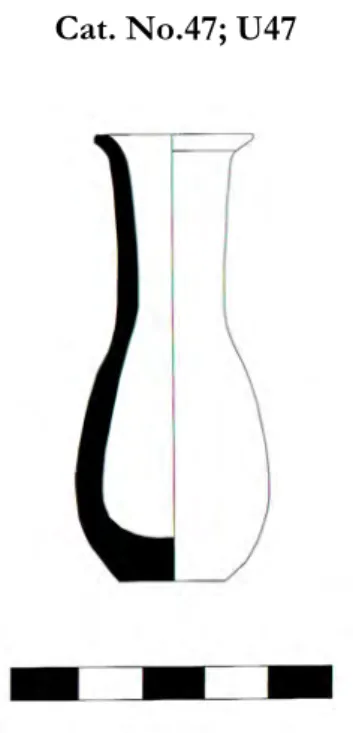
Cat. Nos. 46 and 47 are the smallest and latest of all the unguentaria in Tralleis (Figure 4, U46-U47). Parallels for the smaller unguentaria are also problematic. These types of unguentaria were probably made in the late 1st century A. D. These
two examples mentioned above show the same typical short-necked bulbous shape as the classical glass type Isings64.
Conclusion
In order to summarize the findings concerning the materials examined in this article, it can be stated that only a section of the western necropolis of Tralleis, which covers a considerable wide area, was ex-cavated during the 2007 excavation sea-son. Out of more than 60 unguentaria re-covered from these excavations dating back to the Hellenistic and Roman peri-ods, only 47 are included in this article. In terms of a stratigraphical evaluation, the work site where the findings were un-covered during the 2007 season was not
60 Hayes 1976, 34, Pl. 19, Fig. 158. 61 Hayes 1975, Pl. 37, Nos. 341-343. 62 Bruneau 1970a, Fig. 117, 61.15. 63 Tarsus I, Pl. 159, Fig. 734.
64 Isings 1957, form 6/28a. This form was especially
common during the 1st century A.D and continued
very suitable. The few coins (“Charon’s obol”) uncovered from the tomb were too corroded to make an evaluation. In addition, the typological development of the finds indicate that the tomb was used in different periods for a considerable time commencing from the early Helle-nistic period to the second half of the first century A.D. For this reason, the dating of the findings, arrived at by com-paring, should be considered in terms of the form development or with the exam-ples of the contexts the dates of which are precisely known.
During the work conducted in the western necropolis, tombs of different types and periods were revealed and as a result of the evaluations it was under-stood that the necropolis area was used from the 4th century B.C. to 4th century
A.D. The unguentaria we have evaluated here were discovered from both crema-tion and inhumacrema-tion graves. On the other hand, no unguentaria were encountered in tile graves which most of them date back to the 4th century and where grave gifts
are abundantly present.
A large majority of the unguentaria was found distributed among five klinai within the chamber tomb. It should be noted that the distribution form among the findings, out of the 47 samples, 35 were of fusiform and 12 were of bulbous form. After some time, a large part of these samples were recovered, form de-velopments between the late 4th century
B.C. and the late 1st century A.D. were
able to be completely followed.
As understood from the many
un-guentaria recovered from the necropolis
area, Tralleis unguentaria, as is the case in
many city centers, were most likely to have been placed to present grave gifts or offensive odors. Unguentaria, which makes up an original form of the Helle-nistic and Roman periods ceramics, leads to important conclusions when examined in form development in Tralleis.
Accordingly, Tralleis unguentaria re-flect the specific characteristic features of Anatolia. Excluding a few examples be-longing to the early Hellenistic period, which are horizontally decorated with a colored band on the neck and body, all of them are non-decorated and bear no handle. The clay of the unguentaria was evaluated according to the Munsell cata-logue and ranges of color from 2.5YR 7/4, 5YR 6/6 or 5YR 7/3-4 tons were determined. In all of the examples, mica remains were found and most were ob-served to be of standard dimensions.
Although the earliest examples of the form development of Tralleis unguentaria indicate a date back to the early Hellenis-tic period, these examples only make up a very small number of the findings. Evaluations conducted on these types of examples between the latter half of 4th
century B.C. and the beginning of 3rd
century B.C. resembles the unguentaria body of lekythoi or amphoriskos forms. In these types of examples, the neck is short, the shoulders are wide, the body is round and the mount is flat and wide. In these forms some of the neck and body have a red or reddish brown colored band. Similar to these types of Tralleis examples can be found within the con-text of Corinthian and Athenian agoras towards the end of the 4th century B.C.
In evaluating all the examples recov-ered from Tralleis from a chronological perspective, a large majority of the find-ings is made up of unguentaria dating back to the 2nd century B.C. In particular,
ex-amples dating back to the middle and the latter half of the 2nd century B.C. are
more abundant in numbers. Many of these examples have a spindle-shaped body, downturned rim, long tubular neck, cylindrical stem, and small distinct ring foot. Similar forms can be seen at Kerameikos, Athenian Agora, Corinth, Delos, Pergamon, Labraunda, Ephesos, Metropolis, Stratonikeia, Tarsus and Ere-tria.
As known, the 2nd century B.C. is the
most active period of Tralleis in terms of politics and history. During this period Tralleis, foremost with the city of Perga-mon, undertook both commercial and political relations with many city centers in western Anatolia and played an active regional role. Again during this period, it is known that the city was productive in the area of sculpture. Thus, the 2nd
cen-tury B.C., in which unguentaria dating to this time were extensively recovered, was the most productive artistic age for Tralleis.
Being the point, the examples from Tralleis dating back to the 2nd century
B.C. can be chronologically evaluated ac-cording to different phases by examining form development. The increase in mul-tiple productions during the above-mentioned century resulted in the dete-rioration of labour and quality. This situa-tion is also valid for Tralleis examples as well. In particular, after the mid 2nd
cen-tury B.C., the foot of the unguentaria
be-came longer and towards the end of the century the length of the neck and foot became equal and the diameter of the foot decreased. Among the Tralleis
un-guentaria there are many examples of
these types. Furthermore, in the devel-opment from the earlier to the later pe-riod, a form where the length increases from short to large, from a round globu-lar body to a smaller body and from short foot to a longer foot can be observed.
The wide shoulder pattern seen in the early Hellenistic period disappeared by the Tralleis examples that reflect the form from the middle to the late 2nd
cen-tury B.C. Some of the bodies of the ex-amples are asymmetric. With its unbal-anced and disproportionate body, these types of unguentaria were difficult to stand up and difficult to store an item inside it. Therefore, these types of examples are non-functional in terms of form. These types of unguentaria dating towards the end of the Hellenistic period can be seen not only in Tralleis but also in many cen-ters in Anatolia. In addition to the dete-rioration in form from the earlier until the later periods discussed above, the
un-guentaria made to place in graves were of
lower quality compared to daily use or those made for exports.
The fusiform unguentaria with its thin foot form that made it difficult to stand was replaced by the bulbous formed
un-guentaria of the early Roman period.
Twelve samples of this form were recov-ered at the Tralleis necropolis. In compar-ing the bulbous unguentaria from Tralleis with similar examples and considering the form development, these examples date back from the beginning to the end
of 1st century A.D. The bulbous samples
were distributed among the klinai within the chamber tomb or found at different levels at various locations outside of the structural area. In examining these exam-ples, the majority has a long neck, a rounded body and a flat base.
In all of the examples, the unbal-anced, long foot observed in the late Hel-lenistic period examples can no longer be seen. With the long neck, a body that soundly stands level and with a foot in proportion to this, the bulbous examples are much more functional compared to the fusiform examples of the late Helle-nistic period.
Since all of the unguentaria examples recovered from the western necropolis ex-cavations in 2007, upon examination, were not of different clay, glaze and shapes, these examples can be considered as Tralleis production. However, it is not possible to identify the workshops from the unguentaria uncovered from the exca-vation that took place at the western
ne-cropolis area alone. Aside from this, there
is no stamp or a mark on the unguentaria to identify the workshops. Despite this, among the unguentaria recovered, there are similar examples that appear to have come from the same craftsman. In par-ticular, within the group of examples of the 2nd century B.C. almost all have
simi-lar forms and technical features. Thus, these examples used extensively during the 2nd century B.C. in Tralleis are
con-sidered as local production.
In conclusion, this article has at-tempted to evaluate the Tralleis
unguenta-ria that were uncovered during the 2007
excavation season in a chronological
or-der. As a result of the examinations dertaken, the form development of
un-guentaria in Tralleis, intensive during the
2nd century B.C., was evaluated from late
4th century B.C. until the end of 1st
cen-tury A.D. The materials obtained during this excavation work show similarities with the examples both in Anatolia and in other Greek provinces as well. More-over, the unity within the materials sup-ports the view that they were local prod-ucts. Despite this, the city workshops, re-gional similarities and differences and identifying interactions will only be pos-sible by evaluating the materials to be un-covered in the future excavations.
CATALOGUE65 Cat. No.1; U1
Excavation Inv. No: TRL07NASM153 Find Place: From sarcophagus 2.
H. 14,1 cm; D. Rim. 2 cm; D. Foot. 4, 3 cm.
State of Conservation: Intact. Munsell: 2.5YR 7/6 (light red).
Form and general description: Globular body, convex mouth, short neck, high shoulder, small feet; decorated with red band on neck and shoulder.
Parallels: Corinth VII, Pl. 58, Figs. 585-586; Corinth XIII, Pl. 76, Figs. 10-11; Pl. 77, Fig. 16; Pl. 78, Fig. 7; Agora XXIX, Pl. 85, Fig. 72, 1163-1167.
Date: Third quarter of the 4th century
B.C. or a little later.
65 The measurements are given in centimeters
(accord-ing to preserved maximum height and diameter) and fabric colors are described by reference to the Mun-sell Soil Color Charts (Year 2000 Revised Washable Edition), and the closest Munsell numbers are in-cluded in the catalog.
Cat. No.2; U2
Excavation Inv. No: TRL07NASM159 Find Place: From sarcophagus 2.
H. 14, 3 cm; D. Rim. 3, 1 cm; D. Foot. 4, 4 cm.
State of Conservation: Intact. Munsell: 2.5YR 7/6 (light red).
Form and general description: Globular body; convex mouth; short neck; high shoulder; small feet; decorated with red band on neck and shoulder.
Parallels: Corinth VII, Pl. 58, Figs. 585-586; Corinth XIII, Pl. 76, Figs. 10-11; Pl. 77, Fig. 16; Pl. 78, Fig. 7; Agora XXIX, Pl. 85, Figs. 72, 1163-1167.
Date: Third quarter of the 4th century
Cat. No.3; U3
Excavation Inv. No: TRL07NA229 Find Place: From trench 1.
Max. P. H. 12, 5 cm; D. Foot. 3, 7 cm. State of Conservation: Intact except for neck and rim.
Munsell: 2.5YR 7/4 (light reddish brown).
Form and general description: Globular body, high shoulder; conical ring base. Parallels: Thompson 1934, Fig. 15, B7; Goldman 1940, Fig. 199, No. 16; Vess-berg – Westholm 1956, Fig. 24. 1;
Cor-inth VII, Pl. 58, Figs. 584-585; CorCor-inth
XIII, Pl. 76, Figs. 10-11; Pl. 77, Fig. 16; Pl. 78, Fig. 7; Boulter 1963, Pl. 46, H1;
Labraunda II.1, Pl. 12, No. 163;
Ander-son-Stojanović 1987, Fig. 2, Shape 1; Ölmez 2000, Lev. XXIV, K.9.
Date: Early 3rd century B.C.
Cat. No.4; U4
Excavation Inv. No: TRL07NA228 Find Place: From trench 1.
Max. P. H. 10, 4 cm; D. Foot. 3, 2 cm. State of Conservation: Intact except for neck and rim.
Munsell: 2.5YR 7/6 (light red).
Form and general description: Globular body, high shoulder, conical ring base. Parallels: Thompson 1934, Fig. 15, B7; Goldman 1940, Fig. 199, No. 16; Vess-berg – Westholm 1956, Fig. 24. 1;
Cor-inth VII, Pl. 58, Figs. 584-585; CorCor-inth
XIII, Pl. 76, Figs. 10-11; Pl. 77, Fig. 16; Pl. 78, Fig. 7; Boulter 1963, Pl. 46, H1;
Labraunda II.1, Pl. 12, No. 163;
Ander-son-Stojanović 1987, Fig. 2, Shape 1; Ölmez 2000, Lev. XXIV, K.9.
Cat. No.5; U5
Excavation Inv. No: TRL07NADM27 Find Place: From kline 1 in the chamber tomb.
Max. P. H. 15, 6 cm; D. Rim. 4, 1 cm. State of Conservation: Foot missing. Munsell: 10R 6/4 (pale red).
Form and general description: Globular body, convex mouth, tall neck, high shoulder. Decorated with red band on neck and shoulder.
Parallels: Thompson 1934, Fig. 15, B7; Goldman 1940, Fig. 199, No. 16; Vess-berg – Westholm 1956, Fig. 24. 1;
Cor-inth VII, Pl. 58, Figs. 585-586; CorCor-inth
XIII, Pl. 76, Figs. 10-11; Pl. 77, Fig. 16; Pl. 78, Fig. 7; Boulter 1963, Pl. 46, H1;
Labraunda II.1, Pl. 12, No. 163;
Ander-son-Stojanović 1987, Fig. 2, Shape 1;
Ag-ora XXIX, Fig. 72, Pl. 85, 1168-1169.
Date: Early 3rd century B.C.
Cat. No.6; U6
Excavation Inv. No: TRL07NA221 Find Place: From trench 1.
Max. P. H. 14, 2 cm; D. Foot. 3, 2 cm. State of Conservation: Intact except for neck and rim.
Munsell: 2.5YR 7/6 (light red).
Form and general description: Globular body; tubular neck; high shoulder; conical base. Decorated with red band on body. Parallels: Thompson 1934, Fig. 15, B7; Goldman 1940, Fig. 199, No. 16; Vess-berg – Westholm 1956, Fig. 24. 1; Corinth VII, Pl. 58, Figs. 584-585; Corinth XIII, Pl. 76, Figs. 10-11; Pl. 77, Fig. 16; Pl. 78, Fig. 7; Boulter 1963, Pl. 46, H1;
Labraunda II.1, Pl. 12, No. 163;
Ander-son-Stojanović 1987, Fig. 2, Shape 1. Date: Early 3rd century B.C.
Cat. No.7;U7
Excavation Inv. No: TRL07NADM64 Find Place: From niche in the chamber tomb.
Max. P. H. 14, 6 cm; D. Foot. 3, 9 cm. State of Conservation: Intact except for neck and rim; traces of burning on exte-rior.
Munsell: 10R 6/4 (pale red).
Form and general description: Globular body; tubular neck; high shoulder; conical base.
Parallels: Thompson 1934, Fig. 15, B7; Goldman 1940, Fig. 199, No. 16; Vess-berg – Westholm 1956, Fig. 24. 1; Corinth VII, Pl. 58, Figs. 584-585; Corinth XIII, Pl. 76, Figs. 10-11; Pl. 77, Fig. 16; Pl. 78, Fig. 7; Boulter 1963, Pl. 46, H1;
Labraunda II.1, Pl. 12, No. 163;
Ander-son-Stojanović 1987, Fig. 2, Shape 1. Date: Early 3rd century B.C.
Cat. No.8; U8
Excavation Inv. No: TRL07NADM21 Find Place: From kline 4 in the chamber tomb
H. 14, 8 cm; D. Rim. 3 cm; D. Foot. 2, 8 cm.
State of Conservation: Intact. Munsell: 10R 6/4 (pale red).
Form and general description: Fine mica-ceous, globular body, convex mouth, short neck, high shoulder, small feet. Parallels: Thompson 1934, Fig. 15, B7; Vessberg – Westholm 1956, Fig. 24.1;
Corinth XIII, Pl. 76, Figs. 10-11; Pl. 77,
Fig. 16; Pl. 78, Fig. 7; Boulter 1963, Pl. 46, H1; Labraunda II.1, Pl. 12, No. 163; Anderson-Stojanović 1987, Fig. 2, Shape 1.
Cat. No.9; U9
Excavation Inv. No: TRL07NADM31 Find Place: From kline 5 in the chamber tomb.
H. 9, 4 cm; D. Rim. 1, 9 cm; D. Foot. 2, 2 cm.
State of Conservation: Intact. Munsell: 10R 6/4 (pale red).
Form and general description: Spindle-shaped body; downturned rim; long tu-bular neck; cylindrical stem, small distinct ring foot.
Parallels: Thompson 1934, Fig. 9, A 64, Fig. 15, B 6.
Date: First half of the 3rd century B.C.
Cat. No.10; U10
Excavation Inv. No: TRL07NADM23. Find Place: From kline 5 in the chamber tomb.
H: 9, 7 cm; D. Rim. 2, 5 cm; D. Foot. 2, 7 cm.
State of Conservation: Intact. Munsell: 2.5YR 6/6-8 (light red).
Form and general description: Spindle-shaped body; downturned rim; long tu-bular neck; cylindrical stem; small distinct ring foot.
Parallels: Thompson 1934, Fig. 9, A 64, Fig. 15, B 6.
Cat. No.11; U11
Excavation Inv. No: TRL 07NA224 Find Place: From trench 1.
H. 9, 8 cm; D. Rim. 1, 6 cm; D. Foot. 2, 5 cm.
State of Conservation: Intact. Munsell: 5YR 6/6 (reddish yellow). Form and general description: Spindle-shaped body; downturned rim; long tu-bular neck; cylindrical stem; small distinct ring foot.
Parallels: Thompson 1934, Fig. 52, C 76;
Labraunda II.1, Pl. 12, No. 165; Agora
XXIX, Fig. 72, Pl. 85, 1171.
Date: Second half of the 3rd century B.C.
or late 3rd century B.C.
Cat. No.12; U12
Excavation Inv. No: TRL07NADM16 Find Place: From trench 1.
H. 12, 8 cm; D. Rim. 2, 6 cm; D. Foot. 2, 3 cm.
State of Conservation: Intact.
Munsell: 5YR 6/3-4 (light reddish brown). Form and general description: Spindle-shaped body; downturned rim; long tubular neck; cylindrical stem; small distinct ring foot.
Parallels: Thompson 1934, Fig. 52, C 76;
Labraunda II.1, Pl. 12, No. 165; Agora
XXIX, Fig. 72, Pl. 85, 1171.
Date: Second half of the 3rd century B.C.
Excava Find P H. 10, 3 cm. State o Munse Form shaped bular n ring fo Parallel 2/2, Ta Date: E Cat. N ation Inv. No Place: From s 5 cm; D. Rim of Conservatio ell: 5YR 7/4 ( and general d body; dow neck; cylindri ot. ls: Bruneau af. 210, 011, Early 2nd cent No.13; U13 o: TRL 07 NA sarcophagus m. 2, 2 cm; D on: Intact. (pink). description wnturned rim cal stem; sma
1970a, 448 Taf. 213, 020 tury B.C. A SM 162 3. D. Foot. 2, : Slender-; long tu-all distinct ; FiE IX 0. Excavatio Find Place tomb. H. 16, 2 c cm. State of C Munsell: 1 Form and shaped bo bular neck ring foot. Parallels: T Labraunda XXIX, Fig Date: Earl Cat. No.1 n Inv. No: T e: From klin cm; D. Rim. 2 onservation: 10R 7/4 (pale d general de ody; downtu k; cylindrical Thompson 1 II.1, Pl. 12 g. 72, Pl. 85, ly 2nd century 14; U14 TRL07NADM ne 4 in the ch 2, 9 cm; D. F Intact. e red). escription: Sp urned rim; lo stem; small d 1934, Fig. 52 2, No. 165; 1171. y B.C. M98 hamber Foot. 2 pindle-ong tu-distinct , C 76; Agora
Cat. No.15; U15
Excavation Inv. No: TRL07NADM06 Find Place: From kline 4 in the chamber tomb.
H. 18, 4 cm; D. Rim. 2, 2 cm; D. Foot. 3, 2 cm.
State of Conservation: Intact.
Munsell: 2.5YR 7/3-4 (light reddish brown).
Form and general description: Spindle-shaped body; downturned rim; long tu-bular neck; cylindrical stem; small distinct ring foot.
Parallels: Edwards 1959, 267-268, Pl. 68, Fig. 21; Labraunda II.1, Pl. 12, No. 165. Date: First half of the 2nd century B.C.
Cat. No.16; U16
Excavation Inv. No: TRL07NADM07 Find Place: From kline 1 in the chamber tomb.
H. 15, 9 cm; D. Rim. 2, 7 cm; D. Foot. 2, 1 cm.
State of Conservation: Intact.
Munsell: 2.5YR 6/3-4 (light reddish brown).
Form and general description: Spindle-shaped body; downturned rim; long tu-bular neck; cylindrical stem; small distinct ring foot.
Parallels: Kerameikos IX, Taf. 69, No. 390;
Agora XXIX, Pl. 85, No. 1170.
Cat. No.17; U17
Excavation Inv. No: TRL07NADM99 Find Place: From kline 4 in the chamber tomb.
H. 19, 4 cm; D. Rim. 3, 9 cm; D. Foot. 2, 8 cm.
State of Conservation: Intact. Munsell: 10R 6/3-4 (pale red).
Form and general description: Spindle-shaped body; downturned rim; long tu-bular neck; cylindrical stem; small distinct ring foot.
Parallels: Kerameikos IX, Taf. 69, No. 390;
Agora XXIX, Pl. 85, No. 1170; Civelek
2001, Lev. XXX, U46. Date: Mid-2nd century B.C.
Cat. No.18; U18
Excavation Inv. No: TRL07NADM22 Find Place: From kline 1 in the chamber tomb.
H. 15, 8 cm; D. Rim. 3 cm; D. Foot. 1, 8 cm.
State of Conservation: Intact.
Munsell: 5YR 6/4 (light reddish brown). Form and general description: Spindle-shaped body; downturned rim; long tu-bular neck; cylindrical stem; small distinct ring foot.
Parallels: Kerameikos IX, Taf. 69, No. 390; Gürler 1994, Çiz. 39, 137-141; Agora XXIX, Pl. 85, No. 1170.
Cat. No.19; U19
Excavation Inv. No: TRL07NADM 09 Find Place: From kline 1 in the chamber tomb.
H. 15, 5 cm; D. Rim. 2, 4 cm; D. Foot. 1, 8 cm.
State of Conservation: Intact.
Munsell: 5YR 6/4 (light reddish brown). Form and general description: Spindle-shaped body; downturned rim; long tu-bular neck; cylindrical stem; small distinct ring foot.
Parallels: Kerameikos IX, Taf. 69, No. 390; Gürler 1994, Çiz. 39, 137-141; Agora XXIX, Pl. 85, No. 1170. Civelek 2001, Lev. XXX, U29.
Date: Mid-2nd century B.C.
Cat. No.20; U20
Excavation Inv. No: TRL07NADM18 Find Place: From kline 3 in the chamber tomb.
H. 15, 4 cm; D. Rim. 2, 5 cm; D. Foot. 1, 9 cm.
State of Conservation: Intact. Munsell: 5YR 7/4 (pink).
Form and general description: Spindle-shaped body; downturned rim; long tu-bular neck; cylindrical stem; small distinct ring foot.
Parallels: Kerameikos IX, Taf. 69, No. 390;
Agora XXIX, Pl. 85, No. 1170.
Cat. No.21; U21
Excavation Inv. No: TRL07NADM34 Find Place: From kline 2 in the chamber tomb.
Max. P. H. 13, 7 cm; D. Rim. 1, 7 cm; D. Foot. 2, 1 cm.
State of Conservation: The upper part of the neck and rim are missing.
Munsell: 10R 7/4 (pale red).
Form and general description: Spindle-shaped body; downturned rim; long tu-bular neck; cylindrical stem; small distinct ring foot.
Parallels: Tarsus I, Fig. 135, No. 234; Bruneau 1970b, 507; Kerameikos IX, Taf. 69, No. 390; Agora XXIX, Pl. 85, No. 1170.
Date: Mid-2nd century B.C.
Cat. No.22; U22
Excavation Inv. No: TRL07NADM28 Find Place: From kline 1 in the chamber tomb.
Max. P. H. 13, 4 cm; D. Rim.3 cm.
State of Conservation: Foot missing. Munsell: 10R 6/3 (pale red).
Form and general description: Spindle-shaped body; downturned rim; long tu-bular neck; cylindrical stem; small distinct ring foot.
Parallels: Kerameikos IX, Taf. 69, No. 390;
Agora XXIX, Pl. 85, No. 1170.
Cat. No.23; U23
Excavation Inv. No: TRL07NADM05 Find Place: From kline 5 in the chamber tomb.
H. 19, 9 cm; D. Rim. 2, 9 cm; D. Foot. 2, 8 cm.
State of Conservation: Intact. Munsell: 2.5YR 7/6-8 (light red).
Form and general description: Fine mica-ceous fabric; body surface well-smoothed; spindle-shaped body; down-turned rim; long tubular neck; cylindrical stem; small distinct ring foot.
Parallels: Thompson 1934, Fig. 78, D 78;
Tarsus I, Fig. 135, No. 244; Metzger 1969,
Taf. 28, No. 2.
Date: Second half of the 2nd century B.C.
Cat. No.24; U24
Excavation Inv. No: TRL07NADM12 Find Place: From kline 5 in the chamber tomb.
H. 17, 9 cm; D. Rim. 2, 9 cm; D. Foot. 2, 2 cm.
State of Conservation: Intact.
Munsell: 5YR 6/3-4 (light reddish brown). Form and general description: Spindle-shaped body; downturned rim; Long tubular neck; cylindrical stem; small distinct ring foot.
Parallels: Thompson 1934, Fig. 78, D 78;
Tarsus I, Fig. 135, No. 244; Metzger 1969,
Taf. 28, No. 2; Samothrace 11, p. 219, S138-11; Ölmez 2000, Lev. XXXVI, K.33.
Cat. No.25; U25
Excavation Inv. No: TRL07NADM56 Find Place: From kline 5 in the chamber tomb.
H. 11 cm; D. Rim. 2, 1 cm; D. Foot. 1, 8 cm.
State of Conservation: Intact. Munsell: 10R 7/3 (pale red).
Form and general description: Slender-shaped body; downturned rim; long tu-bular neck; cylindrical stem; small distinct ring foot.
Parallels: Thompson 1934, Fig. 78, D 78;
Tarsus I, Fig. 135, No. 244; Metzger 1969,
Taf. 28, No. 2; Samothrace 11, p. 219, S138-11; Ölmez 2000, Lev. XXXIX, K 39.
Date: Second half of the 2nd century B.C.
Cat. No.26; U26
Excavation Inv. No: TRL07NADM14 Find Place: From kline 4 in the chamber tomb.
H. 21, 9 cm; D. Rim. 2, 4 cm; D. Foot. 3, 3 cm.
State of Conservation: Intact.
Munsell: 5YR 6/3-4 (light reddish brown). Form and general description: Decorated with red band on neck and shoulder66. Body surface well smoothed.
Slender-shaped body; downturned rim; long tubular neck; cylindrical stem; small distinct ring foot.
Parallels: Thompson 1934, Fig. 78, D 78;
Tarsus I, Fig. 135, No. 244; Metzger 1969,
Taf. 28, No. 2; Ölmez 2000, Lev. XXXV, K 30.
Date: Second half of the 2nd century B.C.
66 Boulter 1963, 125; Pemberton 1985, 285;
Cat. No.27; U27
Excavation Inv. No: TRL07NADM15 Find Place: From kline 1 in the chamber tomb.
H. 26, 7 cm; D. Rim. 3, 4 cm; D. Foot. 3, 6 cm.
State of Conservation: Intact.
Munsell: 5YR 6/3-4 (light reddish brown). Form and general description: Spindle-shaped body; downturned rim; long tubular neck; cylindrical stem; small distinct ring foot.
Parallels: Thompson 1934, Fig. 104, E 138; Bucovala 1967, 70, 71, 84.
Date: Late 2nd century B.C.
Cat. No.28; U28
Excavation Inv. No: TRL07NADM17 Find Place: From kline 1 in the chamber tomb.
Max. P. H. 16, 9 cm; D. Rim. 2, 7 cm. State of Conservation: Foot missing. Munsell: 5YR 7/2 (pinkish gray).
Form and general description: Spindle-shaped body; body surface well smoothed; downturned rim; long tubular neck; cylindrical stem.
Parallels: Thompson 1934, Fig. 104, E 138; Bucovala 1967, 70, 71, 84; Samothrace 11, S138-6; Okunak 2005, Çizim 14, Kat. No. 10.
Cat. No.29; U29
Excavation Inv. No: TRL07NADM77 Find Place: From kline 1 in the chamber tomb.
Max. P. H. 15, 6 cm; D. Foot. 1, 8 cm. State of Conservation: Intact except for neck and rim.
Munsell: 10R 6/6 (light red).
Form and general description: Spindle-shaped body; downturned rim; long tu-bular neck; cylindrical stem; small distinct ring foot.
Parallels: Thompson 1934, Fig. 104, E 138, Bucovala 1967, 70, 71, 84; Samothrace 11, S138-6.
Date: Late 2nd century B.C.
Cat. No.30, U30
Excavation Inv. No: TRL07NADM08 Find Place: From kline 3 in the chamber tomb.
H. 16, 4 cm; D. Rim. 2, 4 cm; D. Foot. 1, 8 cm.
State of Conservation: Intact. Munsell: 5YR 7/3-4 (pink).
Form and general description: Spindle-shaped body; downturned rim; long tu-bular neck; cylindrical stem; small distinct ring foot.
Parallels: Thompson 1934, Fig. 104, E 138, Bucovala 1967, 70, 71, 84; Samothrace 11, S138-11; Dündar 2006, Lev. XIX, U115.
Cat. No.31; U31
Excavation Inv. No: TRL07NADM24 Find Place: From kline 4 in the chamber tomb.
Max. P. H. 15, 5 cm; D. Foot. 1, 8 cm. State of Conservation: Rim missing. Munsell: 2.5YR 7/6-8 (light red).
Form and general description: Spindle-shaped body; long tubular neck; cylindri-cal stem; small distinct ring foot.
Parallels: Thompson 1934, Fig. 104, E 138, Bucovala 1967, 70, 71, 84; Samothrace 11, S138-6.
Date: Late 2nd century B.C.
Cat. No.32; U32
Excavation Inv. No: TRL07NA168 Find Place: From trench 1.
H. 13, 2 cm; D. Foot. 1, 9 cm.
State of Conservation: Intact except for neck and rim.
Munsell: 2.5YR 7/6 (light red).
Form and general description: Spindle-shaped body; cylindrical stem; small dis-tinct ring foot.
Parallels: Thompson 1934, Fig. 104, E 138; Bucovala 1967, 70, 71, 84; Samothrace 11, S138-9.
Cat. No.33; U33
Excavation Inv. No: TRL07NADM02 Find Place: From kline 1 in the chamber tomb.
H. 18,8 cm; D. Rim. 2, 8 cm; D. Foot. 3, 8 cm.
State of Conservation: Intact. Munsell: 2.5YR 6/6-8 (light red).
Form and general description: Globular body; cylindrical stem; flaring pedestal foot; underside of base is concave. Paral-lels: Tarsus I, Fig. 135, No. 236; Agora V, Pl. 2, F 49; Wiseman – Mano-Zissi 1976, 280, Fig. 11.
Date: Early 1st century B.C.
Cat. No.34; U34
Excavation Inv.No: TRL07NADM01 Find Place: From kline 1 in the chamber tomb.
H. 19 cm; D. Rim. 4, 2 cm; D. Foot. 3, 8 cm.
State of Conservation: Intact. Munsell: 10R 6/4 (pale red).
Form and general description: Globular body; cylindrical stem; flaring pedestal foot; slightly concave base. Fine mica-ceous fabric; body surface well-smooth- ed.
Parallels: Agora V, Pl. 2, F 49; Wiseman – Mano-Zissi 1976, 280, Fig. 11.
Cat. No.35; U35
Excavation Inv. No: TRL07NADM30 Find Place: From kline 1 in the chamber tomb.
H. 18, 6 cm; D. Rim. 2, 2 cm; D. Foot. 3, 9 cm.
State of Conservation: Intact. Munsell: 10R 6/3 (pale red).
Form and general description: Globular body; cylindrical stem; flaring pedestal foot; underside of base is concave. Paral-lels: Agora V, Pl. 2, F 49; Wiseman – Mano-Zissi 1976, 280, Fig. 11.
Date: Early 1st century B.C.
Cat. No.36, U36
Excavation Inv. No: TRL07NA227. Find Place: From trench 1.
H. 8, 4 cm; D. Foot. 2, 5 cm.
State of Conservation: Neck broken, rim lost.
Munsell: 10R 6/4 (pale red).
Form and general description: Low bulg-ing bulbous body; tall cylindrical neck; slightly concave base.
Parallels: Hayes 1976, 34, Pl. 19, Fig. 158. Date: Early 1st century A. D.
Cat. No.37; U37
Excavation Inv. No: TRL07NADM29 Find Place: From kline 2 in the chamber tomb.
H. 11, 5 cm; D. Rim. 3, 6 cm; D. Foot. 3 cm.
State of Conservation: Intact. Munsell: 10R 6/3 (pale red).
Form and general description: Fairly bul-bous body of truncated ovoid shape; tall tubular neck; everted rim; flat base. Parallels: Tarsus I, Pl. 159, Fig. 730; Brun-eau 1970a, Fig. 117, 61.15.
Date: Mid-1st century A. D.
Cat. No.38; U38
Excavation Inv. No: TRL07NADM20 Find Place: From kline 3 in the chamber tomb.
H. 9, 3 cm; D. Rim. 2, 4 cm; D. Foot. 3 cm.
State of Conservation: Intact. Munsell: 10R 6/3 (pale red).
Form and general description: Bulbous body; narrow neck; everted rim; flat base. Parallels: Tarsus I, Pl. 159, Figs. 730, 732, 734-736; Bruneau 1970a, Fig. 117, 61.15. Date: Mid-1st century A. D.
Cat. No.39; U39
Excavation Inv. No: TRL07NADM13 Find Place: From kline 1 in the chamber tomb.
H. 13, 5 cm; D. Rim. 3, 3 cm; D. Foot. 3, 8 cm.
State of Conservation: Intact. Munsell: 10R 6/4 (pale red).
Form and general description: Bulbous body; short narrow cylindrical neck; everted rim; flat base.
Parallels: Tarsus I, Pl. 159, Figs. 730, 732, 734-736; Agora V, Pl. 2, F 50; Pl. 5, G 98; Lapp 1961, Type 92, D; Bruneau 1970 a, Fig. 117, 61.15; Anderson-Stojanović 1987, Fig. 1h; Civelek 2001, Lev. XXXIII, U51; FiE IX/3, Pl. 41, K 500. Date: Mid-1st century A. D.
Cat. No.40; U40
Excavation Inv. No: TRL07NADM26 Find Place: From kline 4 in the chamber tomb.
H. 8, 9 cm; D. Rim. 2, 6 cm; D. Foot. 3, 1 cm.
State of Conservation: Intact. Munsell: 10R 6/4 (pale red).
Form and general description: Ovoid sagging body; straight tubular neck; short flaring lip; small flat base.
Parallels: Tarsus I, Pl. 159, Fig. 735; Agora V, Pl. 2, F 50, Pl. 5, G 97-98; Pl. 18, M6-7; Bruneau 1970 a, Fig. 117, 61.15;
Samothrace 11, S143-9; Civelek 2001, Lev.
XXXIV, U1; Okunak 2005, Çizim 21, Kat. No. 17.
Cat. No.41; U41
Excavation Inv. No: TRL07NADM11 Find Place: From kline 4 in the chamber tomb.
H. 11, 2 cm; D. Rim. 2, 9 cm; D. Foot. 2, 5 cm.
State of Conservation: Intact. Munsell: 10R 6/4 (pale red).
Form and general description: Sagging round-bodied form; tubular neck; flaring lip; small flat base.
Parallels: Tarsus I, Pl. 159, Fig. 734; Agora V, Pl. 2, F 50, Pl. 5, G 97-98; Pl. 18, M 6-7; Lapp 1961, 199 A, C-D; Bruneau 1970 a, Fig. 117, 61.15; Anderson-Stojanović 1987, 112, Fig. 7; Samothrace 11, S143-1;
FiE IX/3, Pl. 41, L. 486; Dündar 2006,
Lev. XXIII, U136; Okunak 2005, Çizim 21, Kat. No.17.
Date: Mid-1st century A. D.
Cat. No.42; U42
Excavation Inv. No: TRL07NADM03 Find Place: From kline 3 in the chamber tomb.
H. 16, 2 cm; D. Rim. 3, 4 cm; D. Foot. 3, 2 cm.
State of Conservation: Intact. Munsell: 10R 7/4 (pale red).
Form and general description: Low bul-bous body; narrow cylindrical neck; short tapering flat-topped rim; sharply articu-lated. The shape is also found in glass (Isings 1957, form 26).
Parallels: Tarsus I, Pl. 159, Figs. 734-735;
Agora V, Pl. 2, F 50, Pl. 5, G 97-98; Pl.
18, M 6-7; Bruneau 1970 a, Fig. 117, 61.15; Anderson-Stojanović 1987, 112, Fig. 7; Samothrace 11, S 143-1; FiE IX/3, Pl. 41, K 486.
Cat. No.43; U43
Excavation Inv. No: TRL07NADM10 Find Place: From kline 3 in the chamber tomb.
H. 8, 2 cm; D. Rim. 2, 5 cm; D. Foot. 2, 4 cm.
State of Conservation: Intact. Munsell: 10R 6/6 (light red).
Form and general description: Small ovoid body; tubular tall neck; thickened flaring lip; flat roughly-cut base.
Parallels: Tarsus I, Pl. 159, Fig. 734; Hayes 1976, Pl. 37, Fig. 340; Civelek 2001, Lev. XXXIV, U74; Dündar 2006, Lev. XXIV, U138.
Date: Second half of the 1st century A. D.
Cat. No.44; U44
Excavation Inv. No: TRL07NADM25 Find Place: From kline 4 in the chamber tomb.
H. 11, 2 cm; D. Rim. 3 cm; D. Foot. 2, 6 cm.
State of Conservation: Intact. Munsell: 10R 6/6-8 (light red).
Form and general description: Ovoid body; tubular neck; small flat turned base. Parallels: Tarsus I, Pl. 159, Fig. 734; Brun-eau 1970a, Fig. 117, 61.15; Dündar 2006, Lev. XXIII, Kat. No. U137.
Cat. No.45; U45
Excavation Inv. No: TRL07NADM19 Find Place: From kline 1 in the chamber tomb.
H. 10, 4 cm; D. Rim. 2, 8 cm; D. Foot. 2 cm.
State of Conservation: Intact. Munsell: 10R 6/4 (pale red).
Form and general description: Slender ovoid body; tall tubular neck; small flat base.
Parallels: Tarsus I, Pl. 159, Fig. 734; Brun-eau 1970a, Fig. 117, 61.15.
Date: Second half of the 1st century A. D.
Cat. No.46; U46
Excavation Inv. No: TRL07NA219 Find Place: From trench 1.
H. 7, 6 cm; D. Rim; 2, 5 cm; D. Foot. 1, 6 cm.
State of Conservation: Intact. Munsell: 2.5YR 6/6 (light red).
Form and general description: Same ware as Cat. No. 43; small ovoid body, short tubular neck, small flat base.
Parallels: Agora V, Pl. 5, G 97. Date: Late 1st century A. D.
Cat. No.47; U47
Excavation Inv. No: TRL07NA220 Find Place: From trench 1
H. 6, 9 cm; D. Rim. 2, 5 cm; D. Foot. 1, 6 cm.
State of Conservation: Intact. Munsell: 2.5YR 7/6 (light red)
Form and general description: Small ovoid body; short tubular neck; small flat base.
Parallels: Agora V, Pl. 5, G 97. Date: Late 1st century A. D.
List of Figures:
Graphic 1. Shape distribution of unguenta-ria in Tralleis.
Graphic 2. Color distribution of unguenta-ria in Tralleis.
Graphic 3. Chronological distribution of unguentaria in Tralleis.
Figure 1. Tralleis unguentaria from west-ern necropolis, Cat. Nos. U1-U12. Figure 2. Tralleis unguentaria from
west-ern necropolis, Cat. Nos. U13-U24.
Figure 3. Tralleis unguentaria from west-ern necropolis, Cat. Nos. U25-U36.
Figure 4. Tralleis unguentaria from west-ern necropolis, Cat. Nos. U37-U47.
BIBLIOGRAPHY
Agora V H. S. Robinson, Pottery of the Roman Period: Chrononology. The
Athenian Agora V (1959).
Agora XII B. A. Sparkes – L. Talcott, Black and Plain Pottery of the 6th, 5th and
4th Centuries B.C. The Athenian Agora XII (1970).
Agora XXII S. I. Rotroff, Hellenistic Pottery: Athenian and Imported Moldmade
Bowls. The Athenian Agora XXII (1982).
Agora XXIX S. I. Rotroff, Hellenistic Pottery: Athenian and Imported Wheelmade
Table Ware and Related Material. The Athenian Agora XXIX, Part
1 (1997).
Agora XXXIII S. I. Rotroff, Hellenistic Pottery: The Plain Wares. The Athenian
Agora XXXIII (2006).
Akarca 1952 A. Akarca, “Mylasa’da HellenistikBir Mezar”, Belleten 16, 1952, 367-398.
Anderson-Stojanović 1987 V. R. Anderson-Stojanovic, “The Chronology and Function of Ceramic. Unguentaria”, AJA 91, 1987, 105-122.
AvP XII K. Nohlen – W. Radt, Kapikaya, Ein Felsheiligtum bei Pergamon.
AvP XII (1978).
Baldıran 1999 A. Baldıran, “Stratonikeia’dan Unguentariumlar”, Selçuk
Üniversi-tesi Sosyal Bilimler Enstitüsü Dergisi 4, 1999, 335-356.
Berlin 1997 A. Berlin, Tell Anafa II: I, The Hellenistic and Roman Pottery: The
Plain Wares (1997).
Bilde – Poulsen 2008 P. G. Bilde – B. Poulsen, The Temple of Castor and Pollux II, 1. The
finds (2008).
Boulter 1963 C. G. Boulter, “Graves in Lenormant Street, Athens”, Hesperia 32, 2, 1963, 113-137.
Bruneau 1970a P. Bruneau, “Tombes d’Argos”, BCH 94, 1970, 437-531.
Bruneau 1970b P. Bruneau, Recherches sur les cultes de Délos à l’époque hellénistique et à
l’époque impériale (1970).
Bucovala 1967 M. Bucovala, Necropole Elenistice La Tomis (1967).
Civelek 2001 A. Civelek, Tralleis Nekropolisi Buluntuları Işığında Hellenistik ve
Roma Dönemi Seramiği. Ege Üniversitesi, Sosyal Bilimler Enstitüsü
(Unpublished PhD Thesis) (2001).
Civelek 2008 A. Civelek, “Terra Sigillata, Sinter Astarlı Seramikler”, ASanat 128, 2008, 57-62.
Corinth XIII C. W. Blegen – H. Palmer – R. Young, The North Cemetery. Co-rinth XIII (1964).
Daremberg – Saglio 1963 C. Daremberg – E. Saglio, Dictionnaire des Antiquités Grecques et
Romaines (1963).
Dotterweich 1999 U. Dotterweich, Unguentarien mit kuppelförmiger Mündung aus Knidos. Knidos-Studien Band I (1999).
Dündar 2006 E. Dündar, Hellenistik ve Roma Dönemleri Patara Unguentariumları. Adnan Menderes Universitesi, Sosyal Bilimler Enstitüsü, (Un-published Master’s Thesis) (2006).
Edwards 1959 G. R. Edwards, “The Gordion Campaign of 1958: Preliminary Report”, AJA 63, 3, 1959, 263-268.
Erol 2004 D. Erol, Tralleis Kenti Kazılarında Ele Geçen Baskılı Terra Sigillata. Adnan Menderes Üniversitesi, Sosyal Bilimler Enstitüsü, (Un-published Master’s Thesis) (2004).
FiE IX 2/2 V. Mitsopoulos-Leon, Die Basilika am Staatsmarkt in Ephesos
Klei-funde. 1. Teil: Keramik hellenistischer und römischer Zeit. FiE IX 2/2
(1991).
FiE IX/3 R. Meriç, Späthellenistisch-römische Keramik und Kleinfunde aus einem
Schachtbrunnen am Staatsmarkt in Ephesos. FiE IX/ 3(2002).
Forti 1962 L. Forti, “Gli unguentari del primo periodo ellenistico”, RendNap 37, 1962, 143-157.
Gassner 1997 V. Gassner, Das Südtor der Tetragonos-Agora. Keramik und Kleinfunde. FiE XIII 1, 1 (1997).
Goldman 1940 H. Goldman, “The Acropolis of Halae”, Hesperia 9, 1940, 381-514.
Guz-Zilberstein 1995 B. Guz-Zilberstein, “The typology of the Hellenistic Coarse Ware and Selected Loci of the Hellenistic and Roman Periods”, in: A. Belfer-Cohen – A. Ben-Tor – Y. Tsafrir (eds.), Excavations
at Dor, Final Report Volume I B, Areas A and C: The Finds (1995)
289-434.
Gürler 1994 B. Gürler, Metropolis’in Hellenistik Dönem Seramiği. Ege Universitesi Sosyal Bilimler Enstitüsü (Unpublished PhD Thesis) (1994). Hägg – Fossey 1980 I. Hägg – J.M. Fossey, The Hellenistic Nekropolis and Later Structures
on the Middle Slopes. 1973-1977. Acta Universitatis Upsaliensis,
Boreas 4:4 (1980).
Hausmann 1996 U. Hausmann, Hellenistische Keramik. OF XXVII (1996). Hayes 1972 J. W. Hayes, Late Roman Pottery (1972).
Hayes 1975 J. W. Hayes, Roman and Pre-Roman Glass in the Royal Ontario
Mu-seum (1975).
Hayes 1976 J. W. Hayes, Roman Pottery in the Royal Ontario Museum (1976). Heimberg 1982 U. Heimberg, Die Keramik des Kabirions (1982).
Isings 1957 C. Isings, Roman Glass from Dated Finds (1957).
Kerameikos IX U. Knigge, Der Südhügel. Kerameikos IX (1976).
Khairy 1980 N. I. Khairy, “Natatean Piriform Unguentaria”, BASOR 240, 1980, 85-91.
Kurtz – Boardman 1971 D. Kurtz – J. Boardman, Greek Burial Customs (1971).
Labraunda II.1 P. Hellström, Pottery of Classical and Later Date Terracotta Lamps and
Glass. Labraunda Vol. II, Part 1 (1965).
Lapp 1961 P. W. Lapp, Palestinian Ceramic Chronology 200 B.C.-AD. 70 (1961). Metzger 1969 I. R. Metzger, Die Hellenistische Keramik in Eretria (1969).
Myres 1914 J. L. Myres, Handbook of the Cesnola Collection of Antiquities from
Cy-prus, Metropolitan Museum of Art (1914).
Okunak 2005 M. Okunak, Hierapolis Kuzey Nekropolü (159D Nolu Tümülüs) Anıt
Mezar ve Buluntuları. Pamukkale Universitesi, Sosyal Bilimler
Ens-titüsü (Unpublished Master’s Thesis) (2005).
Ölmez 2000 F. Ölmez, Tralleis Nekropolünden Bir Mezar ve Buluntuları. Adnan Menderes Universitesi, Sosyal Bilimler Enstitüsü, (Unpublished Master’sThesis) (2000).
Özgan 1982 R. Özgan, Yunan ve Roma Devri Tralleis Heykeltıraşlığı (1982). Pemberton 1985 E. G. Pemberton, “Ten Hellenistic Graves in Ancient Corinth”,
Hesperia 54, 3, 1985, 271-307.
Pfrommer 1985 M. Pfrommer, “Milet 1983-1984. Klassische und hellenistische Keramik aus dem Heroon 111”, IstMitt 35,1985, 39-58.
Rotroff 1984 S. I. Rotroff, “The Origins and Chronology of Hellenistic Gray Unguentaria”, AJA 88, 1984, 258.
Rotroff – Oliver 2003 S. I. Rotroff– A. Oliver Jr., The Hellenistic Pottery from Sardis. The
Finds Through 1994 (2003).
Samothrace 11 E. B. Dusenbery, Necropoleis: The Necropoleis and catalogues of burials
and Catalog of objects by categories. Samothrace 11 (1998).
Schlörb-Vierneisel 1966 B. Schlörb-Vierneisel, “Eridanos-Nekropole”, AM 81, 1966, 1-135.