Üst-Bilişsel 7E Öğrenme Döngüsünün Öğrencilerin
Fizikteki Epistemolojik Anlayışlarına Etkisi1
The Impact of The Metacognitive 7E Learning Cycle on Students’ Epistemological Understandings
Sevda YERDELEN-DAMAR
Yüzüncü Yıl Üniversitesi, Eğitim Fakültesi, Ortaöğretim Fen ve Matematik Alanları Eğitimi, Van, Türkiye
Ali ERYILMAZ
Orta Doğu Teknik Üniversitesi, Eğitim Fakültesi, Ortaöğretim Fen ve Matematik Alanları Eğitimi, Ankara, Türkiye
İlk Kayıt Tarihi: 07.10.2014 Yayına Kabul Tarihi: 27.05.2015 Özet
Bu çalışmada üst-bilişsel olarak iyileştirilmiş 7E öğrenme döngüsünün onuncu sınıf öğrencilerinin epistemolojik anlayışlarına etkisi araştırılmıştır. Çalışmaya, Ankara’da bulunan iki devlet lisesindeki 107 (49 Kız, 58 Erkek) onuncu sınıf öğrencisi katılmıştır. Çalışmada yarı deneysel desen kullanılmıştır. Her bir okuldan iki sınıf, kontrol ve deney gruplarına rastgele atanmıştır. Kontrol grubunda dersler öğretmen merkezli öğretimle işlenirken, deney grubu ise üst-bilişsel olarak iyileştirilmiş 7E öğrenme döngüsü ile işlenmiştir. Türkçe Fizik Beklentileri Anketi, öğrencilerin epistemolojik anlayışlarını değerlendirmek için kullanılmıştır. Öğrencilerin ön-epistemolojik anlayışlarının kontrol edildikten sonra, üst-bilişsel olarak iyileştirilmiş 7E öğrenme döngüsünün öğrencilerinin epistemolojik anlayışlarına etkisini test etmek için Kovaryans Analizi (ANCOVA) kullanılmıştır. Analiz sonucu, deney ve kontrol grubu öğrencilerinin epistemolojik anlayış puanlarının ortalaması arasında deney grubu lehinde anlamlı bir farkın olduğunu göstermiştir
Anahtar Kelimeler: Fizik eğitimi, kişisel epistemoloji, üst-biliş, 7E öğrenme döngüsü, bilimsel sorgulama
Abstract
This study investigated the effect of metacognitively stimulated 7E learning cycle on tenth grade students’ epistemological understandings in physics. The participants of the study included 107 (49 Female, 58 Male) tenth grade students at two public high schools in Ankara. A quasi-experimental with matching-only pretest-posttest control group design was employed. Two intact classes of each school were randomly assigned to the experimental and control group. The experimental group was instructed based on the metacognitive 7E learning cycle while the control group was taught with the teacher-centered instruction. The Turkish Physics
1. This study is produced from the first author’s dissertation and a part of it was presented at World Conference on Physics Education (2012, Istanbul).
Expectation Survey was applied to probe the students’ epistemological understandings in physics. Analysis of Covariance (ANCOVA) was employed to examine the effect of the instruction relied on the metacognitive 7E learning cycle on the students’ epistemological understandings when their pre-epistemological understandings were controlled. The result indicated that there was a significant difference between two groups’ post epistemological understandings in favor of the experimental group.
Keywords: Physics education, personal epistemology, metacognition, scientific inquiry, 7E learning cycle
1. Introduction
Inquiry-based learning creates a learning environment where students define and investigate problems, formulating hypotheses, designing experiments, gathering data, and driving conclusions about problems. Inquiry-based learning has several advanta-ges. Some of them are improving intellectual power and intrinsic motivation, helping to learn how to investigate, enhancing memory retention, leading student-centered instruction, contributing self-concept and allowing more time for assimilation and accommodation of information (Trowbridge, Bybee, & Powell, 2004). There are se-veral kinds of inquiry-based learning methodologies used in science education. The learning cycle is one of them (Abraham, 2003; Marek & Cavallo, 1997). The learning cycle first was introduced by Karplus and Thier (1967). It consists of three phases, namely, the exploration, invention, and discovery. The initial learning cycle was en-hanced into five phases and named as the 5E learning cycle (Bybee, 1997). Finally, the 5E learning cycle was expanded into the 7E learning cycle by Eisenkraft (2003). This learning cycle differs from other learning cycles with more emphasis on eliciting prior knowledge and transfer of knowledge. The 7E learning cycle has seven phases which are called as the elicit, engage, explore, explain, elaborate, evaluate and extend. Eisenkraft (2003) describes these phases as seen in Table 1.
Table 1. The phases of the 7E learning cycle and their descriptions Phases Descriptions
Elicit The elicit phase involves taking into account students’ prior knowledge and conceptions. Engage The engage phase includes triggering students’ attention, getting students to think about the
subject matter, raising questions in students’ minds.
Explore The explore phase of the learning cycle engages students in observing, recording data, isolating variables, designing and planning experiments, creating graphs, interpreting results, developing hypotheses, and organizing their findings. In this phase, teachers may formulate questions, recommend approaches, give feedback, and evaluate understandings
Explain In the explain phase, students are presented to models, laws, and theories.
Elaborate In the elaborate phase of the learning cycle, students apply their knowledge to new situations, which may involve raising new questions and hypotheses to explore.
Extend The inclusion of the extend phase to the elaborate phase is aimed to clearly remind teachers the importance of practicing the transfer of learning for students. Students need to apply their knowledge into a new context and is not limited to simple elaboration.
Phases Descriptions
Evaluate The evaluate phase of the learning cycle involves both formative and summative evaluations of students’ understandings. Formative evaluation should not be restricted to a specific phase of the learning cycle. Formative evaluation should happen during all interactions with students.
Research studies found that the learning cycle has been more effective than tradi-tional instruction, mainly based on teacher-centered instructions, for enhancing stu-dents’ achievement and conceptual understandings in physics (e.g. Ateş, 2005; Bar-man, BarBar-man, & Miller, 1996; Cherry, 2011; Cobern et al., 2010; Dikici, Türker, & Özdemir, 2010; Kanli & Yagbasan, 2008;), in chemistry (e.g. Ağgül-Yalçın & Bayrak-çeken, 2010; Ceylan & Geban, 2009; Köseoğlu & Tümay, 2010), and in biology (e.g Balci, Cakiroglu, & Tekkaya, 2006; Cakiroglu, 2006; Dogru-Atay & Tekkaya, 2008; Kaynar, Tekkaya, & Çakiroğlu, 2009).
Moreover several studies indicated the positive effects of the learning cycle on re-tention of learning (Harurluoğlu & Kaya, 2011; Sriwattanarothai, Jittam, Ruenwong-sa, & Panijpan, 2009; Turgut & Gurbuz, 2011), on students’ attitudes in physics, che-mistry and biology (Açışlı & Turgut, 2011; Farrell, Moog, &. Spencer, 1999; Parker & Gerber, 2000; Siribunnam & Tayraukham, 2009), on science process skills (Açışlı & Turgut, 2011; Kanli & Yagbasan, 2008; Polyiem, Nuangchalerm, & Wongchantra, 2011), on thinking skills (Siribunnam & Tayraukham, 2009; Temel, Dincol-Ozgur, & Yilmaz, 2012), on their science perceptions ( Köseoğlu & Tümay, 2010; Liu, Peng, Wu, & Lin, 2009; Sriwattanarothai et al., 2009), and epistemological understandings (Bektas, 2011; Kaynar et al., 2009). However, when the outcomes of instructions re-lied on the learning cycle, discussed above, are considered, few studies explored the influence of the learning cycle on students’ epistemological understandings.
Both abroad and in Turkey, most of the learning cycle studies explored the effec-tiveness of the 3E and 5E learning cycle. On the other hand, the effeceffec-tiveness of the 7E learning cycle has been examined in a few studies. Thus, there is a need to study further the effect of the 7E learning cycle in science education. According to the stu-dies investigating the effect of the 7E learning cycle experimentally, the 7E learning cycle promoted students’ achievement and conceptual understandings (Bulbul, 2010; Kanli & Yagbasan, 2008; Polyiem et al., 2011; Siribunnam & Tayraukham, 2009), their attitudes (Bulbul, 2010; Siribunnam & Tayraukham, 2009), their science process skills (Kanli & Yagbasan, 2008; Polyiem et al., 2011) and their thinking skills (Mecit, 2006; Siribunnam & Tayraukham, 2009).
On the other hand, even with the use of the best teaching method, the result might be unsatisfactory. Additional variables related to students’ learning might influence effectiveness of learning activities. For instance, research showed students’ episte-mological understandings, individuals’ views of the nature of knowledge, knowing, and learning (Hofer & Pintrich, 1997; Elby & Hammer, 2010) affect their responses to learning activities (Hammer, 1994; Hogan, 1999; Sandoval, 2005) in science and mathematics. However, most of physics curricula which have been proved to improve
students’ conceptual understandings do not influence their epistemological understan-dings in similar way (Elby, 2001; Redish, Saul, & Steinberg, 1998). Put in different terms, the implicit instructions focusing on students’ conceptual development and as-suming their epistemological understandings would improve in the same way are not so effective compared to the instruction explicitly focusing on their epistemological development (Elby, 2001; Redish & Hammer, 2009) in terms of promoting their epis-temological understandings. However, the limited number of studies inspected the effectiveness of epistemological instructions in which students’ personal epistemo-logies were explicitly emphasized in science and other domains. Furthermore, most of the studies emphasizing explicit epistemological instruction conducted their rese-arch for university students. Unlike Elby’s (2001) and Redish and Hammer’s (2009) studies, other personal epistemology studies tested their instructions in educational psychology or similar courses and aimed mainly to change students’ epistemological beliefs. Thus, more research is needed for exploring the impact of explicitly episte-mological instruction in science and in lower grade levels. In addition, the researcher of the current study could not reach any study testing the effectiveness of the explicit epistemological instruction focusing on students’ personal epistemologies in Turkey. Moreover, scientific inquiry researchers emphasize the importance of metacognti-on for students’ learning. Several researchers claimed the necessity of metacognitive skills for scientific inquiry (Baker, 1991; Schraw, Crippen, & Hartley, 2006; White & Frederiksen, 1998, 2000). For instance, according to Schraw, Crippen, and Hartley (2006), scientific inquiry requires metacognitive skills such as planning, monitoring, reflection, and self-evaluation of learning. Furthermore, Baker (1991) suggested that using metacognition enables science educators to provide better ways for their stu-dents to learn from text materials and to promote independence in learning through lectures, discussion, laboratory work, and hands-on activities. A number of studies in science provided evidence that metacognitive instruction had positive impact on students’ conceptual understandings and achievement (Michalsky, Mevarech, & Ha-ibi, 2009; Mittlefehldt & Grotzer, 2003; Peters & Kitsantas, 2010; Tien, 1998;White
& Frederiksen, 1998; Yuruk, Beeth, & Andersen, 2009), on the retention of learning (Blank, 2000; Georghiades, 2004; Yuruk et al, 2009), on the transfer of learning (Ge-orghiades, 2006; Lin & Lehman, 1999; Mittlefehldt & Grotzer, 2003), students’ meta-cognition (Abd‐El‐Khalick & Akerson, 2009; Baird & White, 1984; Hennessey, 1999; Michalsky et al., 2009) attitudes towards science and learning (Baird & White, 1984; Tien, 1998) and scientific inquiry skills (Lin & Lehman, 1999; Tien, 1998; White & Frederiksen, 1998). Studies exploring the usefulness of metacognitive inquiry-based instruction in which scientific inquiry was incorporated with metacognitive activities (e.g., Tien, 1998; White & Frederiksen, 1998) included very small portion of the me-tacognitive studies conducted in science.
In addition, there are few studies integrated metacognition into the learning cycle (Blank, 2000; Appamaraka, Suksringarm, & Singseewo, 2009; Sornsakda,
Suksrin-garm, & Singseewo, 2009; Yildiz, 2008). However, all used the same integration fol-lowing Blank’s study. Therefore, investigating different integrations using different metacognitive strategies are needed.
The Purpose of the Study
In the light of above discussion, the purpose of this study is to investigate the ef-fect of the metacognitive 7E learning cycle designed to explicitly focus on students’ epistemological understandings in physics on tenth grade students’ epistemological understandings in physics.
Research Question
What are the effects of the metacognitive 7E learning cycle and the teacher-cen-tered instruction on tenth grade public high school students’ epistemological unders-tandings in physics?
2. Method
The Sample of the Study
The participants of the present study included 107 high school students from two schools in Ankara, the capital of Turkey. The schools were selected conveniently by considering the number of science classes in the tenth grade. Two intact classes in each school were randomly assigned to experimental and control groups. The num-bers of students in experimental and control groups according to schools, classes and gender are given in Table 2. Two physics teachers, one is male, and the other is fema-le, participated in the current study. The teachers worked in different schools. In each school, the same teacher had taught both the experimental and control group.
Table 2. The participants of the study in terms of the school, group and gender Schools Experimental Group Control Group
School 1 28 (12 Female, 16 Male) 29 (12 Female, 17 Male) School 2 24 (12 Female, 12 Male) 26 (13 Female, 13 Male) Total 52 (24 Female, 28 Male) 55 (25 Female, 30 Male) Instrument
The Maryland Physics Expectations Survey-II (MPEX-II) was developed by Elby, McCaskey, Lippmann, and Redish (2001) to investigate students’ epistemological stance in physics. The intended population of the MPEX-II is high school and univer-sity students who take physics courses. There are two groups of items in the
MPEX-II. The first group includes 25 Likert-type of items, the score of which ranges from 1 point (strongly disagree) to 5 points (strongly agree). The second group includes multiple-choice items (26-32), whose score ranges from 1 point (a) to 5 points (e).
In this study, the Turkish version of the MPEX-II validated by Yerdelen-Damar, Elby, and Eryilmaz (2012) was used. Cronbach’s alphas were estimated as .64 for the pre-test scores on the Turkish version of MPEX-II and .72 for the post –test scores.
Procedure
The treatment of the study was conducted at two public high schools. First, the MPEX-II was administered as pre-tests by the researcher one week before the treat-ment at the beginning of November. Then, the treattreat-ment was impletreat-mented until the end of the first semester of the academic year. The implementation of the treatment was resumed in the beginning of the second semester and ended at the last week of March. After the treatment ended, in the same week, MPEX-II was administered as post-tests. The study took about four months excluding the pre and post-test admi-nistrations.
As mentioned before, two public schools in Ankara participated in this study. The-se schools were similar to each other on the variables of the study according related statistical analyses. The results of the independent t- tests indicated that there were no differences on the covariates of the study between two schools. Similarly, the schools did not significantly differ on post test scores on the MPEX-II according to the AN-COVA. Therefore, the data obtained from each school were combined and the analy-ses were conducted for whole data rather than for individual school data.
Research Design and Treatment of the Study
A quasi-experimental with matching-only pretest-posttest control group design was employed in this study. The classes were randomly assigned into experimental and control groups. The experimental classes were instructed using metacognitively stimulated 7E learning cycle while the comparison classes were taught based on the teacher-directed instruction. The treatment was implemented in a tenth grade force and motion unit. The 7E learning cycle model developed by Eisenkraft (2003) was used for inquiry based instruction. Explicit metacogntive activities were integrated with the phases of the learning cycle to engage students in metacognitive thinking about epistemological understandings in physics. These activities are the prompted small and whole group discussions, journal writings as homework, error analyses, and concept mapping. In general, in scope of this inquiry-based physics instruction, students engaged in several metacognitively stimulated 7E learning cycle activities which had them make predictions about physical phenomena related to force and motion , collect data to test their predictions, support, refine, and evaluate their expla-nations using evidence, provide coherent causal explaexpla-nations, share and discuss their findings and conclusions with their friends. In several occasions, students were exp-licitly prompted to discuss epistemological issues related to physics knowledge and learning such as differences between physics formulas and concepts, differences bet-ween learning with memorizing or understandings. By these activities, it was aimed to help students learn the nature of physics knowledge and ways of physics learning.
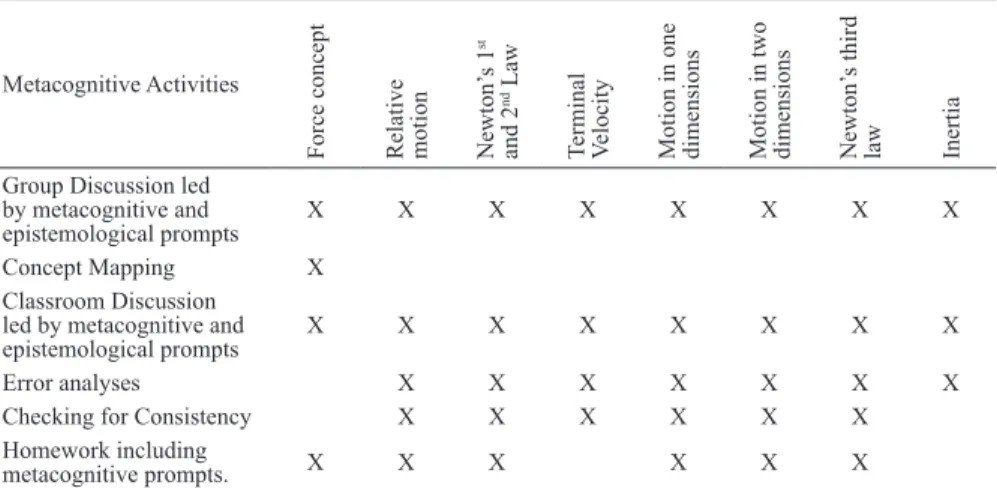
In the treatment period, force concept, relative motion, Newton’s first and second laws, terminal velocity, motion in one and two dimensions, Newton’s third law and inertia topics were covered. For each topic, the separate metacognitive 7E learning cycles were developed by the researchers. Table 3 shows metacognitive activities employed in the present study and the topics introduced by these activities. According to the table, the prompted small and whole group discussions were the most frequent activities
Table 3. Metacognitive activities and their occurrence across topics in force and motion unit.
Metacognitive Activities
Force concept Relative motion Newton’
s 1
st
and 2
nd Law
Terminal Velocity Motion in one dimensions Motion in two dimensions Newton’
s third
law Inertia
Group Discussion led by metacognitive and
epistemological prompts X X X X X X X X Concept Mapping X
Classroom Discussion led by metacognitive and
epistemological prompts X X X X X X X X
Error analyses X X X X X X X
Checking for Consistency X X X X X X Homework including
metacognitive prompts. X X X X X X
In this section, the treatment of experimental group was exemplified on one of the metacognitive 7E learning cycles of the study. This learning cycle is related to “rela-tive motion” topic lasted four-45 minute lessons. Both the experimental and control groups had a two-hour physics course a week. They took each one- hour lesson in two different days a week. In the first part of the learning cycle (the elicit phase), students worked individually and in group. In the work individually sub- part, students were asked to explain their reasoning on two questions. First question was a conceptual question while the second question was an epistemological question aiming to help students think about the importance of thinking about their errors in learning proces-ses. In work together sub-parts, students performed small group discussions. They were urged to discuss their answers to previous questions as a group. Students were prompted to explain why they think such a way and support their answers. In other words, students were encouraged to explain their thoughts to provide causal explana-tions about the phenomenon. The teacher walked among five groups to guide all stu-dents to participate in discussion and to explain their reasoning using metacognitive prompts such as “Do you agree with your friends”, “Does your friend’s explanation make sense to you”.
The engage phase of the learning cycle led students to make prediction about the motion of a car (Car A) relative to another car (Car B). Students individually predicted the observed motion of the Car A in the three different occasions.
In the explore phase of the learning cycle, students set up the experiment and tested their predictions. The teacher helped them to follow the instruction for the ex-periment. Students made experiment including three parts.
In the explain phase of the learning cycle, students shared their experiment results with classroom discussion. The teacher directed the classroom discussion using meta-cognitive prompts. After this discussion, the teacher explained relative motion using students’ expressions. At the end of this part, students employed a metacognitive stra-tegy, error analysis, to compare their predictions and the experiment results. In case of differences, students provided an explanation why they are wrong in their predictions. In the elaborate phase of the learning cycle, students applied relative motion con-cepts. They worked on conceptual questions as a group. Similar to the other part, the teacher guided students in this process as well.
In the extend phase, students worked on conceptual questions which required stu-dents to work on situations different from the situations in the explore and elaborate phases. Students first worked on conceptual questions which asked to apply the rela-tive motion concept into the motion with two-dimension. The second sub-parts of this stage addressed explicitly students’ epistemological understandings in physics. Stu-dents were provided two groups of questions. In the first group of questions, stuStu-dents’ intuition that being ahead implies gone faster led most of them to wrong answers whi-le in the second group of questions, the same intuitions whi-lead them to correct answers. Before the second group of question, students were requested to discuss what they do with the contradiction between common sense and physics. Students were asked to explain their responses as well.
Finally, in the evaluate phase, the same procedures in the elicit part were followed by the students but in addition, they applied the mistake catching strategy to evalu-ate their progress from the beginning of the learning cycle to the end of the learning cycle after small group discussions. After applying the mistake catching strategy, the teacher gave a homework which includes two parts. This is the time for the end of the metacognitive learning cycle related to relative motion topic. In the first part of the homework, students responded to a problem, then, they were asked how other people who don’t know physics might answer to this question and why they might respond like that. Finally, they answered whether there was a way to reconcile the common-sense idea underlying others’ reasoning with their own reasoning in this case. In the second part, students were prompted to think about their own learning during relative motion unit. For example, they were requested to compare what they had known with what they knew in relative motion after the learning cycle they were engaged.
On the other hand, control group was taught by the traditional physics instruction in which the teacher was firstly explained the topic by lecture and, then, teacher solved some example questions and asked the additional questions to students. Students were mostly in listener role, took note what the teacher said and writings in the blackboard. At the end of lessons, the teacher gave homework to students. The students in the control groups were made experiments for some topics as well. However, they made experiments after the teacher explained the topic .They did not make any predictions and the application of the mistake catching strategy. For example, for relative motion topic, the same experiment discussed in above was conducted in the control groups after the teacher explained the relative motion and solved some examples. The teacher helped the students set up their experiments. After they finished the experiment, the teacher asked students their results and asked wrote a report explaining what they did and found in the experiment. The students did not participate in prompted group and classroom discussions which were seen in the experimental groups.
3. Results
In this section, first, descriptive statistics of the study were presented; then, the results of inferential statistics were discussed.
Descriptive Statistics
In this study, four students were absent at the administration of the post-test. The-refore, these students were excluded from analysis of the data. Males included 45.6 % of the participants while females did 54.4 % after missing data analysis. Descriptive statistics of the study are presented in Table 4. On the MPEX-II, students can get 145 as the maximum possible score while they can obtain 29 as the minimum possible score. The mean scores of the groups differed from each other. The metacognitive le-arning cycle group had a higher mean score than the control group had. The skewness and kurtosis values of the variables were within the range of -2 and 2. Thus, it can be said that the scores on the all variables used in the study were normally distributed (George & Mallery, 2001).
Table 4. Descriptive statistics for the variables of the study
N Mean SD Skewness Kurtosis Min Max PREMPEX Control 51 83.45 14.45 0.32 0.32 55 121 Experimental 52 85.90 9.80 0.18 0.30 60 110 POSTMPEX Control 51 87.23 13.14 0.18 0.15 54 119 Experimental 52 99.91 14.70 -0.41 0.12 61 128
Cohen’s d, which is one of effect size (ES) indices, was calculated as .90 for post-test scores on the MPEX. The ES are large according to the threshold values proposed by Cohen (1988).
Selecting Covariates
Tabachnick and Fidell (2007) argue that selecting a set of covariates relies on two conditions. The first one is a theory explaining the relation of the covariate to the de-pendent variable. The theory can be obtained from literature regarding the variables in the particular study. The second condition is statistically determining the set of covari-ates. That is, selecting covariates low correlated with one another and high correlated with dependent variables. In this study, gender, the students’ prior understandings about force and motion unit and the students’ prior epistemological understandings in physics (PREMPEX) were considered as the covariates based on the literature. Ho-wever, only the PREMPEX variable was significantly correlated with the dependent variable (r = .30 p < .05). Therefore, the PREMPEX was identified as the covariate of this study, and the other variables were excluded from the covariates.
The results of One Way Analysis of Covariance Analysis (ANCOVA)
The ANCOVA was performed to explore the impact of the mode of instruction on the students’ POSTMPEX scores when their PREMPEX scores were controlled. All assumptions which are normality, linearity, homogeneity of regression slopes, ho-mogeneity of variance, for performing the ANCOVA were met. In this analysis, the independent variable was mode of instruction, the dependent variable included the POSTMPEX scores and the covariate included the PREMPEX scores. The results of the analysis indicated that there was a significant difference between two groups on the POSTMPEX scores when the PREMPEX scores were controlled. The instruction based on the metacognitive learning cycle was more effective than the teacher centered instruction for improving the students’ epistemological understandings in physics, F (1,100) = 19.97, p < .05, eta squared= .17. Partial eta squared value indicating effect size is large according to the guidelines proposed by Cohen (1988) (small = .01, medi-um = .06=, large = .14). The adjusted mean on the POSTMPEX was 87.64 for the cont-rol group while it was 99.52 for the experimental group. There was a statistically sig-nificant relationship between the students’ PREMPEX and POSTMPEX scores. The value of partial eta squared for this relationship was .08 which was medium effect size.
4. Discussion
This study investigated the impact of the metacognitive 7E learning cycle instruc-tion aiming to explicitly focus on students’ epistemological understandings in physics. The results of the ANCOVA indicated that the instruction based on metacognitive learning cycle was more effective than the teacher-centered instruction for promo-ting the students’ epistemological understandings in physics when their PREMPEX
scores were controlled. This result was compatible with the result of other studies (Brownlee, Purdie, & Boulton-Lewis, 2001; Elby, 2001; Gill, Ashton, and Algina., 2004; Kienhues, Bromme, and Stahl, 2008; Muis & Duffy, 2012; Redish & Hammer, 2009). All studies cited above provided evidence that explicit instruction promoted students’ epistemological understandings. The other studies were different from the current study. For example, all, except for Elby (2001) made studies with undergra-duate or graundergra-duate students. Another difference is that they, except for Elby (2001) and Redish and Hammer, 2009, applied their instructions in educational psychology or related courses.
A few studies focused on the metacognitive learning cycle in which the metacog-nitive prompts were integrated into the phases of the learning cycle (Blank, 2000; Ap-pamaraka et al., 2009; Sornsakda et al., 2009; Yildiz, 2008). As explained before, all studies employed similar metacognitive prompts based on Hennesey’s (1993) status check approaches. The current study is different from these studies in several ways. The first one is that they employed the same set of metacognitive prompts throughout the phases of the learning cycle. This might lead students to engage in similar kinds of metacognitive thinking in all stages of the instruction. However, in the current study, students were directed to engage in different kind of metacognitive thinking processes using various types of metacognitive prompts throughout the instruction. Another difference is that all metacognitive learning cycle studies did not aim to imp-rove students’ epistemological understandings. Thus, the current study suggests a new metacognitive learning cycle to the literature.
This study proposes several implications for teachers, other researchers, curricu-lum developers, and textbook writers based on results of the study. The results indi-cated that explicit emphasis on students’ epistemological understandings significantly improves their epistemological understandings in physics. Effect size obtained in the present study was large, which also shows that the study has a practical importance. Thus, teachers can use the instruction strategy discussed in this study to improve their students’ epistemological understandings. Other researchers can develop similar instruction strategies for other domains such as biology and chemistry to investigate the impacts on students’ epistemological understandings in related domains. Curricu-lum developers can write specific instructional objectives to have teachers explicitly use metacognitive activities in their inquiry-based instructions or other instructions. Textbook writers produce passages which address personal epistemologies of students by using metacognitive prompts. They also write teacher guidebooks to help teachers implement metacognitively and epistemologically prompted activities.
5. Acknowledgement
This study was supported by The Scientific and Technological Research Council of Turkey
6. References
Abd‐El‐Khalick, F., & Akerson, V. (2009). The influence of metacognitive training on pre-service elementary teachers’ conceptions of nature of science. International Journal of Science Education, 31(16), 2161-2184.
Abraham, M.R. (2003). The learning cyle approach as a strategy for instruction in sicence. In B. J. Fraser & K.G. Tobin (Eds.). International handbook of science education (pp. 513-524). Dordrecht, the Netherlands: Kluwer.
Açışlı, S., & Turgut, Ü. (2011). The examination of the influence of the materials generated in compliance with 5E learning model on physics laboratory applications. International Online Journal of Educational Sciences, 3(2), 562-593
Ağgül-Yalçın, F., & Bayrakçeken, S. (2010). The effect of 5E learning model on pre-service science teachers’ achievement of acids-bases subject. International Online Journal of Educational Sciences 2(2), 508-531.
Appamaraka, S., Suksringarm, P., & Singseewo, A. (2009). Effects of learning environmental education using the 5Es-learning cycle approach with the metacognitive moves and the teacher’s handbook approach on learning achievement, integrated science process skills and critical thinking of high school (grade 9) students. Pakistan Journal of Social Scien-ces, 6(5), 287-291.
Ates, S. (2005). The effectiveness of the learning-cycle method on teaching dc circuits to prospective female and male science teachers. Research in Science & Technological Edu-cation, 23(2), 213-227.
Baird, J. R., & White, R. T. (1984). Improving learning through enhanced metacognition: A classroom study. (Eric Document Reproduction Service No. ED 249250)
Baker, L. (1991). Metacognition, reading, and science education. In C.M. Santa and D.E. Alvermann (Eds.), Science learning: Processes and applications (pp. 2-13) Newark, DE: International Reading Association.
Balci, S., Cakiroglu, J., & Tekkaya, C. (2006). Engagement, exploration, explanation, ex-tension, and evaluation (5E) learning cycle and conceptual change text as learning tools. Biochemistry and Molecular Biology Education, 34(3), 199-203.
Barman, C. R., Barman, N. S., & Miller, J. A. (1996). Two teaching methods and students’ understanding of sound. School Science and Mathematics, 96(2), 63-67.
Bektas, O. (2010). The effect of 5E learning cycle model on tenth grade students’ understan-ding in the particulate nature of matter, epistemological beliefs and views of nature of science. Unpublished Doctoral Dissertation, Middle East Technical University, Ankara, Turkey.
Blank, L. M. (2000). Metacognitive learning cycle: A better warranty for students understan-ding. Science Education, 84, 486- 506.
Brownlee, J., Purdie, N., & Boulton-Lewis, G. (2001). Changing epistemological beliefs in pre-service teacher education students. Teaching in Higher Education, 6(2), 247-268. Bulbul, Y. (2010). Effects of 7E learning cycle model accompanied with computer animations
on understanding of diffusion and osmosis concepts. Unpublished Doctoral Dissertation, Middle East Technical University, Ankara, Turkey.
Bybee, R. W. (1997). Achieving scientific literacy: From purposes to practices. Portsmouth, NH: Heinemann.
Cakiroglu, J. (2006). The effect of learning cycle approach on students’ achievement in scien-ce. Eurasian Journal of Educational Research, 22, 61-73.
Ceylan, E., & Geban, O. (2009). Facilitating conceptual change in understanding state of matter and solubility concepts by using 5E learning cycle model. Hacettepe University Journal of Education, 36, 41-50.
Cherry, G. R. (2011).Analysis of Attitude and Achievement using the 5E Instructional Model in an Interactive Television Environment. (Doctoral dissertation). Available from ProQu-est Dissertations and Theses database. (UMI No.3455283)
Cobern, W. W., Schuster, D., Adams, B., Applegate, B., Skjold, B., Undreiu, A., & Gobert, J. D. (2010). Experimental comparison of inquiry and direct instruction in science. Research in Science & Technological Education, 28(1), 81-96.
Cohen, J. (1988). Statistical Power Analysis for the Behavioral Sciences (2nd Ed.). Hillsdale, NJ: Lawrence Earlbaum Associates.
Dikici, A., Türker, H. H., & Özdemir, G. (2010). 5E öğrenme döngüsünün anlamlı öğrenmeye etkisinin incelenmesi. Çukurova Üniversitesi Eğitim Fakültesi Dergisi, 3(39), 100-128. Dogru-Atay, P., & Tekkaya, C. (2008). Promoting students’ learning in genetics with the
lear-ning cycle. The Journal of Experimental Education, 76(3), 259-280.
Eisenkraft, A. (2003). Expending 5E model: A proposed 7E model emphasizes “ transfer of learning and importance of eliciting prior understanding. The Science Teacher, 70(6), 56- 59.
Elby, A. & Hammer, D. (2010). Epistemological resources and framing: A cognitive frame-work for helping teachers interpret and respond to their students’ epistemologies. In L. D. Bendixen & F. C. Feucht (Eds.), Personal Epistemology in the Classroom: Theory, Research, and Implications for Practice. Cambridge: Cambridge University Press, pp. 409-434.
Elby, A. (2001). Helping physics students learn how to learn. American Journal of Physics, Physics Education Research Supplement, 69(7), S54–S64.
Elby, A., McCaskey, T., Lippmann, R. and Redish, E. F. (2001). Retrieved from http://www. physics.umd.edu/perg/tools/attsur.htm
Farrell, J.J., Moog, R.S., & Spencer, J.N. (1999). A guided inquiry general chemistry course. Journal of Chemical Education, 76, 570–574.
George, D., & Mallery, P. (2003). SPSS for Windows Step By Step: A Simple Guide and Refe-rence (11.0 Update). Boston: Allyn and Bacon.
Georghiades, P. (2004). Making pupils’ conceptions of electricity more durable by means of situated metacognition. International Journal of Science Education, 26(1), 85-99. Georghiades, P. (2006). The role of metacognitive activities in the contextual use of primary
pupils’ conceptions of science. Research in Science Education, 36(1), 29-49.
Gill, M. G., Ashton, P. T., & Algina, J. (2004). Changing preservice teachers’ epistemological beliefs about teaching and learning in mathematics: An intervention study. Contemporary Educational Psychology, 29(2), 164-185.
Hammer, D. M. (1994). Epistemological beliefs in introductory physics. Cognition and Ins-truction, 12(2), 151-183.
Harurluoğlu, Y., & Kaya, E. (2011). The effect of learning cycle model on the achievements and retention levels of pre-service science teachers in seed-fruit-flower topics. Iğdır Uni-versity Journal of the Institute of Science and Technology, 1(4), 43-50
Hennessey, M. (1993). Students’ ideas about their conceptualization: Their elicitation through instruction. Paper presented at the annual meeting of the National Association for Rese-arch in Science Teaching, Atlanta, GA.
Hennessey, M. G. (1999). Probing the dimensions of metacognition: implications for concep-tual change teaching-learning. (Eric Document Reproduction Service No. ED 446921). Hofer, B. K., & Pintrich, P. R. (1997). The development of epistemological theories: Beliefs
about knowledge and knowing and their relation to learning. Review of Educational Re-search, 67(1), 88-140.
Hogan, K. (1999). Relating students’ personal frameworks for science learning to their cogni-tion in collaborative contexts. Science Educacogni-tion, 83(1), 1-32.
Kanli, U., & Yagbasan, R. (2008). The effects of a laboratory based on the 7E learning cycle model with verification laboratory approach on students’ development of science process skills and conceptual achievement. Essays in Education, 22 143-153.
Karplus, R., &. Their, H .D. (1967). A New Look at Elementary School Science. Chicago: Rand McNally.
Kaynar, D., Tekkaya, C., & Cakiroglu, J. (2009). Effectiveness of 5E learning cycle instructi-on instructi-on students’ achievement in cell cinstructi-oncept and scientific epistemological beliefs. Hacet-tepe University Journal of Education, 37, 96-105.
Kienhues, D., Bromme, R., & Stahl, E. (2008). Changing epistemological beliefs: The unex-pected impact of a short‐term intervention. British Journal of Educational Psychology, 78(4), 545-565.
Köseoğlu, F., & Tümay, H. (2010). The effects of learning cycle method in general chemistry laboratory on students’ conceptual change, attitude and perception. Journal of Kirsehir Education Faculty, 11(1), 279-295.
Lin, X., & Lehman, J. D. (1999). Supporting learning of variable control in a computer‐based biology environment: Effects of prompting college students to reflect on their own thin-king. Journal of Research in Science Teaching, 36(7), 837-858.
Liu, T. C., Peng, H., Wu, W. H., & Lin, M. S. (2009). The effects of mobile natural-science learning based on the 5E learning cycle: A case study. Educational Technology & Society, 12 (4), 344–358.
Marek, E.A., & Cavallo, A. M. L. (1997). The learning cycle: Elementary school science and beyond. Portsmouth, NH: Heinemann.
Mecit, O. (2006). The effect of 7E learning cycle model on the improvement of fifth grade stu-dents’ critical thinking skills, Unpublished Doctoral Dissertation, Middle East Technical University, Ankara, Turkey.
Michalsky, T., Mevarech, Z. R., & Haibi, L. (2009): Elementary School Children Reading Scientific Texts: Effects of Metacognitive Instruction. The Journal of Educational Rese-arch, 102:5, 363-376
Mittlefehldt, S., & Grotzer, T. A. (2003, March). Using metacognition to facilitate the transfer of causal models in learning density and pressure. Paper presented at National Association of Research in Science Teaching Conference.
Muis, K. R., & Duffy, M. C. (2012, August 13). Epistemic Climate and Epistemic Chan-ge: Instruction Designed to Change Students’ Beliefs and Learning Strategies and Imp-rove Achievement. Journal of Educational Psychology. Advance online publication. doi:10.1037/a0029690
Parker, V., & Gerber, B. (2000). Effects of a Science Intervention Program on Middle‐Grade Student Achievement and Attitudes. School Science and Mathematics, 100(5), 236-242. Peters, E., & Kitsantas, A. (2010). The effect of nature of science metacognitive prompts on
science students’ content and nature of science knowledge, metacognition, and self‐regu-latory efficacy. School Science and Mathematics, 110(8), 382-396.
Polyiem, T., Nuangchalerm,P., & Wongchantra, P. (2011). Learning achievement, science pro-cess skills, and moral reasoning of ninth grade students learned by 7E learning cycle and socioscientific issue-based learning. Australian Journal of Basic and Applied Sciences, 5(10): 257-564,
Redish, E. F., & Hammer, D. (2009). Reinventing college physics for biologists: Explicating an epistemological curriculum. American Journal of Physics, 77(7), 629- 642.
Redish, E. F., Saul, J. M., & Steinberg, R. N. (1998). Student expectations in introductory physics. American Journal of Physics, 66, 212–224.
Sandoval, W. A. (2005). Understanding students’ practical epistemologies and their influence on learning through inquiry. Science Education, 89(4), 634-656.
Schraw, G., Crippen, K. J., & Hartley, K. (2006). Promoting self-regulation in science edu-cation: Metacognition as part of a broader perspective on learning. Research in Science Education, 36, 111-139.
Siribunnam, R., & Tayraukham, S. (2009). Effects of 7-E, KWL and conventional instruction on analytical thinking, learning achievement and attitudes toward chemistry learning. Jo-urnal of Social Sciences, 5(4), 279-282.
Sornsakda, S., Suksringarm, P., & Singseewo, A. (2009). Effects of learning environmental education using the 7E-learning cycle with metacognitive techniques and the teacher’s handbook approaches on learning achievement, integrated science process skills and cri-tical thinking of mathayomsuksa 5 students with different learning achievement. Pakistan Journal of Social Sciences, 6(5), 297-303.
Sriwattanarothai, N., Jittam, P., Ruenwongsa, P., & Panijpan, B.(2009) From research on local materials to the learning of science: An inquiry-based laboratory for undergraduates. The International Journal of Learning, 16(6), 459-473.
Tabachnick, B. G., & Fidell, L. S. (2007). Using multivariate statistics. (Fifth Ed.). Boston: Pearson Education, Inc.
Temel, S., Dincol-Ozgur,S., & Yilmaz, A (2012). The effect of learning cycle model on pre-service chemistry teachers’ understanding of oxidation reduction topic and thinking skills. Necatibey Faculty of Education Electronic Journal of Science and Mathematics Educa-tion, 6(1), 287-305.
Tien, L. T. (1998). Fostering expert inquiry skills and beliefs about chemistry through the MORE laboratory experience. (Doctoral dissertation). Available from ProQuest Disserta-tions and Theses database. (UMI No. 9902256).
Trowbridge, L.W., Bybee, R.W., & Powell, J.C. (2004). Teaching secondary school science: Strategies for developing scientific literacy (8th ed.). New Jersey: Pearson.
Turgut, U., & Gurbuz, F (2011). Effects of teaching with 5E model on students’ behaviors and their conceptual changes about the subject of heat and temperature. International Online Journal of Educational Sciences, 3(2), 679-706.
White, B. Y., & Frederiksen, J. R. (1998). Inquiry, Modeling and Metacognition: Making Science Accessible To All Students. Cognition and Instruction, 16(1), 3-118
Yerdelen-Damar, S., Elby, A., & Eryilmaz, A. (2012). Applying beliefs and resources frame-works to the psychometric analyses of an epistemology survey. Physical Review Special Topics-Physics Education Research, 8(1), 010104.
Yildiz, E. (2008). The effects of metacognition during the instruction based on conceptual change used with 5e model: an application regarding the force and motion subject in the 7th grade. Unpublished Doctoral Dissertation, Dokuz Eylul University, Izmir, Turkey. Yuruk, N., Beeth, M. E., & Andersen, C. (2009). Analyzing the effect of metaconceptual
teaching practices on students’ understanding of force and motion concepts. Research in Science Education, 39(4), 449-475.