161 ACES JOURNAL, VOL. 27, NO. 2, FEBRUARY 2012
Rigorous Analysis of Double-Negative Materials with the Multilevel
Fast Multipole Algorithm
Ozgiir ErgiiP and Lèvent
^Department of Mathematics and Statistics University of Strathclyde, Gl lXH, Glasgow, UK
^Department of Electrical and Electronics Engineering ^Computational Electromagnetics Research Center (BiLCEM)
Bilkent University, TR-06800, Bilkent, Ankara, Turkey [email protected]
Abstract — We present rigorous analysis of double-negative materials (DNMs) with surface integral equations and the multilevel fast multipole algorithm (MLFMA). Accuracy and efficiency of numerical solutions are investigated when DNMs are formulated with two recently developed formulations, i.e., the combined tangential formulation (CTF) and the electric and magnetic current combined-field integral equation (JMCFIE). Simulation results on canonical objects are consistent with previous results in the literature on ordinary objects. MLFMA is also parallelized to solve extremely large electromagnetics problems involving DNMs.
Index Terms — Double-negative materials, metamaterials, multilevel fast multipole algorithm, surface integral equations.
I. INTRODUCTION
Double-negative materials (DNMs) are com-monly used as simplified models of metamate-rials at resonance frequencies [1]. Specifically, a metamaterial structure at a resonance frequency can be modeled (homogenized [2]) as a homo-geneous object with negative permittivity and permeability. Using the equivalence principle, a DNM can be formulated with surface integral equations, which can be discretized and solved nu-merically. Recently, various surface formulations.
such as the Poggio-MiUer-Chang-Harrington-Wu-Tsai (PMCHWT) formulation [3], the Müller for-mulation [4], and the electric and magnetic current combined-field integral equation (JMCFIE) [5], have been used to analyze DNMs [6],[7]. It has been shown that homogenization can provide fast analysis of metamaterial structures before their detailed analysis via full-wave solvers [8].
Although electromagnetics problems obtained via homogenization are relatively easy compared to the original problems, their efficient solutions may not be trivial. Surface integral equations re-quire only the discretization of boundaries, but the resulting matrix equations can be very large be-cause realistic metamaterials are usually large with respect to wavelength. Hence, fast and efficient methods, such as the multilevel fast multipole algorithm (MLFMA) [9]-[13], are required for the solution of large metamaterial problems, even when they are homogenized. Applying MLFMA to homogeneous materials, including DNMs, is straightforward, but the number of iterations must be small for efficient solutions, and thus the choice of the surface formulation is critical for efficient solutions.
In this paper, we present iterative solutions of DNMs using MLFMA. Problems are formulated with two recently developed formulations, namely, the combined tangential formulation (CTF) [14] and JMCFIE [5], and discretized with the Rao-Wilton-Glisson (RWG) functions [15]. Accuracy and efficiency of numerical solutions are
investi-Submitted On: Oct. 21, 2011 Accepted On: Jan. 27, 2012
gated on canonical problems involving the sphere geometry. We show that the conventional JMC-FIE (with a = 0.5 combination parameter) pro-vides efficient solutions but relatively inaccurate results. In addition, accuracy of simulations can significantly be improved using CTF, instead of JMCFIE. These observations are consistent with earlier results obtained for ordinary materials [16]. We also show that the combination parameter of
JMCFIE can be increased towards unity to im-prove the accuracy of JMCFIE, without sacrificing the efficiency. Finally, MLFMA is parallelized using the hierarchical partitioning strategy [17] to solve very large problems involving DNMs. The resulting implementation based on JMCFIE (with high combination parameter) and parallel MLFMA seems to be a suitable solver for the fast
and accurate analysis of DNMs.
II. NUMERICAL SOLUTIONS OF SURFACE FORMULATIONS
For homogeneous penetrable objects, discretiza-tions of surface formuladiscretiza-tions lead to 27V x dense matrix equations in the form of
(1)
Using JMCFIE and a Galerkin discretization.
(2)
for a = 1,2 and b = 1,2, where tm and 6„ represent the testing and basis functions with spatial supports of Sm and Sn, respectively, for m,n = 1,2,...,AT. The combined operators are defined as
+ (1 - a)ñ X (ICo - ICi) - (1 - a)I (3)
añxñx
a ñ X ñ X {rioKo + r/j/Cj)
(4)
(5)
where a G [0,1] is the combination parameter, ñ is the unit normal vector at the observation point r, and r]u = ^ / / ^ / y ^ is the wave impedance in the outer (u = o) and inner (u = i) media. The integro-differential operators are defined as
ÍK I dr'bnir')gu{r,r') (6)
f dr'bnir')xV'gu{r,r'), (7)
JP
where PV indicates the principal value of the integral, ku = ojy/e^y/jm, is the wavenumber, and
— r
denotes the homogeneous-space Green's function in the phasor domain using the e~*'^* time depen-dence. The elements of the right-hand-side vectors in (1) are derived similarly as
(9)
for a = 1,2, where
xñx E'^-^ir) (10)
-\-aT]oñxñxH''"'{r). (11) In (10) and (11), E'""" and iî'"'^ represent the incident electric and magnetic fields created by external sources located in the outer medium.
JMCFIE is a mixed formulation involving directly and rotationally tested electromagnetic fields. Using a Galerkin discretization (using the same set of the RWG functions as the basis and testing functions), JMCFIE involves a well-tested identity operator, i.e..
— /
•/Sr, = /
JS
j ô{r,r')bn{r'), (12)
which is a major error source for low-order dis-cretizations [18]. CTF can be seen as a special case of JMCFIE and it is obtained by setting163 ACES JOURNAL, VOL. 27, NO. 2, FEBRUARY 2012
a = 1 in (3H5), (10), and (11). Note that well-tested identity operators disappear in CTF; this explains why it is more accurate than JMCFIE.
Employing the conventional formulations, such as PMCHWT and JMCFIE, for DNMs is exten-sively discussed in [6],[7]. Using ku = w y ^ ^ / T ^ and r¡u = -/¡hl/y/ëZ leads to negative wavenum-ber and positive wave impedance when the per-mittivity (e„) and permeability (/x«) are negative. In order to construct a tree structure for a DNM, we use the absolute value of ku in the excess bandwidth formula, i.e.,
Ti,u ~ 1.73\ku\ai + 2.16(do)'/^(|A;„|a^)^^^ (13) to determine truncation numbers TI^U and samples on the unit sphere. In (13), ai is the box size at level I and cío is the number of accurate digits for the far-field interactions.
III. NUMERICAL RESULTS
In order to test the accuracy and efficiency of solutions of DNMs with MLFMA, we con-sider increasingly large scattering problems in-volving a sphere of radius 0.3 m. The object is located in free space and illuminated by plane waves at various frequencies. Problems are for-mulated with CTF and JMCFIE and discretized with the RWG functions on Ao/10 triangles, where Xo is the wavelength in the host medium (free space). Both near-field and far-field interactions are calculated with maximum 1% error. Solutions are performed using the biconjugate-gradient-stabilized (BiCGStab) algorithm [19] accelerated with MLFMA. Iterative convergences are also accelerated with the four-partition block-diagonal preconditioner (4PBDP) [16] for the conventional JMCFIE (a = 0.5).
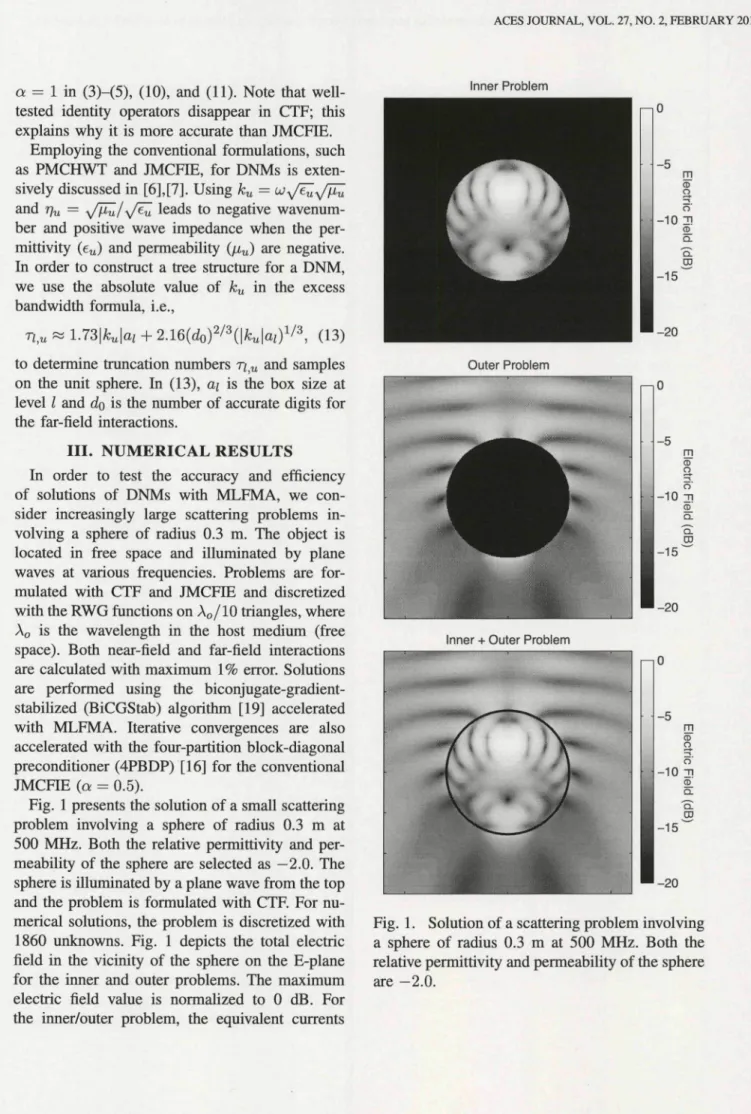
Fig. 1 presents the solution of a small scattering problem involving a sphere of radius 0.3 m at 500 MHz. Both the relative permittivity and per-meability of the sphere are selected as —2.0. The sphere is illuminated by a plane wave from the top and the problem is formulated with CTF. For nu-merical solutions, the problem is discretized with 1860 unknowns. Fig. 1 depicts the total electric field in the vicinity of the sphere on the E-plane for the inner and outer problems. The maximum electric field value is normalized to 0 dB. For the inner/outer problem, the equivalent currents
Inner Problem - 2 0 Outer Problem - 5 m CD o - 1 0 -15 ' - 2 0 Inner + Outer Problem
- 5 1-10 3 'S S 1-15 ' - 2 0
Fig. 1. Solution of a scattering problem involving a sphere of radius 0.3 m at 500 MHz. Both the relative permittivity and permeability of the sphere are - 2 . 0 .
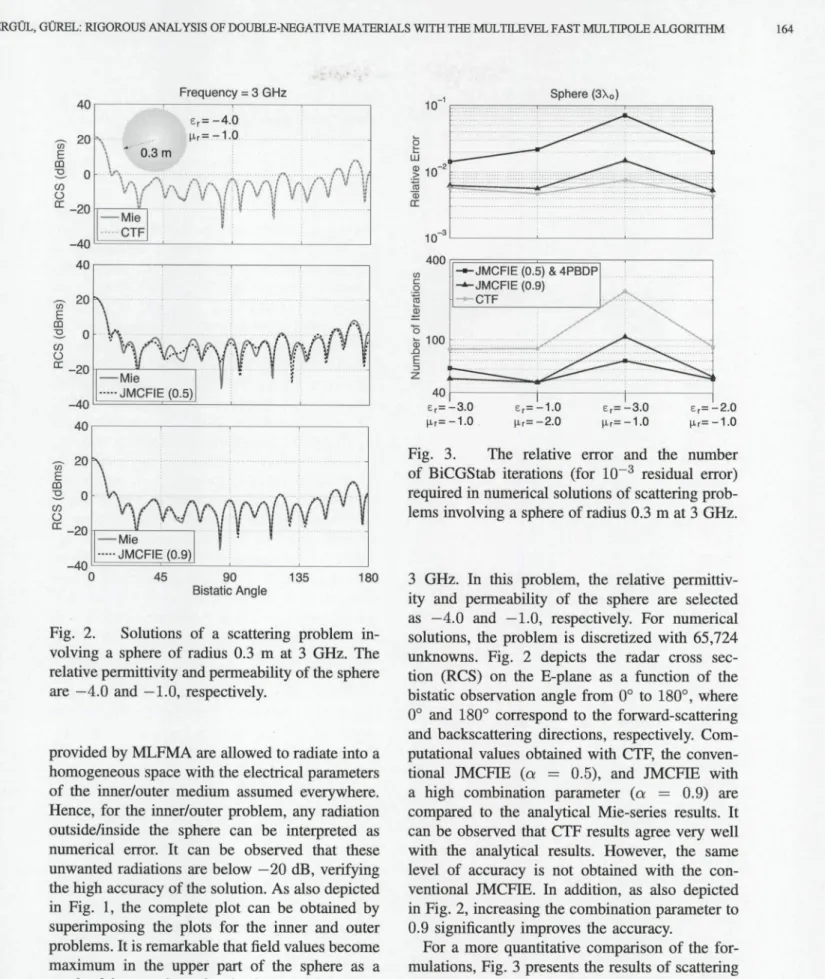
Frequency = 3 GHz Sphere (3Xo) 20 -20 -40 40 - 20 — Mie JMCFIE (0.5) m CO o ce- 2 0 - 4 0 MÍG JMCFIE (0.9) ' ^' • • • ^ 45 90 Bistatic Angle 135 180
Fig. 2. Solutions of a scattering problem in-volving a sphere of radius 0.3 m at 3 GHz. The relative permittivity and permeability of the sphere are —4.0 and —1.0, respectively.
provided by MLFMA are allowed to radiate into a homogeneous space with the electrical parameters of the inner/outer medium assumed everywhere. Hence, for the inner/outer problem, any radiation outside/inside the sphere can be interpreted as numerical error. It can be observed that these unwanted radiations are below —20 dB, verifying the high accuracy of the solution. As also depicted in Fig. 1, the complete plot can be obtained by superimposing the plots for the inner and outer problems. It is remarkable that field values become maximum in the upper part of the sphere as a result of the negative refractive index of the object. Fig. 2 presents the solution of a scattering problem involving a sphere of radius 0.3 m at
-JMCFIE (0.5) & 4PBDP -JMCFIE (0.9)
CTF
Fig. 3. The relative error and the number of BiCGStab iterations (for 10~^ residual error) required in numerical solutions of scattering prob-lems involving a sphere of radius 0.3 m at 3 GHz.
3 GHz. In this problem, the relative permittiv-ity and permeabilpermittiv-ity of the sphere are selected as —4.0 and —1.0, respectively. For numerical solutions, the problem is discretized with 65,724 unknowns. Fig. 2 depicts the radar cross sec-tion (RCS) on the E-plane as a funcsec-tion of the bistatic observation angle from 0° to 180°, where 0° and 180° correspond to the forward-scattering and backscattering directions, respectively. Com-putational values obtained with CTF, the conven-tional JMCFIE (Q = 0.5), and JMCFIE with a high combination parameter (a = 0.9) are compared to the analytical Mie-series results. It can be observed that CTF results agree very well with the analytical results. However, the same level of accuracy is not obtained with the con-ventional JMCFIE. In addition, as also depicted in Fig. 2, increasing the combination parameter to 0.9 significantly improves the accuracy.
For a more quantitative comparison of the for-mulations. Fig. 3 presents the results of scattering problems involving a sphere with different mate-rial properties. A sphere of radius 0.3 m is again investigated at 3 GHz and discretized with 65,724
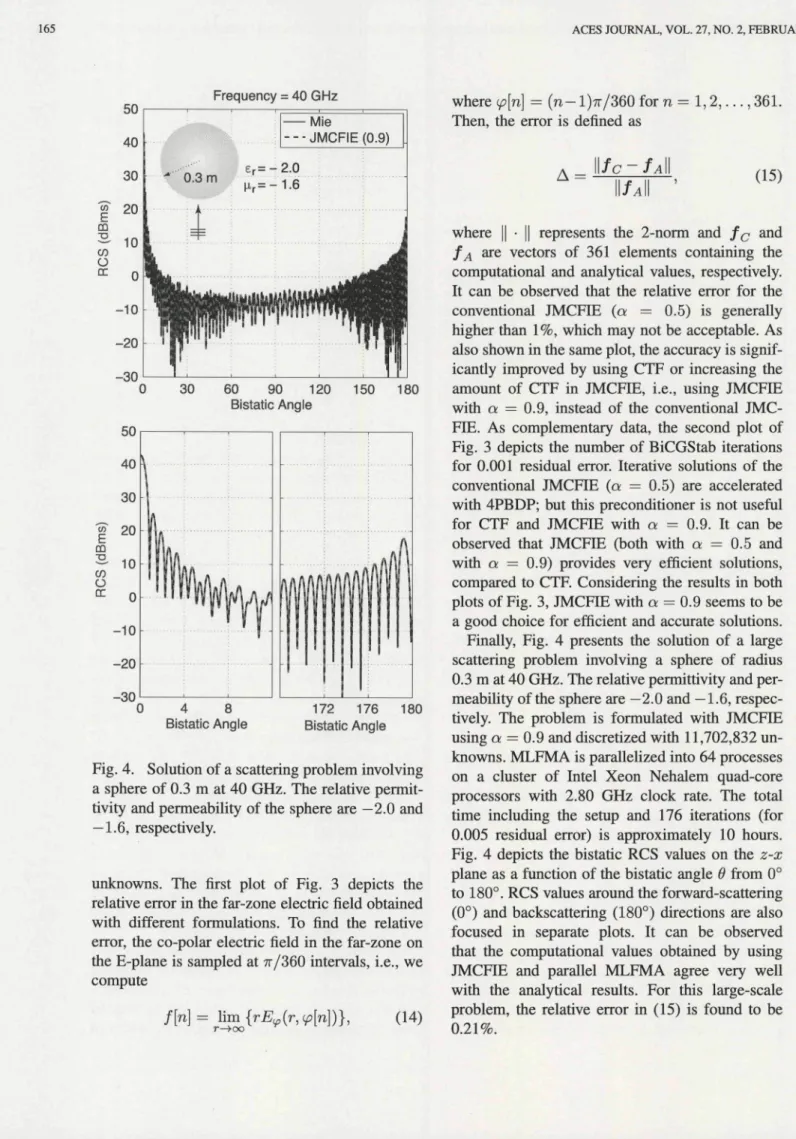
165 ACES JOURNAL, VOL. 27, NO. 2, FEBRUARY 2012 50 40 30 20 10 0 -10 -20 -30 Frequency = 40 GHz Mie - - - J M C F I E (0.9)
where ip[n] = ( n - l)7r/360 forn = 1,2,..., 361. Then, the error is defined as
30 60 90 120 150 180 Bistatic Angle 4 8 Bistatic Angle 172 176 180 Bistatic Angle
Fig. 4. Solution of a scattering problem involving a sphere of 0.3 m at 40 GHz. The relative permit-tivity and permeability of the sphere are —2.0 and — 1.6, respectively.
unknowns. The first plot of Fig. 3 depicts the relative error in the far-zone electric field obtained with different formulations. To find the relative error, the co-polar electric field in the far-zone on the E-plane is sampled at 7r/360 intervals, i.e., we compute
f[n]= lim {rE^{r,ip[n])}, (14)
Wfc-fAW
(15)where || • || represents the 2-norm and fQ and / ^ are vectors of 361 elements containing the computational and analytical values, respectively. It can be observed that the relative error for the conventional JMCFTE (a = 0.5) is generally higher than 1%, which may not be acceptable. As also shown in the same plot, the accuracy is signif-icantly improved by using CTF or increasing the amount of CTF in JMCFTE, i.e., using JMCFIE with a = 0.9, instead of the conventional JMC-FTE. As complementary data, the second plot of Fig. 3 depicts the number of BiCGStab iterations for 0.001 residual error. Iterative solutions of the conventional JMCFTE (a = 0.5) are accelerated with 4PBDP; but this preconditioner is not useful for CTF and JMCFTE with a = 0.9. It can be observed that JMCFIE (both with a = 0.5 and with a = 0.9) provides very efficient solutions, compared to CTF. Considering the results in both plots of Fig. 3, JMCFIE with a = 0.9 seems to be a good choice for efficient and accurate solutions. Finally, Fig. 4 presents the solution of a large scattering problem involving a sphere of radius 0.3 m at 40 GHz. The relative permittivity and per-meability ofthe sphere are —2.0 and —1.6, respec-tively. The problem is formulated with JMCFTE using a = 0.9 and discretized with 11,702,832 un-knowns. MLFMA is parallelized into 64 processes on a cluster of Intel Xeon Nehalem quad-core processors with 2.80 GHz clock rate. The total time including the setup and 176 iterations (for 0.005 residual error) is approximately 10 hours. Fig. 4 depicts the bistatic RCS values on the z-x plane as a function of the bistatic angle 9 from 0° to 180°. RCS values around the forward-scattering (0°) and backscattering (180°) directions are also focused in separate plots. It can be observed that the computational values obtained by using JMCFIE and parallel MLFMA agree very well with the analytical results. For this large-scale problem, the relative error in (15) is found to be 0.21%.
IV. CONCLUSIONS
This paper presents the analysis of DNMs with surface integral equations and MLFMA. Numer-ical results obtained with conventional formula-tions are in agreement with previous results ob-tained for ordinary materials. Numerical exper-iments on canonical objects show that JMCFIE with a = 0.9 is a good choice for efficient and accurate solutions.
ACKNOWLEDGMENT
This work was supported by the Scien-tific and Technical Research Council of Turkey (TUBITAK) under Research Grants 110E268 and 111E203, by the Centre for Numerical Algorithms and Intelligent Software (EPSRC-EP/G036136/1), by the Engineering and Physical Sciences Re-search Council (EPSRC) under ReRe-search Grant EP/J007471/1, and by contracts from ASELSAN and SSM.
REFERENCES
[1] G. Monti and L. Tarricone, "Dispersion anal-ysis of a negative group velocity medium with MATLAB," ACES J., vol. 24, no. 5, pp. 478^86, Oct. 2009.
[2] H. Kettunen, J. Qi, H. Wallen, and A. Sihvola, "Homogenization of thin dielec-tric composite slabs: techniques and limita-tions," ACES J., vol. 26, no. 3, pp. 179-187, Mar. 2011.
[3] A. J. Poggio and E. K. Miller, "Integral equation solutions of three-dimensional scat-tering problems," in Computer Techniques for Electromagnetics, R. Mittra, Ed. Oxford:
Pergamon Press, 1973, Chap. 4.
[4] C. Müller, Foundations of the Mathemati-cal Theory of Electromagnetic Waves. New York: Springer, 1969.
[5] P. Ylä-Oijala and M. Taskinen, "Applica-tion of combined field integral equa"Applica-tion for electromagnetic scattering by dielectric and composite objects," IEEE Trans. Antennas Propagat-, vol. 53, no. 3, pp. 1168-1173, Mar. 2005.
[6] Y. A. Liu and W. C. Chew, "StabUity of sur-face integral equation for left-handed materi-als," IET Microw. Antennas Propag., vol. 1, no. 1, pp. 84-89, Mar. 2007.
[7] J. Rivero, J. M. Taboada, L. Landesa, F. Obelleiro, and I. Garcia-Tunon, "Surface integral equation formulation for the analysis of left-handed metamaterials," Opt. Express, vol. 18, no. 15, pp. 15876-15886, Jul. 2010. [8] L. Gürel, Ö. Ergül, A. Ünal, and T. Malas, "Fast and accurate analysis of large metama-terial structures using the multilevel fast mul-tipole algorithm," Prog. Electromagn. Res., vol. 95, pp. 179-198, 2009.
[9] J. Song, C.-C. Lu, and W. C. Chew, "Multi-level fast multipole algorithm for electromag-netic scattering by large complex objects," IEEE Trans. Antennas Propag-, vol. 45, no. 10, pp. 1488-1493, Oct. 1997.
[10] J. Lee, J. Zhang, and C.-C. Lu, "Perfor-mance of preconditioned Krylov iterative methods for solving hybrid integral equations in electromagnetics," ACES J., vol. 18, no. 4, pp. 54-61, Nov. 2003.
[11] R. J. Burkholder, P. H. Pathak, K. Sertel, R. J. Marhefka, and J. L. Volakis, "A hy-brid framework for antenna/platform analy-sis," ACES J., vol. 21, no. 3, pp. 177-195, Nov. 2006.
[12] M. Vikram and B. Shanker, "An incom-plete review of fast multipole methods-from static to wideband-as applied to problems in computational electromagnetics," ACES J-, vol. 24, no. 2, pp. 79-108, Apr. 2009. [13] H. Fangjing, N. Zaiping, and H. Jun, "An
efficient parallel multilevel fast multipole algorithm for large-scale scattering prob-lems," ACES J., vol. 25, no. 4, pp. 381-387, Apr. 2010.
[14] P. Ylä-Oijala, M. Taskinen, and S. Järvenpää, "Surface integral equation formulations for solving electromagnetic scattering problems with iterative methods," Radio Sei., vol. 40, RS6002, doi: 10.1029/2004RS003169, Nov. 2005.
[15] S. M. Rao, D. R. Wilton, and A. W. Glisson, "Electromagnetic scattering by surfaces of arbitrary shape," IEEE Trans. Antennas Propag, vol. 30, no. 3, pp. 409-418, May 1982.
[16] Ö. Ergiil and L. Gürel, "Comparison of integral-equation formulations for the fast
167 ACES JOURNAL, VOL. 27, NO. 2, FEBRUARY 2012
and accurate solution of scattering problems involving dielectric objects with the multi-level fast multipole algorithm," IEEE Trans. Antennas Propag., vol. 57, no. 1, pp.
176-187, Jan. 2009.
[17] Ö. Ergül and L. Gürel, 'A hierarchical partitioning strategy for an efficient paral-lelization of the multilevel fast multipole algorithm," IEEE Trans. Antennas Propag., vol. 57, no. 6, pp. 1740-1750, Jun. 2009. [18] Ö. Ergül and L. Gürel, "Discretization error
due to the identity operator in surface integral equations," Comput. Phys. Comm., vol. 180, no. 10, pp. 1746-1752, Oct. 2009.
[19] H. van der Vorst, "Bi-CGSTAB: A fast and smoothly converging variant of Bi-CG for the solution of nonsymmetric linear sys-tems," SIAM J. Sei. Stat. Comput., vol. 13, no. 2, pp. 631-644, Mar. 1992.
Özgür Ergül received B.Sc, M.S., and Ph.D. degrees from Bilkent University, Ankara, Turkey, in 2001, 2003, and 2009, respectively, all in electrical and electronics engineering. He is currently a lecturer in the Department of Mathematics and Statistics at the University of Strathclyde, Glasgow, UK. He is also a lecturer of the Centre for Numerical Algorithms and Intelligent Software (NAIS), an EPSRC/SFC funded centre.
Dr. Ergül served as a Teaching and Research Assistant in the Department of Electrical and Elec-tronics Engineering at Bilkent University from 2001 to 2009. He was also affiliated with the Computational Electromagnetics Group at Bilkent University from 2000 to 2005 and with the Computational Electromagnetics Research Center (BiLCEM) from 2005 to 2009. His research inter-ests include fast and accurate algorithms for the solution of electromagnetics problems involving large and complicated structures, integral equa-tions, parallel programming, iterative methods, and high-performance computing.
Dr. Ergül is a recipient of the 2007 IEEE Anten-nas and Propagation Society Graduate Fellowship, the 2007 Leopold B. Felsen Award for Excellence in Electrodynamics, the 2010 Serhat Ozyar Young Scientist of the Year Award, and the 2011 URSI Young Scientists Award. He is the coauthor of more than 140 journal and conference papers.
Lèvent Gürel (Fellow of
ACES, IEEE, and EMA) is the Director of the Computational Electromagnetics Research Center (BiLCEM) at Bilkent University, Ankara, Turkey. He received the B.Sc. degree from the Middle East Technical University (METU), Ankara, Turkey, in 1986, and the M.S. and Ph.D. degrees from the University of Illinois at Urbana-Champaign (UIUC) in 1988 and 1991, respectively, in electrical and computer engineering. He joined the IBM Thomas J. Watson Research Center, Yorktown Heights, New York, in 1991, where he worked as a Research Staff Member. Since 1994, he has been a faculty member in the Department of Electrical and Electronics Engineering of the Bilkent University, Ankara, where he is currently a Professor. He was a Visiting Associate Professor at the Center for Computational Electromagnetics (CCEM) of the UIUC for one semester in 1997. He returned to the UIUC as a Visiting Professor in 2003-2005, and as an Adjunct Professor for several years after 2005. He founded the Computational Electromagnetics Research Center (BiLCEM) at Bilkent University in 2005. Prof. Gürel's research interests include the development of fast algorithms for computational electromagnetics (CEM) and the application thereof to scattering and radiation problems involving large and complicated scatterers, antennas and radars, optical and imaging systems, nanostructures, and metamaterials. Since 2006, his research group has been breaking several world records by solving extremely large integral-equation problems.
Among the recognitions of Prof. Gürel's accom-plishments, the two prestigious awards from the
Turkish Academy of Sciences (TUBA) in 2002 and the Scientific and Technical Research Coun-cil of Turkey (TUBITAK) in 2003 are the most notable. He is currently serving as an associate editor for Radio Science, IEEE Antennas and Wireless Propagation Letters, Journal of Electro-magnetic Waves and Applications (JEMWA), and Progress in Electromagnetics Research (PIER). He is a member of the USNC of the International Union of Radio Science (URSI) and the Chair-man of Commission E (Electromagnetic Noise and Interference) of URSI Turkey National Com-mittee. He served as a member of the General Assembly of the European Microwave Association (EuMA) during 2006-2008. Prof. Gürel served as the Chairman of the AP/MTT/ED/EMC Chap-ter of the IEEE Turkey Section in 2000-2003. He founded the IEEE EMC Chapter in Turkey in 2000. He served as the Cochairman of the 2003 IEEE International Symposium on Electro-magnetic Compatibility. Prof. Gürel is a member of the ACES Board of Directors and the Guest Editor for a special issue of the ACES Journal. He is the organizer and General Chair of the CEM'O7, CEM'O9, and CEM'll Computational Electromagnetics International Workshops held in 2007-2011 in Izmir, Turkey. He is named an IEEE Distinguished Lecturer for 2011-2013 and invited to address the 2011 ACES Conference as a Plenary Speaker.