THE REPUBLIC OF TURKEY
BAHÇEŞEHİR UNIVERSITY
THE PERSPECTIVES OF THE
OWNERS/MANAGERS OF THE SMEs
OPERATING IN PRINTING SECTOR IN ANKARA
ON THE CONCEPT AND OBSTACLES OF
INSTITUTIONALIZATION
Master ThesisNİRAY TUNÇEL
THE REPUBLIC OF TURKEY
BAHÇEŞEHİR UNIVERSITY
THE GRADUATE SCHOOL OF SOCIAL SCIENCES
M.A. PROGRAM IN MARKETING
THE PERSPECTIVES OF THE
OWNERS/MANAGERS OF THE SMEs
OPERATING IN PRINTING SECTOR IN ANKARA
ON THE CONCEPT AND OBSTACLES OF
INSTITUTIONALIZATION
Master ThesisNİRAY TUNÇEL
Thesis Supervisor: ASST. PROF. ELİF KARAOSMANOĞLU
iii
ACKNOWLEDGEMENTS
I want to thank my father, Muzaffer Tunçel, for his efforts to arrange the interviews with his colleagues who are honorable entrepreneurs of printing sector in Ankara. I also want to thank to these eight entrepreneurs for allocating their time for my interviews and answering my questions sincerely. And, my advisor, Dear Elif Karaosmanoğlu, thanks to you for your help and guidance throughout this process. Also, Dear Mehmet Akça, thank you for your contribution to the design of my thesis.
Hope, this study will guide and help other researchers and contribute to overcome the obstacles of institutionalization in Turkish SMEs.
Sincerely,
iv ABSTRACT
THE PERSPECTIVES OF THE OWNERS/MANAGERS OF THE SMEs OPERATING IN PRINTING SECTOR IN ANKARA ON THE CONCEPT AND
OBSTACLES OF INSTITUTIONALIZATION Tunçel Niray
M.A. Program in Marketing
Thesis Supervisor: Asst. Prof. Elif Karaosmanoğlu January 2011, 85 pages
Small and medium enterprises (SMEs) are expectant to be institutionalized to cope with the obstacles related to uncertainty and growth. It is a fact that the term “institutionalization” is attributed variety of different contents and meanings in Turkish context. The main purpose of this paper is to understand the perspectives of the entrepreneur managers of the SMEs towards the concept of institutionalization and its obstacles. The paper firstly explains the concept of the SME, institutionalization and obstacles. Then, the study is qualitative in nature which presents primary data collected through ten in-depth interviews, eight of them are with the owners/managers of the SMEs in printing sector in Ankara who are determined according to the convenience sampling method and the rest of two is with the chairman of Ankara Chamber of Printers, Binders and Craftsmen and the general secretary of Istanbul Chamber of Printers, Binders and Craftsmen.
The interviews with the chairman of Ankara Chamber of Printers, Binders and Craftsmen and the general secretary of Istanbul Chamber of Printers, Binders and Craftsmen focus on the printing sector, institutionalization and SMEs in the sector. The interviews with the owners/managers focus on the concept of institutionalization and barriers. In accordance with the collected data, the similarities and differences on how they define the concept of institutionalization and barriers are intended to reveal. Institutionalization is associated with various terms such as sustainability, rules and standards, growth and professional management and it is confirmed that there are similarities and differences among the perspectives of the owners/managers. It is also determined that obstacles pertaining to institutionalization are seen as similar and different financial, managerial, human resources, production and sector specific factors. Even the owners/managers have a knowledge and interest in institutionalization at a certain level but not adequate, that may be claimed to influence institutionalization attempts negatively and to cause paradoxes related to remedies. In accordance with the data gathered in this research, the paper concludes with the implications related to the institutionalization and the printing sector SMEs, theoretical contribution of the study and recommendations to the policy makers and managers.
v ÖZET
ANKARA’DA MATBAA SEKTÖRÜNDE FAALİYET GÖSTEREN KOBİ SAHİP VE YÖNETİCİLERİNİN KURUMSALLAŞMA KAVRAMI VE DARBOĞAZLARI
HAKKINDAKİ GÖRÜŞLERİ Tunçel Niray
Pazarlama Yüksek Lisans Programı Tez Danışmanı: Yrd. Doç. Elif Karaosmanoğlu
Ocak 2011, 85 sayfa
Küçük ve orta büyüklükteki işletmelerin (KOBİ’lerin) belirsizlik ve büyümeyle ilgili darboğazları aşabilmeleri için kurumsallaşmaları beklenir. Bu açıdan bakıldığında, Türkçe kaynaklarda “kurumsallaşma” terimine çok çeşitli içerik ve anlamlar yüklenmektedir. Bu çalışmanın amacı, KOBİ sahip ve yöneticilerinin kurumsallaşma kavramı ve darboğazları üzerindeki görüşlerini anlamaktır. Çalışmada öncelikle KOBİ kavramı, kurumsallaşma ve darboğazları açıklanmaktadır. Çalışma nitel araştırma deseninde olup verileri elde edebilmek amacıyla on kişiyle derinlemesine mülakat yapılarak gerçekleştirilmiştir. Bunlardan sekizi kolay ulaşılabilir durum örneklemesi yöntemiyle belirlenen Ankara’da matbaa sektöründe faaliyet gösteren KOBİ sahip ve yöneticileriyle, ikisi ise Ankara Matbaacılar, Ciltçiler ve Sanatkârlar Odası Başkanı ve İstanbul Matbaacılar, Ciltçiler ve Sanatkârlar Odası Genel Sekreteriyle gerçekleştirilmştir.
Ankara Matbaacılar, Ciltçiler ve Sanatkârlar Odası Başkanı ve İstanbul Matbaacılar, Ciltçiler ve Sanatkârlar Odası Genel Sekreteri’yle olan görüşmelerde matbaa sektörü, kurumsallaşma ve sektördeki KOBİ’lere ağırlık verilmiştir. Sahip ve yöneticilerle yapılan görüşmelerde kurumsallaşma kavramı ve darboğazları üzerinde durulmuş ve elde edilen veriler doğrultusunda kurumsallaşma kavramını ve darboğazlarını nasıl tanımladıkları ile ilgili farklar ve benzerlikler ortaya konulmaya çalışılmıştır. Kurumsallaşma süreklilik, kurallar ve standartlar, büyüme ve profesyonel yönetim gibi terimlerle ilişkilendirmiş, söz konusu sahip ve yöneticilerin görüşleri arasında benzerlikler ve farklılıklar olduğu tespit edilmiştir. Kurumsallaşmaya ait darboğazların ise finansal, yönetimsel, insan kaynakları, üretim ve sektöre özel benzer ve farklı faktörler olarak görüldüğü belirlenmiştir.
Sahip ve yöneticiler kurumsallaşma hakkında belli bir bilgi ve alaka düzeyine sahip olsalar dahi bunun yeterli olmadığı ve bu durumun kurumsallaşma isteğini olumsuz etkilediği ve çözümlere yönelik çelişkilere neden olduğu söylenebilir. Sonuç olarak, bu araştırmada elde edilen veriler doğrultusunda kurumsallaşma ve matbaa sektöründeki KOBİ’lere yönelik çıkarımlar, çalışmanın kuramsal katkısı ve politika oluşturanlar ve yöneticilere yönelik öneriler yer almaktadır.
Anahtar Kelimeler: Kurumsallaşma, KOBİ’ler, Sahip ve Yöneticiler, Darboğazlar, Matbaa Sektörü
vi
TABLE OF CONTENTS
LIST OF TABLES ...ix
ABBREVIATIONS ... x
1. INTRODUCTION... 1
2. LITERATURE RESEARCH ... 3
2.1. SMEs ... 3
2.1.1. Definition of the SME ... 3
2.1.2. Increasing Importance of SMEs... 9
2.1.3. Place of SMEs in World Economy ... 12
2.1.4. Characteristics of SMEs... 15
2.1.4.1. Qualitative Characteristics of SMEs... 16
2.1.4.1.1. Qualitative characteristics of SMEs related to the entrepreneur ... 16
2.1.4.1.2. Qualitative characteristics of SMEs related to the management function ... 18
2.1.4.1.3. Qualitative characteristics of SMEs related to the finance function ... 20
2.1.4.1.4. Qualitative characteristics of SMEs related to the marketing function... 21
2.1.4.1.5. Qualitative characteristics of SMEs related to the production function... 23
2.1.4.1.6. Qualitative characteristics of SMEs related to the human resource function... 24
2.1.4.2. Quantitative characteristics of SMEs ... 26
2.1.5. SMEs in Turkey ... 27
2.1.5.1. Fundamental weaknesses of the SME sector in Turkey ... 29
2.2. THE CONCEPT OF INSTITUTIONALIZATION ... 30
2.2.1. Different Perspectives about Institutionalization ... 30
2.2.2. Institutionalization in SMEs ... 32
2.2.3. Obstacles of Institutionalization in SMEs ... 33
3. THE RESEARCH DESIGN AND METHOD... 37
vii
3.2. RESPONDENT SELECTION... 37
3.3. DATA COLLECTION METHOD : INTERVIEW TECHNIQUE ... 38
4. ANALYSIS AND FINDINGS ... 40
4.1. PRINTING SECTOR... 40
4.1.1. History ... 40
4.1.2. Current Situation... 41
4.1.3. SMEs in the sector and the Institutionalization... 43
4.1.3.1. Obstacles of institutionalization in printing sector SMEs... 44
4.1.3.2. Chambers and the institutionalization in printing sector SMEs... 46
4.2. THE CONCEPT OF INSTITUTIONALIZATION ... 47
4.2.1. General Information about the Respondents and the SMEs... 47
4.2.2. Perspectives on the Concept of Institutionalization ... 49
4.2.2.1. Definition ... 49
4.2.2.2. Potential advantages and disadvantages ... 52
4.2.2.3. Steps for Institutionalization ... 56
4.2.2.4. Obstacles of institutionalization ... 60
5. CONCLUSION AND DISCUSSION ... 67
5.1. INSTITUTIONALIZATION AND SMEs IN PRINTING SECTOR... 67
5.1.1. Definition of the Institutionalization... 67
5.1.2. Advantages and Disadvantages of the Institutionalization... 68
5.1.3. Steps for Institutionalization ... 68
5.1.4. Obstacles of the Institutionalization ... 69
5.1.5. Paradoxes related to the Concept of Institutionalization... 70
5.2. THEORETICAL CONTRIBUTION OF THE STUDY ... 71
5.3. RECOMMENDATIONS FOR POLICY MAKERS AND MANAGERS ... 73
viii
APPENDICES ... 82 APPENDIX 1 – In Depth Interview Questions with the Chairman of Ankara Chamber of Printers, Binders and Craftsmen and the General Secretary of Istanbul Chamber of Printers, Binders and Craftsmen ... 83 APPENDIX 2 – In Depth Interview Questions with the Owners/Managers.. 84 APPENDIX 3 - Questionnaire ... 85
ix
LIST OF TABLES
Table 2.1 : Criteria that the countries consider while determining their SME
definitions... 3
Table 2.2 : SME definitions of different countries in Europe... 4
Table 2.3 : SME definition of EU... 6
Table 2.4 : SME definitions used in Turkey ... 7
Table 2.5 : SME definition of Turkey adapted to EU’s 8 (with respect to the regulation) ... 8
Table 2.6 : Basic facts about SMEs and large enterprises in Europe ... 12
Table 2.7 : Places of SMEs in some countries’ economies... 14
Table 2.8 : The Range of enterprises and employment with respect to the size of enterprises in some countries... 15
Table 2.9 : Qualitative characteristics of SMEs ... 26
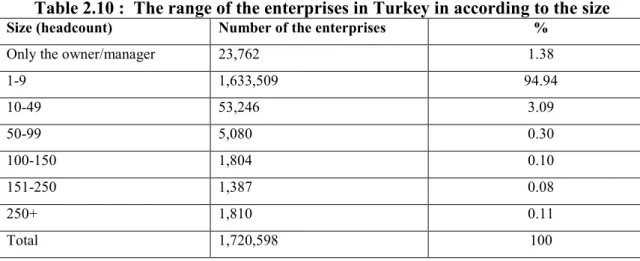
Table 2.10 : The Range of the enterprises in Turkey according to the size... 28
Table 4.1 : Obstacles of institutionalization in printing sector based on the perspectives of the chairman of Ankara Chamber of Printers, Binders and Craftsmen and the general secretary of Istanbul Chamber of Printers, Binders and Craftsmen ... 46
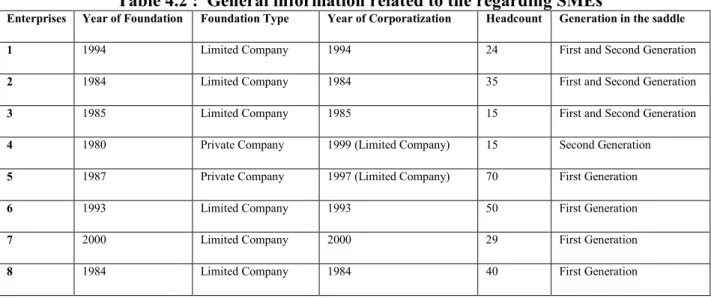
Table 4.2 : General information related to the regarding SMEs... 48
Table 4.3 : General information about the respondents... 48
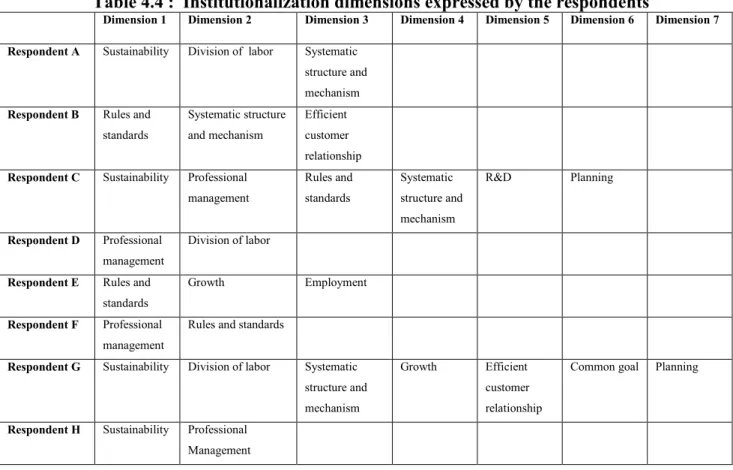
Table 4.4 : Institutionalization dimensions expressed by the respondents... 52
Table 4.5 : Advantages and disadvantages of institutionalization based on the perspectives of the respondents... 56
Table 4.6 : Steps for institutionalization according to the perspectives of the respondents... 60
Table 4.7 : Obstacles of institutionalization according to the perspectives of the owners/managers ... 66
x
ABBREVIATIONS
Ankara Chamber of Industry (Ankara Sanayi Odası) : ASO
European Statistics Office : EUROSTAT European Union : EU
International Organization for Standardization : ISO Organization for Economic Co-operation and Development : OECD Research and Development : R&D Small and Medium Industry Development Organization : KOSGEB (Küçük ve Orta Ölçekli İşletmeleri Geliştirme ve Destekleme
Daire Başkanlığı)
Small and Medium Sized Enterprise : SME, KOBİ (Küçük ve Orta Ölçekli İşletme)
Turkish Banking Regulation and Supervision Agency : BDDK (Bankacılık Düzenleme ve Denetleme Kurulu)
Turkish Republic Prime Ministry State Planning Organization : DPT (Devlet Planlama Teşkilatı)
Turkish State Planning Organization - Small and Medium Sized : KOBİ ÖİK Enterprise Specialization Commission
Turkish Statistics Institute (Türkiye İstatistik Kurumu, : TURKSTAT, TÜİK
Devlet İstatistik Enstitüsü) DİE
Turkish Standards Institute (Türk Standardları Enstitüsü) : TSE United Kingdom : UK United States of America : USA Value Added Tax : VAT
1. INTRODUCTION
Most of the operating firms in Turkey, as well as in other countries, are small and medium enterprises (SMEs) (Akgemci 2001). SMEs are the impulsive power of the economy and international competition in many countries (Ulukan 2005, p. 30). In Turkey, even if the SMEs make a significant contribution to both total value added and employment, they face many problems related to finance, management, human resource, production and many other issues. Most of the SMEs are tend to overcome their problems on their own as much as their resource let them (Ulukan 2005, p. 30). Entrepreneurs, managers, academicians, business consultants are in consensus that solution of problems of the SMEs can only be possible with institutionalization. However, there are too many perspectives on institutionalization, which cause a concept clutter and institutionalization to be regarded as a complicated concept (Ulukan 2005, p. 30).
Even if being an institutionalized firm is a wish of the owners/managers of SMEs, the previously conducted researches show that the most important problem of SMEs is not to be able to get institutionalized (Karpuzoğlu 2000; Okur 2003; Tetik and Uluyol 2005). It is because there are several obstructive factors that prevent SMEs to progress in institutionalization process. Therefore, the importance of institutionalization and obstacles are actual subjects that are considered.
According to another research that is conducted with 150 high level managers (Fındıkçı 2007), nearly all of the respondents (94 percent) state that there are institutionalization and planning problems in their companies. These problems in question are assumed to be related to the wrong assumption and lack of information (Çakıcı and Özer 2008, p. 42).
This research aims to address the concept of institutionalization and obstacles from the perspectives of owners/managers and focuses on the SMEs in printing sector in Ankara. The paper firstly explains the concept of the SME including its definition, importance and place in world economy, characteristics. Then, SMEs in Turkey focusing on the weakness of SME sector is depicted. And then, the concept of institutionalization in
2
literature is considered with regard to the different perspectives on definition, institutionalization and obstacles in SMEs.
The following section then gives the analysis of the research, which is conducted by in-depth interview technique with the chairman of Ankara Chamber of Printers, Binders and Craftsmen, the general secretary of Istanbul Chamber of Printers, Binders and Craftsmen and the owners/managers of SMEs in printing sector.
Findings related to the sector, institutionalization and SMEs in the sector and findings related to the perspectives of the owners/managers on the concept of institutionalization are given respectively. The paper concludes with the implications about institutionalization and SMEs in printing sector, theoretical contribution of the study and recommendations for policy makers and owners/managers of SMEs.
3
2. LITERATURE RESEARCH
In this part, firstly the concept of the SME including its definition, importance and place in world economy, and characteristics are examined. Then, SMEs in Turkey focusing on the weakness of SME sector is depicted. And then, different perspectives about institutionalization in national and international basis, institutionalization in SMEs, and obstacles of institutionalization in SMEs are focused on respectively.
2.1. SMEs
2.1.1. Definition of the SME
The concept of the SME is used in almost all countries. The extent of which the concept means differs across countries related to the economy, industrialization level, market size and production method used (Karataş 1991). Also, countries put various policies and programs to increase the contribution of SMEs to the economy as well as; to determine the target group of those policies and programs; hence they develop their own definitions of SMEs (Alpugan 1994, pp. 3-6).
Countries, in the frame of their policies and resources, determine their SME definitions based on some significant factors such as capital amount, headcount and turnover (Cansız 2008, p. 3). Criteria of some countries’ definitions are given in Table 2.1. Table 2.1 : Criteria that the countries consider while determining their SME definitions
Countries Bangladesh,
Indonesia, Ghana, India, Nepal, Nigeria, Kenya, Sri Lanka Brazil, Malaysia, OECD Thailand EU, USA, Philippines
Japan, Peru, Sudan Turkey,
Venezuela Criteria
Capital Headcount Turnover + Capital
+ Headcount Source: Sanayi Politikaları Özel İhtisas Komisyonu Raporu, DPT, 2000, p. 82, 83 As it is seen from the table, countries use different criteria to define SMEs. In some countries, such as the USA, there is no formal definition of SMEs. However, headcount and turnover are the most important criteria to define SMEs.
4
SBA (Small Business Administration), which has operated since 1920 in the USA usually, adopts number of employees and turnover as definition criteria. For instance, in textile sector SBA accepts 250 employees and 9.5 million dollars turnover as the maximum limit to define a company as a small enterprise. (Müftüoğlu 2007, p. 111) In European countries, there are different definitions of the SME. For instance, In Italy, enterprises that employ at most 250 workers are considered SMEs. Besides, if a company has a professional manager, it is classified as a big enterprise. Classification factors of some European countries are exhibited below in Table 2.2.
Table 2.2 : SME definitions of different countries in Europe
Size Headcount Turnover Balance Sheet
Micro 1-19 (included) Small 20-99 (included) Medium 100-250 (included) Italy
Big >250
Small < 50 < £ 5,6 million < £ 2,8 million England
Medium < 250 < £ 22,8 million < £ 11,4 million Small 1 - 49 (included) Medium 50 - 249 (included) France Big ≥ 250 Small 1-49 (included) Germany Medium 50-249 (included)
Source: Adnan Çelik, Tahir Akgemci, (2007). Girişimcilik Kültürü ve Kobi’ler, Ankara: Gazi Kitabevi, Genişletilmiş 2.B., p. 118, 119
In England, SME definition is written in Company Law. According to the law, to classify a firm as SME, it has to provide at least two of the criteria above in Table 2.2. In statistical use, the Ministry of Trade and Industry of England usually uses the definition below:
Micro size: Firms that have 0-9 employees
5
Medium size: Firms that have 50-249 employees Big size: Firms that have more than 250 employees
In France, SMEs are defined as the companies, managers of which undertake financial, technical, social, moral, and legal obligations personally and directly and also, based on the headcount, they are separated into different sizes (Celik and Akgemci 2007, p. 118) as it is shown in Table 2.2.
SME definition in Germany, which is dependent on various industries, headcount and, annual sales revenue, has been changed in order to comply with EU. As a result, the final SME definition is now based on headcount as it is in two other countries, France and Italy, shown in Table 2.2.
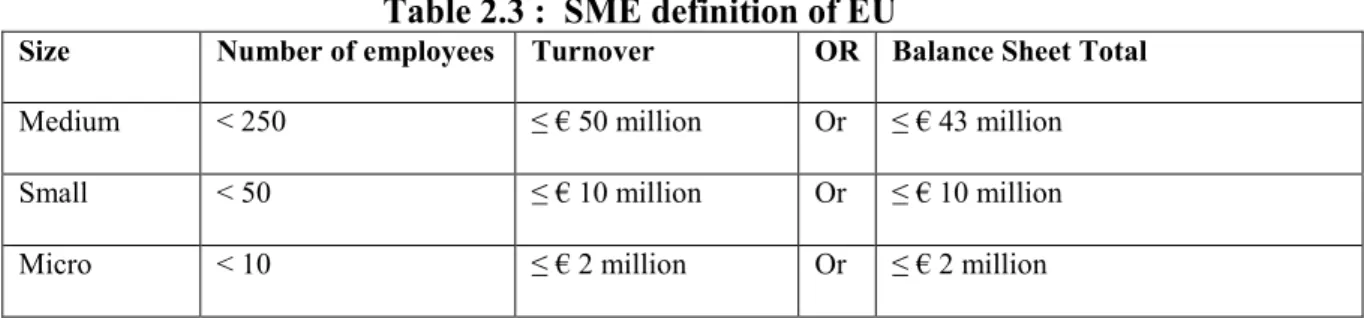
As it is seen from Table 2.2, in many countries firms that have less than 250 employees are considered SMEs but still, definitions differ among countries. EU, not to cause any confusion in neither national nor union bases, for the first time in 1997, developed a SME definition valid for all EU countries and became effective in 1998. This definition classified SMEs in three groups; Micro, small and medium size enterprises. This classification was based on four criteria three of which are quantitative and one is qualitative respectively; headcount, balance sheet amount, turnover and autonomy criteria. Then, these criteria were changed in following years. Personnel and autonomy criteria were remained while balance sheet amount and turnover criteria were pushed up. As well, until the final definition, for micro size enterprises, no numerical value was given for balance amount and turnover criteria but in final definition made in 2005, balance amount and turnover criteria were determined for micro size enterprises. Eventually in 2005, EU, as a single market, developed a common SME definition that is shown in Table 2.3.
6
Table 2.3 : SME definition of EU
Size Number of employees Turnover OR Balance Sheet Total
Medium < 250 ≤ € 50 million Or ≤ € 43 million
Small < 50 ≤ € 10 million Or ≤ € 10 million
Micro < 10 ≤ € 2 million Or ≤ € 2 million
Source : http://ec.europa.eu/enterprise/policies/sme/facts-figures-analysis/sme-definition/index_en.htm
Enterprises qualify as micro, small and medium-sized enterprises (SMEs) if they fulfill the criteria which are summarized in Table 2.3. In addition to the staff headcount ceiling, an enterprise qualifies as an SME if it meets either the turnover ceiling or the balance sheet ceiling, but not necessarily both.
Also, according to the autonomy criterion which is a qualitative one, an enterprise has to be autonomous to be classified as an SME.
Your enterprise is autonomous, if it is totally independent, if it has no participation in other enterprises and no enterprise has a participation in yours. It is also autonomous if it has a holding of less than 25% of the capital or voting rights (whichever is the higher) in one or more other enterprises and/or outsiders do not have a stake of 25% or more of the capital or voting rights (whichever is the higher) in your enterprise. (European Commission 2005, p. 16)
As all other countries, Turkey had different SME definitions until it developed one that was adapted to EU’s. Generally legal SME definitions were generated based on quantitative properties. Definitions that have been developed and used up till now are shown in Table 2.4.
7
Table 2.4 : SME definitions used in Turkey
Note: Assuming EUR 1 = TRL 1, 700 000.
Source: Adnan Çelik, Tahir Akgemci, (2007). Girişimcilik Kültürü ve Kobi’ler, Ankara: Gazi Kitabevi, Genişletilmiş 2.B., p. 111
Institution Definition scope Definition Criterion Micro-sized Enterprise Small-sized Enterprise Medium-sized Enterprise
KOSGEB Manufacturing Industry Headcount _ 1-50 51-150
Halkbank Manufacturing industry, tourism, software development Headcount Fixed investment amount (EUR) - - - - 1-250
Total: Less than 600 billion TL Undersecretariat of Treasury Manufacturing Industry, tourism, agricultural industry, education, health, software development Headcount Investment amount which is subjected in SME Incentive Certificate (EUR) Autonomy Criterion 1-9 - - 10-40 350 Billion TL - 50-250
Less than 950 billion TL
Capital amount that is owned by other enterprises less than 25% Undersecretariat of Foreign Trade Manufacturing Industry Headcount Fixed Investment amount (EUR) - - - - 1-200
Before 2000 less than $1,8 million; after 2000 less than $2 million EximBank Manufacturing Industry Headcount Fixed Investment amount (EUR) - - - - 1-200
Less than $2 million
8
Above, limited number of SME definition is given. Besides them, there are a lot of different definitions. In Table 2.4, it is seen that each institution determines different limitations for headcount, investment amount and sales revenue defining SME. Here, the most important characteristic of the definitions is that they are related to the sectors and this restricts enterprises in some sectors to benefit from some reinforcements and privileges.
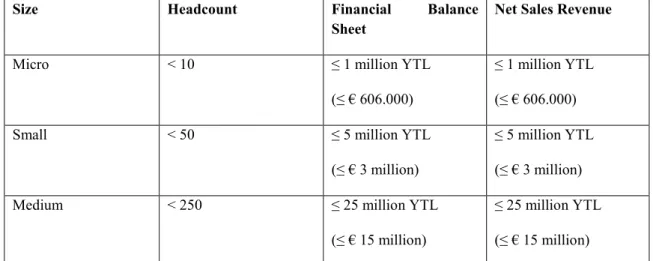
Finally, to avoid any confusion, to create a comprehensive definition, which includes all sectors, and comply with the SME definition of EU, in 2005, Turkey developed a new SME definition that is shown in Table 2.5.
Table 2.5 : SME definition of Turkey adapted to EU’s (with respect to the regulation)
Size Headcount Financial Balance
Sheet
Net Sales Revenue
Micro < 10 ≤ 1 million YTL
(≤ € 606.000)
≤ 1 million YTL (≤ € 606.000)
Small < 50 ≤ 5 million YTL
(≤ € 3 million)
≤ 5 million YTL (≤ € 3 million)
Medium < 250 ≤ 25 million YTL
(≤ € 15 million)
≤ 25 million YTL (≤ € 15 million)
Source: Küçük ve Orta Büyüklükteki İşletmelerin Tanımı, Nitelikleri ve Sınıflandırılması Hakkında Yönetmelik, Karar Sayısı: 2005/9617 R.G. Tarih ve No: 18.11.2005 / 25997
As it is shown above, according to the regulation concerned with SME definition adapted to EU’s, to classify an enterprise as an SME, it is supposed to have less than 250 employees and a financial balance sheet or net sales revenue less than 25 million YTL. Also, it must not be a linked enterprise included in group of a big company. As well, it is necessary to indicate that in the SME definition above; there is no sector-related discrimination as it was the point in definitions of some institutions. This is a constructive improvement. Thus, in addition to the manufacturing industry, many others are involved in the content of new definition.
9 2.1.2. Increasing Importance of SMEs
As globalization and international competition emerged in the last quarter of 20th century and have increased their effects, resources that give competitive advantage to companies and nation have changed. In other words, globalization that is parallel with the technological development puts forward that economies are supposed to have different qualifications today to carry their businesses to the world market level and obtain competitive advantage (Bayrak and Akdis, 2000).
Accordingly, economies of scale that provide competitive advantage to companies traditionally have begun to lose its importance. This idea, which is especially promoted by the economist Schumpeter supports that big companies play a very important role on mass production and fast increase in production. According to Schumpeter, costs can be reduced by the production in large capacity facilities, profitability can be increased by internal and external savings and therefore competitive advantage can be gained (Bayrak and Akdiş 2000).
However, since 60s, breakdowns in economical data, the sharp increase in energy prices specifically in industrialized countries and in relate onto this, increase in input costs and shortage in demand volume caused the extinction of the stability model that is dependent on big-sized enterprises. However, it also caused the small and medium sized enterprises, which survived in competitive war with flexibility, diversity and nimbleness, to gain strength and spread over (Bayrak and Akdiş 2000).
The author of Global Paradox, John Naisbitt (1994, p.8) summarizes this process as “The bigger the world economy, the more powerful its smallest players”. Naisbitt (1994) also states that there is a transition from the economies of scale to the non-economies of scale. The bigger players are not better any more. On contrast, they are less effective, high costly, unnecessarily bureaucratic, far from flexibility, more terrible. Paradox is that passing to the global frame in a broader area, smaller and faster players will be more successful.
As a result of long-continuing crisis, although large number of big companies collapsed, positive characteristics of SMEs such as being flexible, able to maneuver and change made them more attractive. Besides, SMEs, as a result of the changes in economic structure and the effects caused by technological re-structuring, increase their
10
importance by creating net and more job opportunities than the big ones do (Ekin 1996, p. 70). Many research conducted in both EU and the USA shows that SMEs respond the economic recovery earlier, adapt themselves changing business conditions quickly and keep their capacities in more effective level (Karataş 1991, p. 272).
SMEs are considered one of the strongest parts of the economy rather than a problem. Before, these enterprises were considered as the indicators of paralyzed economic structure but today, they are seen as the guarantee for dynamism and flexibility in a country’s economy. As everything is changing very quickly, these characteristics are very significant for economic success (Müftüoğlu 2007, p. 36).
SMEs do not only have economic importance but also have social and political importance. From social aspect, the importance of SMEs is widely accepted due to their contribution to the employment, middle-class characteristics. Their role on dynamic structure that makes social transition easier increases their importance. Moreover, SMEs are one of the fundamental elements of middle-class theory in sociology. From political aspect, SMEs are accepted to be a guarantee for employment and an assurance for democracy. In the country of coalitions, such as Italy, permanency of democratic system is related to the strong structure of SMEs (Müftüoğlu 2007, p. 37).
In the world of which everything is in a permanent change process, it is recognized that this trend has accelerated in recent years not only in technological areas but also in economic and social areas. This fast change phenomenon demonstrates its impacts on the evaluation of SMEs and perspectives about them. The most significant elements of this change process rooted in science and technology for SMEs since 70s are:
i. The developments in non-mechanic technology especially in electronic technology decreased the importance of big sized machines. Or, with its name in economic terminology, economies of scale have decreased its importance (Müftüoğlu 2007, p. 32).
ii. Radical changes in transportation, communication and information technologies have brought new qualifications to marketing, financial accounting, finance, planning and, governance areas (Friedman 2006).
11
iii. Information itself has become a production factor and researches aimed at implementation have become favorable and implementation of innovations has become faster (OECD 2004, p. 13).
iv. The role that science and technology play created “techno-parks”. Business cooperation and flow of information have been a pushing power for small players. Science-technology integration has engendered big-jumps in production systems (Friedman 2006).
v. Automation applications have become widespread, mental power of human has outshined rather than physical power and, decision making and creativeness traits have risen in consideration. Moreover, innovations have augmented value added products in SMEs (Akdiş and Bayrak 2000).
vi. World markets have taken the place of national markets. Demand diversification has risen and demand gaps that small enterprises can target have emerged. These demand gaps named “niche” consist of huge opportunities for SMEs and fresh investments (Müftüoğlu 2007, p. 33).
vii. Widespread independency conscious and individualism trend have been a motivating factor for people who have entrepreneurship potential to start their own businesses (Akdiş and Bayrak, 2000).
viii. There has been a transition from centralization to de-centralization, from representative democracy to participating democracy (Müftüoğlu 2007, p. 33). ix. “Self-sufficiency” phenomenon makes running business independently, being
business men/women and entrepreneurs more favorable and SME entrepreneurship accelerates progressively (Moore and Buttner 1997, pp. 8-9). x. As a result of privatization policies, transportation, catering, cleaning and such
services have been taken over by SMEs (Müftüoğlu 2007).
Müftüoğlu (2007, p. 33) states that changes listed above can be best expressed by E.F. Schumacher’s book (1973) entitled as “Small is Beautiful” which has been a widespread slogan representing all those changes all over the world. Due to those reasons, importance of SMEs has been far greater than before.
12 2.1.3. Place of SMEs in World Economy
Take a look at any big company. Now, look back through time and track down when the company actually began. Not too many were born the size of the National Federal Bank or Procter&Gamble. Almost every company we know of began as an SME. The all-powerful Microsoft began as a couple of guys in a small garage in North-America; Vodafone as we know it today was once a little spin-off from Racal; Hewlett-Packard started in a little wood shack; Google was begun by a couple of young kids who thought they had a good idea; even Volkswagen at one point was just a little car maker in Germany (as opposed to being a giant small car maker globally). (Lukacs, 2005, p. 3)
Lukacs (2005, p. 3) stated the importance of SMEs as a starting point with these sentences. SMEs have become a really important part of the world economy with their fast growth capabilities, regional development roles, and contributions to decrease the unemployment and provide new job areas. Due to these positive sides and many others, SMEs maintain a considerable role in economic and social development of the countries (Cansız 2008, p. 1).
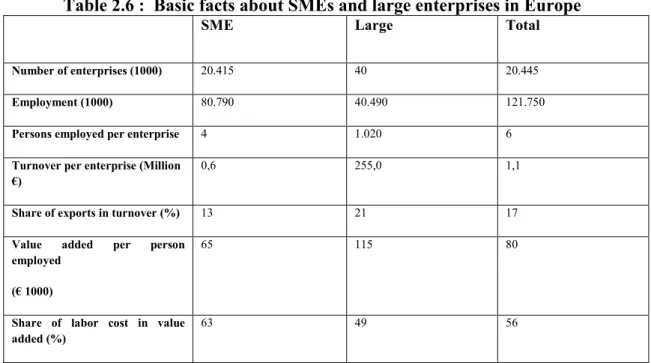
Table 2.6 : Basic facts about SMEs and large enterprises in Europe
SME Large Total
Number of enterprises (1000) 20.415 40 20.445
Employment (1000) 80.790 40.490 121.750
Persons employed per enterprise 4 1.020 6
Turnover per enterprise (Million €)
0,6 255,0 1,1
Share of exports in turnover (%) 13 21 17
Value added per person employed
(€ 1000)
65 115 80
Share of labor cost in value added (%)
63 49 56
Source: Estimated by EIM Business & Policy Research; estimates based on Eurostat' s SME Database. Also based on European Economy, Supplement A, June 2001 and OECD: Economic Outlook, No. 65, June 2001.
Table 2.6 shows that on average, an enterprise in Europe - even including all very large enterprises- provides employment to 6 people; the average for SMEs only is 4 people. However, this varies between 2 people in micro enterprises, and over 1 000 in large enterprises. Between countries, there are large differences as well. On average, an enterprise has 2 occupied persons in Greece and in Hungary too; and 3 in Italy,
13
compared with 10 in Ireland, Luxembourg, Austria and the Netherlands (Lukacs 2005, p. 6).
Of the 19.3 million enterprises in the European Union (EU) today, 99.8 percent are defined as SMEs and employ some 75 million people. There are only 35,000 enterprises, with more than 250 employees, but 18 million enterprises employ fewer than 10 people - the micro- enterprises (6th Annual Report of the European Small Business Observatory).
On a global scale, small and medium-sized enterprises provide some 66 percent of jobs in the European Union (EU) - a percentage which is predicted to rise as SMEs face challenges and opportunities associated with increased globalization, largely through e-commerce and greater Internet usage by entrepreneurs. In the last decade, SMEs were the principle creators of new jobs, whilst on average; big industry has downsized and reduced employment. EU SMEs currently generate 56.2 percent of the private sector turnover (Lukacs 2005, p. 7).
In table 2.7, the places of SMEs in some countries’ economies are given. As it is seen from the table;
i. Most of the enterprises are SMEs
ii. SMEs provide more than half of the employment
iii. Approximately 1 / 3 of the investments are realized by SMEs iv. SMEs have a considerable share on the value added and export.
14
Table 2.7 : Places of SMEs in some countries’ economies
USA Germany India Japan UK South
Korea
France Italy Turkey*
Rate of SMEs to the total enterprises
97.2 99.8 98.6 99.4 96 97.8 99.9 97 98.9
Rate of SME employees to the total employment
50.4 64 63.2 81.4 36 61.9 49.4 56 76.7 Share of SMEs in investment 38 44 27.8 40 29.5 35.7 45 36.9 38 Share of SMEs in production 36.2 49 50 52 25.1 34.5 54 53 37.7 Share of SMEs in export 32 31.1 40 38 22.2 20.2 23 - 10
Share of SMEs in value added
36.2 49 50 52 25.1 34.5 54 53 26.5
Share of SMEs in credits
42.7 35 15.3 50 27.2 46.8 48 - 28.4**
Source: OECD 2002, *DPT KOBİ Stratejisi ve Eylem Planı 2003, **BDDK, Finansal Piyasalar Raporu, Eylül 2007, p. 39
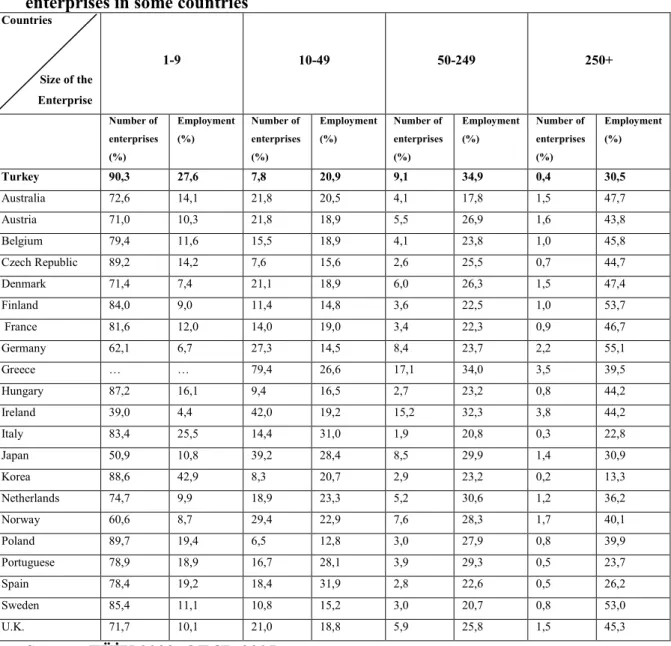
Moreover, Table 2.8 shows the range of the enterprises in manufacturing industry and the employment according to the enterprise size in some countries. Analyzing the table, it is seen that in OECD countries SMEs generate 98% of the enterprises in manufacturing industry and 60 percent of the employment being the main job providers. Moreover, countries consider SMEs key factors for industrial structuring and construct their national SME politics and programs (Cansız 2008, p. 5).
Furthermore, Table 2.8 shows that SMEs form a high percentage of total enterprises in regarding countries. However, big enterprises provide the larger part of total employment in most of those countries despite their small share in number of total enterprises. Yet, in Italy SMEs are better in terms of creating employment than big enterprises (Cansız 2008, p. 6).
15
Table 2.8 : The Range of enterprises and employment with respect to the size of enterprises in some countries
Countries Size of the Enterprise 1-9 10-49 50-249 250+ Number of enterprises (%) Employment (%) Number of enterprises (%) Employment (%) Number of enterprises (%) Employment (%) Number of enterprises (%) Employment (%) Turkey 90,3 27,6 7,8 20,9 9,1 34,9 0,4 30,5 Australia 72,6 14,1 21,8 20,5 4,1 17,8 1,5 47,7 Austria 71,0 10,3 21,8 18,9 5,5 26,9 1,6 43,8 Belgium 79,4 11,6 15,5 18,9 4,1 23,8 1,0 45,8 Czech Republic 89,2 14,2 7,6 15,6 2,6 25,5 0,7 44,7 Denmark 71,4 7,4 21,1 18,9 6,0 26,3 1,5 47,4 Finland 84,0 9,0 11,4 14,8 3,6 22,5 1,0 53,7 France 81,6 12,0 14,0 19,0 3,4 22,3 0,9 46,7 Germany 62,1 6,7 27,3 14,5 8,4 23,7 2,2 55,1 Greece … … 79,4 26,6 17,1 34,0 3,5 39,5 Hungary 87,2 16,1 9,4 16,5 2,7 23,2 0,8 44,2 Ireland 39,0 4,4 42,0 19,2 15,2 32,3 3,8 44,2 Italy 83,4 25,5 14,4 31,0 1,9 20,8 0,3 22,8 Japan 50,9 10,8 39,2 28,4 8,5 29,9 1,4 30,9 Korea 88,6 42,9 8,3 20,7 2,9 23,2 0,2 13,3 Netherlands 74,7 9,9 18,9 23,3 5,2 30,6 1,2 36,2 Norway 60,6 8,7 29,4 22,9 7,6 28,3 1,7 40,1 Poland 89,7 19,4 6,5 12,8 3,0 27,9 0,8 39,9 Portuguese 78,9 18,9 16,7 28,1 3,9 29,3 0,5 23,7 Spain 78,4 19,2 18,4 31,9 2,8 22,6 0,5 26,2 Sweden 85,4 11,1 10,8 15,2 3,0 20,7 0,8 53,0 U.K. 71,7 10,1 21,0 18,8 5,9 25,8 1,5 45,3 Source: TÜİK 2002, OECD 2005 2.1.4. Characteristics of SMEs
SMEs, in terms of size, are small and flexible and, have different characteristics from big enterprises (Koç 2008, p. 15). These specific characteristics should be analyzed in order to be closely acquainted with the SMEs.
While determining a definition of the SME in literature, “size of the enterprise” is taken into consideration and the size is defined as “economic operating volume and capacity” (Müftüoğlu 1978, p. 7). Measuring these economic operating volume and capacity are based on some specific criteria. These criteria are first separated in two groups; qualitative and quantitative (Müftüoğlu 1978, p. 73).
16
In literature, qualitative characteristics can be determined differently. In some studies, lots of qualitative characteristics are listed in detail whereas in others, just general characteristics are stated. Müftüoğlu (2007, p. 47) separated qualitative characteristics in two main groups; the first one is the primary (original) indicators that are related to the owner of the enterprise-entrepreneur, the second one is secondary (derivative) criteria that are related to the structure of the enterprise. The details are explained in the following sub-sections of SMEs.
2.1.4.1. Qualitative characteristics of SMEs
2.1.4.1.1. Qualitative characteristics of SMEs related to the entrepreneur
Entrepreneur is the primary factor to determine the identity of an SME. Therefore, this factor should be considered specifically. Main characteristics related to the entrepreneur are listed below.
i. In SMEs, the owner of the enterprise, entrepreneur, and manager are embodied in a single person. Therefore, success of the SME is highly dependent on this person (Muftuoglu 2007, p. 49). Unfortunately, there is a resultant pressure on the owner/manager to be an expert in all fields of management, and he or she is often conceived as the only one who can make management decisions as a result (Kelliher and Henderson 2006). The merging of ownership and management in micro-firm setting creates a one-person centered organizational structure (Dutta and Evrard 1999; Palvia et al. 1994; Simpson 2001). Therefore, education of the owner about management and entrepreneurship issues is a critical factor for success of the enterprise.
ii. In SMEs, the owner/manager takes over all the risks related to the enterprise. At this point, professional manager and owner/manager are separated because in case of a failure, professional manager does not lose much more than his salary and can continue his position in a different company whereas the owner cannot. An enterprise is far more than a source of revenue for its owner/manager. It is not an independent object. Therefore, there is a strong emotional bound between the enterprise and owner/manager. As a result, risk taken by an owner/manager is not just monetary, it is far more complex (Müftüoğlu 2007, p. 50).
17
iii. In SMEs, there is an absolute integration between the owner/manager and enterprise. We can call it identification. For an owner, his enterprise is a very important part of his life because he puts a great effort in establishing it; hence his future depends on it (Muftuoglu 2007, p. 50).
iv. This tie between the owner/manager and enterprise affects family members. Any failure or success has an influence on the family members both at affective and rational level. Therefore, the relationship is subjective-irrational whereas in big enterprises, the relationship between the professional manager and enterprise is objective-rational (Müftüoğlu 2007, pp. 50-51).
v. In SMEs, the owner/manager works actively in the enterprise. Especially, in micro firms, the owner is the one who is a craftsman working on his table, a buyer of the materials and a marketer of the products, is a borrower of the banks, is a tax payer, and is responsible for all managerial issues at the same time. Time is a particular concern in the micro-firm environment, where the owner is likely to be responsible for all aspects of the business operation (Muftuoglu 2007, p. 51). Time constraint often manifests itself in owners who are primarily interested in immediately applicable performance (Freel 1999). Entrepreneurs are mainly concerned with the day to day demands of running their own business (Storey and Cressy 1996), often to the detriment of long term planning (Kelliher and Reinl 2009).
vi. In SMEs, usually, family members work actively or are grown up with a hope that they will take over the management of the enterprise and are brought up in accordance with this purpose. Otherwise when the owner dies, the enterprise dies with him. This is an importance issue because more than 70 percent of the all businesses in the world are family businesses (Leeders and Waarts 2003). For instance, in USA, 80 percent of all businesses are family businesses. This rate is 80 percent in Spain, 95 percent in Italy and 85 percent in Switzerland (Gümüştekin 2005, p. 74). Therefore, they should get in institutionalization process in time so as to support the sustainability of their businesses.
vii. In SMEs, the relationship between the owner and employees is not indirect and formal rather informal and personal (Muftuoglu 2007, p. 51). There is less
18
internal uncertainty in this environment as the owner is aware of conditions and sentiment through regular contact with workers (Storey and Cressy 1996), creating a link between the micro-firms’ small size and more effective communications (Kelliher and Reinl 2009). As the size grows, this relationship loses its intensity and extent. The form of this relationship turns into an organized or institutionalized relationship from a personal relationship.
In summary, due to the strong tie and identification between the entrepreneur and his enterprise, the role of an entrepreneur is more significant and effective in an SME than it is of a professional manager in a big enterprise.
2.1.4.1.2. Qualitative characteristics of SMEs related to the management function
Management functions in an SME are performed by the owner. Thus, quantitative characteristics related to the entrepreneur are expected to collide with the ones related to the management function. Those characteristics can be summarized as below:
i. Management of the enterprise is carried out by the owner naturally with his property right. Therefore, the owner can last his management functions until he dies or devolve his rights to someone else (Hamer 1987, p. 129)
ii. In SMEs, management functions are performed by the owner on behalf of himself and also he takes all the risks but in big enterprises, professional managers are under the control of the owners or some other boards and parties (Hamer 1987, p. 129).
iii. In SMEs, the direct and personal relationship between the owner and employees requires owner to be a role model. For example, if the owner works from 6 am to 10 pm, he could expect employees to do so. However, if he gives this directive when he is on a blue cruise, employees will not perform this instruction as they are supposed to do. Yet, in big enterprises, managerial hierarchy is institutionalized, authorities and responsibilities are determined. There is an informal and indirect relationship between the management and employee and tends to be hierarchical (Hamer 1987, p. 129).
iv. This natural way of management structure increases the flexibility in SMEs. In big enterprises, hierarchical structure makes relationships between the
19
management and employees more informal, it becomes harder to reach people who are in upper hierarchical level. Moreover, this bureaucratic relationship decreases the flexibility (Hamer 1987, p. 129).
v. There is a centralized management style in SMEs because the owner has all the management authority in hand. In big enterprises, management function is separated by division of labor. Therefore, all managers have authority on managerial issues related to their divisions (Hamer 1987, p. 129).
vi. In SMEs, the owner is responsible for all managerial issues and only one, who determines enterprise’s policy so in this respect, he is a generalist. However, in big enterprises, because there is a division of labor in management, the managers of the divisions are supposed to be experts on their professions. For example, marketing manager is expected to be an expert on marketing; as well as finance manager is expected to be an expert on financial issues (Hamer 2007, p. 129).
vii. In SMEs, because of his powerful position, the owner is able to give subjective-irrational decisions whereas in big enterprises, decisions are taken on more objective and rational basis. That is why professional managers work in big enterprises (Hamer 1987, p. 129).
viii. In SMEs, the owner can prevent any possible hitches but in big enterprises, the division managers try to solve the problem from their points of view. Thus, there is a need to take the issues from different perspectives. As a result, there can be delays in problem solving process (Hamer 1987, p. 129).
ix. In SMEs, the goal of the enterprise is determined by the owner so there is no conflict related to the objectives. In big enterprises, the goal is created as result of a negotiation. However, the conflicts, oppositions and polemics can continue (Hamer 1987, p. 129).
x. In SMEs, short term planning is more favorable. In other words, tactics maintain importance. Big enterprises are run in accordance with long term plans. Therefore, strategic planning is significant (Hamer 1987, p. 129).
20
xi. Moreover, in SMEs, improvisation is a really important success factor. The owner gives more importance on improvisation in management. As the enterprise gets bigger in size, improvisation gives its place to planning (Hamer 2007, p. 129).
To sum up, management of the enterprise is performed by the owner so the management style is centralized. Also, the decisions are taken by the owner and tend to be short term, subjective and irrational. However, centralized management structure induces SMEs to be more flexible than the big enterprises.
2.1.4.1.3. Qualitative characteristics of SMEs related to the finance function
Usually, financial problems take the first place in SMEs and it is the case for both Turkey and other countries. Here, financial characteristics considered important are listed;
i. In SMEs, there is no separated finance department. Usually, there is a department that is responsible for one of three; financial affairs, administrative affairs or financial accounting. However, in those departments financial issues are taken as secondary concern and the personnel is responsible for all of the financial, administrative and accounting issues at the same time (Müftüoğlu 2007, p. 59).
ii. Big enterprises can benefit from opportunities of capital market. But generally, capital markets are closed for SMEs. Also, SME owners are reluctant to have new business partners (Müftüoğlu 2007, p. 60).
iii. SMEs usually face unfavorable conditions taking credits from banks. They take little amount of credits compared to big enterprises and credit cost is higher for them (Müftüoğlu 2007, p. 62).
iv. In case of a bankruptcy of an SME, the owner of the enterprise faces to lose his personal assets in addition to assets of the enterprise (Müftüoğlu 2007, p. 62). v. SMEs are in trouble in terms of self-financing. Usually, they use labor intensive
technologies instead of capital intensive ones. As a result, depreciation amount, which is a self-financing factor and supposed to be separated from fixed-assets, remains inadequate. Therefore, since SMEs allocate fewer funds for
21
depreciation, they cannot use finance source through depreciation effectively and thus cannot benefit from the capacity increase effect of depreciations (Koç 2008, p. 5).
Concisely, non-existence of a separated finance department, difficulties in taking bank credits and self-financing are common financial characteristics of SMEs. Also, SMEs cannot take advantage of the capital market as big enterprises do. Besides, the owner is at risk of losing his personal assets in case of a bankruptcy.
2.1.4.1.4. Qualitative characteristics of SMEs related to the marketing function
Main quantitative characteristics related to the marketing function of SMEs can be stated as below:
i. In SMEs there is no separated marketing department in which professionals are employed. In medium sized enterprises there are departments named purchase and sale or trade management where marketing is considered a subordinated issue. In small sized businesses, marketing function is handled by the owner. From this angle, we can talk about an underdeveloped marketing understanding in SMEs (Freter 1981; Hamer 1987).
ii. SMEs do not benefit from marketing tools adequately due to financial insufficiencies. Economically use of marketing tools (ads, after sale service, credit sale, etc.) usually exceeds the operating volume of these enterprises (Müftüoğlu 2007, p. 65). The most commonly used media for advertising in SMEs are word of mouth, newspaper ads, brochures and PR exercises (Krake 2005). Big enterprises are in a more favorable position using contemporary marketing tools (Müftüoğlu 2007, p. 65).
iii. In SMEs, no regular marketing research is conducted. Instead, marketing related decisions are given based on intuitions and inadequate experience of the owner. This is a typical characteristic of SMEs (Müftüoğlu 2007, p. 65).
iv. Generally, export markets are closed for SMEs. The most significant reason for this situation is the cost of entry to foreign markets. Thus, governments apply various measures for stimulus to make export markets easier to enter for SMEs (Müftüoğlu 2007, p. 66).
22
v. SMEs do not use expensive and complicated sale channels or organizations to market their products. Instead, they build a direct relationship with the customers. This is an advantage for SMEs because they can make their customers loyal to their enterprises. These strong and trustful personal relationships with customers are the key success factor in long term and fundamental condition for persistence (Müftüoğlu 2007, p. 66).
vi. SMEs reach to the nearby markets and accept them as their target market. Yet, the accessibility carried out by globalization and technology requires that target markets should not be distance-focused (Koç 2008, p. 6).
vii. SMEs usually have a restricted market share and cannot be effective on the market (Koç 2007, p. 6). Research suggests that micro-firms have framed relations with the outside environment (Dutta and Evrard 1999), wherein these firms have limited competitive influence, operating from their position in a perfectly competitive market (Simpson 2001; Storey and Cressy 1996). As internal and external interaction is paramount due to the more limited ability of micro-firms to shape their external environment (Smallbone et al. 1999; Kelliher 2007).
viii. One of the most important competencies of SMEs lies under their flexibilities and, therefore, meeting their customers’ special wants and demands. As a result, order oriented production maintains a huge importance for SMEs (Müftüoğlu 2007, p. 68).
In summary, SMEs do not employ professionals in marketing department and financial problems hinder SMEs use marketing tools sufficiently. Also, SMEs do not conduct marketing research and use expensive and complicated sale channels for marketing. Moreover, SMEs reach to nearby markets in which they are ineffective, and also have trouble to enter into export markets. However, the main marketing success of SMEs is their flexible strategies to meet their customers’ special wants and needs.
23
2.1.4.1.5. Qualitative characteristics of SMEs related to the production function
According to Müftüoğlu (2007, pp. 70-74), quantitative characteristics related to the production function are listed below:
i. In SMEs, the labor intensive production techniques are more common especially in small enterprises. Today, in big enterprises, mechanization and automation level (capital intensive production technique) is higher. Thus, in SMEs production planning and controlling are harder.
ii. In big enterprises, mass production is acceptable but in SMEs customized production is common and the smaller the size, the more significant it becomes. iii. Big enterprises usually produce for big markets. Whereas SMEs produce in
accordance with orders.
iv. As a result of order oriented production in SMEs stock problem does not maintain importance. In big enterprises, stock cost can become a huge part of total cost.
v. Due to simple production or production in few quantities, division of labor is low. Big enterprises wherein standardized goods are produced by mass production; division of labor is much more improved.
vi. In big enterprises, each employee is interested in the part he produces or operation he performs. The employee has to do the same work every single day. Thus, he cannot build a relationship with the product and this can make the employee become alienated to his work. In SMEs, due to underdeveloped division of labor, employees tend to work in different sections of production so it makes them feel involved with the whole process.
vii. Big enterprises have competitive advantage in terms of price and quality because of automation and economies of scale. Yet, SMEs have competitive advantage in terms of fast delivery, and customization over special customer requirements regarding products and delivery conditions.
viii. There are skillful and experienced employees in production process in SMEs and it creates a great potential for education of apprentices. From this perspective, SMEs can be considered training centers.
24
ix. In SMEs, the owner/manager is usually experienced about production technique, has improved his qualifications in professional life. This gives a huge potential on product and technical innovations. However, SMEs are far behind of big enterprises considering innovations that need systematic R&D operation because they do not have enough qualified personnel and financial resource to meet the cost.
To sum up, SMEs use labor intensive production techniques rather than capital intensive ones. Also, customized and order oriented production is common for SMEs. Moreover, because of simple production, division of labor is low which makes employees feel involved with the whole process. Competitive advantage of SMEs in production is customization and skillful and experienced employees in production process. Besides, experience and qualifications of the owner/manager in production technique affords an opportunity for product and technical innovations but the cost of R&D operations impedes these innovations.
2.1.4.1.6. Qualitative characteristics of SMEs related to the human resource function
Main quantitative characteristics related to the human resource function of SMEs can be stated as below:
i. Due to use of labor intensive technologies, human factor has a greater significance for SMEs compared to big enterprises. Also, there is no hierarchical structure in these enterprises and as a result there is an informal relationship among personnel and the management (Müftüoğlu 2007, p. 74).
ii. SMEs usually have a qualified labor force because of order oriented production, which requires different operations for special demands. In contrast, big enterprises mostly employ labors who have straight skills (Müftüoğlu 2007, p. 74).
iii. In SMEs, upper and middle management level personnel are knowledgeable about marketing, management, financial accounting, finance and R&D. In reality, it is unlikely that micro-firms will have the resources to employ specialists. They instead tend to employ staff with generalist skill sets (Simpson 2001). There can also be a lack of career path for specialists in this type of
25
organization, and as a result these firms often experience marginal labor markets (Curran 1988).
iv. In SMEs, there is a direct relationship between the management and personnel. Especially in small businesses, the owner works with employees in manufacturing (Müftüoğlu 2007, p. 75).
v. In SMEs, the unionization rate is lower than it is in big enterprises because there is no need for an intermediary in SMEs since employees have a direct relationship with the management (Müftüoğlu 2007, p. 75-76).
vi. In SMEs, the workers’ salaries are lower than their counterparts in big enterprises because big enterprises are capital intensive organizations that make them increase efficiency and, hence higher salaries (Müftüoğlu 2007, p. 76). vii. Because of very low alienation rate in SMEs, the employees are much more
satisfied than the employees in big enterprises despite the lower salaries they earn (Müftüoğlu 2007, p. 76).
viii. The first remedy towards sustaining profitability that big enterprises apply in downturns is to lay off their employees. In contrast, SMEs want to keep their employees accepting the risks of sacrifice. This attitude originates from the qualifications of the employees (Müftüoğlu 2007, p. 77).
ix. SMEs are considered “society educators”. In Germany, education of 90 percent of qualified apprentices and 60 percent of employees who have managing and trading qualifications is provided by SMEs (Hamer 1987, p. 165).
Briefly, human factor is really important for SMEs due to labor intensive production and so SMEs usually have a qualified labor force. Employees have generalist skills because employing specialists is costly. There is a direct relationship between the management and personnel so the unionization rate is low in SMEs. Also, employees in SMEs are much more satisfied than their counterparts in big enterprises in spite of the lower salaries because they are more involved with the whole process. SMEs provide both technical and managerial qualifications to their employees so lay off rate in downturns is lower than it is in big enterprises.
26
SMEs, as they are explained in sub sections above, have idiosyncratic characteristics related to the entrepreneur and management, finance, marketing, production and human resource functions. To remind them as a whole, all of these characteristics are summarized in Table 2.9.
Table 2.9 : Qualitative characteristics of SMEs
Entrepreneur Management Finance Marketing Production Human Resource
• Manager and owner is the same person.
• Owner/manager takes all the risks. • There is integration between the owner/manager and the enterprise. • Owner/manager-enterprise relationship is subjective-irrational. • The owner/manager actively works in the enterprise. • Family members also work actively in the enterprise. • The relationship between the owner/manager and the employees is personal. • Management is performed by the owner. • Owner is required to be a role model. • Personal relationship with the employees provides flexibility. • There is a centralized management style. • The owner prevents any possible hitches. • The goal of the
enterprise is determined by the owner. • Short term planning is more favorable. • Improvisation is a really important success factor. • There is no separated finance department. • Self-financing is difficult. • Capital markets
are close for SMEs. • Bank credits
are costly for SMEs. • Owner loses his
personal assets in case of a bankruptcy. • There is no separated marketing department. • SMEs do not use
marketing tools effectively. • No regular marketing research is conducted. • Direct relationship with the customers is a key success factor. • SMEs reach to the nearby markets. • SMEs have a restricted market share.
• SMEs are flexible to meet special wants. • Labor intensive production is common. • Customized production is acceptable. • SMEs produce
for small markets. • Order oriented
production decreases stock cost.
• Division labor is low due to simple production. • Employees work in different section of production. • Customization is a key success factor.
• There are skillful employees in production process. • Owner/manager is experienced about production technique. • Human factor is really important for SMEs. • SMEs have qualified labor force. • Employees have generalist skill sets. • There is a direct relationship between the manager and personnel. • The unionization rate is low. • Salaries of the
workers are low. • Alienation rate is low among employees. • Employees are usually satisfied. • SMEs are considered society educators.
2.1.4.2. Quantitative characteristics of SMEs
SMEs are classified by some institutions and organizations based on some qualitative characteristics. However, it is hard to talk about integrity among those qualitative characteristics (Koç 2008, p. 6). Some of the qualitative characteristics written in literature are listed below (Müftüoğlu 1978, p. 76).
i.Headcount/working period
27
iii.Value of fixed assets
iv.Utilization area/utilization volume v.Cost/amount of materials used vi.Cost/amount of energy used
vii.Total capital/total effective capital/capital stock viii.Number of orders/number of work stations
ix.Operating capacity/ utilization rate of capacity x.Number of labor shift
xi.Number of machines/value of machinery/operating period of machines xii.Annual depreciation amount
xiii.Manufacturing deepness (number of manufacturing stages) xiv.Sales amount
xv.Profit volume xvi.Added value xvii.Market share
xviii.Amount of tax to paid xix. Export amount and etc. 2.1.5. SMEs in Turkey
Small and medium-sized enterprises (SMEs) constitute a major part of the Turkish economy, accounting for a large proportion of the country’s businesses and total employment (OECD 2004). In Turkey, including service sector, SMEs generate 99.8 percent of total enterprises and 76.7 percent of total employment. SME investments have a share of 38 percent in total investments and 26.5 percent in total value added (KOBİ Stratejisi ve Eylem Planı 2004, p. 13). The share of SMEs in total export differs year by year but approximately it is between 25-30 percent (KOBİ ÖİK 2006) and their share in total bank credits is usually below 25 percent (BDDK 2007).