Examining the Effects of Proprioceptive Training on Coincidence
Anticipation Timing, Reaction Time and Hand-Eye Coordination
Halil Ibrahim Ceylan* and Ozcan Saygin
Mugla Sitki Kocman University, Faculty of Sport Sciences, Mugla, Turkey
KEYWORDS Anticipation. Coincidence. Hand-Eye Coordination. Proprioceptive Training. Reaction Times.
Students
ABSTRACT This paper is aimed to investigate the effects of proprioceptive training on coinciding anticipation
timing (CAT), reaction time and hand-eye coordination. 42 volunteer students participated in the paper. These students were randomly divided into two groups as experiment and control groups. An exercise program was applied to the experiment and control groups for approximately 3 days in 8 weeks, for about 45 to 60 minutes. Additionally, a 20-minute modified proprioceptive balance program was applied to the experiment group only. Paired sample tests were used. As a result, significant differences were found in the CAT performance, reaction time and hand-eye coordination performances of the experiment group, pretest and posttest (p<0,05). Significant differences were found in dominant hand visual reaction time and hand-eye coordination performances of the control group, pretest and posttest (p<0,05). In conclusion, it is seen that proprioceptive trainings affect CAT performance and reaction time performances in a positive way.
*Address for correspondence: Halil Ibrahim Ceylan
Res. Asst.,
Faculty of Sport Sciences, Mugla Sitki Kocman University, Mugla, Turkey
E-mail: [email protected]
INTRODUCTION
Proprioception is defined as the “sixth sense” to include the classical five senses and the body itself, and involves both peripheral and central systems. Proprioception is an important sensory function for all normal mobility actions including administering the dynamic balance and the skill of moving in the right manner (Batson 2008; Og-ard 2011; Hillier et al. 2015), motor control (Hillier et al. 2015). Acquiring a comprehensive under-standing of proprioceptive function is important in that it will contribute greatly to the rehabilita-tion after sports injuries, and will be beneficial in athletic condition and performance (Ogard 2011). Proprioceptive training is defined as the (pre-ventive) ‘series of exercises or situations that will produce a reaction in response to an external stimulant by the nerve system’ (Cerulli et al. 2001). The purpose of the proprioceptive training is to increase the complex activity of the neurovascu-lar system (Ogard 2011). The important compo-nents of the proprioceptive exercises consist of balance training, leg-press and one-leg jumping, back-strengthening and similar kinesthetic chain
exercises (Laskowski et al. 1997). Proprioceptive training is directed to develop the propriocep-tive sense, which is found in the muscles, joints and ligaments. We obtain information about our body and environment with the help of these senses. There is no doubt that sports perfor-mances are based on cognitive and perceptual skills as well as motor and physical abilities (Schwab and Memmert 2012). The effect of exer-cise on cognitive performance is more likely to be of importance because, in many sports, ath-letes have to make decisions rapidly and accu-rately, despite great physical exertion (De-lignieres et al.1994).The relation of the physical exercise and the cognitive functioning could be important because of optimizing processes of the good sport performance (Antunes et al. 2006). In literature, there are some studies which indicate that exercise or physical activity improve cogni-tive and motor function (Bossers et al. 2015; Erick-son et al. 2015; Moreau et al.; Zieres and Jansen 2015). Most sports necessitate athletes to have high perceptual abilities that can affect their re-sponse accuracy and sports performance. Open skills sports such as soccer, badminton and bas-ketball, which are done in a temporally and spa-tially changing environment, necessitate an ath-lete’s fast reaction to sensory stimuli before start-ing the physical action. This is the one aspect of cognitive performance, called anticipation, which is the measurement of accuracy in perfor-mance of motor behavior (Meng et al. 2015). Some movements being sensed beforehand and
being made with correct timing and proper hand-eye coordination prove to be advantageous for the athletes against their opponents. Reaction time means the decision-making process, and the speed to start the movement, and is an important component of many activities. Reaction time, as a criterion of data processing, is a very impor-tant parameter, which is influenced by various factors such as age, gender, stimulus, tiredness, and physical activity (Ashnagar et al. 2015). Most sports depend on an excellent eye-hand coordi-nation, which in turn is directly related to the speed of visual reaction time and motor response (Schwab and Memmert 2012). The hand-eye co-ordination is especially important in individual sports in which the motor-manipulative skills are used much, and in team sports such as handball, basketball, volleyball and the sports in which rackets are used. It has been proven that the manipulative skills are especially important in activities that require sensitivity and rough mus-cle control (Menevse 2011).
Coinciding timing anticipation, reaction time to similar bio-motor skills are higher order per-ceptual abilities (Meng et al. 2015), that have to be developed as it is extremely important in terms of performance and in making use of the strength of the opponent. Poor visual performance in re-action response and anticipation ability may pre-vent high sports achievement (Meng et al. 2015). Hence, in the literature scan, no studies were found that examined the effects of the proprio-ceptive training on the coinciding timing antici-pation, reaction time, and hand-eye coordination. This situation shows the importance of the present paper in terms of the literature. In this paper, the issue of whether the proprioceptive training, which is a different training method when compared with the other types of trainings and which aims to develop the sense of position in the athletes, affects predicting the movements of the opponent in advance and reacting with a proper coordination, has been studied.
METHODOLOGY
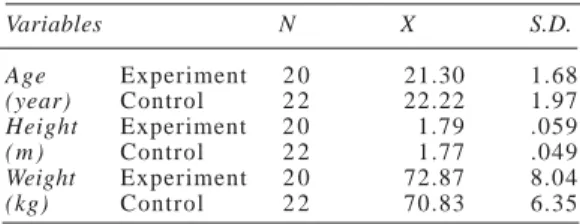
Forty-two volunteer physical education and sport teaching students who having no health problems and sports injuries for doing exercises, participated in the study. These students were randomly divided into two groups—experiment (20) and control (22) (Table 1). An exercise
pro-gram (included main speed, general endurance training program, flexibility and cooling exercis-es) was applied to the two groups for approxi-mately 3 days in 8 weeks, for about 45 to 60 min-utes. Additionally, 20 minutes of modified prop-rioceptive balance program (Verhagen et al. 2004; Panics et al. 2008) was applied to the experiment group only. Coinciding anticipation timing, reac-tion time, hand-eye performance values of ex-periment and control groups were recorded, pre-test and postpre-test.
Sample Modified Proprioceptive Balance Training (Verhagen et al. 2004; Panics et al. 2008).
1. Movement: Standing on one leg in knee
flexion. Taking one step with the other knee flex-ion, and standing in balance for 5 seconds. Re-peated 10 times for each leg.
2. Movement: Standing on one leg in knee
and hip flexion. Taking one step with the other knee and hip flexion leg, and standing in balance for 5 seconds. Repeated 10 times for each leg.
3. Movement: With a partner, stand on one
leg so that the knees are in flexion. With a 5-meter distance between yourself and your part-ner, throw the ball to one another 5 times, catch it and ensure balance! Repeated 10 times for both.
4. Movement: With a partner, stand on one
leg so that the knees and hips are in flexion with one another. With a 5-meter distance between yourself and your partner, throw the ball to one another 5 times, catch it and ensure balance! Repeated 10 times for both.
5. Movement: Stand on one leg on the
bal-ance board for 30 seconds and ensure balbal-ance, then change legs. Repeated twice for both legs.
6. Movement: Stand on one leg on the
bal-ance board for 30 seconds as the hip and knees are in flexion, and ensure balance. Then change legs. Repeated twice for both legs.
7. Movement: Stand in a position such that
one leg is on the balance board, and while doing
Table 1: The values of age and height of control and experiment groups
Variables N X S.D. Age Experiment 2 0 21.30 1.68 (year) Control 2 2 22.22 1.97 Height Experiment 2 0 1.79 .059 ( m ) Control 2 2 1.77 .049 Weight Experiment 2 0 72.87 8.04 (kg) Control 2 2 70.83 6.35
so continue the balance in the horizontal posi-tion. Repeated 10 times for both legs.
8. Movement: Stand on both legs on the
bal-ance board. Perform 10 knee flexion activities and maintain balance.
9. Movement: Stand on one leg in balance
so that the knee in in flexion. Perform 10 knee flexion activities and maintain the balance. Re-peated twice for each leg. ,
10. Movement: Jumping on the soft mat over
the small box with both legs in knees flexed posi-tion (10 repetiposi-tions).
11. Movement: Jumping on the soft mat over
the ball with both legs in knees flexed position (10 repetitions).
12. Movement: Jumping on the soft mat over
the small box with both legs by twisting the body 90o (10 repetitions).
13. Movement: Jumping on the soft mat over
the ball with both legs by twisting the body 90o
(10 repetitions).
14. Movement: Jumping on the soft mat over
the small box with one leg (10 repetitions).
15. Movement: Squats (standing on single
leg or on both legs, taking side steps or without taking side steps)
Data Collection Tools
Anthropometric Measurements
Body Weight and Height: The weight was
measured with an electronic scale with a sensi-tivity of 0.1 kg. The height was measured with a digital device with a sensitivity of 0.01 cm (Tam-er 2000).
Measuring the Coinciding Timing Anticipation
In measuring the coinciding timing anticipa-tion performances, the Bassin Anticipaanticipa-tion Tim-er (Lafayette Instrument Company, Model 50575) measurement device was used. The coinciding timing anticipation of the participants at differ-ent speeds (3 mph, 5mph and 8 mph) were mea-sured in random order (Duncan et al. 2013). The reason for the choice of stimulus speeds was based on paper conducted by Lyons et al. (2008) that determined a stimulus speed of 5 mph as ‘intermediate’, where the stimulus speeds of 3mph and 8 mph were considered ‘slow’ and ‘fast’ speeds respectively, according to the work by Lobjois et al. (2006). Both participants were
giv-en three trial rights before the real measuremgiv-ent started. Five measurements were taken for coin-ciding timing anticipation performance at three different speeds and the average values were recorded (Sogut et al. 2009 reported from Rudis-ill and Jackson 1992).
Measuring the Reaction Time
The dominant hand, visual, audio, and mixed reaction times of the participants were determined by using the Newtest 1000 device. In measuring the reaction times, the dominant fingers of the participants were used, and the measurements were taken in a noise-free and well-lit environ-ment. The measurement was repeated 10 times. The lowest 2 scores and the highest 2 scores were not taken into consideration. The average of 6 scores that were close to each other were recorded as the reaction time (Tamer 2000).
Measuring the Hand-Eye Coordination
In measuring the hand-eye coordination per-formance, the Minnesota Dexterity Test was used. This test was applied to the participants in 2 different styles, as a placing test, and as a turn-ing test. The protocol was introduced to the par-ticipants before the measurements and they were asked to practice. The participants fought against time, and their performances were recorded with a chronometer in seconds. This test was applied thrice on the participants, and the best scores were recorded for statistical analyses (Lafayette Instrument 1998).
Statistical Analyses
Statistical measurements were done using the SPSS program (Version 16.0). The paired sam-ples t-test was used in comparing the pre-and posttests of the experiment and the control group. The significance level was accepted as p<0.05.
RESULTS
Significant difference was found in coincid-ing anticipation timcoincid-ing (3mph, 5mph, 8mph) of the experiment group between pretest and post-test value averages at p<0.05 level. The percent of mean difference between pretest and posttest values for 3mph was 43.17, for 5mph was 43.15, for 8mph was 46.34 (Table 2).
There was significant difference in reaction time performances (visual, audio and mixed) (p<0.05). The percent of mean difference between pretest and posttest values for visual was 28.87, for audio 32.26, for mixed reaction time was 21.54 (Table 3).
Significant difference was found in hand-eye coordination (placing and turning test) per-formances (p<0.05). The percent of mean differ-ence between pretest and posttest values for placing and turning test were 12.24 and 13.08, respectively. (Table 4).
No significant difference was found in coin-ciding anticipation timing (3mph, 5mph, 8mph) performances for the control group between pre-test and postpre-test values averages. The percent of mean difference between pretest and posttest values for 3mph was 22.01, for 5mph was 10.15. A 1.98 decline in the 8 mph performance was ob-served between the pretest and posttest values (p>0.05) (Table 5).
Significant difference was found in the dom-inant-hand visual reaction time performances of control group between pretest and posttest
val-Table 2: Comparison of the pretest and post test values of coinciding-anticipation timing of experiment group
Variables N X S.D. Ä% t p Coinciding Anticipation Timing Pre-test 2 0 62.3 34.75 43.17 3.370 .001*
(3 mph) (ms) Post-test 2 0 35.4 14.16
Coinciding Anticipation Timing Pre-test 2 0 76.7 60.08 43.15 2.406 .026*
(5 mph) (ms) Post-test 2 0 43.6 25.30
Coinciding Anticipation Timing Pre-test 2 0 76.6 45.44 46.34 3.237 .004*
(8 mph) (ms)
Table 3: Comparison of the pretest and post test values of dominant-hand reaction times of experiment group
Variables N X S.D. Ä% t p Visual Reaction Times (ms) Pre-test 2 0 440.5 102.97 28.87 4.388 .000*
Post-test 2 0 313.3 91.68
Audio Reaction Times (ms) Pre-test 2 0 419.3 135.23 32.26 4.428 .000*
Post-test 2 0 284.0 95.79
Mixed Reaction Times (ms) Pre-test 2 0 436.3 77.77 21.54 3.084 .006*
Post-test 2 0 342.3 107.17
*p<0.05
Table 4: Comparison of the pretest and post test values of hand-eye coordination of experiment groups
Variables N X S.D. Ä% t p Turning Test (sec.) Pre-test 2 0 61.67 6.06 12.24 6.705 .000*
Post-test 2 0 54.12 6.14
Placing Test (sec.) Pre-test 2 0 56.08 5.67 13.08 7.214 .000*
Post-test 2 0 48.74 3.30
*p<0.05
Table 5: Comparison of the pretest and post test values of coinciding-anticipation timing of control group
Variables N X S.D. Ä% t p
Coinciding anticipation timing Pre-test 2 2 52.7 21.70 22.01 1.975 .062
(3 mph) (ms) Post-test 2 2 41.1 19.29
Coinciding anticipation timing Pre-test 2 2 51.2 31.81 10.15 .602 .553
(5 mph) (ms) Post-test 2 2 46.0 21.36
Coinciding anticipation timing Pre-test 2 2 45.4 18.65 1.98 -.159 .875
(8 mph) (ms) Post-test 2 2 46.3 20.85 *p<0.05
ues averages (p<0.05). No significant difference was found in dominant-hand audio and mixed reaction times performances of the control group between pretest and posttest values averages (p>0.05) The percent of mean difference between pretest and posttest values for visual, audio and mixed reaction time were 16.67, 2.21, and 6.9, re-spectively (Table 6).
It was observed that a significant difference was found in hand-eye coordination (placing and turning test) performances of the control group between pretest and posttest values av-erages at p<0.05 level. The percent of mean dif-ference between pretest and posttest values for the placing and turning test performances were, 13.64, and 9.6, respectively (Table 7).
DISCUSSION
The purpose of the paper is examining the effects of proprioceptive training on coinciding timing anticipation (3mph, 5mph, 8mph), reaction time (visual, audio, mixed) and hand-eye coordi-nation performances(placing and turning test). A proprioceptive training based on the balance and imbalance-training components is an impor-tant part of the physical condition training tech-nology. The purpose of the proprioceptive train-ing is to increase the complex activity of the neu-romuscular system. Information is transferred from the peripheral receptors, which provide the stability and balance in the body, via the afferent
and efferent of the neural system during the static and dynamic activities (Laskowski et al. 1997). In the literature, there are papers conducted on the positive effects of the proprioception trainings (balance exercises, neuromuscular training) af-fecting the proprioception (Malliou et al. 2004), balance and dynamic postural control (Ljubojevic et al. 2012), joint positions (Panics et al. 2008), muscular force (Heitkamp et al. 2001), and jumping performance (Ziegler et al. 2002; Sanja 2007), improving joint awareness (Asadi et al. 2015). Accurate anticipation of an object with movement is an important determinant of the efficient motor replies (Ramella 1984). An ef-ficient anticipation is not always easy, because it requires that the player have important infor-mation on the inclinations of the opponent in various situations. If the player coincides what will happen and when it will happen, s/he will have great advantages (Schmidt 1991). When the results of the paper are considered, a significant difference has been observed between the pre and post values of the coinciding timing antici-pation (3mph, 5mph, 8mph) performances of the experiment group (Table 2). No significant differ-ences were determined between the pre and post values of the coinciding timing anticipation (3mph, 5mph, 8mph) performances of the control group (Table 5). Duncan et al. (2015) examined coincidence anticipation timing (CAT) perfor-mance at slow and fast stimulus speeds before, during, and after an acute bout of walk on a
tread-Table 6: Comparison of the pretest and post test values of dominant-hand reaction times of control group
Variables N X S.D. Ä% t p Visual Reaction Times (ms) Pre-test 2 2 329.8 57.39 16.67 3.906 .001*
Post-test 2 2 274.8 42.05
Audio Reaction Times (ms) Pre-test 2 2 257.1 48.86 2.21 .623 .540 Post-test 2 2 251.4 28.96
Mixed Reaction Times (ms) Pre-test 2 2 341.7 54.66 6.90 1.215 .238 Post-test 2 2 318.1 69.72
*p<0.05
Table 7: Comparison of the pretest and post test values of hand-eye coordination of control group
Variables N X S.D. Ä% t p
Turning Test (sec.) Pre-test 2 2 62.39 6.16 13.64 5.313 .000*
Post-test 2 2 53.88 4.55
Placing Test (sec.) Pre-test 2 2 55.39 4.81 9.60 4.613 .000*
Post-test 2 2 50.07 3.97
mill (20 minutes at an intensity of 50% of HRR) in adults aged 60 to 76 years. They indicated that stimulus speeds play an important role; specifi-cally walking (exercise) enhances CAT perfor-mance at slow stimulus speeds but reduces CAT performance at fast stimulus speeds. In our pa-per, proprioceptive training improved CAT per-formance at stimulus speeds of 3mph, 5mph, and 8mph. In the paper conducted by Smith and Mitroff (2012), it was reported that the strobo-scopic training affects the coinciding timing an-ticipation in a positive way. In another paper conducted on elderly adults by Lobjois et al. (2006),it was reported that playing tennis affe-cted the coinciding timing anticipation perfor-mance in a positive way. The results of the present paper show parallelism with the results of the abovementioned papers. The exercises performed with ninety percent exercise intensity are interrelated with the coinciding timing antic-ipation depending on weak coincidence (Dun-can et al. 2013). There are various papers in liter-ature showing that the exercise intensity does not affect coinciding timing anticipation perfor-mance, and the coinciding timing anticipation performance was determined only in mild exer-cises (70% exercise intensity) (Lyons et al. 2008). Akpinar et al. (2012) compared the coinciding timing anticipation performances of the players in different racket sports at various stimulus speeds. As a result, they reported that the coin-ciding timing anticipation performances of the players of tennis were good at low stimulus speeds, the coinciding timing anticipation per-formances of the players of badminton were good at medium-level stimulus speeds, and the coin-ciding timing anticipation performances of the players of table tennis players were good in high speed stimulus. The positive effect in the coin-ciding timing anticipation performances may be related with the development in the agreement between the neural and muscle systems.
The time of the reaction is extremely impor-tant in sports in which the movements of the athletes are conditioned with the signals or with the movements of the ball or with the actions of the opponent. In many fast movements, the suc-cess depends on the speed of the athlete for deciding on the counter-movements and on the speed of the reaction (Schmidt 1991). When the results of the paper are considered, it is observed that a significant difference has been determined between the pre and post values of the visual,
audio and mixed reaction time performances of the experiment group (Table 3). In the control group, on the other hand, a significant differ-ence has been determined between the visual reaction time performances; however, no signif-icant differences were found between the pre and post values of the audio and mixed reaction time performances (Table 6). In a paper, which was conducted to test the effects of the aerobic exer-cises on the reaction time, it was reported that the premotor fraction of the reaction time in the exercise group decreased substantially after the exercise, and that the exercise developed the pre-motor fraction of the reaction time (Ozyemisci-Taskiran et al. 2008).
There are papers suggesting that the chron-ic effect of the training is positive on the reac-tion time performance (Collardeau and Alter 2001; Davranche et al. 2006; Fragala et al. 2014; Dogra 2015). Many researches show that a sports ac-tivity reduces reaction time, which is a reliable indicator of rate of processing of sensory stimuli by the central nervous system (Dube et al. 2015). Leon et al. (2015) reported that the aerobic train-ing cognitive exercise program performed for 12 weeks led to a development in the performance of the simple and selective reaction time perfor-mance. Dube et al. (2015) indicated that badmin-ton training for 2 to 3 hours per day for a mini-mum of 2 years is beneficial in improving eye– hand reaction time, muscle coordination, cogni-tive functions, concentration, and alertness. Abu-Saleh (2010) reported that the volleyball-training program, which is conducted for 5 months, three times a week, and for 2 hours, developed the reaction time. Gavkare et al. (2013) reported that the aerobic exercises performed for a minimum of 2 years and, for 2 to 3 hours a day developed the reaction time (audio, visual, and whole body time) of a group. In addition, Whitehurst (1991) re-ported that the aerobic trainings which lasted for 8 weeks, 3 days a week and for 35 to 40 min-utes a day, did not have any effects on the reac-tion times of the elderly women. The improve-ment in the reaction time may be associated with the development in the process skills of the sen-sory-motor performance and central neural sys-tem due to the trainings (Madan 1992), and the effect of the exercises on the reaction time may be associated with the increased stimulation level during the exercises and the metabolic activity (Brisswalter et al. 2002).
The hand-eye coordination means the inte-grated use of the eyes, arms, hands and fingers to perform hand movements directed towards the purpose (Tsang 2014). The hand-eye coordina-tion is especially important in individual sports as well as in team sports in which the motor-hand skills are used together. It has been proven that the hand skills are important in jobs, which require sensitivity and rough-muscle strength (Menevse 2011).
Two different tests for the purpose of mea-suring the hand-eye coordination have been used in this paper. When the findings on the hand-eye coordination are considered, it becomes clear that there is a significant difference between the pre- and posttests of the experiment and the control group in terms of placing and turning performances (Tables 4 and 7). This improvement which is considered apart from the modified neu-ral connections in both the experiment and con-trol group may be explained with the hypothesis claiming that the motor reaction depends on the visual information, and with the eye and hand spatial and temporal connection hypothesis (Sail-er et al. 2000).
In a study by Menevse in 2011, it was report-ed that the participants of the study who had the Palmaris Longus muscle, one of the important muscles in the arms in terms of the flexion force of the hand, in their arms, had better reaction time results than those who did not have this muscle. Good eye-hand coordination increases the skills of the player to perform the complex movement, and to reply to the external stimuli in an efficient way (Paul et al. 2011). The papers that examine the effects of training on hand-eye coordination are very few (Kayapinar et al. 2006), and no studies, which examined the effects of the proprioceptive trainings on hand-eye coor-dination, were observed in the literature.
CONCLUSION
As a consequence, it has been observed that the proprioceptive trainings influenced the co-inciding timing anticipation (3mph, 5mph, 8mph) and the reaction time (audio and mixed) perfor-mances in a positive way. It is being considered that the positive effects of the proprioceptive trainings on the coinciding timing anticipation and the reaction time performances influence neuromuscular processing skills, improving con-centration power and mind-body awareness in a positive way.
RECOMMENDATIONS
Subsequent studies should be conducted on different sports branches (tennis, table tennis, badminton, judo, karate, taekwondo) and with people from different age groups, and also from different genders (women, men). The training program duration and the number of the partici-pants should be increased and examined with athletes at an elite level in a more comprehensive manner. Subsequent studies should be conduct-ed to examine the effects of two different train-ing programs on coincidtrain-ing timtrain-ing anticipation, reaction time, and hand-eye coordination with a control group. In addition to the variables like, coinciding timing anticipation and reaction time, the effects of the proprioceptive trainings on dif-ferent variables (the relation with balance, speed, agility, and sports injuries) should be examined. The trainers should include the proprioceptive training activities, which have positive effects on cognitive functions, in their training programs while they are planning them.
LIMITATIONS
The study is limited to forty-two volunteer-ing physical education and sport teachvolunteer-ing stu-dents who have no health problems and sports injuries from doing exercises, don’t practice reg-ularly, aren’t active athletes. The paper is limited to examining the effects of proprioceptive train-ing on coincidtrain-ing anticipation timtrain-ing (CAT), re-action time and hand-eye coordination
REFERENCES
Abu-Saleh KM 2009. The effect of volleyball training program on the reaction time. Scientific Journal of
King Faisal University (Humanities and Manage-ment Sciences), 10(1): 263-280.
Akpinar S, Devrilmez E, Kirazci S 2012. Coincidence-anticipation timing requirements are different in rack-et sports. Perceptual and Motor Skills, 115(2): 581-593.
Antunes HK, Santos RF, Cassilhas R, Santos RV, Bueno OF et al. 2006. Reviewing on physical exercise and the cognitive function. Revista Brasileira de
Medic-ina do Esporte, 12(2): 108-114.
Asadi A, de Villarreal ES, Arazi H 2015. The effects of plyometric type neuromuscular training on postural control performance of male team basketball play-ers. Journal of Strength and Conditioning Research. Doi: 10.1519/JSC.0000000000000832
Ashnagar Z, Shadmehr A, Jalaei S 2015. The effects of acute bout of cycling on auditory and visual reaction
times. Journal of Bodywork and Movement
Thera-pie, 19(2): 268-272.
Batson G 2008. Proprioception. International
Associ-ation for Dance Medicine and Science (IADMS).
Bossers WJ, van der Woude LH, Boersma F, Hortobagyi T, Scherder EJ et al. 2015. A nine-week-long aerobic and strength training program improves cognitive and motor function in patients with dementia: a ran-domized, controlled trial. The American Journal of
Geriatric Psychiatry. doi:10.1016/j.jagp.2014.12.191
Brisswalter J, Collardeau M, Arcelin R 2002. Effects of acute physical characteristics on cognitive perfor-mance. Sports Medicine, 32(9): 555-566.
Cerulli G, Benoit DL, Caraffa A, Ponteggia F 2001. Proprioceptive training and prevention of anterior cruciate ligament injuries in soccer. Journal of
Or-thopaedic and Sports Physical Therapy, 31(11):
655-660.
Collardeau M, Alter JB 2001. Effects of a prolonged run on simple reaction time of well trained runners.
Perceptual and Motor Skills, 93(3): 679-689.
Davranche K, Audiffren M, Denjean A 2006. A distri-butional analysis of the effect of physical exercise on a choice reaction time task. Journal of Sports
Sciences, 24(3): 323-332.
Delignieres D, Brisswalter J, Legros P 1994. Influence of physical exercise on choice reaction time in sport experts: The mediating role of resource allocation.
Journal of Human Movement Studies, 27: 173-188.
Dogra DK 2015. Effect of 12 weeks specific condition-ing programme on motor fitness of tripura cricketers. Journal Impact Factor, 6(1): 706-714. Dube SP, Mungal SU, Kulkarni MB 2015. Simple visual
reaction time in badminton players: A comparative study. National Journal of Physiology, Pharmacy and
Pharmacology, 5(1): 18-20.
Duncan MJ, Stanley M, Smith M, Price MJ, Wright SL 2015. Coincidence anticipation timing performance during an acute bout of brisk walking in older adults: Effect of stimulus speed. Neural Plasticity, 1-8. Duncan M, Smith M, Lyons M 2013.The effect of
ex-ercise intensity on coincidence anticipation perfor-mance at different stimulus speeds. European
Jour-nal of Sport Science, 13(5): 559-566. doi: 10.1080/
17461391.2012.752039.
Erickson KI, Hillman CH, Kramer AF 2015. Physical activity, brain, and cognition. Current Opinion in
Behavioral Sciences, 4: 27–32.
Fragala MS, Beyer KS, Jajtner AR, Townsend JR, Pruna GJ et al. 2014. Resistance exercise may improve spa-tial awareness and visual reaction in older adults. The
Journal of Strength and Conditioning Re-search, 28(8): 2079-2087.
Gavkare AM, Nanaware NL, Surdi AD 2013. Auditory reaction time, visual reaction time and whole body reaction time in athletes. Ind Med Gaz, 6: 214-219. Heitkamp HC, Horstmann T, Mayer F, Weller J, Dick-huth HH 2001. Gain in strength and muscular bal-ance after balbal-ance training. International Journal of
Sports Medicine, 22(4): 285-290.
Hillier S, Immink M, Thewlis D 2015. Assessing prop-rioception: A systematic review of possibilities.
Neu-ro-rehabilitation and Neural Repair, 1-17. Doi:
10.1177/1545968315573055
Kayapinar FC, Yetkin MK, Soykan A, Caliskan E 2006. On iki haftalik dans egitiminin ilkogretim besinci sinif ogrencilerinin el-goz koordinasyonlari ve reak-siyon surelerine etkisinin degerlendirilmesi.Ataturk Universitesi. Beden Egitimi ve Spor Bilimleri
Dergi-si/Journal of Physical Education and Sport Scienc-es, 8(2): 3-10.
Lafayette 1998. Minnesota Manual Dexterity Test
MODEL#32023 (Examiners Manual). Parkway
North: USA
Laskowski ER, Newcomer-Aney K, Smith J 1997. Re-fining rehabilitation with proprioception training: Expediting return to play. Phys Sport Med, 25(10): 89-104.
Leon J, Urena A, Bolanos MJ, Bilbao A, Ona A 2015. A combination of physical and cognitive exercise im-proves reaction time in persons 61-84 years old. Journal of Aging and Physical Activity, 23(1): 72-77.
Ljubojevic A, Bijelic S, Zagorc M, Radisavljevic L, Uzunovic S et al. 2012. Effects of proprioceptive training on balance skills among sport dance danc-ers. Facta Universitatis Series: Physical Education
and Sport, 10(3): 257-266.
Lobjois R, Benguigui N, Bertsch J 2006. The effect of aging and tennis playing on coincidence-timing ac-curacy. Journal of Aging and Physical Activity, 14(1): 74-97.
Lyons M, Al-Nakeeb Y, Nevill A 2008. Post-exercise coincidence anticipation in expert and novice Gaelic games players: The effects of exercise intensity.
Eu-ropean Journal of Sport Science, 8(4): 205-216.
Madan M, Thombre DP, Bharathi B, Nambinarayan TK, Thakur S et al. 1992. Effect of yoga training on reaction time, respiratory endurance and muscle strength. Indian Journal of Physiological
Pharma-cology, 36(4): 229-233.
Malliou P, Gioftsidou A, Pafis G, Beneka A, Godolias G 2004. Proprioceptive training (balance exercises) reduces lower extremity injuries in young soccer play-ers. Journal of Back and Musculoskeletal
Rehabili-tation, 17(3): 101-104.
Menevse A 2011.Examination of the relationship be-tween muscle palmaris longus and reaction time. World
Applied Sciences Journal, 12(1): 114-118.
Meng KY, Zuhairi NA, Manan FA, Knight VF, Padri MNA et al. 2015. Role of gender, age and ethnicities on visual reaction time and visual anticipation time of junior athletes. Australian Journal of Basic and
Applied Sciences, 9(5): 129-134.
Moreau D, Morrison AB, Conway AR 2015. An ecolog-ical approach to cognitive enhancement: Complex motor training. Acta Psychologica, 157: 44-55. Ogard WK 2011. Proprioception in sports medicine
and athletic conditioning. Strength and
Condition-ing Journal, 33(3): 111-118.
Ozyemisci-Taskiran O, Gunendi Z, Bolukbasi N, Beya-zova M 2008. The effect of a single session submax-imal aerobic exercise on premotor fraction of reac-tion time: an electromyographic study. Clinical
Bio-mechanics, 23(2): 231-235.
Panics G, Tallay A, Pavlik A, Berkes I 2008. Effect of proprioception training on knee joint position sense in female team handball players. British Journal of
Paul M, Biswas SK, Sandhu JS 2011. Role of sports vision and eye hand coordination training in perfor-mance of table tennis players. Brazilian Journal of
Biomotricity, 5(2): 106-116.
Ramella RJ 1984. Effect of knowledge of results on anticipation timing by young children. Perceptual
and Motor Skills, 59: 519-525.
Sailer U, Eggert T, Ditterich J, Straube A 2000. Spatial and temporal aspects of eye-hand coordination across different tasks. Experimental Brain Research, 134: 163–173.
Sanja SS, Milanovic D, Jukic I 2008.The effects of proprioceptive training on jumping and agility per-formance. Kineziologija, 39(2): 131-141.
Schmidt RA 1991. Motor Learning and Performance
from Principles to Practice. California: Human
Ki-netics.
Schwab S, Memmert D 2012. The impact of a sports vision training program in youth field hockey players. Journal of Sports Science and
Medi-cine, 11(4): 624-631.
Smith TQ, Mitroff SR 2012. Stroboscopic training enhances anticipatory timing. International
Jour-nal of Exercise Science, 5(4): 344-353.
Sogut M, Ak, E, Kocak S 2009. 8-10 Yas grubu tenis oyuncularinin sezinleme zamani. Hacettepe Spor
Bilimleri Dergisi, 20(1): 1-5.
Tamer K 2000. Sporda Fiziksel ve Fizyolojik
Perfor-mansin Olculmesi ve Degerlendirilmesi. Ankara:
Bagirgan Yayimevi.
Tsang WW, Fong SM, Cheng YT, Daswani DD, Lau HY et al. 2014. The effect of vestibular stimulation on eye-hand coordination and postural control in elite basketball players. American Journal of Sports
Sci-ence, 2(2): 17-22.
Verhagen E, Beek AVD, Twisk J, Bouter L, Bahr R et al. 2004. The effect of a proprioceptive balance board training program for the prevention of ankle sprains: A prospective controlled trial. The American
Jour-nal of Sports Medicine, 32(6): 1385-1393.
Whitehurst M 1991. Reaction time unchanged in older women following aerobic training. Perceptual and
Motor Skills, 72(1): 251-256.
Ziegler LP, Gibson MH, McBride JM 2002. Proprio-ceptive Training Improves Vertical Jump Perfor-mance in Untrained Women. NSCA Conference: Las Vegas.
Ziereis S, Jansen P 2015. Effects of physical activity on executive function and motor performance in children with ADHD. Research in Developmental