©BEYKENT UNIVERSITY
BUCKLING OPTIMIZATION OF WOOD
COMPOSITE COLUMNS WITH VARIABLE
THICKNESS: BY THE EXAMPLE OF SAPELE
AND OAK
Yeliz PEKBEY
(Department of Mechanical Engineering, Ege University 35100 Izmir, Turkey, [email protected])
Aydogan OZDAMAR
(Department of Mechanical Engineering, Ege University 35100 Izmir, Turkey, [email protected])
Onur SAYMAN
(Department of Mechanical Engineering, Dokuz Eylul University 35100, Bornova-Izmir, Turkey, [email protected])
ABSTRACT
In this study, the problem of finding the shape of the strongest column which has the largest fundamental buckling load with equal length and volume for the clamped-clamped ends was purposed. It was also proved that the solutions of Tadjbakhsk & Keller (1962) and Olhoff & Rasmussen (1977)-Masur (1984) were not optimum for columns with clamped ends. Then, true solution was obtained from Masur's analytical bimodal solution for clamped-clamped case by considering the crushing criteria. To test the accuracy of new optimized columns with clamped ends, both experimental and numerical studies were carried out. In this study, natural composite materials such as sapele and oak with variable circular cross-sections were used. Results of the optimum model proposed in this study were in agreement with results obtained by experimental data and numerical results.
Keywords: Buckling, Optimal columns; Shape design; Bimodal solution;
Unimodal solution; Crush strength
ÖZET
Bu çalışmada, ankastre-ankastre yataklı, burkulma yüküne maruz çubukların aynı uzunluk ve hacimde, fakat daha fazla kritik burkulma yüküne sahip değişken enine kesit çubuk formlarının eldesi amaçlanmıştır. Basmaya
,
Bornova-zorlanan değişken enine kesitli ankastre-ankastre yataklı çubukların burkulma kuvvetleri ve optimum formları Tadjbakhsk & Keller (1962), Olhoff & Rasmussen (1977) ve Masur (1984) tarafından farklı verilmiştir. Literatürde elde edilen kritik burkulma kuvvetleri birbirine oldukça yakın değerlerdir. Ancak farklılık, optimum formdan, özellikle kesitin minimum olduğu noktalardan kaynaklanmaktadır. Bu çalışmada, değişken enine kesitli optimum çubuklarda kabul gören, Tadjbakhsk & Keller (1962), Olhoff & Rasmussen (1977) ve Masur (1984) vermiş oldukları çözümlerin yanlış olduğu gösterilmiştir. Gerçek optimum çözüm, Masur (1984) tarafından verilen bimodal analitik çözüme, ezilme kriteri de eklenerek, yeniden elde edilmiştir. Ayrıca yeni optimum çözümün doğruluğu, hem deneysel hem de numerik yöntemle desteklenmiştir. Bunun için, dairesel enine kesite sahip, doğal kompozit malzeme olan sapele ve meşe ağaç türleri kullanılmıştır. Elde edilen sonuçlardan, yeni çözümle elde edilen optimum çubukların deneysel ve numerik yöntemle örtüştüğü görülmüştür.
Anahtar Kelimeler: Burkulma, Optimum çubuklar, Enine kesit değişimi,
Bimodal çözüm, Unimodal çözüm, Ezilme Dayanımı.
1. INTRODUCTION
The minimization of structural weight and the maximization of critical buckling load is a problem that has been addressed many times. Euler [1] determined critical buckling loads affecting columns with constant cross-section and with four different bearing types. However, if economical and lighter constructions must be designed, the cross-section of the column should be variable. J. L. Lagrange [2] first considered optimal structural design in 1773. His solution was incorrect because of computational errors. Clausen [3] repeated this problem in 1851 for the case of cantilever column, and in 1960, Keller [4] reconsidered the problem in a more general form.
In 1962, the optimum shape of the clamped-clamped column compressed at its ends a given length and volume was first dealt with by Tadjbakhsh & Keller [5]. They examined the optimal longitudinal cross-sections of column under critical buckling loads for different support ends "clamped, clamped-free and clamped-slide-hinged case". They determined the optimal solution of buckling problem for columns with clamped ends analytically, which was unimodal, namely, possessing a single buckling mode as the solutions of the other cases. Tadjbakhsh & Keller [5] obtained optimal design that exhibits hinges at the quarter points and symmetric buckling mode. They obtained that the column cross-section vanished along with the bending moment at the two points. The points of vanishing cross-section and bending moment were found to be placed at x=0.25 and x=0.75 where the column ends x=0 and x=L are
assumed to be clamped-clamped. Myers and Spillers [6] encouraged Tadjbakhsh and Keller's [5] result.
Olhoff & Rasmussen [7] demonstrated that the unimodal solution obtained by Tadjbakhsh and Keller [5] for clamped-clamped ends is incorrect. The results obtained by Tadjbaksh & Keller [5] were not optimal because the second buckling mode crossed the first and became critical at a lower load level. The column buckles by the modes with discontinuities of the slope corresponding to the lower critical load. This leads to necessity of the bimodal formulation of the optimization problem. Olhoff & Rasmussen [7] showed that the optimal solution for columns with clamped ends should be bimodal, namely, possessing two linearly independent buckling modes. Olhoff & Rasmussen [7] introduced a "bimodal solution" of the problem of Lagrange, i.e. one that would accommodate double eigenvalues. They reformulated and extended the problem, including the possibility of the optimum fundamental buckling load being a double eigenvalue taking into account a prescribed minimum allowable value for the column cross-sectional area. They also found that geometrically unconstrained optimum column has finite cross-section throughout. It was performed a numerical solution by a finite difference method, allowing for possible jumps in the slope and in the shear force at two interior points of zero bending moment. Note that the solution found by Olhoff & Rasmussen [7] exhibits no hinges. The optimum bimodal buckling load was later given in review articles [8, 9, 10, 11, 12, 13].
The critical buckling load results of Tadjbaksh & Keller [5], Olhoff & Rasmussen [7] Masur [8] is closer with each other for clamped-clamped ends. Tadjbakhsh & Keller [5] were found the buckling load of the column to be 52.638; which was 32.795% higher than the buckling load of a corresponding uniform column and exceeded by one third the dimensionless buckling load for a uniform column. The buckling load of the column found by Olhoff & Rasmussen [7] was 52.3563; which was 32.62% higher than the buckling load of a corresponding uniform column.
However, in these solutions, only the stability criterion was considered. Especially at points of minimum thickness which was found with bimodal optimum solution crush occurs instead of buckling. For this reason, bimodal solution is neither practical nor optimal. This leads to the necessity of both stability and crush criterion formulation of the optimization problem. Thus, in order to determine the optimum column with clamped ends, it is necessary to consider both stability and crushing criteria at the points of minimum thickness.
The present contribution of this study is taking crushing criterion into account in the formulation of column optimization problem allowing for bimodal optimum solution [14]. In this study, the proposed optimum model solution is
based on stability and crushing criterion in points of minimum thickness. It is emphasized that in the bimodal case, the load in points of minimum thickness is lower than the than critical buckling load. Thus, the optimum column was crushed in the axial force not buckled. The criteria will be developed here using both the analytical closed solution found by Masur [8] for clamped-clamped ends and crush criterion at the points of minimum thickness. The proposed optimum model solution is verified with experimental data for columns with clamped-clamped ends. And then optimal solution which is applicable to practise is obtained.
2. ANALYTICAL METHOD
Let us denote the independent variable, the column of a length, the axial compressive force and the volume by x, L, N and V, respectively. The optimization problem is expressed that the optimal column has same volume of material as a reference column with a constant cross-sectional area A0
L
V = J Adx = A0 L .
0
The column cross-sectional area function is used as the design variable, assuming that the volume and length are given. Considering clamped-clamped ends, an optimal solution was determined by Masur [8]. The formulation of column optimization problem allowing for bimodal optimum solution is following constraints. The eigenvalue problem takes the form for clamped-clamped boundary conditions,
(EIu xx )
xx+ Nu
xxx= 0
U (0) = u
a(0) = u
i(L) = u
a(L) = 0
where ux the two coincident buckling modes u x (i=1, 2) [8]. The relation
between the moment of inertia and the cross sectional area is taken in the following form:
I = c
2A
2where c is a form coefficient. In equation (4), the form coefficient of the cross-section c depends on the cross-cross-section form. Table 1 gives the three different cross-section forms [15]. Introducing the non-dimensional variables g and
Table 1 Form coefficient values of different cross-sections Cross-section form Square Circular Isosceles Triangle Form coefficient c2
1
12
1
4n
S
18
n and the parameter X through
- =
L
A(Ç) = L^n(ç) = jh{ç),
N = XEc
2V
2/ L
4,
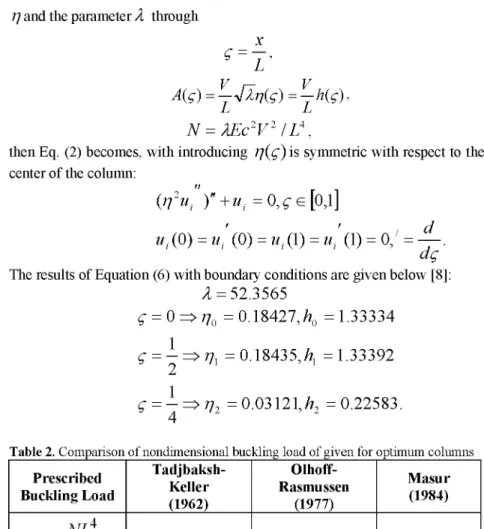
then Eq. (2) becomes, with introducing n ( - ) is symmetric with respect to the center of the column:
(n
2
U " y+U = o,
Ç
g[O,Î]
U (0) = u' (0) = U (1) = U ' (1) = O,
/= dç
The results of Equation (6) with boundary conditions are given below [8]:X = 52.3565
- = 0 ^ n
0= 0.18427,h
0 = 1.33334- = 2 ^ n = 0.18435,H
1= 1.33392
- = 4 = 0.03121,H
2= 0.22583.
Table 2. Comparison of nondimensional buckling load of given for optimum columns Prescribed Buckling Load Tadjbaksh-Keller (1962) Olhoff-Rasmussen (1977) Masur (1984) 3 NL4 À = 2 2
Ec
2V
2 52.6379 52.3563 52.3565X
Table 2 shows non dimensional critical buckling load obtained by Tadjbaksh & Keller [5], Olhoff & Rasmussen [7] and Masur [8]. However, in these solutions, it was only considered stability criterion in structure. As shown in Table 3, when oak wood column is sized according to Masur [8], crushing occurs at the points of minimum thickness without buckling at 4709.08 N whereas the critical buckling load is 6115.28 N. Similar case, it is observed sapele wood column. Crushing force in points of minimum thickness and critical buckling load is calculated as 4753.38 N and 7598.21 N, respectively. The optimal columns must be considered from the point of view of practical design. Consequently, bimodal solution is not practical and optimal.
Table 3. The critical buckling loads comparison of analytical results of optimum
solutions for wood composite materials for variable circular cross-sections (N) N a t u r a l W o o d Composite M a t e r i a l s U n i f o r m Cross-section Variable Cross-section N a t u r a l W o o d Composite M a t e r i a l s U n i f o r m Cross-section T a d b a k s h -Keller (1962) Olhoff-Rasmussen (1977) M a s u r (1984) C r u s h force in points of minimum thickness SAPELE 5729.29782 7639.22573 7598.19448 759S.21272 4753.37518 OAK 4611.12051 6148.16040 6115.26779 6115.28246 4709.07792 In this paper, it is also rearranged at the points of minimum thickness in the solution obtained by taking into consideration of both stability and crushing criterion. At first, the crushing criterion was considered in points of minimum thickness for an assumed initial shape of a column obtained by Masur's [8] bimodal solution. The volume was chosen which satisfied bimodal optimality conditions given by Masur [8] to withstand buckling and crushing in columns. The chosen volume value must be smaller than the initial volume. Then it was added to the volumes at the points of minimum thickness. Added volume A V was calculated using a computer code in MATLAB. The procedure of MATLAB was continued until the difference between chosen volume and uniform column's volume was zero. It was noticed that proposed optimum model solution was valid following equation at the points of minimum thickness:
Nbucklingload ~ A ^yield '
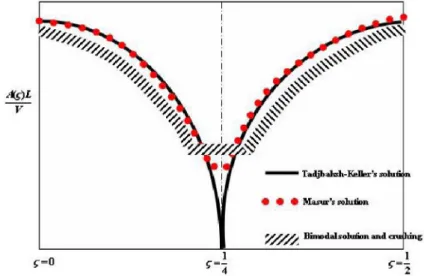
In Figure 1, optimum forms obtained by Tadjbaksh&Keller [5], Masur [8] and proposed optimum solution for clamped-clamped case are showed.
Figure 1. Comparison of Tadjbaksh & Keller, Masur and New Proposed
3. EXPERIMENTAL INVESTIGATION
Proposed optimum column design for given length and volume withstands both buckling and crush, especially, at the points of minimum thickness. To understand the verification of the new proposed optimum column design, two different natural composite materials, which are locally available and commercially important species, were tested: sapele (entandrophragma cylindricum) and oak (quercus spp.).
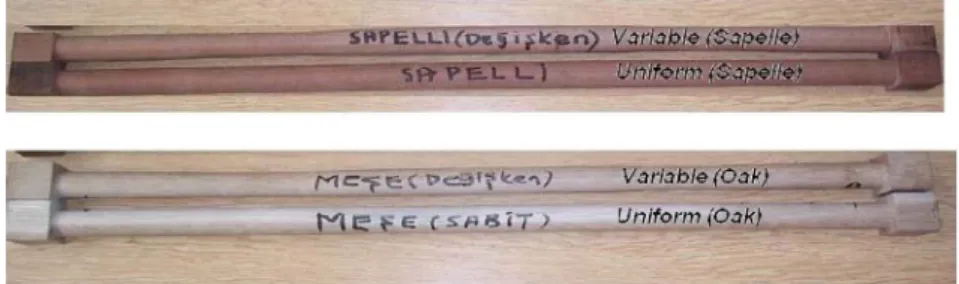
All specimens were manufactured both uniform and variable circular cross-sections. The length was defined as 750 mm. The diameter of wood composite specimen was 25 mm for oak and sapele with circular cross-sections. Each specimen was operated in lathe to obtain the requested diameter. In this way, natural composite materials were manufactured with uniform cross-sections. Other specimens, in other words the wood composite columns with variable cross-sections processed in CNC workbench. Proposed optimum column with variable circular cross-section that considered both bimodal solution and crushing criteria was sized. This procedure was the most-time consuming. Because thickness changes at every point of composite column. Especially, it was very difficult to form the minimum thickness of points of composite columns. Finally, the specimens used in this study were as follows (Figure 2):
• Sapele and oak wood composite materials with uniform cross-sections
• Sapele and oak wood composite materials with variable cross-sections
r —
r i f± i pej'it-t-v,» Variable ¡Oak)pis
f i e t-e Uniform (Oak)
^ —:
Figure 2. Buckling test specimens with uniform and variable cross-sections
for sapele and oak wood materials
Compression strength was determined on a Shimadzu AG 100 kN universal testing machine, applying the load at a displacement rate of 0.5 mm/min. For
compression testing, three specimens each (which were averaged after testing to give a characteristic value), with a length of 40 mm, were cut from sapele and oak stick to give a compressive specimen. The low length-to-width ratio prevented failure of the specimen by Euler buckling [16]. The specimen consists of a straight piece of sapele and oak wood, which is sufficiently short to ensure that failure will occur first in crushing (rather than in buckling). Modulus of elasticity (compressive stress perpendicular to grain) and yield stress were determined from load-deformation diagrams. It is shown in Table 4 the properties of sapele and oak materials. These properties represents as the average values.
Table 4. Average values of properties of sapele and oak wood materials (MPa) Natural Composite
Materials
Modulus of
Elasticity Yield Stress
SAPELE 4257.30 42.8796
OAK 3426.41 42.48
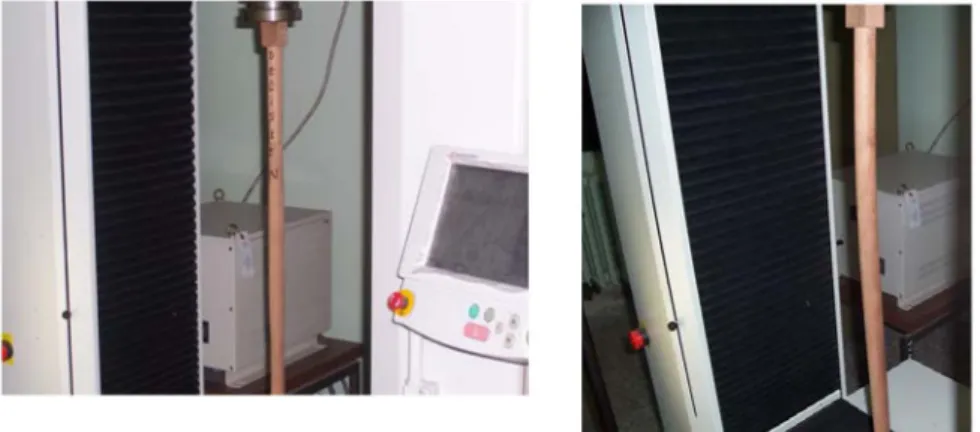
It was also carried out compressive tests for wood materials to obtain critical buckling load. The specimens were clamped at two ends and kept free at other two ends. All specimens were loaded slowly until buckling. It is also shown in Figure 3 buckling test set-up and buckling form for uniform cross-section for sapele materials with clamped ends. From the measured load-strain data, it was calculated the critical buckling load for uniform and variable cross-section. The load which the initial part of the curve deviated linearity, was taken as the critical buckling load.
Figure 3. Buckling test set-up and buckling form for uniform cross-section for sapele
4. NUMERICAL ANALYSIS
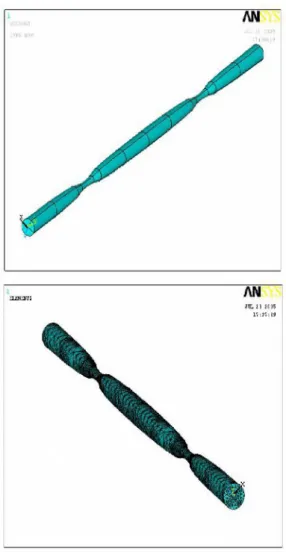
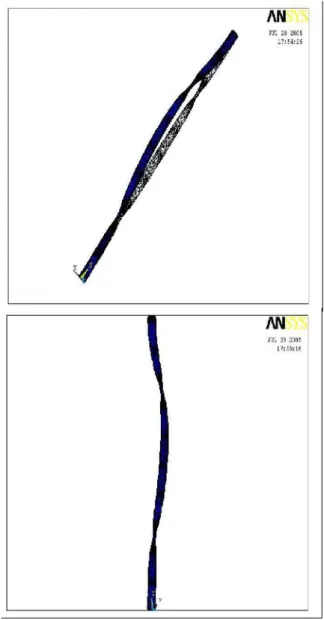
The finite element analysis was conducted to investigate the behavior of sapele and oak wood composite materials under compressive loads. A model of each experimental specimen was analyzed using finite element method. The purpose of this analysis is to model the behavior of a built-up column under axial load, hence, verify the analysis by the experimental results. A three-dimensional finite element model was developed to predict the mechanical behavior of wood composite materials. Two different finite element models were obtained. These were uniform and variable cross-sections for wood composite materials. Another word, uniform column and optimized column were formed using ANSYS for wood composite materials. The specimen length of composites with both uniform and variable cross-sections were taken as 750 mm. The diameter of the wood composites was 25 mm for oak and sapele wood materials, for uniform circular cross-sections. For variable circular cross-sections, the maximum diameter was 27.5 mm for sapele and oak materials. Whereas this diameter was 28.83 mm according to Masur [8]. The columns with uniform cross-sections were modeled with the beam elements [17]. However, other columns, which have variable cross-sections, were modeled with the solid elements. In the finite element model, the optimum element sizes should be defined to obtain accurate results when the models are being meshed. The wood composite columns were analyzed under clamped-clamped end conditions. The finite element mesh model and buckling model for new proposed optimum solution are shown in Figures 4 and 5, respectively.
5. RESULTS AND CONCLUSIONS
The objective of this study was to develop and design optimized composite column against buckling. It is thought about determining what shape of column has the largest possible buckling load of composite column of a given length and volume. And the optimization problem was formulated as the maximization of the smallest eigenvalue given total volume of material of the structure.
It was also proved that the solution of Tadjbakhsh & Keller [5], Olhoff & Rasmussen [7] and Masur [8] was not optimum for columns with clamped ends. The critical buckling load results of Tadjbaksh & Keller [5], Olhoff & Rasmussen [7]-Masur [8] was closer with each other for clamped-clamped ends. However, the difference was originated from optimum shape of the column, especially in points of minimum thickness. Tadjbaksh & Keller [5] found the points of vanishing cross-section to be placed at x=0.25 and x=0.75 where the column ends x=0 and x=L are assumed to be clamped-clamped ends
while Olhoff & Rasmussen [7]-Masur [8] obtained nonzero cross-section in these points with bimodal optimum solution. In this study, true solution was obtained with nonzero cross-section in these points but it was durable crushing. Finally, true solution was obtained that was taken into account crushing criteria to Masur's [8] analytic bimodal solution for clamped-clamped case. The cross-sectional area was changed through column. This area in the middle of the column decreases towards ends. The cross-sectional area that was different from zero in points of minimum thickness must be buckled according to new proposed optimum form of column. New proposed optimum solution was verified with both experimental data and numerical results for columns with clamped ends. It is shown that crushing force is smaller than critical buckling load in the new proposed optimum solution.
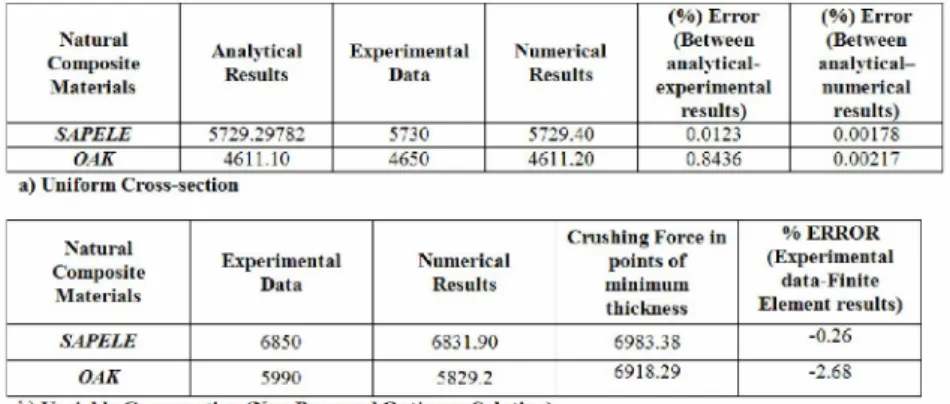
Comparison of buckling loads obtained analytically, experimentally and numerically for uniform and variable circular cross-section for wood materials is shown Table 5 [17]. In this table, variable cross-section form is new proposed optimum form for clamped-clamped case. As shown in Table 5, crushing force in points of minimum thickness is smaller than buckling load, so buckling occurs, not crush. When critical buckling load are examined, it is seen that highest critical buckling load is obtained for sapele.
Table 5. Comparison of buckling loads obtained analytically and experimentally and
numerically for uniform and variable circular cross-section for wood materials Natural Composite Materials Analytical Results Experimental Data Numerical Results (%) Error (Between analytical-experimental results) (%) Error (Between analytical-numerical results) SAPELE 5729.29782 5730 5729.40 0.0123 0.00178 OAK 4611.10 4650 4611.20 0.8436 0.00217 a) Uniform Cross-section Natural Composite Materials Experimental Data Numerical Results Crushing Force in points of minimum thickness % ERROR (Experimental data-Finite Element results) SAPELE 6850 6831.90 6983.38 -0.26 OAK 5990 5829.2 6918.29 -2.68
b) Variable Cross-section (New Proposed Optimum Solution)
As shown in Table 5, the difference between experimental data and finite element results for new proposed optimum solution is very small. Another words, it is good agreement between finite element model and experimental data for proposed optimum solution that takes into account both stability and crush criterion. Consequently, the accuracy of new optimized composite column is proved for clamped ends.
As a result of this study, it was shown that results obtained in the previous studies of variation optimum cross-sectional area for columns under compressive forces clamped-clamped ends was erroneous. The corrected optimum form was obtained and results checked by experimental tests of natural composite columns.
Figure 4. The finite element and mesh model for new
AN
Figure 5. The buckling mode for new proposed optimum solution
REFERENCES
[1] Euler, L., 1744. De curvis elasticis. In Methodus inveniendi leneas curva maximi minimive proprietate gaudentes, sive solutio problematis isoperimetrici lattisimo sensu accepti Lausannae, E65A. O. O. Ser.I., 24, 231-297.
[2] Lagrange, J. L., 1773. Sur la figure des colonnes. Miscellanea Taurinensia, 123. [3] Clausen, T., 1851. Uber die Form architektonischer Saulen. Bulletin
physico-mathematiques et Astronumiques, 1, 279-294.
[4] Keller, J. B., 1960. The shape of the strongest column. Archive for Rational Mechanics and Analysis, 5, 275-285.
[5] Tadjbakhsh, I., Keller, J. B., 1962. Strongest columns and isoperimetric inequalities for eigenvalues. J. App. Mec., 29, 159-164.
[6] Myers, M. K., Spillers, W. R., 1986. A note on the strongest fixed-fixed column. Quarterly of Applied Mathematics, Volume XLIV, Number 3, 583-588.
[7] Olhoff, N., Rasmussen, S.H., 1977. On the single and bimodal optimum buckling loads of clamped columns. Int. J. Solids Struct., 13, 605-614.
[8] Masur, E., 1984. Optimal structural design under multiple eigenvalue constraints. Int. J. Solids and Struc., 20, 211-231.
[9] Cox, S. J., Overton, M. L., 1992. On the optimal design of columns against buckling. SIAM J. Math. Anal. 23, 287-325.
[10] Lewis, A., Overton, M., 1996. Eigenvalue optimization. Acta Numerica, 149-190. [11] Seyranian, A., 1984. On a problem of Lagrange. Mechanics of Solids, 19, 101-111. [12] Seyranian, A. P., Privalova, O. G., 2003. The Lagrange problem on an optimal
column: old and new results. Struct. Multidisc. Optim., 25, 393-410.
[13] Olhoff, N., Seyranian, A.P., 2002. On the the bifurcation and initial post-buckling behavior of bimodal optimal columns. 15th Nordic Seminar on Computational Mechanics, 18-19 October .
[14] Pekbey, Y., 2005. Buckling of economical bars. University of Dokuz Eylul Department of Mechanical Engineering degree of Doctor of Philosophy (In English, Supervisor Prof. Dr. Onur SAYMAN and Assoc. Prof. Dr. Aydogan OZDAMAR).
[15] Pekbey, Y., Ozdamar, A., 2002. Optimum cross-section determination against buckling of bars under compressive loading. The Journal of Graduate School of Natural and Applied Sciences of Dokuz Eylul University, 4(3), 103-112.
[16] Gindl ,W., Teischinger, A., 2002. Axial compression strength of Norway spruce related to structural variability and lignin content. Composites Part A, 33,
1623-1628.
[17] Ozdamar A., Pekbey Y., 2004. Numeric and experimental investigation of buckling optimization of different composite columns with variable cross-sectional area. Ege University Scientific Research Project Report (04/MUH/035), Izmir. (In Turkish)