SPORMETRE, 2017, 15 (3), 165-170
DERİ ENFEKSİYONLARININ
ANKSİYETE ÜZERİNE ETKİSİNİN ARAŞTIRILMASI:
TÜRK GÜREŞÇİLERİ ÜZERİNDE BİR ÇALIŞMA
Ömer KAYNAR
1, Mikail YILMAZ
2, Mahmut AKYÜZ
31Muş Alparslan Üniversitesi Beden Eğitimi ve Spor Yüksekokulu, Muş, 2Muş Devlet Hastanesi Dermatoloji Polikliniği, Muş,
3İnönü Üniversitesi Tıp Fakültesi Psikiyatri Anabilim Dalı, Malatya
Geliş Tarihi: 10.04.2017 Kabul Tarihi: 12.09.2017
Öz: Bu çalışmanın amacı Türk güreşçilerinde deri enfeksiyonlarının sıklığını incelemek ve güreşçilerde deri enfeksiyonlarının anksiye-teye neden olup olmadığını araştırmak. Araştırmaya Türkiye’de farklı illerdeki spor kulüplerinde güreş yapan 190 gönüllü erkek sporcu dâhil edilmiştir. Çalışmaya katılan sporculara, araştırma öncesi hazırlanan Dermatolojik Muayene Bulguları (DMB) anketindeki sorular bir dermatoloji uzmanı tarafından muayene edildikleri esnada sorulmuştur. Ayrıca her bir güreşçinin muayene bulguları da bu anket formuna kaydedilmiştir. Anksiyete düzeyi Beck Anksiyete Envanteri (BAE) ile değerlendirilmiştir. İstatistiksel analiz SPSS 22.0 bilgi-sayar programı kullanılarak değerlendirilmiştir. Çalışmamızda yer alan 190 gönüllü erkek güreşçinin 92 (%57.86)’sinde deri enfeksi-yonlarının görüldüğü tespit edilirken, 67 (% 42.14) sinde deri enfeksiyonu tespit edilmemiştir. Güreşçilerde en sık görülen deri enfek-siyonları sırayla tinea pedis 24 (15.09), tinea korporis 16 (10.16 ), eritrazma 13 (8.17), folikülit 11 (6.91), verrü (siğil) 11 (6.94), oni-komikoz 6 (3.57), paronişi 5 (3.14), herpes 3 (1.88), impetigo 1 (0.64 %), ve tinea versikolor 2 (1.36) olarak tespit edilmiştir. Deri enfeksiyonu görülen güreşçiler ile deri enfeksiyonu görülmeyen güreşçilerin anksiyete düzeyleri karşılaştırıldığında her iki grupta da anlamlı bir farkın olmadığı tespit edilmiştir (p>0.05). Spor literatüründe ilk defa yapılan bu çalışmada, deri enfeksiyonlarının güreşçi-lerde anksiyeteye neden olmadığı sonucuna varılmıştır.
Anahtar kelimeler: Spor, güreş, bakteri, mantar, virus, anksiyete
INVESTIGATION OF THE EFFECTS OF SKIN INFECTIONS ON ANXIETY: A STUDY ON TURKISH WRESTLERS
Abstract: This study aims toexamine the prevalence of skin infections in Turkish wrestlers and to investigate whether skin infections cause anxiety in the wrestlers with infections. 159 volunteer male athletes engaged in freestyle wrestling from sports clubs of Turkey participated in the research. Before the research, questions in “Dermatological Examination Findings (DEF)” questionnaire were asked to participants by a dermatologist during the examination. In addition, examination findings of each wrestler were recorded in this questionnaire form and the detected anxiety levels were evaluated via Beck Anxiety Inventory (BAI). Statistical analysis program; SPSS 22.0 was used for the evaluation. Of 159 voluntary free style male wrestlers in our research, 92 (57.86 %) were detected to have skin infections while 67 (42.14 %) did not have any skin infection. The most common skin infections found in wrestlers are tinea pedis 24 (15.09), tinea corporis 16 (10.16 ), erythrasma 13 (8.17), folliculitis 11 (6.91), verrucous 11 (6.94), onychomycosis 6 (3.57), paronychia 5 (3.14), herpes 3 (1.88), tinea versicolor 2 (1.36) and impetigo 1 (0.64 %), respectively. Comparing anxiety levels of wrestlers who have skin infections and those who do not have, no significant difference was found between two groups (p>0.05). In this study which is the first study conducted on this issue in sports literature, it was concluded that skin infections do not lead to anxiety in wrestlers.
INTRODUCTION
Skin infections are an important health problem in athletes who practiced sports. Skin infections can be found particularly as a result of skin contact and injures, disablements in athletes being engaged with contact sports and mixed martial arts fighters (wrestling, boxing, kickboxing, judo, taekwondo, karate, soccer, etc.). (Hirose et al., 2011; Kordi et al., 2012; Pickup and Adams, 2007). Prevalence of skin infections is the highest in wrestling compared to other sports branches. In wrestling, skin infections can easily occur as a result of contact from skin to skin among athletes during wrestling (Kordi et al., 2012; Herzog et.al., 2017)
Anxiety refers to depression felt against a danger or internal threat, the object of which is uncertain or which cannot be defined by an individual (Beser and Öz, 2003). There are limited studies investigating the relationship between skin infections and anxiety, yet there are studies which prove this relationship. It is even reported that skin diseases such as acne affect personality sense, self-criticism and respect, social isolation feelings and friendship-building abilities (Mallon et.al., 1999; Shuster et.al., 1978)
In literature review, no study was found on the effect of sports-related skin infections on anxiety, however some studies that examine the relationship between sport and anxiety reported in literature, (Vine et. al., 2013: Gucciardi and Dimmock, 2008) even that Anxiety negatively affect competition performances of athletes and lead to training loss, particularly among wrestlers (Kohl ve ark., 2002). Studies in the literature report that skin infection is a health problem which adversely affects health and performance of athletes (Başer, 1998; Kordi et. al., 2007).
Regular training and sportive performance are among the most important ways to succeed in sports. Therefore, training loss should be prevented and psychological factors assumed to have adverse effect on sportive performance such as anxiety, stress should be eliminated. For that reason, there is a need for research to be conducted on investigation of the effects of skin infections on anxiety in sports.
This study aims to investigation of the effects of skin infections on anxiety among Turkish wrestlers.
MATERIAL AND METHOD
Research Group
A total of 159 volunteer male wrestlers from sports clubs in various provinces of Turkey participated to this study. Research group included currently active athletes who practiced wrestling for at least 3 years. Dermatological examinations were taken during the competition of the athletes. Dermatological examination was held in either sports hall or clinic of dermatology in state hospitals by dermatologists. All wrestlers participated to the research were examined by specialist dermatologists and the findings were recorded in “Dermatologic Examination Findings (DEF)” form. “Beck Anxiety Inventory (BAI)” was filled to detect the severity of anxiety.
Dermatologic Examination Findings (DEF)
In this study, DMB questionnaire was formed to detect the prevalence of skin infections such as it tinea corporis, tinea versicolor, tinea pedis, onychomycosis, herpes, verruca, folliculitis, impetigo and erythrasma among wrestlers. Questions in the questionnaire were asked to participants by a dermatologist during the examination.
Beck Anxiety Inventory (BAI)
Following the dermatologic examinations of the wrestlers, questions in BAI form were used to measure prevalence of anxiety symptoms of the wrestlers.
To this end, a scale developed by Beck et al. and tested for reliability and validity by Ulusoy M. et al., having 0.91 internal consistency coefficient and consisting of 21 items was used to detect the prevelance of anxiety symptoms among wrestlers (Beck et.al., 1988; Ulusoy et.al., 1998).
Patients were asked to rate each item with a score between 0 and 3 and accordingly the obtained results differed between 0 and 63.
Ethical Committee
For this study, approval of B.30.2.ATA.0.01.00./152 number and 08.12.2016 data Ethical Committee of Clinical Research, Faculty of Medicine at Atatürk University was obtained. The approval of the all volunteers were received orally and in written.
Statistical Analysis
SPSS 22.0 package program was used for the analysis of the obtained data. Data was tested for normality with the Kolmogorov Smirnov test and Kruskal Wallis-H Testi and Mann Whitney U tests were used for non-normal distributed data. Chi-square test was used for qualitative data.
RESULTS
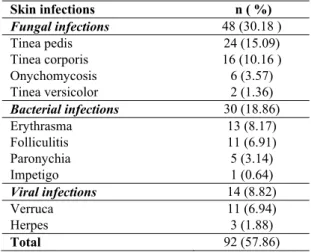
One hundred fifty nine male volunteer wrestlers in the age range of 17 to 35 years and age average of 19.14 and standard deviations of 4.43 participated to our study. Numbers and percentages related to skin infection findings of wrestlers are summarized in Table 1.
Of all wrestlers taking part in this study, 92 free style male wrestlers (57.86 %) were diagnosed with skin infections. 48 (30.18%) of the skin infections were fungal while 30 (18.86%) were bacterial and 14 (8.82%) were viral infections (Table 1).
Moreover, wrestlers developed skin infections while the number of those who applied to doctor was only 17 (18.47 %), However, It was found that 46 (50 %) of wrestlers developed skin infection after they started wrestling.
Table 1: Skin Infection Findings of The Wrestlers
Skin infections n ( %) Fungal infections 48 (30.18 ) Tinea pedis 24 (15.09) Tinea corporis 16 (10.16 ) Onychomycosis 6 (3.57) Tinea versicolor 2 (1.36) Bacterial infections 30 (18.86) Erythrasma 13 (8.17) Folliculitis 11 (6.91) Paronychia 5 (3.14) Impetigo 1 (0.64) Viral infections 14 (8.82) Verruca 11 (6.94) Herpes 3 (1.88) Total 92 (57.86)
In this study, no statistically significant difference was found between anxiety levels of wrestlers having skin infection and those who do not have. (p>0.05) (Table 2).
Table 2. Distribution of Wrestlers' Anxiety Scores by
Skin Infections
Skin infection n Mean rank μ p
Available 92 82.12
2887 0,487 Not Available 67 77.09
Total 159
The correlation between anxiety levels and BMI; age and anxiety levels among wrestlers are presented in Table 3. No statistically significant difference was found between BMI and anxiety levels of wrestlers (p>0.05) (Table 3). No statistically significant difference was found between age and anxiety levels of wrestlers (p>0.05) (Table 3).
Table 3. Variance Analysis Between BMI; Age and
Anxiety Among Wrestlers
BMI n Mean rank p
18 and below 12 71,04 0,205 19-25 96 80,54 26-30 47 77,38 31 and above 4 124,75 Total 159
Age n Mean rank p
17-20 128 77,99
0,58
21-24 20 75,75
25 and above 11 111,14
Total 159
DISCUSSION AND CONCLUSION In the literature review, skin infections were reported to be found in sports and particularly common in wrestling (Kordi ve ark., 2007; Ergün ve ark., 2001; Pasque and Hewett, 2000). Skin infections such as tinea pedis, corporis and versicolor, erythrasma, folliculitis, verru, onychomycosis, panarisi, herpes and impetigo found in the findings of this study are in parallel with other findings in the literature (Adams, 2002); Ragıp, Demet ve Serap, 2015; Field and adam, 2008). Comparing anxiety levels of wrestlers having skin infections with those without skin infections, no statistically significant difference was found higher anxiety levels (p>0.05).
In sports science, no study was found on the relationship between anxiety and skin infections. However, the relationship between dermatologic diseases and psychological disorders has been investigated for a long time apart from the scope of sports science (Mayser, Handrick and Nenoff, 2016; Panconesi, 2003). Studies report a correlation
between many inflamatuar skin diseases such as psoriazis, liken planus, acne and dermatitis and stress, anxiety and depression (Al’Abadie Kent and Gawkrodger, 1994)
There was no relationship between skin infection and anxiety. This result was similar to those of (Yazıcı et al., 2004) and (Aktan et.al., 2000) and is contrast to the results of some studies in which there was a positive relationship between severity of skin infection and severity of anxiety ( Lukaviciute et.al., 2017; Pearl et al., 1998). In the literature, studies conducted on the relationship between skin infections and psychological disorders reported that psychological disorders affect skin infections, even that Patients with chronic dermatologic diseases are at high risk of contract a psychological problems which may continue even after progression of skin disease. (soruour et al., 2017; Koo and Pham, 1992)while some studies reported, on the contrary, skin infections like Herpes simplex virus (HSV) cause psychological disorders like stress, anxiety and depression (Garrie and garrie, 1978); Chida and Mao, 2009; Johnson and Mostaghimi, 1995). The correlation between age and anxiety has been known for so long. It is reported that susceptibility to anxiety increases with aging (Aydemir ve ark., 2015). In the present study, contrary to the findings in the literature, no statistically significant difference was found age on anxiety levels.
It is known that there is a correlation between BMI and anxiety in sedentary. Anxiety levels of obese people were detected to be higher compared to those in normal weight (Zhong et.al.., 2010; Simon et.al., 2008).
In the present study, It was found that there was no statistically significant difference of the BMI on the anxiety in the wrestlers.
Injures or disablement in sportive activities may lead to skin infections. Pain, discomfort and other infection symptoms caused by infections adversely affect performances of athletes (Brukner and Khan., 2007). In many studies conducted in the field of wrestling, training loss and losing competition due to skin infections,( Meulener and Smith, 2011; adam, 2002) cause anxiety among athletes which is consequently assumed to adversely affect the performance. On the contrary to this assumption, the results of the present study
report no statistically significant the effects of skin infections on anxiety in wrestling.
In this study, which is a first-time research in sports literature, it was found that skin infections do not cause anxiety in wrestlers.
Note: This study was orally presented at 14th
International Sports Sciences Congress held in Antalya Belek on 1-4 December 2016.
REFERENCES
1. Hirose N, Suganami M, Ogawa YS, Hiruma M, Ogawa H (2011): Screening examination and treat-ment of Trichophyton tonsurans infection in judo athletes affiliated with the University Judo Federa-tion of Tokyo. Mycoses, 54:35-38.
2. Kordi R, Ziaee V, Rostami M, Wallace WA (2012): Sports injuries and health problems among wrestlers in Tehran. J Pak Med Assoc, 62, 204-208.
3. Pickup TL, Adams BB (2007): Prevalence of tinea pedis in professional and college soccer players ver-sus non-athletes. Clin J Sport Med, 17(1), 52-54. 4. Herzog MM, Fraser MA, Register-Mihalik JK, Kerr
ZY(2017): Epidemiology of Skin Infections in Men's Wrestling: Analysis of 2009-2010 Through 2013-2014 National Collegiate Athletic Association Surveillance Data. J Athl Train, 52(5), 457-463. 5. Beser NG, Öz F(2003): Kemoterapi alan lenfomalı
hastaların anksiyete-depresyon ve yaşam kalitesi. C.Ü. Hemşirelik Yüksek Okulu Dergisi, 7, 47-58. 6. Mallon E, Newton JN, Klassen A, Stewart-Brown
SL, Ryan TJ, Finlay AY. (1999): The quality of life in acne: a comparison with general medical conditi-ons using generic questionnaires. Br J Derma-tol,140, 672-676.
7. Shuster S, Fisher GH, Harris E, Binnell D (1978): The effect of skin disease on self-image. Br J Der-matol, 99 (16), 18-9.
8. Vine SJ, Lee D, Moore LJ, Wilson MR (2013): Quiet eye and choking: online control breaks down at the point of performance failure. Med. Sci. Sports Exerc. 45, 1988-1994.
9. Gucciardi DF, Dimmock JA (2008): Choking under pressure in sensorimotor skills: conscious pro-cessing or depleted attentional resources? Psychol. Sport Exerc., 9, 45-59.
10. Kohl TD, Giesen DP, Moyer JJ, Lisney M (2002): Gladiatorum: Pennsylvania's experience. Clinical Journal of Sports Medicine, 12, 165-171.
11. Başer E (1998):Uygulamaları spor psikolojisi. An-kara: Bağırgan Yayımevi.
12. Kordi R, Mansournia MA, Nourian RA, Angus W (2007): Cauliflower ear and skin infections among wrestlers in Tehran. J Sports SciMed, 6, 39-44. 13. Ulusoy M, Şahin N, Erkmen H (1998): Turkish
version of the beck anxiety inventory: Psychometric properties. J CognPsychol: An Intern Quart, 12, 163-172.
14. Beck AT, Epstein N, Brown G, Steer RA. (1988): An inventory for measuring clinical anxiety:Psychometric properties.J Consult and Clin Psychol, 56, 893-97. 15. Ergün M, Ertam İ, Aytimur D, İşlegen Ç, Sezer
Erboz S (2001): Futbolcularda yüzeyel mantar en-feksiyonu sıklığının araştırılması. Türkderm, 35(4), 312-314.
16. Pasque CB and Hewett TE. (2000): A prospective study of high school wrestling injuries. The Ameri-can Journal of Sports Medicine, 28, 509-515. 17. Adams BB (2002): Dermatologic disorders of the
athlete. Sports Med, 32 (5), 309-21.
18. Ertaş R, Kartal D, Utaş S (2015): Çocuklarda Yü-zeysel Mantar Enfeksiyonları. Turk J Dermatol, 9, 186-189.
19. 17 Field LA, Adams BB (2008): Tinea pedis in athletes. Int J Dermatol, 47 (5), 485–92.
20. Mayser P, Handrick W, Nenoff P (2016): Sports-associated dermatophytoses : An overview. 67(9), 680-8.
21. Panconesi E (2003): Psychosomatic factors in der-matology: Special perspectives for application in clinical practice. Dermatol Clin, 23:233-629. 22. Al’Abadie MS, Kent GG, Gawkrodger DJ (1994):
The relationship between stress and the onset and exacerbation of psoriasis and other skin conditions. Br J Dermatol, 130, 199-203.
23. Yazici K, Baz K, Yazici AE, Köktürk A, Tot S, Demirseren D, Buturak V(2004): Disease-specific Quality of life is associated with anxiety and dep-ression in patients with acne. J Eur Acad Dermatol Venereol, 18, 435–9.
24. Aktan S, Ozmen E, Sanli B (2000)Anxiety, depres-sion and nature of acne vulgaris in adolescents. Int J Dermatol, 39, 354–7.
25. L. Lukaviciute,P. Navickas,A. Navickas,J. Grigaiti-ene,R. Ganceviciene,C.C. Zouboulis (2017): Quality of life, anxiety prevalence, depression symptomato-logy and suicidal ideation among acne patients in Lithuania, 31(7), 1079–1240.
26. Pearl A, Arroll B, Lello J, Birchall NM (1998)The impact of acne: A study of adolescent's Attitudes, Perception and Knowledge. N Z Med J, 111, 269–71.
27. Sorour F, Abdelmoaty A, Bahary MH., El Birqdar B (2017): Psychiatric disorders associated with some chronic dermatologic diseases among a group of Egyptian dermatology outpatient clinic attendants. Journal of the Egyptian Women's Dermatologic So-ciety, 14 ( 1), 31–36.
28. Koo JYM, Pham CT.(1992): Psychodermatology: Practical guidelines on pharmacotherapy. Arch Dermatol, 126, 381-388.
29. Garrie SA, Garrie EV (1978): Anxiety and skin diseases. Cutis, 22(2), 205-208.
30. Chida Y, Mao X (2009): Does psychological stress predict symptomatic herpes simplex virus recurren-ce? A meta-analytic investigation on prospective studies. Brain Behav Immun, 23, 917-925.
31. Johnson FYA & Mostaghimi H (1995): Co Morbı-dıty Between Dermatologıc Dıseases And Psychıat-rıc Dısorders In Papua New Guınea. International journal of Dermatology, 34 (4), 244-248.
32. Aydemir Y, Doğu Ö, Amasya A. Yazgab B, Ölmez EÖ, Gündüz H (2015): Kronik Solunum Ve Kalp Hastalıklarında Anksiyete ve Depresyon Sıklığı ve İlişkili Özelliklerin Değerlendirilmesi. Sakarya Med J, 5(4), 199-203.
33. Zhong W, Cruickshanks KJ, Schubert CR, Nieto FJ, Huang GH, Klein BE, Klein R. (2010): Obesity and depression symptoms in the Beaver Dam Offspring Study population. Depress Anxiety, 27, 846-851. 34. Simon GE, Ludman EJ, Linde JA, Operskalski BH,
Ichikawa L, Rohde P, Finch EA, Jeffery RW (2008): Association between obesity and depression in middle-aged women. General Hospital Psychi-atry, 30, 32-39.
35. Brukner P, Khan K (2007): In: Brukner and Khan’s clinical sports medicine. 3rd Edition. Australia: McGrow-Hill Medical.
36. Meulener M, Smith BL (2011): Herpes gladiatorum with ocular involvement ina mixed martial arts figh-ter. Cutis, 87(3), 146–7.