T.C.
İSTANBUL AYDIN UNIVERSITY INSTITUTE OF SOCIAL SCIENCES
PRICING IN RETAIL INDUSTRY AND CASE STUDY ON PRICING
MBA THESIS Onur AFACAN
Department of Business Business Management Program
iii T.C.
İSTANBUL AYDIN UNIVERSITY INSTITUTE OF SOCIAL SCIENCES
PRICING IN RETAIL INDUSTRY AND CASE STUDY ON PRICING
MBA THESIS
Onur AFACAN (Y1312.130049)
Department of Business Business Management Program
Thesis Advisor: Asst.Prof.Dr. Burçin KAPLAN
v FOREWORD
I want to thank the managers and directors who supported me during the period in preparing the thesis study. Also, I want to thank my cousin, Process Analysis and Reporting Manager who made me contact with his valuable executives. Furthermore, I want to thank my parents and my sisters for their endless support.
Especially, I want to thank and express my gratitudes to my thesis advisor and guide, Asst. Prof. Dr. Burçin KAPLAN. She guided me and showed ways through my study and expanded my views during my research.
vii TABLE OF CONTENTS
Page
TABLE OF CONTENTS ... vii
ABBREVIATIONS ... xi
LIST OF TABLES ... xiii
LIST OF FIGURES ... xv
ABSTRACT………...………….………xvii
ÖZET………xix
1. INTRODUCTION ... 1
1.1. Background of the Research ... 1
1.2. Statement of the Problem ... 2
1.3. Purpose of the Study ... 3
1.4. Research Aim and Objectives ... 4
1.5. Research Questions ... 4
1.6. Significance of the Study ... 5
1.7. Scope of the Research ... 5
1.8. Limitations of the Study ... 6
2. LITERATURE REVIEW: RETAILING CONCEPT, AND RETAILING SECTOR ... 7
2.1. Retailing and Retailer Concepts ... 7
2.2. Retail Store Concept ... 9
2.2.1. Food Oriented Store Retailing ... 9
2.2.2. Product Oriented Store Retailing ... 12
2.3. Retail Selling ... 14
2.4. Functions of Retail Selling ... 15
2.5. Classification of the Retailing Sector ... 16
2.5.1. Retailing Types According to Ownership ... 17
2.5.1.1. Independent Retail Stores ... 17
2.5.1.2. Chain Stores ... 18
2.5.1.3. Franchising ... 19
2.5.1.4. Department Renting ... 19
2.5.1.5. Vertical Marketing Systems ... 20
2.5.1.6. Consumer Cooperatives ... 20
2.5.2. Service Retailing Types ... 21
2.5.3. Retailing Types Without Store ... 22
2.5.3.1. Direct Marketing ... 22
2.5.3.2. Direct Mail Marketing... 23
viii
2.5.3.4. Marketing with Catalogue ... 24
2.5.3.5. Online Marketing ... 24
2.5.3.6. Direct Selling ... 24
2.5.3.7. Kiosks and Vending Machines ... 25
2.5.3.7.1 Selling with Mass Media Vehicles ... 25
2.5.3. Historical Development of Retailing ... 26
2.5.3.1. Historical Development of Retailing at the World ... 26
2.5.3.2. Historical Development of Retailing in Turkey ... 27
2.5.4. Retail Market Overview ... 29
2.5.4.1. Global Retail Market Overview ... 29
2.5.4.2. Turkish Retail Market Overview ... 30
2.5.4.3 Luxury Retail and Luxury Retail Market Overview ... 31
3. PRICING IN RETAIL SECTOR ... 34
3.1. Price Concept ... 34
3.2. Marketing Mix ... 35
3.2.1. Product ... 37
3.2.3. Promotion ... 43
3.2.4. Price ... 44
3.2.4.1 Factors That Affect Pricing ... 45
3.2.4.2 Pricing Methods ... 49
3.2.4.2.1. Cost Oriented Pricing ... 49
3.2.4.2.2. Full-Cost Oriented Pricing... 50
3.2.4.2.3. Variable Oriented Pricing ... 50
3.2.4.2.4. Purpose Oriented Pricing ... 51
3.2.4.2.5. Demand Oriented Pricing ... 51
3.2.4.2.6. Competition Oriented Pricing ... 54
4. RESEARCH ON PRICING AND A CASE STUDY ... 55
4.1. Research Methodology ... 55
4.2. Beymen Company Overview ... 59
4.3. In-Depth Interviews ... 60
4.3.1. Participants ... 60
4.3.2. Questions ... 60
4.3.3. Procedure ... 61
4.3.4. Data Analysis and Results ... 61
4.3.4.1. Maxqda Analysis and Results ... 65
4.3.4.1.1. Pricing Strategies ... 66
4.3.4.1.2. Factors Affect Pricing ... 69
4.4. Retail Textile Sector in Turkey ... 82
4.4.1. Importance of the Retail Textile Sector ... 82
4.4.2. Differences of Luxury Textile Retailing ... 82
4.4.3. General Pricing Policies of the Textile Retail Sector ... 83
4.4.4. Comparison of Research Results with Retail Textile Sector in Turkey ... 84
5. CONCLUSION AND RECOMMENDATIONS ... 85
REFERENCES ... 96 APPENDIXES….. ... 99 1. STRATEGIES ... 109 1.1. Financial Strategy ... 109 1.2. Pricing Strategy ... 109 1.3. Prestige Pricing ... 115
ix
1.4. Special Days ... 117
2. CONSUMER SATISFACTION ... 118
3. FACTORS AFFECT PRICING ... 121
3.1. Competition ... 124 3.2. Internet Sales ... 125 4. CONSUMER INCEPTION... 127 5. BRAND ... 130 5.1. Luxury Brands ... 130 5.2. Brand's Position ... 130 5.3. Brands Number ... 130 5.4. Multibrand Stores ... 130 5.5. Brand Image ... 131 6. CAMPAIGNS ... 132 7. STORES ... 134 7.1. Store Areas ... 134
7.2. Store Based Differences ... 134
7.3. Store Managers ... 136 7.4. Monobrand Stores ... 136 8. PRICE ... 137 9. PRODUCT LINES ... 139 10. DISCOUNT ... 141 11. BEYMEN'S OFFERINGS ... 143 12. OBJECTIVES OF COMPANY ... 144
13. PSYCHOLOGICAL FACTORS AFFECT PRICING ... 145
14. DEMOGRAPHY ... 146 15. PRODUCTION COSTS ... 147 16. AIM OF COMPANY ... 148 17. LUXURY SECTOR ... 149 18. SEWING SERVICE ... 151 19. BEYMEN'S POSITION ... 152 20. TARGET MARKET ... 153 21. SALES BUDGET ... 154 22. SERVICES OFFERED ... 155 REFERENCES………96 RESUME……….156
xi ABBREVIATIONS
TV : Television
U.K : United Kingdom
U.S.A : United States of America YKM : Yeni Karamürsel Mağazaları
xiii LIST OF TABLES
Page
Table 2.1: The Biggest Global Retailers in The World...26
Table 2.2: Major Luxury Goods Companies’ Sales and Profits...29
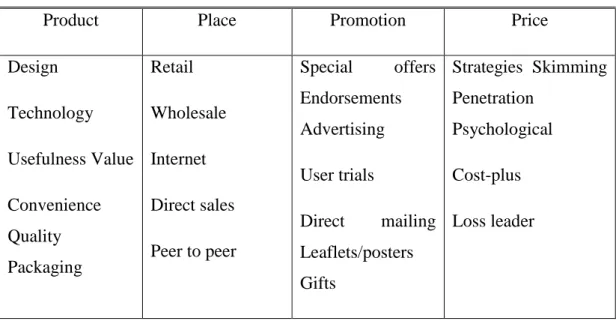
Table 3.1: Marketing Mix Elements...33
xv LIST OF FIGURES
Page
Figure 3.1: Marketing Mix...35
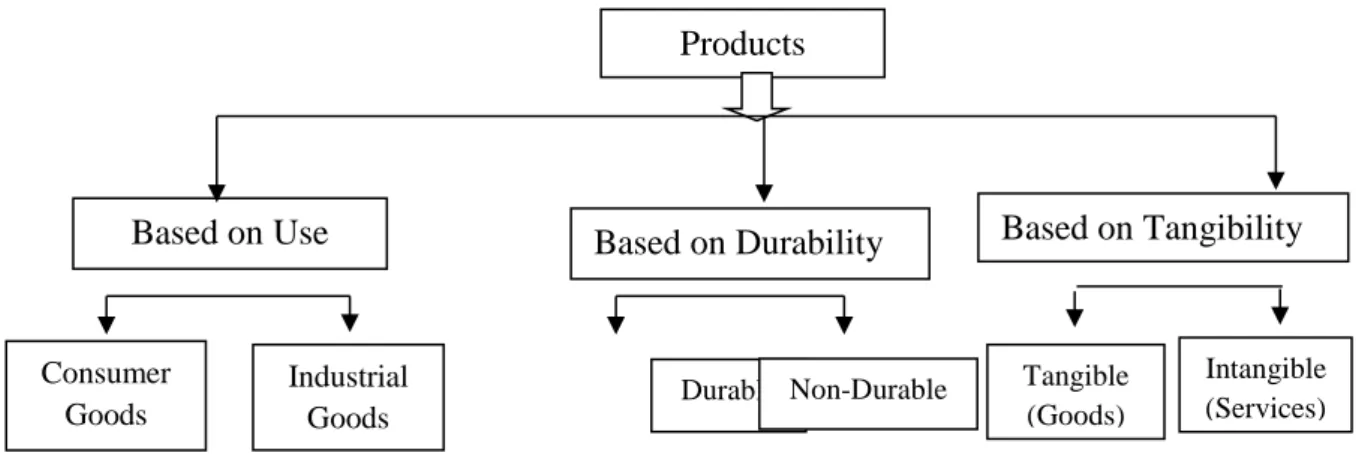
Figure 3.2: Product Classification...37
Figure 3.3: Complex and Basic Distribution Channel Models…...40
Figure 3.4: Zero stage channel of distribution...41
Figure 3.5: One stage channel of distribution...42
Figure 3.6: Two stage channel of distribution...43
Figure 3.7: Three stage channel of distribution...45
Figure 3.8: Price Circle...46
Figure 3.9: Demand Curve...48
Figure 4.1: Pricing Strategies...35
Figure 4.2: Factors Affect Pricing...37
Figure 4.3: Customer Satisfaction...40
Figure 4.4: Internet Sales...41
Figure 4.5: Company Objectives...42
Figure 4.6: Price...43
Figure 4.7: Product Lines...45
Figure 4.8: Stores...46
Figure 4.9: Brand...48
Figure 4.10: Beymen’s Offerings...35
Figure 4.11: Campaigns...37
xvii
PERAKENDE SEKTÖRÜNDE FİYAT BELİRLEME DURUM İNCELEMESİ ÖZET
Bu tez çalışmasında perakende sektöründe fiyatlandırma ve fiyatlandırma stratejilerini etkileyen faktörlerin belirlenmesi amaçlanmıştır. Bu sebeple öncelikli olarak perakendecilik sektörü, perakendeci terimleri, perakende mağaza tipleri sektör bazlı olarak sınıflandırılarak literatür taraması yapılmıştır. Fiyatlandırma kavramının incelenmesinin ardından büyük perakende mağazaların finansal durumları ve özellikleri genel olarak incelenmiştir.
Literatür taramasının desteklenmesi amacıyla perakende sektöründe fiyatlandırma stratejilerini örneklendirmek için Beymen şirketi yöneticileri ile yarı yapılandırılmış derinlemesine görüşmeler yapılmıştır. Elde edilen bulgular perakende tekstil sektörü genel verileriyle kıyaslanmıştır. Veriler doğrultusunda tekstil perakende sektöründe şirketlerin fiyatlandırma konusunda izlemeleri gereken politika ve stratejiler incelenmiş, bu konuyla ilgili problem alanlarına yönelik çözümler belirtilmiştir. Görüşmeler sonucunda elde edilen bulgular perakende sektöründe fiyatlandırma konusunda birçok faktörün belirleyici olduğunu göstermiştir. Ancak Beymen şirketi özelinde yürütülen çalışmada Beymen şirketinin fiyatlandırma stratejisinin marka değeri üzerine oluştuğu saptanmıştır.
xix
PRICING IN RETAIL INDUSTRY AND A CASE STUDY
ABSTRACT
In this thesis study; primary aim is to define Pricing. After an overview of retail, retailing and retailer terms; retailing store concept, functions, types of the sector and classification are stated. Financial management of the stores and bigger organizations are expressed. Besides, it is mentioned about the situation in Turkey and the world. After this necessary information, ‘pricing' is being defined and analyzed. Obviously pricing topic is the core of the retail industry, also this study.
Its methods are defined in detail to understand the retail sector's messy and complicated structure. In order to support the literature review, semi conducted in-depth interviews with the managers about the pricing strategies of the company is implemented. All the elements of the sector have direct relations with prices, and it is affecting both producers, retailers, consumers and the market. Findings are compared with textile retail sector's general results. According to the data, strategies and policies of textile retail sector firms on pricing are analyzed, and solutions about problem areas are described.
Following the interviews and findings, it is seen that pricing is determined by many factors. But the study shows that Beymen’s pricing strategy concentrates on Brand Value.
1 1. INTRODUCTION
1.1. Background of the Research
In the trade world of today, retailing holds a significant place with its active, innovatively changing the working environment, rules, and competitive structure. It has such a wide usage area, nearly in all sectors retailing is being used. Every organization aims to profit, so has to sell products and give service to customers. This sector is ‘customer oriented’ and has to answer all type of needs of them. Thus, from one individual to the whole company, fundamentals of retailing should be well understood and applied.
Retailing started with ‘exchange' and go on with individual sellers, local markets and up to massive shopping centers of now. Apparently, with its so risky and competitive structure, most of the retail foundations from the smallest to the biggest, can't cope with these conditions (except pricing) and has to make changes in their product types, store locations, according to the environment; or end their works and exit the sector. Therefore, pricing is not the only reason for competition but the basis. This structure and characteristics of retail trade can also vary according to social and economic development of the environment.
These factors are population growth, age composition of the population, the variation of income levels, population mobility level and urban development. Without such an obligation of dealing with these hard conditions of the market, today's large and wealthy companies, corporations, commercial entities would not be built and occurred. Furthermore, many more factors that influence the retail sector can be listed.
The global financial crisis which occurred in 2008, has slowed down the development of the retail industry. However, retail companies which are organized in the distribution channel has come to a more stable position, so this caused them to be more resistant against such crisis rather than the other retail companies.
2
As a result of globalization in the industry, first line local retailers like Migros, Gima, Tansaş and Kipa's capitals are owned by foreign companies. Because of this, second line retailers were trying to get developed and also trying to compete with these global organizations. This made second line retailers get stronger and also look for alternative ways to keep stable in the industry. For instance, they started to co-operate with each other.
Globalization affects retailers so much as the traditional part of the retail chain. Their numbers began to decrease because they could not compete with those first and second line retailers.
In these harsh conditions, one of the most important decisions of all retailing actors' is the right pricing of goods and services. The right price is an amount of money which is affordable by customers and satisfy their needs; besides it is an acceptable amount for retailers so that they can make changes in their goods and services. Right price influences are attracting customers to the stores. In our world of today, pricing is not simple as adding cost values to prices as traditional methods. Pricing today has particular strategies and policies depending on different conditions. Today's retailing market is complex, and there is a rapid competition that the companies have to face with; because of this, effects of the pricing strategies in the retail sector have to be analyzed in details according to various factors.
After the foundation of Turkish Republic, textile industrialization started. Especially after 1980's textile industry took the most important role in the economy of the country. More than half of the exports were made by textile companies. Today, the textile retail industry is still having a significant position in the country's economic condition. The most dynamic and variable sector is the retail textile industry. Pricing policies of the companies determine their survival in the industry.
1.2. Statement of the Problem
Producers of the textile retail sector today have to deal with many aspects of pricing strategies. In the textile market, competition is too much, and the survival of the companies are getting harder every day. The problem that the companies face is how
3
to make a pricing strategy that attracts the most consumers and provides the highest benefit.
The textile retail sector has so many variables like campaigns, product types, pricing strategies, different kinds of customers, etc. Also, the employee profile is not a satisfying one. Sales representatives who work in this sector, usually make their last choice to work in the textile retail sector. In job searches, the textile is their last sector option to work. Thus, in these conditions, it is hard to imply the best pricing strategy for companies.
There are various articles, essays, and studies about pricing in the retail sector; but this study primarily focuses on how to develop or choose and imply the best pricing strategy for a company that also suits them best. Theoretical background about the general retail sector, pricing in the retail sector, and also in-depth interviews in one retail textile company including the comparisons to Turkey’s general, will help to understand how to build the best pricing strategy for retail textile companies.
The company takes part not only in the Luxury Textile Retail Sector but also in regular textile retail too. Therefore, the study will provide much more benefit to any kind of textile retail company on pricing.
1.3. Purpose of the Study
This study is formed to analyze the pricing policies and present the best ways of pricing methods in the retail sector. So, in the first part, the retailing concept, retailing types, and store based retailing systems are explained in detail. In the second part of the study; pricing strategies, pricing theories, and pricing terms are examined. The research part of the survey is based on the literature review which points pricing elements and pricing strategies and formulated to find out the necessary data about product based retailing stores in luxury sector, with semi conducted in depth interviews, and through its Maxqda analysis in Beymen. Finally, findings are compared with the general retail textile industry of Turkey. Furthermore, different pricing policies of Beymen were enlightened through the comparisons.
4 1.4. Research Aim and Objectives
Fundamental objectives of the study are listed below:
• Forming a frame for pricing strategies in Turkish product-oriented retail company and use the emerging data for comparison in the sector.
• Finding out the pricing strategies of Turkish luxury textile retailing sector; finding the similarities and differences in the general ready-wear market due to pricing strategies.
• Finding out the key factors that affect luxury textile retailing sector pricing strategies.
• Clarifying the pricing strategies or change needs of existing strategies in the company.
• Finding out how the company differentiates from its rivals in the retail sector. • Determining the different pricing policies of the firm through the comparison with the general retail textile industry of Turkey.
• Providing a vital source for current companies in the sector on specifying, developing and creating best pricing policies according to their variations. In this study, to find out the pricing strategies in retailing sector, interviews were formed and conducted in Beymen. The pricing strategies of product-oriented retailing stores are analyzed, and the overview of the luxurious retailing sector is displayed. Also, the research purpose of the survey is forming an analysis according to pricing strategies in product based retailing category in Turkey. After the analysis made and findings revealed, a comparison made with Turkey’s general textile retail sector policies of pricing and pricing methods.
1.5. Research Questions
In order to investigate the subject, interview questions are formed to find answers to the research questions that are listed below;
• What are the financial objectives of Beymen? • What are the pricing strategies of Beymen?
5
• Which pricing strategies are used in Beymen?
• Are there store based differences in Beymen pricing strategies?
• What is the reason of positioning Beymen Brand in luxury fashion sector? • What is the importance of psychological methods that Beymen use?
1.6. Significance of the Study
Since the present is based on determining the pricing policies of the retail sector, the importance of the survey is identifying the primary factors of pricing policies in the retail sector. In order to determine and evaluate these factors, the research is conducted in a ready-wear company. Regarding the increasingly competitive environment in retail business, it has become difficult to satisfy requests and attract consumers. Customers are aware of this situation, and demand for better. Satisfied consumer means a benefit and brand development. In this case, customer satisfaction is the most connected area with the pricing strategy of a company.
Choosing and applying the best pricing strategy is the crucial point for sector companies. In such hard economic conditions of Turkey today, mistakes which are made in pricing policies can directly cause the most negative results.
1.7. Scope of the Research
In this thesis study; primary aim is to define Pricing. After an overview of retail, retailing, and retailer terms; retail store concept, functions, types of the sector, and classification are stated. Financial management of the stores and bigger organizations is expressed. Furthermore, mentioned about the situation in Turkey, and in the world. After this basic information, ‘pricing’ is being defined and analyzed. Obviously pricing topic is the core of the retail industry, also this study.
The research targets textile and textile fashion retail companies. Especially include administrative offices, top management, and finance departments. Through this study, pricing methods, strategies, and policies in the sector will be understood, the problem areas about pricing will be solved.
6
The study is an excellent source of use to all retail textile companies. Fashion textile companies can benefit more because the research company is also a fashion textile company.
1.8. Limitations of the Study
The research has limitations according to the number of participants and the case. The findings are derived from only one company, and the number of participants was limited. Only three top managers and one manager’s interviews were recorded. Other interviews were done without recording, through short interviews to collect the various data in short period. However, through a larger group of managers, also thoughts and the views of more customers could be integrated to make the research more extensive. Another limitation of the study is related to the fact that it was conducted by only one company. Through the participation of more companies, the study could reflect a more comprehensive perspective.
7
2. LITERATURE REVIEW: RETAILING CONCEPT, AND RETAILING SECTOR
In this section of this thesis study, retailing concept and retailing sector are analyzed. First, it is tried to draw the theoretical framework of the retailing term. Then the classification, historical development and sectoral situation of retailing industry are analyzed.
2.1. Retailing and Retailer Concepts
Retailing is a broad concept which covers more than just store selling. Store oriented retailing service is also a type of retailing service. However, the retailing concept includes a broad range of area which differs from a banking service to the online shopping experience and a coiffeur service to telephone marketing. According to this vast sphere of retailing concept, definitions of retailing, retail stores and retailer should be done in detail.
The basic definition of retailing is selling products and services to end-users (Kunz, 2005:96). The retailing concept can be defined as the intermediation services between producers and final consumers (Tek, 1984:46).
A detailed definition of retailing is that the whole actions which are necessary to the satisfaction of the customers' individual and official needs (Berman and Evans, 2004:365). Retailing industry is the last platform between producers and consumers to transfer goods and services. With the help of retailing sector, the decision about the needed products and services can be made quickly (Parasız, 1999:472).
According to American Marketing Association, retailing is the combination of planning, concept creating, pricing and promotions activities. Retailing is the process of product and service marketing for individual or official object reaching (Mason vd., 1991:5). Retailing can be defined as a system which is established in end user that is the last channel of distribution channel which aims to reach the product or services to the final consumer (Gilbert, 2003:6).
As a part of a retail concept, also ‘who is a retailer?' The question should be answered well.
8
A retailer is a commercial establishment which makes sales to end users for individual or official needs or usage (Levy and Weitz, 2004:8). The retailer is a store type that aims to reach the end users, and with this feature, it differentiates from the wholesale style.
The retailing sector has an important role in our life because retailing contains all relevant activities to reach services and goods to the end users (Kent, 2003:7). Retailing is a detailed concept and activities which include whole parts that can be useful in delivering of goods from producer to end user. According to these complicated stages, the functions of retailing can be ordered below (Berman, 2004:362):
• Product buying
• Transportation of product to the retailer • Determining of price
• Storing of products • Presentation of products • The preparation of the store
• The simplification of shopping experience • Staff management
• Credits • Transactions
• Transactions after selling
The retailers have to satisfy the basic needs. First of all, they have to meet customers' demands and requirements. Second, they have to create a distribution channel for products and production (Kent, 2003:27). Undoubtedly, retailing is vital for consumers because it is the ultimate way to the satisfaction of end-users' needs. The retailing process is also important for producers too.
In the distribution channel, retailing activities has a principal place which is extremely important. Retailing is the most value-creating part of distribution channel system; hence it supplies a better buying experience for final customers (Evans and Berman, 2004:468).
9 2.2. Retail Store Concept
Retailing stores have an important role in our life, and they are established to the satisfaction of our various needs. Retailing stores take place in the last stage of the distribution channel, and they can be defined as the selling points which the products and services that presented to the final consumers. Retailing stores are the places which the goods and services offered to the customers.
However, the retailing process can be operated with stores or without stores. Except for the stores, the retailers can manage their selling process via TV, telephone, the internet, email or face to face. Avon beauty product or Amway cleaning goods are the successful examples of the retailing style without a store. The direct marketing concept is improving in Turkey in particular with the sports-oriented products selling area via TV. Despite direct marketing concept’s development, the store based retailing is still growing because the final consumer can benefit from the real marketing elements in a store atmosphere. Lots of customers enjoy spending their time in stores because they can compare a lot of brands, products, and models. Also, in the buying process, the sales staffs are playing an important role in presenting more interesting ways to the consumers.
The research statistics show that the purchase percentage via telephone or internet is %15; on the other hand, the investment rate in traditional stores is higher than that. With the improvement of the informational technologies, the direct marketing channels’ sale percentage will grow up rapidly in the future (Varinli, 2006:5-6). The store based retailing type can be classified into two main areas: Food Oriented Store Retailing and Product Oriented Store Retailing (Kurşunluoğlu, 2009:2173). In the following part of this study, these two retailing store types are analyzed.
2.2.1. Food Based Store Retailing
Food based retailing stores supply food and other product services which offer the ultimate consumer satisfaction with the buying, pricing and selling processes (Özkan and Akpınar, 2003:22).
10
The food based retailing stores can be classified as small independent stores, traditional supermarkets, food oriented supermarkets, mixed stores, warehouse stores and the stores that supply limited products (Oyman, 2006:80).
Supermarkets are the most known types of retailing stores. Supermarkets provide various product alternatives to the final consumers. The most important feature of supermarkets is that they can also have the other type of product categories except foods. These food oriented stores are the large, low-budget, low-profit margin and high level of selling stores (Kotler and Armstrong, 2006:398).
Supermarkets were established in the United States of America (U.S.A.) in 1930's. The "super" adjective came from the investment source of Hollywood stars in those years. The supermarkets can be defined as the stores which have broad product diversity and huge-partly food departmentalized places and other product types less presented areas. The supermarkets are usually located in approximately 1000 m² selling area. The most important feature of supermarkets is that they are self - service-oriented. The final consumer chooses the product from the shelves and carries to cash point to pay the price. Supermarkets are food based stores, so the product diversity of their goods consists of %70 nourishment. The fundamental features of supermarkets are ordered below (Oyman, 2006:81):
• The supermarkets present food and food oriented products. Their key selling areas are fruit and vegetables, meat, fish, chicken, milk, and milk-based products. Additionally, they can supply cleaning, cosmetics, and draper products. They can present various goods.
• Each of the product types is provided in the departments with large quantities and various brands.
• The supermarket service is based on a self-service system. So the consumer can get the product from open shelves and carry to the cash point.
• The supermarkets offer car-parking service.
• The products are usually purchased from the producer without a negotiator and prepared for sale.
• The big supermarkets sell the products which have the supermarket own brand name.
11
The presentation of the goods in different shelves, many goods, self-service system, the brand variation of products and car parking opportunity are the fundamental features of the supermarkets (Tek, 1984:28).
The hypermarket is the combination of supermarkets, discount stores, and depot stores. The hypermarkets have the same working principle as the supermarkets. Their structure is self-service oriented, and the hypermarkets offer different types of products which are mostly food and less the other categories. Their selling principle is low price, and the size of the hypermarkets can vary from 2500m² to 16000m². The hypermarket size can be different in the different countries (Baş, 2007:15).
Hypermarkets can be defined as the giant retailing stores which sell mostly nutrient oriented goods and the less the other product categories (Boone and Kurtz, 1995:522). The store area size is an advantage of the decrease in effectiveness and costs. The final consumers can reach the all kinds of products with affordable prices in hypermarkets. The large size can cause the hypermarkets to be established out of cities.
The advantages of the hypermarkets are usually enticing for the customers; so that they can overcome the transportation problem. Because the hypermarket price is more affordable from the other stores, the consumers can have the chance to get to the product which they need from one place. In the United States of America, Wall-Mart and K-mart are the most known examples of hypermarkets. In Turkey, MMM Migros and Maxi Tansaş, Real and Carrefour can be evaluated in hypermarket category (Oyman, 2006:85).
Among the food retail stores, convenience stores have a unique place too. The most important specialty of convenience stores is that these stores have long-work hours each day of a week and sell the available products (Kotler and Armstrong, 2006:398). Limited product stores can be defined as the food retailing store category. Their product categories and product types are limited. They offer low prices compared to supermarkets. Their size can vary between 400m² and 800 m². Their selling aim is %20 - %30 discount according to supermarkets. The limited stores’ product line is narrow and in each product line, the brands which they offer are limited. The presentation of goods is different from traditional supermarkets. The boxes are used instead of shelves, and the price tags are usually which located on boxes or shelves are not directly on the
12
product. The specialty of the goods is cheapness. The retailer can sell its brand or non-popular brands (Oyman, 2006:86). In Turkey, the most important sample of limited product stores is A101, BİM, Şok.
Depot stores (Warehouse stores) are the last vital type of food-oriented retail stores. They have the similarity with limited stores for the product lines because they offer limited types of products with low prices and limited service to the final consumers or small stores. Depot stores purchase goods from wholesalers in a particular discount time because they do not have a brand loyalty. The product styles and brands are changeable (Levy and Weitz, 2007:44). Depot stores can be defined as warehouse stores.
The most important feature of this type of stores is that they present limited products. The favorite brands can be purchased in high amounts and be sold to the consumers at affordable prices. In the warehouse stores, the products are presented in the boxes, and the service is limited. The selling environment is depots, and the consumers come to depots and purchase the products. The customer selects the product from boxes, carry his/her product and package it himself/herself (Arslan, 2004:46). Depot stores payment system is with cash, and usually, they do not accept credit or bank cards (Tek and Özgül, 2005:592).
2.2.2. Product Based Store Retailing
The most important types of product-based retail stores are general product retailing stores, specialty stores, department stores, pharmacy chains, category killing stores and full-line discount stores (Kurşunluoğlu, 2009:2173).
In the specialty stores, only one product line or product lines which are related to each other are presented for sales. This type of stores can sell sports products, and in the sports product category, they can sell sports shoes, bag or sports clothes. The most important features of this type of retailing stores are focusing on one product line and expertise. This retail types supply competitive advantage among rivals. In Turkey, the clothes and the shoe stores like Benetton, Sarar, Hotiç are the successful examples of this kind of stores. This type of retail stores has deep product lines, literate and
13
experienced staff and charming store atmosphere. The final consumers select these retail store types because of their advantaged features (Oyman, 2006:86).
The department stores usually sell the consuming goods except for food. They can be established in a single storey or multiple storeys. They are selling the product according to the product line in different departments. Their size is large and they usually created in large buildings (Tek, 1984:22). Various products can be found from cosmetics to the sports equipment in these retailing stores.
The sale area can change from 50.000m² to 80.000m². The most known samples of this stores in U.S.A. are Macy’s, Bloomingdale’s, Sears and and JC Penney. In Turkey; Boyner, Ender ve Çetinkaya, and YKM (Yeni Karamürsel) stores can be given as examples for this store types. The department stores are widespread all over the world. In England: Harrods and Harvey Nichols, in France: Galeries Lafayette, in Germany: Karlstadt and in Spain: El Orte Ingles are the most popular department stores in these countries (Arslan, 2004:49).
In the product-oriented store retailing, full-line discount stores are one of the most important ones. The most important features of the full-line discount stores are limited service, diversity of product and low prices. These kinds of stores offer popular brands and producer brands at the same time (Levy and Weitz, 2007:48). The specialties of the full line discount stores can be ordered below (Berman and Evans, 2011:64):
• High product capacity • Low price
• Low product turnover rate • Various types of products • Centralized payment
• Centralized customer relations
• Fast-moving consumer goods which are branded by producers • Durable goods which branded as popular brands
• The similar product line like the department stores • Low administration costs
14
Category killing stores get this name because of their marketing strategy and also because of presenting very diverse products in one product category (Dunne and Lusch, 1999:9). Low-price retailers can be evaluated as a part of product-oriented retail stores. This type of retailers can supply different type of products which usually belongs to a popular designer or a brand with discounted prices. The clothes, accessories, shoes, furniture and, etc. can be sold out in these types of stores. The products can have a little defect, or they can be in one size. They can be purchased from the manufacturers at the end of the season with large quantities.
These low-price goods are bought from the producers with more discounted prices than the wholesale price (Oyman, 2006:89). The pharmacy chains are not so popular in many countries, and they are specialty stores which mostly present health products (Kurşunluoğlu, 2009:2173). Factory selling stores can be evaluated in the product-oriented retail stores category. In the factory outlet stores, the production surplus and defected goods are sold. With the help of these stores, the manufacturers can have the control on the possibility of discounted products (Arslan, 2004:54).
2.3. Retail Selling
The target group of the retailers is the final consumers. The customers buy the product for their use. It is not possible that users sell the product or reproduce something from existing goods. However, the industrial buyers can sell the goods which they purchase again, or they can use these goods for production. So, the final consumers and industrial customers are different from each other. We can only define a purchase transaction as retail selling if the purchaser uses the purchased goods for buying intention. So, the buyer concept has to be explained. The customer can be defined as a consumer. The consumer can be described as the person who buys products or service for his/her use or his/her family usage. The final consumer does not intend to resell the purchased goods or use of reproduction (Varinli, 2006:6).
Retail selling is based on consumer-oriented benefits and high-level economic systems. In the industrialized countries, the retail sale rests on the ultimate advantages of this system. As a consumer-oriented selling process, retail sale has benefits for both sellers and buyers. However, the existence of lots of retailers in the retail sale system
15
has disadvantages in developing countries. The benefits of retail selling are ordered below (Aydın, 1992:61):
• Time bonus: Retail selling process is an advantage for seller and buyer. The final consumer can quickly reach the products which he/she demands in the retail selling process in anytime. However, the retailer has to supply the goods according to final consumers' time preferences. The right time analysis is important in this process. On the other hand, the retailer has to consider the cost of goods retention.
• Place benefit: The location of retail selling has to be oriented by consumers’ demand. On the other hand, the retailer is not preferred by the consumers. So the consumers prefer the substitute product instead of retailer goods.
• Ownership benefit: In the retail selling, it is possible to sell the consumers credit goods. So, the retailer assigns the product cost, and the payment process is divided into parts.
• Formation benefit: In the retail selling, it is possible to make some changes in the selling products. The retailer can make different shelf, department or vitrine regulations.
2.4. Functions of Retail Selling
The retailing sector has various functions, and these important roles are not limited to only selling. The features of the retail selling are ordered below (Levy and Weitz, 2004:9):
• The retailer selling process supplies diverse product types for final consumers. When the final consumers go for shopping, they demand different kinds of goods with various size, color, design, and shape. The retailers are the most important mechanism for the satisfaction of these requirements.
• The final consumers want to reach different kinds of products whenever and wherever they want. The retailing system is important for the appreciation of this time and place-oriented needs.
• The retailers have the capacity of the division on a significant amount of products, and they supply these goods with small quantities. The retailers buy
16
substantial quantities of goods from manufacturers. On the other hand, the consumers demand few amount of goods which is based on the selling habits and product specialties.
• The retailers have stocks, and with these assets, consumers reach to the goods that they demand. Retailers have an important function in distribution channel to supply the goods that are demanded by consumers.
• The retailer's supply service for the consumers. The supplement of necessary services for the consumers is one of the retailers’ mission. The service which can be demanded by consumers can be information giving, credit supplement, product shows, information about products, warranty, montage services and after-sale services.
• The retailers share information with the consumers. With the help of information technologies in today’s world, the consumers can connect with the retailers about product lines, price lines and about other subjects. With these proposals, the final consumers can have the possibility to reach demanded goods. In the same way, the retailers can reach the consumers with their needs and requirements.
2.5. Classification of the Retailing Sector
The retailing sector classification differentiates according to various approaches. There are economic, technological, legal and social differences in the retailing sector; so, there are different classification types of retailing sector. At the beginning of the retailing sector, the store based retailing is more important; however, today's consumers have some expectations like time trouble, retailing without a store, the convenience projections. Because of this, the retailers focus on direct marketing and internet selling methods without stores. The retailer establishment can be ordered according to the features shown below (Oyman, 2006:79):
• General specialties (product, service, ownership, place etc.) • Corporate marketing methods
• Service type • Placement type
17 2.5.1. Retailing Types According to Ownership
The retailing stores can be classified according to ownership. In this classification, the place and the working style of stores are key points. So, the ownership is an important variable for the retail stores. In the following part of this study, the retailing types according to the ownership are analyzed.
2.5.1.1. Independent Retail Stores
The independent retail stores can be sampled as groceries, butchers, and drapers. Their size is small, and the most vital advantages of independent retailing stores are affiliation to the consumers and time. These types of stores can belong to one person or more than one. The most important features of the independent retailing stores are that the management and ownership qualifications can belong to one person. The small groceries and supermarkets without branch can be evaluated in this retail type. The independent retailers form the most important part of the retailing sector. For example, in Turkey, the number of retail stores is 2 million, and they supply %40 of total sale (Timur, 2011:105). There are some strengths and weaknesses of independent retailing, and they are ordered below (Oyman, 2006:106):
Strengths;
• This type of retailing stores is independent. They are not dependent on any chain or system. So, they do not have a complex structure. They are flexible for store choice, design or close time.
• They have a possibility for an establishment of close relationships with consumers.
• The decision-making process and the application are easier. • They have a specialty in a determined product category. • They have the stock control possibility.
Weaknesses;
• They are not strong in their relationships with suppliers. That is because of their limited purchase and limited bargain power.
18
• There are no divisions of labor in the establishment. So, there is no specialization in various working areas. According to financial limitations, one or two people have to be responsible for the stock control or vitrine arrangements.
• Most independent retailers work effort base, and they usually do not prefer technological facilities.
• They have financial limitations because they do not make promotional activities. Although the TV advertisements can reach large crowds and with its high broadcast and production costs, it is not reachable for independent retailers.
• The small retailing stores are dependent on families or owners. All decisions are taken by the owners. If this person gets sick or has a problem, there can also be problems in the management system of the store.
• Long term planning, innovation track or source distribution may not be possible.
2.5.1.2. Chain Stores
Chain stores can have many branches which are in different sizes. They can be spread all over the country. They are managed from one center, and they can produce their goods. If the production is not possible; they can buy goods from manufacturers (Tuncer, 1986:29).
In the chain stores, there can be joint ownership, and different retailers can come up together and form the chain stores. In the United States; these chain stores can be exampled as Kroger, Safeway, K-mart, Woolworth, and Sears. These kinds of chain stores exist in Europe too. The most famous chain stores in Europe are Kaufhof, Metro, Neckermann, Horten, Marks&Spencer, Sainsbury, GB-hypermarket and Delhaize Supermarket. The chain store retailing type is popular in Turkey also; Yeni Karamürsel, Boyner, Tansaş, Real, CarrefourSA, Teknosa, Metro Gross Market, Vakko, Beymen, 7-Eleven, Levi’s, Burger King, Gima, Kipa, Tesco are the most common examples of chain stores in Turkey (Tek and Orel, 2006:45).
19 2.5.1.3. Franchising
Franchising is based on two elements. There are two major players in franchise system as franchisor and franchisee. The franchisor is the party which gives the license of a known and fruitful product, service or knowledge type. The franchisor does the selling, distribution and administration rights to a brand and delivers these rights to benefit. Franchisor is the protector of itself and the personal franchise system for long-term. The franchisee is the party which benefits from license right. The produced goods and sold services can be done independently by this firm with a fee. In the system, there are two types of payment. First one is the "Lump Sum" payment which is done for the entrance fee. The second payment is "royalty" fee and which is done due to permanent or periodically sale percentage. Extra payments are depending on the continuation and success of the system like education, advertisement costs (Root, 1999:109).
The fundamental features of the franchising system are ordered below (Oyman, 2006:110)
• There are two sides in the franchise system. One part is the franchisor, and the other part is the franchisee.
• The relationship between two sides is based on a contract. • The agreement can include a product, a brand or a service.
• The license type transformation is done from one side to the other in a limited period.
• The party who takes the license rights pay an entrance and royalty fee.
2.5.1.4. Department Renting
Department renting style is the renting process of a particular part of the store to an outside source. Departmental stores usually rent the departments which are based on shoes, cosmetics, and jewelry parts. For example, in Yeni Karamursel Stores (YKM) in Turkey, there are supply corners for Este Lauder and Lancome. Also, Beymen, Koton, Ipekyol, Vivid, Polo Garage’s corners are in the same store (Arslan, 2004:31) Departmental stores can benefit from the advantages of department renting like permanent earnings and cost reduction for the renters. For the renters, the biggest
20
advantage is performing in a stable consumer area. The renter makes disputation of some fees like advertisement and vitrine arrangement. The renter transfers a positive image from the existing brands. There can be differences in the management styles of the rented parts and general store. The rented part can not adjust the whole store image, and it can harm corporation identity. The renter can only present limited products in the rented place. The renting cost can increase highly in time, and the renter can have difficulties to afford these fees (Oyman, 2006:114).
2.5.1.5. Vertical Marketing Systems
The vertical marketing systems have a combined structure. In this structure, the wholesalers, retailers, and producers act altogether. In this system, manufacturers and retailers are usually in big sizes. The product line is limited, and there is not a choice of a possibility of the goods. Because of these factors, the distribution channel has to be controlled deeply. This system is used mostly in furniture, durable goods, and restaurant chains. In the system, all distribution and production functions can be managed by one channel, not by two channels. This distribution network can be defined as corporate vertical marketing system or whole integrated system. For example, as a large scale retailer, salers purchase more than %50 of its products from its own or partial source. This kind of illustration can be seen in Migros. Maret is a part of Koç Group, and this firm sells its products in Migros (Timur, 2011:115).
2.5.1.6. Consumer Cooperatives
These retailing organizations are consumer oriented organizations which are established according to the national laws. This ownership specialty gives democracy chance to a collaborative structure (Arıkbay, 1996:9).
These cooperatives aim to protect the consumer rights and supplements of cheap products for consumers. Cooperatives protect the consumer rights more than retailers’ revenue gaining. Cooperatives are the best solution for getting away from retailers’ venue. Cooperative stores can be established out of cities, and the members can work part time in selling process (Cemalcılar, 2001:165).
21 2.5.2. Service Retailing Types
Service concept can be defined as a benefit which is untouchable and results with non-ownership of a product. The production of a service can depend on a physical product or not. With a basic statement, service can be defined as process, performance, and movements (Oyman, 2006:93)
American Marketing Association (2014) classifies the service into ten types: • Financial service
• Educational service • Tourism service • Health service
• Sports, arts and entertainment service • Telecommunication service
• Personal care service
• Channel, rent and physical distribution service • Professional service
• Public, half-public and non-profit service
There are some differences in service product retailing. These differences are ordered below (Ulubağ, 2015:21-22):
• Untouchability: The most important difference between product and service is untouchability. It is possible to feel the service with five senses or percept easily. • Simultaneous produce and consume: The physical goods are produced in factories, then they are sold out to retailers, and consumers buy and use them. However, service is provided and sold when consumers demand them. Sometimes they are sold out first and produced later.
• Perishability: There is not a stock possibility of service, and they can not be remanded. However, the product can be located in shelves and departments. The physical products have remand possibility. The empty seats in a concert or empty rooms in a hotel mean that capacity is being not-used at a particular time. In the service retailing, the supply-demand balance is important.
22
• Heterogeneous Structure: The physical goods are usually produced by machines in factories. They are mass production style created products and same of each other. However, there is a possibility of homogeneous production in service retail because the service is produced specially for consumers.
2.5.3. Retailing Types Without Store
Retail selling without stores is developing in recent years. New technological improvement in internet and purchase possibility is a major factor for the development of retailing without a store. This type of retailing means that selling process is done without a physical environment. Direct marketing, direct selling, internet marketing, kiosks, and airport retailing can be classified in retailing types without a store. Nowadays this type retailing is improving, and it is affecting traditional retailing (Arslan, 2004:34).
2.5.3.1. Direct Marketing
In direct marketing process, consumers meet the products and services from indirect ways like email, TV, radio, magazine or computer and order the products with these methods (Berman and Evans, 2001:177). Direct marketing can be defined as direct relationships which can be supplied to consumers who are in the direct market. Direct marketing can be effective in direct, fast and measurable consumer acts (Kotler and Armstrong, 2006:504).
Direct marketing has advantages and disadvantages in retailing process. These positive and negative sides can be ordered below (Berman and Evans, 2001:179):
Advantages:
• Low-cost and its reflection to the consumers • Possibility to reach a large geographical area. • Facilities for consumers
• Secure shopping possibility • Flexibility in shopping time • Reach to the target market
23 • Tax flexibility
Disadvantages:
• The evaluation problem of products • High-cost possibility
• Low feed back
• Low selling (especially with catalog) • Existence of rivals
• Non-efficient distribution channels
2.5.3.2. Direct Mail Marketing
With the direct mailing way, the retailers connect with the consumers via email or brochures. They demand the orders via email or telephone. This system is first used in the United States of America to reach rural areas. In Turkey, this system is not so popular because of the usage problems and ulterior motives (Tek and Demirci Orel, 2006:83).
2.5.3.3. Telephone Marketing
Phone marketing can be used for direct-marketing with mail. The telephone is the most important vehicle in this process. However, on its own, the phone marketing can not be efficient, and it has to be supported by other marketing tools. Nowadays, the advertisements of the products are being done on TV, and customers call the given number and order the product (Gambarov, 2007:19).
Marketing with a telephone is vital because it supplies two-sided communication and feeds back opportunity between buyers and sellers. It has advantages like giving information, getting information and reaching the high population in a limited time. With an effective planning, the unnecessary calls can be cut down, and the costs can be reduced (Oyman, 2006:135).
24 2.5.3.4. Marketing with Catalogue
Marketing with the catalog is similar to the direct mailing. The retailers send the product catalogs to the defined address. The catalogs contain price and product information and with this catalog; retailers aim to get orders. The catalog based marketing has common points with direct mailing; because of these similarities, the two methods can be used altogether (Tek and Demirci Orel, 2006:84).
2.5.3.5. Online Marketing
Nowadays, the rapid changes are occurring in the technological field, and the internet is becoming widespread. These changes are affecting the retail sector. The Internet is defined as a new marketing channel, and it offers a different shopping environment to the consumers. The final consumer can reach the products whichever he/she demands without feeling exhausted or hanging out stores. The most important benefit of internet marketing is the comparison possibility. In the online selling process, the consumer can connect with different people, get ideas with them and compare different product in various types. (Enginkaya, 2006:10).
The internet retailing can be done in Turkey from different web sites. The internet retailing process began according to technological improvements and worldwide trends (Tek and Demirci Orel, 2006:122). The internet marketing has been evaluated a single retailing type when it is first started to use. Nowadays, the online marketing is seen a part of various distribution channel strategies. With the better analysis of consumers, firms can develop better strategies and tactics on the Internet (Yakın, 2011:2).
2.5.3.6. Direct Selling
Direct selling is done through a personal contact with the consumer outside of the store, face to face or with a telephone. The most significant advantage which is supplied by direct selling is the publicity according to special consumer needs. The salesman can inform about the details to the consumers. Also, the final consumers feel
25
more comfortable at home more than store environment. The problems which affect choices of customers in stores do not exist in houses (Arslan, 2004:36).
2.5.3.7. Kiosks and Vending Machines
The kiosks or vending machines supply the goods or services via cash or credit card usage. These devices are useful for the crowded places like university campus or business centers. They contain beverages and snacks. The vending machines are common in U.S.A., and the net revenue from vending machines are worked out as 25,6 billion dollars (Levy and Weitz, 2004:61).
The most significant advantage of the kiosks and vending machines are that there is no necessity for a sales person. The knowledge and products are supplied with the help of the machine (Oyman, 2006:135).
2.5.3.7.1 Selling with Mass Media Vehicles
Mass media vehicles are used commonly, and television is the most public mass media vehicle in marketing. Selling via television can be operated in two ways (Tek, 1999:606):
• Direct reaction advertisement: In this method, a TV ad is done for 60-120 seconds, and the product/service is promoted. Then, an order number is given to a consumer, and the orders are being kept on hold. This method is common in sports equipment, clothes, shoes, etc.
• Shopping channels: A whole channel is established for shopping in this system. Detailed programs about a product are broadcasted in this channel, and the consumer can buy the products with the help of a chip which is located inside a remote controller.
Mass media base retailing can be operated via printed media (newspapers and magazines and audio media-radio) (Oyman, 2006:131).
26 2.5.3. Historical Development of Retailing
Retailing concept firstly started with weapon and food trade. The retailing in Anthic Greek and Roman time developed with markets and departments. In the 18th century, wholesale process and mobile trade had improved, and a standard price was used. Since the half of 19th century, retailing has started to get developed. The department store concept revealed itself at this time. The characteristics of this era are the presentation of goods in significant exposition areas and their discounted selling. At the beginning of the 20'th century, chain stores formed. The cooperatives movement started in 1980's resulting in a spread of chain stores (Cengiz and Özden, 2003:2).
2.5.3.1. Historical Development of Retailing at the World
Since the half of 19th Century; the retailing concept has started to improve. The chain store concept has just developed with the help of chain stores. Since 1950, the United States of America has begun to improve. With the diminishing of the chain stores and cooperative development; park problems, substructure issues, and other problems started to occur. People began to migrate to cities in time, workers and small family numbers increased. Because of these reasons, the consuming habits changed, and this change was significant for retailers. The similar position caused a similar change in Europe consuming habits. So, retailing points began to an adaptation process. France, Germany, and Italy took out the retailing channels out of cities in time. So, the parking problems, substructure issues, and other problems have started not to disturb consumers. This regulation caused a big retailing development and high revenues and rapid changes in the sector. These countries are still hosting the largest and most popular retailing firms in the world (Yücel, 2011).
The 1980's were the most crucial years of the development of the retail sector. The multinational firm concept formed in this term and competition improved rapidly. In this era, the industrialized countries started to produce their goods in different countries which provided better conditions and sell their products to other markets. The 1990's were the time which globalization concept has occurred. The international trade and production activities spread all over the world. The retailers have been a significant part of global trade system and competition. The competition press forced
27
retailers to act in the global marketplace. The globalization of retailing started in 1960’s and 1970’s. This movement did not make a global effect, but it was an important step. 35 years ago, as a corporate retailing store Mark&Spencer, bought the %50 stock shares of People’s, D’Alliards and Walkers Clothing Stores’ which operate in Canada as chain stores. So, Marks&Spencer gained an international feature with the buying of these firms.
Carrefour and Promedes entered Spain market in 1970's. The biggest movement which contains the retailers' functions in the international trade occurred in the middle of 1980's and at the beginning of 1990's. Within this process, North American, European and Japanese retailing firms entered to international markets. In this era, the retailers were active in East Europe and East Asia markets. There were not any retailers who operate in the global market in the 100 firms list of 1993. There are four retailers in the same list which was made in 1999. These retailers are Metro (Germany), Carrefour (France), Royal Ahold (The Netherlands) and Wal-Mart (U.S.A.) (Akturan, 2008: 631-642).
2.5.3.2. Historical Development of Retailing in Turkey
Modernism, urbanization and population increase factors affected the change in consuming habits. The demand for foreign goods of people who live in the major cities increased rapidly. In the 19th century, the first biggest store "Bon Marche" in Anadolu was established. Then, many passages were opened in the similar ways. The most important feature of Bon Marche store was that the customers could get inside and shop freely.
The consumers could have the possibility to examine goods and prices inside the store. The prices were adjusted in more affordable prices when it is compared to the local traders. The citizens of Istanbul called whole similar shops as Bon Marche. This event was a significant transformation for the consumers. The changes in consuming habits have also transformed the production patterns. The production structure had to shift itself from its production to presentation needs in margins due to demands. The stores like Bon Marche began to open until the first quarter of 20th Century. The Municipality Law became valid in 1930.
28
With this law, the responsibility and authority to open municipalities have been given to municipalities. In 1950, the municipality of İstanbul called the establisher of Migros. Due to the conclusion which is provided by that person; the first retailing stores were established. The first Migros was established with %51 by Swiss Migros and %49 by Istanbul Municipality and Meat-Fish Corporation. In 1956, GİMA stores were formed in the country, and poor province retailing was established with the help of the prime minister. In 1975, Swiss transferred all of its Migros stock shares to Koc Group. In the modern retailing, this development had affected traditional retailers badly. The development and spread of Supermarkets in 1970’s caused grocery organization to take precautions. They started to make group buying and distribution for competitive advantage (Yüce, 2011).
In 1990's Turkey began to be a part of global markets. With the liberal economic approach, Migros analyzed the demands and needs of Turkish consumers and started to open larger stores. In this era, MM and MMM stores opened, and they began to work until 22.00. Migros started to make personnel education programs and full automation. Turkish consumers began to shop from consumer based cash centers, and it created the first discounted supermarket "Şok". As a retailer store Migros, provides its product brands like rice, oil e.t.c. could reach to the five district of Turkey with 74 branches in Marmara, Aegean, Mediterranean, Central and Southeast Anatolia. The company supplies were with internet based shopping possibility for the consumers. Also, the consumers can benefit from exclusive discounts with its particular consumer card (Migros, 2015).
Another prominent company in food based retail sector in Turkey is Carrefour. The company opened its first branch in İçerenköy in Turkey; then it cooperated with Sabancı Company (Carrefour, 2015). The rapid growth of Turkey's retailing sector caused the establishment of different companies. German Metro Markets started their operations in 1990 in Ankara. In Izmir, multiple partnerships established Kipa in 1992. Early 2000’s has been the corporation and growing time for the retailing sector. In 2005, the CarrefourSA bought Gima and Endi. Ülker purchased Şok Markets to be active in hypermarket and supermarket area. Migros bought Tansaş which operates as a part of Doğuş Companies to enlarge its operations all over Turkey. In 2005, Turkey’s
29
retailing sector improved and the discount spots have started to be established like Bim, A-101, DiaSA (Ulubağ, 2015:32).
2.5.4. Retail Market Overview
The retail market is developing all over the world due to technological developments of the modern world. In this part of the study, the retail market position is going to be examined in Turkey and worldwide.
2.5.4.1. Global Retail Market Overview
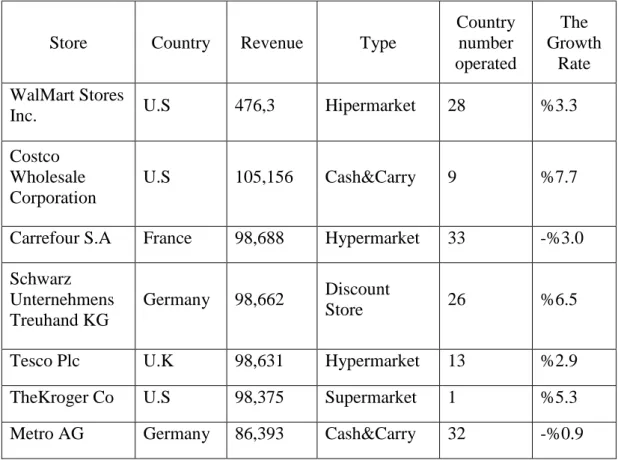
According to 2015 global retailing sector report; in 2013 financial year, 250 biggest retailing companies of the world gained 4.4 trillion dollars income. The %80 of this revenue was explained as income. According to the report, the largest 250 retailers' revenue percentage which is downsized in 2011, continued to decrease in 2013. The income increased %4,3 in 2012; on the other hand, the revenue increased %4,1 in 2013. The WalMart from U.S.A. is listed as the first retailer with 476,3 billion dollars revenue in the list. Costco from U.S.A. is ranked in the second place with its 105,2 billion dollars revenue. Carrefour from France has been the third in the ranking of its 98.7 billion dollars revenue. The list is continued with Schwartz and Tesco (Deloitte, 2015:1-48).
30
Table 2.1. The Biggest Global Retailers in The World
Store Country Revenue Type
Country number operated The Growth Rate WalMart Stores
Inc. U.S 476,3 Hipermarket 28 %3.3
Costco Wholesale Corporation
U.S 105,156 Cash&Carry 9 %7.7
Carrefour S.A France 98,688 Hypermarket 33 -%3.0 Schwarz
Unternehmens Treuhand KG
Germany 98,662 Discount
Store 26 %6.5
Tesco Plc U.K 98,631 Hypermarket 13 %2.9
TheKroger Co U.S 98,375 Supermarket 1 %5.3 Metro AG Germany 86,393 Cash&Carry 32 -%0.9 Source: http://www.themarketingsite.com/live/article/2015-deloitte-global-retailing-survey/39372/
As it seen on Table 2-1; the international retailers continued their operations in other countries in 2013 period. Wal-Mart is operating in 28, Costco is operating in 9, Carrefour is operating 33, Schwarz is operating in 26, Tesco Plc is operating in 13 countries. The hypermarket and discount stores are the most common retailing type in global retailers. In addition to this data, U.S.A is the dominant country in the international retailing market with five stores.
2.5.4.2. Turkish Retail Market Overview
The Turkey retailing sector is proliferating. According to TOBB’s report which was made in 2012, the retailing sector revenue in Turkey will be expected as 190 billion dollars, and the number of the stores will be expected to be 84.000. According to these researches, organized retailing revenue will be expected to be 150 billion dollars in 2023 (TOBB, 2012:50).