Determination of Effects of Plant Growth Regulator Applications on
Alternate Bearing in Pistachios under Suitable Growing Conditions
I. Acar, S.A. Tahtaci, S. Arpaci, Y. Aydin and S. Karadag
Pistachio Research Institute, P.O. Box 32, 27060 Gaziantep, Turkey. Keywords: Pistachio, plant growth regulators, alternate bearing
Abstract
This study was carried out on Uzun and Siirt pistachio cultivars present at the Pistachio Research Institute orchards. After the most suitable pruning, fertilization and irrigation practices, different plant growth regulators were sprayed on entire trees at the different doses, and effects of plant growth regulators on alternate bearing were investigated.
In the study, 10, 25 and 50 ppm 1-Naphthaleneacetic acid (NAA), 25 ppm N-benzyl-9-(2-tetra-hydropyranyl) adenine (BA) and 0.25% urea were used, and 0.25% urea was added to all plant growth regulators’ doses. Plant growth regulators were sprayed to the fruits, buds and leaves to the point of drip. Applications were done two times in year. First application was done at starting kernel development, and second application was done 20 days after the first application.
According to the results, the highest yield was obtained from 25 ppm benzyladenine + 0.25% urea in Uzun (4.98 kg per tree) and 47.29% of inflorescence buds retained in this application. The lowest yield was obtained from control as 4.05 kg per tree and 47.56% of inflorescence buds retained in control.
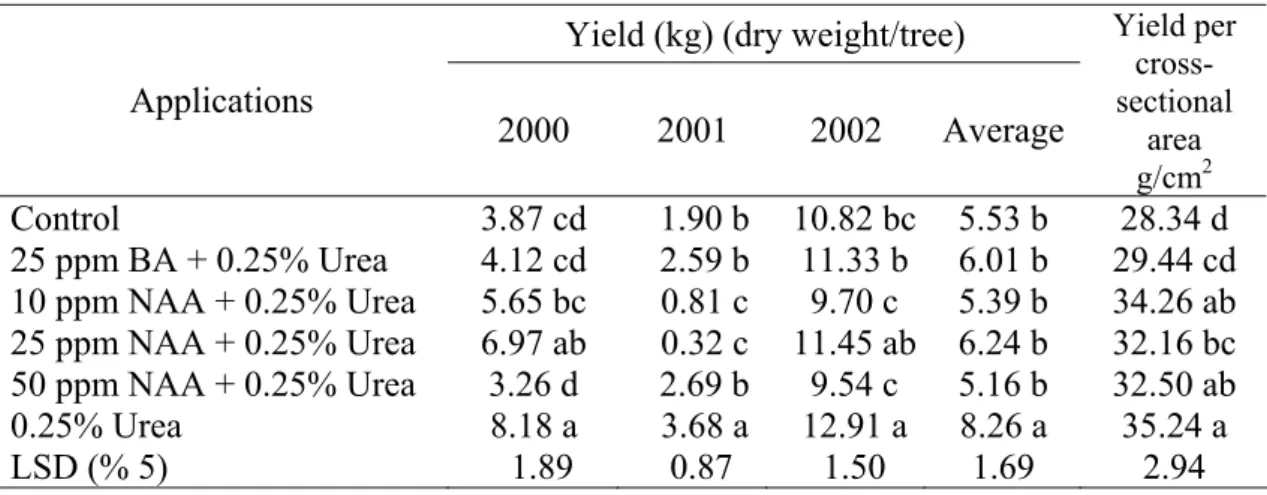
At the Siirt, the highest yield (8.26 kg per tree) was obtained from 0.25% urea application and 51.58% of inflorescence buds retained in this application. The lowest yield was obtained from 50 ppm naphthalene acetic acid application (5.16 kg per tree) and 58.49% of inflorescence buds retained in this application. At the Siirt , 5.53 kg yield per tree was obtained from control and 6.01 kg per tree obtained from 25 ppm benzyladenine + 0.25% urea.
INTRODUCTION
Pistachio trees have been grown under dry conditions in Turkiye. There are 4 main pistachio producer countries in the world; these are Iran, United States, Turkiye and Syria, comprising over 90% of the world production (Anonymous, 2003a). Pistachio production areas are 218500 ha and average production is 55000 metric tons in Turkiye (Anonymous, 2003b). Pistachio yield is low and there are a lot of limiting factors for pistachio yield. These factors may be listed in orde: a) poor, calcareous and stony soil conditions; b) low annual precipitation; c) no irrigation; d) nutrition deficiency; e) inadequate pollination; and f) alternate bearing. The most important of these factors are alternate bearing, inadequate pollination and irrigation (Ak, 1992).
The excessive abscission of floral buds beginning in June and intensifying at the time of seed growth (nut fill) in July during the on-year results in the next year's off-year crop. While the unique mechanism leading to alternate bearing in pistachio has been identified, its physiological basis has not been identified (Lovatt and Ferguson, 2002).
In contrast to other fruit tree species that produce flower buds in limited quantity at the same time a heavy crop is being produced, the pistachio produces abundant inflorescence buds which abscise during the summer. The alternate bearing in this species is the result of assimilate depletion during the heavy crop year (Crane and Nelson, 1971).
There is a strong reproductive demand for nitrogen and carbohydrates in on-years, significant removal of nitrogen in the fruit at harvest, reduced recovery of January applied labeled fertilizer N than off-year trees (Weinbaum et al., 1994).
Lovatt and Ferguson (2002) have provided evidence that excessive abscission of floral buds during early nut development (June-July) in an on-year is hormonally induced: (i) during early development nuts exported the “abscission-promoting” hormone abscisic
acid (ABA); (ii) floral bud ABA concentrations increased approximately 25%; and (iii) floral bud concentrations of the cytokinins isopentyladenine and zeatin riboside decreased 40% during the period of intensive floral bud abscission. The lower cytokinin content would likely cause reduced “sink strength” and ability to compete. The combination of low-biuret urea and 6-benzyladenine applied to the foliage at the beginning of this period (June 1) and half-way through it (July 1) successfully increased leaf concentrations of isopentyladenine (50%) and the retention of floral buds more than threefold in year one and more than twofold in year two on trees bearing a heavy on-crop.
Pontikis (1990) reported that sprays of 2-NAA at 5000 ppm and in fivefold applications at 30-day intervals (starting from mid-June) retained 90.1% of inflorescence buds until bloom period, but only 8.7% of these buds produced weak inflorescences and fruits, all the others abscised when the vegetative bud sprouted.
The objective of this study was to investigate effects of auxin (NAA), cytokinin (benzyladenine) and urea applications on inflorescence bud retention and yield in pistachio during on-year and off-year.
MATERIALS AND METHODS
This study was carried out in the pistachio orchard of the Pistachio Research Institute on 25-year-old Uzun and Siirt cultivars on Pistacia vera rootstock from 2000 till 2002. The trees were selected for uniformity of growth and bearing. The most suitable practices of pruning, fertilization and irrigation were applied uniformly to the experimental trees.
Eighteen uniform trees of each cultivar were marked and divided into 3 tree units to following applications: control, 10 ppm 1-Naphthaleneacetic acid (NAA), 25 ppm NAA, 50 ppm NAA, 15 ppm N-benzyl-9-(2-tetra-hydropyranyl) adenine (BA) and 0.25% urea (low-biuret), and 0.25% urea was added to all application except for control. Applications were done two times in a year and repeated during 2 years (2000 and 2001) on the same trees. First application was done in starting kernel development, and second application was done 20 days after the first application. Plant growth regulators were sprayed to the fruits, buds and leaves to the point of drip.
The numbers of inflorescence buds on four tagged branches on each tree were recorded in June and retained inflorescence buds were counted in October. Thus inflorescence bud retention ratios were determined in respect of applications and cultivars.
Stem diameter was measured 50 cm above the soil surface in November 2002, and stem cross-sectional area calculated. Yield was determined at the harvest time as kg fruit (dry weight)/tree and yield per cross-sectional area (CSA) as g/cm2. Fruit samples (100 nuts/tree) were collected, and nut quality was analyzed for split nuts, 100 dry fruits weight and kernel ratio. Besides, shoot growth was determined with respect to applications. RESULTS AND DISCUSSION
In pistachio, early studies indicate that carbohydrate depletion brought about by large demands of the developing pistachio nut crop, might be responsible for inflorescence bud abscission and resultant alternate bearing. But it does not appear that carbohydrate depletion is involved in the bud drop phenomenon in pistachio. An abscission-controlling substance appears to exist in pistachio (Crane et al., 1976).
Auxin, cytokinin and urea applications to prevent inflorescence bud abscission were made in June and July and then final floral buds were counted in October. Treatments were subsequently made two years on the same trees. The retention of inflorescence buds was different in Uzun and Siirt. Floral buds retention was high in 25 ppm NAA application in Uzun, therefore average yield and yield per cross- sectional area (CSA) was low. In the same way, average yield and yield per CSA was high at 25 ppm BA and 0.25% urea applications, and floral bud retention was moderate. When pistachio trees bearing heavy crop, inflorescence buds were abscissed. Average yield over three years was high in 25 ppm BA application; however, yield per CSA was high at 25 ppm
abscission rate and final percentage are correlated with fruit number. Alternate bearing in pistachio is a consequence of flower bud abscission due to the correlative effect of competition between fruits and buds for metabolites (Porlingis 1974; Takeda et al., 1980).
Siirt cultivar’s response was different from Uzun. Floral bud retention was high and average yield and yield per CSA was low at Control. The highest yield was obtained from urea application and the lowest bud retention from 25 ppm BA application in Siirt (Table 3 and 4).
Foliar auxin, cytokinin and low-biuret urea applications slightly affected yield and bud retention of pistachio trees under Southeast Anatolian conditions in Turkiye. BA and urea applications were more effective on yield of Uzun than of Siirt. Uzun cultivar has strong alternate bearing. Lovatt and Ferguson (1997 and 2002) reported that foliar application of low-biuret urea (0.25% N) combined with 6-benzyladenine (25 ppm) in early June and again in early July significantly increased yield compared to the untreated control.
In Uzun, 25 ppm NAA application increased shoot growth when compared with Control. Splitting rate changed between 45 and 80% with urea and 10 ppm NAA, respectively. Split nut ratio was low whereas 100 dry fruit weight was high in urea application. The higher dry fruit weight was, the lower split nuts in Uzun. Effect of applications was not significant on kernel ratio (Table 5).
In Siirt, shoot growth was generally high when compared with Uzun. Shoot growth was the highest in BA application, but there were no significant differences between BA application and Control. Splitting ratio was the highest in Control and the lowest in BA application while 100 dry fruit weight was same in BA application and Control. 50 ppm NAA application provided high fruit weight but low yield in Siirt. Kernel ratio was not affected statistically by the applications (Table 6). Pontikis (1990) reported that shoot growth and nut splitting were not affected by 2-NAA applications. Lovatt and Ferguson (2002) reported that urea combined with 6-BA significantly increased kg split nuts compared to the control.
CONCLUSIONS
The results of our study showed that urea and BA combined with urea applications might increase the yield in Uzun and Siirt. Yield per tree was high in off-year with BA application in Uzun (Table 2). Thus, Uzun showed more response to BA combined with urea than Siirt. Effectiveness of BA application may relate to alternate bearing intensity, because Uzun shows more strong alternate bearing than Siirt. NAA applications were not effective for inflorescence bud retention and yield in pistachios. Besides applications were not affected fruit qality significantly.
Literature Cited
Ak, B.E. 1992. Değişik Pistacia Türlerine Ait Çiçek Tozlarının Antepfıstıklarında Meyve Tutumu ve Meyvelerin Kaliteleri Üzerine Etkileri. Doktora Tezi (Yayımlanmamış), Adana, 211 s.
Anonymous. 2003a. Fao web page.
Anonymous. 2003b. Agricultural Structure and Production. State Institute Statistics, Ankara, Turkiye.
Crane, J.C. and Nelson, M.M. 1971. The unusual mechanism of alternate bearing in the pistachio. Hort Sci. Vol. 6 (5 ) 489-490
Crane, J.C., Catlin, P.B. and Al-Shalan, I. 1976. Carbohydrate levels in the pistachio as related to alternate bearing. J. Amer. Soc. Hort. Sci. 101(4):371-374.
Lovatt, C.J. and Ferguson, L. 1997. Using foliar Applications of Urea Combined with 6- Benzyladenine to Decrease Pistachio Floral Bud Abscission in an “On” year to Increase Yield the Next Year. California Pistachio Industry, Annual Report Crop Year, 1996-97. pp. 148 -151.
Lovatt, C.J. and Ferguson, L. 2002. Urea combined with 6-benzyladenine to reduce alternate bearing in pistachio and to increase cumulative yield. Final Report. 29th Annual PGRSA Meeting, July 28-August 1, 2002, Westin Nova Scotian Halifax, Nova Scotia.
Pontikis, C.A. 1990. Effects of 2-Naphthaleneacetic acid on alternate bearing of Pistachio. Fruits, May-June 1990, 45(3), 281-285.
Porlingis, J.C. 1974. Flower bud abscission in pistachio (Pistacia vera L.) as related to fruit development and other factors. J. Amer. Soc. Hort. Sci. 99(2).121-125
Takeda, F., Ryugo, K. and Crane, J.C. 1980. Translocation and distribution of 14 C-photosynthates in bearing and nonbearing pistachio branches. J.Amer Soc. Hort. Sci 105 (5), 642-644.
Weinbaum, S., G. Picchioni, T. Muraoka, L. Ferguson, and P. Brown. 1994. Fertilizer nitrogen and boron uptake, storage, and allocation vary during the alternatebearing cycle. J. Amer. Soc. Hort. Sci. 119:24-31.
Tables
Table 1. Effect of different applications on inflorescence bud retention in Uzun. Bud Retention (%) Applications 2000 2001 Average Control 16.52 c 78.60 ab 47.56 bc 25 ppm BA + 0.25% Urea 58.72 a 35.86 c 47.29 bc 10 ppm NAA + 0.25% Urea 13.30 cd 84.45 a 48.88 b 25 ppm NAA + 0.25% Urea 38.33 b 68.74 b 53.53 a 50 ppm NAA + 0.25% Urea 1.73 e 79.43 ab 40.58 d 0.25% Urea 6.08 de 85.44 a 45.76 c LSD (% 5) 9.15 14.29 2.35
Table 2. Effect of different applications on yield per tree and yield efficiency in Uzun. Yield (kg) (dry weight/tree)
Applications 2000 2001 2002 Average Yield per cross-sectional area g/cm2 Control 6.78 abc 1.10 bc 4.27 bc 4.05 bc 15.29 b 25 ppm BA + 0.25% Urea 4.13 c 6.79 a 4.02 bc 4.98 a 23.03 a 10 ppm NAA + 0.25% Urea 4.82 bc 0.08 c 3.53 c 2.81 d 14.61 b 25 ppm NAA + 0.25% Urea 4.32 c 2.49 b 5.74 a 4.19 abc 14.87 b 50 ppm NAA + 0.25% Urea 7.81 ab 0.43 c 3.79 bc 4.01 c 16.04 b 0.25% Urea 9.90 a 0.24 c 4.75 ab 4.96 ab 23.37 a
Table 3. Effect of different applications on inflorescence bud retention in Siirt. Bud Retention (%) Applications 2000 2001 Average Control 60.73 a 58.96 d 59.84 a 25 ppm BA + 0.25% Urea 31.16 b 68.56 abc 49.86 c 10 ppm NAA + 0.25% Urea 35.30 b 73.74 a 54.52 bc 25 ppm NAA + 0.25% Urea 33.12 b 71.19 ab 52.16 c 50 ppm NAA + 0.25% Urea 52.78 a 64.19 bcd 58.49 ab 0.25% Urea 40.48 b 62.68 cd 51.58 c LSD (% 5) 10.16 8.10 4.91
Table 4. Effect of different applications on yield per tree and yield efficiency in Siirt. Yield (kg) (dry weight/tree)
Applications 2000 2001 2002 Average Yield per cross-sectional area g/cm2 Control 3.87 cd 1.90 b 10.82 bc 5.53 b 28.34 d 25 ppm BA + 0.25% Urea 4.12 cd 2.59 b 11.33 b 6.01 b 29.44 cd 10 ppm NAA + 0.25% Urea 5.65 bc 0.81 c 9.70 c 5.39 b 34.26 ab 25 ppm NAA + 0.25% Urea 6.97 ab 0.32 c 11.45 ab 6.24 b 32.16 bc 50 ppm NAA + 0.25% Urea 3.26 d 2.69 b 9.54 c 5.16 b 32.50 ab 0.25% Urea 8.18 a 3.68 a 12.91 a 8.26 a 35.24 a LSD (% 5) 1.89 0.87 1.50 1.69 2.94
Table 5. Effect of different applications on fruit quality and shoot growth in Uzun averaged over two years.
Applications Shoot growth (cm) Split nuts (%) 100 dry fruit weight (g) Kernel ratio (%) Control 5.98 c 70 b 111 bc 41 25 ppm BA + 0.25% Urea 6.77 b 64 bc 111 bc 42 10 ppm NAA + 0.25% Urea 6.58 bc 80 a 109 c 41 25 ppm NAA + 0.25% Urea 9.11 a 59 c 114 ab 40 50 ppm NAA + 0.25% Urea 6.89 b 61 c 111 c 41 0.25% Urea 6.12 bc 45 d 116 a 41 LSD (% 5) 0.78 8.94 3.01 NS
Table 6. Effects of different applications on fruit quality and shoot growth in Siirt averaged over two years.
Applications growth (cm) Shoot Split nuts (%) 100 dry fruit weight (g) Kernel ratio (%)
Control 11.37 a 97 a 149 b 42 25 ppm BA + 0.25% Urea 11.94 a 78 c 149 b 41 10 ppm NAA + 0.25% Urea 9.64 b 86 b 153 ab 42 25 ppm NAA + 0.25% Urea 9.62 b 85 bc 148 b 41 50 ppm NAA + 0.25% Urea 11.70 a 87 b 158 a 41 0.25% Urea 10.72 ab 81 bc 148 b 42 LSD (% 5) 1.57 7.87 6.64 NS