KSÜ Tarım ve Doğa Derg 22(Ek Sayı 1): 98-101, 2019 KSU J. Agric Nat 22(Suppl 1): 98-101, 2019
DOI:10.18016/ksutarimdoga.vi.535130
Onygena, A New Ascomycete Genus Record for Turkey
Yasin UZUN1 , Abdullah KAYA2
Karamanoğlu Mehmetbey University, Science Faculty, Dept. of Biology, Karaman, Turkey
1https://orcid.org/0000-0002-6423-6085, 2https://orcid.org/0000-0002-4654-1406
: [email protected] ABSTRACT
The keratinophilic ascomycete genus, Onygena was reported for the first time from Turkey based on the collection and identification of
Onygena equina (Willd.) Pers. species. The descriptive characters of the identified species are summarized and the collection localities were provided together with the photographs related to its macro and micro morphologies. Research Article Article History Received : 14.03.2019 Accepted : 30.06.2019 Keywords Biodiversity Keratinolytic fungi Onygenaceae Onygena equina New record Turkey
Onygena
, Türkiye İçin Yeni Bir Askomiset Cins Kaydı
ÖZET
Keratinofilik bir Askomiset cinsi olan, Onygena, O. equina türünün toplanıp isimlendirilmesine bağlı olarak Türkiye’den ilk kez rapor edilmiştir. Teşhisi yapılan türün betimleyici özellikleri özetlenmiş ve toplanma lokaliteleri, türün makro ve mikromorfolojisine ilişkin fotoğrafları ile birlikte verilmiştir.
Araştırma Makalesi Makale Tarihçesi Geliş Tarihi : 14.03.2019 Kabul Tarihi : 30.06.2019 Anahtar Kelimeler Biyoçeşitlilik Keratinolitik mantar Onygenaceae Onygena equine Yeni kayıt Türkiye
To Cite : Uzun Y, Kaya A 2019. Onygena, A New Ascomycete Genus Record for Turkey. KSU J. Agric Nat 22(Suppl 1): 98-101.
DOI: 10.18016/ksutarimdoga.vi.535130
INTRODUCTION
Onygena Pers. is a keratinolytic genus within the family Onygenaceae. The members of the genus are characterized by a globose to rounded and usually stalked fruiting bodies, warty or smooth and brownish to lighter membranous peridium, globular 8-spored asci, more or less broadly ellipsoidal spores, and substrates of animal residues such as hairs, plumes, bones, hooves and horns (Ward, 1899; Medardi, 2006). Though 5 species of the genus were described (Kirk et al., 2008), none of them were reported from Turkey according to the current literature (Sesli and Denchev 2014; Solak et al. 2015) and the latest contributions (Kaşık et al., 2017; Akçay et al., 2018; Işık and Türkekul, 2018a,b; Kaya, 2015; Kaya et al., 2016; Kaya and Uzun, 2018; Kaygusuz et al., 2018; Sadullahoğlu and Demirel, 2018; Sesli, 2018; Uzun et al., 2018; Keleş, 2019; Şelem et al., 2019; Türkekul and Işık, 2019) presented after the checklists.
In this study, we present the first Turkish member of the genus Onygena, based on the collections of
Onygena equina (Willd.) Pers. from the European part of Turkey. Onygena equina, commonly known as the horn stalkball, grows on putrefying hooves and horns, and can digest the keratin in those substrates. Though the fungus has so far been reported from Germany, Great Britain, France, Hungary, Italy, North America, Poland, Sweeden, Switzerland and Ukraine (Breitenbach and Kränzlin, 1984 Currah, 1985 Komorowska, 1986 Landvik et al., 1996), Kujawa et al (2012) regard this fungus as a threatened species due to its rarity in Poland.
The study aims to contribute to the macromycota of Turkey by recording a new genus.
MATERIALS and METHODS
Fruit bodies of Onygena were collected during a field trip in Şile district of İstanbul province on 15th
KSÜ Tarım ve Doğa Derg 22(Suppl 1): 98-101, 2019 Araştırma Makalesi/Research Article
99 December of 2018. The morphological and ecological characteristics of the specimens were noted and they were photographed at their growing habitats. Then the sample was taken to the laboratory, dried in an air-conditioned room and prepared as fungarium material. A Nikon Eclipse Ci-S trinocular light microscope, coupled with a Nikon DS-Fi2 camera, and a Hitachi SU5000 scanning electron microscope were used for microscopic investigations. Comparing the obtained descriptive data related to the structure of fruit body and peridium, and the microscopy of the gleba, asci, and spores with the data given in literature (Ward, 1899; Breitenbach and Kranzlin, 1984; Currah, 1985; Hansen, 1998; Medardi, 2006; Roberts and Evans, 2011; Thompson, 2013), identification was performed. The sample was kept in Department of Biology, Kamil Özdağ Science Faculty, Karamanoğlu Mehmetbey University .
RESULTS
Ascomycota Caval.-Sm.
Onygenales Cif. ex Benny & Kimbr.
Onygenaceae E. Fisch.
Onygena equina (Willd.) Pers., Observ. mycol. (Lipsiae) 2: 71 (1800) [1799]
Syn: [Lycoperdon equinum Sowerby, Lycoperdon equinum Willd., Onygena equina (Willd.) Pers. var.
equina, Onygena equina var. mougeotii (Roum.) Sacc.,
Onygena mougeotii Roum.]
Macroscopic features: The mature fruit body resembles a miniature “button mushroom” with a head and a stalk. Head 1.5-4.3 mm in diameter, globose to subspherical, whitish to creamy whitish when young, ochraceous to light brownish when mature. Peridium thin, covered with whitish warts or scales which peel of partially or completely at maturity. Gleba of a darker mass, filling the cavity between the peridium and the stalk. Stalk 4-6(7) × 0.8-1.3 mm, cylindrical, some curved and some slightly tapered or enlarged toward the base, smooth, white, creamy white to very light brown (Figure 1).
Microscopic features: Asci 15-22 × 11-15 μm in diameter, globular to rounded, 8-spored. Paraphyses not observed.
KSÜ Tarım ve Doğa Derg 22(Suppl 1): 98-101, 2019 Araştırma Makalesi/Research Article
100
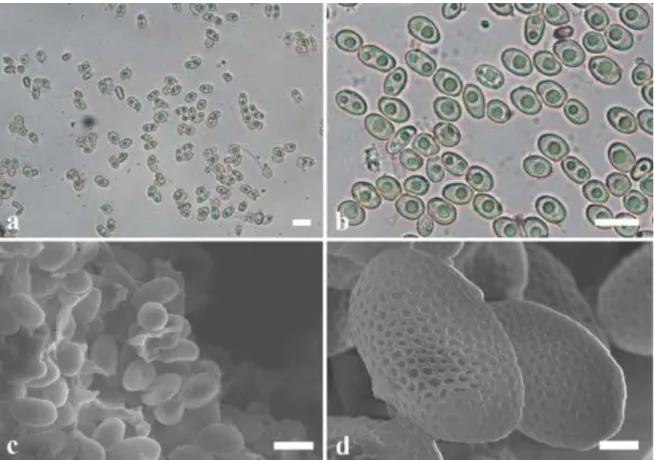
Figure 2. light microscope (a,b) and scanning electron microscope (c,d) images of ascospores of Onygena equina
(bars- a,b: 10 µm, c: 5 µm, d: 1 µm)
Ascospores 7-9 × 4-5.5 μm, broadly elliptical, slightly tapered at one end, hyaline, with one or two oil droplets. Though the spores looks smooth under a light microscope, at higher magnification under scanning electron microscope a net-like ornament is visible (Figure 2).
Ecology: Onygena equina was reported to grow on decaying residues such as bones, horns and hooves of various domestic or wild animals such cattle, sheep, goat, and the antlers of deer (Ward, 1899; Breitenbach and Kranzlin, 1984; Medardi, 2006; Thompson, 2013). Specimen examined: İstanbul, Şile, Esenceli village, in and outside of decaying horn pieces in Quercus sp. forest, 41°04′N-29°25′E, 225 m, 15.12.2018, Yuzun 7023.
DISCUSSION
The members of the genus Onygena are specialized to live on horny substances (Breitenbach and Kranzlin, 1984). Onygena corvina Albertini and Schweinitz and
O. equina are the two most common species of the genus (Trudell and Ammirati, 2009) and very similar to each other (Beug et al., 2014), but O. equina has broader spores and larger head and a shorter stalk.
Onygena equina occurs on the decaying horns and hooves of cattle and sheep while O. curvina usually
found on owl pellets, bird carcasses, hair and wool (Trudell and Ammirati, 2009).
The characteristics of the determined species is generally in agreement with those given by Ward (1899), Breitenbach and Kranzlin (1984), Medardi (2006) and Thompson (2013), but the stalks of the Hansen (1998)’s samples seems to be longer.
ACKNOWLEDGEMENTS
The authors would like to thank Ömer UZUN for his support during the collection of Onygena samples, and to KMU BİLTEM and research assistant Mehmet Ali TOPÇU for their kind help to obtain SEM images. REFERENCES
Akçay ME, Uzun Y, Kesici S 2018. Conocybe anthracophila, A new record for the Turkish Mycobiota. Anatolian Journal of Botany 2(2): 84-87. Beug MW, Bessette AE, Bessette AR 2014. Ascomycete Fungi of North America, a mushroom reference guide. University of Texas Press, Austin, 488 p. Breitenbach J, Kränzlin F 1984. Fungi of Switzerland
Volume 1. Verlag Mykologia, Lucerne, 310 p. Currah RS 1985. Taxonomy of the Onygenales:
Arthrodermataceae, Gymnoascaceae,
Myxotrichaceae and Onygenaceae. Mycotaxon 14: 1–216.
KSÜ Tarım ve Doğa Derg 22(Suppl 1): 98-101, 2019 Araştırma Makalesi/Research Article
101 Hansen PB 1998. Slægten Hornsvamp (Onygena Pers.:
Fr.), sæksvampe på substrater af hornstof. Swampe 37: 19-23.
Işık H, Türkekul İ 2018a. New additions to Turkish macrofungi from Tokat and Yozgat Provinces. Mycotaxon 133: 697-709.
Işık H, Türkekul İ 2018b. Tokat’tan Yeni Bir Lignikol Mantar Kaydı: Lachnum subvirgineum Baral. KSÜ Tarim ve Doğa Dergisi, 21(4): 555-558.
Kaşık G, Aktaş S, Alkan S, Öztürk C 2017. Selçuk Üniversitesi Alaeddin Keykubat kampüsü (Konya) Makromantarlarına İlaveler. Mantar Dergisi, 8(2): 129-136.
Kaya A 2015. Contributions to the Macrofungal Diversity of Atatürk Dam Lake Basin. Turkish Journal of Botany 39: 162-172.
Kaya A, Uzun Y 2018. New contributions to the Turkish Ascomycota. Turkish Journal of Botany, 42(5): 644-652.
Kaya A, Uzun Y, Karacan İH, Yakar S 2016. Contributions to Turkish Pyronemataceae from Gaziantep province. Turkish Journal of Botany, 40(3): 298-307.
Kaygusuz O, Çolak ÖF, Matocec N, Kusan I 2018. New data on Turkish hypogeous fungi. Natura Croatia 27(2): 257-269.
Keleş A 2019. New records of macrofungi from Trabzon province (Turkey). Applied Ecology and Environmental Research 17(1): 1061-1069.
Kirk PM, Cannon PF, Minter DW, Stalpers JA 2008. Dictionary of the Fungi. 10th ed. CAB International, Wallingford, 771 p.
Komorowska H 1986. Onygena equina (Willd.) Pers.: Fr. in Poland. Acta Mycologica 22(1): 49-52.
Kujawa A, Wrzosek M, Domian G, Kędra K, Szkodzik J, Rudawska M, Leski T, Karliński L, Pietras M, Gierczyk B, Dynowska M, Ślusarczyk D, Kałucka I, Ławrynowicz M 2012. Preliminary studies of fungi
in the Biebrza National Park (NE Poland). II. Macromycetes. Acta Mycologica 47(2): 235-264. Landvik S, Shailer NFJ, Eriksson OE 1996. SSU rDNA
sequence support for a close relationship between the Elaphomycetales and the Eurotiales and Onygenales. Mycoscience 37: 237-241.
Medardi G 2006. Atlante Fotografico degli Ascomiceti d’Italia. Centro Studi Micologici, Vicenza, 454 p. Roberts P, Evans S 2011. The Book of Fungi. Ivy Press,
East Sussex, UK. 655 p.
Sadullahoğlu C, Demirel K 2018. Flammulina fennae
Bas, a new record from Karz Mountain (Bitlis). Anatolian Journal of Botany, 2(1): 19-21.
Sesli E, Denchev CM 2014. Checklists of the myxomycetes, larger ascomycetes, and larger basidiomycetes in Turkey. 6th ed. Mycotaxon Checklists Online. 136 p. (http://www.mycotaxon. com/ resources/checklists/sesli-v106-checklist.pdf) Sesli E. 2018. Cortinarius ve Lyophyllum Cinslerine
Ait Yeni Kayıtlar. Mantar Dergisi, 9(1): 18-23. Solak MH, Işıloğlu M, Kalmış E, Allı H 2015.
Macrofungi of Turkey, checklist, vol. 2. Turkey: Üniversiteliler Ofset, İzmir, 280p.
Şelem E, Keleş A, Acar İ, Demirel K 2019. Edible macrofungi determined in Gürpınar (Van) district. Anatolian Journal of Botany 3(1): 7-12.
Thompson PI 2013. Ascomycetes in Colour. Xlibris Corporation, UK, 367 p.
Trudell S, Ammirati J 2009. Mushrooms of the Pacific Northwest. Timber Press, London, 349 p.
Türkekul İ, Işık H 2019. Macrofungal Biodiversity of Reşadiye (Tokat) District. Acta Biologica Turcica 32(2): 95-101.
Uzun Y, Yakar S, Karacan İH, Kaya A. 2018. New additions to the Turkish Pezizales. Turkish Journal of Botany, 42(3): 335-345.
Ward HM 1899. Onygena equina Willd., a Horn-Destroying Fungus. Philosophical Transactions of the Royal Society of London. Series B, 191: 269-291.