EFFECTIVENESS OF ONLINE CUSTOMIZED ADVERTISING
AYŞE BENGİ ÖZCİVAN
İSTANBUL BİLGİ UNIVERSITY 2015
EFFECTIVENESS OF ONLINE CUSTOMIZED ADVERTISING
AYŞE BENGİ ÖZCİVAN 112672034
İSTANBUL BİLGİ UNIVERSITY INSTITUTE OF SOCIAL SCIENCES
MARKETING COMMUNICATION PROGRAM (WITH THESIS)
DISSERTATION ADVISOR: KAAN VARNALI 2015
iii
ACKNOWLEDGEMENTS
This dissertation is a result of a wonderful journey which was a fruitful experience for me. I would like to thank many people who have been with me along the way.
First, I would like to express my deepest gratitude to my advisor Associate Professor Kaan Varnalı for his endless encouragement, support and patience as well as protective treatment throughout my graduate study. I am thankful to him for his inspirational working behavior, continuous motivation and giving flash to my academic career. He taught me how to make a flawless academic research step by step with his priceless guidance. I always admire his eagerness to work and brilliant ideas which gave me a very wide point of view. Most of all, I deeply thank him for canalizing me to the academic life two years ago, for trusting me and for motivating me when I had lost my hope. I promise that I will not let him disappointed in the future. Studying with Associate Professor Kaan Varnalı was a great chance for me in the beginning of my career.
I also would like to present my thanks to Assistant Professor E. Eser Telci for her endless help, both academic and emotional. She always answered my questions and gave me a great support with a motherly behavior. I think that thesis process earned me a great professor, as well as a friend, an elder sister and a guide. She is the one who have a great impression in my academic life and I am proud of having her working discipline style.
I would like to express my special thanks to my dissertation committee members as well. I am grateful to Professor Selime Sezgin for her precious contributions to my dissertation. I also want to acknowledge Associate Professor Özlem Hesapçı Sanaktekin for her valuable suggestions that will enhance my future
iv
studies, and Assistant Professor Barış Ursavaş for his priceless support during my writing process and in the defense jury.
I am also grateful for the understanding of Istanbul Bilgi University Faculty of Communication, Advertising Department, especially head of the department Associate Professor Gresi Sanje. She gave me endless support when I needed, and she brought light to my way with her specific key advises. I thank her for being a supportive, motivative and understanding professor and manager. Additionally, research assistants of the department, my colleagues and roommates deserve thank for their support in my rush-hours. I also thank helpful administrative staff of Marka Okulu, for their unlimited patience to my endless questions. Burcu Gümüş has a special place for me in the faculty with her intimate hugs with good news, her consolations with pretty bad news and her behavior of sharing all of what she has. I thank her for giving the feeling that I have someone so close to me to share every single happiness.
I am grateful for the emotional support, as well as academic support, continuous understanding, and endless motivation of my dear companion and colleague Eser Levi, PhD. She taught me that good persons who help others with no expectation are alive on earth, and I felt really lucky to have one of them. She has an important place in my life, and I am sure that it will go on increasingly.
Four of my friends, actually sisters, deserve special attention since their friendships add great value to my life. Architect and Interior Architect Pelin Özen, Sociologist and Political Science Specialist Vildan Özer, Lawyer Oya Tanrıverdi, LL. M., and Physics and Genetics Engineer Balca Karaçor, MBA are the angels on my shoulders addition to their different titles. We have great time since we have met at high school, and their supportive behavior made my writing process, as well as my
v
life, easier and more fruitful. They made me motivated with their text messages in the days that I could not find even a moment to see them. These four angels shaped my character with their valuable thoughts, knowledge, friendships, lovely families, and with great memories collected together. Mechanical engineer Hazal Ataman is my other sister from high school who gives me happiness and the joy of life with her existence although we see each other rarely. She is and will be the one who I admire and love so much, and I am sure that I will be proud of her success stories, applauding in the frontmost in the near future.
My kind fiancé, my future husband, Alaz Özçelik deserves a special appreciation for his infinite support to all of my decisions. Any of my steps in my life cannot be considered without his valuable caring since 2010. He is a gift to my life with his perpetual well behavior which is a mirror of his family, including our mother Assistant Professor Nurten Özçelik, our father Abidin Özçelik, PhD and our cute brother Industrial Engineer candidate Çelik Özçelik.
Finally, with all my heart, I would like to thank my parents who devoted their life to me. None of my achievements, including this masters degree, would be possible without my mother Yasemin Özcivan’s, my father Zafer Özcivan’s and my lovely sister Cansu Çelebi’s limitless love. I would like to add that, my fresh brother Can Çelebi is a great guide with his future ideas and endless funny character. I acknowledge their tremendous patience, support, encouragement, and trust in me throughout this journey as at each and every step of my life.
vi ÖNSÖZ
Bu tez, benim için çok verimli geçen harika bir yolculuğun sonucu olarak ortaya çıktı. Bu yolculukta yanımda olan herkese teşekkür ederim.
Öncelikle, tez danışmanım Doç. Dr. Kaan Varnalı’ya; beni cesaretlendirdiği için, bana olan desteği, sabrı ve koruyucu tavrı için en derin teşekkürlerimi sunmak isterim. Hocamın çalışma biçimi ve hiç bitmeyen motivasyonu akademik kariyerime ışık tuttu. Kendisinden iyi bir akademik araştırmanın adım adım nasıl yapılabileceğini öğrenirken, bana geniş bir bakış açısı sağlayan çalışma azmine ve fikirlerine hayran kaldım. Her şeyden önemlisi, iki yıl önce bana güvenerek beni akademik hayata yönlendirdiği ve umudumu yitirdiğim zamanlarda beni motive ettiği için kendisine minnettarım. Kariyerimin bu ilk yıllarında Doç. Dr. Kaan Varnalı gibi bir hoca ile çalışmanın benim için büyük bir şans olduğunun farkındayım.
Hem akademik hem de duygusal olarak bana sonsuz destek veren değerli hocam Yrd. Doç. Dr. E. Eser Telci’ye de teşekkürlerimi sunmak isterim. Eser Hocam, zaman ve mekan kısıtlaması olmadan her sorumu bir anne veya bir abla gibi sabırla yanıtladı. Eser Hocam, hem harika bir hoca ve bir rehber olarak hem de bir arkadaş olarak, bu tezin yazım sürecinin bana en büyük kazançlarından biri oldu. Çalışma tarzını kendime örnek aldığım hocama, akademik hayatıma olan katkısı için sonsuz teşekkürlerimi sunarım.
Tez savunma jürime katılarak bana çok yararlı geri bildirimlerde bulunan hocalarıma da teşekkür etmek isterim. Prof. Dr. Selime Sezgin’e, jüri davetimden sunum sonuna kadar olan süre içinde bana karşı gösterdiği koruyucu tavrıyla ve sunumum sonrasındaki kıymetli yorumlarıyla kendisine olan saygımı kat be kat arttırdığı için teşekkür ederim. Aynı zamanda Doç. Dr. Özlem Hesapçı Sanaktekin’e,
vii
jürime katıldığı ve gelecek çalışmalarımda bana yol gösterecek değerli geri bildirimlerini esirgemediği için teşekkür ederim. Yrd. Doç. Dr. Barış Ursavaş’a, tez yazım sürecimde bana destek olduğu, akademik kariyerimdeki her adımımda beni ilgiyle dinlediği, jüri sunumumda yorumlarıyla yanımda olduğu için ve en önemlisi çalışırken dinlenecek harika şarkılar yazıp söylediği albümü için çok teşekkür ederim.
Başta bölüm başkanı Doç. Dr. Gresi Sanje olmak üzere, İstanbul Bilgi Üniversitesi İletişim Fakültesi Reklamcılık Programı’na, tez yazım sürecindeki bir çalışana karşı gösterilen anlayışlı tavır için teşekkür ederim. Gresi Hocam, her ihtiyaç duyduğumda verdiği sonsuz destek ile ve en kördüğüm olduğum anlarda paylaştığı kilit bilgilerle bana ışık tuttu. Kendisinin destekleyici, motive edici ve anlayışlı bir hoca ve yönetici olması, bana kendimi çok şanslı hissettirdi. Ayrıca, Reklamcılık ve Halkla İlişkiler programlarının araştırma görevlilerine, oda arkadaşlarıma da yoğun dönemimde bana gösterdikleri anlayış için çok teşekkür ederim. Aynı şekilde, Marka Okulu idari çalışanlarına, tüm sorularıma sonsuz bir sabırla cevap verdikleri için teşekkür ederim. Burcu Gümüş, her iyi haberde bana en içten şekilde sarıldığı, üzücü haberlerde beni teselli ettiği için ve sahip olduğu tüm bilgileri hesapsızca paylaştığı için fakülte içinde benim için çok özel bir yere sahip. En küçük mutluluğu bile paylaşabileceğim birinin bu kadar yakınımda olduğunu hissettirdiği için kendisine çok teşekkür ederim.
Bana verdiği duygusal ve akademik destek, sonsuz anlayış ve motivasyon için canım yol arkadaşım ve meslektaşım Dr. Eser Levi’ye minnettarım. Eser, bana dünyada hala karşılıksız yardım etmeye hazır insanların var olduğunu öğreten çok değerli dostum olarak, hayatımdaki önemli yerini arttırarak var olmaya devam edecek.
viii
Arkadaşlıklarıyla hayatıma çok büyük değer katan, kız kardeşlerim kadar değerli dört arkadaşıma özel teşekkür etmeyi bir borç biliyorum. Mimar ve İç Mimar Pelin Özen, Sosyolog ve Siyasal Bilimler Uzmanı Vildan Özer, Avukat Oya Tanrıverdi, LL. M., Fizik ve Genetik Mühendisi Balca Karaçor, MBA; sahip oldukları unvanlara ek olarak iki omzumun üzerindeki melekler olarak anılmayı hak ediyorlar. Lise yıllarından beri süren dostluğumuzda çok güzel zamanlar geçirdik ve her zaman birbirimize destek olduk. Tıpkı tüm yaşamımda olduğu gibi, tez yazım sürecimde de bana olan destekleri her şeyi daha da kolaylaştırdı ve iyileştirdi. Onları göremediğim en yoğun zamanlarımda bile telefon mesajlarıyla benden motivasyonlarını esirgemediler. Bu dört melek, değerli düşünceleri, bilgi seviyeleri, dostlukları, muhteşem aileleri ve birlikte biriktirdiğimiz harika hatıralar ile benim karakterimi şekillendiren en önemli insanlar oldular. Her şey için onlara minnettarım. Varlığıyla bana mutluluk ve yaşama sevinci aşılayan Makina Mühendisi Hazal Ataman, lisede sahip olduğum diğer kız kardeşim olarak hayatımda çok önemli bir yere sahip. Hayranlıkla izlediğim ve çok sevdiğim canım dostumun başarılarını yakın gelecekte gururla en önde alkışlayacağıma eminim. Bana kattığı değerler ve mekansal mesafelerle azalmayan yakın dostluğu için, hayatımdaki yeri için kendisine çok teşekkür ederim.
Çok sevgili nişanlım, gelecekteki hayat arkadaşım Alaz Özçelik’e, kararım ne olursa olsun hiçbir zaman sonlanmayacağını bildiğim desteği için minnettarım. Alaz, 2010 yılından beri hayatımdaki her adımda yanımda olduğu için apayrı ve çok özel bir teşekkürü hak ediyor. Annemiz Yrd. Doç. Dr. Nurten Özçelik, babamız Dr. Abidin Özçelik ve canımız kardeşimiz Çelik Özçelik’ten oluşan güzel ailesinin bir yansıması olarak gördüğüm sakin ve duru kişiliği ile hayatın bana sunduğu büyük bir hediye
ix
olduğunu düşündüğüm Alaz’a sadece varlığı için bile binlerce kez teşekkür ederim. Bu teşekkürlerin ömür boyu artacağına eminim.
Son olarak, tüm hayatını bana adayan aileme kalpten teşekkürlerimi sunarım. Bu yüksek lisans derecesi de dahil olmak üzere hiçbir başarım; annem Yasemin Özcivan’ın, babam Zafer Özcivan’ın ve canım ablam Cansu Çelebi’nin sevgisi olmadan mümkün olamazdı. Son iki yıldır biricik abim olan sevgili eniştem Can Çelebi’nin gelecek planları yaparkenki rehberliği ve hayata karşı sahip olduğu mizahi duruşuyla bana kattığı her şey için teşekkür ederim. Ailemin sonsuz sabrını, desteğini, cesaretlendirmesini ve güvenini bu yolculuğun her adımında yanımda hissetmekten mutluluk duyuyorum.
x
TABLE OF CONTENTS
ABBREVIATIONS ... xiii
LIST OF SYMBOLS ... xv
LIST OF FIGURES ... xvi
LIST OF TABLES ... xvii
LIST OF GRAPHS ... xviii
Dissertation Abstract ... xix
Tez Özeti ... xx
INTRODUCTION ... 1
CONCEPTUAL BACKGROUND ... 4
1.1. ONLINE ADVERTISING ... 4
1.1.1. Forms of Online Advertising ... 5
1.1.1.1. Display Advertising ... 6
1.1.1.2. Search Ads ... 7
1.1.1.3. Social media marketing ... 10
1.1.1.4. E-mail advertising ... 11 1.1.1.5. Affiliate marketing ... 12 1.1.1.6. Video advertising ... 13 1.1.1.7. Content marketing ... 15 1.1.1.8. Mobile advertising ... 15 1.1.1.9. Advergames... 16
xi
1.1.1.10. Text advertising ... 16
1.1.2. Online Behavioral Advertising – Online Customized Advertising ... 17
1.1.2.1. Level of customization ... 19
1.1.2.2. Online Advertising Effectiveness ... 21
1.2. REGULATORY FOCUS THEORY ... 23
1.2.1. Promotion-Focused People ... 26
1.2.2. Prevention-Focused People ... 27
1.2.3. Regulatory Focus Theory and Consumer in Decision Making ... 27
1.3. USES AND GRATIFICATIONS THEORY ... 29
1.3.1. Informativeness ... 31 1.3.2. Entertainment ... 32 1.3.3. Irritation... 32 1.4. RISK PERCEPTION ... 33 1.4.1. Security Risk ... 34 1.4.2. Financial Risk ... 35 1.4.3. Product/Service Risk ... 36
1.5. ATTITUDE TOWARD THE AD ... 37
1.6. BRAND ATTITUDE ... 38
1.7. BEHAVIORAL ADVERTISING RESPONSES ... 39
xii
2.1. HYPOTHESES DEVELOPMENT ... 41
2.1.1.Promotion Focus Level and UGT Constructs ... 42
2.1.2.Perceived Security Risk and UGT Constructs ... 43
2.1.3.UGT Constructs and Behavioral and Attitudinal Outcomes ... 44
2.1.4.Attitudinal and Behavioral Outcomes ... 45
2.2. METHODOLOGY ... 46
2.3. DATA ANALYSES ... 50
2.4. RESEARCH MODEL AND HYPOTHESES TESTING ... 58
DISCUSSION ... 63
REFERENCES ... 71
Appendix A. The questionnaire in Turkish ... 85
xiii ABBREVIATIONS
ADATT Attitude toward the ad
AGFI Adjusted goodness-of-fit index AVE Average variance extracted BRATT Brand attitude
CFA Confirmatory factor analysis CFI Comparative fit index CPA Cost per action CPC Cost per click CPL Cost per lead CPM Cost per mile CPS Cost per sales
CR Composite reliability
CRM Customer relationship management CTR Click-through rate
ENT Entertainment
GFI Goodness-of-fit index IFI Incremental index of fit INFO Informativeness
IRR Irritation
NFI Normal fit index PPC Pay per click
QR Quick response
xiv RESP Behavioral ad responses RFT Regulatory focus theory
RMSEA Root mean square error of approximation SRisk Security risk
TLI Tucker-Lewis index
UGT Uses and Gratifications theory
xv LIST OF SYMBOLS
𝜆: Standardized factor loading 𝛿: Squared correlations 𝜀: Error
xvi LIST OF FIGURES
Figure 1.1. The first banner advertising ... 5
Figure 1.2. Display advertising example... 7
Figure 1.3. Search advertising example ... 9
Figure 1.4. Social media advertising example ... 11
Figure 1.5. E-mail advertising example ... 12
Figure 1.6. Affiliate marketing example ... 13
Figure 1.7. Video advertising example ... 14
Figure 1.8. Video advertising example ... 15
Figure 1.9. Aggressive advertising example ... 21
Figure 1.10. Subtle advertising example ... 21
Figure 2.1. Conceptual model ... 41
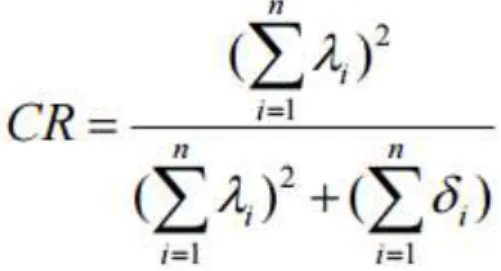
Figure 2.2. Composite reliability formula ... 55
Figure 2.3. Average variance extracted formula ... 55
Figure 2.4. Figure of SEM ... 59
Figure 2.5. Structural model... 62
Figure 3.1. Targeted advertisement example ...66
xvii LIST OF TABLES
Table 1.1. Selected UGT constructs ... 30
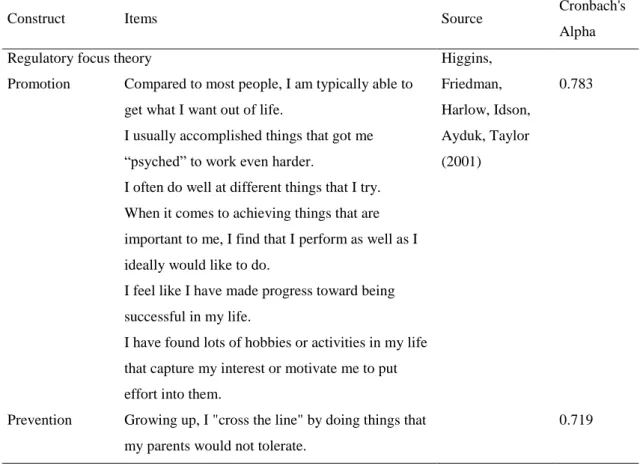
Table 2.1. Scales used in the research ... 46
Table 2.2. Sample characteristics ... 48
Table 2.3. Descriptives and reliability statistics for the scales ... 51
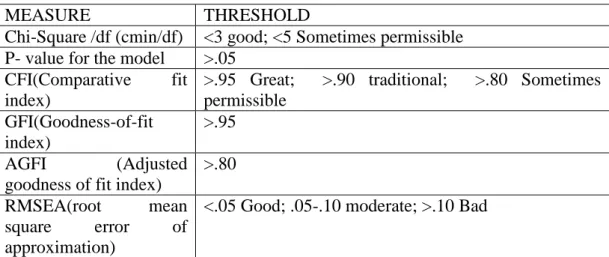
Table 2.4. Threshold values for goodness of fit measures ... 53
Table 2.5. Confirmatory factor analysis results ... 54
Table 2.6. Composite reliability measures of the constructs ... 56
Table 2.7. AVE measures of the constructs ... 57
Table 2.8. Discriminant validity ... 58
xviii LIST OF GRAPHS
xix
Dissertation Abstract
Effectiveness of Online Customized Advertising
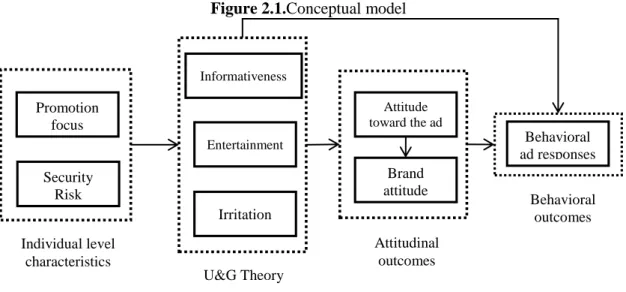
This research explores the effects of promotion focus and perceived security risk levels of consumers, and dimensions of Uses and Gratifications Theory (UGT) on attitudinal and behavioral outcomes of online customized advertising such as attitude toward the ad, brand attitude, and behavioral ad responses. The data collected from 409 respondents through a scenario-based online survey is analyzed using Structural Equation Modeling (SEM). The results show that attitudinal and behavioral outcomes are directly affected by several UGT constructs, which are predicted by promotion focus level and security risk. In particular, consumers who have higher promotion focus level show higher perceived level of informativeness and entertainment towards online customized ads, whereas consumers who have higher perceived security risk have lower perceived level of informativeness and entertainment, and higher level of irritation. Furthermore, attitude toward the ad is found to be affected positively by informativeness and entertainment, and negatively by irritation. Brand attitude is positively related to entertainment and attitude toward the ad, whereas behavioral ad responses is positively related to informativeness, entertainment and attitude toward the ad. The findings suggest that individual level characteristics and UGT constructs should be considered by marketers who use online customized advertising. The study contributes to the theoretical foundation of online customized advertising by introducing promotion focus as an important individual level predictor of success in online customized advertising.
xx Tez Özeti
Kişiselleştirilmiş İnternet Reklamlarının Etkililiği
Bu araştırmada, kişilerin promosyon odak seviyesinin, algılanan güvenlik riski seviyesinin ve Kullanım ve Memnuniyet Teorisi’nin (KMT - Uses and Gratifications Theory) kişiselleştirilmiş Internet reklamlarının bireylerin tutumsal ve davranışsal çıktıları üzerindeki etkisi araştırılmıştır. 409 katılımcıdan senaryo bazlı bir çevrimiçi anket ile toplanan data, yapısal eşitlik modeli (Structural equation modeling) kullanılarak analiz edilmiştir. Sonuçlarda tutumsal ve davranışsal çıktıların, KMT bileşenlerinden; KMT bileşenlerinin de promosyon odak seviyesi ve algılanan güvenlik riski seviyesinden etkilendiği gözlenmiştir. Yüksek promosyon odak seviyesine sahip kişilerin kişiselleştirilmiş Internet reklamlarını daha bilgilendirici ve eğlenceli algıladığı sonucuna ulaşılmıştır. Buna karşılık yüksek güvenlik seviyesi riski algısına sahip kişilerin sözkonusu reklamları daha az bilgilendirici ve eğlenceli, ama daha çok rahatsız edici bulduğu belirlenmiştir. Ek olarak, reklama karşı tutum ile bilgilendiricilik ve eğlendiricilik arasında pozitif; rahatsız edilicik ile negatif bir ilişkiye ulaşılmıştır. Markaya karşı tutumun eğlendiricilik bileşeninden ve reklama karşı tutumdan; reklama verilen davranışsal tepkilerin ise bilgilendiricilik, eğlendiricilik ve reklama karşı tutumdan pozitif etkilendiği gözlenmiştir. Bu çalışma, sözkonusu reklam tekniğini kullanan pazarlama profesyonellerine, kullanıcıların bireysel özelliklerini ve KMT bileşenlerini dikkate alacakları yeni bir bakış açısı kazandırırken; literatüre, promosyon odak seviyesi ile kişiselleştirilmiş Internet reklamları arasındaki ilişkiyi teorik bir katkı olarak sunmaktadır.
Anahtar kelimeler: Çevrimiçi reklamcılık, davranışsal hedefleme, tutum, davranışsal tepki
1 INTRODUCTION
After the Internet revolution, issues business is faced with changed fundamentally. Marketing literature started to deal with some new topics. New study areas became popular, such as online marketing, online advertising, behavioral targeting, and retargeting. Technological innovations offer new opportunities for marketing managers to keep an eye on their consumers. Consumers are being tracked to create offerings relevant to their needs. For instance, a consumer who is looking for a house credit loan sees a bank advertisement offering credit loan with low interest rate. These kind of ads are called online customized ads. It was said in 2000 that the developments in the digital environment would change marketing practices radically in three to five years, ultimately reaching to a point where marketers will be able to reach the right customer at the right time (Kenny & Marshall, 2000). Now, it is possible to know what an individual seeks in the real time.
New advertising models seem to make sense in manager's point of view. However, technological innovations create a new dimension to an old history: privacy concern. Consumers began to worry about their Internet usage because of the feeling of being followed. Use of personal information and previous browsing data is the key to this new advertisement model, but some consumers may react negatively to this model specifically because of the underlying tracking technology. The more personal information is used, the more the feeling of intrusiveness increases, despite the fact that the customization level of the advertisement increases its relevance (Li, Edwards, & Lee, 2002). The aim of a retargeted ad is to be attractive for the customer, but attraction sometimes comes along with intrusiveness and privacy concern.
2
In this study, effects of online customized ads are investigated in light of Regulatory Focus Theory in order to evaluate the psychological state of the consumer and in light of the Uses and Gratifications Theory in order to understand consumers’ ad perceptions.
Psychological issues are a part of the customized advertising model as a cost (Doorn & Hoekstra, 2013). Different psychological types may react in different ways. The Regulatory Focus Theory (hereafter, RFT) suggests that when people are exposed to a message in parallel with their point of view, they have more reliance on the message (Avnet & Higgins, 2006). Promotion focus people are attracted by messages that offer gains while prevention focus ones do not. This duality should present a difference in reaction toward customized ads.
Uses and gratifications theory (UGT) is first mentioned in 1940s in order to study radio usage, and continued to attract researcher attention thereafter (Li, Liu, Xu, Heikkila, & van der Heijden, 2015). UGT is a media theory that investigates the reasons of media usage (Katz, 1959). The theory explains users’ motivations to use traditional media, television, radio or Internet. Users may find the media informative, entertaining, and irritating; which result in different effects on attitudes. In the literature, advertising effectiveness in terms of behavioral and attitudinal outcomes has been repeatedly measured in light of the UGT constructs which contains informativeness, entertainment, and irritation.
Combining these perspectives, this thesis offers a new framework in customized online advertising; aiming to investigate the effects of online customized advertising on attitudinal and behavioral outcomes in the frame of regulatory fit theory
3
and uses and gratifications theory, at the same time controlling for the effect of the perceived security risk level factor.
4
CHAPTER ONE
CONCEPTUAL BACKGROUND
1.1.ONLINE ADVERTISING
A marketer tries to reach the consumer in every single place with relevant offers in order to attract the consumer and turn him/her into a customer. Before the Internet, this aim was tried to be accomplished by traditional channels. However, after technological developments, online environment became an irreplacable area for advertisers. Online media have four properties that help to be distinguished from mass media (Duncan, 2002): (1) targeting individuals as well as segments is possible, (2) consumers can respond to companies on time, (3) interactive media is more measurable and accountable than mass media, (4) more attention is demanded in interactive media because of personalized messages.
Online channels became so critical when reaching the customer that any marketing activity can not be organized without the part of online activities. It is reported that online advertising that is used to pass the marketing message to customers by using World Wide Web (hereafter, WWW) and the Internet (Kim, Park, Kwon, & Chang, 2012) provides as much revenue as traditional advertising channels such as television, radio, and newspaper (IAB, 2013).
After the revolution of WWW in 1989, Internet has become a powerful channel for learning. People have started to find whatever they want easier year by year on the search engines such as altavista and Yahoo!, two of the pioneers of searching on the Internet for consumers. After the searching habit of users became more common, advertising on Internet became an investment channel for brands. A new marketing
5
channel is created and invested on: search marketing. $15 billion of spending on search marketing in 2011 in US is expected to be $24 billion by 2016 (Li & Kannan, 2014).
Searching on Internet provided such an online area that brands can meet with customers and advertising on that online area became inevitable. The first clickable ad is sold by Global Network Navigator in 1993, to a law firm (Adpushup). The first clickable banner is created by AT&T, placed into Hotwired and called the users to click on the ad (Adpushup). The first online advertising placement is made on Hotwired in 1994 with a call-to-action (Chaffey, Ellis-Chadwick, Jonhston, & Mayer, 2006). With “You will!” campaign, the users visit seven museums of the world online when they click on the ad (Figure 1.1)
Figure 1.1. The first banner advertising
Source: http://www.thefirstbannerad.com/
Web 2.0 technology provides interaction between consumers and marketers. That kind of communication gives marketers the ability of real-time communication, which means that consumers expect instant customer service (Clow & Baack, 2012). Hence, instant communication give marketers a path to reach consumers who are in their target audience.
1.1.1. Forms of Online Advertising
Online advertising provides advertisers the ability to make existing and potential customers surprised with a lot of methods in an online environment. New
6
online channels are added and these methods are improving day by day. To be more effective, marketers try to pursue the potential customers by using their behavioral data and catch them suddenly with online ads. Users may be caught by these ads on the edge of the screen, on their Facebook accounts, in their e-mail inboxes, or in the video they are watching.
Major online advertising forms are explained next.
1.1.1.1.Display Advertising
Display ads are the ads that is seen on the screen mainly as banners and sometimes interstitials. Banners are small advertisements that are generally seen at the top, bottom, or side of a web page (Duncan, 2002) and they generally have a visual and text together. By clicking on a banner, users can step on another website. In the Figure 1.2, the banner of a fashion e-commerce website can be seen on a dictionary website.
Banners are seperated into three groups: static, rich media, and video. Static banners include only visuals and texts where rich media has animations. Video banners are placed into videos as a seperate view. Interstitials, other type of display ads, are shown suddenly in a different frame as a pop-up (Duncan, 2002). When the user clicks through the site, these ads appear between two webpages (Plummer, Rappaport, Hall, & Barocci, 2007).
7 Figure 1.2.Display advertising example
Banner effectiveness is a critical measure that shows return on investment to advertisers. Although click through rate (hereafter, CTR) is a critical measure for the advertiser and the web sponsor that displays the ad, it may not be a strong measure of advertising effectiveness (Kim, Park, Kwon, & Chang, 2012; Manchanda, Dubé, Goh, & Chintagunta, 2006; Hofacker&Murphy, 1998). 2 percent to 3 percent of the banners are clicked by the users in the early times of Internet, but the ratio is decreased sharply under 0.25%, so new communication forms are needed by marketers (Kotler & Keller, 2012). According to one of the Web log statistics, banner advertising has a CTR of 0.5% which means that it is not such an effective method (Kim, Park, Kwon, & Chang, 2012).
1.1.1.2.Search Ads
Search engine marketing is one of the main key tools that is used to expose advertisements of the website to the relevant Internet users and get click from them. That kind of marketing tool meets the marketer and the website owner in order to make a deal about placing the ads on the web. The search ad process is listed as follows
8
(Dinner, Heerde, & Neslin, 2014): (1) The advertiser sets the budget, (2) impressions and click-through rates are calculated (3) sales are translated from resulting clicks. This method is usable for advertisers with its never-exceeded budget, because the payment is calculated after the impressions.
Search advertising has two different dimensions: search engine optimization (hereafter, SEO) and search engine advertising. These dimensions are also called as “organic advertising” and “paid advertising”.
Search engine optimization is defined as improving the website’s performance in a search engine results by optimizing the keywords (Eley & Tilley, 2009). When users try to reach a website, they write the keywords in the search bar and some results are shown as a list. The more the website is higher in the list, the more its awareness increases. In order to increase awareness and accordingly the traffic of the website, marketers optimize the keywords to have a higher grade in the sorting of the ads on search websites.
Search Engine Advertising provides the results seen on the first lines of the search engine results, when users define a set of keywords to be requested (Eley & Tilley, 2009). These are the ads that are paid by the brand. Paid advertisements have three different types: paid search ads, contextually targeted search ads, and paid inclusion. Paid search ads, which are also named as pay-per-click (hereafter, PPC) advertising or cost-per-click (hereafter, CPC) advertising, are the text ads placed above the natural results or on the right side of the result page (Plummer, Rappaport, Hall, & Barocci, 2007). Contextually targeted search ads have the target of the webpage subject and they are seen on the page user reads generally under a title of “Ads by Google” (Plummer, Rappaport, Hall, & Barocci, 2007). Paid inclusion is a method that
9
website owner paid to search engine and similar websites (e.g., comparison sites) in order to the websites including the service’s directory can be seen in the first lines of the results (Plummer, Rappaport, Hall, & Barocci, 2007).
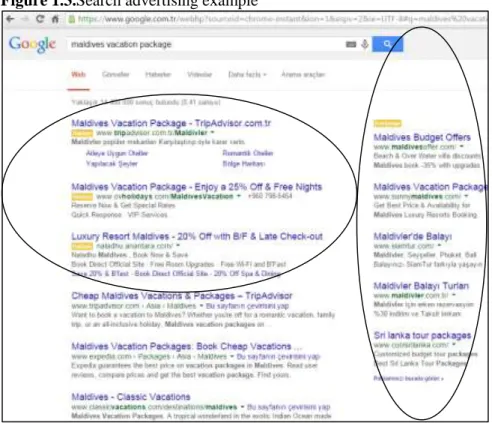
In Figure 1.3, search engine advertising can be seen in the first three lines of the results, and on the right side of the webpage. These are placed under the title of “Ads” that the user can understand the difference between search engine ads and others. Under the paid results, organic results can be seen. Because the search keywords are “Maldives vacation package”, holiday comparison websites are in the results. Tripadvisor is both in the first and fourth lines. It is clear that the website not only paid for the advertisement, but also optimized its website in order to have a high rank in search results in Google.
10 1.1.1.3.Social media marketing
Social networks, such as Facebook, YouTube, or Twitter, have millions of users log in every single day, so they are the powerhouses of highly targeted advertising (Eley & Tilley, 2009). With the help of social network sites, people can create their personal profile and interact with other users by making a network, sharing posts, and keeping in touch with friends and family (Basak & Calisir, 2015). Social media users give their personal information such as birthday, marrital status, location, and interests. These information creates a great data for marketers who is searching for relevant target audience for their products or services. For instance, a brand can find the women aged between 30 and 45, live in metropolitans with a high income, do not work, and have a dog in order to show the advertisement of a new premium dog strap.
Since social networks allow users easily connect with friends and share something with them, marketers pay attention to social media advertising. In Figure 1.4, a sponsored ad can be seen on a Facebook account. Most probably, the owner of the Facebook account is selected as the target and the ad is shown for her (because it is a women’s product) after the elimination, because she is interested in shopping sportive products.
11 Figure 1.4.Social media advertising example
1.1.1.4.E-mail advertising
E-mails became one of the most essential parts of our daily lives. Users send and receive e-mails for information or to do business on the Internet network (Kumar & Sharma, 2014). Addition to personal e-mails, users receive some e-mails that contains marketing contents. According to the research conducted by Technology Advice in March 2015, 60% of Internet users read marketing e-mails, 16% of them read regularly and 12.8% read more than half of the mails (Are your emails ending up in the spam folder? - eMarketer, 2015).
E-mail advertising technology allows marketers to send e-mails about the products, campaigns, or new offers to the subscribers. E-mail ads differentiate from spam or junk, which is the same as unsolicited commercial email messages, with users’ permissions (Breuer, Brettel, & Engelen, 2011). The statistics show that people are
12
aware of receiving some e-mails those are not relevant with their needs. So, purchasing huge e-mail lists and sending e-mails to the individuals in that mass list is not a profitable way to get response from consumers (Clow & Baack, 2012). Targeted methods should be used in order to send the right e-mail to the right consumer in the right time.
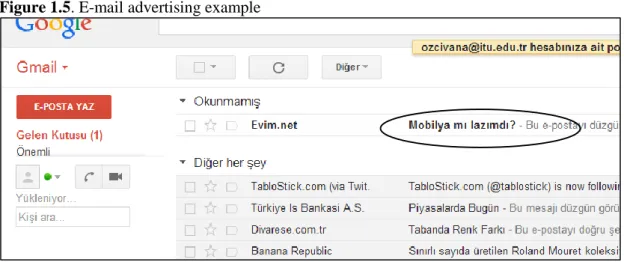
In order to optimize the distribution of the e-mails, marketers use web analytics. Web analytics provide the information about which websites the user visits and how long he or she stays on the website (Clow & Baack, 2012). For instance, in Figur 1.5, the question of “Do you need furniture?” is asked to the user most probably because of his or her spent time on furniture segment of the website. Evim.net should have sent the e-mail to that user thanks to its analytics results about that user. The same e-mail should have been sent to others who meet the same criteria.
Figure 1.5. E-mail advertising example
1.1.1.5.Affiliate marketing
Affiliate marketing is an online advertising system that links the websites. This system contains an affiliate marketers, affiliate network and advertisers. A website is a publisher that serves links to users (Edelman & Brandi, 2015). A publisher agrees with a company in order to promote the company’s products on the affiliate’s website
13
to earn commision from each purchase (Gregori, Daniele, & Altinay, 2014). For instance, when showing a suggestion about bank credits with low interest rates, the website can place a certain bank’s advertisement on the website.
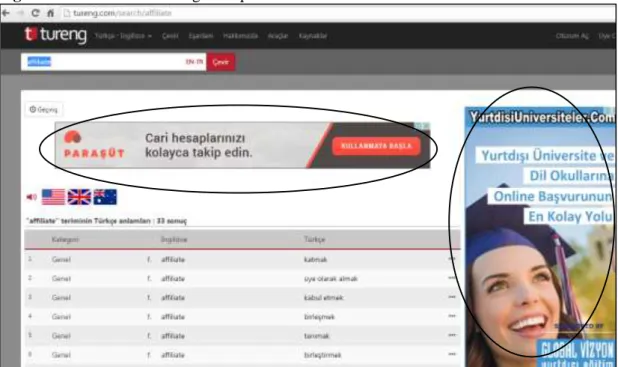
In order to earn commisions from affiliate marketing, the user must search affiliate website, click on the link of the advertiser and make a purchase from the website. As an affiliate website aims to sell products or services through online advertising (Edelman & Brandi, 2015), the main objective of the affiliate marketing system is to have users making purchasing activities. Figure 1.6 shows ads on again a dictionary website which is a member of an affiliate network.
Figure 1.6.Affiliate marketing example
1.1.1.6.Video advertising
Watching video is now a daily routin while using the Internet. In 2013, 90% of the consumers watch videos over the Internet (Accenture, 2013). Each month,
14
hundreds of million hours of video is watched and 300 hours of video is uploaded each minute by more than 1 billion unique visitors (Youtube, 2015).
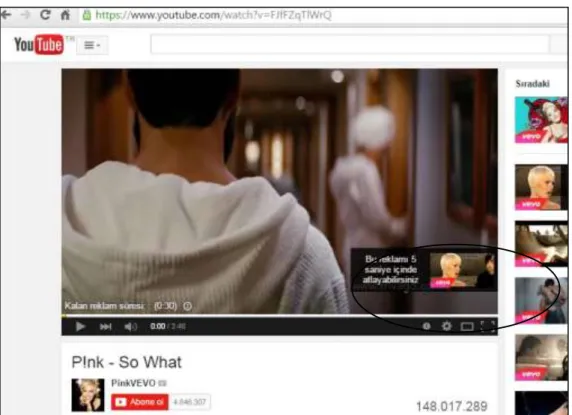
Pre-roll advertisements are shown to users before a video is viewed. Post-rolls are those shown after the video is viewed. Video advertising has preroll and postroll advertisements in the beginning (Plummer, Rappaport, Hall, & Barocci, 2007), but users now are exposed to video advertisings between videos abruptly. The 85% of these advertisements can be skipped (Youtube, 2015). In Figure 1.7, a pre-roll ad of tripadvisor is seen before playing the music video. On the right side of the ad, an option to skip the ad is presented to the user. Figure 1.8 shows a banner ad of a fashion brand on an online cartoon video that was mentioned in the Display ad part.
15 Figure 1.8.Video advertising example
1.1.1.7.Content marketing
Content marketing is defined as “the bit-based objects distributed through electronic channels” (Koiso-Kanttila, 2004). Brands try to take the attention of the audience by promoting the information in the advertisement by content marketing. For instance, a viral video is produced by Jolly Tour in 2015. The video is in a form of scary movie that introduces the horrible holiday of a couple who did not used Jolly Tour while planning the vacation. First, the movie attracts the audience; then the brand and the message is perceived. Since the critical point of the digital content is to create a value for customer (Rowley, 2008), content marketing is a beneficial tool for advertisers. Selling the content can be equal to selling the products in a meaning.
1.1.1.8.Mobile advertising
Using mobile communication technology to promote products or services is called mobile marketing (Pousttchi & Wiedemann, 2006). Mobile advertising is one of the critical dimensions of mobile marketing. Advertising in mobile devices is
16
mainly on targeted advertising. Mobile devices are more suitable for targeting since it provides some information about location, transaction and measurement of campaign effectiveness (Pousttchi & Wiedemann, 2006; Bauer, Barnes, Reichardt, & Neumann, 2005; Figge & Schrott, 2003). This channel of advertising has been updated since quick response (QR) codes are developed. A QR code is a barcode that carry a marketing message by scanning it with a camera of a smart phone (Cunha, Peres, Morais, Bessa, & Reis, 2010). Brands can take customers into their websites or applications with the help of little square codes, called QR codes, with their mobile phones.
1.1.1.9.Advergames
Game industry is now a star for marketers for its creating real time engagement with the users. The advertisements that have a game inside are called advergames. For instance, Axe developed an online game that men try to attract 100 different hot women with their effort by playing the game (Clow & Baack, 2012).
1.1.1.10.Text advertising
Text ads are the smart texts that include a title, a short description and hyperlinked to a website (Eley & Tilley, 2009). They usually seen through a paragraph with a different colour.
17
1.1.2. Online Behavioral Advertising – Online Customized Advertising Online targeted advertising has two forms: contextual advertising and behavioral targeting. Contextual advertising has a system that browses the words in website and matches the advertisement category with the text. It is a technology that is based on the brand, whereas behavioral targeting is based on the user. Before a customer made a conversion, he or she visits the websites for a couple of times (Li & Kannan, 2014). These visits helps marketers to collect information about the customers. Behavioral targeting uses the web search or visited websites data of individuals and shows the relevant advertisements (Brahim, Lahmandi-Ayed, & Laussel, 2011). The behavioral data of people is used in different channels of advertising in order to reach the relevant customers. Different methods of online advertising can be applied by using behavioral information in order to reach the right consumer and avoid waste costs.
Online advertising is a critical dimension for marketing because it can be formed in the frame of the interception of marketers’ needs and consumers’ data. The thing that gives this ability to online advertising is ‘customization’. Behavioral targeting system chooses the advertisement to show to a specific individual parallel with his or her web-browsing behavior including the pages visited and specific keywords searched (Chen & Stallaert, 2014). If customers recognize the suggestions which fit to their preferences and if marketers know the preferences of the customers, the customized suggestions can create a high value for individuals (Simonson, 2005). Since ad-consumer interest relevancy has not hit the bull’s eye yet, users may show a resistance to online ads. Websites which cannot increase users’ acceptance of
18
customized advertising will suffer from sharp decreases in advertising revenues (Schumann, Wangenheim, & Groene, 2014).
Today, firms are able to target advertisements with the help of two key changes: ease of collecting data and Internet as an advertising channel (Iyer, Soberman, & Villas-Boas, 2005). Any form of online advertising that uses the information such as past searching and buying behavior of the advertising receiver is called targeted online advertising (Schumann, Wangenheim, & Groene, 2014). Little text files called “cookies” installed on user’s computer in order to follow his or her online behavior (Chen & Stallaert, 2014). As soon as a user is caught by a cookie, his or her profile is matched with a banner relevant to the behavior and the banner is shown on a particular web site instantly (Clow & Baack, 2012). For instance, if a user sees a display banner about a camera while searching for the translation of a word in tureng.com, most probably he or she searched about digital camera pricings before. Additionally, a L’oreal anti-aging product advertisement on Youtube can be seen by a 30-35 year-old young woman.
Marketers are facing with one important challenge: online media planning. The aim of media planning is to reduce advertising costs by sending the advertisements only to the customers who are interested in the category (Iyer, Soberman, & Villas-Boas, 2005). Increasing investments on digital media allows marketers to reach customers in effective ways on Web 2.0 technologies (Bright & Daughtery, 2012). In order to minimize waste costs, the ads should be distributed to relevant consumers by targeting methods. The paid search system allows marketers to show their banner ad to the users they choose (Clow & Baack, 2012).
19 1.1.2.1.Level of customization
Customization is a method that is used to have more effective and efficient advertising by the brands. Realizing the interests of customers increases the relevancy of the advertisements. In online environment, retargeting is used for showing the right content to the right customer at the right time. However, right customer and right time are determined in exact frames while right content is in an unlimited frame. Since the content of the message affects customers’ persuasion process, it should be edited intently.
The data collected from targeted Internet users is used for the content of the advertising. There is a thin line between targeting and irritating the customer. Customization level of the advertising can be resulted in brand awareness or in brand hatred. Although retargeted advertisement prevent from information overload, the misusage of customization level might cause intrusiveness on the user. In order to avoid the cause of the feeling of being poached, the customization level must be optimized. Customization levels of online ads can be classified as aggressive and subtle.
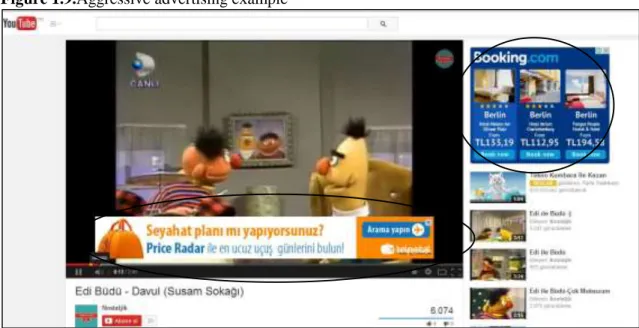
Aggressive customization is the level of online advertisement that is clearly saying that “I followed your path and I know what you are interested in”. For instance, a person who is searching for flights to Barcelona sees the banner of a tourism website which has a message of “Are you planning to go to Barcelona? Cheapest hotels are waiting for you on our website!” with visuals of Barcelona Hotels. That kind of banners are usualy shown on video websites such as Youtube. The user sees the advertisement directly in front of her or his eyes. It is not a sneaky way to show the brand to the customer.
20
Subtle customization is the level of online advertisement that is not saying anything about the poaching process. It is an obscure way to catch the customer and introduce the product. In subtle customization, there is no customer name or personal information, no feeling of being watched, and no information about following the customer. For example, in the same case given in aggressive customization; the text message contains only “Cheapest Barcelona Hotels are in our website” with againg the visuals of Barcelona Hotels. A person reading this message is not expected to be irritated more than that in aggressive type.
A special example for aggressive and subtle customization can be seen on Figure 1.9. It is a screen from a user who searched about Berlin flights and hotels. On the right hand, the Booking.com advertisement shows three different alternatives for Berlin hotels which include one that the users looked in detail on web. The other advertisement is shown just on the video. It is straightly asking “Are you planning a vacation? Find the cheapest flight dates with Price Radar!” The first one does not say that the user is followed. It shows the banner in a sneaky and silent way. However, the second one is clearly asking something about the user’s behavior knowing what the user is searching for. Figure 1.10 shows a subtle e-mail advertising example that asks the next transaction to a user who already have made a transaction.
21 Figure 1.9.Aggressive advertising example
Figure 1.10.Subtle advertising example
1.1.2.2.Online Advertising Effectiveness
In order to understand how consumers react the advertisements, marketers use different measurements. Ad or page impressions are the metrics that show the exposure number of the advertising. Ad impression is used if the ad is, for example, a pop-up
22
which alone contains only the advertisement. If it is a banner, page impression is measured in order to know how many of the page with that banner is exposed to the users. A user can view an advertisement more than once, so “reach” is an important measure. Reach is the unique number of user that sees the ad. The click-through rate (hereafter, CTR) or conversion rate is the most common measurement used in order to show the return on investment (hereafter, ROI) of the advertisement. CTR is the ratio of clicking number of an ad to the exposure number of that ad (Wang & Sun, 2010).
Some other metrics are used in order to measure the cost of online advertising. Cost per mile (hereafter, CPM) shows the cost per 1000 exposure. If CPM is $2, the advertiser pays $2 for 1000 views. Cost per click (hereafter, CPC) means how much cost is recorded per click. If CPC is $0.25, the advertiser pays $0.25 per click. Cost per lead (hereafter, CPL) is the cost per the record from the website that the online ad is linked to. Advertiser pay CPL only if the consumer fills the targeted form and finishes it completely. Filling the form is not the same as sales, it is just getting the registration. The metric for sales is cost per sales (hereafter, CPS) which is paid only if the sales is actualized. Cost per action (hereafter, CPA) is the metric that is generally measures the number of action that advertiser states what it is. The action can be sales or registration.
These mentioned metrics of effectiveness and costs are monetary scales. However, there are some other measures of outcomes which shows the customer’s sensitive reactions after seeing the advertisement. After 25% of CTR is generated by the first banner ad of Hotwired with a call-to-action “Click here!” in 1995, average CTR rates are drastically fell down between 0.2% and 0.3% (www.doubleclick.com) and generally about 1% of those who creates the click-through make purchase
23
(Duncan, 2002). Since Internet users have become experienced and familiar with the brands and advertisements, the decline in CTR is inevitable (Dahlen, 2001; Dahlen et al., 2000; Briggs & Hollis, 1997). Although ratios have some advantages of measuring easily behavioral responses immediately, there may be other factors that has effect on responses (Briggs & Hollis, 1997). So, some other metrics should be considered when measuring the online advertising effectiveness. Advertisers should consider some user related measures of online advertisements such as perceptions, feelings, and attitudes. After clicking the ad, to know where the consumer goes and how he/she interrupts the interaction is critical for marketers. Is the ad strong enough to create a purchase intention on consumer?
1.2.REGULATORY FOCUS THEORY
In today’s marketing world, marketers are eager to know consumers’ needs and wants to be able to meet them. The managing styles are turned into a customer-focused management, so customer relationship management starts to be more and more important. To know what the consumer searches for and surfs on the Internet form the critical knowledge for a product manager. In online marketing context, advertisements are tried to be tailor-fit for each consumer. This effort requires to have the consumers’ insights about what they need and what they want. The difference between “need” and “want” is crucial in the frame of purchasing behavior of a consumer. If a consumer buys a product just because he/she “needs” it, he/she tries to feel more safe, however if he/she buys because of his/her “wants” instead of needing it, he/she tries to be the “owner”. The reason for spending money on a product gives hint about a consumer about his/her goal orientation and it modifies the method for getting the product. If a
24
person who wants to buy the product just because of a “benefit” such as a social need that will represent him/herself as a wealthy person, the buying process will be clear and as short as “go and get it”. In contrast, the buying process will be long and full of price and benefit investigations if the consumer only “needs” the product, for instance in case of a health issue. The “buy-for-need” method will be in a sense of mission, while “buy-for-benefit” will be an eager process.In regulatory focus theory, the feeling of need indicates to be “prevention-focused” and the feeling of want indicates to be “promotion-focused”.
Decision process of spending money on something and settleing the value of a decision is a subjective process that depends on the personal needs and wants. Need or benefit determines the result of the decision process and the value for the decision. The perceived value of an object is changing with the manner in which it is chosen or the decision process strategy and the manner is formed by consumer's concerns and interests (Avnet & Higgins, 2006).
In social psychology literature, regulatory focus theory (RFT) is explained as a person’s behavioral motivation, that is changing with the person’s goal orientation, when his or her manner matches with the stimuli (Aaker & Lee, 2006). Regulatory focus of a person alters his/her manner for a decision. On the basis of the regulatory focus theory, the outcome of a decision should be fit the focus orientation of a person in order to have a positive perception for the decision. The regulatory fit theory suggests that the value of a decision settled by the decision maker is affected by the parallelism of goal orientation and strategic manner (Avnet & Higgins, 2006). Physiological needs, physchological moods, epistemic needs, and social forces affect a person's regulatory orientation (Higgins, 2002).
25
The goal orientation of a person is different for two types of people: promotion-focused and prevention-promotion-focused. Promotion-promotion-focused people are attracted by the benefits of the outcomes while prevention-focused people are attracted by the absence of negative outcomes (Fransen & Hoeven, 2013). Nurturance and security are the main survival needs of two distinct self-regulations (promotion and prevention) respectively and RFT suggests that these kind of different needs are operated by self regulation (Higgins, 2002). A person’s being promotion- or prevention-focused affects his or her decision making process. Promotion-focused people make their decisions considering the outcomes, while prevention-focused ones consider the arguments (Pham & Avnet, 2004). Promotion-focused people are attracted by the benefits of the outcomes while prevention-focused people are attracted by the absence of negative outcomes (Fransen & Hoeven, 2013). Aaker and Lee (2006) found that promotion focus and prevention focus people are affected by promotion framed messages and prevention framed messages respectively (Avnet & Higgins, 2006). Promotion oriented ones try to have good grades and be respected by peers, while prevention oriented ones try to avoid failing grades and avoid disrespect by peers when the goal is to be smart (Leonardelli, Lakin, & Arkin, 2007).
For example, students working for attaining the grade A may be different in different motivations for that grade (Higgins, 2000). It is suggested that the goal of promotion focused students is taken as an ideal and accomplishment while the goal of prevention focues students is taken as an obligation and secure (Higgins, 2005). The difference between the students’ studying motivation shows how the regulatory orientation affects their feeling about their goals and their studying process and methods. The promotion focused students read more than assigned materials, while
26
the prevention focused students only do the necessary work for the class. The manner of the students differ in two ways: promotion focused ones are using an eager way, prevention focused are using a vigilant wayto achive their goals. Prevention-focused are motivated with the utilitarian products and they have stronger purchase intention to them, however the promotion-focused are motivated with the hedonic products and satisfacted from them (Khajehzadeh, Oppewal, & Tojib, 2014). Prevention-focused people decides positively on safe and easy choices, while promotion-focused individuals prefer extreme options which have high risk for both failure and success (Ryu, Suk, Yoon, & Park, 2014).
1.2.1. Promotion-Focused People
A promotion-focused person aims mainly to obtain positive outcome after a decision and is more conscious about the having benefits (Ryu, Suk, Yoon, & Park, 2014). The main goal of these kind of individuals is to gain the benefit which is parallel with his/her ideals. These goals are said to be “ideal goals” (Werth & Foerster, 2007). The ideal goals shapes their attitudes in online environment. For instance, when searching for a product on the WWW, the product with a free gift will be the winner. The promotion can be a discount, a free gif, a brand loyalty, etc. It can be even the feeling when using the product. They are focused on the gain when a decision is about to be made. The keywords of a promotion focus are advancement, growth and accomplishment (Crowe & Higgins, 1997).
27 1.2.2. Prevention-Focused People
Prevention focused individuals have an “execution” aim for their responsibilities. Their goals are called “duty goals” (Werth & Foerster, 2007). The duties they have shape their decisions. These individuals feel anxiety before making a decision because of the responsibility for their tasks. One of the main characteristic of these individuals is evaluating an outcome in the scope of security. A decision is right if only it is safe for a prevention-focused person. This point of view triggers the risk perception. The probability of risk is another key factor for their evaluation of the outcomes of a decision. The risk factor includes both positive and negative outcomes. The keywords of a promotion focus are security, safety and responsibility (Crowe & Higgins, 1997).
1.2.3. Regulatory Focus Theory and Consumer in Decision Making Various examples can be given in marketing context. Advertisements include some stimulis touching the feeling “hope” or “goal”. A person decides what to feel about a product with the help of these stimulis, so the regulatory focus of a person affects the feeling as a subjective norm. For instance, a visual saying that the hair care product is protecting your hair from harmful sunlight attracts prevention focus people. If it says the product gives your hair a shiny appearance, promotion focus people will be attracted. This effect shows in which case the RFT is critical for marketing and advertising contexts. High fit between the message and the consumer’s concerns increases the value of the outcome in consumer’s viewpoint (Avnet & Higgins, 2006). In marketing context, both marketers and academics try to understand when consumers behave how. The motivations behind the decisions have been researched
28
for years in consumer behavior models. However, the behavioral habits and motivations of consumers are changing with the environment, so research has continued in this topic.
Since motivation is entire set of steps those are taken while behaving in an exact way (Jannson-Boyd, 2010), it is the key factor before making a decision. Several reasons such as previous experiences, cultural norms and values, and internal beliefs may affect on a consumer’s goal focus (Jannson-Boyd, 2010). When the discreapancy between the goal focus and the outcome of the decision decreases, the motivation increases (Förster, Grant, Idson, & Higgins, 2001).
Self-regulation includes the results perceived as both positively and negatively (Higgins, 2000). A prevention focused consumer feels anxiety when he/she buys or feels relaxation when he/she does not buy the product and a promotion focused one is dissapointed when he/she does not buy or is pleased when he/she buys (Werth & Foerster, 2007). In order to feel relieved or pleasant, consumers evaluate the product in their regulatory focus limits.
Social cognition studies why people need the acceptance of others, successive moves, security and safety of their family, and to shine in a positive way to other people for 20 years (Bargh, 2002). Since these needs may be the factors that affect consumers before a decision is made, marketers should understand the decision makers’ such psychological needs. To investigate what a person focus on while making a decision is crucial as regulatory focus theory approach is a new point of view for understanding consumer behavior (Werth & Foerster, 2007).
29 1.3.USES AND GRATIFICATIONS THEORY
Uses and Gratifications Theory (UGT) suggests an understanding of the motivations behind the use of media. Mass media communication is the origin of the functionalist perspective of UGT (Luo, 2002) and the antecedents of UGT is studied in 1940s as functionalist effects of radio programs on listening audience (Eighmey & McCord, 1998). That old media use theory explains the motivations of people when using the media such as radio, television, and Internet (Ruggerio, 2000) by searching for the answer of the question of “What do individuals do with media?” instead of “What do media do with individuals?” (Katz, 1959). According to the theory, people are aware of their needs and they aim to fulfill their various needs while using media actively (Katz, Blumler, & Gurevitch, 1974). In today’s world, people use Internet rather than television and radio in order to meet their needs (Basak & Calisir, 2015), so the theory now concerns about the motivations of people surfing on the world wide web after doing their business or checking their e-mails when it is adopted to online media (Eighmey & McCord, 1998).
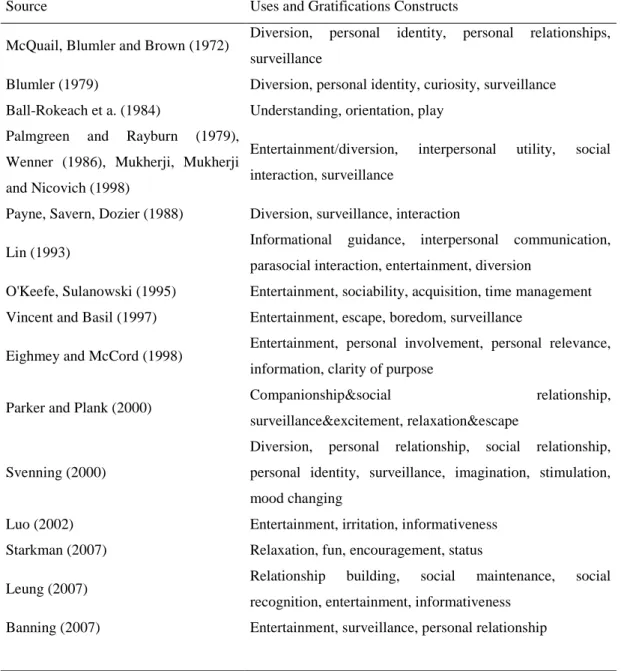
UGT is studied with its different dimensions in the literature. The first two studies that indicate the functional interpretations of the media were Laswell (1948) and Wright (1960) which indicated the functions as surveillance, correlation, entertainment, and cultural transmission for society, for individuals or for groups (Katz, Blumler, & Gurevitch, 1974). After these, several research have been conducted with different dimensions. Several constructs of UGT are used as metrics in the literature and they are shown in Table 1.1 with additions to Plank and Parker (2000).
Uses and gratifications literature indicates that computer based communications are used with the aim of entertainment and information (Eighmey &
30
McCord, 1998). The other important constructs of the theory that are studied in the literature are informativeness, entertainment and irritation (Luo, 2002; Korgaonkar and Wollin, 1999; Chen and Wells, 1998; Eighmey & McCord, 1998; Eighmey, 1997; Plummer, 1971).
Table 1.1. Selected UGT constructs
Source Uses and Gratifications Constructs
McQuail, Blumler and Brown (1972) Diversion, personal identity, personal relationships, surveillance
Blumler (1979) Diversion, personal identity, curiosity, surveillance Ball-Rokeach et a. (1984) Understanding, orientation, play
Palmgreen and Rayburn (1979), Wenner (1986), Mukherji, Mukherji and Nicovich (1998)
Entertainment/diversion, interpersonal utility, social interaction, surveillance
Payne, Savern, Dozier (1988) Diversion, surveillance, interaction
Lin (1993) Informational guidance, interpersonal communication, parasocial interaction, entertainment, diversion
O'Keefe, Sulanowski (1995) Entertainment, sociability, acquisition, time management Vincent and Basil (1997) Entertainment, escape, boredom, surveillance
Eighmey and McCord (1998) Entertainment, personal involvement, personal relevance, information, clarity of purpose
Parker and Plank (2000) Companionship&social relationship, surveillance&excitement, relaxation&escape
Svenning (2000)
Diversion, personal relationship, social relationship, personal identity, surveillance, imagination, stimulation, mood changing
Luo (2002) Entertainment, irritation, informativeness Starkman (2007) Relaxation, fun, encouragement, status
Leung (2007) Relationship building, social maintenance, social recognition, entertainment, informativeness
31 Table 1.1. Selected UGT constructs (continued)
Roy (2007)
User-friendly, self-development, educational opportunities, convenience in communication, enhancement of self-development, wide exposure, global exchange, relaxation Shao (2009) Self-expression, self-actualization, social interaction,
community development, information, entertainment Li, Liu, Xu, Heikkila, Heijden (2015) Enjoyment, fantasy, escapism, social interaction, social
presence, achievement, self-presentation
Huang and Yang (2015) Experiencing a different lifestyle, enjoying the fun of the game, maintaining friendships
Basak and Calisir (2015) Entertainment, self-expression, information seeking, status seeking
1.3.1. Informativeness
Informativeness is defined as the resourceful, useful and knowledgable level of the media (Chen & Wells, 1999). People can use media in order to search for and reach information. According to UGT, informativeness is a kind of motivation that triggers people’s use of media. In online environment, it can be seen from people’s often visits to Wikipedia that searching for information is conducted by an individual’s desire to increase knowledge and awareness of him or herself (Shao, 2009). Users can reach many sources and find information in different formats from simple texts to animated videos in the WWW (Eighmey & McCord, 1998).
The motivations before the use may have an effect on the outcomes after the use. Chen and Wells (1999) found that informativeness is positively related to attitude toward the website. Additionally, Brackett and Carr (2001) found that entertainment, informativeness, irritation, credibility, and demographic variables have effect on attitude toward the ad on the Internet.
32 1.3.2. Entertainment
Entertainment refers to the extent to which media channel is funny for the users. Users are more likely to use the Internet if they feel fun when using it. In 2007, the most watched video category on Youtube is entertainment (Shao, 2009). Previous research show that serving higher entertainment value makes individuals more motivated to use the Internet (Luo, 2002; Chen & Wells, 1999; Ducoffe, 1996). Social media can be counted as a successful example of effective entertaining media that provides high usage levels. Basak and Calisir (2015) found that entertainment has a positive effect on satisfaction from using Facebook.
The informativeness and entertainment are both critical for an advertisement’s value (Ducoffe, 1996; Aaker, Batra, Myers, 1992). Not only the information catches people on the Web, but also entertainment level helps e-marketers keep users on websites (Luo, 2002). If the message both contains information and engagement, then the value of the advertising is optimized (Ducoffe, 1996).
1.3.3. Irritation
Irritation dimension of UGT refers to the feeling of intrusiveness when using the media. Intrusiveness is defined as a perception or psychological consequence that occurs whenan audience's cognitive processes are interrupted (Li, Edwards, & Lee, 2002). Ha (1996) also defined intrusiveness as the degree of interruption in the editorial unit process made by an advertisement in a media vehicle. So, the critical point is to try not to put anything between the consumer and the advertising in perception process. In online advertising context, irritation is an obstacle to be overcome by marketers. People who perceive the Web as irritating have negative