ISSN:1306-732X (Print)/E-ISSN: 2564-680X (Online) Sonbahar Özel Sayısı / Autumn Special Issue
Ekim / October 2020
Yılmaz Onur Arı ve Ramazan Sayar, (2020).“TÜRKİYE’NİN YAŞ MEYVE VE SEBZE İHRACATINI ETKİLEYEN FAKTÖRLER: BİR ÇEKİM MODELİ ANALİZİ” Tokat Gaziosmanpaşa Üniversitesi Sosyal Bilimler Araştırmaları Dergisi. Sonbahar Özel Sayı, s.83-89.
Uluslararası İşletmecilik ve Ticaret-Araştırma
Geliş Tarihi / Received: 15 Haziran 2020 Kabul Tarihi / Accepted: 7 Eylül 2020
83
TÜRKİYE’NİN YAŞ MEYVE VE SEBZE İHRACATINI ETKİLEYEN FAKTÖRLER: BİR ÇEKİM
MODELİ ANALİZİ
Yılmaz Onur ARI
1*+, Ramazan SAYAR
2*-1Dr. Öğretim Üyesi, Bayburt Üniversitesi, Uluslararası İşletmecilik ve Ticaret Bölümü 2Dr. Öğretim Üyesi, Bayburt Üniversitesi, Uluslararası İşletmecilik ve Ticaret Bölümü
*[email protected],*[email protected] +ORCID: 0000-0001-7634-2531, -ORCID: 0000-0002-7860-7561
Öz– Bu makale, çekim modelini kullanarak Türkiye'den yapılan taze meyve ve sebze ihracatının etkilendiği faktörleri incelemektedir.
Türkiye'den en fazla taze meyve ve sebze ithal eden 10 ülke için (2007-2018) dönemini kapsayan yıllık zaman serisi verileri kullanılmıştır. Model tahmininde, klasik tahminciler yerine GMM EGLS tahmincisi kullanılmıştır. Ampirik sonuçlar göstermektedir ki, ithalatçı ülkelerin GSYİH’si Türkiye'nin meyve ve sebze ihracatını olumlu etkilerken, meyve ve sebzelerin dayanıklılığından kaynaklanan ulaşım koşullarındaki zorluklar nedeniyle Türkiye ile bu ülkeler arasındaki mesafeden olumsuz etkilenmektedir. Çalışmada aynı zamanda AB'ye üye bir devlet olmanın meyve ve sebze ihracatını olumsuz etkilediği, ithalatçı ülkenin toplam nüfusu içinde Müslüman nüfusun % 4’ten-fazla olmasının ise meyve ve sebze ihracatını olumlu etkilediği sonucuna varılmıştır. Bu sonuç helal gıda anlayışının dünyada arttığının bir göstergesi olabilir. Ayrıca, AB ülkelerindeki yüksek rekabet nedeniyle, Türkiye’nin bu ülkelere olan ihracatının da olumsuz etkilendiği sonucuna varılmıştır.
Anahtar Kelimeler– Taze Meyve ve Sebze İhracatı, Türkiye Ekonomisi, Uluslararası İktisat Politikası, Çekim Modeli, Uluslararası Ticaret.
FACTORS AFFECTING TURKEY’S FRESH FRUIT AND VEGETABLE EXPORTS: A GRAVITY
MODEL ANALYSIS
Abstract– The paper examines the determinants that impact on Turkey’s fresh fruit and vegetable export with the help of gravity model
analysis. An annual time series data covering the period of (2007-2018) was used for 10 countries, which are the main fresh fruit and vegetables importing countries from Turkey. In model estimation, GMM EGLS estimator was employed instead of classical estimators. According to the empirical results, Turkey's fruit and vegetable exports are positively affected by the importing countries’ economic size while negatively affected by the distance between Turkey and these countries, due to difficulties in transportation conditions -arising from the durability of fruits and vegetables-, changes in nutritional habits, increasing costs disadvantage in competition, etc. The study also concluded that being a member state of the EU, negatively affects the exports of fruits and vegetables, while having more than 4% Muslim population in the importing country’s total population is positively affected the exports of fruits and vegetables. This result may indicate that the understanding of halal food has increased in the world. Besides, due to the high competition in EU countries, Turkey’s exports to these countries are also negatively affected
Keywords– Fresh Fruit and Vegetable Export, Turkish Economy, International Economic Policy, Gravity Model, International Trade. Jel Codes: Q17, F14, F2
84
1. INTRODUCTIONTurkey is suitable for the cultivation of all kinds of fruit except for some types of tropical fruits, thanks to its ecological structure and climatic characteristics. It has an important potential especially in growing vegetables and fruits. While the vegetable group is 32.5 % of the total vegetable production, the share of fruits is 15.6 %. Turkey has an important position in fresh vegetable and fruit production with a share of 48.1 % (Dal ve Kızılaslan, 2019: 157). In 2018, Turkey’s most exported fresh fruit and vegetable product was lemon (332 million dollars). This product is followed by mandarin (311 million $), tomato (291 million $), cherry (161 million $) and orange (160 million $) respectively (AKİB, 2019: 2). Considering the export of fresh vegetables and fruits worldwide, the most exported product group was citrus with 11.2%. The second place is vegetables with 10.8 % and the third place is banana with 10.5 %. In 2016, total fruit and vegetable exports in the world were recorded as 119, 89 billion dollars (ITC Trademap, 2016).
According to the data of the International Trade Organization (ITC) in 2016, it is seen that that Spain ranked first with 13.8 billion $, the Netherlands was second with 11.2 billion $, Mexico was third with 10.5 billion $, China was fourth with 9.8 billion $ and the US was fifth with 9.1 billion $ products at world vegetable and fruit export rankings. The top five countries implemented 45% of the world's total fresh fruit and vegetable exports. Turkey, based on the value, ranked 12th in exporting fresh fruit and vegetable in the world (ITCTrademap, 2016).
Despite the significant amount of production of fruits and vegetables, the ratio of exports to production is quite low in Turkey. Only 9% of 51.2 million tons of fresh fruit and vegetable production is exported. The vast majority of exports are to EU countries. Turkey is often obliged to import fruits and vegetables to meet the industrial demand for raw materials although it is a leading country at producing many agricultural products such as hazelnuts, apricot, fig and cherry. Turkey also imports agricultural products, which are unsuitable and difficult to grow in Turkey’s climate (Dal ve Kızılaslan, 2019: 157).
The main objective of this study is to determine the factors affecting Turkey's fresh fruit and vegetable exports and make suggestions to increase these exports by taking into account these factors. The sections of the paper are as below: In the second part, we conduct a review of literature regarding international agricultural trade. In the third part, we explained the data and the methodology. In section four, we shared the findings of the research. Finally, the results constitute the fifth section.
2. LITERATURE REVIEW
Gravity model is a method frequently used in the literature to predict the determinants of trade flows between countries. In these studies, cross sectional and panel data were generally used (Nitsch, 2000; Feenstra et al, 2001; Sohn, 2005; Genç et al, 2011; Khan et al, 2013; Kaplan, 2016; Atsan and Karapınar, 2019).
In order to research the effect of national borders on worldwide trade within the EU, Nitsch (2000) employed the gravity model by using the panel dataset covering 12 EU countries and the period 1979-1990 in the study. The study concluded that national borders still remain important in international trade within the EU.
Feenstra et al. (2001) investigated the trade flows between the USA and Canada in their work. In the model within the range of 1970 to 1990, they used the total differentiated goods export, total homogeneous goods export, GDP, physical distance data and language dummy variables. In the study, they analyzed the gravity model identities related to the interactive trade flows between the USA and Canada and they examined whether the domestic market effect varies according to the type of product traded. As a result, they opined that the domestic market effect arises in differentiated products, therefore the domestic income elasticity in these products exceeds the income elasticity of the commercial partner.
Using the cross-sectional data of 1995, Sohn (2005) explained the trade flows between South Korea and 30 trade partners with the gravity model. Empirical results showed that the Heckscher-Ohlin model gives a direction to the South Korean trade. Sohn also found that the countries in the Asia-Pacific region positively affect Korea’s trade volume.
Danzinger et al. (2005) investigated Turkey’s trade flows to European Union countries in agricultural sector using panel statistics in the range of 1998-2002. They found that exchange rate affects Turkey’s agricultural exports (edible fruits and nuts, edible vegetables, fresh fruit and vegetables) positively, according to their study that gravity model was used. They also concluded that adaptation to the Common Agricultural Policy and EU membership process increase Turkey’s exports.
Abu Hatab et al. (2010) analyzed the determinants impacting on Egypt’s agricultural exports to its main trade partners 1994 and 2008 with the help of the gravity model in their studies. The paper concluded that 1% increase in the GDP of Egypt increased the agricultural export flows of Egypt by 5.4%. The authors also suggested that transportation costs negatively affect the export of agricultural products.
Genç et al. (2011) examined the determinants of exporting and importing activities in the Black Sea Cooperation (BSEC) zone with the gravity model. In the study, in which panel data method was applied for the period of 1997-2007, they found that the GDPs and populations of the exporting and importing countries have a positive impact on trade flows in the region, but exporting countries’ population and GDP have more effect on trade flows. Then again, they observed that the distance between the capitals of the member countries negatively affects the trade flows, while the countries having a joint border and speaking the identical language have a positive result on the buying and selling transactions. Esmaili and Pourebrahim (2011) analyzed the factors affecting Iran's exports of agricultural products in their studies by employing gravity method. They used a panel data analysis in the range of 2002-2005 and assessed Iran’s agricultural exports to a total of 70 countries (50 developing and 20 developed). As a result of the study, they found that Iran trades with developing countries more than with developed countries. They also emphasized that the countries where Iran is trading more than its potential are generally the neighbors of Iran.
Khan et al. (2013) used the panel data set in the range of 1990 and 2010 to examine the factors of trade between Pakistan and its major partner countries in trade with the help of gravity method. They concluded that GDP and per capita GDP affect trade volume positively while distance and cultural similarities affect trade volume negatively.
85
Kaplan (2016) estimated vegetable and fruit exports of Turkey byemploying Poisson-Pseudo-Maximum-Likelihood Technique. Annual panel data was applied in the range of 2004 - 2014 for 63 countries to which Turkey exports. According to the results Kaplan found that having a common border has a positive effect on fruit and vegetable exports while being a member of EU, 2008 global financial crisis and 2010 Arab Spring political crisis have a negative effect on fruit and vegetable exports.
Atsan and Karapınar (2019) used the gravity method to find the factors, which affect Turkey’s hazelnut exports. They found that the hazelnut-importing country’s population, income per capita, unemployment rate, real interest rate, surface area, the volume of trade, real exchange rate, purchasing power parity and also dummy variables - EU membership, free trade agreement and border neighborhood variables are positively associated with hazelnut exports while the distance between countries, OECD membership, common language and religion variables are negatively related to hazelnut exports.
From recent studies, Nguyen et.al. (2020) conducted an in-depth evaluation of the impact of trade agreements on Vietnam’s rice exports in the range of 1999 and 2016. Their study employed a random boundary gravity model to estimate the inefficiency in the operation of Vietnam’s rice exporting activities under the effect of trade agreements. The outcomes showed that trade agreements that Vietnam participates to affect rice exporting of Vietnam, but the country’s rice exports have not yet exploited these effects efficiently.
3. GRAVITY MODEL
The Gravity Model gives very good results in empirical studies on economic partner relations between countries. The model is inspired by the laws of universal physics of gravity. In general terms, the strength of the relationship depends on both the size of the object and the nature of the environment. As objects get bigger and closer, they show a more intense interrelation (Sevela, 2002: 463)
For the first time physicist Newton found the law of gravity. In economics, this law enables to justify the global exporting and importing activities successfully. Physics asserts that the gravitational force between two objects is entirely associated with the size of the objects and reciprocally related to the square of the distance between these two objects (Anderson, 2010: 2). Similarly, the gravity model helps to estimate the trade volume of two countries in international trade in international trade, according to the size of the countries in terms of GDP and the distance between them (Zhou, 2010: 1629).
The mathematical formulation in Jan Tinbergen's book "Shaping the World Economy: Suggestions for an International Economic Policy", published in 1962, is known as the first user of the Gravity Model in the literature. Tinbergen expanded trade between countries by adding dummy variables to determine whether it affects not only three economic but also political or semi-economic variables (Atsan and Karapınar, 2019: 436). Accordingly, it is possible to show the simple gravity model with the help of the following formula:
Tij= c * 𝐺𝐷𝑃𝑖∗𝐺𝐷𝑃𝑗
𝑅𝑖𝑗
(1)
Located in the equation number 1;
Tij : shows the trade volume between country j and country
i,
GDPi : shows the economic size of country i
GDPj : shows the economic size of country j (GDP or GDP
per capita)
Rij : points the distance between the countries and
c : indicates the gravity constant.
When the logarithm of both sides is taken in the equation, the following equation is obtained;
Log (Tij) = Log (c) + Log (GDPi) + Log (GDPj) –Log (Rij)
(2)
Equation (2) represents the gravity model in its simplest and simple form. According to the equation, the trade volume between the two countries is a function of increasing the economic size of the countries and decreasing the distance between them (Ata, 2012: 277).
It has been suggested by some researchers that distance has lost importance in the face of increasing economic integration day by day. However, the distance factor still maintains its importance in explaining international trade. Indeed, distance represents direct or indirect trade costs such as cost of transportation, possible delays in transportation, border controls, customs tariffs and quotas (Golovko, 2009: 4).
Although the gravity model criticized in various aspects, especially due to the insufficiency of its theoretical structure, it provides two important advantages in investigating global trade flows. Firstly, finding the suitable data for the model is relatively easy and it provides reliability. Secondly, considerations have been thoroughly studied theoretically and developed for the use of these models in researching global trade flows (Paas, 2002: 1).
4. DATA AND METHODOLOGY
As in the literature, the panel data analysis was used in this study because it is suitable for a more comprehensive and broader modelling than the single-dimensional horizontal section and time series. Gujarati (2004) wrote that the use of panel data, which gives more data and information, increases the greater degree of freedom, predicts the problem of heteroscedability and provides better estimation econometrics. Panel data analysis occurs by using time series and cross-section data simultaneously. Dynamic panel data analysis methods come to the fore in models made with panel data. Dynamic panel data analysis becomes important in that it involves the fact that the economic phenomena that occur in any period are affected by the accumulations and experiences of the past. The more preferred method in dynamic panel data analysis is the GMM (generalized method of moments), where the error terms revealed by Arellano and Bond (1991) include autocorrelation and obtain effective estimators in case of both fixed variance and variance. In the GMM method, firstly, the first difference model is created by using the lagged value of the dependent variable and a two-step prediction is made using the GLS method.
The study employed the gravity model and the panel data analysis was created using the GMM (generalized method of moments) EGLS (Estimated generalized least square) method, using the uninterrupted data of 10 countries covering the period 2007-2018. The study used data from 10 countries that are the freshest fruit and vegetable-importers from Turkey between the years 2007 to 2018. These countries are Belarus, Germany, Italy, Iraq, United Kingdom, Netherlands, Poland, Russian Federation, Saudi Arabia and Ukraine. GDP data was obtained from World Bank national
86
accounts data and OECD National Accounts data files. Distance data provided from the http://www.distancefromto.net/ web address. The fruit and vegetable export (EXP) data is obtained from the Mediterranean Exporters' Association (AKİB) web site. Turkish population (TUP) data in importing countries was provided at Republic of Turkey Ministry of Foreign Affairs. In addition, dummy variables were used to identify whether countries are EU member (D1) and Muslim population (D2) is more than 4%. The models subject to the analysis are shown below;
Log (EXP𝑖t ) = α0 + β1Log(GDP𝑖t ) + β2Log(DIS𝑖t )
(3)
Log (EXP𝑖t ) = α0 + β1Log(EXP𝑖t-1) + β2Log(GDP𝑖t ) - β3Log(DIS𝑖t
) (4)
Log (EXP𝑖t ) = α0 + β1Log(EXP𝑖t-1) + β2Log(GDP𝑖t ) - β3Log(DIS𝑖t
) + β4Log(TUP𝑖 )
(5)
Log (EXP𝑖t ) = α0 + β1Log(EXP𝑖t-1) + β2Log(GDP𝑖t ) - β3Log(DIS𝑖t
) + β4Log(TUP𝑖 ) + β5 (D1)
(6)
Log (EXP𝑖t ) = α0 + β1Log(EXP𝑖t-1) + β2Log(GDP𝑖t ) - β3Log(DIS𝑖t
) + β4Log(TUP𝑖 ) + β5 (D1) + β5 (D2)
(7)
In the equations given above;
EXP𝑖t : Fruit and vegetables exports from Turkey to the country i
in year t
GDP𝑖t: Gross domestic income of country i in t
UZ𝑖: distance between the i country and Turkey
TUP: Turkish population living in country i D1 𝑖: Whether country i is an EU member
D2 𝑖: Whether the Muslim population in country i is more than
4% C: constant
In econometric analysis, variables must be stationary to ensure accuracy of time results. In cases where stationarity is not achieved, long-term analysis does not provide the correct result, and a false regression problem is encountered (Kutlar, 2000). Therefore, it is important to stationarizing the series. Since the variables in the drafting model also have a time dimension, it is necessary to examine whether they have a unit root or not. In case of unit root, panel data analysis cannot be used and cointegration analysis should be done instead. Linearizing the gravity model is necessary, so the data obtained by taking the algorithms of all its variables were used in the analysis. Taking the logarithm of a non-stationary time series can cause the series to become stationary since it will reduce the differences between the values of the series (Cevher, 2015).
Either fixed effects models or random effects models should be preferred for making estimations in the methods using panel data (Gujarati and Porter, 2003). In this study, the random effects model was selected because of distance variable (UZ) used by time due to the nature of the gravity model. (Hsiao, 2014; Baltagi, 2008).
5. EMPIRICAL FINDINGS
In this study, the factors affecting the export of vegetables and fruits through the gravity model using E-views 9 program were
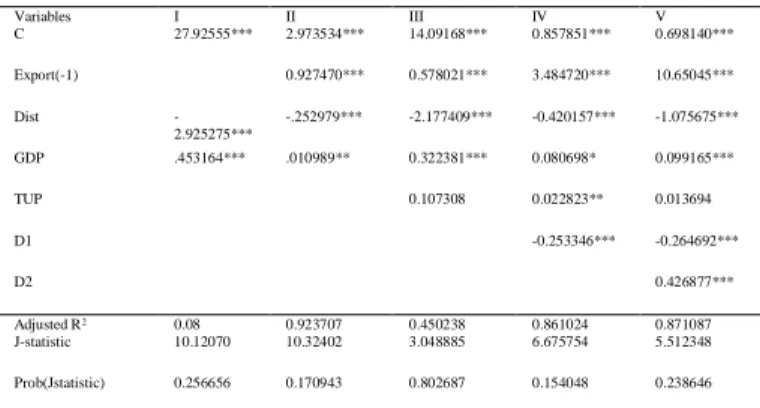
examined with 6 different Panel GMM EGLS models and their results are presented in Table 1 below.
Table 1. Dependent variable of Turkey’s vegetable and fruit exports
Variables I II III IV V C 27.92555*** 2.973534*** 14.09168*** 0.857851*** 0.698140*** Export(-1) 0.927470*** 0.578021*** 3.484720*** 10.65045*** Dist -2.925275*** -.252979*** -2.177409*** -0.420157*** -1.075675*** GDP .453164*** .010989** 0.322381*** 0.080698* 0.099165*** TUP 0.107308 0.022823** 0.013694 D1 -0.253346*** -0.264692*** D2 0.426877*** Adjusted R2 0.08 0.923707 0.450238 0.861024 0.871087 J-statistic 10.12070 10.32402 3.048885 6.675754 5.512348 Prob(Jstatistic) 0.256656 0.170943 0.802687 0.154048 0.238646
Method: Panel GMM EGLS (Cross-section random effects),
Wallace and Hussain estimator of component variances
Note: ***, 1%; **, 5%; *, 10%; It refers to the significance level.
Source: Computed by author using E-views 9.0.
According to the results, the distance (DIS) variable was found to be negative and significant in all models due to the nature of the gravity models. In addition, the national income (GDP), which is used as a magnitude indicator, has been found statistically significant with a positive effect on exports.
Dynamic panel data analysis is created by including the previous period value of the dependent variable in the analysis. Here, in the analysis created by adding the past period value of the export of vegetables and fruits, it was found positive in accordance with the literature and was found statistically significant. Export values of the previous years foreshadow the export of the following years. At this point, Turkey has been established business connections with other countries through many years, bilateral trade relations have been grown as result of this, and then the satisfaction and trust resulting from the trade has been ensuring that this effect occurs. In addition, R2 was very low in Model I, while it’s high in Model II.
When the previous period value of exports was added to the model, R2 increased significantly. So when we add export data of the
previous year, it has a positive impact of Turkey’s current exports today.
The Turkish population (TUP) variable that live in the importing countries was added to expand the gravity model. Here, according to the literature, it is expected that the Turkish population affects the export volume positively. Empirical results of the model showed that the independent variable representing the Turkish population appeared positive, but not statistically significant. The period used in the analysis is small, so this fact may be due to the inability of the Turkish population to see the impact on exports, according to Model IV. Turkish population variable was found positive and statistically significant in the model. Thus, this outcome is consistent with the literature regarding the subject. In this model, the dummy variable (D1), which indicates whether the exporting country is an EU member, has been added and affects the export of fruits and vegetables negatively. In this case, the fruit and vegetable exports between Turkey and EU member states clearly show that there is an intense competition (Kaplan, 2016, 80). In the last model, where all the variables are collected, the D2 dummy variable was added, in which more than 4% of the Muslim
87
population is represented. This variable was found to be positive and statistically significant. However, the Turkish population variable was again positive but statistically insignificant. Here, the fact that the Turkish population also represents the Muslim population and the higher Muslim population outside the Turkish population may cause this situation.
CONCLUSION
This study investigates the factors affecting Turkey's fresh fruit and vegetable exports by gravity model, which is considered as the most suitable model in the literature review. For that purpose, annual panel data covering 10 countries and covering the period 2007-2018 was applied in the gravity model in the study. In model estimation, GMM EGLS estimator was employed instead of classical estimators.
According to the empirical results, Turkey's fruit and vegetable exports are positively affected by GDP of the importing countries while negatively affected by the distance between Turkey and these countries. The Turkish population variable was positive but insignificant except for the IV model. When dummy variables are added to the model, the dummy variable of being a member state of the EU negatively affects the exports of fruits and vegetables, while the dummy variable of having more than 4% Muslim population in importing country is positively affected the exports of fruits and vegetables.
In terms of the results of the research, the fruit and vegetable exports of Turkey are negatively affected by the increase in distance, due to difficulties in transportation conditions -arising from the durability of fruits and vegetables-, changes in nutritional habits, increasing costs disadvantage in competition, etc.
Besides, due to the high competition in EU countries, exports to these countries are also negatively affected. In addition to that, economic size of an importing country and overpopulation of Turkish people and Muslims in the importing country support a positive situation at fruit and vegetable exports for Turkey. This result may indicate that the understanding of halal food has increased in the world. Since religious and national loyalties in these countries provide advantage in exports, an issue should be emphasized more in the export of fruits and vegetables to these countries.
88
REFERENCES
AKIB (2019). Yaş Meyve ve Sebze Sektörü Türkiye Geneli Değerlendirme Raporu, Akdeniz İhracatçı Birlikleri Genel Sekreterliği Yayını, s.1-16.
Abu Hatab, Assem, Romstad, E. & Huo, X. (2010). Determinants of Egyptian Agricultural Exports: A Gravity Model Approach, Modern Economy, 3(1), s. 134-143.
Anderson, J. E. (2010), The Gravity Model, NBER Working Paper Series, 16576, s.1-45.
Arellano, M., & Bond, S. (1991). Some Tests of Specification for Panel Data: Monte Carlo Evidence and an Application to Employment Equations. The Review of Economic Studies, 58(2), 277-297.
Atsan, T. & Karapınar, A. (2019). Türkiye Fındık İhracatını Etkileyen Faktörler: Çekim Modeli Uygulaması, Asos Journal, 7 (89), s.430-444.
Ata, S. (2012). Türkiye’nin İhracat Potansiyeli: Çekim Modeli Çerçevesinde Bir İnceleme, International Conference on Eurasian Economies, 2012, s.276-282.
Baltagi, B. H. (2008), Econometric Analysis of Panel Data, John Wiley And Sons Ltd. 4th Edition, Chichester, England.
Cevher, E. (2015). Türkiye’de Doğrudan Yabancı Sermaye Yatırımının Belirleyicilerinin Zaman Serileriyle Ekonometrik Analizi. Ankara: Zenodo. http://doi.org/10.5281/zenodo.35596
Dal, B & Kızılaslan, H. (2019). Avrupa Birliği Uyum Sürecinde Türkiye’nin Yaş Sebze ve Meyve Sektörü, XI. Ibaness Congress Series, 9-10 Mart 2019, s. 157-163.
Danzinger, F.N.; Herzer, D.; Martinez-Zarzoso, I. & Vollmer, S. (2005). The Impact of a Customs Union Between Turkey and the EU on Turkey’s Exports to the EU, DIW Berlin, Discussion Papers, No. 483.
Esmaili, A. & Pourebrahim, F. (2011). Assessing Trade Potential in Agricultural Sector of Iran: Application of Gravity Model. Journal of Food Products Marketing, 17(5), 459-469.
Feenstra, R. C., Markusen, J.R. & Rose, A.K. (2001). Using the Gravity Equation to Differantiate Among Alternative Theories of Trade, The Canadian Journal of Economics, 34(2), s. 430-447.
Genç, M. Can, Artan, S. & Berber, M. (2011). Karadeniz Ekonomik İşbirliği Bölgesinde Ticaret Akımlarının Belirleyicileri: Çekim Modeli Yaklaşımı, Atatürk Üniversitesi İktisadi ve İdari Bilimler Dergisi, 25, s.207-224.
Golovko, A. (2009). Çekim Modeli: Avrasya Ülkelerinin Dış Ticareti, EconAnadolu Congress, 17-19 Haziran 2019, s.1-22. Gujarati, D. N., & Porter, D. C. (2003). Basic econometrics (ed.). New York: McGraw-HiII.
Gujarati, D.N. 2004. Basic Econometrics. McGraw Hill, USA.
Hsiao, C. (2014). Analysis of panel data (No. 54). Cambridge university press. ITC (2016), International Trade Center Trademap Statistics.
Kaplan, F. (2016). Türkiye’nin Meyve ve Sebze İhracatı: Bir Çekim Modeli Uygulaması. Journal of Yasar University, 11(42), 11-17. Khan, S., Haq, I. & Khan, D. (2013). An Empirical Analysis of Pakistan’s Bilateral Trade: A Gravity Model Approach, The Romanian
Economic Journal, 16(48), s.103-120.
Kutlar, A. (2000). Ekonometrik Zaman Serileri. Gazi Kitabevi.
Nguyen, T. T. H., Tran, T.V.H, Tran, M.D., Hoang, V.H., Hoang, V.H., Nguyen, T.T.C, Hoang, X.Q.,Phan, H.N, Tran, K.H. & Tran, V.T. (2020). Impact Efficiency of Trade Agreements on Vietnam’s Rice Export, Management Science Letters, 10, 1085-1094.
Nitsch, V. (2000). National Borders and International Trade: Evidence from the European Union, The Canadian Journal of Economics, 33(4), 1091-1105.
Paas, T. (2002). European Integration and Eastward Enlargement Process in International Trade: Using a Gravity Approach for Exploring Bilateral Trade Flows. The 42nd Congress of the European Regional Science Association, Dortmund, Germany, 1-18.
Sevela, M. (2002). Gravity-Type Model of Czech Agricultural Export, Agricultural Economics, 48 (10), s. 463-466.
Sohn, C.H. (2005). Does the Gravity Model Explain South Korea’s Trade Flows?, The Japanese Economic Review, 56(4), 417-430. Zhou, M. (2010). Multidimensionality and Gravity in Global Trade, Social Forces, 88(4), 1619-1643.
http://www.distancefromto.net/ Accession Date: 11.05.2020
https://databank.worldbank.org/reports.aspx?source=world-development-indicators Accession Date: 11.05.2020
89
EXTENDED ABSTRACT
Background:
Export activities have a crucial role in Turkish economy. When an increase in exports occurs, factor efficiency increases in the economy. Gains from economies of scale and positive externalities increase, with the easing of the foreign exchange shortage, i mport of intermediate and investment goods becomes easier, production costs in the export sectors are reduced, policies for providing new technologies are encouraged. On the other hand, exports increase employment and contribute to the increase of country and world welfare by providing an opportunity for a distribution of resources suitable for the international division of labor.
Turkey is a country where every kind of fruits and vegetables can be cultivated. Turkey is a leading country at producing hazelnuts, apricot, fig and cherry, but the country has to import most of the fruit and vegetable types, especially to meet the industrial demand. Despite its geographical advantage, the ratio of agricultural production to exports is quite low. Therefore, it is clear that there are some factors affecting Turkey's agricultural exports.
Research Purpose:
The main objective of this study was to determine the factors affecting Turkey's exports of fruit and vegetables and make suggestions to increase Turkey's exports of fresh fruits and vegetables by taking into account these factors. Our study is specifically designed to demonstrate the significance of this issue.
Because this study investigates the relationship of Turkey with its economic partners, the gravity model enables to explain trade flows fruitfully. Gravity model is shown with the following formula;
Log (Tij) = Log (c) + Log (GDPi) + Log (GDPj) –Log (Rij)
This equation represents the gravity model in its simplest and simple form. According to the equation, increasing GDP of the importing countries is directly proportional to the trade volume between Turkey and importing country but the distance between them is inversely proportional to the trade volume.
Methodology:
In this study, panel data analysis was used, just like it’s frequently used in the literature because it is suitable for a more comprehensive and broader modelling than the single-dimensional horizontal section and time series.
The study employed the gravity model and the panel data analysis was created using the GMM (generalized method of moments) EGLS (Estimated generalized least square) method, using the uninterrupted data of 10 countries covering the period 2007-2018. The study used data from 10 countries that are the most fresh fruit and vegetable-importers from Turkey between the years 2007 to 2018. These countries are Belarus, Germany, Italy, Iraq, United Kingdom, Netherlands, Poland, Russian Federation, Saudi Arabia and Ukraine. GDP data was obtained from World Bank national accounts data, and OECD National Accounts data files. Distance data provided from the http://www.distancefromto.net/ web address. The fruit and vegetables export (EXP) data is obtained from Mediterranean Exporters' Association (AKİB) web site. Turkish population (TUP) data in importing countries was provided at Republic of Turkey Ministry of Foreign Affairs. In addition, dummy variables were used to identify whether countries are EU member (D1) and Muslim population (D2) is more than 4%.
Five models were formed and analysed in the study to get the factors to affect Turkey’s fresh fruit and vegetables export.
Conclusion:
According to the empirical results, Turkey's fruit and vegetable exports are positively affected by GDP of the importing countries while negatively affected by the distance between Turkey and these countries. The Turkish population variable was positive but insi gnificant except for the IV model. When dummy variables are added to the model; the dummy variable of being a member state of the EU, negatively affects the exports of fruits and vegetables, while the dummy variable of having more than 4% Muslim population in importing country is positively affected the exports of fruits and vegetables.
Due to difficulties in transportation conditions, Turkey’s agricultural exports are negatively affected by the increase in distance. On the other hand, GDP size of an importing country and overpopulation of Turkish people and Muslims in the importing country support a positive situation at fruit and vegetable exports for Turkey. This result may indicate that the understanding of halal food has increased in the world. Since religious and national loyalties in these countries provide advantage in exports, an issue should be emphasized more in the export of fruits and vegetables to these countries.