BANKING RELATIONSHIP AND FIRM PERFORMANCE A Master’s Thesis by GÖZDE SUNGU Department of Management
İhsan Doğramacı Bilkent University Ankara
BANKING RELATIONSHIP AND FIRM PERFORMANCE
Graduate School of Economics and Social Sciences of
İhsan Doğramacı Bilkent University
by
GÖZDE SUNGU
In Partial Fulfillment of the Requirements for the Degree of MASTER OF SCIENCE
in
THE DEPARTMENT OF MANAGEMENT
İHSAN DOĞRAMACI BİLKENT UNIVERSITY ANKARA
I certify that I have read this thesis and have found that it is fully adequate, in scope and in quality, as a thesis for the degree of Master of Science in Management.
... Assoc. Prof. Zeynep Önder Supervisor
I certify that I have read this thesis and have found that it is fully adequate, in scope and in quality, as a thesis for the degree of Master of Science in Management.
...
Assoc. Prof. Süheyla Özyıldırım Examining Committee Member
I certify that I have read this thesis and have found that it is fully adequate, in scope and in quality, as a thesis for the degree of Master of Science in Management.
... Prof. Nuray Güner
Examining Committee Member
Approval of the Graduate School of Economics and Social Sciences.
... Prof. Erdal Erel
iii ABSTRACT
BANKING RELATIONSHIP AND FIRM PERFORMANCE Sungu, Gözde
M.S., Department of Management Supervisor: Assoc. Prof. Zeynep Önder
July 2013
This thesis examines the relationship between firm performance and the number of banking relationships for the publicly traded Turkish firms listed in the Borsa Istanbul (BIST) for the period 2003-2011, by using 2SLS model. In the analysis, banks are categorized according to their nationalities, ownership structures and orientations; firms are classified based on their size as small and large, the sample period is divided into two as crisis and non- crisis years, considering the effect of the 2008 global crisis on the Turkish economic and financial system. I find that firm performance decreases as the number of banking relationships increases, regardless of bank types. However, this negative relationship between firm performance and the number of banks is observed only in non-crisis times and for only small-sized firms. I also find that firm age, size, obtaining funding from external sources other than bank loans, belonging to a group, related lending, being a multinational company, incentives obtained from government and state-ownership are significant factors affecting the number of banking relationships. However, the significances of these variables differ for different bank and firm types, and for sub-periods.
iv ÖZET
BANKA İLŞKİLERİ VE FİRMA PERFORMANSI Sungu, Gözde
Yüksek Lisans, İşletme Bölümü Tez Yöneticisi: Doç. Dr. Zeynep Önder
Temmuz 2013
Bu tez, Türkiye’de 2003-2011 tarih aralığında Borsa İstanbul’da listelenmiş olan firmaların performanslarıyla, bu firmaların kredi kullandıkları bankaların sayısı arasındaki ilişkiyi 2AEK (iki aşamalı en küçük kareler) modeli kullanarak incelemektedir. Araştırmada, bankalar uluslarına, sermaye yapılarına ve yönelimlerine göre; firmalar büyüklüklerine göre ve araştırma dönemi 2008 yılında yaşanan küresel krizin Tük ekonomisi ve finansal sitemi üzerine etkilerine göre kriz ve kriz harici dönem olarak ayrılmıştır. Araştırma sonuçları; firma performanslarıyla kredi kullanılan bankaların sayısı arasında negatif bir ilişki olduğunu göstermiştir. Fakat firmalar büyüklüğüne göre ve araştırma dönemi kriz ve kriz harici dönem olarak ayrıldığında, bu negatif ilişkinin sadece küçük firmalar ve kriz harici dönem için geçerli olduğu bulunmuştur. Bununla birlikte, firma yaşı, büyüklüğü, banka kredileri haricinde kullanılan diğer borçlanma araçlarının varlığı, grup firması olması, ait olunan grubun içindeki firmalardan birinin banka olması, uluslararası bir firma olma, hükümetten teşvik alma ve devletin sermayedarlar arasında olması kredi alınan bankaların sayısını istatistiksel olarak anlamlı etkilediği gözlenmiştir. Fakat bu faktörlerin anlamlılıkları banka türüne, firma büyüklüğüne ve araştırma dönemine göre farklılık göstermektedir. Anahtar kelimeler: banka ilişkileri, firma performansı, kriz, firma büyüklüğü
ACKNOWLEDGMENTS
First of all, I would like to express my deepest gratitude to my supervisor Assoc. Prof. Zeynep Önder for her valuable guidance and support during my graduate study. She has supported and motivated me with everlasting interest, which enabled me to complete my thesis.
I also would like to thank to Prof. Nuray Güner and Assoc. Prof. Süheyla Özyıldırım for accepting to read my thesis and for her invaluable suggestions.
I am grateful to TUBITAK (The Scientific and Technological Research Council of Turkey)for providing me scholarship during my graduate study.
I am lucky to have Mehmet Akif Esen as one of my best friends who is always ready to listen to me, encourage me and come up with instant solutions all the time. I am also indebted to my friend Berk Yayvak for his support and encouragement. Additionally, I am thankful to Tamer Bakıcıol, Onurcan Ayaş, Mustafa Fırat, Figen Güneş, Ezgi Kırdök, Mustafa Onan, Meltem Türe, Naime Usul, Burze Yaşar and Işıl Sevilay Yılmaz for their valuable supports and friendship during my graduate study.
iii TABLE OF CONTENTS ABSTRACT ... iii ÖZET... iv ACKNOWLEDGMENTS ...v TABLE OF CONTENTS ... vi
LIST OF TABLES ... viii
CHAPTER 1: INTRODUCTION ...1
CHAPTER 2: LITERATURE REVIEW ...11
2.1. Literature On Banking Relationships...11
2.1.1. Theoretical Models...11
2.1.2. Empirical Evidences...20
2.2. Literature on the Relationship between Firm Performance and Banking Relationships ...25
2.2.1. Theoretical Models...25
2.2.2. Empirical Evidences...28
CHAPTER 3: EMPIRICAL MODELS AND DATA ...35
3.1. Empirical Models ...37
3.1.1. Model for the Probability of Having a Banking Relationships ...37
3.1.2. Model for Banking Relationships ...43
iv
3.2. Data ...54
CHAPTER 4: EMPIRICAL RESULTS ...65
4.1. Results of the Probit Model for the Probability of Having a Banking Relationships ...65
4.2. Results of Banking Relationship Model ...73
4.3. Relationship between Firm Performance and the Number of Banks ...81
4.4. Further Estimations ...86
4.4.1. Cash versus Non-Cash Credit Relationships ...86
4.4.2. Effects of the 2008 Global Financial Crisis ...94
4.4.3. Size Effect ...100
4.4.4. Robustness Check with Basic Earning Power Ratio ...107
CHAPTER 5: CONCLUSION ...111
5.1. Limitations and Further Research Areas...119
SELECT BIBLIOGRAPHY ...122
APPENDICES ...130
A. Table A: Gross Domestic Product Results ... 130
B. Table B: Results of the Hausman Test ... 131
C. Table C: Relationship between the Number of Banking Relationships and Firm Innovativeness ...132
v
LIST OF TABLES
1. Impact of the Banking Relationships on Firm Performance ...29
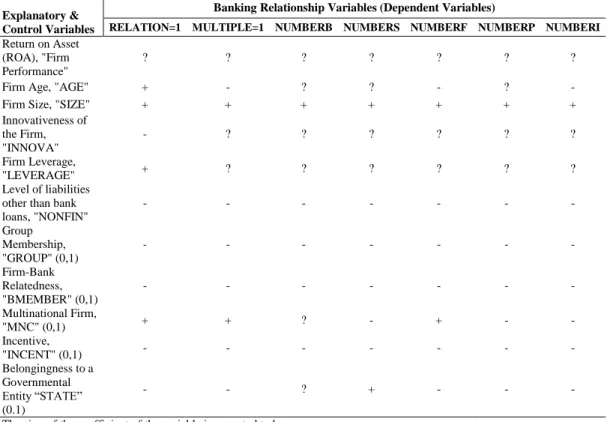
2. Expected Sign of the Explanatory and Control Variables in Their Relation with Banking Relationship Variables...47
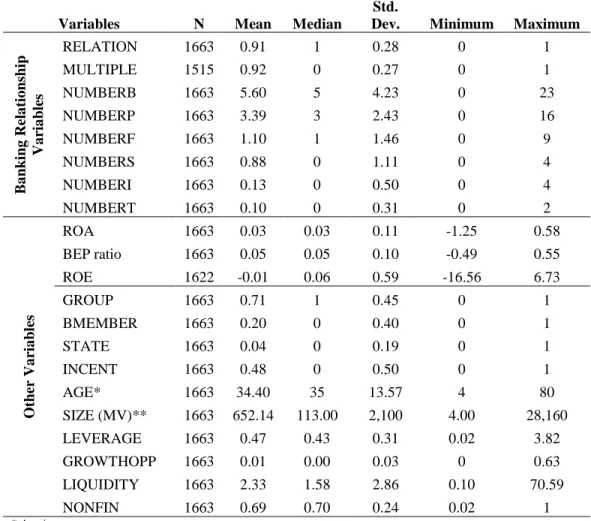
3. Descriptive Statistics of the Variables Used in the Analysis ...56
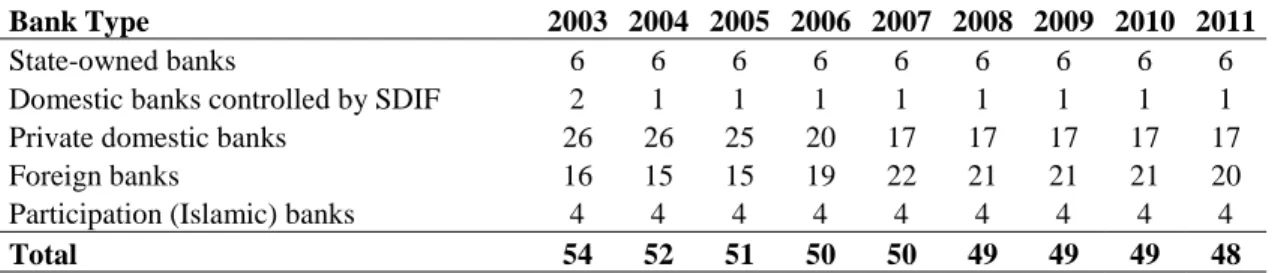
4. Total Number of Banks Operated in Turkey ...57
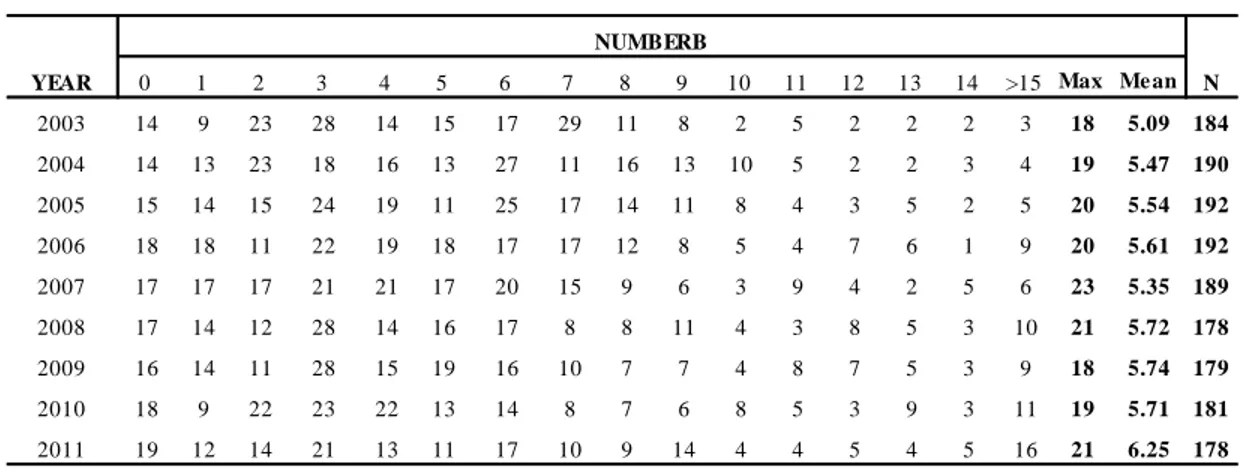
5. Total Number of Banking Relationship Over Time ...59
6. The Number of Banking Relationships in Crisis and Non-Crisis Years ...60
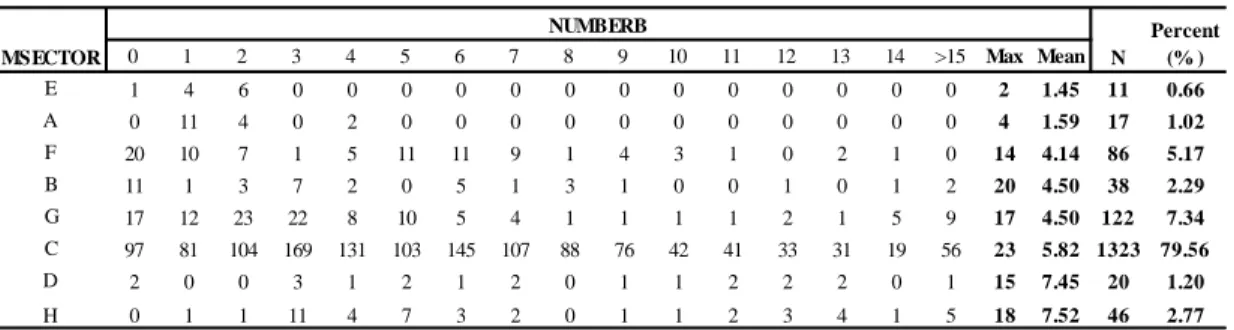
7. Distribution of the Total Number of Banking Relationships According to Industries ...61
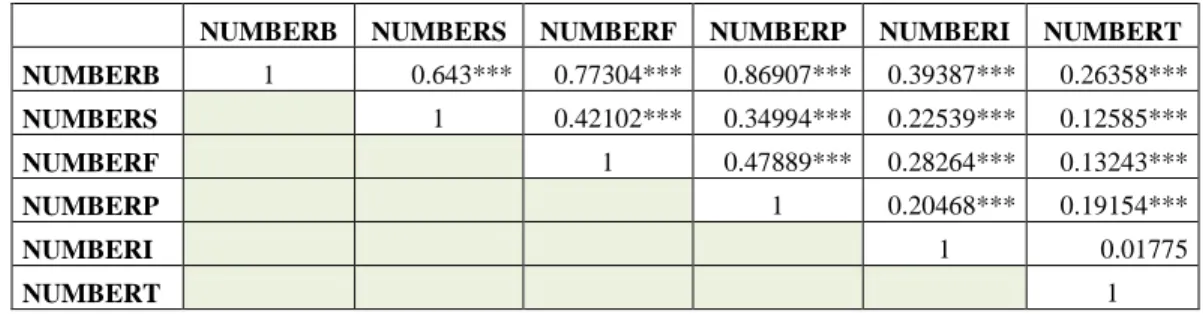
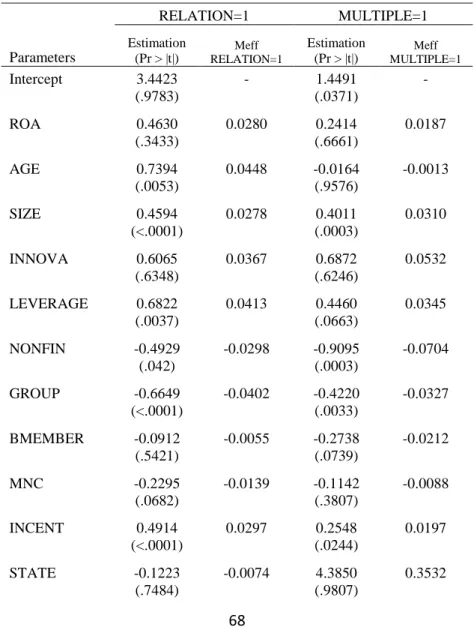
8. Pearson Correlation Coefficients of all Variables in the Models ... 63-64 9. Probit Estimations ... 68-69 10. Determinants of the Number of Banking Relationships ...75
11. Relationship Between Firm Performance and the Number of Banks ...83
12. Descriptive Statistics of the Number of Cash and Non-Cash Credit Relationships ...87 13. Determinants of the Number of Banking Relationships for Different
vi
Credit Types ...90 14. Relationship Between Firm Performance and the Number
of Banks for Different Credit Types ...93 15. Determinants of the Number of Banking Relationships for
Crisis and Non-Crisis Years ...96 16. Relationship Between Firm Performance and the Number of Banks for
Crisis and Non-Crisis Years ...99 17. The Mean Values of the Banking Relationship Variables for
Small- and Large-Sized Firms ...101 18. Determinants of the Number of Banking Relationships for
Small- and Large-Sized Firms ...103 19. Relationship Between the Number of Banks and Performances of Small- and
Large-Sized Firms ...106
1
CHAPTER 1
INTRODUCTION
In the literature, the importance of the financial intermediaries for markets and firms has been known for decades (e.g., Leland and Pyle, 1977; Stancill, 1980). Researchers have explained this importance by referring to the roles of financial intermediaries in solving problems resulted from informational asymmetry in imperfect markets. Among these financial institutions, banks are unique in their ability to solve these problems by gaining private information about their customers through subsequent and long-term provided services (Fama, 1985). Therefore, a remarkable number of analysts have highlighted possible effects of the qualifications of the relationship between banks and firms on the economy. For example, Mishkin (2008) has recently argued the possible agency problem in the lending activities of banks, including securitizations of many credits, as the crucial reason for the 2008 global financial crisis. In this thesis, I consider the importance of the financial intermediations by examining the relationship between
2
firm performance and the number of banking relationships.
The term “banking relationship” is defined in many ways in the literature. For example, Ongena and Smith (2000a) define it as the connection between a bank and its customer that goes beyond the execution of simple, anonymous, financial transactions. More broadly, Boot (2000) explains it as the provision of financial services by a financial intermediary that:
(i) invests in obtaining customer-specific information, often proprietary in nature,
(ii) evaluates the profitability of these investments through multiple interactions with
the same customer over time and/or across products. As these definitions indicate, the term banking relationship can be used to express different types of intermediary services such as cash or liquidity management and lending related services. In empirical studies, researchers commonly use this term to define only the lending (or credit) relationship which involves both short-term and long-term loans. Thus, in this study, I focus on the lending relationship and use the terms “banking relationship” and “lending relationship” interchangeably.
In the literature, most of the empirical evidence for the association between banking relationships and firm performance are from developed countries. However, there is no clear-cut finding about the impacts of the banking relationships on the performances of firms (see Degryse, Kim and Ongena, 2009: 109-115 for the review of this literature). Results are different depending on the country being analyzed, the proxy used to measure firm performance and the types of banking relationships. For example, Degryse
3
and Ongena (2001) show that firm performance measured with sales decreases with the number of banking relationships in Norway, whereas Refait (2003) finds that multiple number of banking relationships results in better firm performance in France. In addition, in Germany, Gorton and Schmid (2000) report a positive relationship between firm performance and the scope of the banking relationship, in contrast to the findings of Weinstein and Yafeh (1998) in Japan.
The characteristics of the relationship between firms and banks in emerging countries are different from the ones in developed countries. One reason for this difference is that emerging countries have different legal frameworks and firm financial structures relative to developed countries (La Porta, López-de-Silanes, Schleifer and Vishny 1998; Demirgüç-Kunt and Maksimoviç, 1998; Levine, 1999). Since financial markets are not well-developed in emerging countries, it is more difficult and costly to raise funds by using other external financing sources such as issuing equity or bonds. This makes bank loans the main source of external capital and thereby, the relationship between banks and firms becomes more important for the firms in emerging markets. Furthermore, banks in emerging markets undertake not only the firm risk but also the country risk related to the fragility of the banking sector, weak creditor rights or judicial inefficiency (Ongena and Smith, 2000b; Qian and Strahan, 2007). Therefore, the relationship between banks and firms may be affected by different factors and the impact of this relationship on firm performances might differ in emerging markets.
4
However, despite these differences and much research in developed countries, there are only two studies that investigate banking relationship in emerging markets. Maurer and Haber (2007) investigate related lending in Mexico for the sample period 1888-1913. They find that Mexican bankers did not choose to lend to poor performed firms measured with productivity level. Limpaphayom and Polwitoon, (2004) examine the relation between close bank relationships and both short- and long-term market performances in Thailand for the sample period 1990-1996. They measure the relationship with the ratio of bank loans to total assets and observe that it does not increase firm performances measured with Tobin’s Q. To my knowledge, there is only one study that investigates bank-firm relationships in Turkey. Ongena and Şendeniz-Yüncü (2011), using 16,056 observations, examine Turkish firms’ choices over the bank types in 2008. They find that the mean number of banks is 2.1 for 7659 firms that have one or more banking relationships. However, they do not investigate the determinants of banking relationships and the impact of the banking relationships on firms’ performances. In this thesis, I try to empirically analyze the relationship between banks and firms’ performances in another emerging market, Turkey, for the period 2003-2011.
After the establishment of Banking Regulations and Supervision Agency (BRSA) in 2000, the Turkish banking sector has started to be regulated more and has started to attract international financial intermediaries from all over the world. With the entrances of many foreign banks, there has been a rapid growth in the sector and the degree of competitiveness between banks has increased in the 2000s. In addition, the inflation rate has been very high in Turkey until quite recently and so, it has been very difficult and
5
costly to raise funds by issuing securities for Turkish firms. For all these reasons, even though Turkish financial sector is characterized as a market-based system (Demirgüç-Kunt and Levine, 1999), bank loans have been relatively easier way of obtaining funds compared to other financial alternatives, resulting in higher leverage ratios for Turkish firms. Cakova (2011) finds the mean debt ratio as 61% for small- and medium-sized Turkish firms, over the period between 1998 and 2008. The mean debt-to-asset ratio was 41% for the firms listed in the Borsa Istanbul (BIST) for the period 2003-2011. However, in Turkey, there is a regulation which restricts the total amount of credit that a firm can borrow from a bank. The current banking law No. 5411 (Section 3, Article 54) limits the total amount of credit provided to a firm. According to this law, banks are not allowed to provide loans more than 25% of their shareholders’ equity. Moreover, a manager of one Turkish bank stated that although the amount of credit demanded by firms are below the limits, banks do not want to take the total risk by themselves and prefer to share the credit risk with other banks, especially after the 2001 Turkish banking crisis. The regulations and the behavior of banks might cause Turkish firms to have multiple banking relationships and increase the number of banking relationships that firms have. As a result, although bank loans have constituted an important source of financing for Turkish firms, no “main bank” or “hausbank” relationship is observed between banks and firms in Turkey, unlike Japan or Germany. With these characteristics, Turkish banking sector has its own idiosyncratic dynamics different from other developed countries. However, the association between banking relationships and firm performance has not been examined yet and it is important to empirically investigate the possible effects of banking relationships on firm performances in Turkey.
6
This thesis analyzes banking relationships for publicly traded firms listed in the BIST for the period 2003-2011.Although the Turkish banking system started to be regulated with the establishment of BRSA in 2000, in order not to bias the results with the negative effects of the 2001 banking crisis in Turkey, the beginning of the sample period is determined as 2003.
In the first part of the thesis, I examine the factors affecting the probability of having a banking relationship, using the probit model. Then, I investigate possible determinants of the number of banking relationships, and the relation between firm performance and the number of banking relationships, using the two-stage least square (2SLS) estimation model. In this analysis, I control for the other firm characteristics such as firm age, size, debt structure and innovativeness, and for year and industry effects. In the literature, firm performance is measured with several proxies that indicate some activities of a firm over a period of time such as profitability, investment or growth opportunities. In this study, firm performance is measured with the profitability of a firm.
I also investigate whether there is any difference in the association between firm performance and banking relationships for different types of banking services. It can be argued that different types of banking services generate different levels of interaction between firms and banks. For example, even though non-cash credits are accepted as ordinary bank loans, they are not as risky as cash credits. Therefore, their collateral requirements are not as strict as the ones for cash credits, and firms can more easily borrow non-cash credits from multiple banks relative to cash credits. Moreover, since
7
non-cash credits seem like trade assurances for firms, these credits do not directly affect firm performances, but support them. Thus, the determinants of banking relationships and the relationship between firm performance and the number of banks may vary according to different types of banking relationships. To investigate this, banking relationships are divided into two as cash and non-cash credit relationships and the models are estimated separately for these types of bank services.
In the literature, some researchers show that the relationship between firms and banks changes during the crisis times. For example, considering the effect of the Asian financial crisis around 1997, Fok et al. (2004) explore that Taiwanese firms establish new banking relationships with domestic banks and end current relationships with foreign banks during the crisis time. Thus, to examine possible impacts of the 2008 global crisis on the relationship between Turkish firms and banks, I also divide the whole sample period into two as crisis and non-crisis periods. Then, I analyze the models for these two sub-periods separately.
In the literature, theoretically and empirically it is shown that the number of banking relationships is more valid for small-sized firms rather than the large-sized ones for two reasons. First, since raising funds by issuing stock or bond is too costly and more difficult for small- and medium-sized firms, these firms rely more on bank loans than large-sized firms. Second, small-sized firms are generally newly established or young firms which do not have enough credit history. Thus, these firms are more likely to suffer from asymmetric information problems which can be solved through close
8
banking relationships. Many empirical studies find that the relationship between firms and banks differs according to firm size in various countries. For instance, Cesarini (1994) find that small-sized firms maintain a small number of banking relationships, 2 on average; whereas large-sized firms maintain many banking relationships, 33 on average, in Italy. Harhoff and Körting (1998a) find that number of creditors increases as the size of the small- and medium-sized German firms increases. Therefore, I also differentiate my sample into two as large- and small-sized firms and I investigate the relationship between firms and banks for these two types of firms separately.
In the analysis, banks are categorized according to their ownership structure, nationality and orientation, as in Ongena and Şendeniz-Yüncü (2011). They find that young, large, multiple-bank, and industry-diversified firms that are located in or close to Istanbul work with foreign banks. They also state that Islamic banks mainly deal with young, multiple-bank, industry-focused and transparent firms. Moreover, differentiating banks according to their nationality, Fok et al. (2004) find that there is a negative relation between the number of domestic-bank relationships and firm performance, but a positive one between the number of foreign-bank relationships and firm performance. Thus, I also examine whether the relationship between firm performance and the number of banks changes according to the bank’s ownership structure, nationality and orientation.
When investigating the probability of having a banking relationship, I find that some factors affect both the probability of having one and also the probability of maintaining multiple banking relationships. For example, these two probabilities increase with firm
9
size, leverage and obtaining incentives from the government, but decrease with the ability of obtaining funding from external sources other than bank loans or from a group it belongs to. On the other hand, some factors affect only one of these two probabilities. Firm age and being a multinational company affect only the probability of having a banking relationship, whereas belonging to a group that owns a bank only affects the probability of having multiple banking relationships.
The results from the firm performance estimations show that there is a significantly negative relationship between firm performance and the number of banks, independent from bank and credit relationship types. More profitable firms maintain a smaller number of banking relationships for both cash and non-cash credits regardless of bank types. However, this negative relationship between firm performance and the number of banks holds for only non-crisis years and small-sized firms and this finding holds for all bank types, except Islamic banks.
Results from the banking relationship estimations show that firm profitability and other firm characteristics, except firm innovativeness and leverage, are significant factors in determining the number of banking relationships. After categorizing banks, I find that the factors that significantly affect the number of relationships with foreign and private domestic banks are similar and, the relationships with state-owned and Islamic banks are also determined by similar factors. For example, as firm profitability increases, the number of relationships with foreign and private domestic banks decreases, but the number of relationships with state-owned and Islamic banks increases. Controlling the
10
effect of different types of credit relationships, I find that factors affecting the number of banking relationships vary across cash and non-cash credit relationships. For example, it is observed that there is a negative and significant relationship between obtaining funds from external sources other than bank loans and the number of banking relationships for only cash credits, but not for the non-cash ones. It is also found that factors that are significantly related with the number of banking relationships are different for crisis and non-crisis years and these differences change according to bank types. For instance, results show that firm performance is a significant factor affecting the number of banking relationship for only crisis years and for only private domestic banks. Lastly, categorizing firms as small- and large-sized ones, it is found that the factors affecting the number of banking relationships, except belonging to a group or a holding, are totally different for small- and large-sized firms.
The remainder of the thesis is organized as follows. In chapter 2, I review the theoretical and empirical literature on banking relationships and their effects on firm performance. Section 3 describes methodology and the data. Section 4 discusses the results of the analyses. Lastly Section 5 concludes the study.
11
CHAPTER 2
LITERATURE REVIEW
In this section, I first review the theoretical and empirical models that examine whether firms have relationships with a single or multiple banks. Then, I summarize the literature available on the relationship between firm performance and the number of banking relationships.
2.1. Literature on Banking Relationships 2.1.1. Theoretical Models
The need for a financial intermediation has emerged as a natural response of the perfect market to the presence of asymmetric information jointly with transaction costs (Leland and Pyle, 1977). And among these financial institutions, banks are unique relative to
12
other intermediaries because of their ability to gain private information about their customers through the subsequent services provided (Fama, 1985). However, in the literature, there are various views about the optimal number of banking relationship to benefit from their roles in imperfect markets or from their uniqueness. Within a static theoretical setting, Diamond (1984), Ramakrishnan and Thakor (1984), and Boyd and Prescott (1986) argue that a single banking relationship arises as the optimal delegated mechanism in order to reduce monitoring, renegotiation and screening costs that arise from informational asymmetries in imperfect markets.
On the other hand, single banking relationships may not be optimal for a firm, since it may cause a holdup problem. Sharpe (1990), Fisher (1990) and von Thadden (2004) show that a firm may encounter a holdup problem in a single banking relationship since single banks can gain ex-post monopoly power by using the proprietary information about the firm obtained through close and subsequent relationships. Within a dynamic theoretical setting and in a competitive market environment, Sharpe (1990) argues that using such a monopoly power, a bank can “informationally” capture a firm, preventing it from switching to another bank, if long-term contract possibilities are limited with respect to the term of renewals. He proposes multiple banking relationships as a way to cope with this holdup problem for firms. Fisher (1990) also studies a simpler version of the Sharpe’s (1990) model in his independent work. However, Fisher (1990) indicates that multiple banking relationships can be an equilibrium solution only in a mixed strategy, not in a pure strategy as Sharpe (1990) indicates. Von Thadden (2004) provides a correct analysis for the study of Sharpe (1990). He indicates that the model developed
13
by Sharpe (1990) can only have an equilibrium solution in mixed strategies, which features a partial information lock-in by firms and random termination of lending relationships. In this way, von Thadden (2004) argue that multiple banking relationships can be an equilibrium solution when there is a partial holdup problem and firms are able to terminate their lending relationships in such circumstances.
Rajan (1992) argues another type of holdup problem for firms in his comprehensive dynamic contracting model. He shows that a bank may call-back loans by using its monopolistic power gained through a single banking relationship, when it detects that the firm is incapable of performing its financial obligations. He indicates that in such cases, the firm suffers from a holdup problem, since it cannot find funds from another bank and thereby has to liquidate its project early. He presents multiple banking relationships as a solution to this type of holdup problem. However, differently from Sharpe (1990) and Fisher (1990), he warns that this solution can cause a winner’s curse problem, for an arms’ length bank. He indicates that within a competitive market environment where repeated lending is allowed, when an arms’ length bank competes with a preexisting bank, it offers lower interest rates for firms aiming to gain them. At the same time, knowing the proprietary information of its customers, the pre-existing bank differentiates its interest rates offered according to the quality of the firms: lower interest rates offered for good firms but higher interest rates offered for bad firms. In the end, bad firms choose an arms’ length bank, whereas good firms maintain their relationships with the preexisting bank. In such cases, the existing bank experiences a
14
winner’s curse, since it seemingly succeeds in winning new customers, but actually ends up with the bad firms.
Von Thadden (1995) shows that a long-term single credit relationship with a termination clause might eliminate both the holdup and winner’s curse problems. He suggests such a termination clause that warrants ending the credit relationship when the loan subject to the banking relationship is not successful, or continuing the credit relationship with the preexisting conditions. He shows that such a clause is beneficial for both firms and banks. It allows firms to continue their banking relationships with favorable preexisting conditions specified in the initial contract. At the same time, it enables banks to unilaterally end the credit relationship early on, if the project financed is not as profitable as it is supposed. In this way, von Thadden (1995) presents a dynamic perspective on Diamond’s (1984) study. Von Thadden (1995) argues that such a single credit relationship with a termination clause can be still optimal for firms in the presence of information asymmetry, as Diamond (1984) suggests.
In addition to the holdup problem, single banking relationships may cause another problem for firms, called the soft budget constraint problem. It was originally introduced by Kornai (1979, 1980 and 1986) as the proliferation of inefficient enterprises resulted from the absence of bankruptcy threats in socialist economies. In the banking relationship framework, Hart (1995), Dewatripont and Maskin (1995) and Bolton and Scharfstein (1996) discuss the soft budget problem as the insufficient firm’s effort in preventing a bad consequence resulting from the absence of bankruptcy threats.
15
Dewatripont and Maskin (1995) investigate the incentives of a firm in a decentralized and centralized credit market environment, when there is an asymmetric information problem. They argue that in a centralized market environment, the absence of bankruptcy threat may encourage banks to continue lending further credits, expecting that the firm will recover and pay previous debts. They indicate credit decentralization as a solution for such cases. Dewatripont and Maskin (1995) show that credit decentralization provides financial discipline by offering a way for creditors to not finance ex-post inefficient long-term projects and thereby, discouraging ex-ante the incentive of managers to accept such projects.
Extending the study of Dewatripont and Maskin (1995), Bolton and Scharfstein (1996) consider the case of strategic default occurring because of firm managers. They argue that managers who perceive that banks expecting to recover their previous loans will ex-post continue lending credits might extensively borrow ex-ante. Furthermore, such managers aiming to divert cash to them might even cause strategic default for a firm. Bolton and Scharfstein (1996) show that borrowing from many banks may prevent such situations, since managers must negotiate a restructuring plan with each of many claimants at the same time in case of strategic default. On the other hand, they also show that borrowing from multiple banks cannot be preferable for firms during the times of project refinancing because of the increasing renegotiation costs. In this way, Bolton and Scharfstein (1996) present the choice of the optimal number of banking relationships for a firm as a tradeoff between the costs or inefficiencies experienced in times of project renegotiation and benefits experienced in cases of strategic default.
16
Following Bolton and Scharfstein (1996), Bris and Welch (2005) construct an agency/signaling model. They show that when the quality of the firms is settled endogenously via the number of the creditors in the model, the higher quality firms choose to borrow from fewer banks in order to signal their quality and confidence of not going to default. They even state that the extreme case, borrowing from a single bank, may be preferred by the firms who need to signal the highest quality. On the other hand, Bris and Welch (2005) also indicate that when the quality of the firms is known, then firms choose to borrow from many banks since there is no more necessity for signaling or financial discipline imposed by the markets.
Petersen and Rajan (1995) develop a multi-period state-contingent loan contract model to examine the optimal number of banking relationships. They investigate a firm’s ability to borrow from banks that have different market powers. To do this, they measure the market power of banks in both concentrated and competitive market environments. They show that when the market power of a bank increases, the credit-constrained young firms get more finance at lower rates and therefore, the value of single banking relationships enhances for such firms. On the other hand, they indicate that the reverse case is true for older and good quality firms that are, on average, older; and good firms are faced with higher interest rates when the monopoly power of the bank increases.
Considering the impact of exogenous liquidity shocks in the market, Detragiache, Garella and Guiso (2000) argue that relationship banks may be unable to continue
17
funding profitable projects. In such times, if the firm cannot refinance its project with the existing bank, then it is required to either refinance by negotiating with an outside bank or prematurely liquidate the project. In these circumstances, they suggest that outside banks might also refuse to lend since they do not know the quality of the projects. Therefore, multiple banking relationships arise as a solution for firms by reducing the probability of an early liquidation of the project in times of exogenous liquidity shocks in the market.
Von Rheinbaben and Ruckes (2004) theoretically model a firm’s optimal choice of the number of lending banks over the extent of information disclosed to these banks. They present this choice as a tradeoff between the benefits of low credit rates offered by many banks and the costs of valuable private information leakage to competitors in the market. Hence, firms determine not only the number of banking relationships but also the scope of their relationship with banks based on the decision to reveal confidential information to the market. Von Rheinbaben and Ruckes (2004) predict a U-shaped relationship between the degree of innovativeness and the number of banking relationships. On one hand, they find that as long as a firm decides to reveal private information, a higher degree of innovativeness makes fewer banking relationships optimal and there is a negative relation between the degree of innovativeness and the number of banks. On the other hand, after some degree of innovativeness, firms become highly sensitive to the information leakage and therefore, choose not to reveal its confidential information in order not to impair output market success. In such cases, firms maintain multiple banking relationships and create competition among these banks in order to decrease
18
borrowing rates. Consequently, the initial negative relation between the degree of innovativeness and the number of banking relationships reverses as the degree of innovativeness continues to increase.
Most of the papers examining the optimum number of banking relationships assume that firms borrow equal proportions from each bank. However, there could be asymmetric or concentrated borrowing activity; that is, while a firm borrows smaller amounts from multiple arms’ length banks for daily capital needs, it may mainly finance its big investment projects by extensively borrowing from a single relationship bank. Because of this, asymmetric borrowing activity is an important issue and thus, deserves to be examined. In the literature, Hubert and Schafer (2002) argue that under the presence of coordination failure between lending banks, many banks wrongly evaluate a firm as financially distressed and as a result, successively withdraw loans to preempt assets of the firms in case of a default. They show that at such times, a firm may be forced into bankruptcy with successive withdrawals, even though it is not the actual case. Hubert and Schafer (2002) indicate that firms may prevent such situations with multiple but asymmetric borrowing activities, which increase the bargaining power of the main bank and thus, provide coordination among lending banks.
Following Hubert and Schafer (2002), Elsas, Heinemann and Tyrell (2004) also analyze the optimal debt structure of a firm by allowing multiple but asymmetric bank borrowing. In their study, Elsas, Heinemann and Tyrell (2004) present supporting results for the findings of Hubert and Schafer (2002). They indicate that large scaled
19
borrowings from a main bank and small scaled borrowings from other arm’s length banks at the same time can be optimal, when many arm’s length banks decide to call back their loans at the interim stage of an investment project because of the coordination failure. In addition to this, they also suggest that such a multiple but asymmetric borrowing structure may be optimal especially for risky firms or for firms with low expected cash flows.
In contrast to the study of Hubert and Schafer (2002), Guiso and Minetti (2006) argue that lending banks may also prefer to continue financing investments if these banks aim to seize assets of a firm by preempting in case of any default. However, Guiso and Minetti (2006) indicate that with multiple but asymmetric borrowing activities, firms may prevent such an opportunistic activity by creating differences in the seizing abilities of lending banks. In their study they show that arm’s length banks may object to continue of financing bad investments, since these banks have limited seizing ability with their small scaled lending amounts compared to the seizing ability of a relationship bank.
In summary, the theoretical literature presents mixed evidences for the optimal number of banking relationships. One group suggests single banking relationships as an optimal mechanism to reduce costs arising from information asymmetries between firms and banks. The other group argues that having multiple banking relationships is optimal to deal with the holdup and soft budget constraint problems. Another group of studies indicates that the choice of the optimal number of banking relationships is a tradeoff
20
between the costs of strategic defaults and the benefits experienced in times of liquidity shock. Also, some other research constructs this tradeoff based on the costs and benefits resulting from the decision to reveal the firm’s confidential information to the market. These studies predict a U-shaped relationship between the importance of revealing confidential information and the number of banking relationships. Under the assumption of asymmetric and concentrated borrowing activity, another group shows that large scaled borrowings from a main bank and small scaled borrowings from other arm’s length banks can be optimal for firms in the presence of some conditions. Therefore, many empiric studies test the validity of these theoretical findings for different countries or firms within a country.
2.1.2. Empirical Evidences
For a variety of countries, there are many empirical studies which estimate the number of banking relationships. Both mean and median number of banks presents a great difference across countries. For example, the mean number of banks is one for Belgium firms (Degryse, Masschelein and Mitchell, 2004) and 30 for Italian firms (D’Auria, Foglia and Reedtz, 1999). The striking thing is that there is a large variation among firms within the same country in the terms of the number of banking relationships. For example, the firm size has an effect on the number of banking relationships. In Italy, while small-sized firms maintain on average two banking relationships, large-sized firms maintain on average 33 numbers of banking relationships (Cesarini, 1994).
21
Because of differences across and within countries, many studies have empirically investigated the macro and micro level determinants of the number of banking relationships.
On the micro level, almost all research indicates that both firm age and size are significant determinants of the number of banking relationships. For instance, the number of creditors increases with the size and age of small U.S. firms for the sample period 1988-1989 (Petersen and Rajan, 1994) and of small- and medium-sized German firms for the sample year 1997 (Harhoff and Körting, 1998a). In addition, many studies present a variety of other firm characteristics as significant determinants such as profitability, leverage and bank debt level (see Degryse et al., 2009: 82-85, 87-91 for the reviews). However, some of these characteristics can have different effects on the choice of the optimum number of banking relationships in different countries. For example, Tirri (2007) finds that there is no relationship between firm profitability, measured by gross operating margin divided by sales, and the number of banking relationships, in Italy. However, Ziane (2003), and Harhoff and Körting (1998a) observe a negative relation between firm profitability and number of banks in France and Germany respectively, unlike Tirri (2007). They measure firm profitability by using different proxies. Ziane (2003) measures firm profitability with the ratio of operating profitability to turnover, whereas Harhoff and Körting (1998a) measure it with the ratio of net income to interest payments.
22
Controlling for borrowing firm characteristics, some studies investigate the effects of bank and market characteristics on the number of banking relationships such as ownership structure of banks or market concentration (Detragiache et al., 2000; Yu and Hsieh,2003; Tirri, 2007; Neuberger, Pedergnana and Räthke-Döppner, 2008; Berger, Klapner, Martinez and Zaida, 2008). For example, Detragiache et al. (2000) find a negative relationship between the number of banks and bank fragility for small-sized Italian firms, as they suggest theoretically. Their study measures bank fragility with two different proxies: observed changes in the ratio of liquid funds to assets and weighted average of the ratio of nonperforming loans to assets. In addition to this, Neuberger et al. (2008) find that the number of bank relationships increase in bank size for the sample year of 1996 and Swiss firms with an average of 4 employees. Berger et al. (2006) and Yu and Hsieh (2003) indicate that the probability of having multiple banking relationships increases when the bank is owned by a governmental entity or by a foreign institution in India and Taiwan. Tirri (2007) and Berger et al. (2006) find that the probability of having a multiple number of banking relationships decreases as market concentration increases in Italy and India, respectively.
For Turkey, the empirical study of Ongena and Şendeniz-Yüncü (2011) provide information about the number of banking relationships. They investigate their analysis by using a representative dataset from Turkey and thereby indicate specific findings for Turkey. However, in their study, they examine firms’ choices over the bank types according to r set of firm and bank characteristics, not the number of banking relationships. Therefore, their study indicates only some descriptive statistics and
23
insights into how firm characteristics vary for different bank types. Using 16,056 observations for the sample year 2008, Ongena and Şendeniz-Yüncü (2011) find the mean number of banks as 2.1 for those that have one or more number of banking relationships.
In macro level, Ongena and Smith (2000b) present the first study that explains the variation across countries. They show that, controlling for a variety of firm- and country-specific variables such as dependence on public capital markets or market concentration or legal structures, on average firms maintain more bank relationships in countries with inefficient judicial systems, poor enforcement of creditor rights, unconcentrated but stable banking systems and active public bond markets. Supporting the findings of Ongena and Smith (2000b), Qian and Strahan (2007) also show that the number of lending relationships is low in countries with better protection of creditor rights and in contrast, it is higher in more risky countries, as measured by the sovereign debt rating.
Apart from these empirical studies, Ongena, Tümer-Alkan and von Westernhagen (2007) investigate the determinants of multiple but asymmetric borrowing activities for German firms using both bank and firm level data. Controlling for both firm and bank’s profitability and ownership structure with firm’s asset specificity variables, they find that risky, illiquid, large and leveraged firms spread their borrowings more equally between multiple arms’ length banks. Furthermore, they show that a relationship bank might capture funds provided by other arm’s length banks if the relationship bank is a
24
public sector bank and if the other banks are large enough to not tie up additional funds in capital.
A new interesting research question which recently draws attention is whether or how the number of banking relationships changes over the business cycle of a firm. However, only a few studies have access to the necessary data for investigation and present evidence about the variation of number of banking relationships over the business cycle. For example, D’Auria et al (1999) analyze the stability of lending relationships over time between the periods of 1985 and 1993 in Italy. They find that firms attempt to broaden the range of financial sources rather than substitute the existing one with another, over time. Sterken and Tokutsu (2002) investigate the determinants of the number of banking relationships of listed Japanese firms between 1982 and 1999. Considering the effect of the asset price bubble in the 1980s, they show that there was a general increase in the number of loans over this period, whereas the average number of banking relationships started to decrease in 1982 and reached the lowest level in 1989 when the bubble bursts. Therefore, Sterken and Tokutsu (2002) argue that there was a credit concentration in the number of banking relationships during the bubble period. However, they also show that this credit concentration dispersed with the burst of the bubble, in 1990s.
To sum up, the empirical studies indicate that the optimum number of banking relationships varies both across and within countries. Furthermore, studies suggest that both country characteristics such as the judicial system, the risk level of a country or
25
type of banking system in a country, as well as firm and bank characteristics affect the number of banks with which a firm has a relationship.
2.2. Literature on the Relationship between Firm Performance and Banking Relationships
2.2.1. Theoretical Models
The number of banking relationships can affect firm performance in different ways. In a static theoretical setting, Diamond (1984), Ramakrishna and Thakor (1984) and Boyd and Prescott (1986) argue that single banking relationships enhance firm performance by reducing monitoring, renegotiation and screening costs arising because of informational asymmetries. Even though these studies acknowledge that multiple banking relationships may likewise reduce these costs, they also point out that multiple banking relationships may increase borrowing costs as well and thus mitigate firm performance.
In a different theoretical setting, Yosha (1995) and Bhattacharya and Chiesa (1995) also argue the positive effect of a single banking relationship on firm performance. In their studies, they analyze the effect of private information leakage resulting in a multiple banking relationship on firm performance. Yosha (1995) shows that firms that are expected to lose more in case of an information leakage prefer single banking relationships and thereby increase firm performance. Similar to Yosha (1995), Bhattacharya and Chiesa (1995) also show that if interim disclosure of R&D knowledge
26
is too severe, then R&D intensive firms perform better by maintaining a single banking relationship rather than maintaining multiple banking relationships.
Different form Yosha (1995) and Bhattacharya and Chiesa (1995), von Rheinbaben and Ruckes (2004) show that the relationship between the number of banks and firm performance depends on the decision of information disclosure made by a firm itself. In their study, they assume that the decision of revealing private information is independent from the choice of the optimal number of banking relationships, since a firm itself, not a bank, decides to disclose private information. Based on this assumption, von Rheinbaben and Ruckes (2004) indicate that the profitability of a firm decreases with the number of banking relationships if it decides to reveal its private information. On the other hand, they also show that if a firm decides not to disclose its private information and if there is enough competition among banks, then multiple banking relationships may reduce borrowing rates and thereby enhances firm performance.
Rajan (1992) and von Thadden (1995) discuss that multiple banking relationships may enhance firm performance by eliminating information lock-in problems and decreasing holdup costs that occur when banks exploit their monopoly powers obtained through single banking relationships. Beside these studies, Detragiache et al. (2000) analyze the effect of exogenous liquidity shocks on the relationship between the number of banks and firm performance. They argue that in time of exogenous liquidity shocks, a relationship bank may object to refinance good projects and thus the firm has to
27
prematurely liquidate its project. They show that in such cases, multiple banking relationships may increase firm performance by reducing risk of premature liquidation of profitable projects.
Bolton and Scharfstein (1996) discuss two-sided effects of multiple banking relationships on firm performance. On one hand, they indicate that multiple banking relationships may decrease firm performance by increasing negotiation costs occurred at the time of strategic defaults. On the other hand, as Detragiache et al. (2000) suggest, Bolton and Scharfstein (1996) also indicate that multiple banking relationships may increase firm performance by diversifying risks arising in case of exogenous liquidity shocks to the banking system.
In summation, theoretical models show different relationships between firm performance and the number of banks. One group of studies considers the effect of costs associated with informational asymmetries and private information leakage. These studies argue that having a single banking relationship reduces these costs and thereby enhances firm performance. The other group of studies considers the effect of costs resulting from information lock-in and holdup problems. And in contrast to the first group, this group argues that having multiple banking relationships increases firm performance by decreasing costs arising from information lock-in and holdup problems. Different from these two groups, the study of Bolton and Scharfstein (1996) considers the effect of strategic defaults and presents the effect of banking relationships on firm performance as two-sided.
28
2.2.2. Empirical Evidences
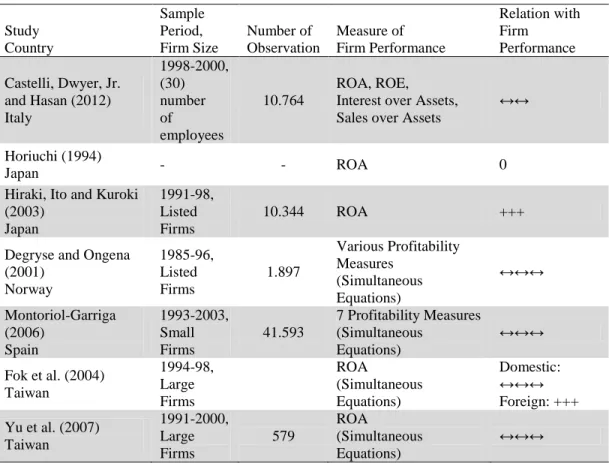
Several empirical studies examine the impact of the number of banking relationships on firm performance in various countries. These studies measure firm performance with different proxies such as profitability, investment and growth opportunities. Table 1 summarizes the results of the studies that measure firm performance with profitability measures. Like theoretical results, empirical results presented in the fourth column of Table 1 also indicate that there is no consistent relationship between the number of banks and firm performance. For example, Degryse and Ongena (2001) find that Norwegian firms with a single banking relationship actually perform better than others with multiple banking relationships. They measures firm performance with three different profitability proxies; ratio of operating income to sales, return of assets (ROA) and return on equity (ROE) and for all, this finding is valid. Similarly, Castelli et al. (2012) and Montoriol-Garriga (2006) also find a negative relationship between firm performance and the number of banks in Italy and Spain, respectively. Measuring firm performance with ROA and ROE, Castelli et al. (2012) indicate that firm performance increases as the number of banks decreases. They also show that this finding is stronger for small firms than for large firms. Montoriol-Garriga (2006) uses ROA and sales growth to measure firm performance for the main study. She also uses five more measures; economic profitability, financial profitability, return on shareholders’ funds, asset turnover and value added growth, to measure firm performance for the robustness check analysis. Using a panel data set for small- and medium-sized firms in the period 1993-2004, Montoriol-Garriga (2006) find that firms maintaining multiple banking
29
relationships have lower profitability. These results provide evidences supporting the theoretical view that fewer bank relationships reduce information asymmetries and agency problems, which outweigh the negative effects arising from holdup problems, and thus increase firm performance better than multiple banking relationships.
Table 1: Impact of the Banking Relationships on Firm Performance
Study Country Sample Period, Firm Size Number of Observation Measure of Firm Performance Relation with Firm Performance Castelli, Dwyer, Jr. and Hasan (2012) Italy 1998-2000, (30) number of employees 10.764 ROA, ROE, Interest over Assets, Sales over Assets
↔↔
Horiuchi (1994)
Japan - - ROA 0
Hiraki, Ito and Kuroki (2003) Japan 1991-98, Listed Firms 10.344 ROA +++
Degryse and Ongena (2001) Norway 1985-96, Listed Firms 1.897 Various Profitability Measures (Simultaneous Equations) ↔↔↔ Montoriol-Garriga (2006) Spain 1993-2003, Small Firms 41.593 7 Profitability Measures (Simultaneous Equations) ↔↔↔ Fok et al. (2004) Taiwan 1994-98, Large Firms ROA (Simultaneous Equations) Domestic: ↔↔↔ Foreign: +++ Yu et al. (2007) Taiwan 1991-2000, Large Firms 579 ROA (Simultaneous Equations) ↔↔↔ Source: Degryse et al., 2009, pg. 111-114, Table 4.13
Studies are listed according to country and then, year of the study. 0 No relationship
+++ Positive and significant at 1% level ↔↔↔ Negative and significant at 1% level ↔↔Negative and significant at 5% level
Yu et al. (2007) examine how issuing public debt affects the relationship between firm performance and the number of banks, using a three stage least square (3SLS)
30
simultaneous estimation model. They find that public debt issuance plays a significantly negative role in determining the effect of the number of banks on firm performance, whereas it plays a significantly positive role in determining the effect of firm performance on the number of banking relationships. That is, firms accessing public debt end up with lower profitability levels, and with larger number of baking relationship.
On the other hand, by distinguishing domestic and foreign banking relationships, Fok et al. (2004) find that firm performances negatively related with the number of domestic banking relationships but positively related with the number of foreign banking relationships in Taiwan. They also explore firms’ behavior during the Asian crisis in the 1990s. They find that firms establish new banking relationships with domestic banks and end their relationships with foreign banks during the crisis time.
Horiuchi (1994) examine the relationship between number of “main bank” relationship and firm profitability in Japan. The major characteristic of the Japanese “main bank” relationship is that a firm’s “main bank” is usually a principal shareholder of the firm and its primary lender. Thus, the firm’s “main bank” usually plays an important role in monitoring the firm and assisting it during periods of crisis (Aoki, Patrick and Sheard, 1994). In this framework, Horiuchi (1994) finds that there is no statistically significant difference between ROA values of Japanese firms having one, two or three “main banks.” Like Horiuchi (1994), Hiraki et al. (2003) investigate the impact of “main bank” relationships on firm profitability but find that when borrowing from a single main bank,
31
borrowing is negatively related to the profitability of the Japanese companies listed on the Tokyo Stock Exchange. Moreover, they also report that having multiple “main bank” relationships is associated with an increase in firm profitability by reducing the holdup costs of firms, especially for those with higher value of growth opportunities.
Beside these, some studies measure firm performance with other ratios instead of profitability measures in order to examine the impact of the number of banking relationships on firm performance. For example, considering all banking relationships besides “main bank,” Kang and Stulz (2000) measure firm performance with stock performance measures and examine the effect of the Japanese banking crisis on firms listed on the Tokyo Stock Exchange from 1986 to 1993. The Japanese banking crisis occurred when the asset price bubble burst in 1989. Thus, Kang and Stulz (2000) divide the sample period into two as before and after banking crisis periods. They find that firms with close banking relationships had better stock performance before the banking crisis, whereas these firms had worse stock performance during the crisis period.
Some studies examine the relationship between number of banks and the probability of survival of new firms in the market. Foglia, Laviola, and Reedtz (1998) show that small and financially distressed Italian firms prefer to have more creditors. Using a dataset for Portuguese firms, Farinha and Santos (2006) find that startup firms maintaining a single banking relationship are more likely to survive for longer periods than those firms with multiple banking relationships. They also show that startup firms which have a bank, except state-owned banks, among its shareholders have a higher probability of survival
32
in future. However, this relationship does not hold if one of the shareholders is a state-owned bank.
For publicly traded U.S. firms over the period 1980-1993, Houston and James (2001) examine whether financial constraints vary with the reliance on bank debt and with the number of banks that a firm has a relationship. Defining cash flow sensitivity as a financial constraint, they show that single-bank firms are significantly more cash-flow-constrained than multiple-bank firms. However, Houston and James (2001) also point out that cash flow sensitivity of a single-bank firm arises from greater cash flow sensitivity for a large investment project. Thus, for a modest level of investment projects, there is no difference between single-bank and multiple-bank firms in terms of being financially constrained.
There are other studies that investigate the impact of the banking relationships on the availability and costs of borrowings to the firms (Weistein and Yafeh, 1998; Harhoff and Körting, 1998b; Petersen and Rajan, 1994).These studies examine the indirect effect of the number of banking relationships on firm performance. Analyzing only main bank relationships in Japan between 1977 and 1986, Weistein and Yafeh (1998) show that main banks offer higher interest rates to their clients and firms with multiple main banks are offered lower borrowing rates. This result provides supporting evidence to the theoretical results of Rajan (1992) and von Thadden (1995). However, for small U.S. firms, Petersen and Rajan (1994) find that multiple bank relationships increase lending
33
rates and reduce the availability of credit. Thus, unlike Weistein and Yafeh (1998), they show that multiple banking relationships indirectly decrease firm performance.
Harhoff and Körting (1998b) study the impact of “hausbank” relationship in Germany. In the German “hausbank” relationship, companies give priority to one bank which runs the core of their banking business, and in return, banks also give priority to their “hausbank” customers. In such a relationship, “hausbank” supports their customers’ day-to-day business activities through electronic and international banking services, receivable management and treasury activities. The “hausbank” relationship is generally seen as long-term and stable partnership. In this vein, Harhoff and Körting (1998b) indicate that the “hausbank” relationships and concentrated borrowings are desirable for German firms since such firms are significantly better than other firms in terms of collateral requirements, interest rates and credit availability.
Despite these studies in the developed countries, there are only two studies that investigate the impact of the banking relationships on firm performance in emerging markets. Maurer and Haber (2007) investigate related lending relationships in Mexico for the sample period 1888-1913. They find that Mexican bankers did not choose to lend to poor performed firms measured with productivity level. Limpaphayom and Polwitoon (2004) investigates the impact of the lending relationships measured with the ratio of both short- and long-term bank loans to total assets on firm performances in Thailand for the sample period 1990-1996. They find a negative relationship between bank lending and both short- and long-term performances of firms measured with Tobin’s Q.
34
To my knowledge, there is no study that investigates the impact of the banking relationships on firm performances in Turkey.
Consequently, the empirical studies indicate that the relationship between firm performance and the number of banks differ both across and even within countries. Furthermore, studies suggest that bank type and the degree of the relationship between banks and firms affect the results.
35
CHAPTER 3
EMPIRICAL MODELS AND DATA
In this thesis, first, the probability of having a banking relationship is examined. For all firms in the sample, initially the factors affecting the probability of having any banking relationship is analyzed. Then, for firms that have a banking relationship, the probability of having a single and multiple banking relationships is investigated. Probit model is used in these two analyses.
Second, the relationship between the number of banks and firm performance is analyzed. Initially, I investigate the determinants of the number of banking relationships, and then examine whether the number of banking relationships affects firm performance or not. The 2SLS model is used in the analysis as in the studies of Degryse and Ongena (2001), Fok et al. (2004), Montoriol-Garriga (2006), and Yu et al.
36
(2007). Hence, the firm performance equation is estimated jointly with the banking relationship equation. I also differentiate banks into various types in order to analyze whether the results change or not. Following Ongena and Şendeniz-Yüncü (2011), banks are categorized according to their nationality, ownership structure and orientation, as domestic, private, foreign, state-owned and participation (Islamic) banks.
Third, I investigate whether the types of credit relationships between a firm and a bank affect the determinants of the number of banks or the impact of the number of banks on firm performance. In this thesis, since I just focus on the credit relationship between a firm and a bank, I can only differentiate banking relationships as cash and non-cash credit ones.
Fourth, I examine whether the 2008 global crisis creates any difference in the relationship between firm performance and the number of banks. The whole sample period is divided into two sub-periods as crisis and non-crisis years. The crisis years are those that the global crisis affected the Turkish economic and financial system. In the literature, some studies state that the effects of the 2008 global crisis was firstly seen in the second quarter of the year 2008 and continued till the end of 2009 in Turkey (for example, Claessens, Dell’Ariccia, Igan and Leaven, 2010; Alp and Elekdağ, 2011). In addition, the growth rate of the gross domestic product in Turkey started to reduce in 2008 and was negative until the fourth quarter of 2009 (Table A). Therefore, the 2008 global crisis is assumed to affect the Turkish economic and financial system in 2008 and 2009. These years are taken as crisis years.
37
Lastly, I analyze whether the relationship between firm performance and the number of banks changes for different firm sizes. The sample is divided into two as large- and small-sized firms based on the median value of the market value of firms in each year. The models are estimated separately for these two firm types.
3.1. Empirical Models
3.1.1. Model for the Probability of Having a Banking Relationship
First, the factors affecting the probability of having any banking relationship are examined. Second, for the firms that have any banking relationship, the factors affecting the probability of having a single or multiple banking relationships is analyzed. Two dummy variables are created for these estimations: RELATION and MULTIPLE. The dummy variable RELATION equals to one if a firm has any banking relationship and zero otherwise. The dummy variable MULTIPLE takes the value of one for firms with multiple banking relationships and zero for firms with a single banking relationship. The following models are estimated using the probit models: