THE ANDICAN UPRISING, 13 MAY 2005
A Master’s Thesis
by
DURUKAN KUZU
Department of International Relations Bilkent University
Ankara September 2008
THE ANDICAN UPRISING, 13 MAY 2005
The Institute of Economics and Social Sciences of
Bilkent University
by
DURUKAN KUZU
In Partial Fulfillment of the Requirements for the Degree of MASTER OF ARTS in THE DEPARTMENT OF INTERNATIONAL RELATIONS BILKENT UNIVERSITY ANKARA September 2008
I certify that I have read this thesis and have found that it is fully adequate, in scope and in quality, as a thesis for the degree of Master of Arts in International Relations.
---Dr. Hasan Ali Karasar Supervisor
I certify that I have read this thesis and have found that it is fully adequate, in scope and in quality, as a thesis for the degree of Master of Arts in International Relations.
---Professor Norman Stone Examining Committee Member
I certify that I have read this thesis and have found that it is fully adequate, in scope and in quality, as a thesis for the degree of Master of Arts in International Relations.
---Associate Prof. Mitat Çelikpala Examining Committee Member
Approval of the Institute of Economics and Social Sciences
---Prof. Dr. Erdal Erel Director
ABSTRACT
THE ANDICAN UPRISING, 13 MAY 2005
Kuzu, Durukan
M.A., Department of International Relations Supervisor: Dr. Hasan Ali Karasar
September 2008
Since the collapse of the Soviet Union state building process in Uzbekistan became subjected to the social, political and economic problems. When all these factors came together Andican Uprising occurred on 13 May 2005. In this thesis I tried to clarify the basic motives behind the Andican Uprising. By investigating these motives, I attempted to shed light on religious fundamentalism that the Government of Uzbekistan faced after the collapse of the Soviet Union. As a part of problematical state building process, role of domestic politics in the emergence of the uprising was also covered by pointing out the characteristics of clan politics and civil society in Uzbekistan. Reasons of the event were also investigated on international level. In this context geopolitical strategy of international actors, the colored revolutions and U.S – Uzbekistan relations were explored. Economic integration of Uzbekistan to world economy and its failing reformation process was explored. While promotion of
democracy in Uzbekistan was necessitating broader freedom for society, religious fundamentalism led the government to intensify its authoritarian character. These two conflicting characteristics of the country created two sides over which international actors played their cards. While the west insisted on the democratization of the country the east supported the Uzbek government’s harsh measurement over religious groups. Andican Uprising is an important case in which it is possible to find all prominent characteristics of the Uzbek politics, and therefore this thesis can be taken as a laboratory work in which all relevant traces were investigated to understand Uzbekistan.
Key words: Andican Uprising, Uzbekistan, Karimov, Ekremiye, Religious
ÖZET
ANDİCAN AYAKLANMASI, 13 MAYIS 2005
Kuzu, Durukan
Master tezi, Uluslararası İlişkiler Bölümü Tez Yöneticisi: Dr. Hasan Ali Karasar
Eylül 2008
Sovyetler Birliğinin çöküşünden bu yana Özbekistan, devlet yaratma sürecinde ekonomik, sosyal ve siyasi olmak üzere bir çok problemle karşı karşıya kaldı. Tüm bu faktörlerin bir araya gelmesiyle 13 Mayıs 2005 tarihinde Özbekistan’ın Andican vilayetinde büyük ölçekli bir ayaklanma ortaya cıktı. Bu tezde Andican ayaklanmasının ardında yatan sebepler açıklığa kavuşturulmaya çalışıldı. Bu sebepleri araştırırken öncelikle Sovyetler Birliğinin çöküsünün ardından Özbekistan’ın yüz yüze kaldığı dini koktenciliğin sebeplerini, doğasını ve derecesini aydınlatmaya çalıştım. Özbekistanda mevcut sivil toplum kuruluşlarının ve klan ilişkilerinin özelliklerini incelemek suretiyle de ülkenin iç politikasi üzerinde ayrıca durdum. Bu tezde iç politikanın yanı sıra uluslararası konjonktürün Andican ayaklanmasında nasıl bir etkisi olmuş olabileceğini görebilmek için Orta Asya da görülen renkli devrimlerle birlikte Amerika Birleşik Devletleri’nin Özbekistanla olan
ilişkilerinin bir analizi yapıldı. Karimov hükümetinin mikroekonmik açıdan başarısız mali reformları da ayrıca incelendi. Bu çalışmanın sonucunda varılan nokta Özbekistan’ın iki önemli yapısal özelliği arasında sıkışıp kaldığı yönünde oldu. Bir yandan demokrasinin ilerletilmesi icin gerekli görülen özgürlükler öteki yandan demokrasinin özünü oluşturan laik yapıya aykırı dini koktenciliğe karşı arttırılan otoriter yapı mevcut durumu oldukça zorlaştırdı. Batı demokrasi savaşı verirken yakın ilişkilerden medet uman Dogu otoriter Karimov hükümetini destekledi. Hali hazırda ekonomik problemlerden şikayetci halk Karimov’un otoriter politikalarından iyice rahatsızlık duymaya başladı. Dini gruplar ekonomik olanaklar sunarak yandaş elde etmek suretiyle bu rahatsızlıktan faydalandı, aynı zamanda sosyal baskıdan bıkmış Özbekler, Amerika ve Avrupa Birliği tarafindan sivil toplum kuruluşları aracılığıyla desteklendi. Bu doğrultuda Andican ayklanması tüm bu faktörleri içerisinde barındıran sosyal bir vakkadır ve bu tez Özbekistanı anlamak için bu ilişkilerin incelendiği bir laboratuvar çalışması olarak algılanmalıdır.
Anahtar Kelimeler: Andican Ayaklanması, Özbekistan, Karimov, Ekremiye,
ACKNOWLEDGMENTS
First and most of all, I wish to express my gratitude to. Dr. Hasan Ali Karasar, who supervised me throughout the preparation of my thesis with great patience and diligence. Without his encouragements and assistance I would not dare to write on such a difficult topic.
I am grateful to Scientific and Technological Research Council of Turkey
(TUBITAK) for funding me through my graduate education. Thanks to the scholarship provided for me, I had no difficulty in searching and retrieving the necessary sources for my study.
It is my pleasure to acknowledge the support of Professor Norman Stone and Associate Prof. Mitat Çelikpala for spending their valuable time to read my thesis and kindly participating in my thesis committee. Without their comments, this work could not take its final form.
I am indebted to Çağdaş Erol and Abdurrahim Özer for helping me through the writing of my thesis. My friends and colleagues Esin,Ayşegül, Çağatay, Pınar, Berivan, Arda and Melih deserve my special thanks for their friendship and support throughout my graduate education.
Cemal deserves my very special thanks for being there whenever I needed, as my second family. His support, patience and boundless faith in me made the completion this work possible
Last but not the least; I owe my family more than a general acknowledgement. They are the reason why I am here today. They are all my reasons.
TABLE OF CONTENTS
ABSTRACT ... iii
ÖZET... v
ACKNOWLEDGMENTS ... vii
TABLE OF CONTENTS... ix
LIST OF TABLES ... xii
LIST OF FIGURES ... xiii
CHAPTER I: INTRODUCTION ... 1
CHAPTER II: THE RELIGIOUS FUNDAMENTALISM AND ANDICAN UPRISING ... 5
2.1 The Government’s Fear of Islamic Movements... 7
2.1.1 Salafism In Uzbekistan ... 8
2.1.2. Religious Opposition Just after the Collapse of the Soviet Union... 10
2.1.3. Hizb ut-Tahrir... 13
2.1.3.1. Roots of the Organization ... 13
2.1.3.2. The Ideology of Hizb ut-Tahrir... 14
2.1.3.3. Hizb ut-Tahrir Operations in Uzbekistan... 17
2.1.4. Islamic Movement of Uzbekistan ... 18
2.1.4.1. The Historical Background of IMU ... 18
2.1.5. The Ekremiye Movement ... 22
2.1.5.1. Leadership of The Ekremiye Group... 23
2.1.5.2. Organizational Structure of the Group IMU ... 24
2.1.5.3. The Ideology of the Ekremiye Group IMU... 25
CHAPTER III: ECONOMIC FACTORS BEHIND THE UPRISING ... 29
3.1. Economics in Uzbekistan After the Collapse of the Soviet Union ... 30
3.1.1. Financial Goals of the Uzbek Administration after Independence ... 31
3.2. Agrarian Disturbances... 33
3.3. Financial Regulations preceding the Andican Uprising... 37
3.3.1. Restrictions on Access to Cash ... 37
3.3.1.1. Role of IMF in the Restriction of Access to Cash ... 38
3.3.1.2. Social Implications of the Restriction... 39
3.3.2. Regulations on Border Security and Customs ... 41
3.3.3. New Rules for Sellers in Bazaars... 42
3.4. Gas and Oil Shortages... 44
CHAPTER IV: THE ROLE OF REGIONAL, INTERNATIONAL, AND DOMESTIC POLITICS IN THE UPRISING ... 47
4.1. United States –Uzbekistan Relations before the Andican Uprising ... 48
4.2. Colored Revolutions ... 53
4.2.1. Rose Revolution in Georgia... 55
4.2.2. The Orange Revolution in Ukraine... 58
4.2.3. The Tulip Revolution in Kyrgyzstan... 61
4.3. Civil Society in Uzbekistan... 65
4.4. Clan Politics ... 70
5.1. The Background of the Uprising... 80
5.2. The Prison Attack... 81
5.3. The Take-Over of the Hokimat Building... 84
5.4. Protests at Babur Square ... 86
5.5. Government Shootings and Departure from the Square ... 90
5.6. Escape to the Kyrgyz Border ... 92
5.7. The Aftermath ... 93
5.7.1. Restriction on the Flow of Information... 93
5.7.2. Intimidation and arrests... 95
5.7.3. The Andican Trials and Asylum Seeking Uzbeks ... 96
5.7.4. International Reaction ... 98
5.7.5. Foreign Policy Implications of Andican Uprising ... 100
CHAPTER VI: CONCLUSION ... 104
SELECTED BIBLIOGRAPHY... 110
APPENDIX I. PHOTOS TAKEN IN ANDICAN ON 13 MAY 2005... 121
APPENDIX II. IMPORTANT FIGURES ... 122
APPENDIX III. PARTIAL DRAFT CONSTITUTION OF HIZB UT- TAHRIR ... 123
APPENDIX IV: MAP OF UZBEKISTAN ... 130
APPENDIX V: AKRAM YULDASHEV'S COMMENTARY ON AS-SAFF SURAH... 131
LIST OF TABLES
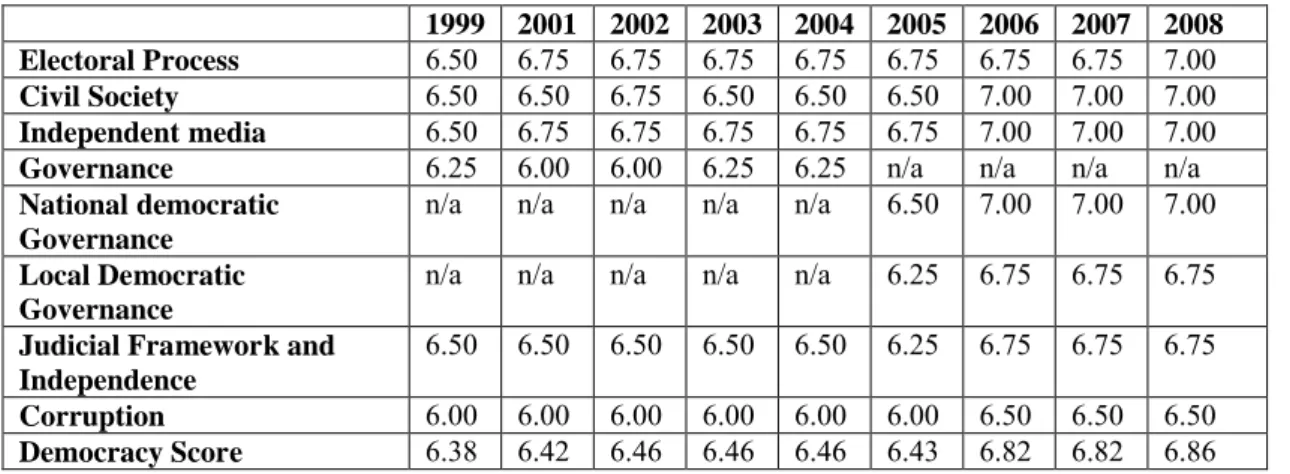
Table I. Uzbekistan Democracy Score... 51
Table II. NGO Sustainability Index, Selected Countries and Years... 68
Table III. 2005 Scores for Uzbekistan ... 69
Table IV. Composition of Selected State Structures by Region 1992-2001... 72
LIST OF FIGURES
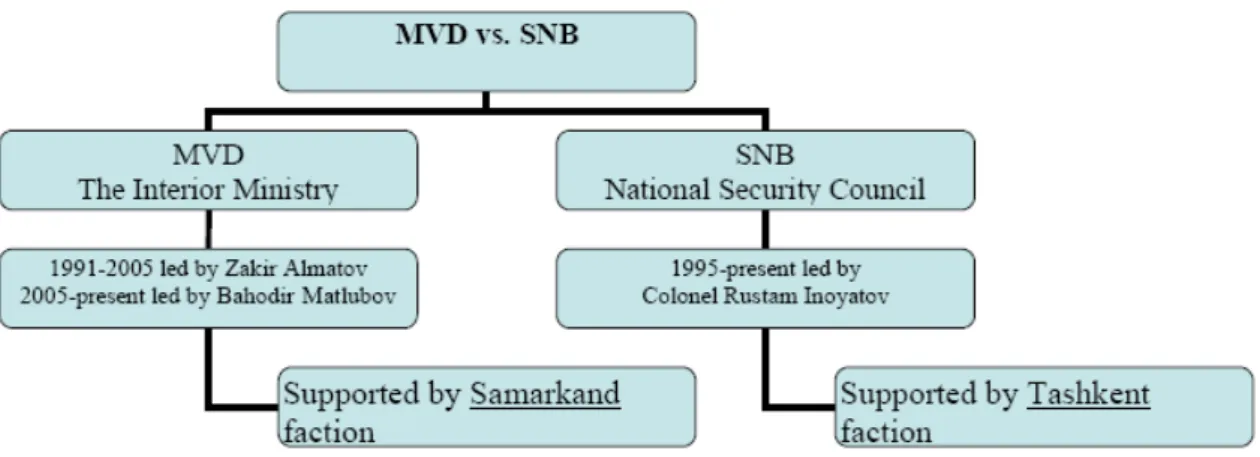
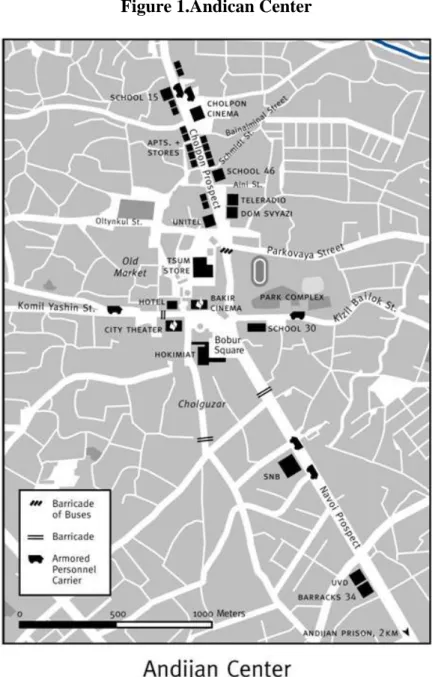
Figure I. Andican Center... 82 Figure II. Rivalry within Ministries ... 77
CHAPTER I
INTRODUCTION
On 13 May 2005 the Uzbek government suppressed mass protests in Andican by violent means leaving many questions unanswered. Contradictory views on the nature of uprising were accompanied by different interpretations by international actors over the Uzbek government’s response to the event. Not only were international institutions and foreign countries divided on Andican question but also scholars have developed different explanations to clarify what happened on 13 May 2005.
In this thesis, I evaluate domestic and foreign factors, which had an important role in both the formation and suppression of the Andican Uprising. Through the evaluation of these factors I intend to present an authentic picture of Andican Uprising. An investigation of the Andican Uprising not only exposes problematical characteristics of the state building process in Uzbekistan but also reveals the strategic concerns of international actors in the whole of Central Asia. In this study, I will examine the specific characteristics of the Uzbek politics and their implications
for regional and international politics. In this context, the Andican Uprising is a unique event, which enables us to understand the important factors in both regional security perceptions and strategic alignments and rivalries.
Although, I will base my arguments on the causal relationships between different factors in this thesis, I begin from the perspective that in the social sciences every causal relationship is subjected to the effect of unique events, which always possess their own conditions. In the literature, most of the scholars and international actors have tried to explain the event from a one-sided perspective and underestimated the other factors, which were actually much more effective than assumed. I will try to fill this gap in the literature.
In the first chapter, I explore the extent and nature of religious fundamentalism, which threatened the secular character of Uzbekistan for long time, in order to determine whether the Andican Uprising was an Islamic revolution organized and assisted by extremist groups. With this purpose in mind, in addition to describing Hizb ut-Tahrir and the Islamic Movement of Uzbekistan, I examine ideological motives and organizational structure of Ekremiye group. Effect of threats presented by the first two extremist organizations on the Uzbek government’s fear of the activities of the Ekremiye group will be questioned. I will also investigate the direct connection of this organization with the uprising in order to examine the role of religious pretexts, which Islam Karimov used in order to justify his aggressive response to Andican Uprising.
In the second chapter, economic factors, which may have contributed to the formation of the Andican Uprising, will be investigated. Failing economic reforms of Uzbek Government after the collapse of Soviet Union and its recent practices that
increased economic discontent among society prior to the Andican Uprising will be pointed out.
In this context, failure of government to carry out feasible economic reforms will be connected to the economic complaints that were voiced by protesters during the Andican Uprising. I will also try to clarify whether or not the government’s failed economic policies contributed to the formation and amplification of Ekremiye group whose members applied religious principles to their commercial activities.
In the third chapter, how international, regional and domestic politics jointly might have affected the genesis of Andican uprising will be discussed. How the colored revolutions might have affected Karimov’s response to Andican uprising will be mentioned within the context of regional politics. At this point I will compare these revolutions with the Andican Uprising to decide if Uzbekistan was also threatened by power politics in the region as Karimov assumed. I will question the possible involvement of the U.S. in Andican Uprising by analyzing its relations with Uzbek government before the uprising.
Karimov believed that the uprising was organized to topple his regime and stressed the role of the U.S funded civil society organizations in the formation of the Andican Uprising. I examine whether the capacity of Uzbek civil society organizations was sufficient to accomplish this.
In addition to these factors, role of clan rivalry in Uzbekistan will also be mentioned to explain how domestic politics might have led to the rise of mass protests in the country. The competition between clan affiliates for getting power and important positions in the government will be revealed to understand its repercussions for the Andican Uprising.
In the fourth chapter, what happened on 12-13-14 May 2005 in Andican will be portrayed. Although the evidence is limited to the information that Uzbek government and refugees from the conflict, I will collate these two sources to obtain a more authentic version of what really happened in Andican. In this part of the thesis extent of violence, number of dead, existence of religious slogans and economic complaints during the events will be investigated to reveal the nature of Andican uprising.
Most of the assessments made by scholars and organizations are based on interviews and thus subjective. Due to the strict control over press members, only video record revealing what happened during the protest was delivered by the Uzbek government and used in the trial of insurgents. However this video record was also reported to have biased characteristics and supposed to be distorted. At this point, lack of an objective assessment makes it necessary to scrutinize the event from contradictory perspectives simultaneously. In addition to the portray of the events in Andican on 12-13 May 2005, aftermath and foreign policy implications of the event will also be given in detail.
CHAPTER II
THE RELIGIOUS FUNDAMENTALISM AND ANDICAN
UPRISING
Andican Uprising, which occurred on the night of 12 May 2005, exhibited the peak of an intensifying conflict between the Uzbek government and public groups. The nature of the uprising is dependent on the prior events, which contributed much to the formation of a common discontent in Uzbek society. The uprising was spontaneous by nature, and increased in scale only with the participation of people from different groups, but in the first stage it was obviously flamed by a well-organized small group of people who attempted to free prisoners accused of being members of Islamist Ekremiye movement.
Details of the event and real factors behind the public support and participation to this specific event will be given under following chapters but now the preceding affairs related to the Ekremiye movement and government precautions leading to Andican Uprising will be the main subject of this part. Hereby, the phenomenology of Ekremiye movement, rationale and fears of the Uzbek
government in its responses to religious activities within the country and extent of these religious factors will be analyzed.
In June 2004, 23 businessmen were arrested. They were: Rasuljon Ajikhaliov, Abdumajit Ibreagimov, Tursunbek Nazarov, Makhamadshokir Artikov, Odil Makhsdaliyev, Dadakhan Nodirov, Shamsitdin Atamatov, Ortikboy Akbarov, Rasul Akbarov, Shavkat Shokirov, Abdurauf Khamidov, Muzaffar Kodirov, Mukhammadaziz Mamdiyev, Nasibillo Maksudov, Adkhamjon Babojonov, Khakimjon Zakirov, Gulomjon Nadirov, Musojon Mirzaboyev, Dilshchodbek Mamadiyev, Abdulvosid Igamov, Shokurjon Shakirov, and Ravshanbek Mazimjnov.1 These 23 members of the Ekremiye group were accused of attempting to disturb the country’s constitutional order by organizing an illegal group, handing out pamphlet forming a threat to public security and being members of a religious radical organization.2
As it is seen, the charges in these trials leading to social uprising in Andican on 12-13 May 2005 had strong religious motivations. That’s why, before reaching a conclusion about the accuracy of the charges against these 23 businessmen, I believe that to explain the Uzbek government’s fear of religious activities would be helpful to make an accurate analysis.
1 Human Rights Watch (HRW), “Bullets Were Falling Like Rain- The Andijan Massacre13 May
2005”, HRW Reports Vol. 17 No5 (June, 2005).
2 BBC Monitoring News file, Twenty-three Uzbeks stand trial on anti-stage charges, 12 February
2005, (Text of report by Russia based web site Ferghana.ru on 11 February and Article 205 of the
2.1 The Government’s Fear of Islamic Movements
In today’s Central Asian countries Islam has played a crucial role in political life.3 Due to the anti-religious characteristics of the communist idea, after the Russian Revolution, central authorities generally disregarded the spiritual traditions of the people4 and authorities regarded religion as a dangerous factor, around which Muslim people could rally in order to form an autonomous political existence.5 In this sense Islam was seen as one of the chief internal threats to the Soviet Union and thus continuously oppressed. 6 However, “Islam has now been transformed from a victim of Soviet oppression into a threat to regional security, democratization and the establishment of open societies in the region.”7
The turning point can be traced to the collapse of the Soviet Union. After the disintegration of the Soviet Union, the peoples of the Central Asian countries thought that they would practice their spiritual beliefs without the restraints of prior communist administrations.
However, in the same countries there were elite groups who adopted the principles of Soviet culture and feared of religious factions would claim political power, which they thought, might lead the country to backwardness. In Uzbekistan Islam Karimov thought that lack of authority in the country would inevitably result in the wrong kind of religious activities leading the country to Shari’a rule; in his own words:
3 For Further information on political role of Islam in Central Asia see, Mehrdad Haghayegh , Islam
and Politics in Central Asia (New York, St. Martin’s Press,1995)
4 Edward Allworth, Central Asia, and 130 years of Russian Dominance: A Historical Overview
(Durham, Duke University Press, 1994)
5 Olivier Roy, The New Central Asia: The Creation of Nations (New York, New York University
Press, 2000)
6Alexandre Bennigsen, Islam in Soviet Union: general presentation (Ankara: METU, 1985.) 7 Adeeb Khalid, “A Secular Islam: Nation, State, and Religion in Uzbekistan”, International Journal
It is common knowledge that the communist ideology –which lacks spirituality, is fanatical and anti-national in character- contributed greatly to the formation of prerequisites for religious fundamentalism and traditionalism within post-Soviet space.8
The new role of Islam in the identity of Uzbek nation and the growing influence of Wahhabi Salafism were the evidence used to justify the fears of post-Soviet governments.
2.1.1 Salafism In Uzbekistan
Wahhabism9 was created by Muhammad ibn Abd al-Wahhab in 18th century and after the first half of 1950s started to spread into the Central Asian Countries. Wahhabi doctrine in Uzbekistan is generally accepted to have affiliation with Salafism, which arose in the middle of 19th century. The first proponents of Salafiyya were Muhammad Abduh (1849-1905), Jamal al-Din al-Afghani (1839-1897) and Rashad Rida (1865-1935). In Arabic, basic meaning of the word Salaf is “the preceding.” However in Islamic literature this term refers to an understanding in which, “Interpretations not based on the original sources of the religion are viewed as distortions that lead Muslims to stray from the path of God.”10
According to Salafism, practices of the first Muslims should be taken as the basis of Islamic rules, thus any changes in interpretation of Islam should be corrected by a return to primitive religious practices. “The 1990s saw the emergence of a clear
8Islam Karimov, Uzbekistan on The Threshold of The Twenty-first Century (Cambridge, MA: Curzon,
1997) pp. 19-29.
9 Any religious activity, whatever its context is, has been called ‘wahhabism’ in Soviet and
Post-Soviet literature.
10Juan José Escobar Stemmann, “Middle East Salafism’s Influence and the Radicalization of Muslim
split between reformist or academic Salafism (Salafiyya al-ilmiyyah) and fighting or “jihadi” Salafism (Salafiyya al-Jihadiyyah).”11 The latter faction was violently hostile to non-believers and people who strayed from the path of God as a result of modernization causing changes in basic implications of Islamic rule. This fanatical attitude leaves no room for collaboration with the state or authorized Islamic foundations.
Salafism supporters have been present in Uzbekistan since 1950. One of the most important scholars who can recite the Quran, in Uzbekistan Abdulhakim12 qori13, was known as an adherent of the Salafism. Kokand preacher, Muhammad Rustamov, who is known as Hindustani14 also contributed to spread of Salafism in Uzbekistan through his underground teachings based on the principles of Hanafi Islam.
His students later formed Salafi movement in Uzbekistan and paved a way for militant Islamic organizations to rise. “These students included Allama Rahmatulla qori(d.1981), who joined Wahhabis while in Andizhan. An even more prominent figure was Abduwali qori Mirzaev, the imam of the great mosque in Andizhan.”15
During the glasnost period, students of Hindustani found opportunity to mobilize support and give voice to their demands for religious freedom. In January
11Juan José Escobar Stemmann, “Middle East Salafism’s Influence and the Radicalization of Muslim
Communities in Europe”, p. 3.
12 “Abdulhakim qori from the city of Margelan is thought to be the father of the Wahhabites. He
became a Wahhabite as early as 1954.” See Ashirbek Muminov “ Traditional and Modern Religious-Theological Schools in Central Asia” in Political Islam and Conflicts in Russia and Central Asia, ed. Lena Jonson and Murad Esenov.( Stockholm: The Swedish Institute of International Affairs, 1999).
www.ca-c.org/dataeng/09.muminov.shtml . (March 25,2008)
13Immams who are capable and authorized to interpret and recite the Quran were used to be called as
qori.
14Hindustani (1892-1989) was the Muslim leader of an underground Islamic movement in Tajikistan
during the Soviet rule.
15
Vitaly V. Naumkin, Militant Islam in Central Asia: The Case of the Islamic Movement of
Uzbekistan, (California, Berkeley Program in Soviet and Post-Soviet Studies Working Paper Series,
1991, a separate Islamic Renaissance Party in Uzbekistan was a founded and other religious political groups followed. Groups espousing an Islamic political agenda such İslam Leşkerleri (warriors) and Adalet were also formed at the beginning of 1990s. The ideological motive of the group was to replace the current government with an Islamic State. Adalet party tried to operate within the government’s sphere of control to bring order to local mahallas through opposing law enforcements.16
It was originally created as a national militia of Muslims. The active members of Adalet patrolled the streets, detained suspicious persons, and clamped down on gambling, trade in alcoholic drinks, prostitution, and other infringements of "Islamic morals and law." In Namangan and Ferghana, so-called "supporters of Islamic morals" began to enforce their understanding of the norms of Shari'a.17
2.1.2. Religious Opposition Just after the Collapse of the Soviet Union
Just after the collapse of the Soviet Union, regional threats which frightened Karimov was about the formation of religious fractions in neighboring countries. For example, Islamic Renaissance Party in Tajikistan was claiming political power in opposition to the government of Rakhmon Nabiev. 18The rise of Taliban movement in Afghanistan was another factor, which increased his anxiety. Despite the existence of such religious threats to the modernization of Uzbekistan, Karimov, in his first years, tried to accommodate the spiritual traditions of the people and even prompted institutions serving to the proper implications of religious traditions.19 However at
16 Vitaly V. Naumkin, Militant Islam in Central Asia: The Case of the Islamic Movement of
Uzbekistan, p. 34.
17Shukhrat Yovkochev, “Politization of Islam in Uzbekistan Before and After Independence,”
www.birlik.net/page-18.uk, (April 3,2008)
18 David Galemba, “The Authoritarian Roadblock on Post-Soviet Central Asia’s Long Road to
Religious Freedom” Rutgers Journal of Law and Religion 8, no.2 (2007), p. 25.
19 “In the early 1990s Karimov attempted to strengthen his position as a Muslim through public
displays of piety, such as quoting from the Koran during his speeches, making the haj and suggesting that he adhered to Islamic dietary requirements... It was vital that Karimov reinforces his connection
the same time, he established a strict state control, which left no space for extremism. Karimov declared that he would absolutely not tolerate any case of the formation of a political opposition based on religion.
Thus more concrete threats appeared when Karimov observed the formation of dissent religious parties in Uzbekistan. “In February 1992, Adolat, Birlik, Erk, and IRP (Islamic Renaissance Party) asked Karimov to start negotiations in Namangan as a united opposition group.”20 Some of the dissent groups were not organized according to religious motives (Erk and Birlik, for example), but they had also been supported by Islamist groups against Karimov’s party. Regardless of whether their principles were religious or secular, almost all opposition parties enjoyed only limited participation in political life. The most important opposition groups, Birlik and Erk, and the proscribed Islamic Renaissance Party were cut off from the political life in the country, “and its leaders have either been jailed or sent to live in Turkey and elsewhere outside the country.”21 Karimov closed and prohibited Adalet in March 1992 and put 27 of its members in prison.22 The leader of IRP, Abdulla Utaev, was detained in December of the same year and all such Islamic groups were made illegal. In 1993, after receiving 12 percent of the votes in presidential elections, the leader of Erk Muhammed Salih was forced to move abroad and his party was
to Islam because Uzbek culture was experiencing a ‘ re-Islamization’ represented by the surge in the number of mosques a renewed interest in the ritual and dogma of the faith and an increase in students studying Arabic ” See Reuel R. Hanks, “Dynamics of Islam, identity, and institutional rule in Uzbekistan: Constructing a paradigm for Conflict Resolution”, Communist and Post Communist
Studies Vol.40 (2007) pp. 215-216.
20 Reuel R. Hanks, “Dynamics of Islam, identity, and institutional rule in Uzbekistan: Constructing a
paradigm for Conflict Resolution”, p. 215.
21 Mehrdad Haghayeghi, Islam and Politics in Central Asia, (New York, St. Martin’s Press, 1995)
p.156. For further detail on Erk and Birlik Party see Abdujabar Abduvakhitov, “Islamic Revivalism in Uzbekistan” in ‘Russia’s Muslim Frontiers, ed. Dale Eickleman ( U.SA Indiana University Press 1993) pp. 79 –101.
22 Center for Defense Information, “Islamic Movement of Uzbekistan”,
forbidden.23 These strict policies of Karimov over the political parties were accepted as the most important factor, which empowered the radical groups. For instance Hunter argued that, “The stifling of democracy and the banning of the opposition ruled out peaceful engagement in politics and radicalized Uzbek Muslim activists.”24
In this framework administrative mechanism to regulate and keep religion under state control was an indispensable part of government politics. In 1998 the Uzbek government founded O’zbekiston Musulmonlar Idorasi (The Spiritual Administration of Muslims in Uzbekistan) in order to check and control the content of all literature and visual media stuff coming to Uzbekistan from abroad. In the same year officials declared that any kind of organization was strictly prohibited from undertaking any activity related to religion in the absence of state control.25 Muslim directorate of Uzbekistan was put in charge by government to control extremist groups; but sometimes it went beyond controlling illegal activities. For instance “in January 1998, Muslim Directorate outlawed the use of loudspeakers in mosques because it is not one of the fundamentals of Islam.”26
The struggle over religious extremism in Uzbekistan was supported by further regulations in 1998. By a “Law on Freedom of Conscience and Religious Organizations,” the Uzbek government banned private training in religion.27 Amendments in the criminal code made religious activities without state control subject to five years of punishment.
The main provisions of the Criminal Code used to repress religious activities of unregistered Muslim groups are as follow: Article 156 (stirring up
23 Vitaly V. Naumkin, Militant Islam in Central Asia: The Case of the Islamic Movement of
Uzbekistan, pp. 24, 34.
24 Shireen T. Hunter, “Religion, Politics, and Security in Central Asia”, SAIS Review Vol. XXI No. 2
(Summer-Fall 2001) p. 76.
25 Human Rights Watch, Human Rights Watch World Report 1999 (New York: Human Rights Watch,
1999), p. 307.
26 Adeeb Khalid, “A Secular Islam: Nation, State, and Religion in Uzbekistan”, International Journal
of Middle East Studies, Vol.35 (2003) p. 590.
national, racial and religious hatred), Article 159 (anti-constitutional activity), Article 242 (organizing a criminal society), Article 244-1 (inciting mass disorder) and Article 244-2 (production and distribution of materials which create a threat to public security and public order).28
As it is seen above, state control over religious activities was becoming more intense every year. Thus the emergence of these radical groups was a result of both their ideological motives and official state control over them. However intensification of the rules regarding illegal activities with respect to religious issues and the control over the religious activities by the government became stricter, when radical organizations increased the scope of their activities. Due to these dialectical relationships, it is problematic to posit a simple causal relationship between the policies of the Uzbek government and extremist groups’ subsequent reactions.
2.1.3. Hizb ut-Tahrir
2.1.3.1. Roots of the Organization
Hizb ut-Tahrir is an organization originally founded by Taquiddin Nabhani in 1953. Nabhani was known as one of the most important Islamic scholars in Eastern Jerusalem .29 Like the leader of the movement himself, most of the members were mainly located in Arab countries, and thus the organization did not penetrate into the Central Asia countries for some time. Karagiannis argued that the Hizb ut-Tahrir
28Human Rights Without Frontiers, “Freedom of Religion and Belief in Uzbekistan”,
http://www.hrwf.net/advocacy/ext/0226%20UzbekReport.doc, (February 24, 2008); “Criminal
Code of Uzbeksitan” is also available at:
http://www.legislationline.org/upload/legislations/34/fc/a45cbf3cc66c17f04420786aa164.htm ,
(February 24, 2008 )
29 Ahmed Rashid, Jihad: The Rise of Militant Islam in Central Asia (London, Yale University Press,
began to be active in Uzbekistan after 1995. It is assumed that Jordanian missionaries who came to Central Asia had set up the first circles of the organization in Uzbekistan. Basic idea lying behind the formation of this organization was the desire to re-establish the caliphate and consequently to create an Islamic state under which all Muslims would be able to unite.30
Due to increasing government control, members of the organization began to flee to Kyrgyzstan from Andican and Ferghana provinces. In order to evaluate the extent of threat posed by this organization, the extent of its membership and the results of their activities should be questioned.
However due to the underground activities of the organization, number of its members and assumptions on the activities of Hizb ut-Tahrir does not go beyond prediction; although, “it is difficult to get the exact number of members, most estimates vary between 15,000 to 20,000.”31 In 2003 International Crisis Group reported that, “Uzbekistan alone holds some 7000 prisoners associated with Hizb ut-Tahrir.”32
2.1.3.2. The Ideology of Hizb ut-Tahrir
The most appropriate way of analyzing the extent of threat the group poses is to evaluate its political claims and arguments in religious subjects. Although, as Mukhametrakhimova states
“
party members claim that their aim is to achieve30 Emmanuel Karagiannis, “Political Islam in Uzbekistan: Hizb ut-Tahrir al Islami”, Europe-Asia
Studies,Vol. 58 No. 2 (March 2006) pp. 261 – 280.
31 Saule Mukhametrakhimova, “Perception and Treatment of the “Extremist” Islamic Group Hizb
ut-Tahrir by Central Asian Governments”, China and Eurasia Forum Quarterly, Volume 4 No. 2 (2006) p. 51.
32 International Crisis Group, Radical Islam in Central Asia: Responding to Hizb ut-Tahrir, ICG Asia
political change through peaceful means”33; and despite the fact that Hizb ut-Tahrir is not accounted among terrorist organizations, the ideological motives of the group are strongly related with Salafism and other radical movements. The organization describes itself as follows;
“Hizb-ut-Tahrir is a political party whose ideology is Islam. Its objective is to resume the Islamic way of life by establishing an Islamic State that executes the systems of Islam and carries its call to the world.”34 Democratic regimes are perceived by the organization, as a revolt against the will of God.35
The organization identifies its methods, which would be used in establishing an Islamic State, as non violent. Rather on this purpose, they stress the mobilization of ummah (Worldwide Muslim community) by political means. 36 The organization claim that the most important function of the state should be “propagation of invitation to Islam”37Hizb ut-Tahrir allows non- Muslims to follow their own beliefs but at the same time all citizens of an Islamic State are considered to be subjected to Islamic rules without discriminating whether they are Muslim or not. 38 In this sense, implementation of Islamic rule on non-Muslims in Islamic states makes religious freedom to non-Muslims meaningless.
33 Saule Mukhametrakhimova, “Perception and Treatment of the “Extremist” Islamic Group Hizb
ut-Tahrir by Central Asian Governments,” p. 51.
34 Hizb ut-Tahrir, “About Us”,
http://www.hizbuttahrir.org/modules.php?op=modload&name=Sections&file=index&req=viewarticle &artid=6&page=1 (July 25,2008)
35 Hizb ut-Tahrir Turkey, “ Islamin Demokrasi Hakkindaki Gorusu (Islam’s perception of
democracy)” http://www.hilafet.com/kitaplar/hizb-ut_tahrir/index.htm (July 25,2008)
36 Hizb ut-Tahrir Britain, “Hizb ut-Tahrir and the Struggle for Khilafah”,
http://www.hizb-ut-tahrir.org/index.php/EN/wshow/297 (July 25, 2008) “Hizb ut-Tahrir calls upon you to mobilise your forces and rally your ranks to help and support it in its work to establish the Khilafah state” See “O Muslims! Shape the Middle East by your own hands, for you are its rightful owners” ,
http://www.hizb-ut-tahrir.org/index.php/EN/nshow/152 ( July 25,2008)
37Hizb ut-Tahrir, Draft Constitution Article 11, http://www.hizb-uttahrir.info/english/constitution.htm
(July 25, 2008)
38 Hizb ut-Tahrir, Draft Constitution Article 7, http://www.hizb-ut-tahrir.info/english/constitution.htm
Although the party claims that “Hizb ut-Tahrir has no association with any other Islamic or non-Islamic movement, party or organization by name or deed”39 and there is no evidence revealing that this organization has been directly involved in terrorist attacks, the extent of the threat this group presents clear from its assistance to religious extremist movements, which challenges the secular character of the state. In justifying this assistance, Rashid makes reference to an interview he conducted with one of the movement’s leaders in Central Asia:
The HT supports the Taliban movement in Afghanistan and many HT members have fled to safety in Afghanistan… If the IMU (Islamic Movement of Uzbekistan) suddenly appears in Ferghana Valley, HT activists will not sit idly by and allow the security forces to kill them.40
While Rashid’s writings are journalistic and not strictly academic his interviews with local people continue to be one of the most popular studies related to the region. With referring to periodicals of the organization, Zeyno Baran, claimed that, after 2001 HT started to demonstrate an inclination to approve the use of violent methods in their movements. In HT periodical Al-Waie dating to June 2001, it was stated that suicide attacks are an acceptable form of protesting activities. Baran also states that in March 2002, HT also claimed “suicide bombs in Israel are a legitimate tactic of war.”41
The Ideological motives of the organization represent an obstacle to any country, which tries to integrate itself to world economics and politics. According to the 186th article of Hizb ut-Tahrir’s draft constitution,
The State is forbidden to belong to any organization that is based on something other than Islam or which applies non-Islamic rules. This includes international organizations like the United Nations, the International Court of
39 Hizb-ut Tahrir Media Office, “Does Hizb ut-Tahrir operate under any other name?” http://www.hizb-ut-tahrir.info/english/about.htm#3 (July 25,2008)
40 Ahmed Rashid, Jihad, p.134.
41 Zeyno Baran,S Frederick Starr, Svante E. Cornell, Islamic Radicalism in Central Asia And the
Justice, the International Monetary Fund and the World Bank, and regional organizations like the Arab League.42
In this context governments of Muslim post-Soviet countries, which have experienced a period of democratization, are in danger of being targeted by Hizb ut-Tahrir.
2.1.3.3. Hizb ut-Tahrir Operations in Uzbekistan
After the explosions in 2004 around the Israeli and the US embassies, and at the general prosecutor’s office, which resulted in thirty and at least three casualties from Uzbek security forces, President Karimov held Hizb ut-Tahrir responsible for the attacks. After the blasts, Karimov stated, “the radical extremist organization Khizb ut-takhrir (Freedom Party) is behind the bloody terrorist acts in the Uzbek capital.”43 The organization did not accept the responsibility and claimed that their operational method was non-violent.44 However in the same speech, Karimov continued to assert that this organization uses violent means in order to achieve its goals.
Some international human rights organizations that take Hizb ut- Tahrir under their wing and protect them say they are innocent lambs. But if this group wanted to create a caliphate (Islamic state) and overthrow the government, how can they do it peacefully, without bloodshed?45
42 Hizb ut-Tahrir, Draft Constitution Article 186, http://www.hizbuttahrir.info/english/constitution.htm
(July 25,2008)
43Vilor Niyazmatov, “Islamic Movement of Uzbekistan not involved in blasts-Karimov”, ITAR-TASS
World Service (1 August 2004), available at Factiva database (April 3,2008)
44Malcolm Haslett, “Islamists blamed for Uzbek attacks”, BBC News (2 August 2 2004),
http://news.bbc.co.uk/1/hi/world/asia-pacific/3528282.stm, (April 3, 2008)
45 BBC Monitoring Central Asia, “Embassy, earlier bombings blamed on same group” (1 August
The opposition of the Uzbek government to Hizb ut-Tahrir not only reveals its effort to protect the secular character of the state but also indicates its tolerance for different kinds of religious beliefs to coexist as long as they have a pacific character. Although members of a very minor Shia group in Uzbekistan believe that the government is not defending the right of Shias sufficiently, state approved imams of the group generally agree that “the country’s Shias do not have any difficulties with Uzbek authorities.”46
On the other hand, the HT movement’s approach towards Shias is a considerable threat to public safety. By interviewing with local leaders of the organization, Ahmet Rashid sheds light on the Hizb ut-Tahrir’s attitude towards shias. “HT is violently anti-Shia; the group would expel all Shia Muslims from Central Asia if it came to power, a stance that would clearly alienate the Shia communities in Southern Uzbekistan.”47 Consequently, Hizb ut-Tahrir threatens not only the secular principles of Uzbek state but also the region’s Shia minorities.
2.1.4. Islamic Movement of Uzbekistan
2.1.4.1. The Historical Background of IMU
Uzbek Islamists declared the formation of Islamic Movement of Uzbekistan in 1996 and defined their primary goal as the removal of Karimov regime forcibly
46
F18News, “Uzbekistan Tight Restrictions on Shia Muslim Minority”,
http://www.forum18.org/Archive.php?article_id=307&pdf=Y (March 6, 2008)
and creation of the Islamic rule in Uzbekistan.48 However later, they extended the scope of their activities into the whole of Central Asia and redefined their basic goal as the establishment of an Islamic state covering all Central Asia. “In the summer of 2001, the IMU announced it had renamed itself as the Islamic Party of Turkestan (IPT)”49
It is generally assumed that IMU has bases in Tajikistan and northern part of Afghanistan. It is strongly associated with the Taliban ideology.50 “In return, IMU received money from bin Laden, safe heaven from the Taliban, and a hand in the drug trafficking trade between Afghanistan and Central Asia.”51
The Uzbek government’s strict policy with respect to Islamic groups after 1992-1993 prompted the leaders of the IMU,Tahir Yuldashev, a leader of the Adalet party, Jumbaoi Ahmadzhanovitch Khojaev (latter known as Juma Namangani), the movement’s military leader as well as their rank–and-file members to flee abroad, mainly to Afghanistan and Tajikistan, where the Islamic Tajik opposition (known as United Tajik Opposition or UTO) enjoyed considerable success in their struggle against the communist government of Tajikistan.52 After the crack down on Islamic groups in Uzbekistan, future members of the IMU volunteered in the Tajik civil war, survived and flourished in Tajikistan and Afghanistan. Karimov’s fear of the movements in Afghanistan and Tajikistan was justified as these two countries provided bases to the terrorist organization which has become a threat to all Central Asian countries.
48 Vitaly V. Naumkin, Militant Islam in Central Asia: The Case of the Islamic Movement of
Uzbekistan, p. 26.
49 Svante E.Cornell and Regine A. Spector, “Central Asia: More than Islamic Extremists”, The
Washington Quarterly, Vol.25 No. 1 (Winter 2002), p. 205.
50 Richard Weitz, “Storm Clouds Over Central Asia: Revival of Islamic Movement of Uzbekistan
(IMU)”, Studies in Conflict and Terrorism,Vol. 27 No.6 (2004) p. 506.
51 MIPT Terrorism Knowledge Base, “Group Profile: Islamic Movement of Uzbekistan”,
http://www.tkb.org/Group.jsp?groupID=4075, (March 08,2008)
52 Richard Weitz, “Storm Clouds Over Central Asia: Revival of Islamic Movement of Uzbekistan
2.1.4.2. IMU in Uzbekistan after 1999
IMU became the most important issue for the Uzbek government after the terrorist bombings of 16 February 1999. Six bombs were exploded in cars around the government buildings in Tashkent just before the Karimov’s scheduled talking in Cabinets of Ministers.
Sixteen people were killed and upwards of 128 were injured. Several bombs exploded in Tashkent's central Mustakillik Square. At least one bomb went off outside the National Bank. Others detonated near outside the Cabinet of Ministers, the Ministry of Internal Affairs and the Nodirabegim.53
In the following days, government accused IMU after arresting more than thirty suspects, and six terrorists held responsible for bombings were sentenced to death. The authorities believed that this was a sabotage planned in order to assassinate Karimov and to overthrow the government.54 Since then, the Uzbek government intensified its precautions against religious activities. Nevertheless, IMU could somehow manage to initiate punitive campaigns in the Ferghana Valley in 1999, 2000 and 2001.55
After Al-Qaida’s attack on the U.S. on 11 September 2001, the Karimov government could find international assistance in its war on terrorism. Under the title of the American NADR (Nonproliferation, Anti-Terrorism, Demining and Related Programs )56 Uzbekistan received considerable aid from the United States in order to combat terrorism. Even though there are some arguments that power of IMU was
53 MIPT Terrorism Knowledge Base, “Group Profile: Islamic Movement of Uzbekistan”,
http://www.tkb.org/Group.jsp?groupID=4075, (March 08,2008.)
54 Vitaly V. Naumkin, Militant Islam in Central Asia: The Case of the Islamic Movement of
Uzbekistan (California, Berkeley Program in Soviet and Post-Soviet Studies Working Paper Series,
2003), p. 26.
55 Center for Defense Information, “Islamic Movement of Uzbekistan”,
http://www.cdi.org/terrorism/imu.cfm, (March 08, 2008.)
56 Office of Management and Budget, “Budget of the United States Government, Fiscal Year 2003,
almost destroyed during US-led war in Afghanistan, the organization continued to pose a potential threat to the security of Central Asia for two reasons.
First, operational bases of the organization not only consisted of the lands in Afghanistan but also throughout the Ferghana Valley. Second, IMU now considers itself to be the representative of a wider group composed of Hizb ut-Tahrir, Uighur separatists, and Tajik and Kyrgyz Islamists, who together form the Islamic Movement of Central Asia.57 In addition, it is also known that Islamic Jihad Group and Jamaat are now operating as the splinter groups of IMU.
It is clear to everybody that activities of IMU were obvious and their intention was to destroy the current government of Uzbekistan. Therefore, it is very natural that Uzbek authorities defined this group as an enemy who has been actually a part of its own society and did not hesitate to counteract it. Arguments about what the government should do in this context commonly miss the point that it’s very hard for any government to secure the citizens when some of them were in purpose to destroy the regime.
Event though the rise of IMU is commonly accepted as a result of the Uzbek state’s crackdowns on them after 1992, the transformation of their aims from the destruction of the Uzbek government to formation of an Islamic State in Central Asia proved that the nature of this organization was much more ideological than reactionary. If this organization was formed as a result of crackdowns by an individual country (Uzbekistan) then why was it attempting to widen its base of operations? It can be true that radicalism increases as a result of oppressive policies however it is also meaningless to assume that it would spontaneously vanish when Uzbek government makes progress in its social policies. It is clear that an
57 Richard Weitz, “Storm Clouds Over Central Asia: Revival of Islamic Movement of Uzbekistan
organization whose aim is to bring sharia to all Central Asian countries would increase its activities when they find a relaxed area to operate in the home country.
The Uzbek government went on to follow its strict policy against any kind of activities, which had the potential to foster radical Islamism. The Ekremiye group was, in this context, one of the social factions, which the Uzbek government perceived as a threat to the secular state.
2.1.5. The Ekremiye Movement
Although the state’s authorities surely defined Ekremiye as an extremist Islamic organization, nature of the group has been very controversial. While scholars like Akiner, Husnuddinov and Babadjanov have argued that Ekremiye is a radical Islamic organization; people who were accused of being associated with the Ekremiye Movement insisted on that such an organization does not even exist.58 After Andican Uprising on 12-13 May 2005, attention has focused on the Ekremiye movement, which was surely a brand new fraction to most.
Local experts have presented some important points to support their claim that Ekremiye is an Islamic organization whose aim is to replace the current regime of current government with an Islamic state. First point considered by Uzbek scholars is about the individual background of Ekrem Yuldashev, founder of the movement and father of the ideology shared by the members of this community.
58 Alisher Ilkhamov, “The Phenomenology of “Akromiya”: Separating Facts from Fiction”, China and
2.1.5.1. Leadership of The Ekremiye Group
Ekrem Yuldashev was born in 1963. After serving in the Soviet army he was selected as candidate for the party membership in the Communist Party of Uzbekistan. However, in 1991 he chose instead to become a member of Islamic party Hizb ut-Tahrir. In the following year he left the organization and declared he was to found his own group. It is ironic that while local experts who see the group as an Islamic radical organization point out that Ekrem Yuldashev was formerly a member of Hizb ut-Tahrir once and developed his first ideas here59 accused members of this community stressed on his pacifist character by indicating that Yuldashev left the group just because “he dismissed the call for an Islamic State”60 and contradicted with the operational methods of Hizb ut-Tahrir.
Ekrem Yuldashev was jailed on the charges of forming an illegal organization. He was released in 1994 due to the lack of evidence. Government detected his group’s ongoing activities and Yuldashev was arrested again in 1999. It was decided that his prison term would be nine and a half years.
Structure of the community and its activities were used as the evidences to accuse Yuldashev. Critical progress in the construction of sodality among Yuldashev’s followers started when local Andican businessman Bahrom Shakirov began to construct a business community, which would operate in accordance with the ideas of Yuldashev. In this framework Shakirov donated a large tract of land in Andican’s Bogi Shamol town with the aim of providing a base for followers of Yuldashev’s teaching to develop a local Islamic economy.
59 Alisher Ilkhamov, “The Phenomenology of “Akromiya”: Separating Facts from Fiction”, p. 39. 60 Alisher Ilkhamov, “The Phenomenology of “Akromiya”: Separating Facts from Fiction”, p. 39.
2.1.5.2. Organizational Structure of the Group IMU
From 1993 to 2005, “as many as 10 enterprises eventually opened on Shakirov's land, Yuldashev said, including a bakery, a hair salon, a cafeteria and a shoe factory. All the owners agreed to contribute a fifth of their profits to a charitable fund.”61
With the assistance from this fund, followers of Yuldashev could afford to promote studies on Islamic education. Their effort to popularize Yuldashev’s personal interpretation of Islamic principles was identified by government as an illegal movement in violation of the state control on religious education. (Law on Freedom of Conscience and Religious Organizations of 1991 required all religious activities and institution to be registered by state authorities.)62
Information on the group’s organizational structure can only be obtained from the investigations of a professional team assembled by the public prosecutor of Uzbekistan in 2005. At the conference of Carnegie Endowment for International Peace on 2 May 2006, a member of this expert group, Bakhtiyar Babadjanov stated that;
Trusted members of the organization (Itoatchilar – “subordinates”) searched for appropriate candidates to fill vacancies. These candidates (Yollanma ishchilar – “hired”) would go through a number of preliminary interviews and be offered lump-sum financial assistance. Then, should an Yollanma ishchilar seem to be inclined to adopt the ideas of the organization and pass vigorous background checks, he became an Itoatchi - a regular member of the organization. Inside an enterprise, workers were divided into khalka (“cells”) of 3 to 7 people, led by Peshqadamlar (“leaders”). The Hos moddiy ma'su
61 N.C. Aizenman, “The Eye of the Uzbek Storm”, Washington Post Foreign Service, Sunday, May
29, 2005, p. A16, http://www.washingtonpost.com/wp-dyn/articles/A27664-2005May29.html (March 14, 2008)
62 Annette Bohr, Uzbekistan, Politics and Foreign Policy (Great Britain, Royal Institute of
(“supervisor”) was in charge of production, while the Hos ruhiy ma'sul (“supervising religious leader”) was responsible for ideology.63
2.1.5.3. The Ideology of the Ekremiye Group IMU
At this point it is very important to understand the ideology and nature of this seemingly commercial organization. “Yimonga Yu” [İmana Yol in Turkish]- “Road to faith” written by Ekrem Yuldashev and the alleged supplement of this text which clearly defines the stages of an Islamic revolution are the most important sources, which reveal ideological motives of the group. There is no evidence that any adherent of Yuldashev’s “Yimonga Yul” raised political demand for an Islamic State.
Nevertheless, according to local experts and the Uzbek government, the principles laid out in these texts functioned as a guide for an Islamic revolution and followers of Yuldashev’s teaching would ultimately come into action when the conditions become ripe. Government officials also used this supplement64 to support the view that Ekremiye is an Islamic organization and has certain objectives
At a speech in 1999 Yuldahshev himself said that “Having written a religious book, I wanted to call people to the truth and kindness to each other.”65 However it was obvious from prior developments that this call had eventually led to the formation of an organized group.
63 Bakhtiyar Babadjanov, Akramia: A Brief Summary, (Tashkent, Carnegie Endowment for
International Peace Paper, 2 May 2006),
http://www.carnegieendowment.org/events/index.cfm?fa=eventDetail&id=881&&prog=zru ( March 23, 2008 )
64 This document was presented in the trial of 23 businessmen and used to indicate accuracy of the
accusations against them.
65 Alisher Ilkhamov, “The Phenomenology of “Akromiya”: Separating Facts from Fiction”, China and
Zuhriddin Husnuddinov, rector of Tashkent University and a special advisor to Karimov on spiritual issues from 2001 to 200566 translated and interpreted five stages of “ Yimonga Yul ” as follows:
“Stage 1 “Sirli” (secret), the goal of which is the recruiting of new members of the movement;
Stage 2 “Moddii” (material), directing the accumulation of the movement’s financial potential;
Stage 3 “Ma’navii” (moral-spiritual), the goal of which is the indoctrination of the movement’s members;
Stage 4 “Uzvii maidon” (organic union), the essence of which is the infiltration into state institutions;
Stage 5 “Tuntarish” (translated as violent coup d'état), the final point of which is the establishment of a new state order based on Shariat, beginning at a local, followed by the central level.”67
These objectives in the text seem to be very similar to methods of Hizb ut-Tahrir which is available on the official website of the organization. The operational method of the HT consists of three stages. The first stage reveals the importance of cultivating people to generate the idea, the second stage requires educated people to interact with the Ummah (worldwide Muslim community) and form an organized group; and third stage foresees the seizure of political power; the establishment and the employment of the ideology through Ummah.68 These stages also seem to be compatible with some of the stages in “Road to Faith.” Such as, Sirli: accumulation
66 Sarah Kendizor, “Inventing Akromiya: The Role of Uzbek Propagandists in the Andijon Massacre”,
Demokratizatsiya ( 2006) , http://findarticles.com/p/articles/mi_qa3996/is_200610/ai_n17194604, (March 14,2008)
67 Alisher Ilkhamov, “The Phenomenology of “Akromiya”: Separating Facts from Fiction”, p.39. The
translation Ilkhamov used was cited from Husnuddinov, Islam: Movements, Currents, Sects, (Tashkent: National Encyclopedia of Uzbekistan, 2000)
68 Hizb ut-Tahrir, “The Method of Hizb-ut Tahrir”,
http://www.hizbuttahrir.org/modules.php?op=modload&name=Sections&file=index&req=viewarticle &artid=6&page=2, (March 14, 2008)
of new members, Uzvii maidon: penetration into state institutions and Tuntarish: formation of an Islamic government evoke the methods of Hizb ut-Tahrir.69
While Husnuddinov translated the fifth stage as a violent coup d’etat, Bakhtiyar Babadjanov interpreted it as “Akhirat”70 (outcome), which means an evolutionary progression and does not necessarily require any violent use of force to change the current regime. Even though Uzbek scholars have interpreted the nature of movement differently it was their common view that Yuldashev’s ideas would ultimately lead a regime change in favor of an Islamic state. From this point of view, it can be assumed that no matter the nature of movement was evolutionary or revolutionary, what scared government was ultimate change of the current regime.
Relatives of the accused businessmen claimed that Uzbek authorities fabricated the supplement to Yuldashev’s Yimonga Yul in order to justify their position on the eyes of international media. However, First Deputy Prosecutor General of the Republic of Uzbekistan Anvar Nabiev denied these claims.71 Although the author of this supplement is not known, it strengthened the idea that there is a strong similarity between Ekremiye and Hizb ut-Tahrir.
Even though the authenticity of this last document is debatable, the existence of “a group” consciousness is obvious. Although nature of the group may not be revolutionary, it nevertheless poses “a potential” threat to the secular character of the state. It is evidently seen that followers of Yuldashev applied spiritual principles in commercial activities; this kind of activities impacted on social life of group
69 Alisher Ilkhamov, “The Phenomenology of “Akromiya”: Separating Facts from Fiction”, p.39. The
translation Ilkhamov used was cited from Husnuddinov, Islam: Movements, Currents, Sects, (Tashkent: National Encyclopedia of Uzbekistan, 2000)
70 Bakhtiyar Babadjanov, “The Fergana Valley: Source or Victim of Islamic Fundamentalism, Central
Asia and Caucasus”, http://www.ca-c.org/dataeng/10.babadzh.shtml (March 14,2008)
members and it was enough for Karimov to determine that Ekremiye is a part of “a religious threat” in Uzbekistan.
Public support to the group has the potential to turn this social network to a political faction, which shall possibly claim power in a democratic system. Karimov expressed his concerns on the religious activities by stating that, "Attempts to artificially implant democratic processes in Uzbekistan can lead to third forces making use of the situation. These third forces are Islamic fundamentalists."72
The precautionary policies of Karimov government to eliminate this possibility should be evaluated in this context. From this perspective, discrimination between moderate Islamists and radicals did not mean much to Karimov. What the government perceived as a threat was not only armed action but also political and social means that would have potential to inspire such religious activities.
More restrictive policies against this faction started after bombing attacks of July 2004. Even though Islamic Jihad Group took the responsibility for the attacks,73 the government continued to be more careful on possible formation of any other religious organization.
72 BBC Monitoring Newsfile, “Uzbek leader warns against ‘artificial’ democratization” 14 May 2005 73 Zeyno Baran, S Frederick Starr, Svante E. Cornell, “Islamic Radicalism in Central Asia And the
CHAPTER III
ECONOMIC FACTORS BEHIND THE UPRISING
Most of the western scholars and analysts interpreted the Andican Uprising as a primary result of an economic dissatisfaction of the people. Since complaints about poor economic conditions were voiced during the uprising, observers concluded that the reason for this violent event should be attributed to an economic squeeze prior to the uprising.
The IMF had reported the economic condition of Uzbekistan as very prosperous. According to IMF reports released in March 2005, GDP growth in Uzbekistan was approximately 7,5 percent. Although this figures indicates a recovery in Uzbek economy, local residents of Andican claimed, “GDP growth here is not improving the lives of ordinary people.”74 For many experts of the region, deterioration in the economic conditions of Uzbekistan and its political problems endangered the security and social stability.
Structural reforms in economics are strongly needed to promote better living conditions in Uzbekistan but the political elite has not been willing to accept
alterations that would undermine their privileged status. There are several explanations of why GDP growth did not increase but actually worsened the living standards of Uzbek citizens. Restrictive regulations related to the border trade and bazaars, the inability to use oil reserves, strict monetary policies and agrarian disturbances all together contributed to discontent in Uzbek society.
3.1. Economics in Uzbekistan After the Collapse of the Soviet Union
Before explaining the recent implications of the general economic structure, which created a discontent among Uzbek citizens, the rationale of the government behind its economic policies and phases of economic transition after the collapse of the Soviet Union should be explored. This facilitates an understanding of the microeconomic implications of the Uzbekistan’s destructive macroeconomic policies for small sized entrepreneurs and the greater part of the population.
In the Soviet system, almost all the republics were dependent upon each other in terms of the flow of raw materials. After the collapse of the Soviet former republics that had previously been designated by the central government as suppliers of raw materials were left with little or no production capacity for consumer goods. Moreover, each republic had been obliged to focus on the supply of a specific commodity. This structure left former Soviet republics vulnerable to the economic deficiencies.
Before the collapse of the Soviet Union Uzbekistan “ran a trade deficit in consumption goods, machinery and fuel, and ran a trade surplus in agricultural