ELSEVIER Synthetic Metals 79 (1996) 11-16
Conducting polymer composites of polythiophene with natural and
synthetic rubbers
Semih Yigit, Jale Hacaloglu, Ural Akbulut, Levent Toppare *>I
Department of Chemistry, Middle East Technical University, 06531 Ankara, TurkeyReceived 18 January 1995; accepted 6 November 1995
Abstract
Electrochemical synthesis of conducting polymer composites of polythiophene was achieved. Synthetic and natural rubbers were used as the insulating polymer matrices, FT-IR, differential scanning calorimetry (DSC) , scanning electron microscopy (SEM) and mass spectrometry (MS) were utilized to characterize the composite blends. The conductivity measurements were done by using a standard four-probe technique. The above-mentioned methods show that the resultant composites have different properties compared to polythiophene due to interaction of the rubbers with electrochemical polymerization of thiophene, whereas the same argument is not valid for the polypyrrole synthesis via the same procedure.
Keywords: Polythiophene; Composites; Rubbers
1, Introduction
In recent years, conducting polymers with highly extended conjugated electron systems in their backbones have attracted great interest due to their electrical, electrochemical and opti- cal properties [ 1 ] , The electrically condticting polymers stich as polypyrrole, polythiophene, polyfuran and polyaniline have been examined for possible electronic and chemical applications [ 2-41, However, practical applications of the conducting polymers have been slow owing to certain defi- ciencies like poor mechanical properties and environmental and thermal instability [ 5-71. Polythiophene (PTh) has been intensively studied by either electrochemical [8-lo] or chemical [ 11,121 polymerization. Applications of PTh such as electrooptical switching and memory devices [ 131 or organic batteries [ 141 have been proposed. The electrochem- ical polymerization is usually done by electrochemical oxi- dation of thiophene on a Pt or Pt-coated substrate to obtain a thin uniform film. Pt is selected because it is inert against the polymerization reaction at the relatively high oxidation potential of thiophene. Electrochemical polymerizations of some composite conducting polymers by making use of an insulating polymer have also been reported [ 15-171. The main idea is to obtain homogeneous composites, thus improv-
* Corresponding author.
’ Present address: Department of Chemistry, Bilkent University, 06533 Ankara, Turkey.
0379-6779/96/$15.00 0 1996 Elsevier Science S.A. All rights reserved
ing their mechanical properties with little decrease in the conductivities.
In this work, the synthesis and characterization of con- ducting composites of PTh with a synthetic rubber (SR) and a natural rubber (NR) were studied. Characterization of the composite films was done by using scanning electron micros- copy (SEM), differential scanning calorimetry (DSC) , FT- IR and direct and indirect pyrolysis mass spectrometry (MS) analyses to elucidate possible reactions between rubber and PTh during polymerization.
2. Experimental
PTh-SR and PTh-NR composites were prepared by elec- trochemical polymerization of thiophene onto a synthetic or natural rubber-coated Pt electrode at a constant potential of + 1.8 V versus Ag/Ag+ (lo-’ M) reference electrode. The electrolyses were achieved with a Wenking POS 73 potentiostat.
The insulating rubber films were dip-coated from the tol- uene solution ( 10 mg 1 - ’ ) of a Malezian-based natural (mol. wt. about 1 500 000) or synthetic (mol. wt. 1 000 000) rubber (cis- 1,4-polyisoprene) . The amounts of insulating and conducting polymers in the composites were determined gravimetrically.
Polymerizations of thiophene were run in a three-electrode system under controlled potential conditions. The electrolysis
12 S. Yigit et al. /Synthetic Metals 79 (1996) II-16
cell was equipped with Pt foils (1.5 cm2), as working and counter electrodes, and a capillary Ag/Ag+ as the reference electrode. Acetonitrile (Aldrich Co. 27,071-7) was used as the solvent; tetrabutylammonium tetrafluoroborate (TBAFB, Aldrich Co. 21, 7966-4) was used as the electrolyte. The natural or synthetic rubber-coated Pt electrodes were also electrolyzed in the same medium in the absence of thiophene in order to check whether there is a change in the structure or in the weight of the insulating polymer.
Conductivity measurements were done by a four-probe technique. The composites were characterized by FT-IR (Nicolet 510 FT spectrometer), DSC (TA Instruments ther- mal analyst 2000 system) and SEM (JEOL JSM-6400 scan- ning microscope).
Direct or indirect pyrolysis analyses were achieved by MS. Direct pyrolysis consists of an insertion pyrolysis probe which is our own design, a Balzers QMG 3 11 quadruple mass spectrometer and a personal computer for the control of the instrument and data acquisition and processing [ 181. In the case of indirect pyrolysis, the evolved gases in the pyrolysis chamber were analyzed.
3. Results and discussion
The electrooxidation of thiophene (Th) using an SR- and NR-coated Pt anode gives black films which can be peeled off from the Pt electrode surface. During electrolysis, the color of the PTh film turns from green to black as the doping state increases. As soon as the electrolyses are started in the presence of Th, both NR and SR leave the electrode to a certain extent as a viscous material. Thus, the gravimetrically determined composition values can only indicate the upper limit of rubber content in the composites. This behavior is not observed in the presence of pyrrole or in the absence of either Th or pyrrole, which suggests that PTh growth on the Table 1 Conductivities of SR-PTh films % PTh Conductivity (S cm-‘) 65 1x10⁻¹ 15 2x 10-I 80 2.6x 10-l 85 3x 10-l 90 4x 10-I 95 6x10-l Table 2 Conductivities of NR-PTh films % PTh 80 85 90 95 Conductivity (S cm-‘) 3.0x 10-I 3.5x10-’ 3.2x 10-l 3.7x 10-l
Pt surface causes degradation of the rubbers via a possible chemical reaction between PTh and rubber,
Polymeric composite films are obtained by peeling them off from the electrode surface. The films are stored in dry N2 atmosphere because the conductivity of the PTh films is reduced with moisture in air. The measured conductivities according to the weight percent of the PTh in composite blends (with NR and SR) are given in Tables 1 and 2. The high percentages of Th in the composites are due to losses in rubber content during Th polymerization. This did not allow us to obtain high rubber content composite films.
When the films are washed with toluene (solvent for NR and SR), no change is measured in the weight, indicating that the films do not dissolve in the solvent. The washing proce- dure was repeated for several weeks in order to see whether there is a loss in weight, since natural and synthetic rubber
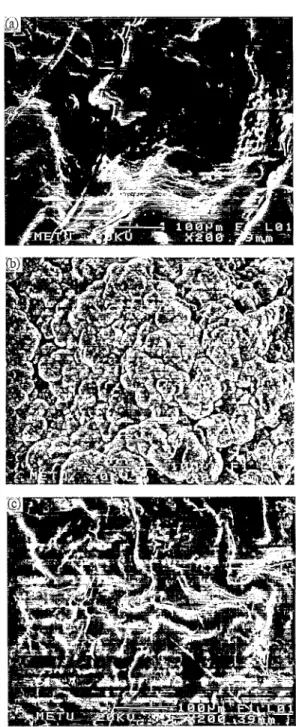
Fig. 1. SEM micrographs of (a) electrode side of composite film (86% PTh + 14% NR), (b) solution side of electrolytic film, and (c) washed film.
S. Yigit et al. /Synthetic Metals 79 (1996) 11-16 13
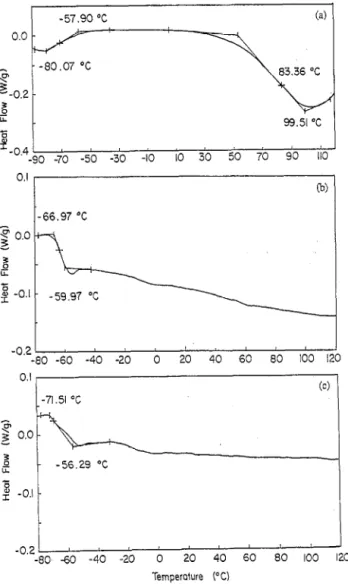
Fig. 2. SEM micrographs of (a) electrode side of composite film (62% PTh+38% SR), (b) solution side of composite film, and (c) washed film. can easily be removed by toluene. No weight losses could be detected and no marked changes were measured in conduc- tivity. This result indicates that a chemical reaction may exist between PTh and rubber. The SEM micrographs of the com- posite blends show that the PTh grows uniformly in the insu- latingrubbers. PTh crests grow out of the surfaceof thecoated electrode toward solution producing a cauliflower-like sur- face. The surface appearances of the films (Figs. 1 and 2) reveal that the electrode and solution sides of the film are quite different, whereas washing after the electrolyses creates no further differences in the surface morphology of the Th film. DSC (Fig. 3) thermograms show that different thermal behaviors exist for NR, SR and the composite films (80% PTh) . The glass transition temperatures of NR and SR are around - 64 and - 69 “C, respectively. DSC of the PTh-SR composite yields two separate transitions around -70 and
83 “C, which are distinctly different from those of SR (Fig. 3 (a) ) . This result is further evidence for a chemical inter- action between PTh and rubbers.
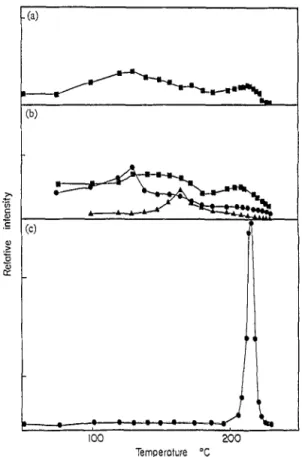
FT-IR spectra (Figs. 4 and 5) reveal that the rubbers are incorporated into the PTh film. Though some changes in the spectra exist, it is not possible to make any suggestions about the possible chemical interactions between the rubbers and conducting polymer using IR data. To get a better understand- ing of the interaction, pyrolysis experiments were carried out. The direct and indirect pyrolysis mass spectra of the composites were compared with those of the corresponding homopolymers. NR and SR show very thermal behavior in accordance with the other thermal analysis data. The principal products from the thermal degradation of these polymers are l-methylcyclopentene and 1-methylcyclohexene under the experimental conditions of direct pyrolysis [ 191. Monomer, dimer, trimer and tetramer peaks are also present in the spec- tra. The decomposition mainly occurs in a narrow tempera- ture range of 213 to 225 “C. Under the same pyrolysis conditions PTh starts to degrade at relatively low temperature ranges (about 150 “C) by evolution of low molecular weight species such as CS and the monomer [ 201. High mass frag-
I - 57.90 T (a)
B
-0.41 ,
-90 -70 -50 -30 -10 IO 30 50 70 90 110 t- 66.97 “C -0.2 1 -00 -60 -40 -20 0 20 40 60 00 100 I: 0.1 Cc) 1 -0.2 / -80, -60 -40 -20 0 20 40 60 00 100 120 Temperature PC)Fig. 3. DSC thermograms of (a) composite film (80% PTh+ 20% SR), (b) natural rubber (NR), and (c) synthetic rubber (SR),
14 S. Yigit et al. /Synthetic Metals 79 (1996) 11-16 t 6 + f 92 . 2 90 - z 88 - 86 - 84 cc) 4000 3500 3000 2x0 2000 1500 loco 500 Wovenumber h-0
Fig. 4. FT-IR spectra of (a) polythiophene (PTh), (b) composite film (80% PTh + 20% NR), and (c) natural rubber (NR)
ments are detected above 200 “C. Thermal decomposition of PTh-NR and PTh-SR occurs over a broader temperature range. It is apparent that thermal stability of the composites is lower. The second and the most important difference is disappearance of the peaks related to NR and SR from the pyrolysis spectra. Furthermore, considerable increase in rel- ative yields of ions at 57 (C,H:) and 174 a.m.u. has been observed: CHz=CHC(CH$ CH
‘15
CH^‘:r-Ym?
(b)
100 3x0 3000 2500 20CC 1500 COO Wavenumber (cm-11Fig. 5. FT-IR spectra of (a) composite film (85% PTh t 15% SR), and (b) synthetic rubber (SR),
loo xx,
Temperoture “C
Fig. 6. Ion temperature profiles from (a) PTh, (b) NR-PTh composite film (82% PTh t 18% NR), and (c) NR recorded during direct pyrolysis: I, 57 a.m.u.; 0, 81 a.m,u.; A, 174 a.m.u. fragments.
S. Yigit et al. /Synthetic Metals 79 (1996) II-16 15
(a)
(b)
200
Temperature OC
Fig. 7. Ion temperature profiles from (a) PTh, (b) SR-PTh composite film (77% PTh+23% SR), and (c) SR recorded during direct pyrolysis: n , 57 a.m.u.; 0, 81 a.m.u.; A, 174 a.m.u. fragments.
-I
In Figs. 6 and 7 ion temperature profiles (variation of rel- ative intensities of ions as a function of temperature) of some characteristic fragments detected during thermal decompo- sition of NR, SR, PTh-NR and PTh-SR composites are given to illustrate the main differences. These results may be directly related to the presence of chemical interaction between the components of the composites. Yet, one can argue that the presence of PTh affects the decomposition of rubber or vice versa. However, other experimental evidence such as degradation of rubber during electrolysis, insolubility of the composites in toluene and thermogravimetric results supports the fact that chemical interaction has taken place.
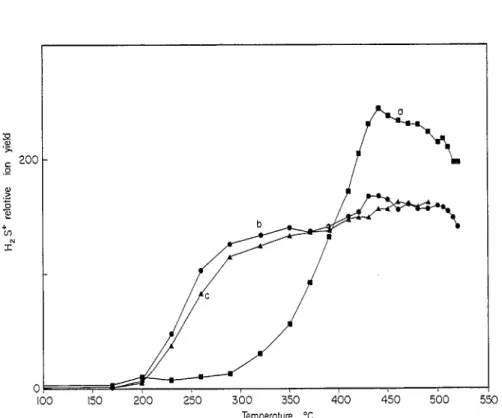
Indirect pyrolysis (evolved gas) mass spectrometric results confirm the existence of the chemical interaction between the two components of the composites. In this method only the stable thermal decomposition products can be detected. The peaks related to the characteristic degrada- tion products of NR and SR such as l-methylcyclopentene and 1-methylcyclohexene almost disappear from the pyrol- ysis mass spectra. It was further noticed that H,S generation is significantly higher in the blends; it starts to appear in the spectra around 200 “C, 1.50 “C lower than the temperature at which H2S formation is observed from the pure PTh [20] (Fig. 8). Last but not the least, the important point to be discussed is the formation of the &Hz fragment at 57 a.m.u. Its formation may be directly related to breaking of the double bonds in NR and SR during polymerization of PTh onto NR- and SR-coated electrodes. Based on the results, the following polymerization mechanism is proposed:
100 150 200 250 300 350 400 450 500 550
Temperature “C
Fig. 8. Ion temperature profiles of H?S from (a) PTh, (b) NR-PTh (82% PTh t 18% NR), and (c) SR-PTh (77% PTh + 23%SR) recorded during indirect pyrolysis.
S. Yigit et al. /Synthetic Metals 79 (1996) 11-16 CH3 -CH2CH2C=CHCH2 CH2 - + ?
‘C
\s
C”3 C’-‘3 -CH2 -C - CHCH2 CH2 - + -CH2 CH2 C + l ‘CHCH2CH2 - --f CH3 -CH$H2C + CH2=CHCH2 6 I sv
A detailed study of the thermal decomposition mechanism and decomposition products of the composites is in progress.
4. Conclusions
In the electrochemical polymerization of Th onto rubber- coated Pt electrodes, composites of PTh and polyisoprene were formed, together with some chain scission leading to the degradation of the rubbers.
Acknowledgements
This work is partially supported by the DPT Research Fund (95K-120 498).
References
I. 11 T.J. Skotheim (ed.), Handbook of Conducting Polyrnem, Marcel Dekker, New York, 1986.
[2] A.F. Diaz, K.K. Kanazawa and G.P. Gardini, J. C/le/n. Sot., C/lern. Cornmun., (1979) 635.
[3] K.K. Kanazawa, A.F. Diaz, W.D. Gill, P.M. Grant, G.B. Street, G.P. Gardini and J.F. Kwak, Synth. Met., 1 (1979/1980) 329.
[4] G. Tourillon and F. Gamier, J, Electroaual. Chem. Intetficial Electrochem., 135 (1982) 173.
[5] H. Lindenberger, D. Schafer-Siebert, S. Roth and H. Hanack, Synth. Met., 18 (1987) 37.
[6] M. Zagorcska, A. Pro& S. Lefrant, Z. Kucharski, J. Suwalski and P. Bemier, Synth. Met., 18 (1987) 43.
[7] R. Quian, J. Qiu and D. Shen, Syrlth. Met., 18 (1987) 13.
[S] D. Braun, D. Moses, C. Zhang and A.J. Heegcr, Syntlr. Met., 5.5-57 (1993) 4145.
[9] Yen Wei, Guang-Way Jang and Chi-Cheung Ghan, J. Polyp. Sci., 28 (1990) 219.
[IO] S. Hotta, S.D.D.V. Rughooputh, A.J. Heeger and F. Wudl, Macromolecules, 20 (1987) 212.
[ 111 Z. Cai and CR. Martin, J. Am. Chem. Sot., 111 (1989) 4143. [ 121 T. Yamamoto, K. Sanechika and A. Yamamoto, J. Polym. Sci., Polyrn.
Lett. Ed., 18 (1980) 9.
[ 131 K. Yoshino, K. Kaneto and Y. Inuishi, @l, J. Appl. Phys., 22 (1983) L157.
[ 141 K. Kaneto, K. Yoshino and Y. Inuishi, Jpn. J. Appl., Phys., 22 (1983) L567.
[ 151 S. Dogan, U. Akbulut, T. Yalcin, S. Suzer and L. Topparc, Synth. Met., 60 (1983) 27.
[ 161 H. Lin Wang and J.E. Fernandez, Macromolecules, 26 (1993) 3336. [ 171 F. Selampinru, U. Akbulut, T. Yalcin, S. Suzer and L. Toppare, Syuth.
Met., 62 (1994) 201.
[ 181 M.M. Fares, J. Hacaloglu and S. Suzer, Eur. Polym. J., 7 (1994) 845. [ 191 J. Hacaloglu, M.M. Fares and S. Suzer, Europ. Polym. J., (1994),
submitted for publication.
[20] F. Vatansever, U. Akbulut, L. Toppare and J. Hacaloglu, Polymer, (1995), accepted for publication.