Effects of Salicylic Acid on the Growth and Some Physiological
Characters in Salt Stressed Wheat (Triticum aestivum L.)
Diğdem KAYDAN1, Mehmet YAĞMUR1 Neşe OKUT1 Geliş Tarihi: 20.11.2006
Abstract: This study was conducted to determine the effects of seed soaking in salicylic acid (10-2 mol/L,
10-4 mol/L, 10-6 mol/L and control) on the growth and some physiological characters in wheat (Triticum aestivum L.) under salinity (8 ds m-1) and non salinity conditions. NaCl reduced the emergence percentage, the growth
parameters (shoot and root dry weight), K+/Na+ ratio, osmotic potential and photosynthetic pigments (Chl a, b
and carotenoids) contents in wheat seedlings. The emergence percentage was not changed, in contrast, shoot and root dry weight of seedlings, K+/Na+ ratio, photosynthetic pigments (Chl a, b and carotenoids) contents and
osmotic potential were increased by salicylic acid treatments under non salinity condition. Seed soaking in SA increased the emergence percentage, osmotic potential, shoot and root dry weight, K+/Na+ ratio, photosynthetic
pigments (Chl a, b and carotenoids) contents in the salinity stressed wheat seedlings. These results were indicated that SA has positive effects on plant growth in salinity and non salinity conditions. But the effects of SA was higher on emergenge percentage, K+/Na+ ratio and osmotic potantial in salinity condition compared to non
salinity condition was obtained in this study.
Key Words: Salicylic acid, salinity, wheat
Salisilik Asitin Tuz Stresindeki Buğdayın (Triticum aestivum L.)
Büyümesi ve Bazı Fizyolojik Özellikleri Üzerine Etkileri
Öz: Bu çalışma tohuma uygulanan salisilik asitin (10-2 mol/L, 10-4 mol/L, 10-6 mol/L ve kontrol) tuzlu (8 ds
m-1) ve tuzsuz koşullarda buğdayın büyümesi ve bazı fizyolojik özellikleri üzerine etkilerini belirlemek için
yürütülmüştür. Tuz buğday fidelerinde çıkış oranı, büyüme değerleri (toprak altı ve toprak üstü kuru ağırlıklar), K+/Na+ oranı, ozmotik potansiyel ve fotosentetik pigment (Klo a, b and karotenoidler) içeriklerini azaltmıştır.
Tuzsuz şartlarda salisilik asit uygulamasının çıkış oranını değiştirmediği, aksine fidelerin toprak altı ve toprak üstü kuru ağırlıkları, K+/Na+ oranı, fotosentetik pigment içerikleri (Klo a, b and karotenoidler) ve ozmotik
potansiyelini arttırmıştır. Tuz stresindeki fidelerde ise salisilik asit uygulaması ile çıkış oranı, ozmotik potansiyel, toprak altı ve toprak üstü kuru ağırlıkları, K+/Na+ oranı ve fotosentetik pigment (Klo a, b and karotenoidler)
içerikleri artmıştır. Bu sonuçlar salisilik asitin tuzlu ve tuzsuz şartlarda bitki büyümesini olumlu yönde etkilediğini göstermektedir. Fakat tuzlu şartlarda salisilik asitin çıkış oranı, K+/Na+ oranı ve ozmotik potansiyele olan
etkilerinin tuzsuz şartlardaki uygulamasına nazaran daha yüksek olduğu belirlenmiştir.
Anahtar Kelimeler: Salisilik asit, tuzluluk, buğday Introduction
Salinity is one of the main problems that negatively affect soil fertility and limit plant production (Richards 1954). Soil salinity affects osmotic stress, decreasing water availability, ionic stress, changes in the cellular ionic balance (Kirst 1989). The effect of salinity were determined at seedling stage of wheat range from reduction in germination percentage, fresh and dry weight of shoots and roots to the uptake of various nutrient ions (Afzal et al. 2005).
Salicylic acid (SA) is recognized as an endogenous signal molecule, mainly involved environmental stress tolerance in plants. Seed soaking 1University of Yüzüncü Yıl, Fac. of Agric., Dept. of Field
Crops, Van-Turkey
have been shown to enhance stand establishment in non saline areas (Khan 1992) and have potential in saline areas as well (Basra et al. 2005). Plants produce proteins in response to abiotic and biotic stress and many of these proteins are induced
Plants produce proteins in response to abiotic and biotic stress and many of these proteins are induced by phytohormones such as ABA (Jin et al. 2000) and salicylic acid (Hoyos and Zhang 2000). SA is synthesized by many plants (Raskin et al. 1990) and is accumulated in the plant tissues under the impact of unfavorable abiotic factors, contributing to the increase
of plants resistance to salinization (Ding et al. 2002, Kang and Saltveit 2002). In addition, SA-induced increase in the resistance of wheat seedlings to salinity (Shakirova and Bezrukova 1997). Thus the detrimental effects of high salts on the early growth of wheat seedlings may be alleiveted by treating seeds with the proper concentration of a suitable hormone (Darra et al. 1973).
The aim of the present work was to study the character of the changes induced by SA in the growth of wheat plants under salinity and non salinity conditions.
Materials and Methods
The pot trial was conducted in greenhouse during October-November 2004 with using a complete randomized design containing of non salinity and sodium chloride (NaCl) (0 and 8 ds m-1) (Rhoades et al. 1992) and four SA, (S0:0 mol/L, S1:10-6 mol/L, S2:10-4 mol/L, S3:10-2 mol/L) with 3 replications. The seeds of local variety, Tir, were used as experimental material. In this study home bred, Tir, line was selected as the test plant because of the current concern for high yielding in Van Region. Seeds were surface sterilized then rinsed with sterilized water and air-dried.
Salicylic acid was dissolved in distilled water and the pH was adjusted at 6.5 with NaOH. The seeds were soaked with different SA levels for 12 h in the dark at 22 oC.
Soil Description: The soil samples were air dried and sieved (< 2 mm stainless steel mesh) before determination of chemical properties. The soil samples used in the pots were dried, powdered and mixed thoroughly. The texture of the soil based on sand clay silt, total oganic matter 2.1 %, total salt 0.025 %, pH 7.50, total nitrogen 0.8 %, available phosphorus 15.8 mg P kg-1 dry soil, exchangeable potassium 150.5 mg K kg-1 dry soil.
Each plastic pot (14 x 17 cm) with the closed bottom end was filled-up with 2 kg air-dried soil and kept inside glass greenhouse under natural light. Soil was allowed to equilibrate in the greenhouse for 1 week before sowing the seeds. All pots were fertilized with 100 mgNkg-1 (AS) and 100 mgPkg-1 (TSP). The respective amount of SA was soaked with the seed before sowing. Pre-soaked ten seeds were sown in each pot. The seedlings were irrigated with non salinized tap water every 2-3 days, maintaining the soil moisture content at 15 % (w/w) by weighing. The pots were randomly arranged in a greenhouse and
rearranged several times during the growth period. Samples were collected after 21 days of emergence. After harvest, the seedlings were separated into shoots and roots, and rinsed thoroughly with deionized water. The dry weight (DW) of shoots and roots were recorded after dried at 70 oC for 48 h (Bray 1963).
The determining of leaf osmolality, extracts were prepared from leaves by using Jones and Turner’s (1978) method. The osmolality (-MPa) was determined by using a Vapour–pressure osmometer (Vapro Osmometer).
Chlorophyll Extraction and Measurement: Chlorophyll concentration was determined from fully expanded leaves. A leaf sample of 0.1 g was ground and extracted with 5 mL of 80% (v/v) acetone in the dark (Arnon 1949). The mixture was filtered and absorbancies (Jenway 6105 UV/VIS, Spectrophotometer) were determined at 645, 663 and 450 nm. Concentration of chlorophyll a (Chl a), chlorophyll b (Chl b) and carotenoids were estimated by the equations of Witham et al. (1971).
Extraction and measurement of K+/Na+ ratio: Dried plant samples were finely ground in a stainless steel miller. Shoot samples were wet digested with a HNO3 and HClO4 acid mixture and analyzed by a flame photometer (SOLAAR AA Series, Thermo Electron Corporation).
The data were statistically analyzed by COSTAT and MSTATc computer programme and comparative analyses of the means were performed by LSD.
Results and Discussion
Emergence percentage: Variance analysis results of emergence percentage are shown in Table 1. According to Table 1, salt (P<0.01) and salicylic acid (P<0.05) affected emergence percentage significantly. In addition, an interaction was obtained between salicylic acid and salt significantly (P<0.05). Emergence percentage was reduced by salinity compared to non salinity condition. Increasing of SA levels caused increases in emergence under salinity condition. But under non salinity condition, emergence percentage was not affected by SA levels. On the contrary, emergence percentages were drastically increased by SA under salinity conditions compared to non treatment of SA. (Figure 1). The seeds pretreated with S3 exhibited higher emergence percentage than untreated seeds. Shakirova et al. (2003), El-Tayeb (2005) and Afzal (2005) observed that SA treatment increases emergence percentage under salinity conditions.
Table 1. Summary of variance analysis
M S
Source df Emergence
Percentage Shoot Dry Weight Root Dry Weight Chl a Chl b Carotenoids K
+/Na+
Ratio Potential Osmotic
Main Effects Salicylic Acid 3 147.16* 213.98** 115.36** 6.640** 2.633** 3.283** 0.493** 0.082** Salt 1 3901.50** 2626.08** 555.84** 54.77** 1.966** 3.944** 4.690** 0.277** Interaction SAXSalt 3 96.05* 0.293 17.318 0.500 0.195 0.156 0.183** 0.238** Error 16 29.41 18.63 18.603 0.223 0.162 0.173 0.021 0.005 Total 23 **P<0.01, *P<0.05 0 10 20 30 40 50 60 70 80 90 100 E m er ge nce pe rc ent age ( % ) -Salt +Salt S0 S1 S2 S3
Figure 1. Effects of SA on emergence percentage under
salinity and non salinity
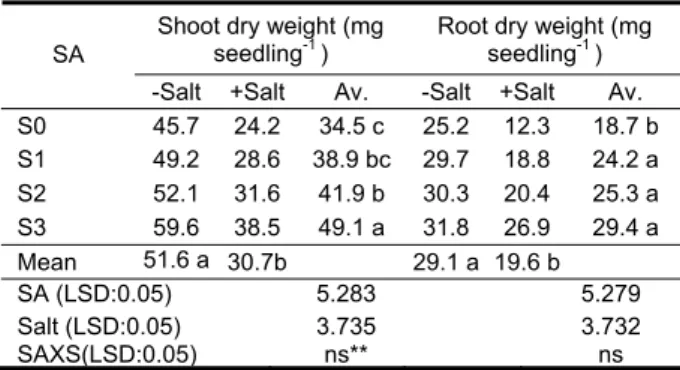
Table 2. Effects of salicylic acid on the growth parameters of wheat
Shoot dry weight (mg
seedling-1 ) Root dry weight (mg seedling-1 )
SA
-Salt +Salt Av. -Salt +Salt Av. S0 45.7 24.2 34.5 c 25.2 12.3 18.7 b S1 49.2 28.6 38.9 bc 29.7 18.8 24.2 a S2 52.1 31.6 41.9 b 30.3 20.4 25.3 a S3 59.6 38.5 49.1 a 31.8 26.9 29.4 a Mean 51.6 a 30.7b 29.1 a 19.6 b SA (LSD:0.05) 5.283 5.279 Salt (LSD:0.05) 3.735 3.732 SAXS(LSD:0.05) ns** ns
*The same letters are not statistically significant in columns (p<0.05); **ns, non significant
Shoot dry weight and root dry weight: Variance analysis results of shoot dry weight and root dry weight are shown in Table 1. According to Table 1, salt (P<0.01) and salicylic acid (P<0.01) influenced shoot dry weight and root dry weight significantly.
Dry weights of shoot and roots decreased drastically under salinity condition compared with non salinity condition. These results are similar to those reported by and Afzal (2005) who found that dry weight was reduced by salt stress in wheat. Dry weights of seedlings was decreased due to salinity stress but
seedlings raised from seeds primed with SA improved dry weight of seedlings as compared to non treatment of SA under non salinity and salinity conditions (Table 2). Maximum shoot and root dry weights were recorded in seedlings raised from seeds primed with S3 treatments. Salt tolerance was increased in seeds subjected to S3 level of SA as indicated by shoot and dry weight. This may indicate that, treatment of seed with SA exhibited an significant increase in salt tolerance. These results was similar to the studies of El-Tayeb (2005) reported that SA pretreatment increased dry weight in the stressed barley seedlings. In an another work Gutierrez Coronado et al. (1998), observed significant effect of SA on soybean increaeses in shoot growth, root growth and plant height. Khodary (2004) who reported that SA increased the fresh and dry weight of shoot and roots of salt stressed maize plants.
Photosynthetic pigments (chlorophyll a, b and carotenoids) contents: Variance analysis results of photosynthetic pigments (chlorophyll a, b and carotenoids) are shown in Table 1. According to Table 1, salt (P<0.01) and salicylic acid (P<0.01) affected photosynthetic pigments (chlorophyll a, b and carotenoids) significantly.
Under the influence of salinty the photosynthetic pigments greatly decreased. Dela-Rosa and Maiti (1995), observed that chlorophyll biosynthesis decreased salt conditions of sorghum plants. El-Tayeb (2005) found that Chl a, b and carotenoids decreased significantly in NaCl treated plants in comparison to controls of barley plants.
SA treatments were increased pigments content of the plants under non salinity and salinity condition (Table 3). In bean plants, foliar spray with saliciylic acid, increased Chl a, b and carotenoids under normal field conditions (Türkyılmaz et al. 2005). Pancheva et al. (1996), showed that long-term treatment (7 days) of barley seedlings with SA decreased the rate of
Table 3. Effects of salicylic acid on photosynthetic pigment contents of wheat
Chl a (mg g-1 fresh weight) Chl b (mg g-1 fresh weight) Carotenoids (mg g-1 fresh weight)
SA
-Salt +Salt Average -Salt +Salt Average -Salt +Salt Average S0 10.29 7.10 8.19 c * 4.03 3.31 3.67 c 2.02 1.31 1.66 c S1 10.30 7.20 8.75 c 4.13 4.07 4.10 bc 2.49 2.02 2.25 b S2 11.14 7.85 9.49 b 4.88 4.27 4.57 b 2.83 2.00 2.42 b S3 12.38 8.88 10.63 a 5.66 4.77 5.21 a 4.06 2.82 3.44 a Meann 10.78 a 7.75 b 4.67 a 4.10 b 2.85 a 2.04 b Salysilic Acid (LSD:0.05) 0.578 0.493 0.510 Salt (LSD:0.05) 0.409 0.348 0.360 SAXSalt (LSD:0.05) ns** Ns ns
*The same letters are not statistically significant in columns (p<0.05); **ns, non significant photosynthesis (chlorophyll content) whereas
short-term treatment (2 hours) did not effect chlorophyll content as compared with unterated control plants. Zhou et al. (1999) reported that photosynthetic pigments were increased in corn with SA application. Moreover, Khan et al. (2003) showed that SA increased photosynthetic rate in corn and soybean.
The seeds pretreated with 10-2 mol/L SA solution exhibited higher chlorophyll content. These results are in agreement with those obtained by other author, showing that SA significantly inreased the pigment content under salt stress (El-Tayeb 2005)
Shoot K+/Na+ ratio: Variance analysis results of shoot K+/Na+ ratio are shown in Table 1. According to Table 1, salt (P<0.01) and salicylic acid (P<0.01) affected shoot K+/Na+ ratio significantly. In addition, an interaction was obtained between salicylic acid and salt significantly (P<0.01).
Salinity reduced K+/Na+ ratio in the shoots compared to non salinity condition. Salt stress induced decrease in the K+/Na+ ratio is inimical to cellular biochemical processes. In addition to this, potassium provides necessary osmotic potential for water uptake by plant cells (Claussen et al. 1997). Thus, K+ uptake is pivotal for cell turgor and maintenance of biochemical processes under salinity. In plants, Na+ competes with K+ uptaken under salinity conditions (Chinnusamy and Zhu 2003). Previous studies have shown that high K+/Na+ ratio show a positive relationship with salt tolerance (Ashraf et al. 1997).
0 0,3 0,6 0,9 1,2 1,5 1,8 2,1 K/ N a r at io -Salt +Salt So S1 S2 S3
Figure 2. Effects of SA on K+/Na+ under salinity and non
salinity conditions
SA treatments increased K+/Na+ ratio in the plant shoots under salinity condition. However K+/Na+ ratio was the highest in 10-2 mol/L seed applied SA (Figure 2). Hamada and Al-Hakimi (2001), observed positive effects of SA in the Na, K, Ca and Mg content of wheat plants grown under salinity. SA application inhibited Na accumulation in salinity condition. This main indicate that, seed pretreatment with SA induced a reduction sodium absorption and toxicity, which is further reflected in low membranes injury, high water content and dry matter production (El-Tayeb 2005). Also SA incrases K+ concentrations of plants under salinity condition. Günes et al (2005) found SA treatments stimulated N accumulation in plants. And P, K, Mg and Mn concentrations of SA received plants were increased in the stress conditions.
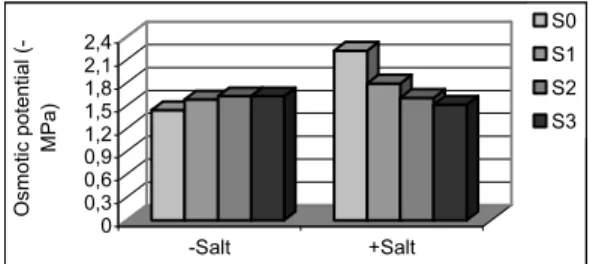
Osmotic potential: Variance analysis results of osmotic potential are shown in Table 1. According to Table 1, salt (P<0.01) and salicylic acid (P<0.01) affected osmotic potential significantly. In addition, an interaction was obtained between salicylic acid and salt significantly (P<0.01).
The osmotic potential was decreased by the influence of salinity stress. Osmotic potential was increased by application of SA levels. The highest osmotic potential was obtained by the seeds pretreated with 10-2 mol/L SA solution. Comparing to effect of four different SA concentrations during osmotic potential, that SA application was more effective at 10-2 mol/L than the others. The effects of SA was higher on osmotic potantial in salinity condition compared to non salinity condition was obtained in this study (Figure 3). Chinnusamy and Zhu (2003) have suggested that plant survival depends on maintaining a positive turgor, which is indispensable for expansion growth of cells and stomatal opening. A decrease in water availability under soil salinity causes osmotic stress, which leads to decreased turgor. Szepesi et al. (2005) reported that salinity reduced osmotic potential but the SA pretreatments increased it.
0 0,3 0,6 0,9 1,2 1,5 1,8 2,1 2,4 Os moti c po te nti al ( -MP a) -Salt +Salt S0 S1 S2 S3
Figure 3. Effects of SA on osmotic potential (-MPa) under salinity and non salinityconditions
Conclusion
The effects of SA is higher on emergenge percentage, K+/Na+ ratio and osmotic potential in salinity condition compared to non salinity condition. The highest effects on plant growth and some physiological characters in wheat was obtained level of SA with 10-2 mol/L. In conclusion, data presented indicate that the presowing seed treatment of SA in regulating stress response of wheat, and suggest that SA could be used as a potential growth regulator to improve plant growth under salinity conditions.
References
Afzal, I., M. Shahzad, B.N. Ahmad and M.F. Ahmad. 2005. Optimization of hormonal priming techniques for alleviation of salinity stress in wheat (Triticum aestıvum L.) .Caderno de Pesquisa Ser. Bio., Santa Cruz do Sul. 17: 95-109.
Arnon, D. I. 1949. Copper enzymes in isolated chloroplasts. Polyphenoloxidase in Beta vulgaris. Plant Physiology 24, 1–10.
Ashraf, M., K., Aasiya and A. Khanum. 1997. Relationship between ion accumulation and growth in two spring wheat lines differing in salt tolerance at different growth stages. J. Agronomy and Crop Science 178:39-51. Basra, S.M.A., I. Afzal, R.A. Rashid and A. Hameed. 2005.
Inducing salt tolerance in wheat by seed vigor enhancement techniques. International Journal Biotechnology and Biology 1:173-179.
Bray, J.R. 1963. Root production and the estimation of net productivity. Can. J. Bot. 41:65-72.
Chinnusamy, V. and J.K. Zhu. 2003. Topics in current genetics. In: H. Hirt, K. Shinozaki (Eds.): Plant stress responses to abiotic stres. Springer-Verlag Berlin Heidelberg: 4.
Claussen, M., Luthen, H., Blatt, M. and M. Bottger. 1997. Auxin induced growth and its linkage to potassium channels. Planta 201:227-234.
Darra, B.L., S.P. Seth, H. Sinhg and R.S. Mendiratta. 1973. Effect of hormone-directed presoaking on emergence and growth of osmotically stressed wheat (Triticum aestivum L.). Agronomy Journal 65: 292-295.
Dela-Rosa, I.M. and R.K. Maiti. 1995. Biochemical mechanism in glossy sorghum lines for resistance to salinity stress. J. Plant Physiol. 1469 and environmental stress in Phytochemical ecology: allelochemicals. In: Chou C.H. and G.R. Walter (eds), Mycotoxins and Insect Pheromones and Allelomones. Taiwan, Academia Sinica Monograph Series 9: 101–118.
Ding, C.K., C.Y. Wang, K.C. Gross and D.L. Smith. 2002. Jasmonate and salicylate induce expression of pathogenesis-related protein genes and increase resistance to chilling injury in tomato fruit. Planta 214: 895-901.
El-Tayeb, M. A. 2005. Response of barley grains to the interactive effect of salinity and salicylic acid. Plant Growth Regulation 45:215–224.
Güneş, A. , A. İnal, M. Alpaslan, N. Çiçek, E. Güneri, F. Eraslan, and T. Güzelordu. 2005. Effects of exogenously applied salicylic acid on the induction of multiple stress tolerance and mineral nutrition in maize (Zea mays L.) Archives of Agronomy and Soil Science 51(6): 687 – 695.
Gutierrez–Coronado, M.A., C. Trejo-Lopez and A. Larque Saavedra. 1998. Effects of salicylic acid on growth of roots and shoots in soybean. Plant Physio. Biochem. 36: 653–665.
Hamada, A.M. and A.M.A. Al-Hakimi. 2001. Salicylic acid versus salinity-drought-induced stress on wheat seedlings. Rostlinna Vyroba 47 (10): 444-450.
Hoyos, M. E. and S.Q. Zhang. 2000. Calcium-independent activation of salicylic acid- indcued protein kinase and a 40-kilodalton protein kinase by hyperosmotic stress. Plant Physiology 122: 1355-1363.
Jin, S., C.C.S. Chen and A.L. Plant. 2000. Regulation by ABA of osmotic stress induced changes in protein synthesis in tomato roots. Plant Cell and Environment 23:51-60. Jones, M.M.N. and C. Turner. 1978. Osmotic adjustment in
leaves of Sorghum in response to water deficits. Plant Physiol. 61:122–126.
Kang, H.M. and M.E. Saltveit. 2002. Chilling tolerance of maize, cucumber and rice seedling leaves and roots are differentially affected by salicylic acid. Physiol. Plant 115: 571–576.
Khan, A.A. 1992. Preplant physiological seed conditioning. Horticultural Review 14:131-181.
Khan W., P. Balakrishnan and D.L. Smith. 2003. Photosynthetic responses of corn and soybean to foliar application of salicylates. Journal of Plant Physiology 160 (5): 485-492.
Khodary, S.E.A. 2004. Effect of salicylic acid on the growth, photosynthesis and carbohydrate metabolism in salt-stressed maize plants. International Journal of Agriculture and Biology 6: 5-8.
Kirst, G.O. 1989. Salinity tolerance of eu-karyotic marine algae. Ann. Rev. Plant Physiol., Plant Mol. Biol. 40: 21-53.
Pancheva, T.V., L.P. Popova and A.L. Uzunova. 1996. Effects of salicylic acid on growth and photosynthesis in barley plants. J. Plant Physiol. 149: 57-63.
Raskin, I., H. Skubatz, W. Tang and B.J.D. Mense. 1990. Salicylic acid levels in thermogenic and non-thermogenic plants. Annals of Botany 66: 376-373. Richards, L.A. 1954. Origin and nature of saline and alkali
soils. pp, 1-6. In: Diagnosis and improvement of saline and alkali soils. Agricultural Handbook No: 60, USDA, Washigton, D.C., USA.
Rhoades, J.D., A. Kandiah and A.M. Mashali. 1992. The use of saline waters for crop production. FAO Irrigation and Drainage Paper No.48, 133 pp, Rome.
Shakirova, F.M. and M.V. Bezrukova. 1997. Induction of wheat resistance against environmental salinization by salicylic acid. Biol. Bull. (Izv. Russ. Acad. Sci.) 24:109– 112.
Shakirova, F.M., A.R. Sakhabutdinova, M.V. Bezrukova, R.A. Fatkhutdinova and D.R. Fatkhutdinova. 2003. Changes in the hormonal status of wheat seedlings induced by salicylic acid and salinity. Plant Sci. 164: 317–322. Szepesi, A., J. Csiszar, S. Bajkan, K. Gemes, V. Horvath, L.
Erdei, A.K. Deer, M. Simon and I. Tari. 2005. Role of salicylic acid pre-treatment on the acclimation of tomato plants to salt- and osmotic stress. Proceedings of the 8th Hungarian Congress on Plant Physiology and the 6th Hungarian Conference on Photosynthesis 49(1-2):123-125, Acta Biologica Szegediensis.
Türkyılmaz, B., L.Y. Aktaş and A. Güven. 2005. Salicylic acid induced some biochemical and physiological changes in Phaseolus vulgaris L. Science and Engineering Journal of Firat Univ. 17(2): 319-326.
Witham, F.H., D.R. .Blaydes and R.M. Devlin. 1971. Experiments in plant Physiology. Van Nostrand Reinhold, New York.1-11.
Zhou X.M., A.F. MacKenzie, C.A. Madramootoo and D.L. Smith. 1999. Effects of stem-injected plant growth regulator, with or without sucrose, on grain production, biomass and photosynthetic activity of field-grown corn plants. J. Agronomy and Crop Science 183: 103-110.
İletişim Adresi:
Diğdem KAYDAN
University of Yüzüncü Yıl, Fac. of Agric., Dept of Field Crops, Van-Turkey, Corresponding: