Abstract.
Background: The RNASEL G1385A variant was
recently found to be implicated in the development of prostate
cancer. Considering the function of RNase L and the
pleiotropic effects of mutations associated with cancer, we
sought to investigate whether the RNASEL G1385A variant is
a risk factor for breast cancer. Patients and Methods: A total of
453 breast cancer patients and 382 age- and sex-matched
controls from Greece and Turkey were analyzed. Genotyping
for the RNASEL G1385A variant was performed using an
Amplification Refractory Mutation System (ARMS). Results:
Statistical evaluation of the RNASEL G1385A genotype
distribution among breast cancer patients and controls revealed
no significant association between the presence of the risk
genotype and the occurrence of breast cancer. Conclusion:
Although an increasing number of studies report an association
between the RNASEL G1385A variant and prostate cancer
risk, this variant does not appear to be implicated in the
development of breast cancer.
RNASEL (MIM# 180435) encodes for the ubiquitously
expressed ribonuclease L (RNase L) that mediates antiviral
and pro-apoptotic activities of the 2-5A system (1). The
RNASEL Arg462Gln (G1385A) variant, which has three
times less enzymatic activity than the wild-type, was
recently found to be implicated in up to 13% of prostate
cancer cases (2, 3). Furthermore, germ-line RNASEL
mutations segregating with disease within hereditary
prostate cancer (HPC) families and loss of heterozygosity
(LOH) involving the RNASEL locus in tumor tissues has
been observed (4). RNase L has been proposed to suppress
the development of prostate cancer through its ability to
degrade RNA and initiate a cellular stress response that
leads to apoptosis (1). By fluorescence in situ hybridization,
RNASEL was assigned to 1q25 (5). Cytogenetic studies
have shown that one of the most frequently observed
karyotypic changes seen in breast cancer involve the long
arm of chromosome 1. Analysis of polymorphic DNA
markers to search for allelic losses at this chromosome
region suggested that inactivation of a gene(s) located on
1q23-32, which encompasses the RNASEL locus, might
contribute to the genesis of breast cancer (6). Breast cancer
is a polygenic disorder and inherited mutations have been
observed in BRCA1, BRCA2, ATM, p53 and CHEK2 genes
(7). Interestingly, germ-line mutations in CHEK2
(checkpoint kinase 2, a ubiquitously expressed protein
2547
Correspondence to: Tayfun Özçelik, Department of Molecular Biology and Genetics, Bilkent University, Bilkent – Ankara 06800, Turkey. Fax: +90-312-266-5097, e-mail: [email protected] Key Words: RNASEL, breast cancer.
A
NTICANCERR
ESEARCH 24: 2547-2550 (2004)Lack of Association Between RNASEL Arg462Gln
Variant and the Risk of Breast Cancer
AKIN SEVINÇ
1, DRAKOULIS YANNOUKAKOS
2, IRENE KONSTANTOPOULOU
2, ESRA MANGUOGLU
3,
GÜVEN LÜLECI
3, TANER ÇOLAK
3, CEMALIYE AKYERLI
1, GÜLSEN ÇOLAKOGLU
1, MESUT TEZ
4,
ISKENDER SAYEK
5, GERASSIMOS VOUTSINAS
6, GEORGE NASIOULAS
6, EIRENE PAPADOPOULOU
7,
LINA FLORENTIN
8, ELENA KONTOGIANNI
9, BETÜL BOZKURT
10, NESLIHAN AYGÜN KOCABAS
11,
ALI ESAT KARAKAYA
11, ISIK G. YULUG
1and TAYFUN ÖZÇELIK
1,121
Department of Molecular Biology and Genetics, Bilkent University, Ankara, Turkey;
2
Molecular Diagnostics Laboratory, I/R-RP, National Center for Scientific Research Demokritos, Athens, Greece;
3Departments of Medical Biology and Genetics, and Surgery, Faculty of Medicine, Akdeniz University, Antalya;
4
Atatürk Chest Disease Research Hospital, Ankara;
5
Department of Surgery, Faculty of Medicine, Hacettepe University, Ankara, Turkey;
6Institute of Biology, National Center for Scientific Research Demokritos, Athens;
7Molecular Biology Research Center "HYGEIA" - "Antonis Papayiannis", Athens;
8
Alfalab, Molecular Biology and Cytogenetics Center, Athens;
9IVF & Genetics, Athens, Greece;
10
Department of Surgery, Ankara Numune Research and Teaching Hospital, Ankara;
11Department of Pharmaceutical Toxicology, Faculty of Pharmacy, Gazi University, Ankara;
12
Ayhan Sahenk Foundation, Istanbul, Turkey
kinase) were found to be associated with prostate cancer
risk as well (8). Based on the chromosomal localization and
function of RNASEL, and pleiotropic effects of
cancer-associated mutations as exemplified by CHEK2 in both
breast and prostate cancers or BRCA1 in breast and
ovarian cancers, we sought to investigate the hypothesis
that the Arg462Gln variant of this gene is associated with
breast cancer risk.
Patients and Methods
Peripheral blood samples were collected from 152 Greek and 301 Turkish breast cancer patients (invasive breast carcinoma, mean age: 49.65, standard deviation: 12.95, age range: 20-86). They were divided into two groups as premenopausal (n= 203; mean age: 40.29, standard deviation: 7.82, age range: 20-58), and postmenopausal (n=250; mean age: 57.40, standard deviation: 11.15, age range: 31-86). At the time of blood donation, each individual completed a standardized questionnaire that included information about age and menopausal status (Greece); and age, menopausal status, age at menarche, age at full term pregnancy, number of full term pregnancies, family history of breast cancer, smoking history and height and weight (Turkey). Histopathology of the tumor was obtained through medical records. The age-matched control group comprised 164 Greek and 218 Turkish apparently healthy women with no history of
cancer. They were also divided into two groups as premenopausal (n=180; mean age: 37.91, standard deviation: 8.05, age range: 15-52) and postmenopausal (n=202; mean age: 58.55, standard deviation: 9.77, age range: 30-88). Informed consent was obtained from all subjects.
DNA was extracted from peripheral blood and the RNASEL G1385A mutation was detected using the Amplification Refractory Mutation System (ARMS) (2). Genotyping was performed and confirmed by two independent researchers. The association between the G1385A genotype and incidence of breast cancer was evaluated statistically using binary logistic regression (SPSS 9.0.0).
Results and Discussion
The RNASEL Arg462Gln variant was analyzed in 453
female breast cancer patients and 382 age- and
sex-matched controls. The combined Greek and Turkish
population allele frequencies of the A allele was 0.334
and 0.359 for cases and controls, respectively. Although
the A allele frequency was slightly different between the
two populations (cases: 0.385 and controls: 0.442 Greek;
and cases: 0.309 and controls: 0.298 Turkish), the
genotype distributions in the control groups were in
Hardy-Weinberg equilibrium in both populations. Our
study showed that there is no significant association
A
NTICANCERR
ESEARCH 24: 2547-2550 (2004)2548
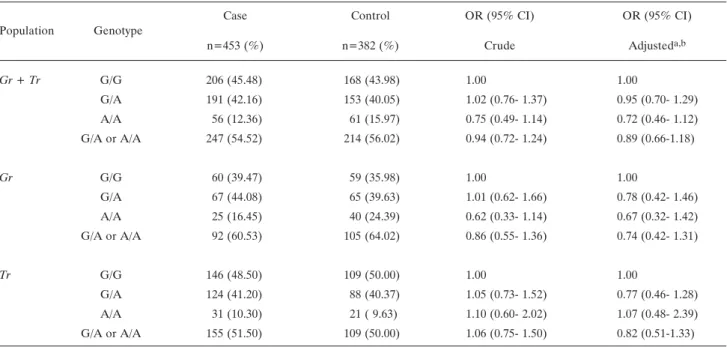
Table I. Distribution of RNASEL G1385A genotypes and breast cancer risk in the age-matched controls and breast cancer patients.
Case Control OR (95% CI) OR (95% CI)
Population Genotype
n=453 (%) n=382 (%) Crude Adjusteda,b
Gr + Tr G/G 206 (45.48) 168 (43.98) 1.00 1.00 G/A 191 (42.16) 153 (40.05) 1.02 (0.76- 1.37) 0.95 (0.70- 1.29) A/A 56 (12.36) 61 (15.97) 0.75 (0.49- 1.14) 0.72 (0.46- 1.12) G/A or A/A 247 (54.52) 214 (56.02) 0.94 (0.72- 1.24) 0.89 (0.66-1.18) Gr G/G 60 (39.47) 59 (35.98) 1.00 1.00 G/A 67 (44.08) 65 (39.63) 1.01 (0.62- 1.66) 0.78 (0.42- 1.46) A/A 25 (16.45) 40 (24.39) 0.62 (0.33- 1.14) 0.67 (0.32- 1.42) G/A or A/A 92 (60.53) 105 (64.02) 0.86 (0.55- 1.36) 0.74 (0.42- 1.31) Tr G/G 146 (48.50) 109 (50.00) 1.00 1.00 G/A 124 (41.20) 88 (40.37) 1.05 (0.73- 1.52) 0.77 (0.46- 1.28) A/A 31 (10.30) 21 ( 9.63) 1.10 (0.60- 2.02) 1.07 (0.48- 2.39) G/A or A/A 155 (51.50) 109 (50.00) 1.06 (0.75- 1.50) 0.82 (0.51-1.33) Gr: Greek, Tr: Turkish populations. OR: Odds Ratio, CI: Confidence Interval. ORs and 95% CIs were calculated using binary logistic regression. Adjusted for aage and menopausal status (Gr, Gr+Tr) and bsmoking status, body mass index, age at menarche, age of 1st pregnancy, number of
between RNASEL G1385A mutation and breast cancer
risk (t-test, p=0.66) (Table I). Stratification of the data
according to age and menopausal status in the Greek
population; age, menopausal status, smoking status, body
mass index, age at menarche, age of first pregnancy,
number of children, family history of breast cancer in the
Turkish population; or age and menopausal status in both
populations combined, did not change the results.
Inclusion of two different Eastern Mediterranean
populations and a fairly large number of cases and
controls makes this study relatively strong. Given the
sample size and allele frequencies, the study has a power
of 90% to confirm an odds ratio as low as OR = 1.6 at a
significance level of · = 0.05.
In conclusion, our study suggests no significant
association between the RNASEL G1385A variant and
breast cancer risk in the Greek and Turkish populations.
These results may need to be further corroborated by other
investigations and in different populations since this is the
first study reporting on the association of the RNASEL
G1385A variant and breast cancer.
Acknowledgements
We gratefully acknowledge Dr. Atilla Halil Elhan for help in statistical analyses. All experiments were performed in accordance with Greek and Turkish laws and regulations.
Grant sponsors: The Scientific and Technical Research Council of Turkey (TÜBITAK-GSRT-11), Bilkent University, Turkey, the Greek General Secretary for Research and Technology (97EKBAN2-1.2-112) and the Stavros Niarchos Foundation for Charity, Greece.
References
1 Silverman RH: Implications for RNase L in prostate cancer biology. Biochem 42: 1805-1812, 2003.
2 Casey G, Neville PJ, Plummer SJ, Xiang Y, Krumroy LM, Klein EA, Catalona WJ, Nupponen N, Carpten JD, Trent JM, Silverman RH and Witte JS: RNASEL Arg462Gln variant is implicated in up to 13% of prostate cancer cases. Nature Genet 32: 581-583, 2002.
3 Nakazato H, Suzuki K, Matsui H, Ohtake N, Nakata S and Yamanaka H: Role of genetic polymorphisms of the RNASEL gene on familial prostate cancer risk in a Japanese population. Br J Cancer 89: 691-696, 2003.
4 Carpten J, Nupponen N, Isaacs S, Sood R, Robbins C, Xu J, Faruque M, Moses T, Ewing C, Gillanders E, Hu P, Bujnovszky P et al: Germline mutations in the ribonuclease L gene in families showing linkage with HPC1. Nature Genet 30: 181-184, 2002. 5 Squire J, Zhou A, Hassel BA, Nie H and Silverman RH:
Localization of the interferon-induced, 2-5A-dependent RNase gene (RNS4) to human chromosome 1q25. Genomics 19: 174-175, 1994.
6 Chen LC, Dollbaum C and Smith HS: Loss of heterozygosity on chromosome 1q in human breast cancer. Proc Natl Acad Sci USA 86: 7204-7207, 1989.
7 Balmain A and Ponder B: The genetics and genomics of cancer. Nature Genet 33: 238-244, 2003.
8 Dong X, Wang L, Taniguchi K, Wang X, Cunningham JM, McDonnel SK, Qian C, Marks AF, Slager SL, Peterson BJ, Smith DI, Cheville JC et al: Mutations in CHEK2 associated with prostate cancer risk. Am J Hum Genet 72: 270-280, 2003.