© TÜBİTAK
E-mail: [email protected] doi:10.3906/sag-1008-1
Development and validation of the Turkish version of the
MNREAD visual acuity charts*
Şefay Aysun İDİL1, Deniz ÇALIŞKAN2, Namık Barış İDİL3
Aim: To design and validate a Turkish version of the MNREAD acuity charts.
Materials and methods: A vocabulary was created using high-frequency words that appear in Turkish schoolbooks used by 8-year-old children in the third grade. In total, 125 sentences were generated. Th e sentences were read by 2 groups (20 adults and 20 primary school students), and reading time and verbal mistakes were recorded. Th ereaft er, persistent verbal mistakes and sentences with extreme high and low mean reading speeds were excluded. Finally, the validity of the participants’ reading speed as measured with the MNREAD Turkish version was determined by comparing it to their reading speed for daily reading tasks.
Results: Reading speed for text of 1.6 M print size (logMAR 0.6) was 185.10 ± 20.46 words/min, reading speed for text of 1 M print size (logMAR 0.4) was 185.45 ± 27.27 words/min, and the maximum reading speeds calculated using the MNREAD Turkish version were 191.50 ± 32.19 words/min for chart 1 and 190.55 ± 27.35 words/min for chart 2. As expected, correlations were observed between chart 1 and chart 2 (r = 0.88, P < 0.01), between chart 1 and logMAR 0.6 text (r = 0.74, P < 0.01), between chart 1 and logMAR 0.4 text (r = 0.67, P < 0.01), between chart 2 and logMAR 0.6 text (r = 0.63, P < 0.01), and between chart 2 and logMAR 0.4 text (r = 0.59, P < 0.01).
Conclusion: Th e MNREAD Turkish version was tested using persons with normal vision and results were obtained from similar groups using daily reading material. Th e MNREAD acuity charts are logarithmic and continuous-text reading acuity charts for people in Turkey with normal and low vision.
Key words: MNREAD acuity chart, validation, vision test, visual acuity, low vision
MNREAD görme keskinliği kartlarının Türkçe versiyonunun
geliştirilmesi ve validasyonuk
Amaç: MNREAD (Minnesota Low Vision Reading Test) yakın keskinlik kartlarının Türkçe versiyonun geliştirilmesi ve validasyonudur.
Yöntem ve gereç: Kelimeler, İlköğretim (3.sınıf) Türkçe kitabındaki sıklık dağılımına göre belirlenmiştir. Toplam 125 cümle oluşturulmuştur. Cümleler 20 erişkin, 20 ilköğretim öğrencisinden oluşan 2 grupta standart koşullarda okutularak, okuma zamanı, hatalı ve atlanan kelimeler belirlenmiştir. Israrla hata yapılan kelimelerin olduğu ve ortalama okuma hızından 1 standart sapmadan fazla sapma gösteren cümleler elenmiştir. MNREAD kartlarının validitesi günlük okuma materyalleri ile kıyaslanarak değerlendirilmiştir.
Original Article
Received: 02.08.2010 – Accepted: 21.09.2010
1 Department of Public Health, Low Vision Rehabilitation and Research Center, Faculty of Medicine, Ankara University, Ankara - TURKEY 2 Department of Public Health, Faculty of Medicine, Ankara University, Ankara - TURKEY
3 Faculty of Computer Engineering, Ufuk University, Ankara - TURKEY
Correspondence: Aysun İDİL, Department of Public Health, Low Vision Rehabilitation and Research Center, Faculty of Medicine,
Ankara University, Ankara - TURKEY
E-mail: [email protected]
Introduction
In the assessment of near acuity, it is known that measurements based on a single optotype are not adequate indicators of reading performance, because reading function is a highly complex ability apart from good acuity. Th is function is a combination of sensual (such as visual acuity and contrast sensitivity), motor (such as eye movements), and cognitive abilities. Print size is the most important factor that aff ects reading speed in individuals with normal and low vision (1,2). Th us, continuous-text reading acuity charts with proven validity and reliability are required for the assessment of reading performance, rather than single optotype measurements.
In Turkey, a near acuity chart is available based on the decimal system, prepared with Turkish sentences arrayed in an arithmetical manner (3); however, use of logarithmic charts is suggested for comparability in the assessment of near and distant acuity, and Eğrilmez et al. developed the fi rst Turkish logarithmic near acuity chart (4). Minnesota Low-Vision Reading Test (MNREAD) reading charts are continuous text charts used to assess reading acuity and reading speed in people with normal and low vision (5).Th ese charts were developed for computer-based use in 1989 and as printed material in 1993. Th ey are designed to measure reading acuity, critical print size, and maximum reading speed. Th ey are reliably used in clinical applications and in scientifi c research. Every sentence consists of 3 lines and 60 characters. Charts include 19 logarithmic sentences in the logMAR range of –0.5 to 1.3, with 0.1 logarithmic intervals. MNREAD charts also show the equivalent Snellen and M values, in addition to logMAR.
English language versions of these charts have been translated and validated in many languages (French, Portuguese, Italian, and Japanese) (6,7). Development of versions in diff erent languages is not in the form of simple translation. Reading charts need to be prepared exclusively for each language in a way that abides by the general rules of each language, and their validity and reliability must be tested.
Th e aim of the present study was to develop a Turkish version of a text-based logarithmic reading chart that would be useful in terms of international comparability in clinical applications and scientifi c research, in which near vision and reading performance could be evaluated.
Materials and methods
Th is methodological study was performed in 3 stages at the Ankara University Faculty of Medicine, Department of Public Health and Rehabilitation and Research Center, as follows:
1. Establishment of the Turkish sentence pool. 2. Statistical evaluation based on reading speed, prototype, standard deviation, and number of errors recorded in adults and children in order to form the MNREAD-P.
3. Evaluation of the validity of the MNREAD-P Turkish version’s representation of everyday reading material.
Inclusion criteria were as follows: 1. Native Turkish speaker.
2. 20/20 (0.0 logMAR) degrees binocularly in both eyes without the need for correction, based on the Early Treatment Diabetic Retinopathy Study
Bulgular: Okuma hızı 1,6 M print boyutunda (logMar 0,6) 185,10 ± 20,46 kelime/dk, 1.0 M print boyutunda (logMar 0,4) metin için 185,45 ± 27,27 kelime/dk, MNREAD Türkçe versiyonunda kart 1 için 191,50 ± 32,19 kelime/dk, kart 2 için 190,55 ± 27,35 kelime/dk olarak saptanmıştır. kart1 ve kart 2 arasında (r = 0.88, P < 0,01), kart 1 ve logMar 0,6 metin arasında (r = 0,74, P < 0,1), kart 1 ve logMar 0,4 metin arasında (r = 0.67, P < 0,01) anlamlı korelasyon bulunmuştur. Benzer durum, kart 2 için sırasıyla r = 0.63 (P < 0,01), r = 0,59’dur (P < 0,01).
Sonuç: MNREAD Türkçe versiyonu görme keskinliği normal olan kişilerde test edilmiştir ve sonuçlar günlük okuma materyalleri ile benzer materyaller ile karşılaştırılmıştır. MNREAD Türkçe versiyonunun okuma hızı günlük okuma materyallerine istatistiksel olarak eş değerdedir. MNREAD okuma kartları Türkiye’de normal ve az görenler için geliştirilmiş logaritmik ve metin tabanlı okuma kartıdır.
(ETDRS) chart for distant visual acuity and the Lighthouse near acuity chart for near visual acuity.
3. Absence of eye pathology, including strabismus. 4. Absence of a reading problem.
5. Absence of any condition that could hinder the ability to participate in the study procedures.
6. Provision of informed consent.
Th e study protocol adhered to the tenets of the Declaration of Helsinki and was approved by the Ankara University Faculty of Medicine Ethics Committee.
Reading function was examined with standard illumination of 80 candle m–2 and a reading distance
of 40 cm, binocularly. Illumination standardization was performed using a digital light meter (luxmeter). All tests were conducted by the same researcher.
Establishing the Turkish sentence pool
Methods that were used in the design of the English language MNREAD charts and in the formation of versions in other languages were used in the formation of the Turkish sentences. A basic Turkish schoolbook used by third graders was the basis for determining the words to be used in the sentences. Book pages were digitized using a decision-support program written on the Microsoft Visual C# 2008 Express Edition platform (supported by Service Pack 1), and then were converted from images to text; punctuation marks were fi ltered and stem analysis was applied to the words.
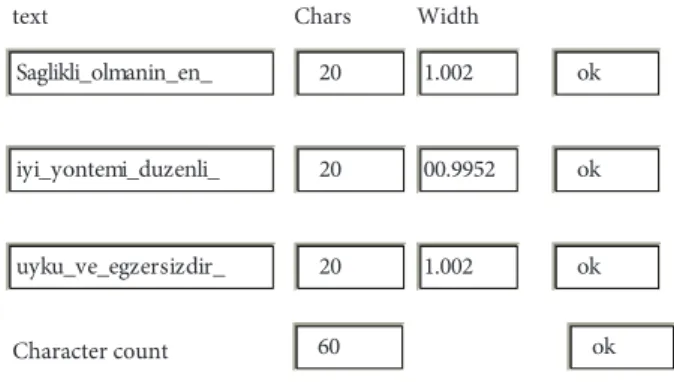
Candidate sentences were formed based on the most frequently used words and subjects. Th e “mn test,” which is based on the number of characters and letter width (Figure 1) and is available on the MNREAD website, was used in the formation of the sentences (8). Th e general property of the candidate sentences formed with the “mn test” was that they contained 3 lines, with a target total of 60 characters, target width of 1000, and acceptable range of 0.972-1.028. A general characteristic of MNREAD charts is that sentences are independent of each other in terms of meaning; they start with an uppercase letter and no punctuation is used.
According to published reports, MNREAD charts should consist of 60 characters to equal the width of
10 standard words, as standard word length is defi ned as 6 characters.
When prepared sentences are written in the “mn test” boxes mentioned before in the computer environment, sentences are automatically checked for both the number of characters and width, and are then rejected or approved. For instance, the writing of “i” instead of “a” in an approved sentence is rejected, even if the character number does not change. In this manner, 125 Turkish candidate sentences were formed. Th ese sentences were evaluated in terms of rules of grammar and understandability by 2 linguists, who subsequently rejected 10 of them.
Th e remaining 115 sentences were printed with 3 lines each, in 16-point Times Roman font and with 4 variations of sentence order.
Establishing the prototype MNREAD Turkish version
Th e 115 sentences approved based on the “mn test” were tested in a group of 20 adults and a group of 20 children. Sentences prepared in 4 diff erent orders were used randomly for 5 people in each group. During this evaluation, reading speed (at the level of 0.1 second) and the number of misread and missed words were recorded for each of the 115 sentences for each of the participants. In addition, we asked the participants to rate the understandability of the sentences. Reading speed was calculated using the following formula: reading speed (words/min) = 60 ´ (10 – number of errors)/time (s).
Validation
Validation was performed using a diff erent study group that consisted of 10 women and 10
text Chars Width
Saglikli_olmanin_en_ 20 1.002 ok
iyi_yontemi_duzenli_ 20 00.9952 ok
uyku_ve_egzersizdir_ 20 1.002 ok
Character count 60 ok
men who had not previously read the sentences. MNREAD prototype chart 1 and chart 2 were read to every individual under standard conditions, and the reading time of every readable sentence and the misread and missed words were recorded on the point paper prepared for the application. Th e values obtained from each participant are written in the questionnaire; reading acuity, critical print size, and maximum reading speed were noted.
Reading acuity was considered the smallest print size that a participant could read without making signifi cant reading errors. Critical print size was considered the smallest print size that a participant could read with maximum reading speed. Maximum reading speed was considered the reading speed that was not limited by print size; it is the mean speed over the critical print size (reading platform in the questionnaire) in terms of words/min.
For validation, a text paragraph with a size of 1.6 M taken from a journal (0.6 logMAR-20/80 Snellen) and a newspaper text paragraph with a size of 1 M (0.4 logMAR-20/50 Snellen) were chosen in order to represent daily reading materials. Th e consistency of MNREAD chart 1 and chart 2 with each other and with selected everyday reading material was evaluated using Pearson’s correlation test. Th e Turkish version of the MNREAD charts was organized on the same platform, prepared by taking the functional changes associated with logarithmic values.
Results
In all, 115 sentences (10 of the 125 Turkish sentences formed with the “mn test” were determined not to be suitable in terms of understandability and grammar rules by 2 linguists) were tested in 2 groups (adult and children) that met the study’s inclusion criteria. Th e adult group included 10 females and 10 males; 5 of them had graduated from primary school, 6 from high school, and 9 from higher education. Th e children’s group included 20 fi ft h-grade students, aged 10-11 years (10 male and 10 female), who did not have reading problems as reported by their classroom teachers.
Th e mean adult reading speed for the 115 sentences was 153.69 ± 9.52 words/min(range: 119.85-176.15 words/min). Accordingly, 29 sentences that deviated
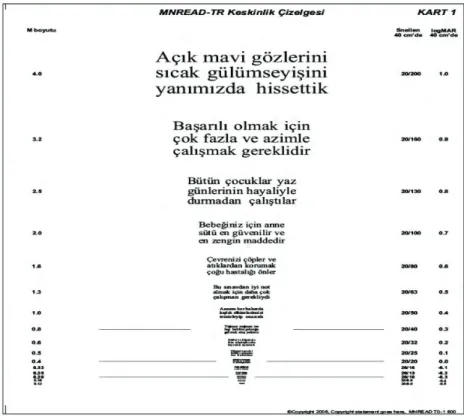
by ±1 SD from the mean were eliminated. Th e mean reading speed in the children’s group was 106.26 ± 15.47 words/min (range: 74.68-126.52 words/min) and 23 sentences were eliminated in this group using the same method. In all, 8 of the eliminated sentences were shared by both groups. In addition, sentences that were mistaken repeatedly in each group were eliminated. As a result, only 51 of the 115 sentences had suitable properties for the MNREAD reading chart with regards to reading speed and faulty reading conditions. From among these 51 sentences, 38 were selected and prototype MNREAD Turkish version reading charts 1 and 2 was established. Th e charts were in the logMAR range of –0.5 to 1.3, with 0.1 logarithmic intervals, and were formed of 19 sentences in the Times Roman font.
Th e 20 adults chosen for the charts’ validation study read a journal text paragraph 1.6 M in size (0.6 logMAR, 20/80 Snellen) and a newspaper text paragraph 1 M in size (0.4 logMAR, 20/50 Snellen) under defi ned standard conditions in order to represent the MNREAD chart 1 and chart 2 as everyday routine materials. Th eir MNREAD chart 1 and chart 2 reading performances are shown in Figures 2a and 2b. Based on their performance, the critical print size and maximum reading speed were determined for each participant. Mean maximum reading speed was 191.50 ± 32.19 words/min (range: 101-283 words/min) for chart 1 and 190.55 ± 27.35 words/min (range: 121-283 words/min) for chart 2. Pearson’s correlation of chart 1 and chart 2 was statistically signifi cant (r = 0.881, P < 0.01).
Mean journal text paragraph reading speed (0.6 logMAR) was 185.10 ± 20.46 words/min, versus 185.45 ± 27.27 words/min for the newspaper text paragraph (0.4 logMAR). Th e correlation of MNREAD chart 1 to the journal text paragraph (r = 0.747, P < 0.01) and newspaper text paragraph (r = 0.673, P < 0.01) was statistically signifi cant. Similarly, correlation of chart 2 to the journal text paragraph (r = 0.629, P < 0.01) and newspaper text paragraph (r = 0.591, P < 0.01) was statistically signifi cant.
Th e Turkish version of the MNREAD text-based near reading charts was formed of 19 sentences logarithmically organized, independent of each other in terms of meaning and having validity for representing daily reading materials (Figure 3).
(a)
Discussion
Th e present study aimed to develop and validate a Turkish version according to the design features of MNREAD acuity charts. Single optotype or word-based scales have been used to evaluate near visual acuity. For instance, the Lighthouse near acuity chart
is designed according to the M system and uses Sloan letters; however, near visual acuity is only one of the elements that aff ect reading function. As such, continuous text charts are required for evaluating reading performance. Th e MNREAD acuity chart is a logarithmic chart that reliably evaluates reading performance according to print size in individuals
Figure 2. (a) MNREAD chart 2 reading speeds (logMAR), (b) MNREAD chart 2 reading speeds (logMAR). (b) Reading speed Chart 2 Sentences 1000 100 10 1 -0.5 -0.2 0.1 0.4 0.7 1 1.3 Chart 1 Sentences Reading speed 1000 100 10 1 -0.5 -0.2 0.1 0.4 0.7 1 1.3
with normal or low vision, and it is used in clinical applications and in research. Visual acuity and reading speed are the most important parameters in the examination and follow-up of patients with normal and low vision and in the evaluation of the effi cacy of applied treatments. MNREAD charts are commonly used in clinical studies and in research related to many disciplines, including ophthalmology, neurology, physiology, and ear-nose-throat (9-14).
Reading acuity, critical print size, and maximum reading speed in individuals with low vision are the most important parameters for preassessment, and for determining the optical device to be prescribed and the required magnifying power. It is not possible to determine a system enabling the patient to read quickly and fl uently by considering near visual acuity. Near visual acuity measured with MNREAD charts facilitates the measurement of the critical print size and maximum reading speed, as well as objective follow-up and comparison in clinical applications and in research. With its logarithmic design, use of the measurement, routinely at a distance of 40 cm,
is possible at less of a distance for patients with low vision. Mean maximum reading speed was 190 words/ min for the MNREAD chart and 185 words/minfor the newspaper text paragraph. Virgili et al. showed that MNREAD charts are as reliable as ETDRS charts for measuring distant acuity at the logMAR level in the evaluation of reading acuity in children (15).
Translations of the original MNREAD charts were completed in the present study; they were designed in Turkish using the methods and tests used to develop the original charts. In the development of the Turkish version, linguistic and social qualities suitable for the characteristics of the Turkish language and Turkish society were taken as a base. To validate the MNREAD charts, MNREAD charts were compared with texts representing everyday reading materials. In the present study, 2 text paragraphs chosen from a journal and an article were used for validation, and it was detected for both of them that reading speed correlated with the MNREAD charts (0.74, 0.62). In the Portuguese version, it was stated that this comparison was progressively correlated (0.82) (6). References
1. Legge GE, Pelli DG, Rubin GS, Schleske MM. Psychophysics of reading. I. Normal vision. Vision Res 1985; 25: 239-52. 2. Legge GE, Rubin GS, Pelli DG, Schleske MM. Psychophysics of
reading. II. Low vision. Vision Res 1985; 25: 253-65.
3. Soytürk MK, Küçüksezer F, Beştaş H. Bir yakın görme eşeli örneği. In: Kural G, Duman S, editors. Turkish Ophthalmology Society XXX. National Congress Bulletin. Antalya: 1996; 1005-6 (in Turkish).
4. Eğrilmez S, Eğrilmez ED, Akkın C, Kaşkaloğlu M, Yağcı A. Uluslararası standartlara uygun bir Türkçe yakın okuma eşeli. Türk Oft Gaz 2004; 34: 404-12 (in Turkish).
5. Mansfi eld JS, Ahn SJ, Legge GE, Leubaker A. A new reading acuity chart for normal and low vision. Ophthalmic Visual Optics/Noninvasive Assessment of the Visual System Technical Digest 1993; 3: 232-5.
6. Castro CT, Kallie CS, Salomão SR. Development and validation of the MNREAD reading acuity chart in Portuguese. Arq Bras Oft almol 2005; 68: 777-83.
7. Nakamura H, Oda K, Fujita K, Yuzawa M. Th e prescription of reading aids with the MNREAD-J reading acuity chart for low vision patients with AMD. Jpn Orthopt 2000; 28: 253-61. 8. http://gandalf.psych.umn.edu/groups/gellab/MNREAD2000/
mntest.html (last accessed 20 February 2007).
9. Wolff sohn JS, Anderson SJ, Mitchell J, Woodcock A, Rubinstein M, Ffytche T et al. Eff ect of age related macular degeneration on the Eger macular stressometer photostress recovery time. Br J Ophthalmol 2006; 90: 432-4.
10. Chung ST, Jarvis SH, Cheung SH. Th e eff ect of dioptric blur on reading performance. Vision Res 2007; 47: 1584-94.
11. Braswell J, Rine RM. Evidence that vestibular hypofunction aff ects reading acuity in children. Int J Pediatr Otorhinolaryngol 2006; 70: 1957-65.
12. Fujikado T, Asonuma S, Ohji M, Kusaka S, Hayashi A, Ikuno Y et al. Reading ability aft er macular translocation surgery with 360-degree retinotomy. Am J Ophthalmol 2002; 134: 849-56. 13. Mruthyunjaya P, Stinnett SS, Toth CA. Change in visual
function aft er macular translocation with 360 degrees retinectomy for neovascular age-related macular degeneration. Ophthalmology 2004; 111: 1715-24.
14. Tejeria L, Harper RA, Artes PH, Dickinson JM. Face recognition in age related macular degeneration: perceived disability, measured disability and performance with a bioptic device. Br J Ophthalmol 2002; 86: 1019-26.
15. Virgili G, Cordaro C, Bigoni A, Crovato S, Cecchini P, Menchini U. Reading acuity in children: evaluation and reliability using MNREAD charts. Investigative Ophthalmology and Visual Science 2004; 45: 3349-54.