TRADITIONAL MEDICINE: ANSWERING
THE QUESTION OF KNOWLEDGE
ACQUISITION AND TRANSMISSION
AMONG THE TRADITIONAL HEALTH
PRACTITIONERS IN UGANDA
Peter BAGWANA Abstract:
The practice of traditional healing is a continuous experience that has been part of national healthcare systems of many African societies for many years. Using a descriptive research design, this study aimed to explore the ways in which traditional health practitioners acquire knowledge of traditional healing and treatment with herbal medicines. It is possible for many spiritual healers and herbalists to know what they know but almost impossible to tell how they know the things they do and this may turn up a health hazard. Some of the traditional healers and herbalists interviewed for this study consented to not having logical/scientific explanation to most of their practices. Many believe that disease does not respond to right explanation but right medicine. However, in recognition of its role in saving lives of particularly the poor and those living in remote and hard to reach areas, scientific research should be conducted to help traditional healers and herbalists understand their practices. Traditional healers themselves must express willingness to learn from each other.
Keywords: Uganda, Disease, Traditional medicine, Traditional health practitioners, Knowledge Acquisition
Özet
Geleneksel sağaltım pratikleri, pek çok Afrika ülkesinin ulusal sağlık sistemlerine eklemlenmiş bir şekilde uzun yıllardır sürdürülmekte ve tecrübe edilmektedir. Betimleyici bir araştırma dizaynı doğrultusunda bu çalışma, geleneksel sağlık pratisyenlerinin, bitkisel ilaçlarla geleneksel sağaltım irfanını kazanma yollarını ortaya çıkarmayı amaçlıyor. Birçok ruhani şifacı ve otacının neyi
bildiklerinden haberdar olmak olası iken nasıl bildiklerini keşfetmek neredeyse imkansızdır. Bu durum kolaylıkla kendisi sağlık için tehlike arzeden bir sağaltım anlayışına dönüşebilir. Bu çalışma içerisinde görüşülen geleneksel şifacı ve otacıların bir kısmı, sağaltım pratiklerinin çoğu için mantıki/bilimsel bir açıklamaya sahip olmadıklarını ifade ettiler. Çoğu hastalığın doğru açıklamaya değil doğru ota yanıt verdiğine inanıyordu. Yine de ulaşılması zor ve uzak bölgelerde yaşayan genellikle fakir insanların hayatını kurtarmaktaki rolleri dikkate alındığında geleneksel şifacı ve otacıların, birbirlerinin uygulamalarını öğrenmeyi de içerecek şekilde kendi pratiklerinin neliğini anlamalarına yardım edecek bilimsel araştırmaların yapılması kritik önemde olabilir.
Anahtar Kelimeler: Uganda, Hastalık, Geleneksel tababet, Geleneksel sağaltım pratisyenleri, Bilgi edinimi
1. Introduction
The development and use of Traditional Herbal Medicine (THM) has got a very long historical backdrop that corresponds to the Stone Age. In Africa, the practice of traditional healing and magic is much older than the Egyptian medical sciences (Nakato, 2006). It is also part of the Greek and Chinese history and has generally been practiced in the rest of Europe, Asia, South America and other cultures for many years. The early Greeks used or were familiar with words like “magi” to refer to the magician and “Magea” to mean the religion of the magician (Tambiah, 1990:9). The diversity in the use of traditional medicine (TM) makes it difficult to coin its various properties into a concise and acceptable definition at global level. Nevertheless, the World Health Organisation (WHO) has provided a comprehensive definition of TM as “diverse health practices, approaches, knowledge and beliefs incorporating plant, animal and/or mineral based medicines, spiritual therapies, manual techniques and exercises applied singularly or in combination to maintain well-being, as well as to treat, diagnose or prevent illness” (WHO, 2002:7)
The recognition of disease and illnesses in traditional Africa, meant that every society needed to devise means of containing the problem. Worldwide, different societies have different herbal traditions that have evolved over a long period of time (Ibrahim, 1999-2015). Similar to modern day Western treatment patterns, African traditional societies also involved surgery, dietary therapy, psychotherapy on top of traditional exorcism, rituals and sacrifice (Tasha, 2012). Disease and illness were a result of malfunctioning of some parts of the social order. Therefore the wellbeing of a given society depended entirely on the proper functioning of each and every part of the
whole. This also explains why disease was not viewed as individual problem but rather societal/community concern and therefore called for community rather than individual intervention to create balance between the physical world and spiritual forces of that particular society (Nzewi, 2002). The continued use of traditional medicine is also premised on the recognition and belief that the health of the body, mind and spirit are related and must be attempted holistically at all times.
In African traditional setting, there is always an explanation as to why someone is suffering from a certain disease at a particular time. According to Ayodele (2002), disease and illness mostly revolves around witchcraft/sorcery, gods or ancestors, and natural illness well as inherited diseases. But in many instances, the first aspect associated with the cause of disease and illness is witchcraft. This is more instanced among the Azande community, where all deaths are linked to witchcraft (Evans-Pritchard, 1937). However, we should also consider the fact that different societies and cultures have different methods of understanding illness and what is regarded as a right way of treatment in one society may significantly differ in another community (Chavunduka, 1980).
In his book, Magic, Science, Religion and the scope of rationality, Tambiah (1990) takes on a single explanation of the causes of disease and illnesses. Drawing evidence from the Greek tradition, Tambiah is quick to assert that illnesses are attributed to natural causes. He refuses to associate diseases/illnesses with magic or mystical forces and further mentions that whilst early Greeks were familiar with the concepts of magic and occult powers, they still could not attach/associate magic with illness and disease. While Tambiah’s explanation of illnesses may be seen in many respects as ideal and standard way of understanding disease and illnesses, we should also bear in mind that it is drawn from European perspective whose value systems are certainly different from those of other regions in the world.
The idea of witchcraft/magic covers a lot of meanings. Witchcraft is a spiritual practice or act by which forces of darkness are transmitted via the spiritual world (Nkosi, 2012). Individuals who believe in magic and witchcraft will assert that they have intrinsic and automatic efficacy (Tambiah, 1990). Tambiah has however defined witchcraft in the form of magic as the opposing side of religion. He points out that it is considered as a sin intended to manipulate God and it is hugely denounced in the bible. Sir Edward Taylor (1854-1938), looks at magical arts as false arts: “one of the most pernicious delusions that ever vexed mankind” (cited in Tambiah,
1990:45). Magical ideas according to Taylor are premised on the principle of “association of ideas” where humanity has continuously failed to distinguish cognitive relations from causal relations.
While Evans Pritchard and Bronislaw Malinowski may blame Taylor for postulating a psychological contextualisation of magic and for not recognising that the associations are social and only occur when evoked in specific ritual situations, my own understanding of the vice would be double edged. Looking specifically at my own culture, many social constructions exist about different phenomena but they barely contain any empirical value and they have remained recurrent events in our cultural awareness. For instance, while growing up we were told not to do so many things and that if we did they would bring bad luck or misfortune. We were not allowed to sweep or sow at time as these were associated to magic and witchcraft. Interestingly, these are the things we used to do often and none of the associated outcomes occurred. It would simply be unimaginable to associate touching your head and getting bald when a swarm of bees is passing. However, there were instances when such connections (association of ideas) turned out to be the absolute reality. For instance whenever an owl sounded relentless around a given home, it was a sign of misfortune, and in most cases death of a relative of a village member.
In Uganda, there is limited regulation on practice or belief in witchcraft, sorcery, magic and religion. Traditional healers (diviners, herbalists, faith healers or miracle workers) have ran several stories in the Newspapers, on radios and Television stations advertising and giving healing testimonies of their activities.
1.1 The Research Problem
In Uganda, like elsewhere in Africa and other developing countries, the use and practice of traditional medicines is central in the provision of health care (WHO, 2002). According to the Ugandan Ministry of Health, about 60% of Ugandans believe in traditional medicine (MoH, 2009). Compared with modern allopathic medicine, traditional medicine is free, available and can easily be accessed by all (Tabuti, 2006; Anoka, 2012). As a result, there is limited consultation with traditional healers since herbal medicine is free and almost within everyone’s reach especially in the rural areas of the country (Tabuti, 2006). But even where consultation is done, there is lack of coherence among traditional healers on the preparation procedure and correct dosage of herbal medicines (Wilcox & Bodeker, 2004). Part of the
problem is that many practitioners of traditional medicine continue to lack scientific explanations for their practices. While they believe in the outcomes of their practices, they do not possess knowledge of how such outcomes come about.
Science and magic are quite identical and this is instanced in the recognition that the magician, just like the modern medical doctors believes that similar causes produce similar results and remediation follows standard rules set against a particular cause (James Frazer, 1832-1917). Sir Edward Taylor (1854-1938) coins magic and witchcraft as “pseudo sciences” that cannot explain their practices. The two scholars do not directly disassociate magic from science but rather magical science was false science bent on the rhetoric use of “ambiguous phrases, vague diagnoses and predictions such that most outcomes can be retrospectively interpreted as fulfilments” (Tambiah 1990:46).
The question of how knowledge is acquired and accumulated remains one of the biggest challenges in traditional healing and treatment with herbal medicines. It is possible for many healers and herbalists to know what they know but almost impossible to tell how they know what they know and this may create a huge health risk to the overwhelming number of users of traditional medicine. It is therefore imperative that we provide explanations on how traditional healers operate amidst constant criticisms that majority are fake and simply extorting money and duping the public.
2. Research Setting and Method 2.1. Study Area
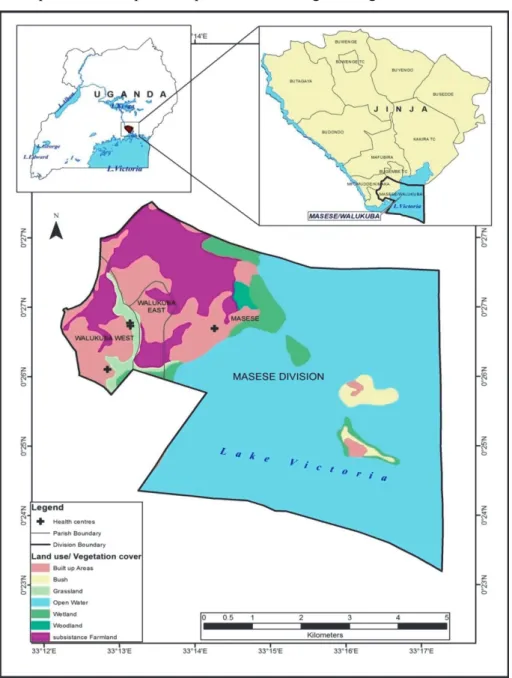
The study was conducted in two small communities of Walukuba and Masese. These communities are found Jinja district; Eastern Uganda.
Jinja district is located along the northern shores of Lake Victoria and east of River Nile. It has an area of 767.7sq Km of which 701.9 sq km is land and the rest (65.8 Sq km) is covered by water bodies.
Figure 1 illustrates the location and the social economic activities of the study area. The vegetation consists of thickets, bush lands, woodlands and grasslands. This makes crop agriculture the dominant type of land use in the area. An aerial view of Masese hill shows a highly organised and generally planned elite settlement contrary to the temporary and makeshift houses of particularly fishermen that occupy the shores of the lake and also depend it on for survival.
The study area consists of a mixed ethnic identity. While the Basoga remain the predominant tribal group in the area, there are also many other ethnicities in the area recognised from the different languages that are spoken in the area. It should be recalled that Jinja was once the industrial herb of Uganda and many people of different tribal backgrounds came to Jinja in search for employment from the lucrative industries. Many industries were located around Walukuba and Masese and this explains the continued diversity in ethnicity among the occupants of these areas.
2.2 Methodology
Principles of qualitative investigation were used throughout the study to enable full description, and inference of shared experiences of the phenomenon under investigation. Qualitative methods of investigation involve rigorous descriptions of practices in the context and actual circumstances in which they appear (Murphy & Dingwall, 2003). This is in addition to the routine, everyday working apparatus that gathers information as it is spoken, written, narrated or drawn. It is this uniqueness that makes qualitative studies “soft studies” and therefore different from other numerical/statistical calculations associated with quantitative studies.
A descriptive research design that involved use of in-depth interviews was used in this study to delineate opinions, experiences and context of research participants in order to understand how individuals acquire knowledge in traditional healing and treatment with herbal medicines. A validated interview guide was developed to guide the research.
Data for this study was gathered from three different categories of respondents. The first category comprised of users/experiencers of traditional herbal medicines. They directly experience, perceive, adapt and ultimately attach or construct meanings to all traditional healthcare practices in their communities.
The second and third category comprised of local cultural experts and traditional healers respectively. Data presented in this study is a reflection of narratives and descriptions of these three categories of respondents.
Data collection and analysis was systematic process that valued every aspect, behaviour, or actions sought relevant to the experience being investigated. This process of giving equal attention to all expressions of experience is what Moustakas (1994) calls “Horizonalization” (p. 120) and it was employed throughout this study. As Moustakas (1994) and Creswell
(2007) suggest, I engaged in the study “epoch” and cast aside all the presuppositions I held about the subject matter to allow for full inference and description of the experience/phenomenon being investigated.
3. Study Results
In conducting this study, I was quite aware that knowledge acquisition is more or less a product of social interaction and that most of the meanings attached to social phenomena are social constructions. However, in the following discussion I present a holistic depiction of knowledge of study phenomenon as acquired and narrated by the research participants themselves.
As I conducted the study, I increasingly became aware that it was very hard for the majority of my respondents to explain how they come to know the things they know and practice in relation to traditional healing and use of traditional medicines. Many users/experiencers of traditional medicines could not explain how the medicines work. They could not explain how they come to know the medicines they have continuously used for many years. Just a handful of them mentioned that they grew up watching and keenly observing their parents use traditional herbal medicines. And therefore their knowledge was a result of learning and continued interaction with their parents.
Knowledge of traditional medicines accumulated over a long time is transmitted orally from generation to generation. Parents and grandparents are the sole source of traditional knowledge and they pass on this knowledge to their sons and daughters as exhibited by most of the respondents. One of the respondents thus narrated, My father used to make an extract from kikaka (Aloe sp.) and he always made sure that a small dose was always mixed in our sauce at least 3 times a week and this always prevented us from any serious attack and up to now I do the same for my children. A large part of responses revolved around the same genre of knowledge. The young generation have acquired knowledge through their parents and grandparents, or through interaction with other elderly members of their communities. The implication is that across generations, knowledge is acquired and transmitted through social interaction between those who possess the knowledge and those who seek the knowledge.
Whilst the process of knowledge accumulation and transmission was clearly known, the real study problem remained unanswered. Individual respondents expressed that knowledge is transmitted orally from generation to generation through learning from parents, grandparents and social interaction with other community members. But they could not explain how their grandparents and parents came to acquire such knowledge. However, my interaction with traditional healers and other cultural experts gave me a
clear understanding as to why many respondents could not answer the question of knowledge acquisition and accumulation quite convincingly. It also revealed a different picture of how social constructions come about and how individual persons benefit from the process of such constructions to acquire knowledge. Below is an excerpt of the in-depth interviews I held with traditional healers whose real names will be withheld for confidentiality and protection of identity.
3.1 Traditional healers’ understanding of knowledge accumulation and transmission in traditional medicine.
The question here would be the “ability to know as opposed to having knowledge” of traditional medicines and the whole process of healing, said one of the respondents. As one grows, he is being taught “how to come to know, as opposed to how to have the knowledge.” This formed the platform upon which the question of traditional medicine and the general process of traditional healing were attempted.
The Western approach to disease diagnosis and treatment is by far different from how knowledge of illnesses and treatment is applied under the traditional perspective of disease management and control. Knowledge acquisition by trained western doctors is through diagnosis: a doctor may never tell the nature of illness and its corresponding mode of treatment until a diagnosis is carried out. On the other hand, people schooled in traditional thought will reject the western mode of knowledge accumulation as it assumes a standard progression of disease in individuals. It is quite simplistic for the western perspective to fail to recognise that people react, and are affected differently, even in circumstances when they are faced with similar challenges. Disease symptoms also manifest differently and it could wrong to assume a standard progression of disease amongst patients.
In the same measure, our reaction to medication also tend to vary and assuming a single therapy as standard measure of prevention and treatment of a given disease may simply be an oversight of other realities that surround man as a versatile and fragile member of society. Traditional approach therefore holds that “there is no standard patient and therefore no standard medicine.” Emphasis is put on individual patients in the state in which they appear as the most important source of information and knowledge about that particular patient as opposed to generalisations associated with the western mode of treatment.
Below are some of the explanations given by traditional healers that can help in understanding how the practitioners of traditional herbal medicines and the healers come to know what they know in regard to their practices.
Ancestral spirits
The ancestral spirits of healing are the most important source of knowledge of traditional medicines and healing systems and everything else in relation to the practice of healing and treatment with traditional medicines is secondary to the powers of ancestral spirits. The way this works is through the healer becoming possessed with the spirits that then inform him or her of what to do, which medicine to use, where to find the medicine and how to prepare and prescribe it. At this point, the spirits are the sole source of knowledge of traditional healing and treatment with indigenous plants. However, after working on more that 10 people who possess the same problem, the traditional healer becomes an expert himself and will not wait to be possessed or rather wait to receive instructions from the healing spirits before he prescribes medicine to patients. This is the element of learning that is inevitable in any form of knowledge acquisition and accumulation. The healer will use the knowledge they would have acquired through experience to treat patients that come in with problems that are similar to those the healer has worked on before.
However, we should also recall that once a healer is possessed with ancestral spirits, he loses his soul and spirit; he becomes unconscious and not aware of what is taking place. The question then; is how does the healer get to know what he knows and the things he does when he is possessed and seemingly unconscious? Spirit possession occurs quite differently: it can fully possess someone and in this case the person is fully unconscious and does not know what is going on. In this situation, the healer will rely on the people who were around to inform him what the spirits were communicating. For such healers the people around are the intermediate source of knowledge of right medicine and healing.
However, healers can still create a mutual relationship with their spirits in such a way that the spirits can only partially possess them. This process of creating a cordial relationship with spirits is referred to as “ancestralisation.” The concept of ancestralisation can only be achieved through training and development. A trained healer will be able to create a mutual relationship with the spirits, talk to them freely and they will not fully possess him as
they also enjoy communicating with the healer. This relationship is necessary for the survival of both the healer and the spirits. Therefore to the traditional healer and the rest of the medicine men, the ancestral spirits of healing are their primary source of knowledge.
Knowledge through dreams
Knowledge accumulation in traditional medicine and healing also manifests through dreams. A healer may see a patient in a dream, wearing a light coloured shirt, with green sandals and suffering from a heart problem or swollen feet. Interestingly, when this patient consults the healer (who saw him/her in a dream), he does not need to talk about himself because the healer would have already seen him in a dream. As soon as the patient arrives, the dream manifests in what they are wearing and I am able to tell his problem and also prescribe right medicine for him, said one of the respondents. For formality purposes however, a healer is expected to talk to the patient who appeared in their dreams but in reality you do not need their explanation before treating or healing them. He added, I do not need to know your problems before I provide you solutions...right diagnosis is not always necessary provided you know the right answer.
Many traditional healers and herbalists lack formal education but they are able to treat and heal patients. For instance, a healer may not know the position of the heart on the human body, may not even know how it functions, but he may be able to prescribe right medicine for the heart. To compound his argument, he recalled his own experience while undergoing training in traditional herbal medicines and healing. As a learned traditional healer, he was very critical and inquisitive of every stage and practice of traditional healers and herbalists to the extent that he constantly annoyed his trainers. He questioned every process and application and demanded explanation as to why things were happening the way they were. His behaviour would be interpreted to be close to spying as opposed to learning. Yet in reality he had strong belief and interest in traditional indigenous knowledge and healing practices and wanted to understand all questions related to traditional medicine and healing. At this level, one of his trainers got angry and asked him, “does disease respond to right medication or right explanation?” perhaps to ascertain the earlier assertion that right diagnosis is not always necessary provided you know the right answer. A traditional healer’s concept of care and treatment is different from western biomedical concept of care. Under the traditional thought, the philosophy of how
medicines work is not important but rather, what kind of medicines will work on a particular patient is necessary.
Knowledge through dreams is not limited to traditional healers alone but also to herbalists. A herbalist may see certain herbs healing particular diseases in a dream. And they apply such medicine to cure particular diseases as they appeared in their dreams, they work out miracles. However, such dreams are instigated by spirits. Healing spirits may manifest in dreams instructing the herbalist or a healer to get a certain herb, boil it and treat the patient. This is therefore one way through which herbalists develop knowledge of treating particular diseases using particular herbs. Ordinary people will then learn from these gifted people about what and how questions of traditional medicine and healing.
Interest
To some people, knowledge about traditional is generated through their desire to know. This is the written format of calling. You get passionate about something and you eventually learn how to do it. However, this interest may not be your own inner interest, but rather an interest of the spirits that indirectly enters your soul and drives you to want to practice and perform their healing duties. This is something thing one may not easily realise at face value, yet it is such a strong sensation that will make an individual wholly immersed into the practice of traditional medicine and healing. One may not be forced or directly experience the wrath of spirits, but spirits will create a sense of interest in that person that sees him or her express interest and desire to know about traditional medicine and this corresponds fairly with the earlier expression that everything else is secondary to the role of spirits in regard to the general knowledge acquisition and the actual process of healing and treating patients with traditional herbal medicines. The interest that is initiated into someone may not be of immediate nature and can manifest at a later stage in someone’s career.
Relating to the same, one of the respondents posed a question... what aroused your interest to investigate about traditional therapies? Responding to his own question, he argued that while this could have been as a result of knowledge gap in the academics or simply personal desire to want to know about traditionalism and healing, it is also possible that there is a spiritual force that is silently driving my interest to know. This was frightening to me
and almost ended the interview. But I also understood that it takes more than just having the interest but also a strong mind set and belief in traditional medicine and healing practices for one to become possessed. This kept me strong and carried on the interview but the expression of my respondent repeatedly showed that there is no fire without smoke. While I may be thinking that it is entirely academic, it could simply be a means to an end; an indirect calling to spiritual healing.
In a different tone however, he noted that while spiritual healing is not limited to particular categories of people, they have time and again possessed the uneducated strata of society. He asserted that lately, in their communication with spirits, they have been questioning them about their interest to possess only the uneducated and not the educated members of society. He noted that the face of traditional medicine and spiritual healing would tremendously change if spirits started possessing the educated. The blend of western training and possession of traditional indigenous knowledge can be the silver bullet to all the limitations of THMs and healing practices across all the practicing nations.
Knowledge through coercion
This is the invitation to know which is usually enforced through coercion. It usually happens when the person supposed to be possessed stubbornly refuses to respond to the various signs transmitted by the spirits. Coercion appears in the form of plagues, sicknesses and other rare and frightening occurrences intended to frighten someone to respond to the demands of the spirits. These will repeatedly affect the person supposed to be possessed and his family until he visits a healer for spiritual healing. The healer will then establish whether the person is spiritually possessed and therefore the wrath of the spirits are manifesting in the problems affecting his family, or simply bewitched. If the cause is possession of ancestral spirits, he will then be immediately initiated into the process of becoming a spiritual healer which calls for numerous ritual practices and sacrifices. This process should be done in the presence of the entire community. The initiation process also marks the beginning of the healing of the affected person. As rituals are performed and sacrifices made, the affected person and family immediately start healing from the previous diseases and catastrophes. The community must witness the whole process in anticipation that the person will serve them upon healing. In a generation where traditional healing is done for commercial purposes, and therefore attracting
many quark healers, the participation of the community also ensures that the healer is genuine and has passed through the whole process of healing. And whenever the community is excluded, the implication is that someone is fake, doing it for commercial gains or that the person’s immediate family is too religious to sanction and support his spiritual healing.
Spirits have got the powers to draw the person of their interest from wherever they may be to the epicentre or place of origin of the first occupants of that family/clan for performance of spiritual rites. In other words there is no objection to the calling or invitation by the spirits whenever you are a person of their choice. As one is coerced into becoming a healer, he is also invited to know. It is the beginning of the process of learning, experiencing and acquiring knowledge in traditional healing.
Symbolism
Symbolism is one of the most important sources of knowing. Throughout history, traditional healers and herbalists have relied on nature and earthly symbols to learn many facts about healing and treatment with traditional medicines. These healing symbols may appear in the form of animals, plants and birds or earthly features like the sun, moon, stars among others. Healing using these symbols occurs when there is sudden change in the behaviour of these natural and earthly features. The change may however be one of misfortune, and a healer is expected to have mastered the art of using such symbols to serve the actual purpose of their patients. For instance if one is looking for medicine that cures a particular disease and animals passes across your path/direction, it is highly likely, you will not get the right medicine for that particular disease. The situation is significantly different when that particular animal moves straight into your direction. It signifies you are taking the right path for the right medicine and here symbols are acting as a source of knowledge of healing and treatment with traditional medicine. Symbols may therefore signify both good and evil. An owl for example is one of the birds with whose behaviour and character signifies different situations in the life experiences of man. If it sounded relentlessly at awkward hours around someone’s house, it is usually a sign that the family has lost a member, someone is critically ill or someone has died in the community. According to one of the respondents, the scientific explanation to these social realities is that human souls and spirits are sometimes manifested in plants and animals respectively and this is the reason animals are able to communicate different realities about human
beings. And it is for this particular reason that birds and animal sacrifices are made in almost all processes of healing. They contain the human soul and because you cannot sacrifice a fellow human being, the blood of animals and birds can well serve the purpose.
It is also worth noting that symbols act in different ways in the process of predicting and finding remedies to problems. To some traditional healers and herbalists, if a patient provided them with his/her full names and actual date of birth, without necessarily telling their problems, a healer will be able to get the right medicine for such a patient with the knowledge of behaviour of symbols that may be encountered in the forest. For instance, a branch may fall off a certain tree upon mention of the details of the patient. That will immediately inform the experienced healer that all the medicine required to treat that particular patient can be got from that particular tree whose branch fell off upon reciting the name and actual date of birth of the patient.
The most fascinating experience of symbolism and healing given by one of the respondents was that of a giraffe. He noted that the combination of a giraffe, and the grass or leaves of trees to which it feeds can be so informative in regard to traditional healing and treatment with traditional medicine. Because of his western training background, this traditional healer was able to tell that plants can communicate to each other particularly in terms of danger or risk of extinction. He asserted that when a giraffe goes to a tree and starts to feed on it leaves to near extinction, the plant leaves can communicate to each other and produce a bitter substance that will automatically prevent the giraffe from feeding on the remaining leaves. According to him, that particular moment when the bitter subsistence is produced and the giraffe posses in its feeding is the exact time medicine is created. A healer is expected to observe and not to miss any moments of this process of creating the bitter substance because it takes up to five seconds when the giraffe has walked away to pluck off the remaining leaves that contain the bitter substance. Beyond this period, the leaves will get back to their normal state and will not be medicine any longer. The purpose plants do this (produce bitter substance) is to prevent animals from consuming all the leaves that would result into the plant withering away. But to a trained healer, it all symbolises medicine for treatment of particular ailments.
Of course not all traditional leaders are gifted with the attribute to interpret symbols and use them to heal patients, yet it one of the most powerful source of information in traditional healing and treatment with herbal medicines. Other traditional healers have specialised in the use of
Earthing: they rely on certain positions and appearances of the stars, sun and moon to treat their patients.
Coincidental talks
This is another way of knowing. Knowledge is sometimes transmitted through coincidental talks. Take the example of being in a taxi and fellow passengers are discussing a problem that has for long puzzled you. Passengers are talking about your exact situation and the medicinal plants that can address the situation. You will want not to interrupt their conversation but you will visibly look unsettled and wish to join the conversation. However, you will realise that you only need to be attentive or silently pull out your mobile phone and record the whole conversation. In this way you will have acquired useful information through related explanations by others.
Flashes
Flashes are similar to symbols but they rather manifest differently in their explanation of social realities. For instance you may be in the middle of a certain discussion and out of nothing you think about your mother and you immediately want to excuse yourself and make a telephone communication with your mother. However, before you get on your feet, you receive a phone call and it is your mother calling. How that happens is sometimes not explainable, yet very useful to a traditional healer and herbalist. A healer may hesitate using particular medicines to a given patient in case he perceives negative flashes. This was perhaps to attempt to take back to the earlier assertion that there is not standard medicine as there is no standard patient in traditional healing but rather you treat that individual patient as he presents himself and within the prevailing conditions.
At this point I have largely discussed the various ways through which spiritual healers come to know what they about traditional healing and treatment with traditional herbal medicines. I have also intermittently pointed at herbalists in the above discussion but not in an elaborated way. The question of how an ordinary man who is not spiritually possessed comes to know about the use of traditional herbal medicines for treatment of various ailments still remains unanswered in this study. Through dialoguing and in-depth interviews, I realised that knowledge acquisition is mostly through observation and learning from elders. As already intimated, Parents
and Grandparents are the sole source of traditional knowledge and they pass on this knowledge to their sons and daughters as exhibited by all my respondents. But one will still want to establish how the parents and grandparents knew about these different mixtures used in the treatment of various ailments. This question was only attempted by traditional healers who stated that “traditional knowledge on healing and treatment with herbal medicines is only perceived by spiritual healers and is known to rest of the people through interaction with them.” And this is the reason ordinary people (non-possessed) can never understand and explain their knowledge of traditional medicines and healing. As earlier mentioned, spirit possession occurs differently: it can fully possess someone and in this case the person is unconscious and does not know what is going on. In this situation, the healer will rely on the people who were around to inform him what the spirits were communicating. For such healers the people around are the intermediate source of knowledge of right medicine and healing. These ordinary people will have become experts in traditional knowledge because of their role in mediating between the spirits and the healer and they will pass it on to their children. And this is the only way people have come know what they know about traditional medicine and healing.
4. Conclusions and Recommendations
In spite of its wide recognition in the fight against diseases, the role of traditional medicine has been dwindling with the emergence of modern ways of diagnosing and treatment of diseases in Uganda. The traditional healer’s society has experienced numerous shortfalls that have severely damaged their public reputation and operations. Human sacrifice for wealth is recently on the rise in the country. Traditional healers are asking their clients to sacrifice fellow humans as a quicker way of getting rich. Many of them will accept not having a single knowledge about their everyday practices yet they continue fleecing the public of their money.
Traditional healers and herbalists interviewed for this study consented to not having logical/scientific explanation to most of their practices. They do not understand how their medicine works on patients and they have taken it as such. In the event, they have come up with such notions that “right diagnosis is not necessary provided you know the right answer.” Others intimated that disease does not respond to right explanation but rather right medicine. Critics of traditional medicine and healing have thus capitalised on these offenses to further disregard traditional medicine as a potential backup
to the stagnant healthcare system in the country. The lack of a rational explanation to the practices of traditional healers and herbalists is a very big gamble, perhaps more risky than the problem they are poised to address. The development and acceptance of scientific reason in many African societies will further expose the bareness of traditional healing practices as individuals increasingly become enlightened and seek for truer explanations to their problems.
However, for such radical change to take place, scientific rationality must aim quick to dissolve circumstances that lead to continued use of traditional medicine in the daily health care practices of many small societies. It is to our common knowledge that traditional health care practices are paramount in saving lives of particularly the poor and those living in remote and hard to reach areas with little or no access to modern health care services. In this situation, scientific rationality must create an environment that will ensure universal access to social services.
Scientific reason should not aim to destroy but rather work out mechanisms to improve traditional medicine as alternative or complementary treatment option.
Scientific research is also needed to help traditional healers and herbalists understand how medicines work and the potential risk such medicines would have on the patient if wrongly diagnosed and prescribed. Besides, traditional healers themselves must express desire and willingness to learn and share different healing strategies in order to recuperate their reputation and extend better services to the public. Both western and traditional health practitioners should draw on their unique and diverse knowledge base to discover their strength and weakness and learn from one another. But this can only be possible if both practitioners cast aside their biases and approached the problem with an open mind.
References
Anoka, A.N. (2012) “Herbal Medicine used in the Treatment of Malaria: Vernonia amygdalina: An overview of Evidence and Pharmacology”, in Toxicity and Drug Testing” Prof. Bill Acree (Ed). ISBN: 978-953-51-0004-1, In Tech:
Croatia. DOI: 10.5772/30381. Available
from:12.07.2015https://docs.google.com/viewerng/viewer?url=http://cdn.intec hopen.com/pdfs/28119.pdf&time=52d70e2ce99dc039748af68dc1dcd160 Ayodele, S.J. (2002) “The Yoruba Cultural Construction Of Health And Illness”,
Chavanduka, G.L. (1994) Traditional medicine in modern Zimbabwe, Harare: University of Zimbabwe Publications.
Creswell, J.W. (2007) Qualitative inquiry and research design: Choosing among five traditions. Thousand Oaks, CA: Sage.
Denzin, N. K. & Lincoln, Y.S (Eds.) (2005b) The handbook of qualitative research, Thousand Oaks: Sage.
Evans-Pritchard, E.E (1937) Witchcraft, Oracles and Magic among the Azande, London: Oxford Press.
Harlacher, T., (2009) Traditional ways of coping with consequences of traumatic stress in Acholiland: Northern Ugandan ethnography from a Western psychological perspective, Ph.D. Dissertation, University of Freiburg.
Nakato, L. (2006) Honouring the African Traditional Herbalist” African Traditional Herbal Research Clinic Newsletters, Special Edition-HIV/AIDS, 25 years 1(10).
Nkosi, M., (2012) “Understanding and Exploring Illness and Disease in South Africa: A Medical Anthropology Context” International Journal of Humanities and Social Science, Department of Development Studies & Anthropology University of Zululand: South Africa.
Meki, N. (2002) “Backcloth to Music and Healing in Traditional African Society.” Voices, a World Forum for Music Therapy, 2(2).
Sekagya H. Yahaya, “Kampala District Traditional Healers’ Directory: A continuous Effort in Upgrading Traditional Practitioners” Media World, Issued May-2005.
Tabuti, J.R.S. (2006) Herbal Medicines used in the Treatment of Malaria in Uganda. A case study of Budiope County, Department of Botany, Makerere University.
Tambiah, S.J. (1990) Magic, Science, Religion and the Scope of Rationality, New York: Cambridge University Press.
Tasha, D. (2012) “Traditional African Healing” 12.07.2015 www.africanholocaust.netnews-ah/trad/healing.html.
Willcox, M.L. & Bodeker, G. (2004) “Traditional Herbal Medicines for Malaria”, BMJ, Nov, 13, 1156-1159.
WHO, (2002) WHO Traditional Medicine Strategy, 2002-2005, Geneva: WHO press.