Ş B
OYUN CERRAHİSİDE
Developmental delays in preschool children with
adenotonsillar hypertrophy
Adenotonsiller hipertrofisi olan okul öncesi çocuklarda gelişimsel gecikmeler
Erkan Soylu, MD.,1 Nusret Soylu, MD.,2 Cahit Polat, MD.,3 Öner Sakallıoğlu, MD.,3Ömer Uçur, MD.,2 Gökçe Bozdoğan, MD.4
ABSTRACT
Objectives: This study aims to investigate the effects of adenotonsillar hypertrophy on general development, as well as fine and gross motor capabilities, social communication, and language development in children with adenotonsillar hypertrophy by applying the Denver Developmental Screening Test-II.
Patients and Methods: The study included 30 patients (12 boys, 18 girls; mean age 53.3±12.2 months; range 32 to 72 months) who were indicated for adenotonsillectomy due to adenotonsillar hypertrophy between February 2013 and July 2013. The control group comprised 30 children participants (12 boys, 18 girls; mean age 53.1±12.8 months; range 32 to 72 months) with no adenotonsillectomy indication. All participants included in the study were performed routine physical examination, flexible fiberoptic nasopharyngoscopy, and tympanometry. Brodsky scale and fiberendoscopic findings were used to categorize tonsil and adenoid sizes, respectively. Following ear, nose, and throat evaluation, a psychologist conducted Denver Developmental Screening Test-II in all participants blindly.
Results: Adenotonsillar hypertrophy patients had higher abnormal levels of general development (c2=7.13, p=0.028). Although patients and controls had similar levels of fine motor, gross motor, and personal-social development levels, there was a statistically borderline difference between them in terms of language development (t=1.82, p=0.074).
Conclusion: The possibility of adenotonsillar hypertrophy should definitely be considered in children with delayed general and language developments.
Keywords: Adenotonsillar hypertrophy; general development; language development; preschool children. ÖZ
Amaç: Bu çalışmada adenotonsiller hipertrofili çocuklarda Denver Gelişimsel Tarama Testi-2 uygulanarak adenotonsiller hipertrofinin genel gelişimin yanı sıra ince ve kaba motor yetenekler, sosyal iletişim ve dil gelişimi üzerindeki etkileri araştırıldı.
Hastalar ve Yöntemler: Şubat 2013 - Temmuz 2013 tarihleri arasında adenotonsiller hipertrofi nedeniyle adenotonsillektomi endikasyonu konulan 30 hasta (12 erkek, 18 kız; ort. yaş 53.3±12.2 ay; dağılım 32-72 ay) çalışmaya dahil edildi. Kontrol grubuna adenotonsillektomi endikasyonu olmayan 30 çocuk katılımcı (12 erkek, 18 kız; ort. yaş 53.1±12.8 ay; dağılım 32-72 ay) dahil edildi. Çalışmaya alınan tüm katılımcılara rutin fizik muayene, fleksibl fiberoptik nazofarengoskopi ve timpanometri uygulandı. Tonsil ve adenoid boyutlarını sınıflandırmak için sırasıyla Brodsky skalası ve fiberendoskopik bulgular kullanıldı. Kulak, burun, boğaz değerlendirmesinin ardından tüm katılımcılara bir psikolog tarafından kör olarak Denver Gelişimsel Tarama Testi-2 uygulandı.
Bulgular: Adenotonsiller hipertrofi hastalarının anormal genel gelişim seviyeleri daha yüksek idi (c2=7.13, p=0.028). Hastalar ve kontrollerin ince ve kaba motor ile kişisel-sosyal gelişim düzeyleri benzer olmasına karşın dil gelişimi açısından aralarında istatistiksel olarak sınır düzeyde farklılık vardı (t=1.82, p=0.074).
Sonuç: Genel gelişim ve dil gelişimi geriliği olan çocuklarda adenotonsiller hipertrofi olasılığı mutlaka akla getirilmelidir. Anahtar Sözcükler: Adenotonsiller hipertrofi; genel gelişim; dil gelişimi; okul öncesi çocuklar.
1Department of Otolaryngology, Medipol University, İstanbul, Turkey
2Department of Child and Adolescent Psychiatry, Medical Faculty of İnönü University, Malatya, Turkey 3Department of Otolaryngology, Elazığ Training and Research Hospital, Elazığ, Turkey 4Department of Child Development, Elazığ Training and Research Hospital, Elazığ, Turkey
Received / Geliş tarihi: January 23, 2015 Accepted / Kabul tarihi: December 20, 2015 Correspondence / İletişim adresi: Erkan Soylu, MD. Medipol Üniversitesi Tıp Fakültesi
Kulak Burun Boğaz Hastalıkları Anabilim Dalı, 34214 Bağcılar, İstanbul, Turkey. Tel: +90 505 - 658 77 62 e-mail (e-posta): [email protected]
Available online at www.kbbihtisas.org
doi: 10.5606/kbbihtisas.2016.42724 QR (Quick Response) Code
Adenotonsillar hypertrophy leads to upper airway obstruction, snoring, oral respiration, frequent awakenings and in advanced cases, periods of apnea. Adenotonsillar hypertrophy is the most common cause of sleep-disordered breathing (SDB) in children.[1,2] All of the sleep problems that occur in patients with adenotonsillar hypertrophy are grouped under the heading of SDB. This term includes sleep pathologies ranging from simple snoring to advanced obstructive sleep apnea syndrome.[3]
Sleep-disordered breathing has been reported to influence somatic growth. Several studies have shown that SDB is associated with reduced gains in height and weight[4-7] and failure to thrive in infants.[8] These growth alterations have been associated with a number of factors, including reduced secretion of growth hormone and insulin-like growth factor-1,[9-11] low energy intake as a result of difficulty swallowing, and increased energy expenditure during sleep.[12]
Complete or partial episodes of obstructive SDB lead to repeated conditions of hypoxemia, hypercapnia and an aroused state-- all of which affect normal development of the nervous system. Damage to cells in the prefrontal regions of the central nervous system has been found to be of particular consequence, since any cortical dysfunction in this region results in behavioral and cognitive disturbances in children.[13,14] Studies have also demonstrated that adenotonsillar hypertrophy adversely affects the performance of children in school and in intelligence tests, and that adenotonsillectomy improved their performance.[15,16] Additionally, in our previous studies, we reported increased psychiatric morbidity in patients with adenotonsillar hypertrophy, and observed considerable recovery six months after adenotonsillectomy.[17,18]
A number of previous studies presented various complications caused by adenotonsillar hypertrophy. In this study, we investigate the effect of adenotonsillar hypertrophy on general development, as well as fine motor, gross motor, social communication, and language development by applying the Denver Developmental Screening Test-II (DDST-II) in children with adenotonsillar hypertrophy. To our knowledge, the DDST-II has not been previously applied in patients with adenotonsillar hypertrophy.
PATIENTS AND METHODS Participants
This study was approved by the local ethics committee of Medipol University. Written and verbal informed consent was obtained from parents of each participant. The study was conducted in accordance with the principles of the Declaration of Helsinki. Thirty patients (12 boys, 18 girls; mean age 53.3±12.2 months; range 32-72 months), who had adenotonsillar hypertrophy and were recommended for adenotonsillectomy at Elazığ Training and Research Hospital between February 2013 and July 2013 were included in the study group. All patients in the study group had symptoms of difficulty in nasal respiration, and snoring and mouth breathing during sleep and wakeful hours. The control group consisted of 30 participants (12 boys, 18 girls; mean age 53.1±12.8 months; range 32-72 months) who did not have complaints such as recurrent tonsillitis, snoring, mouth breathing, and had no adenotonsillar hypertrophy on fiberendoscopic evaluation. Individuals with any problems in their ears, allergic rhinitis, chronic inflammatory diseases, obesity, acute infection, craniofacial anomaly, recurrent tonsillitis without obstructive complaints, type B tympanogram after tympanometry analysis and who could not comply with flexible fiberoptic endoscopy were excluded from the study.
Procedure
Patients in both groups underwent routine physical examination, flexible fiberoptic nasopharyngoscopy, and tympanometry. Brodsky scale[19] and fiberendoscopic findings[20] were used to categorize tonsil and adenoid size respectively. Following evaluation, patients recommended for adenotonsillectomy were informed about the study. The study was conducted with 60 patients who agreed to participate. Following ENT evaluation, the DDST-II was administered to each child by a blinded psychologist. The DDST-II was conducted and scored according to the standard instructions and criteria detailed in the test manual.
Denver developmental screening test-II The DDST-II is a simple method of evaluating the development of infants and preschool children. The test was prepared by Frankenburg and Dodds in 1967 and reviewed in 1971.[21,22]
The DDST was the first developmental test standardized for Turkish children, and was adapted to the Turkish society and standardized by Yalaz and Epir in 1982.[23] The DDST is easily performed in children aged from one month to six years. It includes a set of questions for parents, and tests for the child involving 20 simple tasks and items within four categories: language (39 items), fine motor adaptive (29 items), gross motor (32 items), and personal-social (25 items) skills. The number of items administered during an assessment varies with the child’s age and ability. The DDST has particular importance in following-up the development of infants and early identification of developmental deviations, thereby permitting earlier commencement of rehabilitation.
In the interpretation and evaluation of the DDST the general development level was considered “normal” in the case of maximum one signal or no retardation in any areas; “abnormal” in the case of two or more retardations; and “suspicious” in the case of one retardation accompanied by one signal or two or more signals.
Statistical analysis
SPSS for Windows version 16.0 software (SPSS Inc., Chicago, IL, USA) was used for the statistical analysis. For continuous variables, comparisons between the two groups were made using Student’s t-test. In addition to the descriptive analysis, a chi-square test was performed for independent groups with a p value of 0.05.
RESULTS
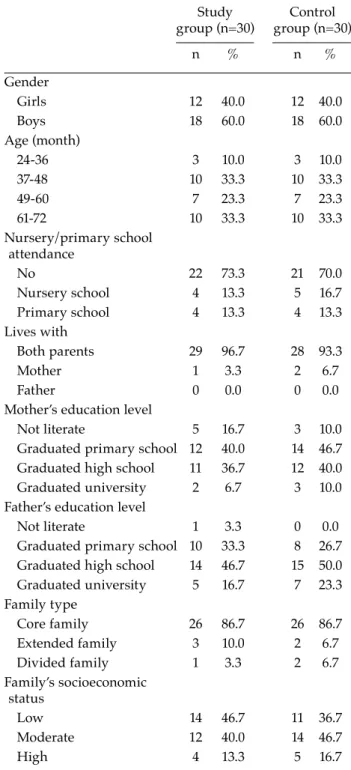
We found no significant difference between the two groups in terms of average age (p=0.951, t=0.062). In both groups, 60% (n=18) of cases were male and 40% (n=12) were female. Table 1 illustrates the socio-demographic characteristics of cases; there were no significant differences between the two groups (p>0.05).
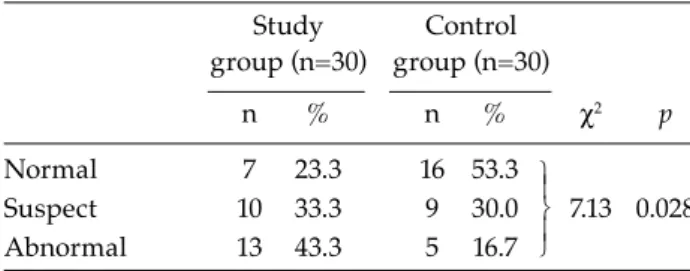
Table 2 compares general development levels in the two groups. Patients in the study group showed highly abnormal general development levels (c2=7.13, p=0.028). Table 3 compares developmental levels in terms of language, fine motor, gross motor, and personal-social parameters. Even though there were no significant differences between the two groups
in other areas, there was a statistically borderline difference between the groups in terms of language development (t=1.82, p=0.074).
DISCUSSION
According to the DDST-II results, there was a significant delay in general development among patients with adenotonsillar hypertrophy
Table 1. Socio-demographic characteristics of cases Study Control group (n=30) group (n=30) n % n % Gender Girls 12 40.0 12 40.0 Boys 18 60.0 18 60.0 Age (month) 24-36 3 10.0 3 10.0 37-48 10 33.3 10 33.3 49-60 7 23.3 7 23.3 61-72 10 33.3 10 33.3 Nursery/primary school attendance No 22 73.3 21 70.0 Nursery school 4 13.3 5 16.7 Primary school 4 13.3 4 13.3 Lives with Both parents 29 96.7 28 93.3 Mother 1 3.3 2 6.7 Father 0 0.0 0 0.0
Mother’s education level
Not literate 5 16.7 3 10.0 Graduated primary school 12 40.0 14 46.7 Graduated high school 11 36.7 12 40.0 Graduated university 2 6.7 3 10.0 Father’s education level
Not literate 1 3.3 0 0.0 Graduated primary school 10 33.3 8 26.7 Graduated high school 14 46.7 15 50.0 Graduated university 5 16.7 7 23.3 Family type Core family 26 86.7 26 86.7 Extended family 3 10.0 2 6.7 Divided family 1 3.3 2 6.7 Family’s socioeconomic status Low 14 46.7 11 36.7 Moderate 12 40.0 14 46.7 High 4 13.3 5 16.7
compared to the control group. Considering the sub-groups of the test, fine motor, gross motor, social communication and skills were similar in both groups. Although not statistically significant, patients in the study group showed high retardation in language development compared to the control group. Evaluating these results, it is observed that the delay in general development is caused mainly by delayed language development.
Children with adenotonsillar hypertrophy frequently wake from sleep. They are unable to have a refreshing, efficient sleep, and experience decreased rapid eye movement (REM) sleep.[24,25] It is known that REM sleep is important for brain development and maturation in children, and it has been demonstrated that in cases with adenotonsillar hypertrophy, hypoxia and decreased REM sleep influence brain development, leading to neurocognitive, behavioral, and emotional disorders as well as decreased quality of life.[24-27] Ezzat et al.[28] found a significant difference in the neurocognitive functions of children, as measured by their IQ, when compared to the control group and there was a significant correlation between severity of desaturation and preoperative impairment of the IQ. Nevertheless, such impairment of neurocognitive function is not permanent, but rapidly and almost entirely reversible.
Additionally, in cases with adenotonsillar hypertrophy, airway obstruction leads to oral breathing, which in turn causes postural alterations of several orofacial structures such as an open mouth, lower-anterior position of the tongue, and a lower position of the hyoid bone. In the long-term, these postural alterations may also have effects on dental occlusion and facial skeletal growth.[29,30] The postural modifications may in turn affect other orofacial functions such as chewing and swallowing, as well as several aspects of speech production.[31] These previous studies showed that brain hypoxia and decreased REM sleep negatively affect brain development. Mouth-breathing inhibits craniofacial development in the long-term, which results in the deterioration of oral motor functions and the production of speech. Both the malfunctions in brain development and speech problems among patients with adenotonsillar hypertrophy provide reasonable explanations for the delay identified in both general and language development in the present study.
Adenotonsillar hypertrophy is a serious public health problem that requires a multidisciplinary approach because it not only causes upper respiratory tract obstructions, sleep problems and mouth breathing, but also developmental, behavioral, neurocognitive, and psychiatric disorders. Adenotonsillectomy is curative in its treatment.[15-18,28] However, there are no commonly accepted objective criteria for adenotonsillectomy in patients with SDB. Clinicians generally recommend adenotonsillectomy based on parents’ anamnesis and physical examination, with each clinician approaching the problem in different ways. Although the American Academy of Paediatrics[32] recommends that indications for adenotonsillectomy due to SDB should be based on the objective sleep test, fewer than 10% of adenotonsillectomies performed in North
Table 2. Comparison of general development Study Control group (n=30) group (n=30) n % n % c2 p Normal 7 23.3 16 53.3 Suspect 10 33.3 9 30.0 7.13 0.028 Abnormal 13 43.3 5 16.7 ˝ ˛ ˛ ˜ ˜
Table 3. Comparison of developmental age of the two groups
Study group (n=30) Control group (n=30)
Mean±SD Mean±SD t p Language 50.9±12.5 57.1±13.8 1.82 0.074 Fine motor/adaptive 56.9±11.3 55.7±12.7 0.39 0.700 Gross motor 58.2±13.8 57.3±13.5 0.24 0.814 Personal-social 52.0±10.8 52.6±9.7 0.23 0.822 SD: Standard deviation.
America are confirmed via polysomnography (PSG).[33] Additionally, a number of previous studies revealed that patients with adenotonsillar hypertrophy who had normal PSG and simple snoring only in their sleep also had neurocognitive, behavioral, and developmental problems, and that these patients responded positively to adenotonsillectomy.[34,35] There is a necessity for objective and commonly accepted criteria to determine which patients with adenotonsillar hypertrophy could respond positively to surgery. Worldwide, most cases of adenotonsillectomy are recommended for chronic tonsillitis and difficulty breathing during sleep. However, recent studies emphasize that adenotonsillar hypertrophy is associated with neurocognitive, behavioral, psychiatric, and developmental disorders. Otorhinolaryngology, pediatric neurology, child psychiatry, and pediatric specialists should adopt a multidisciplinary approach toward patients displaying delayed linguistic or general development, as well as neurocognitive and behavioral dysfunction.
In conclusion, otorhinolaryngologists should be aware of these potential complications of adenotonsillar hypertrophy. We suggest that neurocognitive, behavioral, psychiatric, and developmental problems should be considered alongside indications for surgery in patients with adenotonsillar hypertrophy.
Declaration of conflicting interests
The authors declared no conflicts of interest with respect to the authorship and/or publication of this article.
Funding
The authors received no financial support for the research and/or authorship of this article.
REFERENCES
1. Paradise JL, Bernard BS, Colborn DK, Janosky JE. Assessment of adenoidal obstruction in children: clinical signs versus roentgenographic findings. Pediatrics 1998;101:979-86.
2. Mitchell RB, Kelly J. Behavior, neurocognition and quality-of-life in children with sleep-disordered breathing. Int J Pediatr Otorhinolaryngol 2006;70:395-406.
3. Guilleminault C, Pelayo R, Leger D, Clerk A, Bocian RC. Recognition of sleep-disordered breathing in children. Pediatrics 1996;98:871-82.
4. Marcus CL, Carroll JL, Koerner CB, Hamer A, Lutz J, Loughlin GM. Determinants of growth in children with the obstructive sleep apnea syndrome. J Pediatr 1994;125:556-62.
5. Stradling JR, Thomas G, Warley AR, Williams P, Freeland A. Effect of adenotonsillectomy on nocturnal hypoxaemia, sleep disturbance, and symptoms in snoring children. Lancet 1990;335:249-53.
6. Brouillette RT, Fernbach SK, Hunt CE. Obstructive sleep apnea in infants and children. J Pediatr 1982;100:31-40.
7. Williams EF, Woo P, Miller R, Kellman RM. The effects of adenotonsillectomy on growth in young children. Otolaryngol Head Neck Surg 1991;104:509-16.
8. Freezer NJ, Bucens IK, Robertson CF. Obstructive sleep apnoea presenting as failure to thrive in infancy. J Paediatr Child Health 1995;31:172-5.
9. Bar A, Tarasiuk A, Segev Y, Phillip M, Tal A. The effect of adenotonsillectomy on serum insulin-like growth factor-I and growth in children with obstructive sleep apnea syndrome. J Pediatr 1999;135:76-80.
10. Singer LP, Saenger P. Complications of pediatric obstructive sleep apnea. Otolaryngol Clin North Am 1990;23:665-76.
11. Goldstein SJ, Wu RH, Thorpy MJ, Shprintzen RJ, Marion RE, Saenger P. Reversibility of deficient sleep entrained growth hormone secretion in a boy with achondroplasia and obstructive sleep apnea. Acta Endocrinol (Copenh) 1987;116:95-101.
12. Richards W, Ferdman RM. Prolonged morbidity due to delays in the diagnosis and treatment of obstructive sleep apnea in children. Clin Pediatr (Phila) 2000;39:103-8.
13. Rosen CL, Storfer-Isser A, Taylor HG, Kirchner HL, Emancipator JL, Redline S. Increased behavioral morbidity in school-aged children with sleep-disordered breathing. Pediatrics 2004;114:1640-8. 14. Kurnatowski P, Putyński L, Lapienis M, Kowalska B.
Int J Pediatr Otorhinolaryngol 2006;70:419-24.
15. Gozal D, Pope DW Jr. Snoring during early childhood and academic performance at ages thirteen to fourteen years. Pediatrics 2001;107:1394-9.
16. Kim JK, Lee JH, Lee SH, Hong SC, Cho JH. School performance and behavior of Korean elementary school students with sleep-disordered breathing. Ann Otol Rhinol Laryngol 2011;120:268-72.
17. Soylu E, Soylu N, Yıldırım YS, Polat C, Sakallıoğlu O. The prevelance of psichiatric symptoms in preschool children with adenotonsillar hypertrophy. Int J Pediatr Otorhinolaryngol 2013;77:1094-8.
18. Soylu E, Soylu N, Yıldırım YS, Sakallıoğlu Ö, Polat C, Orhan I. Psychiatric disorders and symptoms severity in patients with adenotonsillar hypertrophy before and after adenotonsillectomy. Int J Pediatr Otorhinolaryngol 2013;77:1775-81.
19. Brodsky L. Modern assessment of tonsils and adenoids. Pediatr Clin North Am 1989;36:1551-69.
20. Cassano P, Gelardi M, Cassano M, Fiorella ML, Fiorella R. Adenoid tissue rhinopharyngeal obstruction grading based on fiberendoscopic findings: a novel approach to therapeutic management. Int J Pediatr Otorhinolaryngol 2003;67:1303-9.
21. Frankenburg WK, Dodds JB. The Denver developmental screening test. J Pediatr 1967;71:181-91.
22. Frankenburg WK, Camp BW, Van Natta PA, Demersseman JA. Reliability and stability of the Denver Developmental Screening Test. Child Dev
1971;42:1315-25.
23. Yalaz K, Epir S. Denver Developmental Screening Test Manuel. Adaptation to Turkish Children and Standardisation. Ankara: Meteksan Matbaası.; 1982. 24. Blunden S, Lushington K, Kennedy D, Martin J,
Dawson D. Behavior and neurocognitive performance in children aged 5-10 years who snore compared to controls. J Clin Exp Neuropsychol 2000;22:554-68. 25. Kaemingk KL, Pasvogel AE, Goodwin JL, Mulvaney
SA, Martinez F, Enright PL, et al. Learning in children and sleep disordered breathing: findings of the Tucson Children's Assessment of Sleep Apnea (tuCASA) prospective cohort study. J Int Neuropsychol Soc 2003;9:1016-26.
26. Franco RA Jr, Rosenfeld RM, Rao M. First place--resident clinical science award 1999. Quality of life for children with obstructive sleep apnea. Otolaryngol Head Neck Surg 2000;123:9-16.
27. Ali NJ, Pitson D, Stradling JR. Sleep disordered breathing: effects of adenotonsillectomy on behaviour and psychological functioning. Eur J Pediatr 1996;155:56-62. 28. Ezzat WF, Fawaz S, Abdelrazek Y. To what degree does
adenotonsillectomy affect neurocognitive performance in children with obstructive sleep apnea hypopnea syndrome due to adenotonsillar enlargement? ORL J Otorhinolaryngol Relat Spec 2010;72:215-9.
29. Löfstrand-Tideström B, Thilander B, Ahlqvist-Rastad
J, Jakobsson O, Hultcrantz E. Breathing obstruction in relation to craniofacial and dental arch morphology in 4-year-old children. Eur J Orthod 1999;21:323-32. 30. Hultcrantz E, Larson M, Hellquist R,
Ahlquist-Rastad J, Svanholm H, Jakobsson OP. The influence of tonsillar obstruction and tonsillectomy on facial growth and dental arch morphology. Int J Pediatr Otorhinolaryngol 1991;22:125-34.
31. Mora R, Crippa B, Dellepiane M, Jankowska B. Effects of adenotonsillectomy on speech spectrum in children. Int J Pediatr Otorhinolaryngol 2007;71:1299-304. 32. American Academy of Pediatrics. Section on Pediatric
Pulmonology, Subcommittee on Obstructive Sleep Apnea Syndrome. Clinical practice guideline: diagnosis and management of childhood obstructive sleep apnea syndrome. Pediatrics 2002;109:704-12. 33. Weatherly RA, Mai EF, Ruzicka DL, Chervin RD.
Identification and evaluation of obstructive sleep apnea prior to adenotonsillectomy in children: a survey of practice patterns. Sleep Med 2003;4:297-307. 34. O'Brien LM, Mervis CB, Holbrook CR, Bruner JL,
Klaus CJ, Rutherford J, et al. Neurobehavioral implications of habitual snoring in children. Pediatrics 2004;114:44-9.
35. Kennedy JD, Blunden S, Hirte C, Parsons DW, Martin AJ, Crowe E, et al. Reduced neurocognition in children who snore. Pediatr Pulmonol 2004;37:330-7.