An analysis of the properties
of recycled PET fiber-gypsum
composites
Abstract
The production of composites materials has gained importance due to the in-creasing and more complex needs of today. Materials used for composites, where the aim is to produce products that have better properties compared to the com-ponents forming the main body, can be composed of products obtained from raw materials or recycled products. By adding PET fibers, which are among recycled products, into the composites, the use of limited raw material resources and the harm to the environment during the processes during the lifecycle of the prod-uct is minimized. Additionally, gypsum, which is used as matrix in the compos-ite, is easily obtainable, has adequate raw material resources, is easily given form, produces a clean-flat surface, has sufficient tensile and compressive strength and is a good humidity equalizer and sound regulator. However, gypsum has a low impact strength and toughness value. As it is necessary to increase its impact re-sistance, some research is carried out to this end. In this study, composite ma-terial is produced by adding polyethylene terephthalate fibers that are recycled products manufactured from recycled PET bottles and which have not been tried before and PVA based adherence-enhancing additive into the gypsum matrix to improve the properties of gypsum. Test results show that with the addition of fiber the flexural strength of gypsum has somewhat decreased but the addition of the adherence-enhancing additive has considerably increased the compressive and flexural strength. As expected from fiber reinforced composites, the impact and toughness values of the material has considerably increased. The positive effect of the adherence additive between the gypsum matrix and the fiber is clearly visible in the micro analysis carried out.
Keywords
Composites, Gypsum, Recycled PET fibers. Seda ERDEM1, Nihal ARIOĞLU2
1 [email protected] • Department of Architecture, Faculty of Architecture,
Istanbul Technical University, Istanbul, Turkey
2 [email protected] • Department of Architecture and Engineering,
Faculty of Architecture and Engineering, Beykent University, Istanbul, Turkey Received: April 2016 •Final Acceptance: February 2017
do
i: 10.5505/i
tu
1. Introduction
The energy used in the production, usage and elimination phases of new materials is quite high. Besides, raw material resources found in nature is quite limited. Additionally, the process-es prprocess-esent in the lifecycle of the mate-rial create soil, water and air pollution and the environment is damaged. The efforts to avoid these damages, elimi-nate them and minimize the usage of resources increase the importance of recycling.
Recycling lowers the resources re-quired during the production process, preserves the energy required during production and transportation and re-duces the damage to the environment caused by the lifecycle of the products (Lei et al., 2009). Recycling is import-ant because of both ecological and eco-nomic reasons.
The price of materials obtained through recycling methods are rela-tively cheaper than materials produced out of raw materials (Parres et al., 2009).
Today, polymers, which are one of the most widely used materials, remain in nature without decaying for many years. As their waste causes pollution, it is necessary to recycle them. The pro-duction of PET bottles made of poly-ethylene terephthalate is increasing ev-ery year in relation to the welfare level and consumption. While in 2012 the manufacture of PET bottles in Turkey was 3,8 billion liters, it is believed to be approximately 4.1 billion liters in 2013 (http://www.suder.org.tr). The yearly consumption of PET in the world is approximately 13 million tons (Ahmad et al., 2008). Although the consump-tion of the PET bottles is high, waste PET bottles can now be recycled with chemical and mechanical methods and recycled material obtained from waste PET bottles are reused in the textile, information and construction sectors.
On the other hand, gypsum is one of the traditional building materials with a wide range of use; it is used for cen-turies for functions such as acoustic in-sulation and separating wall elements. Although gypsum is a material that is easily obtainable, is cheap, has suffi-cient mechanical resistance strength as well as humidity equalizer and
brittle behavior properties, its impact strength is low.
The main aim of this study is to im-prove the brittleness and the impact strength of the gypsum composite ma-terial that may be used in buildings and to recycle rPET fibers and to research the possibilities of producing new composite materials from these fibers and gypsum. The study is experimental and the mechanical and physical prop-erties of the composites developed are determined by SEM analysis which are advanced technical analysis.
Thus, it is believed that for the gyp-sum composites, a contribution is made to increasing its performance as a building material and by using rPET fibers a contribution is made to the im-provement of economic and ecologic conditions.
2. Experimental
2.1. Materials and technical testing Physical and mechanical tests of composites were made at the Materi-als Laboratory of the Faculty of Archi-tecture, Istanbul Technical University. Molding plaster preferred for building interiors and made of β-calcium sul-fate hemihydrate (β-CaSO4.1/2 H2O) was used in the tests. Recycled poly-ethylene terephthalate fibers were used as reinforcement phase in the compos-ite. During the production phase of the preparatory work carried out with the staple fibers created as the end-product by the company that procured fiber, it was observed that rPET fibers were not dispersed homogeneously in the gyp-sum paste. This time, products that did not undergo finishing in the produc-tion process, that were moist and uncut with diameters of 3,3 and 6,6 dtex were obtained from the supplier. A homoge-neous dispersion was achieved in the studies that were made with this prod-uct whose qualifications were defined. In the main experiments, critical fiber length of these fibers in the composite was calculated and the fibers were cut in the laboratory into 10 mm lengths in accordance with this calculation.
During the sample production, it was determined that the setting dura-tion of gypsum was inadequate for the preparation and molding of the sam-ples. Due to this, citric acid (C6H8O7)
was added to the mixture at the ratio of 0,025% of the weight of the gypsum to delay the setting of the gypsum. Ad-ditionally, PVA based adherence-en-hancing additive was added to the mixture at the ratio of 5% of the weight to increase the adherence between the gypsum matrix and the rPET fibers. During the sample production, when the rPET fibers were first added to gyp-sum powder and then water was add-ed, the fibers were not dispersed ho-mogeneously. This time gypsum paste and rPET fibers were first mixed with the help of a mixer. However, during the process of mixing, the fibers stuck to the mixer and lumps were formed and it was observed that they, again, were not dispersed homogeneously. As it was emphasized in the literature (Arıoğlu et al., 2008) that the fibers had a structure prone to forming lumps in a dry mixture, this time the fibers were left in water before the mixing process and thus it was ensured that they were dispersed homogeneously in water. Rest of the materials (gypsum powder, polymer additive and citric acid as a retarder) were added to the mixture and they were mixed manually and a homogeneous mixture was obtained.
The ratio of the fibers in the mix-tures were determined as 0.05%, 0.075%, 0.1%, 0.15%, 0.2%, 0.25%, 05% and 1%. Samples with more than 1% fi-ber volume (2% and 5%) were also pre-pared but production was stopped as the dispersions were not homogeneous in these samples.
Samples were first prepared with the ratio of water/gypsum for the gyp-sum matrix as 50/100, 55/100, 60/100, 65/100 and 70/100. The water/gypsum
ratio of the mixture prepared for the gypsum-fiber composites was deter-mined as 0,65 as this made the casting easier during the application.
Standard samples were produced with a dimension of 40 x 40 x 160mm and were left to dry in a 40oC
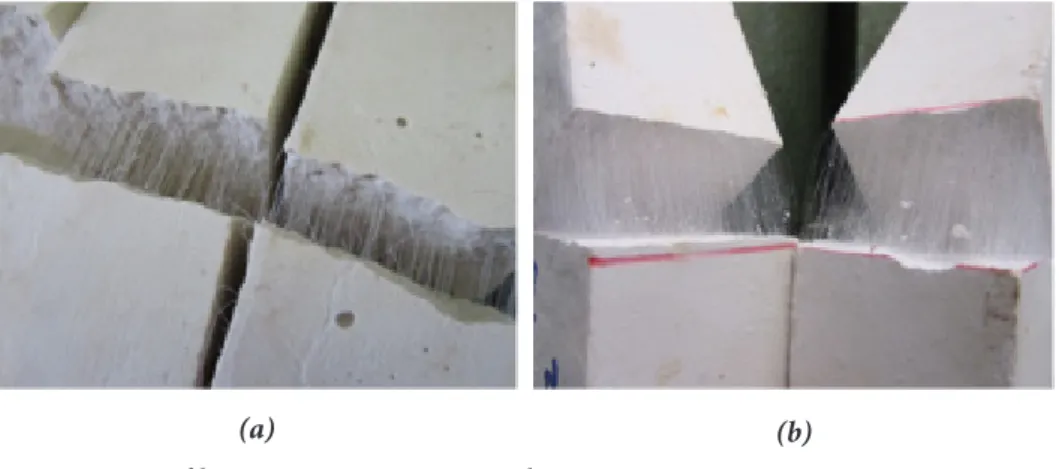
dry-ing-oven for 7 days. For experiments made to determine the modulus of elasticity and toughness values, the samples prepared were Φ75 mm x 150 mm. For determining the impact strength test 10 x 10 x 160 mm samples were produced (Fig. 1 a-b). The ho-mogeneous dispersion of the rPET fi-bers in the gypsum matrix can be seen clearly in the photographs.
2.2. SEM Analysis
SEM analysis were made to ana-lyze the micro structures of the rPET fibers used as reinforcement phases with the gypsum matrix in the com-posites. Thus, a clearer information will be obtained about the interaction, adherence and the behavior of the fi-bers between gypsum and fiber. SEM analyses were made in the ITU Nano/ Micro Electromechanical Systems Lab-oratory and Material LabLab-oratory of the Trento University in Italy. The mechan-ical tests were conducted with Seidner Form+Test Compression Testing Ma-chine with bending press (10 kN) and compression press (200 kN). The im-pact strength tests were investigated on a CEAST 2000, by the Charpy method, on notched specimen. TS EN 13279-1, TS EN 13279-2 standards were used in all tests. The surfaces of ruptures were gold-sputtered for microscopy obser-vations by means of a Field Emission Scanning Electron Microscope
(FE-Figure 1. rPET fiber-gypsum composite samples.
SEM, Supra 40, Zeiss) for microstruc-tural analysis.
3. Results and discussion 3.1. Mechanical properties of gypsum-rPET fibers composites
Mechanical resistance strength of fiber-reinforced composites changes in relation to the adherence between the matrix and the phase. The fibers are bound together and are held aligned in the important stressed directions by matrix. Through the matrix, the prin-cipal load bearing elements are fibers, and these loads are transferred to the fibers by the matrix. The efficiency of this transfer is related to the quality of the bond between the fiber and the matrix. The adherence between the surface of the fibers and the matrix must be strong and the matrix must be able to transform the shear stress to the fibers (Özkul, 2016). Accordingly, critical fiber length gains importance for the composites reinforced with staple fibers. In situations where fibers shorter than the critical fiber length are used, the fibers do not have a strength-ening effect in the composite. Addi-tionally, if the adherence between the fiber and the matrix is weak, the fibers get out of the matrix and are separat-ed. The critical fiber length of the rPET fiber that will be used for tests is cal-culated by the Kelly-Tyson correlation given in Formula 1 (Erdem, 2013). Here, lcrit representscritical fiber length,
σ the tensile strength of the fiber, d the
diameter of the fiber and τ the shear stress. The critical fiber length has been calculated as 10 mm according to this.
(1)
Another approach in determining the critical fiber length was used and gypsum composites reinforced with rPET fibers were produced with the
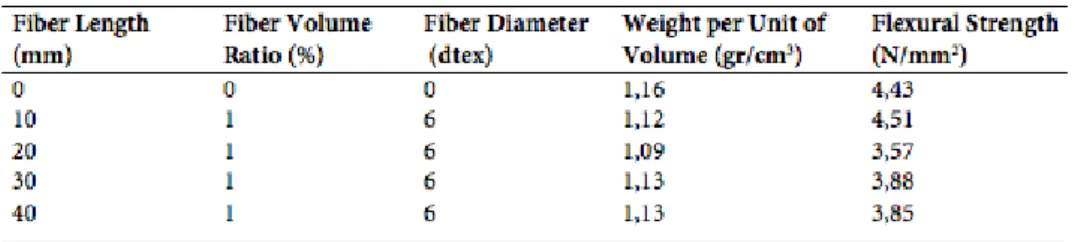
same volume ratio (1%) and with dif-ferent lengths (10, 20, 30 and 40mm). Adherence-enhancing additives were not added into these samples. Table 1 includes weight per unit of volume and flexural strengths of these composites.
As seen in Table 1, the weight per unit of volume of the reference gyp-sum is measured as 1,16 gr/cm3. It
is observed that the weight per unit of volume value of the gypsum com-posites decreases due to the addition of fibers. Additionally, the flexural strengths of the composites decrease as the fiber length increases. Eve, et al. (2002) analyzed the properties of gypsum composites reinforced with different lengths of polyamide fibers and determined that as fiber lengths increase, the fibers were not dispersed homogeneously in the matrix and thus the flexural strengths of the samples decrease. The reason for this decrease was explained by the increase in the capillary structure of the composites (Eve et al., 2002). Similar results were achieved in this study as well. With the addition of the rPET fiber, the capillary structure of the composite increased, as the fiber length increased, the fibers were not dispersed homogenously. It was determined that the sample pre-pared with the 10mm fiber had the highest flexural strength. Results of ex-perimental studies also prove that the critical 10 mm fiber length determined by calculations is the right decision.
Figure 2 shows the weight per unit of volume graph of samples. The weight per unit of volume of the refer-ence gypsum without fiber is 1,12 gr/ cm3. It is seen that as the fiber ratio
in-creases, the values of samples with 3,3 dtex do not change. There is an insig-nificant increase to 1,13 gr/cm3’e in the
values of the samples with %0,75, %0,1, %0,15, %0,2 and % 0,5 fiber in volume. The reason for this situation is believed to be the increasing capillary structure Table 1. Flexural strength values of gypsum composites reinforced with fibers of different
due to the increase in the fiber volume ratio. It was determined that sample values of 3,3 dtex fiber composites and reference gypsum sample without fiber were the same, 1,12 gr/cm3 between the
ratios 0,05% and 0,2%. As per volume, between the ratios %0,25 and %1, the weight per unit of volume of samples containing 6,6 dtex fiber decreased a little and was determined as 1,11 gr/
cm3. Table 2 shows test results
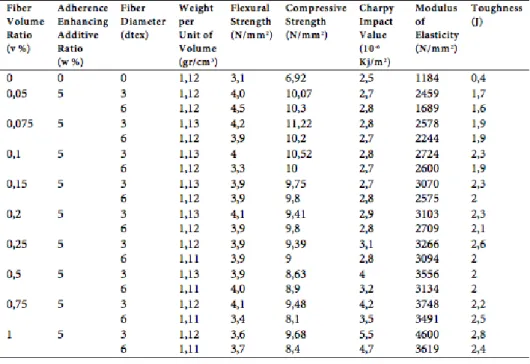
belong-ing to composites containbelong-ing 10mm long 3,3 and 6i6 dtex rPET fibers and reinforced with PVA based adherence enhancing additives.
The compressive strength of the ref-erence gypsum without fiber is 3,1 N/ mm2. Although there is a decrease in
the compressive strengths of the com-posites due to the increase in the fiber volume ratio, it is determined that these values are higher than those of the reference gypsum without fiber. With the addition of the fiber, the compressive strength of the gypsum has increased almost 62% (See Fig. 3). The sample with the highest value has 0,075% fiber by volume. It is believed that the fibers counterbalance the hor-izontal tensile stress and prevent the shear stress and horizontal swellings formed in the composites. Therefore, it can be said that the mechanical resis-tance of the composites has increased. Siddique et al. (2008), in a citation from Soroushian et al. (2003), stated that the compressive strengths of con-crete composites reinforced with recy-cled polymer fibers increased a small amount (Siddique et al., 2008).
Figure 4 shows the test results of the three-point bending method carried out on the composites with a dimen-sion of 40x40x160 mm. The effect of fiber addition is seen clearly in case of flexion. Additionally, fibrous charac-Table 2. Properties of rPET fiber-gypsum composites.
Figure 2. Graph showing weight per unit of
volume of composites.
Figure 3. Graph showing compressive
teristics such as the type, form, slender-ness ratio and volume ratio of the fiber play an important role in toughness (Ersoy, 2001). In this study, the flexural strength values of all composites have increased with the addition of the fiber. The highest flexural strength value is 4,47 N/mm2 andthis was determined in
the 0,05% fiber by volume composites with 6,6 dtex fiber. Nevertheless, as the fiber proportion increased, the flexural strength of composites decreased a lit-tle. Similarly, Eve et al. (2002), in their study analyzing the gypsum compos-ites with polyamide fibers, expressed that the flexural strength of composites decreased with the increase in fiber by volume ratio and that samples includ-ing polyamide fiber between 0% and 1% by volume have the highest value (Eve et al., 2002).
When Table 1 and Table 2 are an-alyzed, the positive effect off adher-ence-enhancing additives on the flexural strengths of fiber reinforced composites are clearly seen. In Table 1, it is seen that in comparison with the reference gypsum without fiber, there is an insignificant increase in the flex-ural strength values of the composites with fibers with no adherence-enhanc-ing additives. However, in Table 2 it is seen that with the addition of the adherence enhancing additives there is a 42% improvement in the flexural strength values. It is determined that the adherence-enhancing additive surrounds the fibers and improves the adherence between fiber and gypsum that is weak and decreases the porosity of the matrix.
In fiber-reinforced composites, not only the volume ratio, but also the di-ameter of the fiber influences the me-chanical endurance of the composites. As the length/diameter ratio of the fibers increase the amount of weight transferred to the fibers by the matrix also increases. When sufficient inter-face bond is provided for the compos-ites produced by small diameter fibers, higher strength is achieved than the composites reinforced with large di-ameter fibers (Şahin, 2006). It is de-termined here as well that the tough-ness of samples with 3,3 dtex fibers are higher than the others.
Charpy impact test results involving
10x10x160 mm composites are shown as graphics in Figure 5. As expected, as the fiber volume ratio increases, the impact resistance values of com-posites also increase. Impact value is improved almost twice and the highest impact value belongs to the composites Figure 4. Flexural strength of composites
graph.
Figure 6. Modulus of elasticity of
composites.
Figure 5. Charpy impact value of composites
graph.
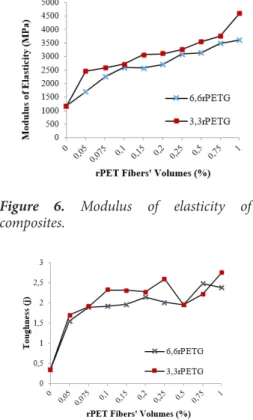
with the highest amount of fiber (1%). The fact that the gypsum composite has a higher impact resistance in com-parison to reference gypsum without fiber can be explained with the “Gor-don-Cook” theory. The impact power is directed towards the direction of the fiber when approaching the fiber. A large part of the deformation power is transformed into tensile strength and friction. Because of this, shear stress is created between the fiber and the ma-trix and this situation continues until the adherence between the fiber and the matrix is weakened (Ersoy, 2001). The use of adherence enhancing addi-tives in this study strengthens this situ-ation and consequently decreases con-siderably the brittleness of the gypsum. It is seen in Figure 6 that the mod-ulus of elasticity values of the com-posites increase as the amount of fi-ber increases. It is determined that composites with 1% of fiber volume have the highest modulus of elasticity values. Pursuant to the static modu-lus of elasticity correlation, although tensile strengths of composites with different fiber volume proportions do not change significantly, deformation decreases because of the increase in fi-ber and hence causes an increase in the modulus of elasticity. Figure 7 shows the toughness values of the composites. As the amount of fiber increases, there is an increase in the toughness values also increase, like the modulus of elas-ticity. This increase is an expected re-sult in all fiber-reinforced composites. The impact strength of the gypsum samples is increased with rPET fibers. The toughness value of the reference gypsum sample without fiber was in-creased 7 times following the addition of fibers. When the toughness values of the composites with the lowest fi-ber ratio (0,05% of volume) and the composite with the highest fiber ration (1% of volume) are compared, there is approximately a 62% improvement. Fibers prevent the micro cracks from developing into macro cracks in the composites under stress and thus pre-vent sudden fractures in composites because of compression and impact. Toughness value results calculated by the stress deformation graph support the results of the Charpy impact test.
Like all other composites with brittle matrix and ductile fibers, the power holding characteristic of the materi-al increases toughness under pressure (Ersoy, 2001). Similarly, Parres (2009) stated that under impact the brittleness of gypsum reinforced with polyamide fibers obtained from wasted tires de-creases with the addition of fibers (Par-res et al., 2009).
Still, it is stated that no matter how strictly the production conditions are controlled, composites are generally among materials with highest failure rate (Aran, 1990). It is known that the amount of these failures change in re-lation to production methods. For ex-ample, manually produced composites have the highest rate of failure. Addi-tionally, in fiber reinforced compos-ites, failure occurs due to following reasons: the average fiber volume ratio being small, misplacement or breaking of the fiber, presence of fibers not dis-persed homogenously and dense parts in the matrix, delamination, errors due to setting of the material, resin cracks formed during cooling at the end of the production and errors due to the pres-ence of areas with fibers undampened by the matrix (Aran, 1990). Likewise, it is stated that these failures lower the strength of the composite materi-als and the drop gets bigger by the in-crease of strain.
In this study, many unfavorable situ-ations in line with the above-mentioned views have been encountered. The gyp-sum paste was first mixed with a mixer but it was observed that the fibers stuck to the mixer and formed balls and did not disperse homogeneously. There-fore, the method of manual production was preferred to mix the gypsum paste and the mixing of fibers into the gyp-sum paste. However, the above-men-tioned failures occurred in the gypsum composite and accordingly, there were drops in the mechanical strengths of the composite samples.
3.2. Morphology of gypsum-recycled PET fiber composites
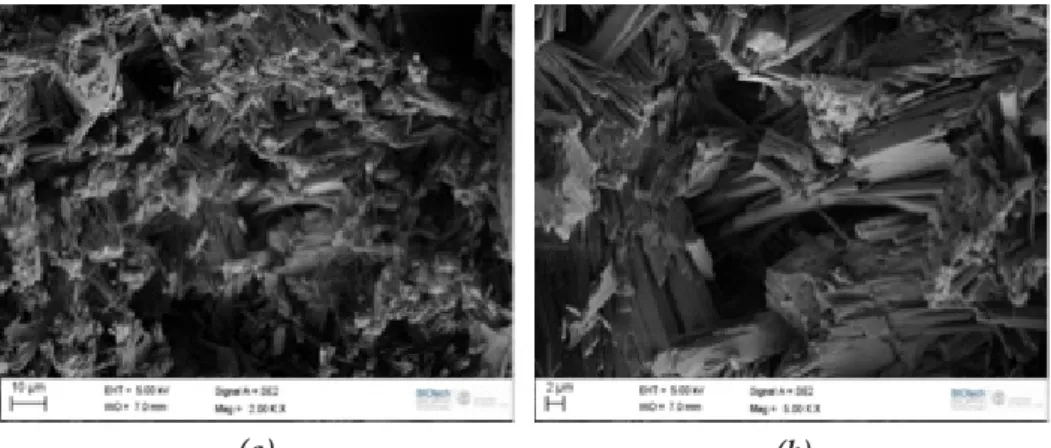
The micro analysis of gypsum com-posites and the dispersion of fibers in the matrix was carried out by scanning electron microscope (SEM). When the reference gypsum without fiber in
Fig-ure 7a-b is analyzed, small needle-like crystals inside the gypsum is seen. These crystals have a complex layout and a random orientation. When the microstructure of the gypsum was ana-lyzed in other studies small needle-like crystals were similarly observed (See Eve et al. 2007).
Figure 8 shows the SEM images of gypsum composites containing only fiber and without
adherence-enhanc-ing additives. In these photographs the crystalline microstructure of the fiber, rPET fibers, dehydrate crystals adhered to the fibers and details of the bond between the fiber and the gyp-sum are seen.
In the preliminary tests, mois-ture-free fibers were used in the gyp-sum paste but as they did not disperse homogeneously, uncut and unfinished rPET fibers were procured from the Figure 7. SEM photographs of reference gypsum samples without fiber magnified (a) 2.00
KX, (b) 5.00 KX times.
Figure 8. SEM photographs magnified 500 X times of gypsum composites reinforced with 6,6
dtex rPET fibers and without adherence-enhancing additives.
Figure 9. SEM photographs magnified 1.00 KX times of gypsum composites reinforced with
3,3 dtex rPET fibers and with adherence-enhancing additives.
(a) (a) (a) (b) (b) (b)
company. These moist fibers were cut according to the critical fiber length and were used in the composite. How-ever, the use of moist fibers created a problem. During the sample produc-tion process, following the drying of composites in the drying-oven, the fi-bers lost some of the water they con-tained and because of the decrease in volume the fibers shrunk and voids were formed around them. Although the dehydrate crystals adhered to the fibers show some amount of adher-ence between the gypsum matrix and the fibers, the presence of voids around the fibers indicate the weakness of the adherence between the fiber and the gypsum matrix (See Figure 8a-b). In other words, it is believed that ade-quate adherence between the gypsum matrix and the fibers was not achieved because of these voids. Similar results were found in literature research (Eve et al., 2007).
In Figures 9 and 10 the dispersion of the rPET fibers inside the gypsum composites that contain adherence-en-hancing additive. The voids seen around the fibers in Figure 8 are not seen in these composites because of the added adherence-enhancing additives.
Rubio-Avalos et al. (2005) have stat-ed that by the addition of styrene-buta-diene latex additives into the gypsum, the capillary voids in the gypsum ma-trix are filled and this additive coats the surfaces of the gypsum crystals, and forms a polymer film layer, in other words a polymer mesh layer inside the matrix. Thus, under strain, the spread of micro cracks in the composites is prevented and the flexural strength of the composites is increased
(Ru-bio-Avalos et al., 2005). Here as well, it can be said that, following the addition of the adherence enhancing additive, a polymer film layer was created in-side the gypsum matrix similarly and the adherence enhancer surrounded the fibers and increased the adherence between the gypsum and the fibers. Following this improvement, the me-chanical strength of the composites has increased.
4. Conclusion
Studies made to decrease the use of raw material resources to produce building materials and the energy used for the production-consumption pro-cesses, to minimize the direct or indi-rect harm given to the environment, gain more importance every day. In this study, fiber from wasted PET bot-tles was added into the gypsum matrix and a composite material was designed and produced in lab scale. Thus, the aim was to achieve both economic and ecologic benefits and to improve prop-erties of gypsum such as the low impact strength-toughness value. In the tests carried out, first rPET fibers in different lengths were added into the gypsum matrix and the flexural strength values of these composites were determined and compared. Their strength values were observed to be lower than the gypsum without fiber. In tests made for a homogenous mixture and to deter-mine the fiber length, it was observed that as the fiber length increased, the fi-bers were not dispersed homogenously in the composite and accordingly their strength values dropped. It was decid-ed that the best way to prevent fibers forming lumps in the mixture was to Figure 10. SEM photographs magnified 1.00 KX times of gypsum composites reinforced
with 6,6 dtex rPET fibers and with adherence-enhancing additives.
leave the fibers in water before the mix-ing process and ensure their homoge-nous dispersion. As a result of these tests, critical fiber length was deter-mined to be 10 mm. When it was de-termined that the adherence between the fiber and the gypsum was not ad-equate, adherence enhancing additives were added to the composite. In the micro analysis, when the additive was added it was observed that the adher-ence enhancer surrounded the fibers, increased the bond between the fibers and the gypsum and improved adher-ence. In other words, it was observed that voids that decreased the adher-ence and the strength were not creat-ed around the fibers. In measurement performed under these conditions, a significant increase in the mechanical strengths of the composites was deter-mined. Thus, an improvement of 60% in the compressive strength and 40% in the flexural strength of the compos-ites were achieved. It is also believed that in flexural strength, the fibers met horizontal tensile stress and prevented the shear stress and horizontal swell-ing formed in the composites. The best performance was achieved with com-posites containing 0,1% fiber by vol-ume. The use of fiber and adherence enhancer together improved more than expected the toughness and im-pact resistance values of gypsum. The toughness value increased almost 7 times while the impact resistance value increased twice. The modulus of elas-ticity also increased significantly. These results are believed to be guiding for studies made to solve problems devel-oping due to the use of wasted fiber in the composites. It is believed that the compressive strengths of composites may be improved by the production of composites with the fibers placed orderly in a single direction instead of a random dispersion. When the fibers are dispersed angularly, when force is applied perpendicularly to direction of the fiber, the fibers act like voids in the composites and some amount of decrease is seen in the strength of the composites (Arıoğlu et al., 2008). However, when force is applied per-pendicular to the fibers, the reaction of the fibers will change. Therefore, laying down the fibers biaxial and
uni-formly in the composites must also be researched.
Acknowledgements
The authors gratefully acknowledge Prof. Dr. Erol Gürdal, Prof. Dr. Clau-dio Migliaresi, Assoc. Prof. Dr. Levent Trabzon, Dr. Serkan Yatağan, Dr. Dario Zeni, İbrahim Öztürk, Prof. Dr. Ergin Arıoğlu, Zehra Kundak, Mümin Bala-ban and for their helpful participation and also appreciate the hospitality of the Department of Materials and In-dustrial Technologies at the University of Trento, Italy.
References
Ahmad, I., Mosadeghzad, Z., Daik, R. and Ramli, A. (2008). The effect of alkali treatment and filler size on the properties of sawdust/UPR composites based on recycled PET wastes, Journal
of Applied Sciences, 109, 3651–3658.
Aran, A. (1990). Elyaf Takviyeli
Karma Malzemeler, [Fiber Reinforced Composites], İstanbul: İstanbul
Techni-cal University Rectorship Offset Shop, Turkey.
Arıoğlu, E., Yüksel, A., Yılmaz, A.,O. (2008) Püskürtme Beton, Bilgi
Föyleri-Çözümlü Problemler, [Shot-crete, Data Sheets- Problems with Solu-tions], Chamber of Mining Engineers of
Turkey Publishing No:142, İstanbul. Ersoy, H. Y. (2001). Kompozit
Mal-zeme, [Composite Materials], İstanbul:
Literatür Publishing.
Eve, S., Gomina, M., Hamel, J. & Orange, G. (2002). Microstructural and mechanical behaviour of polyam-ide fibre-reinforced plaster composites,
Journal of the European Ceramic Soci-ety, 22, 2269-2275.
Eve, S., Gomina, M., Ozouf, J. C. & Orange, G. (2007). Microstructure of latex-filled plaster composites, Journal
of the European Ceramic Society, 27,
1395-1398.
Lei, Y., Wu, Q., Clemons, C. and Guo, W. (2009). Phase structure and properties of poly(ethylene terephthal-ate) / high-density polyethylene based on recycled materials, Journal of
Ap-plied Polymer Science, 113, 1710–1719.
Özkul, H., (2016). Composite
Mate-rials Lecture Notes, Istanbul Technical
Erdem, S. (2013). Geri dönüştürülmüş PET lifi-alçı kom-pozitlerin özelliklerinin belirlenmesi, [An analysis of the properties of the re-cycled PET fiber-gypsum composites], (Ph.D. Thesis), Istanbul Technical Uni-versity, Turkey.
Parres, F., Crespo-Amorós, J. E. and Nadal-Gisbert, A. (2009). Mechanical properties analysis of plaster reinforced with fiber and microfiber obtained from shredded tires, Construction and
Build-ing Materials, 23, 3182-3188.
Rubio-Avalos, J. C., Manza-no-Ramírez, A., Luna-Bárcenas, J. G.,
Pérez-Robles, J. F., Alonso-Guzmán, E. M., Contreras-García, M. E. & González-Hernández, J. (2005). Flex-ural behaviour and microstructure of a gypsum-SBR composite material,
Ma-terials Letters, 59, 230–233.
Siddique, R., Khatib, J. and Kaur, I. (2008). Use of recycled plastic in con-crete: a review, Waste Management, 28, 1835-1852.
SUDER (http://www.suder.org.tr) Şahin, Y. (2006). Kompozit
Malzem-elere Giriş, [Introduction to Composite Materials], Ankara: Seçkin Publishing.