Citation: Pa ge
12
Pa ge12
Financial contributions and economic outlook in
Bosnia from Dayton to 2008 global economic
recession
Umit Hacioglu
Faculty of Economics and Administrative Sciences, Beykent University, Istanbul, Turkey [email protected]
Hasan Dincer
Faculty of Economics and Administrative Sciences, Beykent University, Istanbul, Turkey
Abstract
Following the end of the war in Bosnia (1992-1995), approximately 90 percent of Bosnia’s economic infrastructure and assets destroyed costing more than 20 billion dollars according to the World Bank sources. By the end of the war, the unemployment rate in the new state has reached to 90 percent. With the contribution of the World Bank and other NGOs into Bosnian economic rehabilitation and recovery process, unemployment rate in the country significantly fell to 30 percent. The latest studies in literature illustrates that “Conflict” naturally has negative effects on economic activity, investment climate, financial stability, welfare and growth rate of conflicting parties. Moreover, the link between the risk of conflict recurring level and the low income illustrated in studies must be taken into consideration seriously in the era of global economic recession. The peace and stability in Bosnia maintained by military contribution depends on the success of recovery process of Bosnian economy. However, the global economic recession has been affecting the economic activity in region. In this study, the effects of conflict in Bosnia on economic activity have been illustrated and the recovery process of Bosnian economy from The Dayton Accords to the era of global economic crisis has been evaluated. The role of the World Bank and NGOs in recovery process has been also examined.
Pa ge
13
Pa ge13
1. IntroductionThe Region of the Balkans is recently one of the most important places in the world shaping the politics and international relations. Moreover, the region in literature is also defined as “the powder keg of Europe”. At the last century the region experienced two dramatic events: I. and II. World War and the interethnic conflict emerged during the collapse of the Federation of Yugoslavia. Nowadays, the region is experiencing heavy economic turmoil which can be a threat to peace and stability in post conflicted societies.
The Economic prosperity as an important paradigm for emerging markets and post conflicted economies is attractive issue in literature in era of global economic recession. Moreover, with the contribution of the World Bank, IMF, OECD and other NGOS, it is tried to overcome negative effects of the conflict experienced in Bosnia and Kosovo on economic activity. The main program of rehabilitation process is titled as Reconstruction and Recovery Program. This program also emphasizes on fighting against unemployment and poverty which escalates the risk of conflict.
According to World Bank statistics, in the last 20 years, 80% of the world's poorest 20 countries witnessed confusion, conflict or civil war. In the first 5 years, post-conflict economic growth in these countries increased by 44%, indicates the contribution of economic prosperity to peace (WBR, 1998).
The link between economic growth and stability achieved in post conflict era also illustrates the link between poverty and conflict risks in the foreground.
The latest studies demonstrate the relations between the level of conflict risk and unemployment, inequality in income and resource allocation, poverty, and lack of authority, economic integration problem in the region and the world and the lack of fiscal and monetary discipline (Evans, 2011; Collier, 1999; Collier and Hoeffler, 2002; Collier and Hoeffler, 2004; Collier et al., 2007; Collier, 1999).
The conflict naturally with its fatal effects on investment climate, financial stability, infrastructure and human resources devastates national welfare. Within a general frame, the conflict has two main catastrophic impacts on economics. The first impact on economy stems from the lack of fiscal discipline. Government in conflict situation has to fuel the army’s activities. The second impact is related to market discipline and functionality. The risk of conflict and disciplinary erosion in monetary politics has negative “crowding out” effect on private investor (Orhan, et al, 2009; Hacioglu, 2009; Hacioglu, 2010).
Pa ge
14
Pa ge14
2. 1991-1995 Bosnian War and Destruction on the Economy
During the disintegration of Yugoslavia, the bloodiest pages of history are written in Bosnia- Herzegovina between 1991- 1995. War in the country causes to around 250,000 civilians lost their lives, it induces also approximately 200,000 civilians were injured, approximately one million people end up homeless, and 1.5 million people became refugees. Although it has been many years out of the war, In Bosnia, especially in Srebrenica, mass graves are still mined and perpetrators, who killed to innocent Bosnians, cannot be (Holbrooke, 1998; Yenigun and Hacioglu, 2010).
Although passing of years on the war, destruction on national economy still can be felt. While the country's key industry and economic infrastructure is heavily damage during the war, Gross Domestic Product (GDP) has dropped to $ 2.1 billion, decreasing by 80%. On the other side, per capita income has declined from $ 2,450 to $ 500. The most important economic devastation created by the war has emerged as halt of production of the key industry, as we look at the socio-economic side, 90% of the total population has become dependent on foreign aid to survive according to DB statistics. Although 20 years after the start of the war and after the end of the war 16 years, unemployment rate in the country has become a structural problem. Currently, the unemployment rate in this country remains at the level of about 35%.
Although Bosnia-Herzegovina is the leading of the weak economies of the Federation before the war, it had an important power especially in heavy metal industry and constructional work. It is understood from reports, which is described in The World Bank Development Programs that the Bosnia was talented and it had highly educated workforce before the war (WBR, 2002; Rozen, 1996; WBP, 2000). Bosnia had a significant production capacity on electricity generation, lumbering, textiles, clothing, industrial machinery manufacturing business lines. Together with the war, these sectors that constitute the backbone of the economy have been destroyed. While the war changing social status of civilians, it also taking away the civilians’ inherent right to life. On the one hand people have lost their jobs; on the other hand they were required to vital support on the basic issues such as the nourishment, shelter, safety, health, transportation, communication, water supply and so on. Along with the destroying economic structure in country, the main agricultural activities also have come to an end, infrastructure such as electricity, under drainage and railway have collapsed, liquid assets that individuals have in banks are frozen, and cash have lost to its value.
Pa ge
15
Pa ge15
3. Political Economic Outlook aftermath the Dayton Peace Accord (1995)
While The Dayton Peace Accord ended the war in Bosnia that took place between the years of 1991-1995, it also provided the recognition of BiH as a new state on the world stage. Although Bosnians, who are victims of war and lost their lands, exposed to assimilation and genocide, can’t reach to their rights, they have had a new state with the termination of the war. However, this state became the center of the bureaucratic and political problems in a short span of time as the premature product of delayed peace treaty that having double-headed regulatory system, gathering under a single roof to interchanging presidency system (Yenigun and Hacioglu, 2010) Annex 3a determines the nature of presidency system (Dayton Accord, Annex 3A):
“Free and fair, internationally supervised elections will be conducted within six to nine months for the Presidency and House of Representatives of Bosnia and Herzegovina, for the House of Representatives of the Federation and the National Assembly and presidency of the Bosnian Serb Republic, and, if feasible, for local offices”
Article of Dayton Peace Accord provides for gather under a single roof of warring factions. According to this Accord, while Bosnian Croats and Bosnians come under the Federation (FBiH), Bosnian Serb established its own autonomous states under Republika Srpska (RS). It is expected that, these two states operate autonomously in their internal affairs under the umbrella of BiH and they common action on topics such as foreign policy, customs application and EU relations (Yenigun and Hacioglu, 2010).
By virtue Dayton Peace Accord, to gather under a single roof of parties plays an important role providing the stability and peace. Economic growth can be sustainable, the country's fiscal discipline should be ensured, permanent solutions are necessary to unemployment problem for achieve the political stability (Hacioglu, 2009). In this context, a new agenda for economic development of Bosnia is provided under the auspices of the High Representative. Legal basis of new economic development calendar is Dayton Peace Accord. Factors located in new calendar: (i) the gather under a single roof to discrete-economic systems, (ii) the establishment of economic institutions and organizations on countrywide, (iii) the establishment of the Central Bank, (iv) the creation of a single Bosnia currency (v) the
Pa ge
16
Pa ge16
determination to country's customs and tariff policies, (vi) the management of public debt (Dayton Accord).
By virtue Dayton Accord, it is provided to be created of board, which managing the country's monetary policies and reserves for a period of 6 years and to be created of Bosnia currency unit that indexed to German Mark (CM-Convertible Mark; indexed to EUR in 2002). The country's public buildings have been constructed up to 1997. After the establishment of the Parliament and the Council of Ministers, macro-economic legislative packages are quickly published in the assembly in accordance with Dayton (1997). Country’s currency, the state budget, customs tariffs and policies, foreign trade regulations, foreign debt management elements have been put into practiced by making lawful on these packages. Immediately after this legislative work $90 million financial backing is provided within the framework Stand-by Accord with the IMF (WB, 1997). In parallel with the implemented of the economic recovery and financial institutions, more reliable data and statistics for the country’s economy have started to get since 1997.
Despite the efforts of the High Representative (OHR), the problems experienced on the common financial issues of Federation of Bosnia - Herzegovina and Republika Srpska (RS) in the double-headed and premature state structure that emerged after the The Dayton Accords increases. When the efficiency and functionality problem of interchanging presidency system added to RS’s uncompromising attitude, economic development efforts from time to time have reached a deadlock (Yenigun and Hacioglu, 2010).
In particular, Bosnian Serbs denied paying to the World Bank the amount that belonged to themselves from the Former Yugoslavia’s debit and their uncompromising attitude about the war criminals caused to delay in economic aid to Bosnia. The uncertainties and a weak economic structure in the post-war period has accelerated to migration abroad of young people and this situation also has been hampered the post-war refugees re-settle in their homeland (Effeon and O’brien, 2004; Yenigun and Hacioglu, 2010).
The Central Bank has become fully-entitled to ensure fiscal discipline with the close contact of IMF and with the authorization from OHR (www.ohr.int). It is observed on Figure 5 that, Bosnia-Herzegovina and Croatia has brought under the control of inflation more effectively as compared with the Serbia and Kosovo.
4. Economic Conditions in Bosnia
By the end of the Federation of Yugoslavia, the UN oversaw a long time bloody conflicts in Bosnia. The conflicts in Bosnia devastated peace and stability for all ethnic groups.
Pa ge
17
Pa ge17
Bosnian Serbs backed by Serbia have all opportunities to gain access to federation’s heavy arms. Federation air forces and land forces were dominating everywhere bombing civilians targeting specially Bosnians surrounding major cities such as Sarajevo, Tuzla, Bihac and many others even though the UN Security Council announced security zones including 6 of them.
The conflict and deepening security issue in Bosnia and Croatia and subsequently in Kosovo devastated fundamental living conditions. The major impacts of the conflict melt down economic stability and activity. Economic instability subsequently resulted in lower income level, lack of monetary and fiscal discipline, higher unemployment, inflation rates and debt ratios. On the other hand, the impacts of conflict on infrastructure affected production and energy facilities, transportation, supply, health services, market conditions and communication channels. Violence, thievery, corruption, human trafficking, abuse of women and refugee problems were some of social diseases experienced during turmoil (Hacioglu, 2008).
By the end of war in Bosnia (Dayton Accord, 1995), reconstruction and recovery program of Bosnian state aimed to facilitate economic and social activity. International actors including The UN, EU, the World Bank, the IMF and NGOs had preliminary role in the process of reconstruction and recovery.
Even though seventeen years of The Dayton Accords has been in practice, it is early to mention the success of the peace stability efforts and economic recovery programs. Moreover, the region is still prone to interethnic conflict while many issues are still far away from solution.
The risk of conflict in the Balkans is still available and depends on political and social uncertainty. The conflict risk attached to post conflict economies affect economic stability, prosperity and development while discouraging international entrepreneurs for future investment decisions required boosting economic activities in the area. The conflict risk in the region also affects the compliance of conflict-torn economies with neighboring and global economies. In this context, the risk of conflict in the area has negative impacts on investment climate and economic stability.
Due to the collapse of economic conditions and infrastructure in Bosnia between 1992 and 1995, reliable sources and data on economic activity could not be obtained. Moreover, the impact of war felt countrywide following the next 10 years by the end of war. Following the intervention of the World Bank, IMF and the UNCTAD into recovery process and stability efforts, there became some opportunities to maintain country statistics. In 1998, the recovery
Pa ge
18
Pa ge18
program took place in practice and matured following years until 2008 global economic crisis and European Debt Crisis.
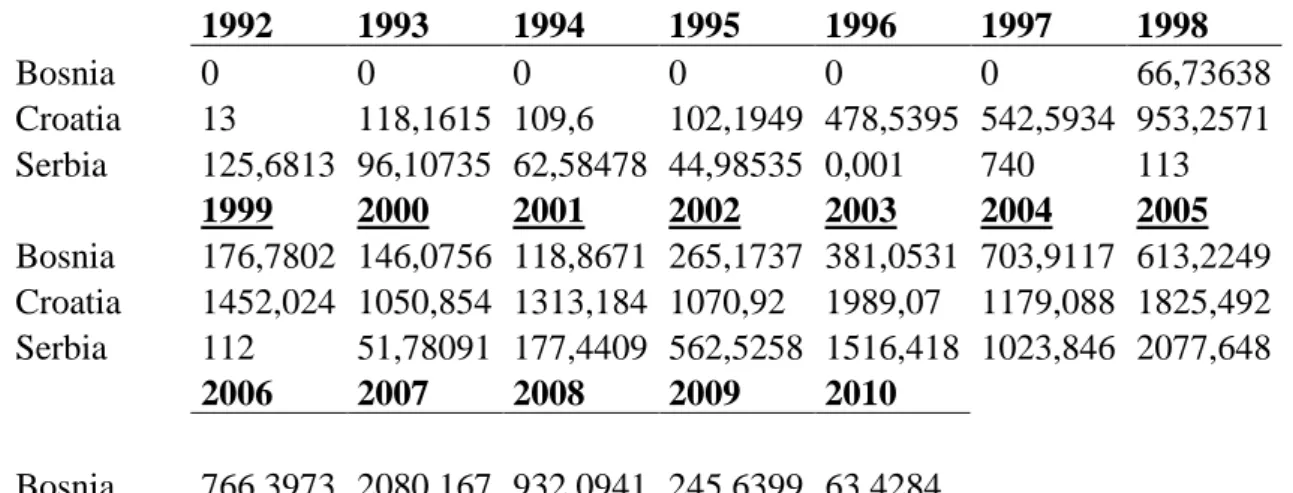
1992 1993 1994 1995 1996 1997 1998 Bosnia 0 0 0 0 0 0 66,73638 Croatia 13 118,1615 109,6 102,1949 478,5395 542,5934 953,2571 Serbia 125,6813 96,10735 62,58478 44,98535 0,001 740 113 1999 2000 2001 2002 2003 2004 2005 Bosnia 176,7802 146,0756 118,8671 265,1737 381,0531 703,9117 613,2249 Croatia 1452,024 1050,854 1313,184 1070,92 1989,07 1179,088 1825,492 Serbia 112 51,78091 177,4409 562,5258 1516,418 1023,846 2077,648 2006 2007 2008 2009 2010 Bosnia 766,3973 2080,167 932,0941 245,6399 63,4284 Croatia 3472,802 5035,372 6179,178 2911,247 582,605 Serbia 4877,706 4373,359 2955,296 1958,844 1328,558
Table 1: Foreign Direct Investments- FDIs (1992-2010)
Source: UNCTADstat
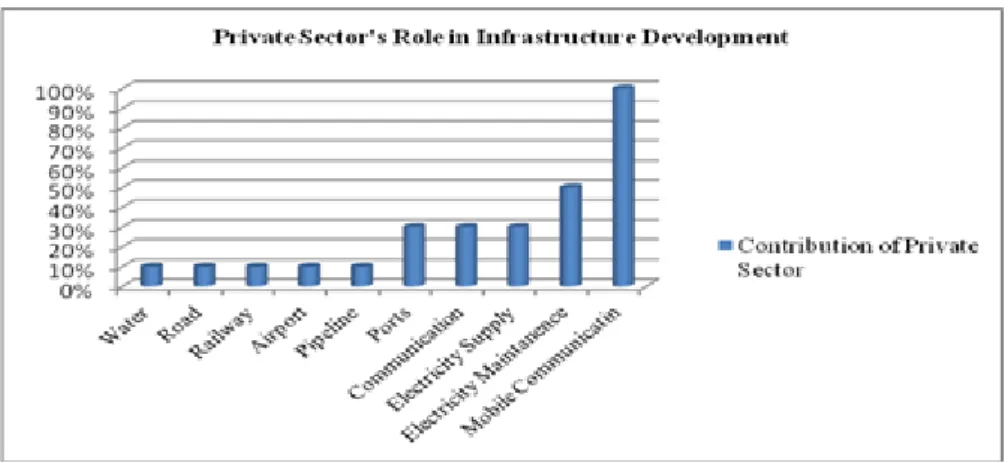
The World Bank, EU, and the United Nations contributed immediately to the Reconstruction and Recovery Process required for economic development of Bosnia simultaneously with other NGOs and private entrepreneurs. Private entrepreneurs have special role in reconstruction process of infrastructure including especially mobile communication and energy supply (Schwartz et al., 2004; WBR, 1998).
Decrease is observed the risk of conflict recurrence which is parallel with economic growth after the reconstruction and recovery process in the countries which are subject to the conflict. Improvement of infrastructure is of vital importance in terms of economic reconstruction. Significant increase in contribution to developed countries’ infrastructure works will contribute to peace and stability. Figure 2 reveals the relationship between the risk of conflict and GDP per capita. And this figure shows that this risk is a significant increase in less developed countries (Collier and Hoeffler, 2002).
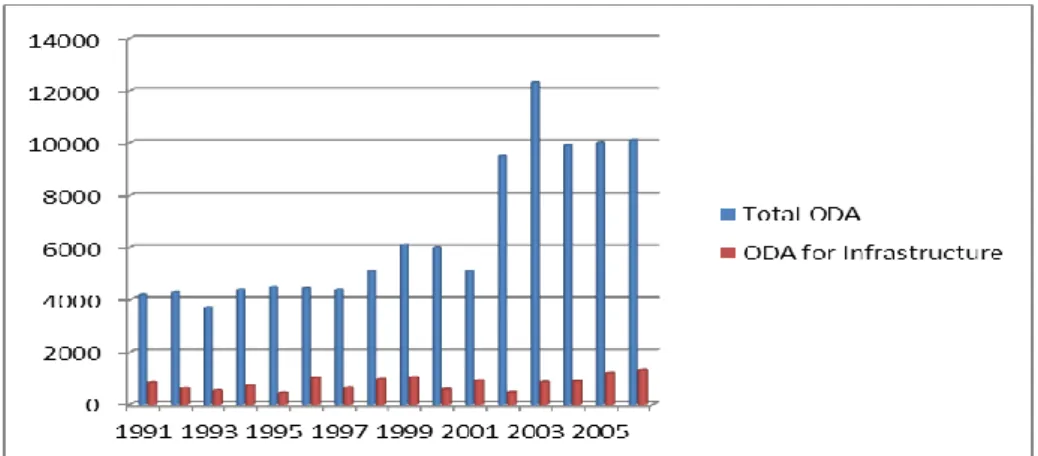
Financial contributions, which are provided for in post-conflict economies of OECD countries, are being transferred to infrastructure works through Official Development Assistance, ODA program. In this context, it is observed that a very limited portion of the general ODA resources transferred to the post-conflict areas (fig. 3). Economic growth that is supported by the infrastructure improvement will create increase in national product per capita so the risk of conflict recurrence will be limited.
Pa ge
19
Pa ge19
Figure 1: The Role of Private Sector in Infrastructure Development in Post Conflict
Condition.
Source: Schwartz et al,. 2004, p.15. Data used from 31 countries prone to conflict
Figure 2: Linear Relationship between the Probability of Conflict Recurrence and GDP Per
Capita
Source: Data for the Collier and Hoeffler, 2002, p.13-28
Post-conflict period, countries become addicted to external grants, even if they are in transitional periods. Especially, the completion of the reconstruction, economic recovery and reconstruction process and the creation of free market dynamics steady, integration with external markets and the development of economic infrastructure that is upgradable will reduce the conflict risk in these countries.
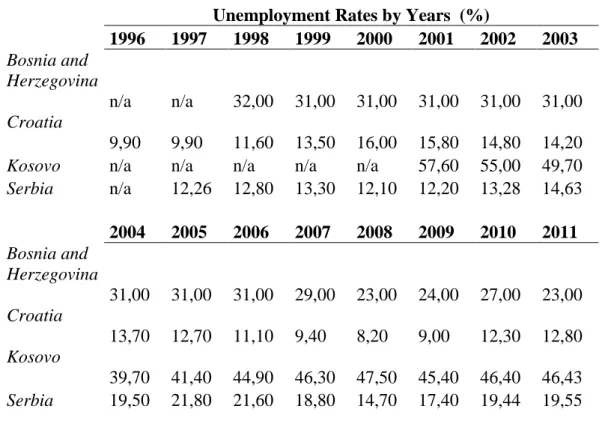
According to reports by the World Bank and the IMF, post-conflict in the Balkans, particularly in Kosovo and Bosnia, one of the main problems is unemployment. The last decade in Kosovo, according to official figures, the unemployment rate passes 40%.
Socio-economic life is threatened in BiH because unemployment is still a major problem in here. Especially, providing the national economy of skilled labor force, which left the country in post-war, and to make investment of multinational companies within the framework of social responsibility, will contribute to the recovery process.
Pa ge
20
Pa ge20
Figure 3: The Amount Allocated to Infrastructure in ODA Grants ($ Million)
Inflation Rates by Year (%)
1996 1997 1998 1999 2000 2001 2002 2003
Bosnia and Herzegovina
n/a n/a n/a 2,7 4,9 4,6 0,3 0,5
Croatia
71 3,7 9,1 4 4,6 3,7 1,6 1,7
Kosovo n/a n/a n/a n/a n/a 116 3,5 0,3
Serbia n/a n/a 30,00 41,10 70,00 80,60 8,86 2,91
2004 2005 2006 2007 2008 2009 2010 2011 Bosnia and Herzegovina 0,29 2,5 6,1 1,49 7,4 -0,3 2,1 5 Croatia 2,03 3,3 3,2 2,8 6,06 2,37 1,04 3,5 Kosovo -1 -1,4 0,6 4,3 9,35 -2,41 3,4 8,1 Serbia 10,61 17,28 12,67 6,50 12,43 8,11 6,17 9,90
Table 2: Inflation Rates by Years (1996-2011)
Source: IMF Data Base
Pa ge
21
Pa ge21
Unemployment Rates by Years (%)
1996 1997 1998 1999 2000 2001 2002 2003 Bosnia and Herzegovina n/a n/a 32,00 31,00 31,00 31,00 31,00 31,00 Croatia 9,90 9,90 11,60 13,50 16,00 15,80 14,80 14,20
Kosovo n/a n/a n/a n/a n/a 57,60 55,00 49,70
Serbia n/a 12,26 12,80 13,30 12,10 12,20 13,28 14,63 2004 2005 2006 2007 2008 2009 2010 2011 Bosnia and Herzegovina 31,00 31,00 31,00 29,00 23,00 24,00 27,00 23,00 Croatia 13,70 12,70 11,10 9,40 8,20 9,00 12,30 12,80 Kosovo 39,70 41,40 44,90 46,30 47,50 45,40 46,40 46,43 Serbia 19,50 21,80 21,60 18,80 14,70 17,40 19,44 19,55
Table 3: Unemployment Rates by Years (%), (1996-2011)
Source: IMF and World Bank Data Bank. Due to the war between 1991 and 1995 destructed to economic infrastructure, accurate data for this period cannot be obtained.
Figure 5: Unemployment Rates by Country (1996-2011)
It is understood that factors, which threaten the economic and political stability on post-conflict period in Balkans, affect the security issue at the same time. These primary factors (i) Energy shortages of economies that recently emerge in area (ii) The state mechanism that functions slowly (iii) Foreign aid dependency, (iv) The boundary problem that cannot be resolved, (v) Co-presidential system, (vi) The enforcement system, (vii) The global economic crisis, (viii) Budget deficits, (ix) intense political agenda and problems, (x) Re-appearance of historical hatred on the Serbian side after the independence of Kosovo and as a result, actions and riots that occasionally emerge.
Pa ge
22
Pa ge22
Immediately after the Treaty of Dayton, when the war was over in1995 in BiH, 90% of the country's economic infrastructure and assets were destroyed; skilled workforce transferred to abroad or was destroyed in the war (Cousen and Cater, 2001). According to World Bank estimates, it is expected that the reconstruction cost to country’s assets, which have been destroyed, to be over $ 20 billion (WBR, 1999). Post-war unemployment rates are seen on an average 30% in Bosnia and on an average 45% in Kosovo (Table 2, Figure 5: Unemployment Rate by Years). Efforts, which are obtained immediately after the war and after the Treaty of Dayton and intended to catch the pre-war level in 1991, could partially accomplish.
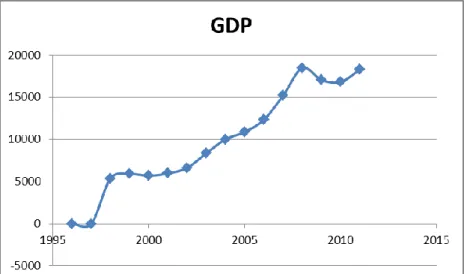
Foreign investment is recorded on very low levels by reason of political risk and instability, lack of legislation and uncertainties between 1996 and 1999 in BiH. In 2002 and 2004 increase was observed in foreign investment with the effect of privatization (see the Table 1). While foreign investments, respectively; the most is manufacturing, banking, trade, services, transportation and tourism sectors, foreign capital flows of BiH is from Austria (59.6%) that is maximum and from Croatia (14.8%). BiH has drawn foreign direct investment in 2004 and 338 million euros. In parallel with the recovery process in the post-war period, GDP and foreign direct investment inflows have rapidly increased (See also. Table 1 Figure 1: Direct foreign investments).
Although BiH, which harbor the most important industrial cities of the federation before the breakup of Yugoslavia, has entered into the process of recovery in post-war, unemployment problem is still shown the country’s biggest economic problem at the end of 15 years that have passed. Reports indicate that the country's unemployment rate is between 30-35 percent (WDR, 2011; IMF: World Economic Outlook Database 2011). Although, post-war Bosnia Economy has provided to rapid and significant recovery, this growth has been limited according to Serbia and Croatia.
5. Conclusion
The conflict naturally with its fatal effects on investment climate, financial stability, infrastructure and human resources devastates national welfare. Within a general frame, the conflict has two main catastrophic impacts on economics. The first impact on economy stems from the lack of fiscal discipline. Government in conflict situation has to fuel the army’s activities. The second impact is related to market discipline and functionality. The risk of conflict and disciplinary erosion in monetary politics has negative “crowding out” effect on private investor.
Pa ge
23
Pa ge23
GDP by Years (billion $) 1996 1997 1998 1999 2000 2001 2002 2003 Bosnia and Herzegovina n/a n/a 5.377 5.911 5.697 5.980 6.635 8.370 Croatia 23.380 20.118 21.625 19.891 21.336 22.870 26.471 33.875Kosovo n/a n/a n/a n/a 1.849 2.535 2.703 3.355
Serbia n/a n/a n/a n/a 8.661 11.433 15.099 19.671
2004 2005 2006 2007 2008 2009 2010 2011 Bosnia and Herzegovina 10.022 10.890 12.349 15.228 18.501 17.043 16.830 18.294 Croatia 40.710 44.420 49.076 58.604 69.308 63.040 60.589 65.137 Kosovo 3.621 3.741 3.918 4.651 5.668 5.449 5.601 6.488 Serbia 23.712 25.234 29.332 39.389 48.834 41.648 38.707 45.641
Table 4: GDP by Years (billion $), (1996-2011)
Source: IMF and World Bank Data Bank
Figure 6: GDP Increase by Years (the post-war period, 1996-2011)
Pa ge
24
Pa ge24
Figure 7: GDP Increase by Years in BiH
Source: IMF and World Bank Data Repository, 2011
Figure 8: Comparative GDP Figure (1996-2011)
Source: IMF and World Bank Data Repository, 2011
The Economic prosperity as an important paradigm for emerging markets and post conflicted economies is attractive issue in literature in era of global economic recession. Moreover, with the contribution of the World Bank, IMF, OECD and other NGOS, it is tried to overcome negative effects of the conflict experienced in Bosnia and Kosovo on economic activity. The main program of rehabilitation process is titled as Reconstruction and Recovery Program. This program also emphasizes on fighting against unemployment and poverty which escalates the risk of conflict.
The violent turmoil in Bosnia had negative impact on economic activity and market discipline. Following the end of war by the Dayton Peace Accords, economic prosperity and political stability were the key objectives. In this regard, the World Bank, EU, and the United
Pa ge
25
Pa ge25
Nations contributed immediately to the Reconstruction and Recovery Process which is a necessity for economic development of Bosnia. In addition to this NGOs and private entrepreneurs have also contributed to this recovery process. Private entrepreneurs have special role in reconstruction process of infrastructure in major sectors including especially health, education, transportation mobile communication and energy supply.
Economic Development and the Success of Recovery process depend on financial contributions. Financial contributions provided for post-conflict economies from OECD countries, are being transferred to infrastructure works through Official Development Assistance, ODA program. In this context, it is observed that a very limited portion of the general ODA resources transferred to the post-conflict areas.
Economic growth that is supported by the infrastructure improvement will create increase in national product per capita so the risk of conflict recurrence will be limited. Peace in Bosnia and Herzegovina relies on the success of economic development and the recovery process. International organizations, private entrepreneurs and NGOs have significant role in peace process in Bosnia by contributing into the development and growth in this country.
References
Collier, P. (1999). Doing Well out of War. Conference on Economic Agendas in Civil Wars, London, April.
Collier, P. & Hoeffler, A. (2002). On the Incidence of Civil War in Africa. Journal of
Conflict Resolution, 46(1): 7-14.
Collier, P. & Hoeffler, A. (2004). Greed and Grievance in Civil War. Oxford Economic
Papers, 56: 1-7.
Collier, P., Hoeffler, A. & Soderbom, H. (2007). Post-Conflict Risks. Oxford: Center for the Study of American economics.
Collier, P. (1999). On the Economic Consequences of Civil War. Oxford Economic Papers, 51(1): 4-18.
Cousen, E. & Cater, C. K. (2001). Toward Peace in Bosnia Implementing the Dayton Accords. International Peace Academy Occassional Paper Series, Lynee Riener Publisher, Boulder.
Effeon, L. & O’Brien, S. (2004). Bosnia and Herzegovina: Country Assistance Evaluation. Washington: World Bank Publication.
Evans, A. (2011). Resource scarcity, climate change and the risk of violent conflict. WDR: 1-21.
Pa ge
26
Pa ge26
Hacıoğlu, Ü. (2008). Tanıdık Tehlike Çanlarının Yeni Adresi: Kosova- Bosna Ekseni.
Stratejik Araştırmalar Dergisi, 1(2): 189-212.
Hacıoğlu, Ü. (2009). Challenging Issue of Sustainable Interethnic Peace and Security: Which Strategy Secures Best in the Balkans. 2nd International Symposium on the Strategy
and Security Studies, 16-17 April, İstanbul.
Hacıoğlu, Ü. (2010). The Role of Energy on Security and Stability in Post Conflict Countries(PCCs). Proceedings of the 3rd International Symposium on the Strategy and
Security Studies, 15-16 April, İstanbul.
Holbrooke, R. (1998). To End a War. New York: Random House.
Orhan, O. Z, Zehir, C. & Hacıoğlu, Ü. (2009). Çatışma Riskinin Ekonomik Analizi. Stratejik
Araştırmalar Dergisi, 1(4): 50-68.
Rozen, L. K. (1996). For Bosnians, A jobless Peace: Economy Struggles to Revive. Christian
Science Monitor, 6-9.
Schwartz, J., Shelly, H. & Bannon, I. (2004). The Private Sector’s Role in the Provision of
Infrastructure in Post Conflict Countries. Public-Private Infrastructure Advisory Facility, Trends and Policy Options. Washington: World Bank Publication
Yenigün, C. & Hacıoğlu, Ü. (2010). Bosna Hersek: Etnik Savaş-Eksik Antlaşma, İnat, K. et al. (ed.). Istanbul: Dünya Çatışma Bölgeleri, Nobel Yayınları.
Reports
DEIK Bosna Hersek Ülke Bülteni, Nisan 2005
EN (1998): Presidency conclusions, Vienna European Council, December 1998
EU (2004): “Bosnia and Herzegovina, Stabilization and Association Report 2004”, Commission Staff Working Paper, Brussels, March 30.
Economics in Peacemaking: Lessons from Bosnia and Herzegovina: The Portland Trust, 2009
IMF (2004) : Rebuilding Fiscal Institutions in Post Conflict Countries. IMF (2008): The World Economic Outlook
IMF (2009): The World Economic Outlook
World Bank: World Development Reports, 2003,2004,2005,2006,2007,2008,2009,2010, 2011
World Bank (1997): Memorandum of the President of the International Development, Association to the Executive Directors on a Country Assistance Strategy (CAS), Progress Report of the World Bank Group for Bosnia and Herzegovina.
Pa ge
27
Pa ge27
World Bank (1999): Bosnia and Herzegovina: 1996–1998. Lessons and Accomplishments (PEIR). Washington.
World Bank (2000) :Memorandum of the President of the International Development, Association to the Executive Directors on a Country Assistance Strategy (CAS), Progress Report of the World Bank Group for Bosnia and Herzegovina.
World Bank (2002). Preliminary Findings from the LSMS, BiH authorities in cooperation with the World Bank, NY
World Bank (2002): Bosnia and Herzegovina – Local Level Institutions and Social Capital Study, NY
World Bank (2004): Memorandum of the President of the International Development, Association to the Executive Directors on a Country Assistance Strategy (CAS), Progress Report of the World Bank Group for Bosnia and Herzegovina.
World Bank (2007): Memorandum of the President of the International Development, Association to the Executive Directors on a Country Assistance Strategy (CAS), Progress Report of the World Bank Group for Bosnia and Herzegovina.
World Bank (2011): Memorandum of the President of the International Development, Association to the Executive Directors on a Country Assistance Strategy (CAS), Progress Report of the World Bank Group for Bosnia and Herzegovina.
World Bank Report (1998):“ Post Conflict Reconstruction: The Role of the World Bank, Washington.
World Bank Paper (2000): Bosnia and Herzegovina, Post-Conflict Reconstruction Washington.
World Bank Report (2002): From Aid Dependency to Fiscal Self-Reliance: A Public Expenditure and Institutional Review (PEIR)BiH.
Internet www.consilium.europa.eu/ueDoes/ems_Data/does/pressdata/enJer/Declang4.doe.html www.ebrd.com www.ifc.org www.ihr.int www.ilo.org www.miga.org www.ohr.int/dpa/default.asp?content_id=380 www.ppi.worldbank.org/index.aspx www.setimes.com
Pa ge