3D Human Pose Search using Oriented Cylinders
Selen Pehlivan and Pınar Duygulu
Bilkent University,Department of Computer Engineering
06800, Ankara, Turkey
{pselen,duygulu}@cs.bilkent.edu.tr
Abstract
In this study, we present a representation based on a new 3D search technique for volumetric human poses which is then used to recognize actions in three dimensional video sequences. We generate a set of cylinder like 3D kernels in various sizes and orientations. These kernels are searched over 3D volumes to find high response regions. The distri-bution of these responses are then used to represent a 3D pose. We use the proposed representation for (i) pose re-trieval using Nearest Neighbor (NN) based classification and Support Vector Machine (SVM) based classification methods, and for (ii) action recognition on a set of actions using Dynamic Time Warping (DTW) and Hidden Markov Model (HMM) based classification methods. Evaluations on IXMAS dataset supports the effectiveness of such a ro-bust pose representation.
1. Introduction
Nowadays, multi-camera systems are becoming afford-able to be used widely. Being more reliafford-able and robust, they are preferred against single camera systems in many appli-cations, especially for surveillance. Human action recogni-tion and monitoring in multi-camera systems has a special importance, but still remains as a challenge.
The natural and most common way to store human poses is to use 3D volumes obtained by re-construction from mul-tiple views [13,11,7,18]. The challenging part is to find a representation which is efficient and also robust to view point changes, or to different sizes and styles of human bod-ies in searching for poses or actions. While 3D shape rep-resentation is a well studied area [1,9,10,4], human poses are more challenging than any rigid body object due to ar-ticulated structure of human bodies. The high number of degree of freedoms on the human body, causing many dif-ferent potential configurations, requires search algorithms specific to articulated structures of human poses.
In this study, our objective is to introduce a robust repre-sentation for finding human body parts in any configuration
to recognize 3D poses and further 3D action sequences. We consider body parts as a set of cylinders with various ori-entations and sizes, and represent poses as distribution of these cylinders.
Before describing the details of the proposed method, we briefly discuss previous work on multi-camera action recognition in Section 2. The pose representation is then introduced in Section3. Next, in Section4, we present the methods used for action recognition. After providing exper-imental results in Section5, we conclude with the summary and discussions in Section6.
2. Related Work
The study done by Miki´c et al. [13] presents a frame-work to model human poses and track them using Bayesian Network. In the study, human poses are computed using 3D reconstruction and modeled as ellipsoids and cylinders using twist based approach.
Another group of studies propose appearance based methods in 3D. Some of them can be applied for estimat-ing poses in addition to action recognition. Huang and Trivedi [7] present such an approach for gesture analysis over voxel data. They introduce 3D cylindrical shape con-text and model spatial-temporal information by HMM. In the study, they utilize from more samples in arbitrary views for training the system. Another work is that of Cohen and Li [5] allowing view-invariant pose identification over vol-umetric data. The reference points laying on a bounding cylinder called reference shape are used to encode a pose. An adaptation of the study is used in [14]. In this case, an optimized cylinder inscribed in volumetric human pose is used as the reference shape and Dynamic Time Warping is applied for recognizing action categories. In both stud-ies, a single cylindrical shape is used as reference to reveal the distribution of sampled points over pose surface. In-stead, we define a volumetric pose as a distribution of high-response regions to cylindrical kernels of different sizes in the form of voxel grid.
Two parallel studies based on view-invariant features from 3D data are done by Canton-Ferrer et al. [3] and Wein-16
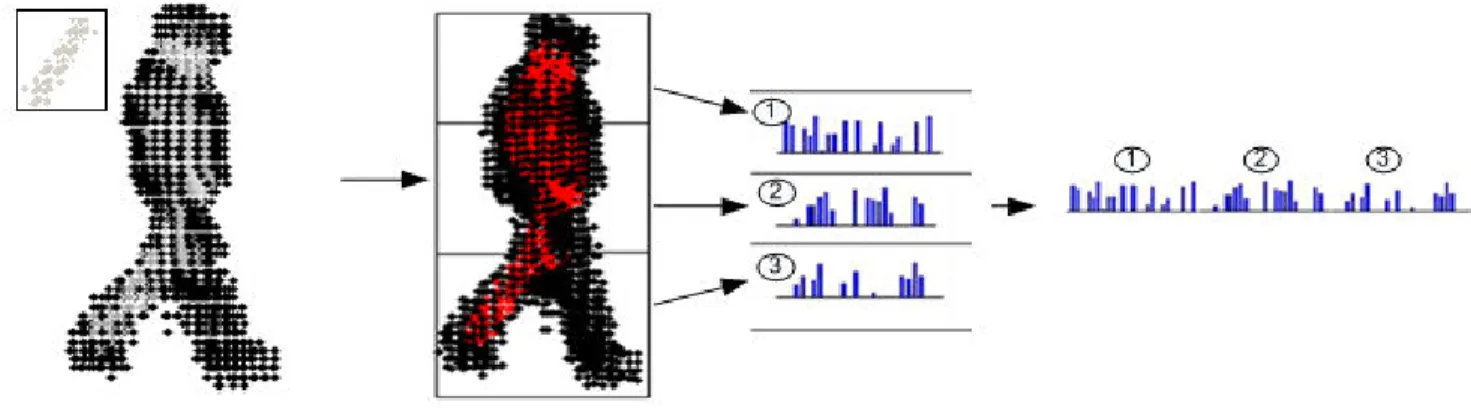
Figure 1. Representing 3D poses as distribution of cylinders: First, a set of 3D kernels in different orientations and sizes are searched over volumetric pose data. Then, regions having a score more than a threshold are selected. The bounding volume is computed and then divided into three parts through the vertical axis. From each sub-volume, high response regions are selected and histograms holding distribution of oriented cylinders are created. The combination of the three histograms constructs the feature vector to be used as a pose representation.
land et al. [17] extending motion templates [2] to three di-mensions, called Motion History Volumes (MHV). MHV represents a whole action as a single volumetric data, that is also the temporal memory of the action.
Another strategy is to use volumetric key poses. Wein-land et al.[6] present a probabilistic method based on exem-plars using HMM. Exemexem-plars are key poses extracted by re-construction from action sequences. A similar work Action Net [12] is a graph based approach that models 3D poses as transitions of 2D views.
3. Representation of 3D Poses
A human pose is characterized by configuration of body limbs having cylinder like shapes in different sizes and ori-entations. This notion plays an important role while struc-turing our representation. We model poses as a set of cylin-ders with various sizes and orientations. Motivated by the success of representing 2D human poses as distribution of rectangles over complicated models [8], we use the distri-bution of these cylinders as a compact representation for 3D human poses.
In order to find cylinder-like structures over body, we generate a set of 3D kernels and measure the correlation of these kernels with human poses represented in the form of volumetric data. High response regions are likely to correspond to body parts at specific orientations and sizes. Rather than using complex models, we count the frequen-cies of these responses for different orientations and sizes. A simple localization is provided by partitioning the bound-ing volume into sub-volumes and then combinbound-ing the corre-sponding histograms. Figure1illustrates the overall process for representing poses. In the following, the details of the proposed method are described.
3.1. Forming and Applying 3D Kernels
We assume that 3D poses are provided in the form of voxel grid. In order to locate cylinders, we construct 3D kernels in a similar format to search over volumetric data appropriately. To model a cylinder of specific size and ori-entation, a new kernel is formed as a grid data consisting of voxels that are located inside this cylinder. This results in a cylinder-like voxel grid.
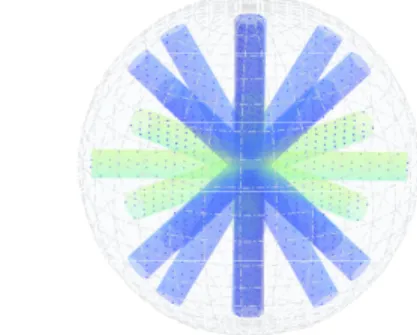
A set of kernelsK is constructed from a specified size of cylinder by rotating it around its local axisα◦apart (see Figure2for an example). While rotating, the symmetry of kernel reduces almost one half of the search space in 3D. Therefore, the number of kernels inK with α◦apart can be computed as follows:
|K| = 1 + (90α − 1)(360α ) + (180α ) (1) where, the first and the third components are the number of different kernels in vertical and horizontal positions of the cylinder respectively. The second component is rotation by
360
α times around the vertical axis for eachα◦ apart from
the vertical axis.
Limbs in the human body are in various sizes. Although longer cylinders may be more discriminative compared to shorter cylinders to locate a limb, due to noise factors we may loose some limbs if the cylinder is too long. For this reason, we construct a set of oriented kernels for various sizes defined by the length of the cylinders to detect limbs in various lengths. Although by changing the radius of the cylinders limbs in different thicknesses can be detected, em-pirically we have observed that a thick limb can be repre-sented as a collection of thin cylinders, and therefore we only choose a single radius value for all cylinder types.
Figure 2. Left is the kernel in the form of voxel grid and right is the set of kernels with various orientations around the local axis 45◦apart. The number of kernels for this size is 13.
of the kernels with volumetric pose data and obtain re-sponses for each voxel. High response voxels correspond to body parts having same orientation with the applied ker-nel. To detect voxels with high response, the responses are scaled in the range of[0, 1] and then, regions having a score more than a threshold are selected. In the experiments, we choose 0.8 as the threshold. This threshold may change de-pending on whether the search is performed over dense or sparse data.
3.2. Distribution of Cylinders
We define a pose descriptor as distribution of oriented cylinders. First, we form a set of kernels with different sizes and orientations as mentioned previously. Then, we present a representation storing the frequency of high response re-gions to each kernel.
Although distribution of cylinders reveals crucial infor-mation, localization is needed for a better representation. For this purpose, we fit a bounding volume to each pose and divide the bounding volume into N equal sized sub-volumes through the vertical axis. This process corresponds to dividing the height of an actor’s pose into partitions. Em-pirically, we have found thatN = 3 gives the best perfor-mance. The computed histograms of each sub-volume is then combined to obtain a single feature vector for a given pose.
4. Recognition of Actions
In this section, we present methods for recognizing tions using proposed pose representation. Considering ac-tions as sequence of poses, we evaluate two methods for recognition: a) Dynamic Time Warping(DTW) and b) Hid-den Markov Model(HMM).
4.1. Dynamic Time Warping
In our problem, actions are sequence of poses where each pose is modeled as a distribution of cylinders using proposed representation. The concatenation of 1-D fea-ture vectors per pose results in a 2-D representation per ac-tion. Action sequences performed by different actors vary in time and speed. The most common way to handle sim-ilarities among time series is to use Dynamic Time Warp-ing(DTW) [15]. However, DTW for 2-D series is an NP-complete problem.
Instead, we make use of the approach of Ikizler et al. [8] to find similarities between 2-D representation of action se-quences. In this approach, DTW is applied to compare 1-D series located at the same bin location of two different action representations. This is to measure the fluctuations through time at the same bin location corresponding to num-ber of high response cylinders of a specific orientation and size. We sum the results of DTW for all bin comparisons and find an optimum match.
Throughout an action, some body regions in the form of voxel grid do not change. Therefore, data series at some bins of the histogram rarely change. We measure the vari-ance at each bin location to measure the amount of change for a cylinder with specific size and orientation through time. Then, we set the 1-D series at that bin location to a zero vector, if variance is below a threshold.
4.2. Hidden Markov Model
Second method that we apply for action recognition is Hidden Markov Models(HMM). In our problem, we have a set of actions consisting of consecutive frames. A frame at timet only depends on a previous frame at time t − 1. Thus, HMM is a good technique to model our problem. In our case, we model the problem using discrete HMMs [16]. In this approach, we first quantize all the poses in train-ing actions ustrain-ing k-means clustertrain-ing algorithm into a set of codewords which we refer to as pose-words. Then, we construct HMM models per action class using 3 states. An unknown action sequence is assigned to a class giving the highest likelihood for its HMM model. Similar to DTW, the variance of each bin is computed to find uniform series. These are set to zero vector.
5. Experimental Results
5.1. Dataset
We test our pose descriptor on publicly available INRIA Xmas Motion Acquisition Sequence (IXMAS) dataset [17]. We choose 5 actions performed by 12 different actors 3 times in different orientations. These actions are walk, wave, punch, kick and pick up.
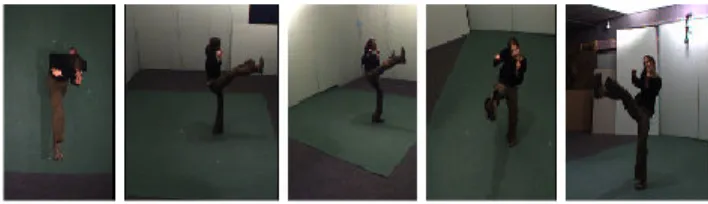
Figure 3. Example views from IXMAS dataset. Multi-camera sys-tem has 5 cameras.
Figure 4. From left to right: the actual kick pose, enhanced kick pose, the difference between them. We fill the missing voxels us-ing close morphology operator with a 3D sphere structurus-ing ele-ment. In the third figure, we represent the actual pose and the en-hanced version as overlapped to clearly represent the added voxels after closing operation.
videos are used to construct volumes. Volumes from multi-ple views are extracted using shape from silhouette tech-nique. Results are taken using volumes in the form of [64x64x64] voxel grid.
5.2. Data Enhancement
Volumetric poses have defects that significantly reduce the recognition rate. Before extracting pose histograms, some techniques are used to enhance volumetric data to eliminate reconstruction defects. In our experiments, we perform morphological closing on volumetric data using sphere structural element with radius 2. The closing op-erator can close up internal holes corresponding to missing voxels. Data enhancement process is shown in Figure4.
5.3. Pose Representation
We define a set of kernels with different sizes and orien-tations. During our experiments, we form the set of kernels with sizes [1x5],[1x10] and [1x20] where [nxm] means a cylinder with radiusn and length m. Then, we rotate each kernel to obtain a set of oriented cylinders. These kernels are constructed with30◦apart. The number of kernels per size is 31.
After forming kernels, each one of them is searched over pose volume resulting in scores as kernel responses (see Figure5) . Then, we divide voxel grid into 3 sub-volumes. The number of high response voxels to these kernels at each
sub-volume are stored in a histogram of oriented cylinders. After forming histograms, we concatenate them to be used for pose inference. Please note that, each histogram is nor-malized prior to concatenation into a single pose vector.
5.4. Pose Retrieval
There are many configurations of body parts that reveal different body poses. Among various kinds of poses, some are more discriminative known as key poses. In the fol-lowing, we measure the performance of the proposed pose representation to classify key poses. We use two methods to evaluate the descriptor performance.
The simplest method that we use is the nearest neighbor (NN) based classification. We use the Euclidean distance to find the best matched pose. The stand alone and complete performances of various sized kernels are shown in Table1. Poses Accuracy Accuracy Accuracy Accuracy
all [1x5] [1x10] [1x20] walk 96.97 93.94 96.97 96.97 wave 90.91 90.91 93.94 81.82 punch 63.64 48.48 69.70 72.73 kick 87.88 84.85 84.85 75.76 pick 96.97 90.91 96.97 93.94
Table 1. NN-based Classification results: 3 kernel sets with sizes [1x5], [1x10] and [1x20] are constructed with 30◦apart. [1x5] means that a voxel grid inside a cylinder with radius 1 and length 5. The fist column lists the names of the selected key poses. The third column gives the performances when all kernels are used. The other columns gives the stand alone performances of each kernel with different sizes.
Nearest neighbor based classifications requires a search over the whole dataset. Another method is multi-class Sup-port Vector Machine (SVM) classification. SVM classifiers are formed using RBF kernel and trained using 3 actors. We evaluate the performances for 5 action classes. The results are presented in Table2.
Poses Accuracy Accuracy Accuracy Accuracy all [1x5] [1x10] [1x20] walk 100 87.50 91.67 95.83 wave 91.67 54.17 95.83 79.17 punch 66.67 66.67 66.67 45.83 kick 100 100 100 95.83 pick 95.83 95.83 95.83 95.83
Table 2. SVM-based Classification results: 3 kernel sets with sizes [1x5], [1x10] and [1x20] are constructed with 30◦apart.
The results show that NN-based method is better than SVM based method. While taking more computation time, since all the examples in the data set are searched it is more likely to find a closer example with the NN-based method.
Figure 5. Kernel search results for five classes of 3D key poses: From left to right, poses are walk, wave, punch, kick and pick up. Figure represents poses from an arbitrary view. Gray level voxels are the high response regions for the corresponding kernel that is also drawn on the top left corner of each pose. Lower response regions below0.8 are not counted. For walking pose, we represent search responses for two kernels in order to show different responses on the same pose. Through the experiments, we construct kernels in various sizes. For example, as shown in the third example a smaller size kernel is successful in finding upper arm of a wave pose. Note that, while using various length kernels, the radius size is fixed to 1 giving 3 voxels width.
It is likely that by increasing the number of training exam-ples SVM-based method will be comparable to NN-based method, but still with a very few examples the results are acceptable.
5.5. Action Recognition
The proposed pose descriptor is also evaluated for action recognition. We select the same set of action classes and test the same kernel configurations used for pose retrieval. We evaluate two methods to classify actions. First, we perform action matching by DTW. DTW gives highest performance for the combination of [1x5] and [1x10] kernels. The con-fusion matrix can be found in Figure6.
100.0 2.78 94.44 19.44 5.56 72.22 5.56 5.56 75.00 5.56 2.78 16.67 94.44
walk wave punch kick pick up
walk
wave
punch
kick
pick up
Figure 6. DTW-based Classification results: experiments are done over 5 classes that are performed by 12 actors in 3 different view-point. This is the confusion matrix when [1x5] and [1x10] kernels are used.
The second method used for action recognition is HMM. Actions performed by 3 actors in 3 different orientations
are used for training and the remaining dataset is used for testing. We quantize training actions using k-means clus-tering algorithm into 80 pose-words and construct HMM models per action class using 3 states. The recognition per-formances over 5 classes are shown in Table3.
100 14.81 14.81 18.52 11.11 77.78 18.52 3.7 7.41 59.26 7.41 81.48 85.19
walk wave punch kick pick up walk wave punch kick pick up
Figure 7. HMM-based Classification results:experiments are done over 5 classes that are performed by 12 actors in 3 different view-point. 3 actors are used to train HMM models and remaining used for testing. This is the recognition performance when all kernel types are used.
In our experiments, DTW gives highest recognition rate for 5 classes of actions using kernels with sizes [1x5] and [1x10]. HMM gives the highest accuracy using all ker-nels. On the other hand, DTW-based action classification requires one-to-one comparison in order to find most sim-ilar action. However, HMM only requires a trained model with a set of action samples. Therefore, it has a lower run-ning time.
Poses DTW DTW HMM HMM all [1x5][1x10] all [1x5][1x10] walk 97.22 100 100 100 wave 94.44 94.44 77.78 62.96 punch 69.44 72.22 59.26 70.37 kick 66.67 75 81.48 62.96 pick 91.67 94.44 85.19 74.07
Table 3. HMM and DTW Classification results respectively: ex-periments are done over 5 classes that are performed by 12 actors in 3 different viewpoint. The first one is the recognition rates when all kernel types are used. The second one is the recognition rates when [1x5] and [1x10] kernels are used.
6. Summary and Discussion
In this study, we propose a new pose representation us-ing distribution of oriented cylinders. The representation is for 3D poses re-constructed from multiple camera views. Human body consists of cylinder like body parts. Similarly, we model 3D poses as a set of cylinders. Kernels are con-structed in various sizes and orientations to find limbs in any configuration. The distributions of high responses are used as our representation.
The proposed descriptor is based on searching cylinders to find body limbs that can change their orientations in dif-ferent body configurations. Therefore, it is suitable to be used for highly salient actions with observable changes in body configuration. During experiments, we select 5 classes that have discriminative key poses. On the other hand, the data used for experiments is sparse and has defects. It re-sults in lower responses for some body limbs during search. The recognition results will be better over denser and higher resolution data.
Another important point is about scaling volumetric poses. Actions can be performed by different actors. There-fore, volumetric poses vary in terms of size. In this study, we do not scale the volumetric poses and use them as they are. We observe that cylinders with small radius sizes can form larger cylinders. We argue that they include the high response regions returned by larger cylinders. So, the distri-bution of a small size cylinder will be higher for all kernel types over a bigger pose. So histogram normalization solves this problem without needing a volume scaling.
The same is true for cylinder lengths. However using a shorter cylinder can cause the lost of true poses. We ob-serve that, the cylinders with different lengths return more distinguishing results than different radius sizes. As a result we preserve the radius of cylinders as small as possible and form kernels with various lengths.
An action can be performed by an actor in any orienta-tion. This shifts the histogram bins holding responses of kernels constructed through the vertical axis rotation. In
this study, we do not apply any strategy to provide pose alignment. We still obtain high pose retrieval results both by NN-based classification and SVM-based classification. This shows that the pose samples with different orientations are enough to handle viewpoint variations. In the future, PCA-based alignment can also be applied to volumetric data prior to histogram extraction. Moreover, some of body pixels such as torso pixels can be excluded from the com-putation of the distribution as they result in high responses for more than a cylinder kernel.
References
[1] M. Ankerst, G. Kastenmueller, H. P. Kriegel, and T. Seidl. 3d shape histograms for similarity search and classification in spatial databases. LNCS, pages 207–228, 1999.1
[2] A. F. Bobick and J. W. Davis. The recognition of human movement using temporal templates. IEEE Transactions on
pattern analysis and machine intelligence, 23(3):257–267,
2001.2
[3] C. Canton-Ferrer, J. R. Casas, and M. Pardas. Human model and motion based 3d action recognition in multiple view sce-narios. In In European Signal Processing Conference, 2006.
1
[4] D. Y. Chen, X. P. Tian, Y. T. Shen, and M. Ouhyoung. On vi-sual similarity based 3d model retrieval. In Computer
Graph-ics Forum, volume 22, pages 223–232, 2003.1
[5] I. Cohen and H. Li. Inference of human postures by clas-sification of 3d human body shape. In IEEE International
Workshop on Analysis and Modeling of Faces and Gestures,
2003.1
[6] D. D. Weinland, E. E. Boyer, and R. Ronfard. Action recog-nition from arbitrary views using 3d exemplars. In ICCV, 2007.2
[7] K. S. Huang and M. M. Trivedi. 3d shape context based gesture analysis integrated with tracking using omni video array. In IEEE Workshop on Vision for Human-Computer
Interaction (V4HCI), in conjunction with CVPR, 2005. 1
[8] N. Ikizler and P. Duygulu. Histogram of oriented rectangles: A new pose descriptor for human action recognition. Image
and Vision Computing, 2009.2,3
[9] A. E. Johnson and M. Hebert. Using spin images for efficient object recognition in cluttered 3d scenes. PAMI, pages 433– 449, 1999.1
[10] M. Kazhdan, T. Funkhouser, and S. Rusinkiewicz. Ro-tation invariant spherical harmonic represenRo-tation of 3d shape descriptors. In Proceedings of the 2003
Eurograph-ics/ACM SIGGRAPH symposium on Geometry processing,
pages 156–164, 2003.1
[11] R. Kehl and L. Gool. Markerless tracking of complex human motions from multiple views. Computer Vision and Image
Understanding, 104:190–209, 2006.1
[12] F. Lv and R. Nevatia. Single view human action recogni-tion using key pose matching and viterbi path searching. In
IEEE Conference on Computer Vision and Pattern Recogni-tion, 2007.2
[13] I. Miki´c, M. Trivedi, E. Hunter, and P. Cosman. Human body model acquisition and tracking using voxel data.
Interna-tional Journal of Computer Vision, 53(3):199–223, 2003. 1
[14] M. Pierobon, M. Marcon, A. Sarti, and S. Tubaro. Clustering of human actions using invariant body shape descriptor and dynamic time warping. In IEEE Conference on Advanced
Video and Signal Based Surveillance, 2005.1
[15] L. Rabiner and B. H. Juang. Fundamentals of speech
recog-nition. 1993.3
[16] L. R. Rabiner. A tutorial on hidden Markov models and se-lected applications in speech recognition. Proceedings of the
IEEE, 77(2):257–286, 1989. 3
[17] D. Weinland, R. Ronfard, and E. Boyer. Free viewpoint ac-tion recogniac-tion using moac-tion history volumes. Computer
Vision and Image Understanding, 104(2-3):249–257, 2006. 2,3
[18] P. Yan, S. M. Khan, and M. Shah. Learning 4d action feature models for arbitrary view action recognition. In IEEE
Con-ference on Computer Vision and Pattern Recognition, 2008. 1