© TÜBİTAK
doi:10.3906/kim-1808-26 h t t p : / / j o u r n a l s . t u b i t a k . g o v . t r / c h e m /
Research Article
Chemistry of endemic Tanacetum mucroniferum Hub.-Mor. & Grierson extracts
and three new sesquiterpene lactones
Hüseyin SERVİ1,2,∗,, Nezhun GÖREN3,
1Department of Pharmaceutical Botany, Faculty of Pharmacy, Altınbaş University, İstanbul, Turkey 2Department of Chemistry, Faculty of Arts and Science, Yıldız Technical University, İstanbul, Turkey 3Department of Molecular Biology and Genetics, Faculty of Arts and Science, Yıldız Technical University,
İstanbul, Turkey
Received: 09.08.2018 • Accepted/Published Online: 10.12.2018 • Final Version: 05.02.2019
Abstract: Tanacetum mucroniferum Hub.-Mor. & Grierson was collected from Sakaltutan in Erzincan Province of Turkey. Comparative phytochemical investigation was carried out on the ethyl acetate and methanol extracts of the plant. The secondary metabolites were isolated and purified by chromatographic methods such as column chromatography, medium pressure liquid chromatography, high-performance thin-layer chromatography, and preparative thin-layer chromatography. The extracts of the aerial parts of Tanacetum mucroniferum yielded three new sesquiterpene lactones and some known compounds, namely two sesquiterpene lactones, six flavonoids, three coumarins, and one triterpene. Structures of isolated compounds were determined by IR, UV, 1H NMR, APT, COSY, HSQC, HMBC,
NOESY, and MS (EI, CI) spin decoupling, and some chemical reactions were carried out.
Key words: Tanacetum mucroniferum, sesquiterpene lactones, flavonoids, coumarin, triterpene
1. Introduction
The genus Tanacetum L. of the family Asteraceae is represented in Turkey by 60 taxa, of which 23 are endemic.
Chrysanthemum, Pyrethrum, and Leuchanthemum are related to the genus Tanacetum. Tanacetum species
show very small morphological differences. It makes the identification of the species very difficult. Tanacetum
mucroniferum is an endemic species of Turkey found in Northeast and East Anatolia. This species is an
intermediate species between T . aucheranum and T . sipikorense.1
The essential oil composition and DPPH scavenging activity of Tanacetum mucroniferum were reported. The essential oil showed low DPPH scavenging activity.2 The stem extract of Tanacetum mucroniferum was
investigated for inhibitory activity against acetylcholinesterase (AChE) and butyrylcholinesterase (BChE). The extract showed moderate AChE inhibition and low BChE inhibition.3
Phytochemical research revealed that sesquiterpene lactones are the principal secondary metabolites of this genus. The sesquiterpene lactones have chemosystematic significance in the family. The investigations of
Tanacetum L. species are important to find new bioactive compounds, to find out the species of economic value,
and to eliminate the systematic classification errors of the species.4 According to our literature survey, there
are no previous reports on the chemistry of T . mucroniferum. Herein, the phytochemistry of ethyl acetate and methanol extracts of Tanacetum mucroniferum is reported for the first time.
∗Correspondence: [email protected]
2. Results and discussion
Ethyl acetate and methanol extracts of the aerial parts afforded three new compounds, ajanolide 1 β ,10α -epoxide (2), mucronolide (10), and 1 α ,3 β ,10α -trihydroxy-7 α ,11 α H-germacra-4-en-12-6 α -olide (15), and twelve known compounds: two sesquiterpene lactones, 9 α -acetoxyartecanin (11) and arsanin (12); six flavonoids, cirsimaritin (3), jaceosidin (4), 5,3’,4’-trihydroxy-3,6,7,5’-tetramethoxyflavone (5), salvigenin (7), 5-hydroxy-3′,4′,6,7-tetramethoxyflavone (8), and cirsilineol (9); three coumarins, scoparone (6), scopoletin (13), and umbelliferone (14); and one triterpene, α -amyrin (1).
Compounds 2 and 15 were detected on TLC as pale brown and compound 10 as a yellow spot when treated with CeSO4. The 1H NMR spectra of two compounds in CDCl3 (compounds 2 and 15) and one in
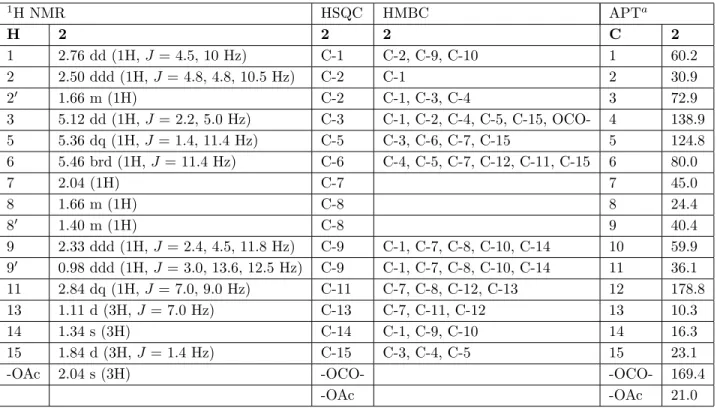
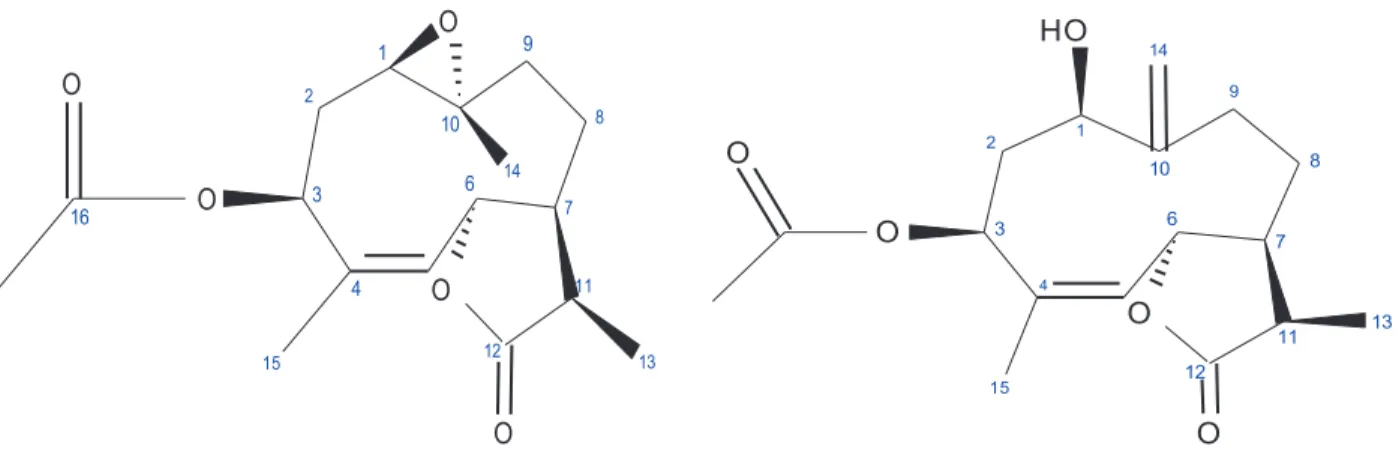
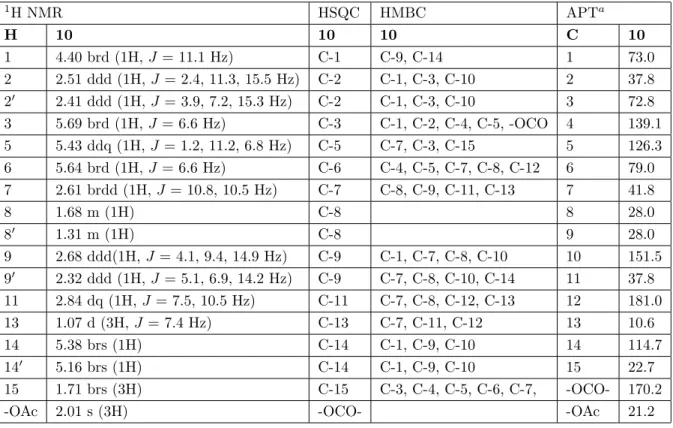
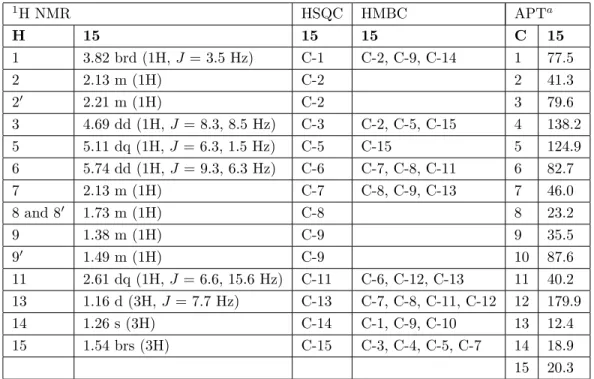
pyridine (compound 10) showed three oxygen functions’ signals and an olefinic group in the molecules. The signals observed at δ 5.38 (H-14, brs) and δ 5.16 (H-15′, brs) 17 suggested an exocyclic methylene group in compound 10. The structures were also verified with APT and HSQC experiments. The APT spectra gave four methyl, three methylene, six methine, two carbonyl, and two quaternary carbon signals for compound 2 (Table 1); three methyl, four methylene, six methine, two carbonyl, and two quaternary carbon signals for compound 10 (Table 2); and three methyl, three methylene, six methine, one carbonyl, and two quaternary carbon signals for compound 15 (Table 3). The structures of compounds 2, 10, and 15 are given in Figures 1, 2, and 3, respectively.
Table 1. 1H NMR (500 MHz, CDCl
3, δ) , APT (125 MHz, CDCl3, δ) , HSQC, and HMBC of compound 2.
1H NMR HSQC HMBC APTa H 2 2 2 C 2 1 2.76 dd (1H, J = 4.5, 10 Hz) C-1 C-2, C-9, C-10 1 60.2 2 2.50 ddd (1H, J = 4.8, 4.8, 10.5 Hz) C-2 C-1 2 30.9 2′ 1.66 m (1H) C-2 C-1, C-3, C-4 3 72.9 3 5.12 dd (1H, J = 2.2, 5.0 Hz) C-3 C-1, C-2, C-4, C-5, C-15, OCO- 4 138.9 5 5.36 dq (1H, J = 1.4, 11.4 Hz) C-5 C-3, C-6, C-7, C-15 5 124.8 6 5.46 brd (1H, J = 11.4 Hz) C-6 C-4, C-5, C-7, C-12, C-11, C-15 6 80.0 7 2.04 (1H) C-7 7 45.0 8 1.66 m (1H) C-8 8 24.4 8′ 1.40 m (1H) C-8 9 40.4 9 2.33 ddd (1H, J = 2.4, 4.5, 11.8 Hz) C-9 C-1, C-7, C-8, C-10, C-14 10 59.9 9′ 0.98 ddd (1H, J = 3.0, 13.6, 12.5 Hz) C-9 C-1, C-7, C-8, C-10, C-14 11 36.1 11 2.84 dq (1H, J = 7.0, 9.0 Hz) C-11 C-7, C-8, C-12, C-13 12 178.8 13 1.11 d (3H, J = 7.0 Hz) C-13 C-7, C-11, C-12 13 10.3 14 1.34 s (3H) C-14 C-1, C-9, C-10 14 16.3 15 1.84 d (3H, J = 1.4 Hz) C-15 C-3, C-4, C-5 15 23.1
-OAc 2.04 s (3H) -OCO- -OCO- 169.4
-OAc -OAc 21.0
Ajanolide 1 β ,10α -epoxide (2) and mucronolide (10) were heliangolide type and 1 α ,3 β ,10α -trihydroxy-7 α ,11 α H-germacra-4-en-12-6 α -olide (15) was a germacranolide type sesquiterpene lactone. The coupling con-stants of H-5/H-6 of compounds 2 and 10 were broad. The small value of J5,6is characteristic for heliangolide.5
3 2 4 1 6 10 7 8 9 11 12 O O 13 O 15 O 16 O 17 14 3 2 4 1 6 10 7 8 9 11 12 O O H O 15 O 13 O 14
Figure 1. Molecular structure of compound 2. Figure 2. Molecular structure of compound 10.
10 5 1 4 2 3 8 7 9 6 11 12 O 15 O OH 14 OH HO 13
Figure 3. Molecular structure of compound 15.
Ajanolide 1 β ,10 α -epoxide (2) was obtained from chemical transformation of ajanolide A,5 but this
compound had not been isolated from a natural source before.
Spectral data of 10 were similar to those of 1 β -hydroxy-3β -acetoxygermacra-4,10(14)-dien-6β ,11 β (H)-12,6-olide.6 The coupling constants of H-6/H-5 and H-6/H-7 of 1 β -hydroxy-3β
-acetoxygermacra-4,10(14)-dien-6 β ,11 β (H)-12,-acetoxygermacra-4,10(14)-dien-6-olide were J = 10.0, 9.8 Hz, but the coupling constant of H--acetoxygermacra-4,10(14)-dien-6/H-5 of compound 10 was J = 6.6 Hz and H-6/H-7 was broad. In the spin decoupling experiment of compound 10, irradiation of the H-6 signal collapsed the H-5 signal to a singlet and broad double doublet at 2.61 (H-7) to a double doublet.
Spectral data of 15 were very similar to 1 α ,3β ,10α -trihydroxy-7α ,11β H-germacra-4 Z -en-12,6 α -olide,7
with the exception of a few differences in the coupling constants of H-6. The coupling constants of H-6/H-5 and H-6-H-7 of 1 α ,3β ,10α -trihydroxy-7 α ,11 β H-germacra-4 Z -en-12,6α -olide were J = 11.0, 11.0 Hz, but the coupling constants of H-6/H-5 and H-6/H-7 of compound 15 were J = 6.3, 9.3 Hz.
Here, it was reported that three new sesquiterpene lactones, ajanolide 1 β ,10α -epoxide (2), mucronolide (10), and 1 α ,3 β ,10α -trihydroxy-7 α ,11α H-germacra-4-en-12-6 α -olide (15), were isolated from a natural source for the first time. Additionally, the flavone 5,3′,4′-trihydroxy-3,6,7,5′-tetramethoxyflavone (5) was reported for the first time from the family Asteraceae and the sesquiterpene lactone 9 α -acetoxyartecanin (11) for the first time from Tanacetum genus. These compounds had previously been isolated from different natural sources.
3. Experimental 3.1. Plant materials
Plant materials were collected during the flowering period from Sakaltutan in Erzincan Province in 2008. The voucher specimen was deposited at the Herbarium of the Faculty of Pharmacy, İstanbul University (Voucher No. ISTE 85425), Turkey. Plant material was identified by Professor Neriman Özhatay.
3.2. Extraction of plant material
Air-dried and powdered plant material (1200 g) was macerated with hexane, ethyl acetate, and methanol, respectively. Each extract was concentrated under reduced pressure to give a solvent-free residue, and 4 g of crude hexane extract, 17.6 g of crude ethyl acetate extract, and 63 g of methanol crude extract were obtained from the aerial parts of T . mucroniferum. All of the extracts were kept in a deep freezer (–15 °C) until the day they were used for isolation.
3.3. Isolation of compounds
Ethyl acetate extract was fractioned on a silica gel column using hexane, ethyl acetate, and methanol as eluents of increasing polarity. A total of 31 fractions were obtained. Fractions were compared by TLC using appropriate mobile phases and CeSO4 was sprayed to visualize the spots on TLC plates. Fractions containing similar bands
on the chromatograms were combined to obtain the final seven fractions. The isolated compounds were obtained by further separation of the fractions.
Fifth, sixth, and seventh fractions were refractionated via medium pressure liquid chromatography by using the gradient elution of the solvents: hexane, CH2Cl2, CHCl3, ether, ethyl acetate, and methanol.
The compounds were isolated by means of preparative TLC, using precoated silica gel 60 HF254 + 60
HF254+366 + 60 GF254, with 0.2 mm layer and different solvent systems. The sample (15 mg) was applied to
the layer for each plate. UV detection (254 and 366 nm) and CeSO4 spray were used to locate the bands. Thus,
compound 1 (7 mg)8 was isolated from the fifth fraction; compounds 2 (8 mg), 3 (8 mg),9 4 (9 mg),10,11 and
5 (5 mg)12 were isolated from the sixth fraction; and compounds 6 (11 mg),13−15 7 (13 mg),16 8 (7 mg),17 9
(6 mg),18,19 10 (7 mg), 11 (9 mg),20 and 12 (10 mg)21 were isolated from the seventh fraction.
MeOH extract was fractionated with liquid–liquid chromatography using hexane, CH2Cl2, ethyl acetate,
and BuOH:H2O (70:30) as eluents and 4 fractions were obtained. The isolated compounds were obtained by
further separations of the CH2Cl2 fraction.
CH2Cl2 fraction was refractionated on a silica gel column by using the gradient elution of CHCl3, ether,
ethyl acetate, and methanol. Fractions were compared by TLC using appropriate mobile phases and CeSO4 was
sprayed as a derivatization reagent. Fractions containing similar bands on the chromatogram were combined to obtain the final fractions. Thus, compounds 13 (5 mg),22 14 (4 mg),23 and 15 (3 mg) were isolated from the
CH2Cl2 fraction.
3.4. Identifications of compounds
Structures of isolated compounds were determined by means of spectral analyses including 1H-NMR, APT,
COSY, HSQC, HMQC, spin decoupling, NOESY, UV-Vis, FTIR, MS techniques, and some by chemical reactions. NMR techniques were run in CDCl3 using TMS as internal standard on a 500 MHz Bruker Avance III.
with attenuated total reflectance attachment. Mass spectra were recorded using a TOF/Q-TOF ion trap mass spectrometer. Dual ESI was used as an ion source in MS.
3.4.1. 3 β Acetoxy1 β ,10α epoxy6β (H)7,11 α (H)germacra4Zen6,12olide (ajanolide 1 β ,10α -epoxide) (2)
Crystalline; the melting point was 127.3 °C and specific rotation [a]²² = –14.15. 1H NMR (500 MHz, CDCl 3, δ) and APT (125 MHz, CDCl3, δ) given in Table 1; ESIMS m/ z : [M +Na]+(C17H24O5) 331,
[331-CH3COOH +H]+ 272, [272- (OCOCCH3+ H)-CH3]+ 185 and [185- CO +2]+ 159.
Table 2. 1H NMR (500 MHz, pyridine, δ) , APT (125 MHz, pyridine, δ) , HSQC, and HMBC of compound 10.
1H NMR HSQC HMBC APTa H 10 10 10 C 10 1 4.40 brd (1H, J = 11.1 Hz) C-1 C-9, C-14 1 73.0 2 2.51 ddd (1H, J = 2.4, 11.3, 15.5 Hz) C-2 C-1, C-3, C-10 2 37.8 2′ 2.41 ddd (1H, J = 3.9, 7.2, 15.3 Hz) C-2 C-1, C-3, C-10 3 72.8 3 5.69 brd (1H, J = 6.6 Hz) C-3 C-1, C-2, C-4, C-5, -OCO 4 139.1 5 5.43 ddq (1H, J = 1.2, 11.2, 6.8 Hz) C-5 C-7, C-3, C-15 5 126.3 6 5.64 brd (1H, J = 6.6 Hz) C-6 C-4, C-5, C-7, C-8, C-12 6 79.0 7 2.61 brdd (1H, J = 10.8, 10.5 Hz) C-7 C-8, C-9, C-11, C-13 7 41.8 8 1.68 m (1H) C-8 8 28.0 8′ 1.31 m (1H) C-8 9 28.0 9 2.68 ddd(1H, J = 4.1, 9.4, 14.9 Hz) C-9 C-1, C-7, C-8, C-10 10 151.5 9′ 2.32 ddd (1H, J = 5.1, 6.9, 14.2 Hz) C-9 C-7, C-8, C-10, C-14 11 37.8 11 2.84 dq (1H, J = 7.5, 10.5 Hz) C-11 C-7, C-8, C-12, C-13 12 181.0 13 1.07 d (3H, J = 7.4 Hz) C-13 C-7, C-11, C-12 13 10.6 14 5.38 brs (1H) C-14 C-1, C-9, C-10 14 114.7 14′ 5.16 brs (1H) C-14 C-1, C-9, C-10 15 22.7 15 1.71 brs (3H) C-15 C-3, C-4, C-5, C-6, C-7, -OCO- 170.2
-OAc 2.01 s (3H) -OCO- -OAc 21.2
3.4.2. 1 β -Hydroxy-3 β -acetoxy-4Z,10(14)-dien, 6 β , 7 α , 11 α (H)-6,12-olide (Mucronolide) (10) The melting point was 223.4 °C and specific rotation [a]²² = 17.19. 1H NMR (500 MHz, pyridine, δ) and APT
(125 MHz, pyridine, δ) given in Table 1; ESIMS m / z : [M +Na]+(C
17H24O5) 331, [331- CH3COOH]+271,
[271- (OCOCCH3) -CH3]+ 185 and [185- CO]+ 157.
3.4.3. 1 α ,3 β ,10α -trihydroxy-7 α ,11 α H-germacra-4-en-12-6 α -olide (15)
1H NMR (500 MHz, CDCl
3, δ) and APT (125 MHz, CDCl3, δ) given in Table 1; ESIMS m /z : [M +Na]+
Table 3. 1H NMR (500 MHz, CDCl
3, δ) , APT (125 MHz, CDCl3, δ) , HSQC, and HMBC of compound 15.
1H NMR HSQC HMBC APTa H 15 15 15 C 15 1 3.82 brd (1H, J = 3.5 Hz) C-1 C-2, C-9, C-14 1 77.5 2 2.13 m (1H) C-2 2 41.3 2′ 2.21 m (1H) C-2 3 79.6 3 4.69 dd (1H, J = 8.3, 8.5 Hz) C-3 C-2, C-5, C-15 4 138.2 5 5.11 dq (1H, J = 6.3, 1.5 Hz) C-5 C-15 5 124.9 6 5.74 dd (1H, J = 9.3, 6.3 Hz) C-6 C-7, C-8, C-11 6 82.7 7 2.13 m (1H) C-7 C-8, C-9, C-13 7 46.0 8 and 8′ 1.73 m (1H) C-8 8 23.2 9 1.38 m (1H) C-9 9 35.5 9′ 1.49 m (1H) C-9 10 87.6 11 2.61 dq (1H, J = 6.6, 15.6 Hz) C-11 C-6, C-12, C-13 11 40.2 13 1.16 d (3H, J = 7.7 Hz) C-13 C-7, C-8, C-11, C-12 12 179.9 14 1.26 s (3H) C-14 C-1, C-9, C-10 13 12.4 15 1.54 brs (3H) C-15 C-3, C-4, C-5, C-7 14 18.9 15 20.3 References
1. Davis, P. H.; Matthews, V. A.; Kupicha, F. K.; Parris, B. S. Flora of Turkey and East Aegan Islands, Fifth Edition; Edinburgh University Press: Edinburgh, UK, 1975.
2. Polatoglu, K.; Sen, A.; Kandemir, A.; Gören, N. J . Essent. Oil Bear. Pl. 2012, 15, 66-74.
3. Orhan, I. E.; Tosun, F.; Gülpınar, A. R.; Kartal, M.; Duran, A.; Mihoglugil, F.; Akalgan, D. Phytochem. Lett.
2015, 11, 347-352.
4. Spitzer, C.; Steelink, C. Phytochemistry 1966, 5, 357-365.
5. Kulyyasov, A. T.; Edil’baeva, T. T.; Turdybekov, K. M.; Raldugin, V. A.; Shakirov, M. M.; Adekenov, S. M. Chem.
Nat. Comp. 1999, 35, 55-60.
6. Marco, J. A.; Sanz-Cervera, J. F.; Manglano, E.; Sancenon, F.; Rustaiyan, A.; Kardar, M. Phytochemistry 1993,
34, 1561-1564.
7. Mahmoud, A. A.; Ahmed, A. A.; Linuma, M.; Tanaka, T. Phytochemistry 1994, 36, 393-398. 8. Gören, N.; Tahtasakal, E. Phytochemistry 1994, 36, 1281-1282.
9. Öksüz, S. Phytochemistry 1990, 29, 887-890.
10. Ivancheva, S.; Cherneva, J.; Stancheva, B. Progress in Botanical Research 1998, 227-230. 11. Wilkomirski, B.; Kucharska, E. Phytochemistry 1992, 31, 3915-3916.
12. Wollenweber, E.; Valant-Vetschera, K. M.; Roitman, J. N. Nat. Prod. Commun. 2007, 2, 997-1002.
13. Gonzalez, A. G.; Barrera, J. B.; Mendez, J. T.; Sanchez, M. P.; Martinez, J. L. E. Phytochemistry 1990, 29, 2339-2341.
14. Gonzalez, A. G.; Barrera, J. B.; Mendez, J. T.; Sanchezs, M. L.; Martinez, J. L. E. Phytochemistry 1992, 31, 1821-1822.
15. Triana, J.; Eiroa, J. L.; Morales, M.; Pérez, F. J.; Brouard, I.; Marrero, M. T.; Estévez, S.; Quintana, J.; Estévez, F.; Castillo, Q. A. et al. Phytochemistry 2013, 92, 87-104.
16. Noori, S.; Hassan, Z. M.; Yaghmaei, B.; Dolatkhah, M. 2013. Cell Immunol. 2013, 286, 16-21. 17. Polatoğlu, K.; Karakoç, O. C.; Demirci, F.; Gökçe, A.; Gören, N. J . AOAC Int. 2013, 96, 1222-1227.
18. Mosharrafa, S. A. M.; Mansour, R. M. A.; Abou-Zaid, M.; Saleh, N. A. M. Bull. Chem. Soc. Ethiop. 1994, 8, 9-13. 19. Marzouk, M. M.; Mohamed T. A.; Elkhateeb, A.; El-toumy, S. A.; Hegazy, F. E. M. Syst. Ecol. 2016, 65, 143-146. 20. Trifunovic, S.; Vajs, V.; Juranic, Z.; Zizak, Z.; Tesevic, V.; Macura, S.; Milosavljevic, S. Phytochemistry 2006, 67,
887-893.
21. Barrero, A. F.; Sanchez, J. F.; Barren, A.; Barrero, A. R. Phytochemistry. 1992, 31, 332-335. 22. Sy, L. K.; Brown, G. D. Phytochemistry 1999, 50, 781-785.