SHORT COMMUNICATION
Hemostatic Activity of
Cistus creticus Extract in Wistar Albino Rats
Ayşe Esra Karadağ1,2
&Ayşegül Çaşkurlu1
&Mehmet Evren Okur3 &Etil Guzelmeric4 & Neslihan Üstündağ Okur5 &Fatma Tosun1 &Erdem Yesilada4 &Fatih Demirci6,7
Received: 12 October 2020 / Accepted: 30 November 2020 # Sociedade Brasileira de Farmacognosia 2021
Abstract
Aerial part preparations of Cistus creticus L., Cistaceae, are traditionally used in Anatolia as a hemostatic agent. The air-dried aerial parts were extracted with methanol. Gels were prepared, followed by the hemostatic activity evaluation using Wistar albino rats in vivo tail tip amputation model. The chemical characterization of the total extract was performed by high-performance thin-layer chromatography. The methanol extract was loaded to a hydrogel base to complete a concentration of 2.5 and 7.5%. As a result, the 2.5% extract gel was found more effective on both bleeding time and amount. Hyperoside and tiliroside, which may be the components responsible for the hemostatic properties of the analyzed plant material, were dereplicated as major constituents. Keywords HPTLC . Topical application . Blood stopper . Coagulating activity . Flavonoid glycoside . Tail bleeding
Introductory Remarks
Cistus creticus L. belongs to the Cistaceae family and grows in Mediterranean countries which include the Southern European and Northern African coasts along with the Levantine coast of Western Asia. Various preparations are known in traditional medicine and used mainly as an antispas-modic, tonic, anti-diabetic, anti-inflammatory, hemostatic, carminative, and among other uses (Yeşilada et al.1995;
Honda et al. 1996; Yeşilada et al. 1997a, b; Tuzlacı and
Aymaz 2001; Attaguile et al. 2004; Koçyiğit and Özhatay 2006). The purpose of this study was to prepare a gel from the C. creticus methanol extract and to prove its hemostatic activity on Wistar albino rats. To the best of our knowledge, this is the first study on in vivo hematological evaluation of C. creticus extract gel.
Materials and Methods
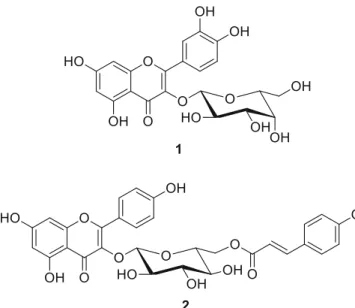
The aerial parts of Cistus creticus L., Cistaceae, were collected on 28 May 2018 from Çınarcık, Yalova, Turkey. Dr. Yavuz Bülent Köse identified the plant material and voucher speci-mens which were deposited in the Herbarium of the Faculty of Pharmacy, Anadolu University (ESSE 15549). The air-dried aerial parts (500 g) were crushed and extracted with methanol (1 l) by maceration in a dark place at room temperature (3× 24 h). After filtration and evaporation in vacuo, the extract yield was 19.9% dry weight. For the HPTLC analysis, the extract was dissolved in methanol (10 mg/ml) and used as a test solu-tion. HPTLC analysis was performed on glass HPTLC plates coated with silica gel 60 F254 (Merck). Ethyl acetate-d i c h l o r o m e t h a n e - f o r m i c a c i acetate-d - a c e t i c a c i acetate-d - w a t e r (100:25:10:10:11, v/v/v/v/v) was used as a developing solvent system. Sample test solution (10 mg/ml) (5μl) and 0.2 mg/ml of each standard solutions of hyperoside (1), tiliroside (2), and quercitrin (2 μl) were applied on the plates and developed
* Ayşe Esra Karadağ [email protected]
1
Department of Pharmacognosy, School of Pharmacy, Istanbul Medipol University, 34810 Istanbul, Turkey
2 Department of Pharmacognosy, Graduate School of Health Sciences,
Anadolu University, 26470 Eskişehir, Turkey
3
Department of Pharmacology, Faculty of Pharmacy, University of Health Sciences, 34668 Istanbul, Turkey
4
Department of Pharmacognosy, Faculty of Pharmacy, Yeditepe University, 34755 Istanbul, Turkey
5 Department of Pharmaceutical Technology, Faculty of Pharmacy,
University of Health Sciences, 34668 Istanbul, Turkey
6
Department of Pharmacognosy, Faculty of Pharmacy, Anadolu University, 26470 Eskişehir, Turkey
7
Department of Pharmacognosy, Faculty of Pharmacy, Eastern Mediterranean University, Mersin 10, Famagusta, North Cyprus, Turkey
https://doi.org/10.1007/s43450-020-00120-7
/ Published online: 7 January 2021 Revista Brasileira de Farmacognosia (2020) 30:844–847
according to well-known procedures (Guzelmeric et al.2015). Detection was performed at 366 nm and with NP-PEG 400 reagent solutions (Guzelmeric et al.2015).
To prepare the base gel, a previously reported methodology was used with slight modifications (Ayla et al.2019). Two different gels with 5% and 7.5% extract concentrations were prepared. Viscosity and pH value were measured by using a viscometer and a pH meter, respectively. Formulations were evaluated for 3 months at 5 ± 3 °C, 25 ± 2 °C, and 40 ± 2 °C. Wistar albino rats were procured from Istanbul Medipol University, Meditam, Istanbul, Turkey. The rats were hosted in cages with food and water ad libitum, at 20 ± 1 °C. Approval of the study protocol was obtained from the Ethical Committee of Istanbul Medipol University (Approval Number: 2019-08). This research was conducted in accordance with internationally accepted principles for lab-oratory animals’ use and care such as the European Community guidelines (EEC Directive of 1986; 86/609/
EEC). Rats were processed according to the laboratory animal ethical guidelines. Thirty-five animals were assigned into 5 groups of 7 rats each as follows: group 1: control (untreated); group 2: blank gel; group 3: 2.5% C. creticus extract gel; group 4: 7.5% C. creticus extract gel; and group 5: Ankaferd® group. Anesthesia of rats was achieved by in-traperitoneal injection of 80–100 mg/kg ketamine and 10 mg/kg xylazine.
In vivo bleeding test was performed in rats by tail tip ampu-tation method. Accordingly, the distal 1 cm of the tail of the rat was placed prone under anesthesia and cut transversely using a scalpel. After bleeding occurred, each wound was irrigated with an equal volume (1 ml) sample. Gentle compress was then ap-plied to the wound for 1 min with the help of gauze. Clotting time was determined by a stopwatch as the time elapsed from the onset of bleeding until the occurrence of permanent hemostasis. To determine the amount of bleeding, the difference was record-ed as the amount of blerecord-eding (g) before and after each gauze application. Each rat was followed for 30 min to evaluate the bleeding status. At the end of the study, experimental animals were sacrificed with carbon monoxide gas under anesthesia (Sogut et al.2015). In vivo study outcomes were given as means ± standard error of the mean (mean ± SEM). Statistical analyses were evaluated with GraphPad Prism 7.0 program. Statistical significance between groups was analyzed by one-way ANOVA followed by Dunnett’s post hoc test. Values for p < 0.05 were considered statistically significant.
Results and Discussion
Chemical analysis of the C. creticus methanolic extract was performed by HPTLC, where hyperoside (1) and tiliroside (2) were detected as the main components, while quercitrin was absent. The results of the HPTLC analysis are shown in Fig.1. Consequently, these components may be considered as the main components responsible for the hemostatic effect of
Fig. 1 HPTLC chromatogram of standard compounds and aerial parts of Cistus creticus methanol extracts. Detection was performed at 366 nm with NP-PEG 400 reagent solutions. Abbreviations: H, hyperoside (1); T, tiliroside (2); and Q, quercitrin
Fig. 2 Comparison of mean bleeding time of all groups. Data are expressed as mean ± SEM. ***p < 0.001 and **p < 0.01 compared with the control group. Ankaferd® blood stopper was used as a positive control for a topical hemostatic agent
845 Rev. Bras. Farmacogn. (2020) 30:844–847
C. creticus. It is a well-known fact that plant extracts rich in flavonoids have a high antioxidant capacity and accordingly exhibit various biological activities (Raza et al. 2017; Grochowski et al.2018).
The physicochemical properties of the extract gels were also tested. The pH value of the 2.5% extract gel was deter-mined as 7.545, and that of the 7.5% extract gel was 7.209. The viscosity of the gel containing 2.5% extract was 4.867 cP and the viscosity of the gel containing 7.5% extract was 126.667 cP. As the amount of extract increased, the viscosity value also increased. The stability studies indicated no signif-icant change in the pH, viscosity, and appearance of the for-mulations by the end of 3 months.
The hemostatic activity of the gel was statistically evaluat-ed by calculating the in vivo experimental bleevaluat-eding model by bleeding time (min) and bleeding amount (g). The bleeding amount was described as the collected blood after tail tip am-putation. The bleeding amounts in each group are shown in Fig.2. The mean bleeding times achieved were 1.13 ± 0.1 g for the control group, 1.05 ± 0.04 g for the blank gel group, 0.76 ± 0.04 g for the 2.5% extract loaded gel group, 0.99 ± 0.02 g for the 7.5% extract loaded gel group, and 0.40 ± 0.06 g for the Ankaferd® group. The Ankaferd®—positive con-trol—(p < 0.001) and 2.5% formulation (p < 0.01) groups sig-nificantly decreased the bleeding amounts comparing to the control group. There were no significant differences between the blank gel group, 7.5% extract loaded gel group, and con-trol group. Ankaferd® blood stopper, a registered traditional herbal medicine (Thymus vulgaris, Glycyrrhiza glabra, Vitis vinifera, Alpinia officinarum, and Urtica dioica), was used as a positive control for a topical hemostatic agent (Iynen et al.
2011). Tail bleeding times (Broze et al.2001) were used to evaluate hemostasis in murine models and the results in each group are shown in Fig.3. The bleeding time of untreated rats (control group) was measured as 27.4 ± 3.6 min. When the blank gel applied group (23.6 ± 2.9 min.) was compared with
the control group, the bleeding time presented no obvious difference (p < 0.05). In addition, the tail bleeding time of rats treated with Ankaferd® was 7.4 ± 0.5 min, which was signif-icantly shortened (p < 0.001) compared to the control group. Compared to the control group, 2.5% and 7.5% extract loaded gel groups (15.8 ± 1.8 min and 16.6 ± 1.2 min, respectively) significantly (p < 0.01) reduced tail bleeding time. The fast decrease in the bleeding time could be due to vasoconstriction or platelet aggregation (Ebrahimi et al.2020). When the ef-fects of the gel formulation prepared at 2.5 and 7.5% were compared to the control group, it was found that the 2.5% extract loaded formulation was more effective on both bleed-ing time and bleedbleed-ing amount. Therefore, this activity was concentration-independent. In relation to the hemostatic ef-fect, hyperoside was reported to possess blood coagulating activity (Ku et al. 2013). Flavonoids (active redox agents) are widely spread in nature and fully recognized as antioxi-dants or scavengers. The pharmacological potential of the C. creticus is probably due to the capability of polyphenols and flavonoids to interact with important cellular processes in which key enzymes such as cyclooxygenase, lipooxygenase, phospholipase A2, NADH-oxidase, or glutathione reductase are involved. Consequently, the hemostatic activity of the an-alyzed plant may be attributed to its major flavonoids (active redox agents) which have been fully recognized as antioxi-dants or scavengers and the hemostatic potential of the ana-lyzed plant material is probably due to the capability of flavo-noids to interact with key enzymes of important cellular processes.
Acknowledgments Part of this work was subject to patent application (TPE2020/08345). This work is dedicated to late Prof. Hulusi Malyer. Authors’ Contribution AEK: conceptualization, formal analysis, investi-gation, and writing of the original draft. AÇ: formal analysis, investiga-tion, and project administration. MEO: conceptualizainvestiga-tion, formal analy-sis, investigation, resources, and writing of the original draft. EG, NÜO, FT, EY, and FD: technical supervision and resources. All authors: critical revision of the manuscript.
Funding This research project was supported by The Scientific and T e c h n o l o g i c a l R e s e a r c h C o u n c i l o f T u r k e y ( P r o j e c t N o . : 1139B411801272). The authors would like to thank The Scientific and Technological Research Council of Turkey 2209-B Programme.
Compliance with Ethical Standards
Conflict of Interest The authors declare that they have no conflict of interest.
References
Attaguile G, Perticone G, Mania G, Savoca F, Pennisi G, Salomone S (2004) Cistus incanus and Cistus monspeliensis inhibit the contrac-tile response in isolated rat smooth muscle. J Ethnopharmacol 92: 245–250.https://doi.org/10.1016/j.jep.2004.02.020
Fig. 3 Comparison of mean bleeding amount of all groups. Data are expressed as mean ± SEM. ***p < 0.001 and **p < 0.01 compared with the control group. Ankaferd® blood stopper was used as a positive control
Ayla S, Okur ME, Günal MY, Özdemir EM, Çiçek Polat D, Yoltaş A, Karahüseyinoğlu S (2019) Wound healing effects of methanol ex-tract of Laurocerasus officinalis roem. Biotech Histochem 94:180– 188.https://doi.org/10.1080/10520295.2018.1539242
Broze J, Yin ZF, Lasky N (2001) A tail vein bleeding time model and delayed bleeding in hemophiliac mice. Thromb Haemost 85:747– 748
Ebrahimi F, Mahmoudi J, Torbati M, Karimi P, Valizadeh H (2020) Hemostatic activity of aqueous extract of Myrtus communis L. leaf in topical formulation: in vivo and in vitro evaluations. J Ethnopharmacol 249:112398.https://doi.org/10.1016/j.jep.2019. 112398
Grochowski DM, Locatelli M, Granica S, Cacciagrano F, Tomczyk M (2018) A review on the dietary flavonoid tiliroside. Compr Rev Food Sci Food Saf 17:1395–1421. https://doi.org/10.1111/1541-4337.12389
Guzelmeric E, Vovk I, Yesilada E (2015) Development and validation of an HPTLC method for apigenin 7-O-glucoside in chamomile flowers and its application for fingerprint discrimination of chamomile-like materials. J Pharm Biomed 107:108–118.https:// doi.org/10.1016/j.jpba.2014.12.021
Honda G, Yeşilada E, Tabata M, Sezik E, Fujita T, Takeda Y, Takaishi Y, Tanaka T (1996) Traditional medicine in Turkey VI. Folk medicine in West Anatolia: Afyon, Kütahya, Denizli, Muğla, Aydin prov-inces. J Ethnopharmacol 53:75–87. https://doi.org/10.1016/S0378-8741(96)01426-2
Iynen I, Sogut O, Kose R (2011) The efficacy of Ankaferd® blood stop-per in heparin-induced hemostatic abnormality in a rat epistaxis model. Otolaryngol Head Neck Surg 145:840–844.https://doi.org/ 10.1177/0194599811415594
Koçyiğit M, Özhatay N (2006) Wild plants used as medicinal purpose in Yalova (Northwest Turkey). Turkish J Pharm Sci 3:91–103 Ku SK, Kim TH, Lee S, Kim SM, Bae JS (2013) Antithrombotic and
profibrinolytic activities of isorhamnetin-3-O-galactoside and hyperoside. Food Chem Toxicol 53:197–204.https://doi.org/10. 1016/j.fct.2012.11.040
Raza A, Xu X, Sun H, Tang J, Ouyang Z (2017) Pharmacological activ-ities and pharmacokinetic study of hyperoside: a short review. Trop J Pharm Res 16:483–489.https://doi.org/10.4314/tjpr.v16i2.30
Sogut O, Erdogan MO, Kose R, Boleken ME, Kaya H, Gokdemir MT, Ozgonul A, Iynen I, Albayrak L, Dokuzoglu MA (2015) Hemostatic efficacy of a traditional medicinal plant extract (Ankaferd® blood stopper) in bleeding control. Clin Appl Thromb 21:348–353.https:// doi.org/10.1177/1076029613504129
Tuzlacı E, Aymaz PE (2001) Turkish folk medicinal plants. Part IV. Gönen (Balikesir). Fitoterapia 72:323–343.https://doi.org/10. 1016/S0367-326X(00)00277-X
Yeşilada E, Honda G, Sezik E, Tabata M, Fujita T, Tanaka T, Takeda Y, Takaishi Y (1995) Traditional medicine in Turkey. V. Folk medi-cine in the inner Taurus Mountains. J Ethnopharmacol 46:133–152.
https://doi.org/10.1016/0378-8741(95)01241-5
Yeşilada E, Gürbüz I, Ergun E (1997a) Effects of Cistus laurifolius L. flowers on gastric and duodenal lesions. J Ethnopharmacol 55:201– 211.https://doi.org/10.1016/S0378-8741(96)01502-4
Yeşilada E, Üstün O, Sezik E, Takaishi Y, Ono Y, Honda G (1997b) Inhibitory effects of Turkish folk remedies on inflammatory cyto-kines: interleukin-1α, interleukin-1β and tumor necrosis factor α. J Ethnopharmacol 58:59–73. https://doi.org/10.1016/S0378-8741(97)00076-7
847 Rev. Bras. Farmacogn. (2020) 30:844–847