POLAR REPRESENTATION OF COMPLEX OCTONIONS
1Mehdi JAFARI
1Department of Mathematics, Technical and Vocational University, Urmia, IRAN
(Geliş/Received: 26.03.2016 ; Kabul/Accepted in Revised Form: 25.04.2016 )
ABSTRACT: The complex octonions are a non-associative extension of complex quaternions, are used in areas such as quantum physics, classical electrodynamics, the representations of robotic systems, kinematics etc. (Kansu et al., 2012, James et al., 1978). In this paper, we study the complex octonions and their basic properties. We generalize in a natural way De-Moivre’s and Euler’s formulae for division complex octonions algebra.
Key Words: De-Moiver’s formula, Euler’s formula, Complex octonion
Kompleks Oktoniolarin Kutupsal Gösterimi
ÖZ: Kompleks oktonyonlar, kompleks kuaterniyonların birleşimli olmayan ve kuantum fiziği, klasik elektrodinamik, robotik sistemlerin gösterimleri, kinematik (Kansu et al., 2012, James et al., 1978) gibi alanlarda kullanılan bir uzantısıdır. Bu makalede, kompleks oktonyonlar ve temel özelliklerini çalıştık. De-Moivre ve Euler formüllerini Kompleks oktonyonlar cebiri için tabii bir şekilde genelleştirdik. Anahtar Kelimeler: De Moivre’s formülü, Euler’s fromülü, Kompleks oktonyonlar.
INTRODUCTION
The octonions are the largest of the four normed division algebras. While somewhat neglected due to their non-associativity, they stand at the crossroads of many interesting fields of mathematics (Baez, 2002). A study of the classical electromagnetism’s energy described by the complex octonions in sixteen dimensions is given by Kansu et al. (Kansu et al., 2012). The complex exponential
e
i
cos
i
sin
generalizes to quaternions by replacing i by any unit quaternion µ since any unit pure quaternion is a root of -1. Hence, any quaternion may be represented in the polar formq
q e
where
is a real angle. As with complex numbers and quaternions, any octonion can be written in polar form as(cos
sin )
x
r
w
wherer
N
xandw
2
1.
In this paper, we introduce the complex octonions algebra, OC, and study some fundamental algebraic properties of them. The polar representation of complex octonions are given, and then by means of the De-Moivre's theorem, any powers of these octonions are obtained. Finally, we give some examples for more clarification.MATERIAL AND METHOD
A complex octonion X has an expression of the form
7 0 0 1 1 2 2 3 3 4 4 5 5 6 6 7 7 0 0 1 , (1) i i i X A e A e A e A e A e A e A e A e A e A e
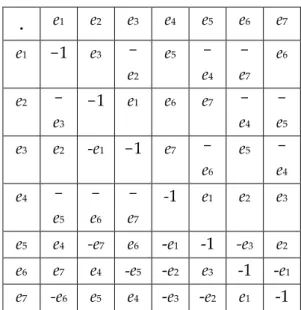
where A0A7 are complex numbers and , (0ei i 7) are octonionic units satisfying the equalities that are given in the table below;
Table 1. Octonionic units
.
e
1e
2e
3e
4e
5e
6e
7e
1-1 e
3-e
2e
5-e
4-e
7e
6e
2-e
3-1
e
1e
6e
7-e
4-e
5e
3e
2-e
1-1
e
7-e
6e
5-e
4e
4-e
5-e
6-e
7-1
e
1e
2e
3e
5e
4-e
7e
6-e
1-1
-e
3e
2e
6e
7e
4 -e
5-e
2e
3-1
-e
1e
7-e
6e
5e
4-e
3-e
2e
1-1
As a consequence of this definition, a complex octonionX can be written as',
X x i x
(2)
where x andx', real and pure octonion components, respectively. The set of all complex octonions is denoted by OC.
For defined octonion in equation (1), the scalar and vectorial parts can be given, respectively, as
0 0
,
XS
A e
(3)
1 1 2 2 3 3 4 4 5 5 6 6 7 7.
XV
A e
A e
A e
A e
A e
A e
A e
(4)
A complex octonionXcan also be written as
0 0 1 1 2 2 3 3 4 5 1 6 2 7 3 4 ( ) ( ) ' , X A e A e A e A e A A e A e A e e Q Q e
(5)
where 2 1 e and
2 2 2
0 1 1 2 2 3 3 1 2 3 , ' HC 1 , i , Q Q QA A e A e A e e e e AC(6)
the complex quaternion division algebra (Jafari, 2016).For two complex octonions 7 0 i i i X A e
and 7 0 , i i i Y B e
the summation and substraction processes are given as 7 0 ( i i) .i i X Y A B e
(7)
Addition and subtraction of complex octonions is done by adding and subtracting corresponding terms and hence their coefficients, like quaternions.The product of two complex octonions X SXVX,Y SYVY
is expressed as
,
X Y X Y X Y Y X X Y
X YS S V V S V S V V V
(8)
Multiplication is distributive over addition, so the product of two octonions can be calculated by summing the product of all the terms, again like quaternions. This product can be described by a matrix-vector product as 0 1 2 3 4 5 6 7 0 1 0 3 2 5 4 7 6 1 2 3 0 1 6 7 4 5 2 3 2 1 0 7 6 5 4 3 4 5 6 7 0 1 2 3 4 5 4 7 6 1 0 3 2 5 6 7 4 5 2 3 0 1 6 7 6 5 4 3 2 1 0 . A A A A A A A A B A A A A A A A A B A A A A A A A A B A A A A A A A A B X Y A A A A A A A A B A A A A A A A A B A A A A A A A A B A A A A A A A A 7 , B (9)
where
X Y
,
O
C. Complex octonions multiplication is not associative, since 1 2 4 1 6 7 1 2 4 3 4 7(
)
,
(
)
.
e e e
e e
e
e e e
e e
e
(10) It is clear that subalgebra with bases
e e e e
0,
1,
i,
j(2i j, 7)is isomorphic to complex quaternionsalgebera
H .
CSOME PROPERTIES OF COMPLEX OCTONIONS
1)
The Hamilton conjugate of 70 i i X X i
X
A e
S
V
is
7 0 0 1.
i i X X iX
A e
A e
S
V
(11)
The complex conjugate of X is7 ' ' ' 0 0 0 0 0 1 1 1 7 7 7 1
(
)
(
)
... (
) .
i i iX
A e
A e
a
ia e
a
ia e
a
ia e
(12)
The Hermitian conjugate of X is 7 † * ' ' ' 0 0 0 0 0 1 1 1 7 7 7 1
( )
i i(
)
(
)
... (
) .
iX
X
A e
A e
a
ia e
a
ia e
a
ia e
(13)
It is clear the scalar and vector parts of Xis denoted by 2 X X X S
and
. 2 X X X V 2)The norm of
X is 7 2 2 0 X i iN
XX
XX
X
A
C
(14) If
N
X
1,
thenX is called a unit complex octonion. We will use 1O
Cto denote the set of unit complex octonions. IfN
X
0,
thenX is called a null complex octonion.Lemma 1. Let
X Y
,
O
C.
The conjugate and norm of complex octonions satisfy the following properties: * * † † * * * † † † * * * † † †1)
, (
)
, (
)
2)
, (
)
, (
)
3)
, (
)
, (
)
4)
X X,
XY X YX
X
X
X
X
X
XY
Y X
XY
Y X
XY
Y X
X
Y
X
Y
X
Y
X
Y
X
Y
X
Y
N
N
N
N N
(15)
3) The inverse of X with
N
X
0,
is1 1 . X X X N (16) Example 1. Consider the complex octonions
1 1 2 3 4 5 6 7 2 1 2 3 4 5 6 7 3 1 2 3 4 5 6 7
3
1
2
(1
)
2
(1
)
,
2
2
1
1
(1
)
2
(1
)
2
2 ,
2
2
1 (2
)
(1
)
,
X
e
i e
i e
i e
i e
e
e
X
e
i e
i e
i e
i e
e
e
X
i e
ie
e
i e
i e
e
e
(17)
The norms of
X X X
1,
2,
3 are1
1,
20,
35 2 .
X X X
N
N
N
i
(18) The conjugates ofX X X
1,
2,
3 are1 1 2 3 4 5 6 7 * 2 1 2 3 4 5 6 7 † 3 1 2 3 4 5 6 7
3
1
2
(1
)
2
(1
)
,
2
2
1
1
(1
)
2
(1
)
2
2 ,
2
2
1 (2
)
(1
)
,
X
e
i e
i e
i e
i e
e
e
X
e
i e
i e
i e
i e
e
e
X
i e
ie
e
i e
i e
e
e
(19)
The inverse of
X X
1,
3are 1 1 1 2 3 4 5 6 7 3 1 2 3 4 5 6 73
1
2
(1
)
2
(1
)
,
2
2
1
[1 (2
)
(1
)
],
5 2
X
e
i e
i e
i e
i e
e
e
X
i e
ie
e
i e
i e
e
e
i
(20)and
X
2 not invertible. Theorem 1. The set 1O
Cof unit complex octonions is a subgroup of the group 0O
C where 0Proof: Let 1
,
O .
CX Y
We have NXY 1, i.e.1
O
CXY
and thus the first subgroup requirement is satisfied. Also, by the property1
1,
X X X
N
N
N
(21)the second subgroup requirement 1 1
O .
CX
RESULT AND DISCUSSION
Trigonometric Form and De Moivre’s Theorem Every non-null complex octonion
7 0 i i i
X
A e
can be written in the trigonometric (polar) form(cos
sin ),
X
R
W
(22) with 7 2 0,
X i iR
N
A
cos
0 XA
N
and
1 2 7 2 1sin
i i XA
N
. The unit complex vector
W
w i w
*is
given by 1 2 7 7 1 2 7 2 1 2 1
1
(
,
,...,
)
( ,
,...,
).
(
i)
iW
w w
w
A A
A
A
(23)
Example 2. The polar form of the complex octonions 1
1
( ,1
, 2 ,1
, 2, 0,
3
)
2
2
X
i
i
i
i
is
1 cos 1sin 4 4 X
W
(24) andX2 i (1 2 ,i i 1, 2 i, 1, 2 ,i i1, 5)
is
2 cos 2sin , X
W
1 cos ln( 1 2), 2 i
i
(25)
where 1 3 2 ( ,1 , 2 ,1 , 2, 0, ) 2 W i i i iand
2 1 (1 2 , 1, 2 , 1, 2 , 1, 5). 2 W i i i i i(26)
It is clear that
1 21
W WN
N
and
WW1 1W W2 2 1.Since
W
2
1
we have a natural generalization of Euler's formula for generalized quaternions2 3 4 2 4 3 5
1
...
2!
3!
4!
1
...
(
...)
2!
4!
3!
5!
cos
sin ,
We
W
W
W
W
(27)
Lemma 2. For every unit vector
W
,
we have
cos
1Wsin
1
cos
2Wsin
2
cos
1 2
Wsin
1 2
. (28)Theorem 2. (De-Moivre's formula) Let
X
N
x(cos
W
sin )
be a complex octonions. Then for any integer n;(
) .(cos
sin
)
n n
x
X
N
n
W
n
(29) Proof: The proof will be by induction on nonnegative integers n and letN
X
1
.For
n
2
and on using the validity of theorem as lemma 1, one can show2
(cos
W
sin )
cos 2
W
sin 2
(30)
Suppose that(cos
W
sin )
n
cos
n
W
sin
n
,
we aim to show1
(cos
W
sin )
n
cos(
n
1)
W
sin(
n
1) .
(31)
Thus1
(cos
sin )
(cos
sin ) (cos
sin )
(cos
sin
)(cos
sin )
cos(
)
sin(
)
cos(
1)
sin(
1) .
n nW
W
W
n
W
n
W
n
W
n
n
W
n
(32)The formula holds for all integers n; 1 cos sin , X
W
(33)
cos( ) sin( ) cos sin . n X n W n n W n
(34)
■ Example 3. LetX
3 (1
i i
, , 2 ,1
i
i
,1, 1, 2)
be a complex octonion. Every power of this octonion isfound with the aid of Theorem 1. For example, 20-th and 83-th powers are
20 20 20 19
5
5
2 (cos 20
sin 20
)
6
6
1
3
2 (
)
2 [ 1
3(1
, , 2 ,1
,1, 1, 2)],
2
2
X
W
W
i i
i
i
(35)
and 83 83 825
5
2 (cos 83
sin 83
)
6
6
2 ( 3
).
x
W
W
(36)
We investigate some properties of the complex octonions by separating them in two cases: i) Complex octonions with complex angles (ϕ=φ+iφ∗); i.e.
(cos
sin ),
XX
N
W
(37)
ii)
Complex octonions with real angles (ϕ=φ, φ∗=0); i.e.(cos
sin ).
X
X
N
W
(38)
Theorem 3. De Moivre’s formula implies that there are uncountably many unit complex octonionX
cos
W
sin
satisfyingX
n
1
for n≥3.Proof: For every unit vector
W
,
the unit complex octonion2
2
cos
sin
,
X
W
n
n
(39)
is of order n. For
n
1
or n2, the complex octonion X is independent ofW
.
■
Example 4.
1
( ,1
, 2 ,1
, 2, 0,
3
)
2
2
X
i
i
i
i
is of order 8 and3
(1
, , 2 ,1
, 1,
1
, 2)
2
2
X
i i
i
i
is of
order 12.Theorem 4. Let
X
cos
W
sin
be a unit complex octonion. The equationA
n
X
hasn
roots, and they are 2 2 cos( ) sin( ) , 0,1, 2,..., 1. k k k A W k n n n (40)
Proof: We assume that
A
cos
W
sin
is a root of the equationA
n
X
,
since the vector parts ofX
andA
are the same. From Theorem 2, we havecos
sin
,
n
A
n
W
n
(41)
thus, we findcos
n
cos ,
sin
n
sin ,
So, then
roots ofX
are2 2 cos( ) sin( ) , 0,1, 2,..., 1. k k k A W k n n n
(42)
■
Example 5. Let
3
(1 2 ,
3, 2 ,
1, ,
1
1, 2)
cos
sin
2
2
6
6
X
i
i i
i
W
be a unit complex octonion. The cube roots of the octonionX
are1 3 cos( 6 2 ) sin( 6 2 ) , 0,1, 2. 3 3 k k k X
w
k(43)
For
k
0
, the first root is 130 cos sin 0.98 0.17
18 18
X W W, and the second one for
k
1
is 1 3 1 13 13 cos sin 0.64 0.76 18 18X W W and third one is
1 3 2 25 25 cos sin 0.34 0.93 . 18 18 X W W (44)
Also, it is easy to see that
1 1 1
3 3 3
0 1 2
0.
X
X
X
The relation between the powers of complex octonions can be found in the following Theorem.
Theorem 5. Let
X
be a unit complex octonion with the polar formX
cos
W
sin .
If m 2
Z {1},
then
X
n
X
m if and only if nm(mod ).p (45)Proof: Let nm(mod ).p Then we have
n a p m
.
,
wherea
Z.
cos sin cos( ) sin( ) 2 2 cos( ) sin( ) n X n W n ap m W ap m a m W a m
(46) cos( 2 ) sin( 2 ) cos sin . m m a W m a m W m X
Now supposecos
sin
nX
n
W
n
and
X
m
cos
m
W
sin
m
.
(47)
IfX
n
X
m then we getcos
n
cos
m
andsin
n
sin
m
,
which means2 , Z. n
m
a a (48) Thusn
m
2
a
or nm(mod ).p (49) ■ Example 6. Let2
(1 2 ,
3, 2 ,
1,
1
,
1, 2)
2
2
X
i
i i
i
be a unit complex octonion. From Theorem 5, 2 8, / 4 m so we have9 17 2 10 18 3 11 19 4 12 20 8 16 24
...
...
...
...
1
... 1.
X
X
X
X
X
X
X
X
X
X
X
X
X
X
X
(50)
CONCLUSIONIn this paper, we defined and gave some of algebraic properties of complex octonions and investigated the De Moivre’s formulas for these octonions. The relation between the powers of complex octonions is given in Theorem 5. We also showed that the equation
X
n
1
has uncountably many solutions for any unit complex octonions (Theorem 3).FUTHER WORK
We will give a complete investigation to real matrix representations of complex octonions, and give any powers of these matrices.
REFERENCES
Baez, J., 2002, ‚The Octonions‛, Bulletin (New Series) Of The American Mathematical Society (Bull. Amer. Math. Soc.) Vol. 39, pp. 145-205.
Kansu, M.E., Tanışlı M., Süleyman D., 2012, ‘’Electromagnetic Energy Conservation with Complex Octonions’’, Turk Journal of Physics, Vol. 36, pp. 438 – 445.
James, D., Edmonds, J., 1978, ‚Nine-vectors, Complex Octonion/quaternion Hypercomplex Numbers, Lie groups, and The 'Real' World‛, Foundations of Physics, Vol. 8, pp. 303-311.
Jafari, M., 2016, ‚On The Matrix Algebra of Complex Quaternions‛, Accepted for publication in TWMS Journal of Pure and Applied Mathematics. DOI: 10.13140/RG.2.1.3565.2321