REPUBLIC OF TURKEY
YILDIZ TECHNICAL UNIVERSITY
GRADUATE SCHOOL OF NATURAL AND APPLIED SCIENCES
CORPUS-DRIVEN SEMANTIC RELATIONS EXTRACTION FOR
TURKISH LANGUAGE
TUĞBA YILDIZ
PhD. THESIS
DEPARTMENT OF COMPUTER ENGINEERING
PROGRAM OF COMPUTER ENGINEERING
ADVISER
ASSOC. PROF. DR. BANU DİRİ
REPUBLIC OF TURKEY
YILDIZ TECHNICAL UNIVERSITY
GRADUATE SCHOOL OF NATURAL AND APPLIED SCIENCES
CORPUS-DRIVEN SEMANTIC RELATIONS EXTRACTION FOR
TURKISH LANGUAGE
A thesis submitted by Tuğba YILDIZ partial fulfillment of the requirements for the degree of PhD is approved by the committee on 24.07.2014 in Department of Computer Engineering, Computer Engineering Program.
Thesis Adviser
Assoc. Prof.Dr. Banu Diri Yıldız Technical University
Approved By the Examining Committee Assoc. Prof. Dr.Banu Diri
Yıldız Technical University _____________________
Assist. Prof. Dr. Zeynep Orhan
Fatih University _____________________
Assist. Prof. Dr. M. Fatih Amasyalı
Yıldız Technical University _____________________
Prof. Dr. A. Coşkun Sönmez
İstanbul Technical University _____________________
Assoc. Prof. Dr.Songül Albayrak
ACKNOWLEDGEMENTS
I am deeply thankful to my advisor Assoc. Prof. Dr. Banu Diri for her tremendous support and mentorship during my thesis journey. She did not only help me during my research but encouraged me to make it better. With her guidance and knowledge, I was able to look at my research from different perspective.
I would like to thank my committee members Assist. Prof. Dr. M.Fatih Amasyalı and Assist. Prof. Dr. Zeynep Orhan for their support and contribution to my thesis. They were always available to answer my questions and encourage me this tough work. My colleague at Bilgi University, Assist. Prof. Dr. Savaş Yıldırım, did not only help me with my project but taught me different perspectives. I thank him for his support.
My dearest friends, Sevda, Aslı and Pınar always supported my journey by sharing joy and their admiration to encourage me.
My dear family, my sister Jülide, my mummies Semra and Gül, daddy Tarık would like thank them all for their support for encouraging me and giving their full support with my decision.
During my PhD period, I was lucky to be receive the most amazing gifts of my life; my 5-year-old daughter Nehir and 1-year-old Nil. I thought it would be hard to complete my degree with two pregnancies and raising children. After, they came to my world, everything become much meaningful. They motivated me with their love and smiles. All were thanks to their existence in my life. My daughters are the toughest and most joyful chapters of my life.
My academic success wouldn't be possible if I didn't have the most amazing husband in my life. My dear husband, Bora Yıldız; you were the biggest supportive of this work. With every decision, you were with me, this means a lot. Thank you for being my best friend and love of my life for twenty years.
Thesis is dedicated to my husband, Bora Yıldız, who takes care of me and his family more than himself.
July, 2014 Tuğba YILDIZ
iv
TABLE OF CONTENTS
PageLIST OF SYMBOLS ... vii
LIST OF ABBREVIATIONS ... ix
LIST OF FIGURES ... xi
LIST OF TABLES ... xii
ABSTRACT ... xiv
ÖZET ... xvi
CHAPTER 1 INTRODUCTION ... 1
1.1 Literature Review ... 1
1.2 Objective of the Thesis ... 2
1.3 Hypothesis ... 2
CHAPTER 2 SEMANTIC RELATION ... 3
2.1 Semantic Relation between Nominals ... 6
2.1 Related Works about Methods ... 7
2.2 Turkish Studies ... 10 CHAPTER 3 EXPERIMENTAL SETUP ... 12 3.1 Corpus ... 12 3.2 Preprocessing ... 12 3.3 Methods ... 13 3.3.1 Pattern-based Approach ... 13
3.3.2 Bootstrapping Approach with Seed Words ... 13
3.3.3 Distributional Similarity Approach ... 14
3.4 Similarity Measures for Word and Vector Similarity ... 14
v
3.4.2 Distributional Methods ... 17
3.4.2.1 Association Measures ... 17
3.4.2.2 Vector Similarity Mesaures ... 19
3.4.3 Term Weighting Schema ... 19
3.5 Performance Measures ... 21
CHAPTER 4 HYPONYM/HYPERNYM ... 22
4.1 Related Works ... 23
4.2 Methodology ... 26
4.2.1 Candidate Hyponym/Hypernym Selection ... 26
4.2.2 Elimination based Assumptions ... 27
4.2.3 Model-1:Statistical Elimination ... 28
4.2.3.1 Experiments ... 31
4.2.3.2 Results and Evaluation of Model-1 ... 32
4.2.4 Model-2:Statistical Expansion ... 34
4.2.4.1 Experiments ... 39
4.2.4.2 Results and Evaluation of Model-2 ... 40
CHAPTER 5 MERONYM/HOLONYM ... 44
5.1 Related Works ... 44
5.2 Types of Meronym ... 46
5.3 Transitivity of Meronym ... 48
5.4 Meronym and Other Semantic Relations ... 50
5.5 Meronym Studies in Computational Linguistics ... 52
5.6 Methodology ... 53
5.6.1 General Patterns (GP) ... 54
5.6.2 Dictionary-based Patterns (TDK-P) ... 56
5.6.3 Bootstrapped Patterns (BP) ... 58
5.6.3.1 Pattern Identification ... 59
5.6.3.2 Part-Whole Pair Detection ... 59
5.6.3.3 Experimental Design ... 61
5.6.4 Statistical Selection ... 65
5.6.5 Baseline Algorithms ... 65
5.6.6 Challenges ... 66
5.6.7 Results and Evaluation ... 69
5.6.7.1 Analysis of GP vs. TDK-P ... 69
5.6.7.2 Analysis of BP ... 71
5.6.7.3 Analysis of Distinctive Parts vs. General Parts ... 72
5.6.8 Statistical Measurements ... 73
5.6.9 Production Capacity and Recall Estimation ... 74
5.6.10 Semantic Relatedness ... 76
CHAPTER 6 SYNONYM ... 79
vi
6.1 Related Works ... 81
6.2 Methodology ... 83
6.2.1 Model-1: Synonym Detection ... 83
6.2.1.1 Features from Corpus ... 84
6.2.1.2 Results and Evaluation of Model-1 ... 87
6.2.2 Model-2: Synonym Extraction ... 89
6.2.2.1 Features ... 89
6.2.2.4 Results and Evaluation of Model-2 ... 93
CHAPTER 7 CONCLUSION ... 96 REFERENCES ... 103 APPENDIX-A PATTERN SPECIFICATIONS.………...116 APPENDIX-B SYNONYM EXAMPLES…..………...118 CURRICULUM VITAE………119
vii
LIST OF SYMBOLS
bit,d Binary weight of term
C A set of terms/concepts/vocabulary ci∈C A term/concept
<ci,cj>∈R An untyped semantic relation <ci,t,cj>∈R A typed semantic relation count(wi) Number of wordi
d Document as a vector
dft Document frequency of a term D(ci) Depth of each concept
fi Feature vector
F Feature matrix
fi ∈ F Feature vector in feature matrix
gloss(r(ci)) A set of possible WordNet relations with gloss IDFt Inverse document frequency
log-tf Logarithmic term frequency
N Dimension size
N00 N00 is number of times neither x nor y occurs N01 N01 is number of times y appears without x N10 N10 is number of times x appears without y N11 N11 is the number of times x and y co-occur N(S) A set of the neighbors of S
P(c) Probability of a concept
P Patterns
𝑟 ∈R A relation in set of semantic relations R A set of semantic relation
S A synset
S30 Success rate for 30 candidates 𝑡 ∈T A semantic relation type ti ith term
T Semantic relation type TFt,d Number of t in document d
TFt,d×IDFt Term frequency-inverse document frequency v Size of vocaublary
wi Term/word
x Vector of x
viii
y Vector of y
yi An element of vector of y #ofC Number of cases
#ofCpW Production capacity
#ofC>1 Number of cases whose whole are seen more than 1 times #ofCpW>1 Number of cases per whole whose frequency is greater than 1
#W Number of whole
ix
LIST OF ABBREVIATIONS
a-scoring-f Abstract Scoring Function AVG_cpr Average Case Per Row AVG_cpc Average Case Per Column BalkaNet Balkan WordNet
BOUN Boğaziçi University BP Bootstrapped Pattern CHL Candidate Hyponym List
CI Component-Integral
DAP Doubly-Anchored Pattern DFEAT Distributional Features
DFEAT-PAT Distributional and Pattern-based Features DSIM Distributional Similarity
DSIM-PAT Distributional Similarity and Pattern-based Features ESL English as Second Language
FN False Negative
FP False Positive GenCor General Corpus
GP General Pattern
Gr-bin Graph Scoring with Binary
Gr-co Graph Scoring with Co-occurrence HSO Hirst and St-Onge
IC Information Content
IG Information Gain
IR Information Retrieval IS-A Is-a Relation
JCN Jiang-Conrath
LCH Leacock and Chadorow LCS Lowest Common Subsumer LESK Lesk Method
LF Lexical Functions
LIN Lin Method
LSP Lexico-Syntactic Pattern
MC Member-Collection
MRD Machine Readable Dictionary
NC Noun Compunds
NewCor News Corpus
NLP Natural Language Processing
x PAT Pattern-based Features
PMI Pointwise Mutual Information POS-tag Part of Speech Tag
RES Resnik
Sim-2nd Average Similarity Score Sim-bin Simple scoring with Binary
Sim-co Simple scoring with Co-occurrence Sim-cos Simple scoring with Cosine
Sim-dice Simple Scoring with Dice
Sim-hyper Similarity with Target Hypernym SVM Support Vector Machine
TDK Turkish Language Association
TDK-P Turkish Language Association Pattern
TN True Negative
TOEFL Test of English as a Foreign Language
TP True Positive
VSM Vector Space Model Wiki Wiktionary
WordNet Lexical Database WUP Wu and Palmer
WWW World Wide Web
X2 Chi-square
XCES XML Corpus Encoding Standard XML Extensible Markup Language
xi
LIST OF FIGURES
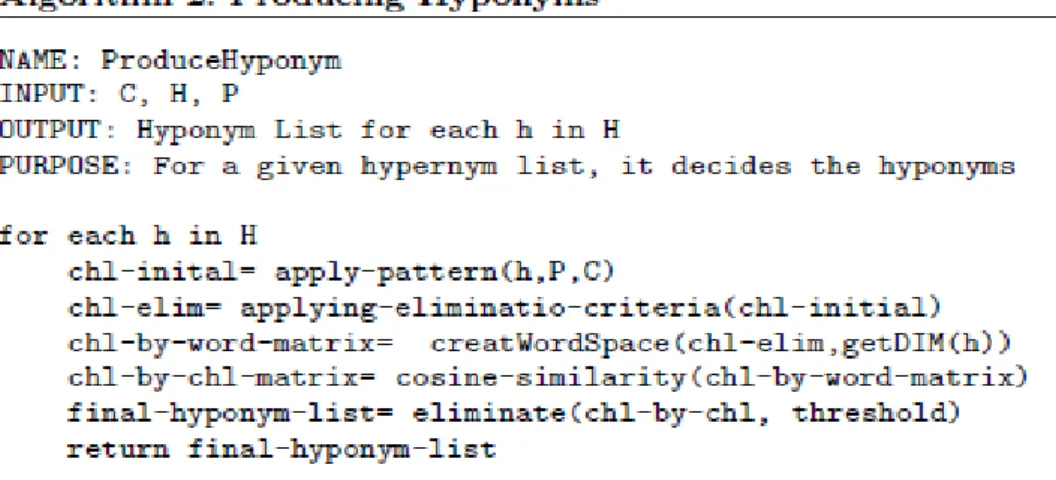
Page Figure 4.1 Create Dimension for Given Hypernym List (C=Corpus, H=HypernymList, DIM=Dimension) ... 31 Figure 4.2 Create Hyponym List for each Hypernym in H (C=Corpus, H=Hypernym
List, DIM= Dimension, P= Pattern, chl= candidate hyponym list) ... 32 Figure 4.3 The Generic Algorithm that Applies Bootstrapping Approach (C=Corpus,
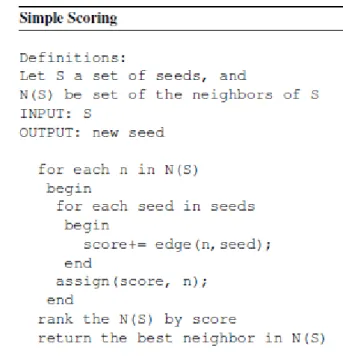
P= Pattern, H=Hypernym List)... 35 Figure 4.4 The Graph-based Algorithm (S=a set of input seeds, N(S)=a set of the
neighbors of S) ... 36 Figure 4.5 Calculate All Similarity Scores between Candidates and Seeds. Then
Return the Best Candidate (S=a set of input seeds, N(S)=a set of the
neighbors of S) ... 37 Figure 5.1 High-level Representation of the System ... 58 Figure 6.1 Representation of the Synonym Extraction in Model-2 ... 90
xii
LIST OF TABLES
PageTable 2.1 A list of semantic relations at various syntactic levels ... 7
Table 3.1 Term weighting schemas ... 20
Table 3.2 Contingency table ... 21
Table 4.1 The number of items in Web, corpus and output of each step ... 32
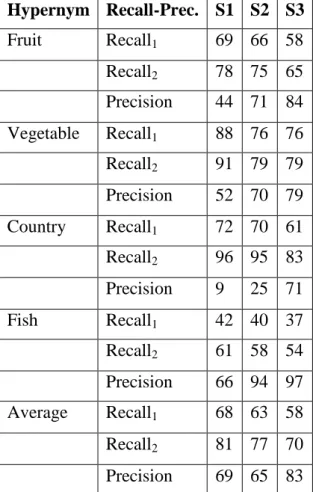
Table 4.2 Precision and recall values for Fruit, Vegetable, Country and Fish ... 33
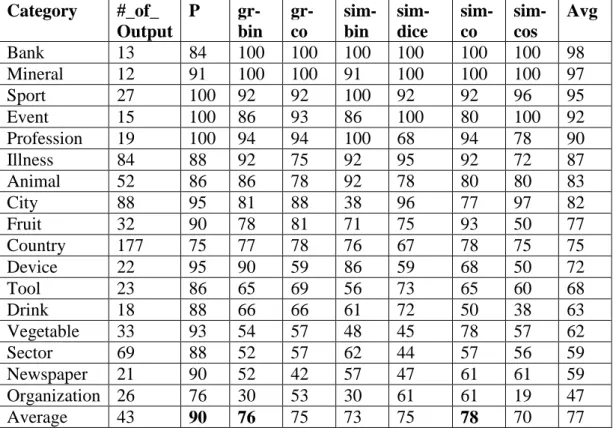
Table 4.3 First 5 seeds for each category ... 40
Table 4.4 Precision analysis of the first experiment ... 41
Table 4.5 Recall analysis of second experiment ... 42
Table 4.6 Recall analysis of third experiment ... 43
Table 5.1 Patterns that are used in three different studies ... 55
Table 5.2 A summary for General Patterns (GP) ... 56
Table 5.3 Examples of GP ... 56
Table 5.4 A summary for Dictionary-based Patterns (TDK-P) ... 57
Table 5.5 Examples of TDK-P ... 57
Table 5.6 Reliability of patterns ... 64
Table 5.7 Ambiguous and unambiguous pattern list ... 67
Table 5.8 The precision of GP and TDK-P for the first N selections ... 70
Table 5.9 The precision results of the scores for five wholes ... 71
Table 5.10 The results for the distinctive parts precision ... 73
Table 5.11 Statistical measurements for GP vs. TDK-P ... 73
Table 5.12 The precision (prec) results for training set (TS) size of 50,100 and 150 .. 74
Table 5.13 Best patterns of GP vs. TDK-P ... 74
Table 5.14 Ranked by success rate in precision of each pattern ... 75
Table 5.15 Correlation table ... 76
Table 5.16 SR with examples interpreted in corpus and patterns for GP vs. TDK-P ... 77
Table 5.17 Comparison of precisions of GP vs. TDK-P for semantic relatedness ... 77
Table 5.18 The results of BP for part-whole relation and SRs ... 78
Table 5.19 Performance in precision of statistical metrics for semantic relatedness ... 78
Table 6.1 General Patterns, Dictionary-based Patterns and Bootstrapped Patterns ... 85
Table 6.2 Dependency features ... 86
Table 6.3 F-measure of semantic relations (SRs) features ... 87
Table 6.4 Statistics for features ... 88
Table 6.5 F-measure of dependency relations features ... 88
Table 6.6 Tendencies of groups to semantic relations in percentage ... 91
Table 6.7 Information gain (IG) of each feature with its type ... 94
Table 6.8 Confusion matrix ... 94
Table 6.9 Precision, recall and F-measure of all attributes ... 95
xiii
Table 6.11 Precision, recall and F-measure of features from dictionary definitions ... 95
Table 6.12 Precision, recall and F-measure of features from corpus ... 95
Table A.1 General Patterns and their Turkish equivalents ... 116
Table A.2 Dictionary-based Patterns and their Turkish equivalents ... 117
xiv
ABSTRACT
CORPUS-DRIVEN SEMANTIC RELATIONS EXTRACTION FOR TURKISHLANGUAGE
Tuğba YILDIZ
Department of Computer Engineering PhD. Thesis
Adviser: Assoc.Prof. Dr. Banu DİRİ
Identification of semantic relations is the core problem in many Natural Language Processing tasks. One of the important tasks is to build up ontology or to construct thesaurus/lexicon. The most popular and widely used lexical database, WordNet is developed by manually. So it is used as source and also comparable work for most of the studies. Although these types of lexicons are reliable and effective, their production can be troublesome and time-consuming in some cases. So acquisition of semantic relation automatically from large amount of electronic documents (corpora, dictionaries, newspapers, newswires, etc.) becomes more important.
In this study, automatic and semi-automatic acquisition system for acquisition of hyponym/hypernym, meronym/holonym and synonym relations are handled from large corpus in Turkish Langage for nouns. For this purpose, some sort of methods is proposed to realize the model.
The method for hyponym/hypernym relation relies on lexico-syntactic pattern and semantic similarity. Once the model has extracted the items using patterns, it applies similarity based elimination of the incorrect ones in order to increase precision. Second model is based on similarity based expansion in order to increase recall. Several scoring functions are within bootstrapping algorithm are applied.
For meronym/holonym, lexico-syntactic patterns are utilized and adopted again to a Turkish huge corpus. Two different approaches are proposed to prepare patterns; one is based on pre-defined patterns that are taken from literature, second automatically produces patterns by means of bootstrapping method. Pre-defined patterns are categorized into two clusters; General and Dictionary-based patterns. Once these patterns help the system to extract matched cases, it proposes a list of part-whole pairs depending on their co-occur frequencies. For latter, bootstrapping model takes manually
xv
prepared unambiguous seeds to induce syntactic patterns and estimates their reliabilities. Then, system extracts pair instances then ranks them by instance reliability scoring. Additional, statistical selection is used on global data obtaining from all results of entire patterns, where global data refers to a whole-by-part matrix on which several association metrics such as information gain, T-score etc. are measured and compared. Finally, how these patterns and statistical method improve the system accuracy especially within corpus-based approach and distributional feature of words is evaluated.
For synonym relation, the main assumption is that synonym pairs show similar semantic and syntactic characteristics by the definition. They share same meronym/holonym and hypernym/hyponym relations. Contrary to synonymy, hypernymy and meronymy relations can be easily acquired by applying lexico-syntactic patterns to a corpus. Such acquisition might be utilized and ease detection of synonymy. Likewise, some particular syntactic relations are utilized such as object/subject of a verb etc. Machine learning algorithms were applied on all these acquired features. The first aim is to find out which syntactic and semantic features are the most informative and contributes most to the model. Performance of each feature is individually evaluated with cross validation. The model that combines all features shows promising results and successfully detects synonymy relation. Another model is proposed to extract synonym relation with using integration of some sort of sources such as WordNet, bilingual on-line dictionary and monolingual on-line dictionary.
The main contributions of the study is considered as being first major attempt for Turkish hyponym/hypernym, meronym/holonym and synonym identification based on corpus-driven approach for Turkish Language. Second contribution is to use integrated approaches such as pattern-based method with statistical elimination and expansion, bootstrapping patterns, etc. for extracting relations. Third contribution is to use multiple resources such as WordNet, mono/bilingual on-line dictionaries, etc. and to integrate them
Key words: Lexico-Syntactic Pattern, Pattern-based approach, Bootstrapping approach, Distributional Similarity, Hyponym/Hypernym, Meronym/Holonym, Synonym, Semantic similarity.
YILDIZ TECHNICAL UNIVERSITY GRADUATE SCHOOL OF NATURAL AND APPLIED SCIENCES
xvi
ÖZET
DERLEM TABANLI ANLAMSAL SÖZLÜK OLUŞTURMA Tuğba YILDIZ
Bilgisayar Mühendisliği Anabilim Dalı Doktora Tezi
Tez Danışmanı: Doç. Dr. Banu DİRİ
Anlamsal ilişkilerin çıkarılması, Doğal Dil İşleme uygulamaları için büyük önem taşır. Bu uygulamalardan biride ontoloji/sözlük oluşturmaktır. Günümüzde sıkça kullanılan WordNet, insanlar tarafından elle oluşturulan bir sözlüktür. Birçok çalışmaya kaynak olan WordNet, ne kadar güvenilir ve etkili olsa da zahmetli ve zaman alıcıdır. Bu yüzden anlamsal ilişkilerin büyük elektronik dokümanlardan (derlem, sözlük, gazete, etc.) otomatik olarak çıkarılması önemli hale gelmiş, örüntü-tabanlı, dağılım benzerliği, makine öğrenmesi algoritmaları ya da hibrit yöntemler kullanılarak çözümler sunulmuştur.
Bu çalışmada, tam ve yarı otomatik yöntemler kullanılarak, isimler için alt/üst, parça/bütün ve eş anlamlılık ilişkileri Türkçe dilinde, derlem kullanılarak çıkarılmaya çalışılmış ve birkaç model sunulmuştur.
Alt/üst kavram ilişkisi için sunulan metot, sözlük-yapısal örüntülere ve anlamsal benzerliğe dayanır. Örüntüler, derleme uygulanarak aday alt kavramlar çıkarılmıştır. Sonrasında ise kesinliği arttırmak için benzerlik ölçütleri kullanılarak eleme yapılmıştır. Anma değerini arttırmak için farklı bir model olan istatistik tabanlı genişleme yöntemi kullanılmış, farklı skorlama ve ağırlıklandırma fonksiyonları modele dahil edilmiştir. Parça/bütün ilişkisi için, örüntü yaklaşımı kullanılmış ve Türkçe derleme uygulanmıştır. İki farklı örüntü yapısı kullanılmıştır. İlki literatürde daha önceden tanımlı olan örüntülerin Türkçe'ye çevrilmesi ile gerçekleştirilmiştir. Diğer ise önyükleme metodu ile otomatik olarak belirlenmiştir. Tanımlı örüntüler, Genel ve Sözlük tabanlı olarak iki sınıfa ayrılmıştır. Bu örüntüler derleme uygulandıktan sonra, çıkan durumlar üzerinden birbirleri ile kaç defa çıktığı bilgisi kullanılmıştır. Diğer metot da ise önceden belirlenen kelime çiftleri kullanılarak, derlemdeki örüntüler bulunmuş ve örüntülerin güvenilirliği
xvii
hesaplanmıştır. Güvenli örüntüler yardımıyla yeni çiftler bulunmuş ve kelime çiftlerinin güvenilirliği hesaplanmıştır. Bazı ölçütler (bilgi kazancı, T-score gibi) kullanılarak karşılaştırma yapılmıştır. Son olarak bu örüntülerin ve metodun sistem doğruluğunu nasıl geliştirdiği incelenmiştir.
Eş anlamlılık ilişkisi için kullanılan yaklaşım, eş anlamlı olan çiftlerin benzer anlamsal ve sözdizimsel karakterlere sahip olmasıdır. Bu çiftler aynı alt/üst ve parça/bütün ilişkilerini paylaşırlar. Eş anlam ilişkisini, alt/üst ya da parça/bütün ilişkisindeki gibi örüntüler kullanarak derlem içinden yakalamak Türkçe için zordur. Bu yüzden bağımlılık ilişkileri (nesne/özne, etc.) kullanılmıştır. Çalışmanın ilk amacı modeli geliştirecek sözdizimsel ve anlamsal özellikleri çıkarmaktır. Bunun için herbir özellik çapraz doğrulama yöntemi ile değerlendirilmiştir. Model, özelliklerin birleşimi ile başarılı sonuçlar vermiştir. Bu yaklaşıma ek olarak, WordNet ve tek/iki dilli sözlükler kullanılarak verilen bir kelimenin eş anlamlısı derlemden çıkarılmıştır.
Çalışmadaki en büyük katkı, Türkçe derlem üzerinde alt/üst kavram, parça/bütün ve eş anlamlılık ilişkisinin yarı ve tam otomatik olarak çıkarılmasıdır. İkinci katkı, WordNet, sözlük gibi birçok kaynağın adapte edilmesi ile oluşturulan birleşik bir modelin kullanılmasıdır.
Anahtar Kelimeler: Örüntü-tabanlı yaklaşım, Önyükleme-tabanlı yaklaşım, Bölüşüm-tabanlı yaklaşım, Alt/Üst Kavram, Parça/Bütün, Eş Anlam, Anlamsal Benzerlik
1
CHAPTER 1
INTRODUCTION
1.1 Literature Review
Semantic relation refers to the relation between words, phrases, sentences and documents. In literature, comprehensive studies of semantic relation can be obtained with different perspectives [1], [2], [3]. For Lyons [1], who is a popular English linguist, “As far as the empirical investigation of the structure of language is concerned, the sense of a lexical item may be defined to be, not only dependent upon, but identical with, the set of relations which hold between the item in question and the other items in the same lexical system.” Cruse [3] as a linguistics, give another description about semantic relation “the meaning of a word is fully reflected in its contextual relations; in fact, we can go further and say that, for present purposes, the meaning of a word is constituted by its contextual relations.” According to Chaffin and Hermann’s perspective [4] as psychologists, “semantic relations between concepts are basic component of language and thought”.
Recently, semantic relation became major interest of computational linguistics. Various studies have been proposed for automatically identification of semantic relation from corpus. Most of the previous studies have been based on a key insight by Hearst [5] that lexico-syntactic patterns (LSPs) found in plain text to identify particular semantic relations. Other corpus-based attempts have used the statistics of co-occurrence and proposed bootstrapping mechanism [6]. In addition, distributional similarity techniques are utilized for constructed thesaurus [7]. Recently, machine learning algorithms are applied to syntactic, lexical and grammatical features that are obtained from corpus [8]. All these techniques can be employed together to develop integrated systems and increase the accuracy rate.
2 1.2 Objective of the Thesis
Identification of semantic relation from raw text is an important problem in Natural Language Processing (NLP). Numerous studies have been devised for extracting semantic relations. Most of them have been worked on English. Although valuable Turkish studies have been done in literature, number of studies is very few and based on dictionary definitions. This study is first major attempt based on corpus-driven integrated approach for Turkish domain.
The study aimed to develop an integrated model for acquisition of particular semantic relations; hyponym/hypernym, meronym/holonym and synonym from large Turkish corpus automatic and semi-automatically. The proposed model relies on combination of different approaches: lexico-syntactic patterns, distributional similarity and bootstrapping approach. All the techniques can retrieve semantic relations with promising results. The objective is to get better relevance and more precise results.
1.3 Hypothesis
A broad variety of methods are utilized especially for English to extract semantic relations. All predefined and the most widely used approaches for extracting semantic relations can be applied into Turkish domains. We realized this hypothesis with developing an integrated model to harvest particular semantic relations: hyponym/hypernym, meronym/holonym and synonym.
For this purpose, different approaches are adopted into proposed model. The most common approach is pattern-based approach that performed the hyponym/hypernym and meroym/holonym relations. Contrary to hypernym/hyponym and meronym/holonym relations, synonym relations can not be easily acquired by applying LSPs to a corpus. So another approach which is based on distributional similarity is carried out synonymy relations detection. In addition, corpus statistics are used with semantic similarity measurements to contribute the models.
3
CHAPTER 2
SEMANTIC RELATION
The widespread usage of World Wide Web (WWW) leads to enormous amounts of electronic text, including newspaper, emails, tweets, blogs, articles, documents from different domains, and so on. Browsing or filtering documents, extracting the information in which the people are interested, is an area of growing interest within Information Retrieval (IR) area. IR is one of the most important applications of Natural Language Processing (NLP), which is an interdisciplinary research area that deals with how computers can be used to understand and manipulate natural language text or speech. Beside information retrieval, other applications such as machine translation, question answering, and information extraction play an important role as NLP applications.The diversity of approaches and applications are developed about knowledge levels of NLP; Phonetics and Phonology, Morphology, Syntax, Semantics, Pragmatics and Discourse. All these levels have been studied extensively in different perspectives such as computer science, linguistics, statistics, and mathematics and also concerned in other disciplines such as psychology, philosophy and anthropology.
Semantic is one of the knowledge levels in NLP and defined as “is the technical term used to refer to the study of meaning, and, since meaning is a part of language, semantic is a part of linguistics” [9]. Semantic relation is a subfield of semantic and refers to the relation between words, phrases, sentences and documents. Semantic information is valuable asset and essential for many NLP problems.
Semantic relation can be defined as a set of semantic relations R between a set of concepts C is a relation R ⊆ C × T × C, where T is a set of semantic relation types. A relation r ∈ R is a triple <ci,t,cj> that represent ci,cj ∈ C with type t ∈ T.
4
It is possible to mention the existence of semantic relations’ properties. Murphy [10] identified and clarified 8 properties: productivity, binarity, variability, prototypicality and canonicity, semi-semanticity, uncountability, predictability, universality.
1. Productivity: It is easy to produce new relations.
2. Binarity: Relations can binary that a word can relate one word.
3. Variability: Relations between words vary with the sense of the word and context.
4. Prototypicality and canonicity: Some word pairs present better relation examples and some word pairs seen as standard exemplars of a relation.
5. Semi-semanticity: Other properties which are non-semantic relations, such as grammatical category, co-occurrence, etc. have important role to determine whether a particular relation is considered to hold between two words.
6. Uncountability: The number of semantic relations is not counted and they are applied to open class.
7. Predictability: Semantic relations can be predicted from particular patterns and rules.
8. Universality: Semantic relations are general and same concepts are related with same semantic relations in any language.
As described above, uncountability defined as “the number of semantic relation types is not objectively determinable” [10]. When we observe the state-of-the-art lists of semantic relations used in the literature, there are contradictory views about number of semantic relations. Some studies [4], [11] proposed five semantic relations can be seen as primitive: class inclusion (hypernym/hyponym), part-whole (meronym), similars (synonym), contrast (antonym) and case relations. They provided a list of 31 semantic relationships [4] as sub-relations and these five families provide an apriori framework within other sub-relations. On the other hand, there is no agreement on the number and abstract level of semantic relations [12], [13], [14], [15]. In the context of this work, we focus on hyponym/hypernym, meroym/holonym and synonym relations. The most widely used semantic relations in literature are given below:
Hyponym/Hypernym: Hyponym/Hypernym is a relation of inclusion and is known as IS-A relation in so many studies. e.g., “A dog is an animal”, the term dog is a hyponym with respect to hypernym animal. Horizontal relation can be labeled co-hyponyms such as cat, bird and horse for animal. This relation is also
5
called subordination/superordination, subset/superset, generic-specific, taxonomy. Lyons defined hyponym/hypernymy relation as “the relation which holds between a more specific, or subordinate, lexeme and a more general, or superordinate, lexeme” [2].
Meronym/Holonym: Another important semantic relation is the part-whole or meronym relations. Part-whole is a relationship between terms that respect to the significant parts of a whole. For example, “the eye is part of the face”, the term “eye” in the sentence is a part with respect to whole “face”. Cruse [3] describes the meronymy as follows “The whole-part lexical relation is an association between a lexical unit representing a part and a lexical unit representing its corresponding whole”. Palmer [9] uses term component for part-whole and defines component as “the total meaning of a word being seen in terms of a number of distinct element or components of meaning”.
Synonym: Synonyms are words with identical or similar meanings. When two or more words have the same or nearly the same meaning in some or all senses, then they are synonymous. For example, “car is synonymous with auto”. Palmer identified synonym as “Synonym is used to mean sameness of meaning” [9]. For Chaffin, “terms that overlap in denotative meaning, connotative meaning, or both” [4].
Antonym: Antonyms are words express opposite or incompatible meanings. For example, “fast-slow or old-young”. Chaffin described antonym as named contrast “this family consists of relations in which the meaning of one term contrasts, opposes, or contradicts the other term” [4].
Another discussion is about productivity property of semantic relations. Semantic relation is generally concerned with open-class words; nouns, verbs, adjectives, and adverbs. According to Miller [16], closed-class words generally play a grammatical role and open-class words play a referential role. The tangible reason for usage of them is that new or familiar open-class words can be used to express new concepts. For Miller, “Two facts about open-class words are immediately apparent: There are a great many of them and their meanings are intricately interrelated.” In addition to that, a new relation can be extracted whenever a new word is coined. It is clarified in Murphy’s [10] listing of semantic relations properties. Productivity, which is one of the properties of semantic relations, means that new relations among words can be created easily.
6 2.1 Semantic Relation between Nominals
Semantic relations have been a subject of other disciplines, more recently, is has become a major interest of computational linguistics. The studies in computational linguistics show a wide variety of methods of semantic relations on noun compounds especially in English. Noun compounds are “sequences of two or more nouns related through modifications” [17]. However the semantic classification of noun compounds (NCs) is seen as complex. Several reasons are listed as:
1. NCs have implicit semantic relations.
2. The interpretation of NCs is knowledge intensive. 3. It can represent more than one semnatic relations. 4. It is context-dependent.
Recently, studies are focused on extracting nominals (nouns) in the context of the sentences. One study produce the set of general rules, which are manually coded, are applied in order to interpret noun sequences in unrestricted text involving the taxonomic information [18]. Lauer proposed a set of 8 prepositional paraphrases: of, for, with, in,
on, at, about, and from for compounds [19]. The study used corpus statistics with using
computing frequencies of prepositions and involved them in probabilistic model. The other attempt classified noun compounds from the domain of medicine with using 13 semantic relations between the head noun and the modifier [20]. In the other study, Rosario et al. (2002) used the MeSH hierarchy and a multi-level hierarchy of semantic relations, with 15 classes at the top level to classify noun compounds [21]. Lapata classifies nominalizations “i.e. compounds whose head noun is a nominalized verb and whose prenominal modifier is derived from either the underlying subject or direct object of the verb" [22], [23] in domain independent text. The model is proposed as a statistical approach to interpret noun constituents. Nastase and Szpakowicz [13] dealt with noun phrases with a head noun and one modifier which can be noun, adverb and adjective. They extracted attributes of pairs from definitions with using WordNet and Roget's Thesaurus to capture relation between two elements. Two-level hierarchy with five semantic relations at the top and 30 semantic relation at the bottom was proposed. Then they used machine learning methods and similarity measurements to find the similarities. Other researchers [24], [25] used supervised and unsupervised learning algorithm for assigning semantic relation to noun-modifer pair.
7
Other comprehensive studies about identifying semantic relation especially on noun compounds proposed in recent years. Moldovan [14] proposed 35 semantic relations to classify in noun phrases. They identified feature vector of each noun phrases and then used semantic scattering to label noun phrases automatically [14]. Table 2.1 shows 35 different semantic relations that used in [14]. Instead of using primitive ones, they used mostly associative relation types. The same classes have been used with applying support vector machines (SVM) to classify semantic relations in nominalized noun phrases [26]. It was concluded that SVM seem better performance than other models. As a recent study, supervised, knowledge-intensive approach for the automatic semantic relation extraction between nominals was presented [8]. They used lexical, syntactic, and semantic features extracted from such as hand-built lexicon and additional annotated corpora.
Table 2.1 A list of semantic relations at various syntactic levels [14]
SR SR SR SR
Possesion Cause Accompaniment Probability of Existance
Kindship Make/Produce Experiencer Possibility
Property/Attribute-Holder Instrument Recipient Certainty
Agent Location/Space Frequency Theme
Temporal Purpose Influence Result
Depiction-Depicted Source/From Associated With Stimulus
Part-Whole(Meronymy) Topic Measure Extent
Hypernymy(IS-A) Manner Synonymy Predicate
Entail Means Antonymy
2.2 Related Works about Methods
Semantic relations are keys to various important particular NLP tasks such as information retrieval, information extraction, summarization, machine translation, question answering, textual entailment, and word sense disambiguation. Most of the studies rely on modern semantic resources such as thesauri, ontologies or lexical databases.
Taxonomy is a composition of a list of terms C organized into a hierarchy with a set of semantic relation R. On the other hand, thesaurus is a composition of a list of terms C organized into a hierarchical, equivalence and association relations R such as make/produce, cause, purpose, etc.Whereas lexical database is defined as “is a triple (C,
S, R) where C is a vocabulary, S is a set of synsets, R is a set of semantic relations
8
[31], which is a large lexical database of English, is the most popular and useful resource to provide NLP applications. It includes entries for open-class words (nouns, verbs, adjectives and adverbs) that only organized into hierarchies. On the other hand, ontology is a general structure that is knowledge representation model [28].
Over the past decades, many considerable studies have dealt with semantic relation to create semantic lexicons. For this purpose, linguists made considerable efforts to collect information about words, find relations between them and build semantic resource such as lexicons, dictionary, ontology, Machine Readable Dictionaries (MRDs).
These types of resources such lexicons, thesaurus and dictionaries are reliable, effective and widely used. Whereas the process which is collecting and defining the terms, can be troublesome, time-consuming and cost of extension and maintenance operation is expensive in some cases. Because any lexicon should be updated in order to add new words. In addition to that, lexicon can be insufficient to cover domain specific words. For example, proper noun is highly important for some applications and WordNet’s coverage of proper nouns is rather sparse.
In order to overcome these types of problems, NLP studies give more importance to ontology building, thesaurus construction, and semantic network construction automatically from some sources such as documents, corpus, Wikipedia, Web, etc. According to Igo [32], techniques for building semantic lexicon can be divided into two groups: corpus-based methods and Web-based methods. “Corpus-based methods are typically designed to induce domain-specific semantic lexicons from a collection of domain-specific texts. In contrast, Web-based methods are typically designed to induce broad-coverage resources, similar to WordNet. Many domains use specialized vocabularies and jargon that are not adequately represented in broad-coverage resources (e.g., medicine, genomics, etc.)”. With using these types of sources, many methods have been proposed, including pattern-based [5], statistical and bootstrapping methods [6], distributional similarity [7], knowledge-based methods [8], and machine learning techniques [15]. In addition, some studies which combined complementary approaches by looking for semantic relations.
The pattern-based method, which is leading one, is the most popular and widely used in the literature. The process of approach starts with defining which semantic relation will be involved and developing patterns that express that particular relation. Patterns are
9
searched in the sources to extract instances. These instances can be used directly or help to find new patterns recursively. For example, the LSPs such as “NPx is part of NPy” is used for meronym/holonym relation in studies. Instances that matched the pattern are used part-whole pairs or used to find new patterns.
Attempts based on patterns are proposed to extract lexical information from MRD in the literature [33], [34], [35]. Because of the limitations of MRDs, Hearst was the first to apply a pattern-based method to extract hyponym from unrestricted text, which is Grolier’s American Academic Encyclopedia [5]. Hearst’s approach became a pioneer and numerous studies used this approach for extracting semantic relations.
Pantel [36] presented Espresso algorithm which is a framework based on pattern-based approach in [5]. The method started with applying seed pairs to corpus and used generated sentences to exploit generic patterns. They scored the reliability of patterns and instances for filtering them. The top-10 best patterns were used to find new pairs. Similar approach was also applied into on-line encyclopedia. One attempt addressed the problem of identification of semantic relations from Wikipedia [37]. They proposed an approach to identify lexical patterns in Wikipedia automatically and then they were applied to existing ontology, WordNet.
Another study [24] presented an algorithm based on Vector Space Model (VSM). Vectors were derived from statistical analysis that is obtained frequency of patterns of words by Web. These vectors were then used in a nearest-neighbor classifier.
One approach [38] for semantic relation extraction was based on combining LSPs and statistical techniques. LSPs were applied to corpus to detect a first set of pairs of co-occurrences. On the other track, statistical unsupervised system relies on distributional similarity, was used to obtain second set of pairs. Integration of both approaches was used for extraction semantic relations form corpus.
Various studies were also introduced other approaches for extracting, identifying or detecting semantic relations. A uniform approach [39] was described with using supervised corpus-based machine learning algorithm for classifying word pairs. Another approach was to build semantic lexicons for specific categories with simple bootstrapping mechanism with simple statistics [6], [40], syntactic information [41], [42], and improved version with LSPs [43]. A weakly supervised bootstrapping
10
algorithm that combined corpus-based method for inducing semantic lexicon with statistics of Web, was developed in study [31].
Several studies reported on corpus statistics approaches to noun compound. They used frequency of nouns and involved them in probabilistic model [19], [44], [45]. Some studies were based on hand-coded rules [17], [18]. There have been significant studies, which present supervised, semi-supervised, unsupervised, graph-based methods for automatic extraction of semantic relations. One study proposed pattern clusters method for nominal relation classification from large corpus in an unsupervised manner [46]. Another study presented an unsupervised method using graph model [41]. Another unsupervised method that held between nouns is based on discovering predicates that make explicit hidden relations [47]. Finally, a supervised, knowledge-intensive approach to the automatic identification of semantic relations between nominal was described [8]. Lexical, syntactic and semantic features were collected from different sources and a classification algorithm is applied.
Another way is using clustering algorithms on feature vectors to extract word senses [7]. This technique adopted the hypothesis that depends on the distributional similarity. Another important study [48] compared the knowledge-based, corpus-based and Web-based similarity measures for semantic relation extraction and reported which measures gives best results in which case.
2.3 Turkish Studies
For Turkish language, few studies have been presented for discovery of semantic relations. BalkaNet [49] was the first project to develop of a multilingual lexical database for Balkan languages such as Turkish WordNet. Although the project has not been completed yet, it was used for comparison with other studies.
One of the studies was proposed to construct Turkish WordNet automatically [50]. Four methods were proposed for automatic generation of Turkish WordNet: Translation from WordNet, Dictionary Definitions, Patterns, Usage of Unit Information. Two of them (Patterns and Translation) were applied to only hyponym/hypernym relations with 66% success ratio.
11
Another study was presented a rule-based method in order to extract semantic relations between words in a Turkish dictionary (TDK) 1 and to build a hierarchical structure as WordNet [51]. Rules in the study used surface form, category and definition of the word. They only applied the rules for hypernym and synonym relations. The success ratio is 94% for hypernym extraction. The hierarchy was compared with Turkish WordNet.
One of the recent studies to harvest semantic relations were based on TDK and Wiktionary (Wiki) 2. They defined some phrasal patterns that are observed in dictionary definitions to represent particular semantic relations [52]. The accuracy rate of the prior relations: hyponym/hypernym (94%), meronym/holonym (55%), synonym (88%). In some recent works, similar approaches were employed to develop a semantic network by using structural and string patterns in TDK [53], [54]. Relations used in studies were hyponym, synonym, antonym, member-of, amount-of, group-of and has-a. The overall accuracy is 86% for both studies.
Most of previous studies in Turkish depend on dictionary definitions and phrasal patterns. In the context of this study, an integrated model was developed for acquisition of particular semantic relations; hyponym/hypernym, meronym/holonym and synonym from large Turkish corpus automatic and semi-automatically. This study is first major attempt based on corpus-driven integrated with pattern-based and distributional similarity approach with using statistical measurements and other features that are obtained from mono/bilingual on-line dictionaries and WordNet. Antonym and case relations are eliminated due to the scope of the thesis is concerned with only nouns. Antonym relations are mostly between adjectives and case relations are generally between verbs.
1 Türk Dil Kurumu (The Turkish Language Association). 2
12
CHAPTER 3
EXPERIMENTAL SETUP
3.1 Corpus
In our experiments, we used the BOUN Web corpus and language resources. They propose a set of language resources for Turkish language processing applications. They present an implementation of a morphological parser based on two-level morphology, an averaged perceptron-based morphological disambiguator with accuracy of 98%, and a Web corpus [55].
The BOUN Web corpus contains four sub-corpora. Three of them named NewsCor are from three major Turkish news portals and the other corpus named GenCor is a general sampling of Web pages in the Turkish Language. For encoding of the xml files, XML Corpus Encoding Standard (XCES) is used. The corpus is tokenized and encoded in paragraph and sentence levels and other symbols are also tagged. The size of the corpus is about 490M tokens.
3.2 Preprocessing
We conducted several experiments on unparsed corpora, and also we parsed it with the morpohological parser [55]. While the words are chosen, morphological disambiguator is included into system to select the less ambiguous word. As a result, each word in raw text is converted into surface form surface+root+POS-tag. For example, “arabalar+araba+noun” (cars+car+noun).
On the other hand, this form is insufficient in other experiments, especially for syntactic features extraction. Then we parsed each word into its morphemes. The representation
13
of a parsed tokens is in the form of surface+root+POS-tag+[and all other markers].For example, “arabalar+araba+noun+a3sg+pnon+gen”.
+a3sg: 3sg number-person agreement
+pnon: No possessive marker
+gen: Genitive case marker
3.3 Methods
In this study, three different methods are used for extracting semantic relations. General procedures of each method are described with details in the next sections.
3.3.1 Pattern-based Approach
The most precise and well-known method that relies on LSPs is applied by Hearst [5] to raw text. The method is suggested for inferring the hyponym relations and it is stated that it is also available for other semantic relations. There have been so many attempts to extract semantic relation with using pattern-based approach. It is beneficial to find pairs and also for discovery of new patterns. General procedure of pattern-based approach is given for discovering new patterns/new pairs in the following:
1. Define the semantic relation (eg.hyponym/hypernym)
2. Collect a list of pairs (eg. apple/fruit) that are obtained by observed LSPs. The list can be automatically using the bootstrapping method.
3. Deploy the pairs to corpus
4. Find the patterns that indicate these pairs and keep them 5. Apply new patterns to second step again
3.3.2 Bootstrapping Approach with Seed Words
Bootstrapping method is commonly used in information extraction. Although the method is used in pattern discovery, it is also used without pattern-based approach. The approach is used for building semantic lexicon with initial seeds [6]. General outline of the algorithm is:
14
1. Choose categories (eg. vehicle) and small set of initial seed words for each category (initial seeds: car, auto, truck, plane, train)
2. Collect the context with window including seed words
3. Count the co-occurrence of words and compute the score of each word 4. Results are ranked and top-N words are selected as a new seed word 5. Return to step 2 and iterate n times
3.3.3 Distributional Similarity Approach
Distributional similarity approach, which is a popular method, is based on distributional hypothesis [56] which adopts that semantically similar words share similar contexts. The process of this approach was as follows; co-occurrence, syntactic information, dependency relations, etc. of the words surrounding the target word are extracted as a first step. This step can be named as feature extraction. Afterwards target word is represented as a vector with these contextual features. At the second step, the semantic similarity of two terms is evaluated by applying a similarity measure between their vectors. The words can be ranked according to their scores. Finally, top candidates are selected as most similar words from ranked list.
3.4 Similarity Measurements for Word and Vector Similarity
Similarity measure is a function that calculates a score from obtained feature vector. On the other hand, semantic similarity measures are used to evaluate similarity or relatedness of terms.
Methods that have been explained previously in Section 3.3 utilize some measurements to improve performance and compare the methods, respectively. In this study, various metrics are used to measure of word and vector similarity while extracting each semantic relation. Two basic algorithms are used to find word similarity: thesaurus-based and distributional algorithms (also vector similarity).
3.4.1 Thesaurus-based Methods
Thesaurus-based algorithms benefits from the structure of existing thesaurus and ontology to measure the semantic similarity/relatedness of terms. In this study, WordNet is used to compute only noun-noun similarity. For this purpose,
15
WordNet::Similarity package [57] is used. WordNet::Similarity package is freely available software package which covers modules for semantic similarity and relatedness between a pair of concepts. It includes six similarity measures and three relatedness measures. All are based on WordNet lexical database. WordNet::Similarity can be utilized by the utility program similarity.pl. It allows running all measures interactively.
For example, lin is one of the modules in WordNet::Similarity package and it relies on method represented by Lin [59]. A user can run lin module with two words pair such as car - bus and car - auto as following:
similarity.pl --type WordNet::Similarity::lin car bus car#n#1 bus#n#1 0.603649218135011 similarity.pl --type WordNet::Similarity::lin car auto car#n#1 auto#n#1 1
car#n#1 refers to the first WordNet noun sense of car associated with a word or word#pos combination. 0.603649218135011 represent the relatedness value between
car and bus when using lin module.
In this thesis, ten modules are used to decide for similarity and relatedness. Three of them are based on the information content (IC) of the least common subsume (LCS). LCS of concepts c1 and c2 is the lowest node in the hierarchy that subsumes both c1 and c2. In the formula, words(c) is the set of words subsumed by concept c and N is the total number of words in the corpus. IC is a measure of the specificity of a concept and defined as,
P(c) = w ∈words (c) count (w)
N (3.1)
IC(c) = -logP(c) (3.2)
Three modules depend on IC and LCS in WordNet::Similarity package include of Perl modules that described in the following:
RES: The method is described by Resnik (1995) [58]. The method relies on the IC of LCS of two nodes.
16
LIN: The method is described by Lin (1998) [59]. The method relies on the IC of LCS with sum of the IC of both c1 and c2.
SimLIN(c1,c2) =
2×logP (LCS c1,c2 )
logP c1 +logP (c2)
(3.4) JCN: The method is described by Jiang and Conrath (1997) [60]. The method relies on IC of LCS with sum of the IC of both c1 and c2. JCN takes the difference of the sum and IC of LCS.
SimJCN(c1,c2) =
1
2×logP LCS c1,c2 −(logP c1 +logP c2 )
(3.5) The other three modules depend on path length in WordNet::Similarity package include of Perl modules that described in the following:
PATH: It is a baseline algorithm that represents the shortest path in the thesaurus between two concepts, c1 and c2.
SimPATH(c1,c2) = -log shortestpathlen(c1,c2) (3.6) LCH: The method is described by Leacock and Chodorow (1998) [61]. It uses path with D that is the maximum depth of the taxonomy.
SimLCH(c1,c2) = max[ -log shortestpathlen(c1,c2)/(2*D)] (3.7) WUP: The method described by Wu and Palmer (1994) [62]. It finds the depth of LCS and scales with sum of depths of the each concepts.
SimWUP(c1,c2)=2*depth(LCS(c1,c2))/(D(c1)+D(c2)) (3.8) There are four measures in the package as follows:
HSO: The method is described by Hirst and St-Onge (1998) [63]. HSO considers many other relations in WordNet and also consider other POS-tags.
Path_weight= C- path-length – (k * number of changes in direction) (3.9) LESK: The method which is described by Banerjee and Pedersen (2002) [64], adopts the Lesk approach to WordNet. Relations are set of possible relations in WordNet whose glosses.
17
SimLESK(c1,c2)= 𝑟,𝑞∈𝑅𝑒𝑙𝑎𝑡𝑖𝑜𝑛𝑠 overlap(gloss r c1 , gloss r c2) (3.10)
VECTOR: The method is based on word senses using second order co-occurrence vectors of glosses of the word senses. Context of pieces of text for Word Sense Discrimination is proposed [65]. This idea is adopted by [66], [67] to represent the word senses by second-order co-occurrence vectors of WordNet definitions.
VECTOR_PAIR: The module computes the relatedness of two word senses with using the VECTOR Algorithm. This measure is derived from [67].
3.4.2 Distributional Methods
Distributional method is clarified as “The intuition of distributional methods is that the meaning of a word is related to distributional of words around it” [68]. Because of limitations of Thesaurus-based methods such as lack of words, need of strong hyponym/hypernym relation etc., distributional methods can be used as complementary method. Distributional method represents features of context of word w. These context features of w can be extracted from corpus and obtains feature vector fi ∈ F matrix. Features can be collected from collocation, bag of words or dependency relations. Collocation features captures the words that are positioned left or right of the target word w. Depending on the window size, root form of the word and POS-tags are used in the vector. Bag of words are unordered set of words of neighbors of target word w without importance of position. Dependency relations such as subject of, object of, etc. can be used as features under this assumption: “nouns bearing the same grammatical relation to the same verb might be similar” [68].
Co-occurrence is occurrence of two terms from a text corpus with in a broad context. It seems as good predictor for next word. Co-occurrence vectors can be derived by using co-occurrence statistics from large text corpora. The values between two words or a word and a feature can be measured with using some metrics. It is named as co-occurrence measures, weights or association measures.
3.4.2.1 Association Measures
Co-occurrence vector handles a value about its neighbor in its cell. It can be binary value like 1 if x and y occur in some context window, and 0 otherwise. Instead of binary value, usage of frequency or probability can be a better way. Since terms (y1,y2,…)
18
occur often word x are more likely to be good indicator. However they also are imperfect because of words that are appearing frequently such as the, and, they etc. So we need an association measures instead of raw count (frequency).
Information Gain (IG): is used to measure how many number of bits of information the presence or absence of a term in a document contribute to making the correct classification decision on a category. It is frequently used as a term goodness criterion in many problems in information retrieval. IG is also called expected mutual information, [68]. The formula of IG criterion of a term (c) and category (D) is defined to be in (3.11):
IG(c) = i=1m P Di logP(Di) + P(c) mi=1P Di c logP Di c + P c mi=1P Di c logP(Di|c ) (3.11)
In the framework of the thesis, semantic relations are used in the formula instead of term and category. For example, while term represents “part” relation, category represents “whole”.
Pointwise Mutual Information (pmi): is the pointwise mutual information that is one of the commonly used metrics for the strength of association between two variables.Thus, it is worth analyzing the difference between information gain and mutual information. The formulas show that IG is the weighted average of the mutual information IG(c,D) and IG(𝑐 ,D), where the weights are the joint probabilities P(c,D) and P(𝑐 ,D). So IG is also called average mutual information. The main disadvantage of PMI is its bias towards low frequent terms. The pointwise mutual information criterion is defined in formula with x and y, which represent two words. N11 is the number of times x and y co-occur, N10 is number of times x appears without y, N01 is number of times y appears without x, N00 is number of times neither x nor y occurs, N is the total number of x. The formula is given in (3.12)
pmi(x,y) = log N11N
(N11 + N01)(N11 + N10) (3.12)
Dice: It is very similar to pmi criterion. While pmi is theoretical measure, dice is empirical one. The dice coefficient of two sets is a measure of their intersection scaled by their size. The formula is defined to be as (3.13):
dice(x,y) = log 2N11
19
Jaccard: It is the ratio of number of times the words occur together to the number of times at least any one of the words occur [69].
Jaccard(x,y) = N11
(N11 + N01+N10) (3.14)
Chi-Sqaure (X2): It measures the lack of independence between x and y using two way contingency table. The events A and B are defined to be independent if P(A,B)= P(A)P(B) or, equivalently, P(A|B) = P(A) and P(B|A) = P(B). The formula is defined to be:
X2(x,y) = N(N11N00−N01N10) 2
N11 + N01 N11+N10 (N10+N00)(N01+N00) (3.15) T-score: It is defined as a ratio of difference between the observed and the expected mean to the variance of the sample. The formula is defined to be:
T-score(x,y) = (N11−(N10+N11)(N01+N11))
N N11 (3.16)
3.4.2.2 Vector Similarity Measures
Vector similarity measures are to find the similarity of two vectors, 𝑥 and 𝑦 which are represented as a vector. For the vector similarity, measurements of baseline, overlap, dice, jaccard, cosine, etc. can be used. dice and jaccard are also used in vector similarity. In this study, the most widely used measure that is cosine, is utilized.
Cosine: A word space in which, words are represented as vectors to compute similarity between two target words x and y. The co-occurrence can be measured with respect to documents, windows, sentences, or other units. The formula is defined to be:
Cosine(𝑥 ,𝑦 )= 𝑁𝑖=1𝑥𝑖×𝑦𝑖
𝑁𝑖=1𝑥𝑖2 𝑁𝑖=1𝑦𝑖2
(3.17)
3.4.3 Term Weighting Schema
The vector space model [70] is one of the most well known models that represent document and query as a vector in multidimensional term space. In vector space model, a document is represented as a vector in the term spaces, d= (w1, w2,…w 𝑉 ), where 𝑉 ,
20
is the size of vocabulary. The value of wi between (0,1) displays how much the term contributes to the semantic of document.
Weighting is a way of numerical statistic which respects how important a word to a document. It is important to choose a proper weighting schema. There are various term weighting schema derived from the different assumptions and the probabilistic models including binary, raw count (frequency), logarithmic and inverse term frequency. Table 3.1 shows the weighting schema with formulas.
Table 3.1 Term weighting schemas Term Frequncy Alternatives Formula
Normal TFt,d
Binary
bit,d = 1, 𝑇𝐹𝑡,𝑑 > 0
0, 𝑜𝑡ℎ𝑒𝑟𝑤𝑖𝑠𝑒
Logaritmic 1+log(TFt,d)
Term-Frequency (TFt,d): It is raw frequency and contrary to binary weighting, does matter how many times of a term appears in a given document d.
Binary (bit,d): It is the simplest scheme and refers to absence or presence of a given term in related document; no matter how many times a term appears in a document. Thus, the possible values are either 0 or 1.
Logaritmic (log(TFt,d)): It is a smoothed frequency logarithmic TFt,d function. It is used to scale the effect of unfavorable high term frequency in a document.
When a document is considered, all the terms are equally important. Although some particular terms such as and, with, that, etc. (ve, ile, bu, vb.), generally appear so many times in a document, their effects are slight or “no discrimating power in determining relevance” [68]. Intervention is a need to weight of these terms. So that Document frequency dft, defined to be the number of documents that contain a term t. Inverse document frequency (IDFt) is defined to scale weight of t:
IDFt = log
N
dft (3.18)
TF-IDF: Combination of TFt,d and IDFt is a statistical measure used to evaluate how important a word is to a document in a collection or corpus.
21 3.5 Performance Measures
The two most widely used measures for effectiveness of the system are precision and recall. Precision and recall have been used generally to measure the performance of information retrieval and information extraction systems. Recall indicates what proportion of all the relevant items have been retrieved from the collection. Precision indicates what proportion of the retrieved items is relevant.
Precision = #(relevant items retrieved) / #(retrieved items) = P(relevant|retrieved) (3.20) Recall = #(relevant items retrieved) / #(relevant items) = P(retrieved|relevant) (3.21)
Table 3.2 Contingency table
Relevant Not Relevant
Retrieved True Positive (TP) False Positive (FP) Not retrieved False Negative (FN) True Negative (TN) According to Table 3.2, precision and recall can be represented as follows:
Precision = TP / (TP + FP) (3.22)
Recall = TP / (TP + FN) (3.23)
Another approach to combine recall and precision is the F-measure. The F-measure has been defined as a weighted combination of Precision and Recall. F-measure is shown as follows:
F-measure = (2*Precision*Recall) / Precision + Recall (3.24) Alternative way is to use accuracy for evaluation the performance. According to Table 3.2, accuracy is represented as follows:
Accuracy = (TP + TN) / (TP + FP + TN + FN) (3.25)
In this study, precision, recall and F-measure are incorporated to evaluate the performance of the models. On the other hand, judgment of items as relevant or not in huge sized corpus is a basic problem. It is generally done manually by human as a gold standard which is used to judge the words indicate the proper semantic relation or not in this work. Three human annotators are manually tagged and evaluated the results.
22
CHAPTER 4
HYPONYM/HYPERNYM
The hyponym/hypernym relation is one of the semantic relations that play an important role in many NLP applications. The hyponym/hypernym relation referred as class inclusion, subclass/class, IS-A, a-kind-of, subordinate/superordinate, species/genus in the literature. Lyons defined hyponym as “the relation which holds between a more specific, or subordinate, lexeme and a more general, or superordinate, lexeme” [2]. In the words of Miller, “A concept represented by the synset {x, x', …} is said to be a hyponym of the concept represented by the synset {y, y', ...}, if native speakers of English accept sentences constructed from such frames as An x is a (kind of) y. The relation can be represented by including in {x, x', …} a pointer to its superordinate, and including in {y, y', …} pointers to its hyponyms” [16].The hyponym/hypernym relation is tested by frames such as “An X is a Y, An X is kind
of Y” or “An X is type of Y”. e.g., “A dog is an animal”, the term dog is a hyponym with
respect to hypernym animal. Cruse mentioned that the expression “An X is a kind/type
of Y” is more discriminating than “An X is a Y” [71].
The hyponym/hypernym relation is generally seen as transitive and asymmetrical relation. There is a hierarchical structure between hyponym and hypernym. Horizontal relation can be labeled co-hyponyms such as cat, bird and horse for animal. All features of a hypernym are inherited to its hyponym. A study [72] defined that a hyponym inherits all features of hypernym with minimum one more feature that distinguish it from other co-hyponyms. For example, apple is a fruit and it inherits all features of fruit however it is different from orange under shape, taste, etc.
![Table 2.1 A list of semantic relations at various syntactic levels [14]](https://thumb-eu.123doks.com/thumbv2/9libnet/3256065.8344/24.892.137.801.525.741/table-list-of-semantic-relations-various-syntactic-levels.webp)