Singapore Management University Singapore Management University
Institutional Knowledge at Singapore Management University
Institutional Knowledge at Singapore Management University
Research Collection School Of Economics School of Economics
5-2010
On Domains that Admit Well-Behaved Strategy-Proof Social
On Domains that Admit Well-Behaved Strategy-Proof Social
Choice Functions
Choice Functions
Shurojit CHATTERJISingapore Management University, [email protected] Remzi SANVER
Istanbul Bilgi University Arunava SEN
Indian Statistical Institute
Follow this and additional works at: https://ink.library.smu.edu.sg/soe_research
Part of the Economic Theory Commons
Citation Citation
CHATTERJI, Shurojit; SANVER, Remzi; and SEN, Arunava. On Domains that Admit Well-Behaved Strategy-Proof Social Choice Functions. (2010). 1-28. Research Collection School Of Economics.
Available at:
Available at: https://ink.library.smu.edu.sg/soe_research/1229
This Working Paper is brought to you for free and open access by the School of Economics at Institutional Knowledge at Singapore Management University. It has been accepted for inclusion in Research Collection School
On Domains That Admit Well-behaved Strategy-proof
Social Choice Functions
Shurojit Chatterji, Remzi Sanver and Arunava Sen
May 2010On domains that admit well-behaved
strategy-proof social choice functions
Shurojit Chatterji,
∗Remzi Sanver
†and Arunava Sen
‡May 18, 2010
Abstract
In this paper, we investigate domains which admit “well-behaved”, strategy-proof social choice functions. We show that if the number of voters is even, then every domain that satisfies a richness condition and admits an anonymous, tops-only, unanimous and strategy-proof social choice function, must be semi-single-peaked. Conversely every semi-single-peaked domain admits an anonymous, tops-only, unanimous and strategy-proof social choice function. Semi-peaked domains are generalizations of single-peaked domains on a tree introduced byDemange(1982). We provide sharper versions of the results above when tops-onlyness is replaced by tops-selectivity and the richness condition is weakened.
Keywords and Phrases: Voting-rules, Strategy-proofness, Restricted Domains, Tops-Only domains.
JEL Classification Numbers: D71
1
Introduction
The celebrated Gibbard-Satterthwaite Theorem (Gibbard(1973),Satterthwaite(1975)) rules out the existence of strategy-proof, non-dictatorial social choice function over the complete domain of preferences. This is a powerful negative result and has stimulated a very large literature which has investigated the structure of strategy-proof social choice functions on restricted domains. One of the most salient restricted domains in this respect is the domain of single-peaked domains. It is now well-known that these domains admit a large class
∗Singapore Management University, Singapore.
†Bilgi University, Istanbul, Turkey.
of strategy-proof social choice functions satisfying additional, attractive properties such as anonymity and Pareto-efficiency. These include the median voter rule (see Moulin (1980)). Of course, single-peaked domains are also very important in Arrovian aggregation theory and forms the bedrock of the modern theory of political economy. In this paper, we address a converse question. What are the domains that admit “well-behaved” strategy-proof social choice functions? In particular, do single-peaked domains emerge in a natural way from a characterization of domains that admit “well-behaved” strategy-proof social choice functions? We consider a standard voting environment with a finite number of individuals/voters and alternatives. Preferences are assumed to be antisymmetric. We provide two partial character-izations of domains. Our first result states that if the there is an even number of individuals, then any domain that satisfies a richness condition and admits an anonymous, tops-only, unanimous and strategy-proof social choice function, is semi-single-peaked. Moreover every semi-single-peaked domain admits an anonymous, tops-only, unanimous and strategy-proof social choice function for an arbitrary number of individuals. Our second result considers the case where the tops-only condition is replaced by the tops-selectivity condition. We show that if there is an even number of individuals, then any domain that satisfies a weaker rich-ness condition than in the first result and admits an anonymous, tops-selective, unanimous and strategy-proof social choice function, is extreme-peaked. Moreover every extreme-peaked domain admits an anonymous, tops-selective, unanimous and strategy-proof social choice function for an arbitrary number of individuals.
As the name suggests, semi-single-peakedness is closely related to single-peakedness. In fact, it is a generalization of the notion of single-peaked preferences on a tree initially pro-posed by Demange (1982) in a different context. Semi-single-peakedness is defined in the following way. There is a tree where the nodes are alternatives. There is also a distinguished alternative on every maximal path in the tree which we refer to as the threshold on that path. The location of thresholds on different maximal paths are subject to strong restric-tions. Semi-single peaked preferences on every path satisfy two restrictions: (i) they “decline” along the path from the peak in the direction of the threshold on that path (ii) alternatives that lie beyond the threshold are worse than the threshold. Single-peaked preferences are a special case of semi-single-peaked preferences when the underlying tree is a line and the preference restrictions are satisfied with respect to any placement of the threshold. An im-portant respect in which semi-single-peaked preferences differ from single-peaked preferences is that, unlike the latter, restrictions are imposed in one direction. Extreme-peaked prefer-ences are a special case of single-peaked preferprefer-ences when the underlying tree is a line and the threshold is at one extremity of the line. In Section3, we discuss semi-single peakedness at greater length and note that the domain of single-peaked preferences is the largest domain of “neutral” semi-single-peaked preferences.
One feature of our results deserves special mention. The notions of semi-single-peakedness and extreme-peakedness are based on an underlying structure on alternatives (a tree in the
case of semi-single-peakedness and a line in the case of extreme-peakedness). We do not start with the assumption that there is an underlying structure of a tree or a line on alternatives; instead we uncover this structure as a consequence of our assumption that the domain admits well-behaved, strategy-proof social choice functions. The only structure that we impose on alternatives is via a richness condition on domains that we have used in our earlier papers (Aswal et al. (2003) and Chatterji and Sen (2010)). For the semi-single-peakedness result, we assume that the domain is strongly path-connected. Two alternatives ai and aj are strongly path-connected if there exists an ordering in the domain where ai and aj are ranked first and second respectively and another one where the reverse is true; moreover the rankings of other alternatives are the same in the two orderings. We require that the graph of strong connections be path connected; i.e. that we can find a path between any pair of alternatives in terms of strong connections. Importantly, we do not make any other assumptions on this graph. One of the major steps in our proof is to show that if such a domain admits a well-behaved strategy-proof social choice function, then this graph must be a tree. We go on to show that there must be appropriate thresholds on every path of the tree and that preferences must satisfy appropriate restrictions with the respect to the tree and the specification of the thresholds. For the extreme peakedness result we require an even weaker notion of path-connectedness. Two alternatives ai and aj are weakly connected if there exists an ordering in the domain where ai and aj are ranked first and second respectively and another one where the reverse is true. We say that the domain is rich if there exists a path between any pair of alternatives in terms of weak path-connectedness. We then show that if such a domain admits an anonymous, tops-selective and strategy-proof social choice function, then the graph of weak connections must be a line. In addition, the threshold must be an extreme point of the line and that preferences must be extreme-peaked.
In a series of papers (Nehring and Puppe (2007b), Nehring and Puppe (2007a)) investi-gate the structure of strategy-proof social choice functions in an abstract algebraic setting. Formally our results are independent of theirs; however some of their results are motivated by similar concerns. We discuss the relationship between our results in Section 3.1. There are several other papers (Danilov (1994), Schummer and Vohra(2002)) that investigate the structure of strategy-proof social choice functions that choose locations on trees where pref-erences are single-peaked-like (such as quadratic). It is clear that our focus is different from these papers; however our results confirm that such domains are salient from the point of view of admitting well-behaved, strategy-proof social choice functions.
RecentlyBallester and Haeringer(2007) have provided a characterization of single-peaked preferences using axioms directly on voter preferences and profiles. In contrast, our approach focuses on domains that admit well-behaved strategy-proof social choice functions.
The paper is organized as follows. In Section 2, we set out the model and the basic definitions. Sections 3 and 4 are concerned with semi-single-peaked and extreme-peaked domains respectively. Section 5concludes.
2
Preliminaries
We let A = {a1, ..., am} denote the set of alternatives where ∞ > m ≥ 3. There is a finite set of voters or individuals N = {1, ..., n} with n ≥ 2. Each voter i is assumed to have a linear order Pi over the elements of the set A which we shall refer to as her preference ordering. For all aj, ak ∈ A, ajPiak will signify the statement “aj is strictly preferred to ak according to Pi. We let P be the set of all linear orders over the elements of the set A. The set of all admissible orderings is a set D ⊂ P. A preference profile P = (P1, ..., Pn) ∈ Dn is a list of admissible preference orderings, one for each voter.
For all s = 1, ..., m, Pi ∈ D, and aj ∈ A, we shall say that aj is sth ranked in Pi if |{ak ∈ A|ajPiak}| = m − s. We will write aj = rs(Pi) if aj is sth ranked in Pi.
The object of study of the paper is a social choice function (SCF). An SCF is a mapping f : Dn −→ A. We restrict attention to SCF’s that satisfy unanimity, that is, f (P ) = a
j whenever P ∈ Dn is such that a
j = r1(Pi), i = 1, ..., n. We will also assume that D satisfies minimal richness, which requires that for each aj ∈ A, there exists Pi ∈ D such that r1(Pi) = aj, j = 1, ..., m.
In our framework each voters’ preference ordering is private information; they must there-fore be elicited by the mechanism designer. If an SCF is strategy-proof, then no voter can benefit by misrepresenting her preferences irrespective of her beliefs about the preference an-nouncement of other voters. Formally, an SCF is strategy-proof if for all P = (Pi, P−i) ∈ Dn, and for all P0
i ∈ D, we have either f (Pi, P−i) = f (Pi0, P−i) or f (Pi, P−i)Pif (Pi0, P−i). An SCF is tops-only if it is determined completely by the peaks of the voters preferences, that is, f (P ) = f (P0) whenever r
1(Pi) = r1(Pi0), i = 1, ..., n. An SCF is top-selective if for each profile P of preference orderings, f (P ) ∈ {ak|ak = r1(Pi), i ∈ {1, ..., n}}. In order to define an anonymous SCF, we let η : N → N denote a one to one function and define the η per-mutation of a profile P of preference orderings as the profile Pη = (P
η(1), ..., Pη(n)). An SCF is anonymous if for any profile P and any η permutation of P , f (P ) = f (Pη).
3
Tops-Onlyness and Semi-Single-Peaked Domains
In this section we investigate domains which admit a strategy-proof, anonymous, unanimous and tops-only SCF. We require domains under consideration to satisfy a further richness condition which we describe below.
Definition 1 Two alternatives aj, ak are strongly connected in D, denoted aj ≈ ak, if there exists Pi, ¯Pi ∈ D such that
(i) r1(Pi) = aj = r2( ¯Pi) (ii) r2(Pi) = ak= r1( ¯Pi)
(iii) rj(Pi) = rj( ¯Pi), j = 3, . . . , m.
According to the definition, two alternatives aj, ak are strongly connected if there exists an admissible ordering where aj and ak are ranked first and second respectively; another ordering where ak and aj are ranked first and second respectively while both orderings agree in the ranking of the rest of the alternatives. This notion is a strengthening of the connectedness condition (see Definition 5below) that was introduced in Aswal et al.(2003) and used subsequently in Chatterji and Sen(2010).
Definition 2 The domain D is strongly path-connected iff for all ar, as ∈ A, there exists a sequence of alternatives aj(k) ∈ A, k = 0, . . . , T such that
(i) aj(0) = ar (ii) aj(T ) = as
(iii) aj(k)≈ aj(k+1), k = 0, . . . , T − 1.
It is convenient to think of strong path-connectedness in terms of graphs. Fix a domain D. Consider a graph whose nodes are the elements of A. Two nodes in this graph constitute an edge if they are strongly connected. The domain D is strongly path-connected if every pair of nodes in this graph can be joined by a sequence of edges, i.e if the graph is connected. Strong path-connectedness is a richness condition on the admissible domain of preferences in that it requires that there be sufficiently many strong connections among alternatives. This condition is satisfied by many of the admissible domains that have been studied in the literature on strategy-proofness. We give some examples below.
Example 1 The domain of all preference orderings P is clearly a strongly path connected domain. The associated strong connectivity graph is the complete graph on A. Note that there are much smaller domains whose strong connectivity graph is the complete graph on A. The smallest such domain has M(M − 1) orderings.
Example 2 Single-Peaked Domains These domains were introduced in Black (1948) and have been extensively studied in the context of strategy-proofness. (see, for exampleMoulin (1980)).
Let > be a linear ordering over A. A preference ordering Pi is single-peaked (with respect to >) if for all a, b ∈ A, [r1(Pi) > a > b or b > a > r1(Pi)] =⇒ aPib.
Alternatives are ordered, say on the real line. An ordering is single-peaked if alternative a which lies “between” the peak of the ordering and another alternative b, is strictly preferred to b. We will let DSP denote the set of all single-peaked preferences with respect to some fixed order >.
a1 a2 a3 a4 a5 a6
Figure 1: The graph G
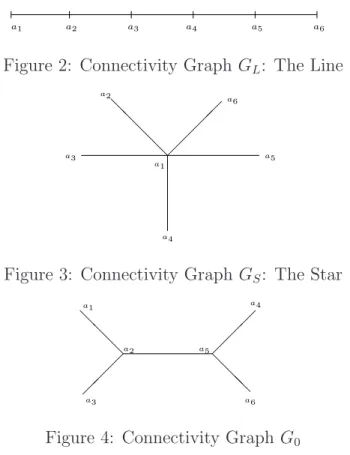
We claim that DSP is a strongly connected domain. To see this assume without loss of generality that a1 > a2 > . . . > am. Note that for any ordering in DSP, if aj is first-ranked, then either aj+1 or aj−1 must be ranked-second, for any j = 2, . . . , m. If a1 is first, then a2 must be second and if am is first, then am−1 must be second. A critical observation is that if an ordering is single-peaked, then the ordering obtained by switching the first and second alternatives while leaving all other alternatives unchanged, is also single-peaked. Thus a1 ≈ a2 ≈ . . . ≈ am. The strong connectivity graph for this case is shown in Figure 2below.
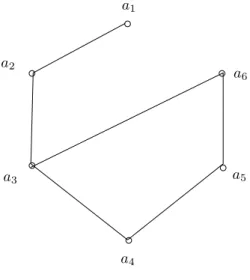
Example 3 We can start with an arbitrary connected graph on A and construct a do-main which induces the graph as its strong connectivity graph. For instance let A = {a1, a2, a3, a4, a5, a6}. Consider the graph G in Figure 1.
The domain D induces G as its associated strong connectivity graph. P1 P2 P3 P4 P5 P6 P7 P8 P9 P10 P11 P12 a1 a2 a2 a3 a3 a3 a4 a4 a5 a5 a6 a6 a2 a1 a3 a2 a6 a4 a3 a5 a6 a4 a3 a5 a3 a3 a4 a4 a5 a2 a2 a3 a3 a3 a5 a3 a6 a6 a6 a6 a4 a1 a1 a2 a4 a2 a4 a4 a5 a5 a5 a5 a2 a5 a5 a1 a2 a1 a2 a2 a4 a4 a1 a1 a1 a6 a6 a6 a1 a6 a1 a1
Table 1: The domain D
Observe that D is not the unique domain which induces G. In fact, it is a minimal in the set of domains which induce G, i.e. there does not exist a domain of smaller size which induces G. If one assumes that domains under consideration satisfy the symmetry requirement that
if there exists an ordering with aj first and ak second ranked, then there exists another ordering with ak first and aj second ranked, then the maximal domain inducing G has 288 orderings. In general, suppose G is an arbitrary strong connectivity graph. Suppose G has e edges. Let D be a domain satisfying the symmetry property described above whose associated connectivity graph is G and let |D| denote its cardinality. Then, it is easy to verify that 2e ≤ |D| ≤ 2e(m − 2)!. Conversely, let t be an even integer with 2e ≤ t ≤ 2e(m − 2)!. Then there exists a domain D with |D| = t such that D induces G.
We give an example below of a class of well-known domains that violate the property of strong path-connectedness.
Example 4 Separable Preferences over Product Domains (LeBreton and Sen (1999), Barber´a et al. (1991), Barber`a et al. (1993)). In this setting the set A is the product of M component sets, i.e A ≡ A1× ... × AM where |Aj| ≥ 2 for all j = 1, . . . , M . We shall write a typical element a ∈ A as a ≡ (a1, ..., aM) or (aQ, a−Q) where Q ⊂ {1, ..., M }.
The ordering Pi is separable if for all Q ⊂ {1, ..., M}, and a, b, c, d ∈ A, we have [(aQ, c−Q)Pi(bQ, c−Q) =⇒ [(aQ, d−Q)Pi(bQ, d−Q)].
We shall let DSEP denote the set of all separable preferences over A. We claim that DSEP violates path-connectedness.
To see this pick Piand let r1(Pi) = a. Separability implies that the second ranked alterna-tive in Pi must be of the form (bk, a−k) for some bk ∈ Ak and some k ∈ {1, . . . , M }. Assume without loss of generality that k = 1. Pick b2 ∈ A2such that b2 6= a2. Since Piis separable, we must have (a1, b2, a−{1,2})Pi(b1, b2, a−{1,2}). Now consider any P0
i ∈ DSEP such that r1(Pi0) = (b1, a−1) and r2(Pi0) = a. Separability of Pi0 implies that (b1, b2, a−{1,2})Pi0(a1, b2, a−{1,2}). Hence P0
i contains at least two preference reversals relative to Pi contradicting part (iii) of Definition 1. Thus no pair of alternatives is strongly connected, i.e DSEP is not strong path-connected.
We address the following question: what strongly connected domains D admit SCFs that are strategy-proof, anonymous, unanimous and satisfy the tops-only property? The class of domains that we will identify in this context is related to the domains initially identified in Demange (1982). In order to do so we need some additional concepts.
Let G be a connected graph, the set of whose nodes is A. Recall that a path in G is a sequence {aj(k)}, k = 0, . . . , T such that every pair (aj(k), aj(k+1)), k = 0, . . . T − 1 is an edge in G.
We say that G is a tree if there is a unique path linking every pair aj, ak ∈ A. In other words G contains no cycles. The graph in Figure1is not a tree but the graphs in Figures2,
3,4 are trees.
A path {aj(k)}, k = 0, . . . , T in a tree G is maximal if there does not exist an alternative ar distinct from aj(0) or an alternative asdistinct from aj(T ) such that (ar, aj(0)) or (as, aj(T ))
a1 a2 a3 a4 a5 a6
Figure 2: Connectivity Graph GL: The Line
@ @ @ @ ¡¡ ¡¡ a1 a2 a3 a4 a5 a6
Figure 3: Connectivity Graph GS: The Star
¡¡ ¡ @ @@ @ @ @ ¡ ¡ ¡ a1 a2 a3 a4 a5 a6
Figure 4: Connectivity Graph G0
are edges in G. In other words, a path is maximal if it cannot be “extended” by adding more edges at the ends. Note that every path in G can be extended to a maximal path. For any pair of distinct alternatives aj, ak ∈ A, we will let haj, aki denote the unique path connecting aj and ak. If ar is one of the alternatives in the sequence of alternatives which comprises the path between aj and ak, we shall simply say that ar belongs to the path between aj and ak and write it as ar ∈ haj, aki. We will let inthar, asi denote the alternatives in the path har, asi excluding ar and as. We will also let haj, aki denote a maximal path containing aj and ak. We shall let P(G) = {p1, . . . pR} denote the set of maximal paths in G.
Observation 1 Let pt ∈ P(G) and let al ∈ p/ t. We claim that there exists a unique alter-native, ar∈ pt such that every path from any as∈ pt to al, contains ar. To see this, pick an arbitrary as ∈ pt and consider the unique path has, ali. Without loss of generality, represent this path by the sequence {aj(k)}, k = 0, . . . T where aj(0) = as and aj(T )= al. Let k∗ be the minimal integer such that aj(k∗) ∈ pt and aj(k∗+1) ∈ p/ t. Such an integer clearly exists. We
claim that aj(k∗) is the alternative ar. To verify this pick any another as0 ∈ pt and suppose
that the path from as0 to al does not contain aj(k∗). Then we have another path from as0
to al: from as0 to aj(k∗) on pt and then the path {aj(k)}, k = k∗, . . . T . This contradicts the
assumption that G is a tree. A similar argument shows that ar is unique.
For any maximal path pt and ak ∈ p/ t, let γ(pt, ak) be the alternative ar described in the previous paragraph, i.e. ar is the unique alternative in pt with the property that every path
from an alternative in pt to ak contains ar.
Consider for example the graph in Figure 4. Let pt= {a1, a2, a3} and let ak = a4. Clearly ak ∈ p/ t. Then γ(pt, ak) = a2 because all paths connecting nodes in pt contain a2.
Definition 3 Let G be a tree. The map λ : P(G) → A is a Threshold Assignment Map (TAM) if there exists ak ∈ A such that
(i) For all pt∈ P(G), [ak ∈ pt] =⇒ [λ(pt) = ak]. (ii) For all pt∈ P(G), [ak ∈ p/ t] =⇒ [λ(pt) = γ(pt, ak)].
The function λ specifies a threshold for every maximal path in G. In particular, there exists an alternative ak such that the threshold for every maximal path containing ak is ak; for maximal paths that do not contain ak, the threshold is the unique alternative that lies on every path from an alternative on the path and ak (Observation 1).
Let G be a tree and λ, a TAM (for G). We shall refer to the pair (G, λ) as an admissible pair.
We give some examples of admissible pairs. Observe that there exists a unique maximal path {a1, a2. . . , a6} in GL. Here, the threshold for the unique maximal path can be any of the alternatives a1, . . . , a6. Formally, let λi be the function that associates the alternative ai, i = 1, 2 . . . 6 with the unique maximal path. Then (GL, λi) is an admissible pair.
There are 10 maximal paths in GS of the form {aj, a1, ak} where j, k ∈ {2, 3, 4, 5, 6} with j 6= k. One TAM λ1 specifies a
1 as the threshold for every maximal path. In addition, let λj, j = 2, 3 . . . 6 be the TAMs which specify a
j as the threshold for every maximal path containing aj and a1 for every other maximal path. The only admissible pairs here, are (GS, λj), j = 1, 2 . . . , 6.
Maximal paths in G0are as follows: p1 = {a1, a2, a3}, p2 = {a4, a5, a6}, p3 = {a1, a2, a5, a4}, p4 = {a1, a2, a5, a6}, p5 = {a3, a2, a5, a4} and p6 = {a3, a2, a5, a6}. Define the function λ4 as follows: λ4(p
1) = a2, λ4(pt) = a4 for t = 2, 3, 5 and λ4(t) = a5 for t = 4, 6. Then λ4 is a TAM and (G0, λ4) is an admissible pair. Other admissible pairs can be similarly defined.
We now define restrictions on preferences.
Definition 4 The domain D is semi-single-peaked with respect to the admissible pair (G, λ) such that for all Pi ∈ D and all pt ∈ P(G) such that r1(Pi) ∈ pt, we have
(i) [ar ∈ pt such that λ(pt) ∈ hr1(Pi), ari] =⇒ [λ(pt)Piar].
(ii) [ar, as ∈ pt such that ar, as∈ hr1(Pi), λ(pt)i and ar ∈ hr1(Pi), asi] =⇒ [arPias].
We say that D is semi-single-peaked if there exists and admissible pair (G, λ) with respect to which it is semi-single-peaked.
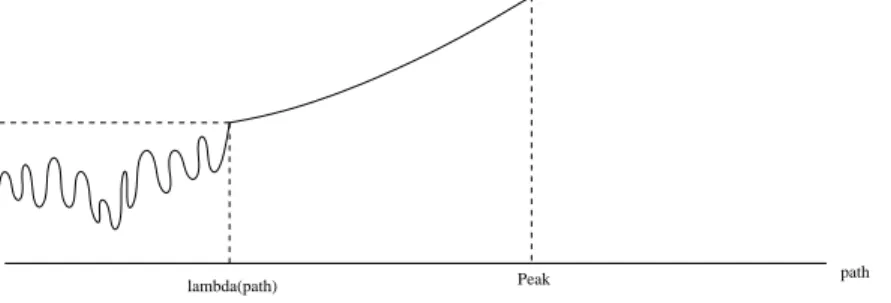
Let Pi be a semi-single peaked ordering. Let a be the peak of Pi. Pick a maximal path pt containing a. Let b be the threshold for this path, i.e. λ(pt) = b. Then, it must be the case preferences “decline” on the path from a to b. Moreover b is better (according to Pi) than any alternative c which is further along ptthan b in the direction “away” from a. These restrictions are shown in the diagram below.
Peak
lambda(path) path
Figure 5: Semi-Single Peaked Preferences
Consider the admissible pair (GL, λ3), i.e the λ for the unique path is a3. Consider the preference orderings below.
P1 P2 P3 P4 P5 a5 a5 a5 a5 a5 a6 a4 a4 a3 a4 a4 a3 a3 a4 a1 a3 a6 a1 a6 a3 a1 a2 a2 a2 a2 a2 a1 a6 a1 a6
Table 2: Preferences in the case (GL, λ3)
In Table2, preference orderings P1, P2 and P3 are semi-single- peaked for (GL, λ3). How-ever P4 and P5 are not; P4 and P5 violate parts (ii) and (i) of Definition 4respectively.
Consider semi-single-peaked preferences with respect to the admissible pair (GS, λj), for any j = 1, . . . , 6. All such preference orderings are subject to the same restriction: whenever aj, j = 2, . . . , 6 is ranked first, a1 must be ranked second. No other restrictions are implied. Finally, consider semi-single-peaked preferences with respect to (G0, λ4). Suppose a1 is ranked first in Pi. Then semi-single-peakedness would require (i) a2 to be ranked above a3 (ii) a2 should be ranked above a5 which in turn should be ranked above both a4 and a6.
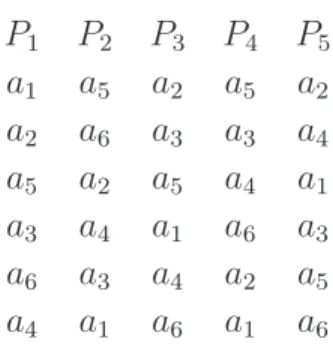
In Table 3, P1, P2 and P3 are semi-single-peaked with respect to (G0, λ4) but P4 and P5 are not.
Semi-single-peaked preferences are clearly related to “single-peaked orders on a tree” introduced by Demange (1982). An order > is single-peaked on a tree G if and only if it is
P1 P2 P3 P4 P5 a1 a5 a2 a5 a2 a2 a6 a3 a3 a4 a5 a2 a5 a4 a1 a3 a4 a1 a6 a3 a6 a3 a4 a2 a5 a4 a1 a6 a1 a6
Table 3: Preferences in the case (G0, λ4)
single-peaked on every path of G. This notion was introduced in the context of aggregation theory. In particular it was shown that a non-empty core is guaranteed for every simple game defined on the set of players N and profiles of single-peaked orders on G. Moreover, such preferences were the “largest” set which had the non-emptiness of the core property. We identify semi-single-peaked domains as a salient domain in a different context; we show that domains which admit well-behaved SCFs are semi-single-peaked provided they satisfy some richness conditions.
It is important to point out that single-peaked orders on a tree are a subset of semi-single-peaked preferences. In fact the set of semi-semi-single-peaked preferences is significantly larger than the set of single-peaked orders on a tree. This is because semi-single-peaked preferences are restricted only on one side of the peak. In contrast single-peaked preferences are restricted on both sides of the peak. Consider the simplest case where G is a line (Figure
2). Suppose a3 is the peak. Then single-peakedness would require a2 to be ranked above a1 and a4 to be ranked above a5 and a5 to be ranked above a6. Semi-single-peakedness specifies an additional alternative, the threshold, say a4. Suppose a2 is the peak. We only impose restrictions on alternatives in the “increasing” direction from a2; in particular a3 should be better than a4 and a5 and a6 must be worse than a4.
We can make the relationship between semi-single-peaked and single peaked preference on a tree, precise. Let G be a tree and let DSP(G) denote the set of single-peaked preferences on G. Let (G, λ) be an admissible pair and let D(G, λ) denote the set of semi-single-peaked preferences with respect to (G, λ). Finally, let Λ(G) denote the set of TAMs λ such that (G, λ) is admissible. The following proposition establishes the connection between single-peakedness and semi-single-single-peakedness.
Proposition 1 DSP(G) = ∩
λ∈Λ(G)D(G, λ).
Proof : It is easy to check that if Pi ∈ DSP(G), then Pi ∈ ∩λ∈Λ(G)D(G, λ). Now suppose that Pi ∈ ∩λ∈Λ(G)D(G, λ) but Pi ∈ D/ SP(G). There must therefore exist alternatives b, c and a path ptcontaining r1(Pi) and b, c such that b ∈ hr1(Pi), ci and cPib. Let λ be a TAM where
the alternative ak in Definition 3is the alternative c. Then Pi violates part (ii) in Definition
4, contradicting the assumption that Pi ∈ D(G, λ). ¥
Proposition 1 implies that the domain of single-peaked preferences on a tree G, is the largest domain of semi-single-peaked domains consistent with all specifications of thresholds. Single-peaked preferences are therefore, “neutral” within the class of semi-single-peaked pref-erences, i.e. one where it is not necessary to specify thresholds. We note that a meaningful notion of a neutral domain requires restrictions on the set of admissible permutations on alternatives with respect to which the neutrality property is defined. If neutrality is required with respect to all permutations of alternatives then the only neutral domain is the complete domain P. According to Proposition1, single-peaked preferences is the neutral domain where admissible permutations can relabel thresholds arbitrarily. However the ordering generated by such a permutation must be semi-single-peaked with respect to the relabeled threshold.
Can one offer a behavioural justification of semi-single-peaked preferences? For every path pt ∈ P(G), one can think of the threshold λ(pt), as a focal point “beyond” (in the direction “away” from the peak) which preferences are comparatively vague. Consider a tax-payer’s preferences over tax rates from 0 to a 100 percent. If she has a threshold of 25 percent and a peak of 10 percent, then her preferences decline till 25. Beyond this threshold, she has no views (say whether 45 percent is better than 50 percent) except that everything is worse than 25 percent. On the other hand, if her peak is 40 percent, then her preferences decline till 25 percent with everything below 25 percent less-well preferred to 25 percent.
We now state our main result.
Theorem 1 Let D be a strongly path-connected domain and let n be an even integer. If there exists an anonymous, tops-only, unanimous and strategy-proof SCF f : Dn→ A, then D is semi-single peaked. Conversely, if D is a semi-single-peaked domain, then there exists an anonymous, strategy-proof, tops-only and unanimous SCF f : Dn→ A for all integers n. Proof : We first prove the first part of the Theorem. We begin with a Proposition which is of some independent interest.
Proposition 2 Let D be an arbitrary domain and let n be a positive even integer. Suppose there exists an anonymous, tops-only, unanimous and strategy-proof SCF f : Dn→ A. Then there exists an anonymous, tops-only, unanimous and strategy-proof SCF g : D2 → A. Proof : Let f : Dn→ A be a anonymous, tops-only and strategy-proof SCF and suppose n is even. Let N1 = {1, . . . ,n
2} and let N2 = { n
2 + 1, . . . , n}. Define g : D2 → A as follows. Pick an arbitrary pair P1, P2 ∈ D. Then g(P1, P2) = f (P ) where P ∈ Dn and Pj = P1 for all j ∈ N1 and Pj = P2 for all j ∈ N2. In other words, the value of G at the two-individual profile (P1, P2) is the value of the f at the n-individual profile P where all individuals in the
set N1 have the same ordering P1 and all individuals in N2 have the same ordering P2. It is easy to verify that g is unanimous and tops-only (these properties are inherited from the corresponding properties in f ). We show below that g is anonymous and strategy-proof.
In order to show that g is anonymous, pick P1, P2 ∈ D. We will show that g(P1, P2) = g(P2, P1). Let P be the n-individual profile where individuals in N1and N2 have the orderings P1 and P2 respectively and let ¯P be the n-individual profile where individuals in N1 and N2 have the orderings P2 and P1 respectively. Consider the permutation η : N → N defined by η(i) = (i + n
2) mod n. Observe that ¯P is the image of P under η, i.e. Pη = ¯P . Since f is anonymous, f (P ) = f ( ¯P ). But g(P1, P2) = f (P ) and g(P2, P1) = f ( ¯P ), so that g is anonymous.
We now show that g is strategy-proof. Pick arbitrary orderings P1, P10, P2 ∈ D. Once again let P be the n-individual profile where individuals in N1 and N2 have the orderings P1 and P2 respectively. Let g(P1, P2) = f (P ) = a. Let f (P10, P1, . . . , P1, P2, . . . , P2) = b. We must have either b = a or aP1b; otherwise individual 1 would manipulate in P via P0 1 contradicting the strategy-proofness of f . Now let f (P0
1, P10, P1. . . , P1, P2, . . . , P2) = c. In order to prevent individual 2 from manipulating in the profile (P0
1, P1, . . . , P1, P2, . . . , P2) via P0
1, we must have c = b or bP1c, i.e either c = a or aP1c. Progressively switching individual preferences in the set N1 from P1 to P10, we obtain that if g(P10, P2) = x, then either x = a
or aP1x. Therefore g is strategy-proof. 1 ¥
Let D be a strongly path-connected domain. Suppose that there exists n even, such that there exists f : Dn → A which is anonymous, tops-only, unanimous and strategy-proof. In view of Proposition 2, we can assume without loss of generality that n = 2. We will show that D is semi-single-peaked.
Let f be a two-person anonymous, tops-only, unanimous and strategy-proof SCF. We shall denote the two individuals by i and j and their typical preference orderings by Pi and Pj respectively. Since f is tops-only we can also represent the profile (Pi, Pj) by (ak, ar) where ak and ar are the peaks of Pi and Pj respectively. Thus f (ak, ak0) will denote the
social choice for a profile of preferences where individual i has a preference ordering whose peak is akand j has a preference ordering whose peak is ak0. We will also interchangeably use
the notation (akal. . . ) to signify a preference ordering whose (i) peak is ak (ii) whose second ranked element is aland (iii) the order of the remaining alternatives is not specified. Finally, a preference profile where individual i has the preference ordering (akal. . . ) and j has the preference ordering (ak0al0. . .) is denoted (akal. . . , ak0al0. . . ), and f (akal. . . , ak0al0. . . ) will
denote the outcome of f at this profile.
We begin with two important properties of the ≈ relation associated with D.
1It is clear from our proof that the following more general statement is true. Suppose that there exists
an anonymous, tops-only, unanimous, strategy-proof SCF f : Dn → A. Then there exists an anonymous,
Lemma 1 Let ar, as ∈ A such that ar ≈ as. Then f (ar, as) ∈ {ar, as}.
Proof : Suppose the lemma is false, i.e let f (ar, as) = ak 6= ar, as. Since f is tops-only f (aras. . . , as) = ak (we are using the fact that there exists a feasible ordering aras. . . since ar ≈ as). But then individual i manipulates via (as. . .) thereby obtaining as since f is
unanimous. ¥
Lemma 2 Let ar, as ∈ A and suppose f (ar, as) = ar. Let at be an alternative distinct from ar and as.
(i) If at≈ as, then f (ar, at) = ar.
(ii) If at≈ ar and at ≈ as, then f (at, as) = at.
Proof : We consider (i) first. Since as ≈ at, we can find Pj, Pj0 ∈ D such that (i) r1(Pj) = as = r2(Pj0) (ii) r2(Pj) = at = r1(Pj0) and (iii) rl(Pj) = rl(Pj0), l = 3, . . . , m. Since f is tops-only f (ar, Pj) = ar. Suppose f (ar, Pj0) 6= ar. If f (ar, Pj0)Pjar, then j manipulates at (ar, Pj) via Pj0. If arPjf (ar, Pj0), then arPj0f (ar, Pj0) as well by construction, so that j manipulates at (ar, Pj0) via Pj. Hence f (ar, Pj0) = ar. Since f is tops-only f (ar, at) = ar.
We now show that (ii) holds. Since at ≈ ar, we can find Pi, Pi0 ∈ D such that r1(Pi) = ar = r2(Pi0) and (ii) r2(Pi) = at = r1(Pi0). Since f is tops-only f (Pi, as) = ar. Since f is strategy-proof, it also follows from standard arguments that f (P0
i, as) ∈ {ar, at}. Since at ≈ as, Lemma 1 that f (Pi0, as) ∈ {at, as}. Hence f (Pi0, as) = at. Since f is tops-only
f (at, as) = at as required. ¥
We can now demonstrate further important properties regarding the ≈ relation.
Lemma 3 The ≈ relation does not admit cycles i.e. there does not exist a sequence ak(j), j = 0, . . . , T such that ak(j)≈ ak(j+1), j = 0, . . . , T − 1 and ak(T )≈ ak(0).
Proof : Since ak(0) ≈ ak(1), Lemma 1 implies f (ak(0), ak(1)) ∈ {ak(0), ak(1)}. Assume with-out loss of generality that f (ak(0), ak(1)) = ak(0). Since ak(1) ≈ ak(2), Lemma 2 (i) im-plies f (ak(0), ak(2)) = ak(0). Moreover applying the same argument along the sequence ak(j), j = 2, . . . , T , we obtain f (ak(0), ak(T )) = ak(0). Suppose to the contrary ak(0) ≈ ak(T ).
Since f (ak(0), ak(T −1)) = ak(0), ak(0) ≈ ak(T ) and ak(T ) ≈ ak(T −1), we can apply Lemma 2 to obtain f (ak(T ), ak(T −1)) = ak(T ). Now applying Lemma2(i) repeatedly along the sequence ak(j), j = T −1, . . . , 0, we obtain f (ak(T ), ak(0)) = ak(T ). By anonymity, f (ak(0), ak(T )) = ak(T ). But this contradicts our earlier conclusion that f (ak(0), ak(T )) = ak(0). ¥
We have demonstrated that the strong-connectivity graph induced by D is a tree. Let this tree be denoted by G. The set of its maximal paths will be denoted by P(G).
The distance between any pair as, ar ∈ A, denoted by d(as, ar) is defined as |{k 6= s, r : ak ∈ has, ari}|. It is thus, the number of alternatives not including as and ar that lie on the path between as and ar.
Lemma 4 f (ar, as) ∈ har, asi for all ar, as∈ A.
Proof : We prove the lemma by induction on d(ar, as). Observe first that the lemma holds in the case where d(ar, as) = 0 (i.e. ar = as) by virtue of the assumption that f is unanimous. Now suppose that f (ar, as) ∈ har, asi whenever d(ar, as) ≤ t for some integer t < m − 1. Pick ar, as such that d(ar, as) = t + 1. Suppose f (ar, as) = az ∈ ha/ r, asi. There must exist ak ∈ har, asi such that ar ≈ ak. Note that d(ak, as) = t so that f (ak, as) ∈ hak, asi ⊂ har, asi. Since ar ≈ ak, there exists Pi, ¯Pi ∈ D such that (i) r1(Pi) = r2( ¯Pi) = ar (ii) r2(Pi) = r1( ¯Pi) = ak and (iii) rj(Pi) = rj( ¯Pi) for j = 3, . . . , m. Since f is tops-only, f (Pi, as) = az. Moreover, using standard arguments for strategy-proofness, it follows that f ( ¯Pi, as) = az. Hence f (ak, as) = az by tops-onlyness. Since az ∈ ha/ r, asi by assumption, we have a contradiction to our earlier conclusion that f (ak, as) ∈ hak, asi. ¥
Pick an arbitrary pair ar, as be such that d(ar, as) = 1. Let har, asi be a maximal path. Suppose har, asi = {aj(0), . . . , aj(k)= ar, aj(k+1), aj(k+2) = as, aj(k+3). . . , aj(T )}.
Lemma 5 (i) Suppose f (ar, as) = ar, i.e. f (aj(k), aj(k+2)) = aj(k). Pick integers u, v such that u ≥ 0, u < v and k + v ≤ T . Then f (aj(k+u), aj(k+v)) = aj(k+u).
(ii) Suppose f (ar, as) = as, i.e. f (aj(k), aj(k+2)) = aj(k+2). Pick integers u, v such that v ≤ 0, u < v and k + u ≥ 0. Then f (aj(k+u), aj(k+v)) = aj(k+v).
Proof : We first prove (i). Consider the case where u = 0. Since f (aj(k), aj(k+2) = aj(k) and aj(k+1) ≈ aj(k+2), a direct application of Lemma 2(i) yields f (aj(k), aj(k+1)) = aj(k). An identical argument yields f (aj(k), aj(k+3)) = aj(k). Moreover, since aj(k+3) ≈ aj(k+4) etc till aj(k+v−1) ≈ aj(k+v), the same argument applied repeatedly yields f (aj(k), aj(k+v)) = aj(k).
Now consider the case where u = 1. Choose an arbitrary v such that v > 1 and k +v ≤ T . By Lemma 4, f (aj(k+1), aj(k+v)) ∈
aj(k+1), aj(k+v) ®
. Note that since aj(k) ≈ aj(k+1), we can argue (like in the proof of Lemma2(ii)) that f (aj(k+1), aj(k+v)) ∈ {aj(k), aj(k+1)}. But aj(k)∈/ haj(k+1), aj(k+v)i. Hence f (aj(k+1), aj(k+v)) = aj(k+1). Applying this argument repeatedly, we obtain f (aj(k+u), aj(k+v)) = aj(k+u).
The proof of part (ii) is the symmetric counterpart of the proof of part (i) of the Lemma
and is therefore omitted. ¥
Lemma5 says the following. Suppose we can find two alternatives ar and as where there is exactly one alternative other than ar and as in the (unique) path that connects ar and as. Suppose f (ar, as) = ar. Then if one picks a profile, (ak, ak0) where (i) both ak and ak0 lie on
a maximal path connecting ar and as(ii) both ak and ak0 lie on the segment of this maximal
path which begins at ar and contains the path from ar to as and (iii) ak is closer to ar than ak0, then f (ak, ak0) = ak.
Consider an arbitrary maximal path pt ∈ P(G). Assume without loss of generality that pt = {aj(0), . . . , aj(k), . . . , aj(T )}. Consider profiles of preferences where the peaks of both individual’s preferences lie on pt, i.e. profiles of the form (aj(k), aj(k+2)), k = 1, . . . , T − 2. In view of Lemma 4, the following cases are mutually exhaustive.
Case A: There exists k ∈ {0, . . . , T − 2} such that f (aj(k), aj(k+2)) = aj(k+1). Case B: For all k ∈ {0, ..., T − 2}, f (aj(k), aj(k+2)) ∈ {aj(k), aj(k+2)}.
Suppose Case A holds. The following lemma characterizes the SCF in this case.
Lemma 6 Suppose Case A holds, i.e. there exists k such that f (aj(k), aj(k+2)) = aj(k+1). Then for any preference profile (aj(r), aj(s)), 0 ≤ r, s ≤ T (i.e. both individual’s peaks lie on pt), f (aj(r), aj(s)) = aj(k+1) if min{r, s} ≤ k + 1 ≤ max{r, s} aj(max{r,s}) if k + 1 > max{r, s} aj(min{r,s}) if k + 1 < min{r, s}
Proof : We have assumed that f (aj(k), aj(k+2)) = aj(k+1). We show that f (aj(k−1), aj(k+3)) = aj(k+1)as well. Since aj(k)≈ aj(k−1)there exists Pi, ¯Pi ∈ D such that (i) r1(Pi) = aj(k)= r2( ¯Pi) (ii) r2(Pi) = aj(k−1) = r1( ¯Pi) and (iii) rj(Pi) = rj( ¯Pi) for j = 3, . . . , m. By tops-onlyness f (Pi, aj(k+2). . . ) = aj(k+1). Now consider f ( ¯Pi, aj(k+2). . . ). Since for all al, aj(k+1)Pial iff aj(k+1)P¯ial, strategy-proofness implies f ( ¯Pi, aj(k+2). . . ) = aj(k+1). By tops-onlyness, one has f (aj(k−1), aj(k+2)) = aj(k+1). An analogous argument with respect to k + 3 applies to yield f (aj(k−1), aj(k+3)) = aj(k+1). Repeated application of this procedure yields f (aj(r), aj(s)) = aj(k+1) whenever min{r, s} ≤ k + 1 ≤ max{r, s}.
Now take (aj(r), aj(s)) with k + 1 > max{r, s}. As f (aj(k), aj(k+3)) = aj(k+1), by strategy-proofness, f (aj(k+1), aj(k+3)) = aj(k+1)holds. We have f (aj(r), aj(s)) = aj(max{r,s})by Lemma5
(ii). An analogous reasoning appealing to Lemma5(i) establishes f (aj(r), aj(s)) = aj(min{r,s})
whenever k + 1 < min{r, s}. ¥
Consider maximal paths pt = haj(0), . . . , aj(T )i where Case A holds, i.e. there exists k ∈ {0, . . . , T − 2} such that f (aj(k), aj(k+2)) = aj(k+1). Define λ(pt) = aj(k+1). We show that properties (i) and (ii) of Definition 4 hold. Pick Pi such that r1(Pi) ∈ pt and let aj(r) ∈ pt be such that λ(pt) ∈ hr1(Pi), aj(r)i. It is evident from Lemma 6 that f (Pi, aj(r)) = aj(k+1) = λ(pt). Suppose that individual deviates to P
0
i where r1(P
0
unanimity, f (Pi0, Pj) = aj(r). Since f is strategy-proof, we must have λ(pt)Piaj(r) as required by part (i) of Definition 4.
Now, pick some aj(r), aj(s)∈ ptsuch that aj(r), aj(s) ∈ hr1(Pi), λ(pt)i and aj(r)∈ hr1(Pi), aj(s)i. Let individual j have preference Pj with r1(Pj) = aj(r). By Lemma 6, f (Pi, Pj) = aj(r). Now consider a deviation by individual i to ¯Pi such that r1( ¯Pi) = aj(s). Again by Lemma 6, f ( ¯Pi, Pj) = aj(s). By strategy-proofness of f , we must have aj(r)Piaj(s), as required by part (ii) of the Definition 4.
Now consider a path pt = {aj(0), . . . , aj(k), . . . , aj(T )} where Case B holds. Note that in this case we must have f (aj(0), aj(2)) ∈ {aj(0), aj(2)}.
Suppose f (aj(0), aj(2)) = aj(0). Define λ(pt) = aj(0). Consider any Pi ∈ D with r1(Pi) ∈ pt. Consider ar, as ∈ hλ(pt), r1(Pi)i such that ar ∈ {as, r1(Pi)}. From Lemma 5 (i) we have f (Pi, ar) = ar and f (as, ar) = as. Strategy-proofness, yields arPiasas required by Definition
4.
Suppose f (aj(0), aj(2)) = aj(2). There are two subcases to consider.
(a) f (aj(k), aj(k+2)) = aj(k+2)for all k ∈ {0, . . . , T − 2}. Then, in particular f (aj(T −2), aj(T )) = aj(T ). Let λ(pt) = aj(T ). Consider any Pi ∈ D with r1(Pi) ∈ pt. Consider ar, as ∈ hλ(pt), r1(Pi)i such that ar ∈ has, r1(Pi)i. By Lemma5(ii), f (Pi, ar) = ar and f (as, ar) = as. From strategy-proofness, we must have arPias, as required by Definition 4.
(b) Suppose there exists t where f (aj(t), aj(t+2)) = aj(t). Let t be the lowest index for which f (aj(t), aj(t+2)) = aj(t) that is, f (aj(l), aj(l+2)) = aj(l+2), 0 ≤ l < t. Therefore, f (aj(t−1), aj(t+1)) = aj(t+1). Since aj(t+1) ≈ aj(t+2), and f (aj(t), aj(t+2)) = aj(t), Lemma 2 (i) implies f (aj(t), aj(t+1)) = aj(t). However, since aj(t−1) ≈ aj(t), and f (aj(t−1), aj(t+1)) = aj(t+1), Lemma 2 (i) implies f (aj(t), aj(t+1)) = aj(t+1). We have a contradiction. Hence this case cannot arise.
We have shown that there exists a tree G and a function λ : P(G) → A such that all orderings in D satisfy the restrictions in Definition 4. In order to show that D is semi-single-peaked, we only need to show that the pair (G, λ) is admissible for G (Definition 3).
For every ar, aj ∈ A, as is the neighbour of ar on the path haj, ari if (i) as ∈ haj, ari (ii) there does not exist ak 6= ar, as with ak ∈ has, ari. In other words, as is a neighbour of ar on the path haj, ari if as lies on the path and there does not exist an alternative ak on the same path lying “between” as and ar. We say that as is a neighbour of ar if there exists a path containing ar and as is a neighbour of ar on that path.
Let pt ∈ P(G). Let P(pt) denote the set of maximal paths that contain λ(pt). Let P(pt) = {pl ∈ P(pt) : λ(pl) 6= λ(pt)}. Thus P(pt) are those paths containing λ(pt) with the property that their λ’s do not coincide with λ(pt).
Lemma 7 Let ptbe a maximal path such that P(pt) 6= ∅. Then there exists a unique neighbour as of λ(pt) such that as∈ pl for all pl ∈ P(pt). Moreover λ(pl) 6= λ(pt) for all pl= hλ(pt), asi.
Proof : Pick arbitrary pl, pl0 ∈ P(pt). Let as be the neighbour of λ(pt) on the path
hλ(pl), λ(pt)i. We claim that as ∈ pl0. Suppose not. Then there exists ar distinct from
as which is the neighbour of λ(pt) on the path hλ(pt), λ(pl0)i.
Applying Lemma 5 (ii) to the path pl0, we have f (λ(pt), as) = as. Applying the same
lemma to the path pl, we have f (λ(pt), ar) = ar. Now consider the path har, asi. Since G is a tree, this path contains λ(pt). In fact har, asi can be written as
{aj(0), . . . , aj(k−1), aj(k), aj(k+1), . . . aj(T )} where aj(k−1) = ar, aj(k) = λ(pt) and aj(k+1) = as. Then we have f (aj(k−1), aj(k)) = aj(k−1) and f (aj(k), aj(k+1)) = aj(k+1). However we have already shown in dealing with Case B, part (b) above (using Lemma 2 (i)) that f cannot behave like this. This establishes the first part of the Lemma.
Suppose the second part of the Lemma is false, i.e. there exists pl = hλ(pt), asi such that λ(pl) = λ(pt). Applying Lemma 5 (i) to the path pl, we have f (λ(pt), as) = λ(pt). By assumption and the first part of the Lemma, there exists pl0 = hλ(pt), asi such that
λ(pl0) 6= λ(pt). Applying Lemma5(ii) to the path pl0 we have f (λ(pt), as) = as, contradicting
our earlier conclusion. ¥
We identify an alternative a∗
kby the following algorithm. Start with an arbitrary maximal path p1
t. If P(p1t) = ∅, we let λ(p1t) = a∗k. If P(p1t) 6= ∅, pick an arbitrary p2t ∈ P(p1t). If P(p2
t) = ∅, we let λ(p2t) = a∗k. Otherwise pick p3t ∈ P(p2t) and check if P(p3t) = ∅ etc. The algorithm stops whenever a∗
k has been found.
Consider the rth step of the algorithm, r > 1. Since the algorithm has not stopped at step r − 1, i.e. P(pr−1
t ) 6= ∅. Therefore there must exist a maximal path pl containing λ(pr−1t ) such that λ(pl) 6= λ(pr−1t ). It follows from the construction of the algorithm that pl contains the alternatives λ(p1
t), λ(p2t), . . . , λ(pr−1t ), i.e pl = hλ(p1t), . . . , λ(pr−1t )i. It follows from the second part of Lemma 7 that λ(pr
t) 6= λ(p1t), . . . , λ(pr−1t ). For any positive integer r, let D(pr
t) = P(prt) − P(prt). These are the maximal paths discarded in the rth step of the algorithm. By definition these are paths pl which contain λ(pr
t) and satisfy λ(pl) = λ(prt). Suppose that prt ∈ D(plt) for some integer l < r. From our earlier remarks, pr
t ∈ hλ(p1t), . . . , λ(pr−1t )i. Also λ(prt) 6= λ(plt) contradicting our assumption that pr
t ∈ D(plt). Thus the algorithm cannot pick a maximal path in the rth step which has been discarded in an earlier step. Since the number of maximal paths is finite, this implies that the algorithm must terminate, i.e a∗
k exists. Observe that by construction, λ(pl) = a∗
k for all maximal paths pl that contain a∗k. Now pick a maximal path pt such that a∗k ∈ p/ t. Since G is a tree, there must exist a (unique) path containing a∗
k that has a unique alternative in common with pt. Let this alternative be aj. In order to prove that the pair (G, λ) is an admissible pair, it suffices to prove that λ(pt) = aj. Suppose that this is false, i.e. λ(pt) 6= aj. Let ar be the neighbour of aj on the path haj, λ(pt)i and let as be the neighbour of aj on the path haj, a∗
ki. Applying Lemma 5 to the path pt, we have f (aj, ar) = ar. Applying the same lemma to the path pl, we have
f (as, aj) = as. Now consider the path har, asi. Since G is a tree, this path contains aj. In fact har, asi can be written as {aj(0), . . . , λ(pt), . . . , aj(k−1), aj(k), aj(k+1), . . . , a∗k, . . . , aj(T )} where aj(k−1) = ar, aj(k) = aj and aj(k+1) = as. Then we have f (aj(k−1), aj(k)) = aj(k−1) and f (aj(k), aj(k+1)) = aj(k+1). As we have seen earlier, this contradicts the strategy-proofness of f via Lemma 2(i).
This completes the first part of the proof.
We now show that if D is semi-single-peaked (with respect to an admissible pair (G, λ)), then it admits an anonymous, tops-only, unanimous and strategy-proof SCF for all n.
For any set B ⊂ A, let G(B) be the minimal subgraph of G that contains B as nodes. More formally, G(B) is the unique graph that satisfies the properties below.
1. The set of nodes in G(B) contains B.
2. Let aj, ak ∈ B. The graph G(B) has an edge {aj, ak} only if {aj, ak} is an edge in G.
3. G(B) is connected.
4. ak ∈ G(B) if and only if ak ∈ har, aji where ar, aj ∈ B.
An alternative way to define G(B) would be as the minimal graph satisfying properties 1, 2 and 3 above. It is clear that G(B) exists and is a tree.
For any profile P ∈ Dn, let {r
1(P )} denote the set of all first-ranked alternatives in the profile P , i.e {r1(P )} = {ai ∈ A|r1(Pi) = ai for some i ∈ N}. Let ak ∈ A be the alternative specified in Definition 3 applied to the admissible pair (G, λ). Consider the graph G({r1(P )}). Assume ak ∈ {r/ 1(P )}. Since G is a tree and contains no cycles, there exists a unique alternative in G({r1(P )}) that belongs to every path from akto {r1(P )}. Let this alternative be denoted by β(P ).
Consider the following example. Suppose N = {1, 2, 3}. Consider the admissible pair (G0, λ4) (Figure4) and let P be a profile such that {r1(P )} = {a1, a2, a3}. Then β(P ) = a2.
Define the SCF f : Dn→ A as follows.
f (P ) = ½
ak if ak ∈ G({r1(P )}) β(P ) if ak∈ G({r/ 1(P )})
It follows immediately from the construction that f is anonymous, unanimous and tops-only. We now show that f is strategy-proof, which will conclude the proof.
Fix a profile P . Observe that whether ak ∈ G({r1(P )}) or ak ∈ G({r1/ (P )}), there exist individuals i and j such that f (P ) ∈ hr1(Pi), r1(Pj)i (since G({r1(P )}) only considers nodes that belong to an interval of the form hr1(Pi), r1(Pj)i). Moreover these individuals can be chosen such that there does not exist an individual i0 such that r1(Pi0) ∈ hr1(Pi), f (P )i
and r1(Pi0) ∈ hr1(Pj), f (P )i (i.e i and j are the closest peaks on either “side” of f (P ) on a
maximal path containing f (P )). Note that these individuals need not be unique; let the set of these individuals be N0.
We first show that an individual i /∈ N0 cannot manipulate at P . Observe first that if ak ∈ G({r1(P )}) (i.e. f (P ) = ak), then i cannot the change the outcome by any deviation. Suppose therefore that ak ∈ G({r/ 1(P )}) so that f (P ) = β(P ). By deviating to P
0
i where r1(Pi0) = ak, i can change the outcome to ak. We claim that this is, in fact, the only outcome different from β(P ) that i can obtain by deviating from Pi. Suppose this is false. Then it must be the case that there exists Pi0 which induces the sub-tree G({r1(P
0
i, P−i)}) and the outcome β(Pi0, P−i) which is distinct from both β(P ) and ak. Consider i
0
∈ N0. It follows that there exists a path in G from r1(Pi0) to ak via β(P ) and another distinct one from r1(Pi0) to ak via β(P
0
i, P−i)). This contradicts our assumption that G is a tree.
Suppose therefore that f (Pi0, P−i) = akfor some Pi0 ∈ D. In that case β(P ) ∈ hr1(Pi), aki. Since λ(hr1(Pi), aki) = ak (since (G, λ) is an admissible pair), it follows from Definition 4 (ii) of semi-single-peakedness that β(P )Piak. Hence i cannot manipulate.
Now consider deviations by individuals i ∈ N0. Suppose j is the other individual such that f (P ) ∈ hr1(Pi), r1(Pj)i. Consider λ(pt) where pt is any path hr1(Pi), r1(Pj)i. There are several possibilities enumerated below.
1 ak ∈ pt where pt ∈ hr1(Pi), r1(Pj)i. Clearly λ(pt) = ak (part (i) of Definition3).
2 ak ∈ p/ twhere pt∈ hr1(Pi), r1(Pj)i. Let the unique path from akto G({r1(P )}) intersect a path pt in hr1(Pi), r1(Pj)i at a∗k. Clearly λ(pt) = a∗k (part (ii) of Definition 3). Case 1 can be sub-categorized into the cases below.
1(i) ak ∈ inthr1(Pi), r1(Pj)i. Then f (P ) = ak.
1(ii) r1(Pi) ∈ hr1(Pj), aki. Then f (P ) = r1(Pi).
1(iii) r1(Pj) ∈ hr1(Pi), aki. Then f (P ) = r1(Pj).
Similarly Case 2 can be sub-categorized into the cases below.
2(i) a∗
k ∈ inthr1(Pi), r1(Pj)i. Then f (P ) = a∗k.
2(ii) r1(Pi) ∈ hr1(Pj), a∗ki. Then f (P ) = r1(Pi).
In Cases 1(ii) and 2(ii), individual i is getting her best alternative and will clearly not manipulate.
Suppose either Case 1(i) or 2(i) occurs. In each case f (P ) = λ(pt) where pt= hr1(Pi), r1(Pj)i. If i announces Pi0 such that r1(P
0 i) ∈ hr1(Pj), f (P )i, then f (P 0 i, P−i) = r1(P 0 i). By semi-single-peakedness, f (P )Pif (P 0
i, P−i) (Definition 4 (i)) so that i does not manipulate. Suppose i deviates to Pi0 such that r1(P
0
i) /∈ hr1(Pj), f (P )i. It follows from the construction of f that f (Pi0, P−i) = r1(Pj) or else f (P
0
i, P−i) = ak = f (P ). This case is clearly covered by our earlier argument (Definition4 (i)).
Now suppose either Cases 1(iii) or 2(iii) hold. By deviating to Pi0 such that r1(P
0
i) ∈ hr1(Pj), aki (in Case 1(iii)) or r1(P
0
i) ∈ hr1(Pj), a∗ki (in Case 2(iii)), i can obtain the out-come f (Pi0, P−i) = r1(P
0
i). By part (ii) of Definition 4 of semi-single-peakedness, we have f (P )Pif (P
0
i, P−i). Once again i cannot manipulate. ¥
We now discuss semi-single-peakedness and related literature.
3.1
Discussion
In this section, we discuss the relationship of our work with that of Nehring and Puppe (2007b) andNehring and Puppe (2007a). They define a ternary relation B over A with the following interpretation: if (x, y, z) ∈ B, then y is “between” x and z. They say that a linear order Pi is generalized single-peaked with respect to B iff (r1(Pi), y, z) ∈ B ⇒ yPiz. They define the notion of a property space and use it to construct a natural “between-ness” relationship. According to Theorem 4 in Nehring and Puppe (2007b), if there exists a strategy-proof and neutral social choice function defined on a rich domain of generalized single-peaked preference induced by a property space, then this property space must, in fact, be a median space. They go on to characterize strategy-proof and neutral social choice func-tions on these domains. The necessity part of this result is similar in spirit to our analysis. However our analysis and results are quite different in view of the following observations. (1) They start with a property space and a rich domain of generalized single-peaked pref-erences with respect to the betweenness relation induced by the space. The starting point of our analysis is a different and more direct notion of rich domains which has no reference to property spaces or any notion of betweenness. (2) Our notion of richness is specified in terms of the terms of the ways in which alternatives are ranked first and second in admissible orderings in the domain. It is this structure that we exploit to obtain the ordering on alter-natives which is central to the variant of single-peakedness that we characterize. Although their definition of richness does put restrictions on the way that alternatives are ranked first and second in the domain, the exact specification is different from ours. Nor is the structure of these relationships used in the manner that we do. (3) The notions of general-ized single-peakedness and semi-single-peakedness are related but independent of each other.
For instance, a single-peaked (in the standard sense) is both generalized single-peaked and single-peaked. However domains that are generalized single-peaked are not necessarily semi-single-peaked and vice-versa. For instance, the complete domain is generalized semi-single-peaked but not semi-single-peaked. Conversely one can construct semi-single-peaked domains with a suitable specification of a threshold that is not generalized single-peaked for any betweenness relation. (4) The axioms on social choice functions, in addition to strategy-proofness, used to characterize domains are different. They focus on neutrality while we look at anonymity and either tops-only ness or tops-selectivity.
4
Tops-Selectivity and Extreme-Peaked domains
In this subsection, we explore the consequences of replacing the tops-only requirement by the top-selectivity requirement. In general the two requirements are independent of each other. Note that the SCF f defined in the proof of the previous theorem is tops-only but not top-selective (there exist profiles where the outcome is ak which is not the peak of any individual). One can also easily construct a SCF where the outcome is always, say either individual j or k’s peak depending on individual j’s bottom-ranked alternative. Such a SCF would be tops-selective but not tops-only. Observe however that a tops-selective SCF is always unanimous.
Our main result in this subsection states that an appropriately rich domain which admits an anonymous, strategy-proof and tops-selective SCF for an even number of voters must be a special class of semi-single peaked domains which we call extreme-peaked domains. Conversely, every extreme-peaked domain admits an anonymous, strategy-proof and tops-selective SCF for an arbitrary number of voters. An important aspect of this result is that the richness condition required for this result is weaker than the richness required for Theorem
1. The reason for this is that though tops-selectivity and tops-onlyness are independent conditions, tops-selectivity in conjunction with strategy-proofness implies tops-onlyness in the case of two voters. Therefore for the case of two voters at least, domains which admit anonymous, strategy-proof and tops-selective SCFs must be semi-single peaked. We are able to identify the exact sub-class of semi-single peaked domains which satisfy this property in the presence of a weaker richness property.
We now describe this richness property.
Definition 5 Two alternatives aj, ak are connected in D, denoted aj ∼ ak, if there exists Pi, ¯Pi ∈ D such that r1(Pi) = aj = r2( ¯Pi), r2(Pi) = ak= r1( ¯Pi).
This notion was introduced in Aswal et al. (2003). Observe that two alternatives which are strongly connected are also connected.
Definition 6 The domain D is weakly path-connected iff for all ar, as ∈ A, there exists a sequence of alternatives aj(k) ∈ A, k = 0, . . . , T such that
• aj(0) = ar • aj(T ) = as
• aj(k)∼ aj(k+1), k = 0, . . . , T − 1.
The notion of weak path-connectedness is analogous to the notion of path-connectedness. It requires every pair of alternatives to be joined by a sequence of pairs of alternatives which are connected. We note that the notion of weak path-connectedness is substantially weaker than that of strong path connectedness. For instance, the domain of separable preferences in Example 4 is weakly path-connected (for details, see Aswal et al. (2003)) although we have shown that it is not strongly path-connected.
Definition 7 A domain D is extreme-peaked with respect to the linear order τ iff either (i) or (ii) below hold.
(i) [asτ arτ r1(Pi)] ⇒ [arPias] for all Pi ∈ D, and for all ar, as ∈ A. (ii) [r1(Pi)τ arτ as] ⇒ [arPias] for all Pi ∈ D, and for all ar, as ∈ A.
We say that D is extreme-peaked if there exists a linear order with respect to which it is extreme-peaked.
We claim that an extreme-peaked domain is semi-single-peaked. In particular it corre-sponds to the semi-single-peakedness where the admissible pair (G, λ) is such that G consists of a single maximal path (i.e. G = GL as in Figure 2) and the TAM λ for the unique path selects one of the extreme alternatives/nodes (terminal nodes) in the maximal path (i.e. either a1 or a6 in Figure 2).
Our main result in this subsection is the following.
Theorem 2 Let D be a weakly path-connected domain and let n be an even integer. If there exists an anonymous, tops-selective and strategy-proof SCF f : Dn → A, then D is extreme-peaked. Conversely, if D is an extreme-peaked domain, then there exists an anonymous, strategy-proof and tops-selective SCF f : Dn→ A for all integers n.
Proof : We begin with the first part of the Theorem. Using the same arguments as in Proposition 2, it is straightforward to prove the following.
Proposition 3 Let D be an arbitrary domain and let n be an even positive integer. Suppose there exists an anonymous, tops-selective and strategy-proof SCF f : Dn → A. Then there exists an anonymous, tops-selective and strategy-proof SCF g : D2 → A.