An exact tool allocation approach for CNC
machines
M. SELIM AKTURK
Abstract. An e xac t approach is developed to dete rmine the
optimum machining conditions an d tool allocation decisions simultane ously to minimize the total production cost on a CNC turning machine . The re are multiple machining operations an d we consider a set of alte rnative cutting tool types for e ach operation. The e xisting tool manage me nt approache s at the system leve l fail to relate the tooling issues to the machining conditions, and ignore the tool availability and tool wear restrictions. Consequently, we not only improve the ove rall solution by e xploiting the interactions betwe e n these two decision making problems, but also preve nt any unfeasibility that might occur for the tool allocation problem due to tool conte ntion am ong the operations for a limited number of tool type s by considering the mach ining operation, tool availability an d tool life limitations. The computation al results indicated that the ave rage computation time to find an optimum solution was 1.11 s, whe reas the maxim um time was 11.45 s, for a set of randomly ge nerated problems.
1. Introduction
There is an increasin g require ment for manufactur-ing industrie s to achie ve effective, diverse, small lot produc tion , so as to meet dive rsifie d use r needs. Num erical control ( NC) is a form of program mable autom ation, which is de sign ed to accom modate varia-tion s in product configuravaria-tion s. Its prin cipal applica-tion s are in low an d m edium volum e situaapplica-tion s, prim arily in a batch production mode . The results of a US Census Bure au survey of nearly 10 000 manufac-turin g firm s in 1990 offe red insigh t into use of 17 manufacturin g technologie s, such as CAD
/
CAE, robots. NC machine tools, with 41.5% of the respon dents indic ating its use, was the most wide ly use d manufactur-ing technology. Machinery produ ction statisticsre-lease d by the Japan ese Ministry of Internation al Trade and Industry showe d that the num ber of NC machine tools produce d in Japan was equal to 61 695 in 1990, which made more than 75% of total machine tool prod uction share s ( Asai and Takashim a 1994) . Further-more, one of the major compon ents of a fle xible manufacturin g syste m ( FMS) is compute r num erical control ( CNC) machine tools. A FMS is usually de fined as a group of CNC machine tools interconn ected by a material handling system and controlle d by a com pute r system.
In view of the high investment and ope rating costs of CNC machines and hence of FMSs, attention should be paid to their effective utilization . Gray et
al. ( 1993) an d Veeram ani et al. ( 1992) give exte nsive
surveys on the tool manage ment issue s of autom ate d manufacturin g syste ms, and emphasize that the lack of toolin g con side ration s has re sulte d in th e poor pe rformance of these syste ms. Kouvelis ( 1991) ide nti-fied cutting tool utilization as an importan t param eter for the overall system perform ance . In this study, the cost of toolin g has been reporte d to be 25± 30% of the fixe d and variable costs of production. Gray et al. ( 1993) also pre sent an integrate d conceptual fram e-work for resource plan ning to exam ine how tool manage ment issue s can be classifie d into tool-le vel, machine-le vel, and syste m-le vel concerns. Tool man-age ment de cision s arise in production plan nin g and schedulin g, and involve machine groupin g, part type sele ction and loadin g, and tool allocation at the syste m level. The ke y tool manage ment issue s at the single machine le vel are loadin g and placin g a set of tools in the machine ’ s magazin e, determinin g the part input seque nce to meet certain magazin e constraints and establish ing tool replace ment strate gies. Tool manage -ment issue s at the tool leve l inclu de tool sele ction activitie s, such as the numbe r and type of cuttin g tools, and tool cuttin g spe eds and feed rate s for each manufacturin g ope ration.
0951-192X/99 $12.00Ó 1999 Taylor & Francis Ltd Author: M. Selim Akturk, De partm ent of Industrial Engine ering, Bilkent
For solving the tool allocation proble m at the system le vel, most of the publishe d studie s use 0± 1 bin ary variable s, i.e. a particular tool j is assigne d to ope ration i, to represent tool require men ts. Ste cke ( 1983) form ulate s the FMS loadin g proble m as a non lin ear mixed-inte ger program ming ( MIP) proble m and solves it through lin earization technique s. Sarin and Chen ( 1987) give an inte ge r program ming ( IP) form ulation under the assum ption th at th e total mach inin g costs depe nd upon th e tool± m achin e com bin ation . Ram et al. ( 1990) de ve lop a n e w form ulation for the sam e proble m usin g discre te generalize d networks to prop ose an efficie nt algorithm for solving the resultin g mathematical mode l. Both the machining costs and tool lives are conside red as fixe d system param eters regardle ss of the machinin g condi-tion s. Leung et al. ( 1993) propose a lin ear inte ge r mode l to solve part assign ment and tool allocation sim ultan eously to min im ize th e sum of m ach ine proce ss, in-proce ss tool use and material handling costs. Maheshwari and Khator ( 1995) exte nd the IP loading mode l of Leung et al. to evaluate several ope rational control strate gies by utilizin g a sim ulation mode l. All of these studie s assume constant proce ssing times and tool lives as a priori inform ation by ign oring their interaction with the machining conditions sele c-tion and the tool availability restricc-tion s. Therefore, they cann ot conside r the actual tool wear and the corresponding tool life lim itation s, he nce the resultin g tool replace ment ne eds and their impact on the total cost. Furthe rmore , depe nding on the batch size , the numbe r of tools require d to produce a certain operation migh t be greate r than one . Finally, most of the studie s de termine the tool require ments for each operation inde pe nde ntly, and fail to consider the conte ntion am ong the ope ration s for a lim ite d numbe r of tools. The ope rational characte ristics of the syste m com pon ents, such as machin ing condition s, tool availability and tool life , should be take n into account for the reliable mode llin g of CNCs, or the abse nce of such crucial issue s could le ad to unfeasible or inferior results.
At the machine level, most of the studie s emphasize the minim ization of tool switches due to a change in a part mix ( Tang and Denardo 1988, Kouvelis 1991, Cram a et al. 1994) . Unfortu nate ly, these studie s also assume constant proce ssing tim es and tool live s, even though the tool wear, conse quently the tool replace -ment freque ncy, is dire ctly relate d with the machining condition s sele ction . Further, in the multiple operation case , non -machining time com pon ents, such as the tool replace ments, can have a sign ifican t impact on the total cost of production be cause of the relative ly short tool lives of many turning tools as stated by Gray et al. ( 1993) . In the same study, they reported that tools are
chan ge d ten times more ofte n due to tool wear than to part mix.
The machinin g condition s optim ization for a single ope ration is a well known proble m, whe re the de cision variable s are the cutting spe ed and feed rate . Se veral models and solution methodologie s have been devel-ope d in the lite rature ( Gopalakrishn an and Al-Khayyal 1991, Tan and Creese 1995) . Howeve r, the se mode ls only conside r the contributio n of machinin g time and tooling cost to the total cost of ope ration, and the y usually ignore the contribution of non-machining tim e compon ents to the ope rating cost, which could be very significan t for the multiple ope ration case . Furthe r-more , the existing studie s exclude the tooling issue s such as the tool availability and the tool life capacity lim itation s. As a re sult, the ir results can le ad to infe asibility due to tool contention am ong the opera-tions for a lim ite d numbe r of tool types.
The remain der of this pape r is organize d as follows. In the next section, we de fine the scope of the study with the underlyin g assum ptions and state a mathe ma-tical formulation of the proble m. In section 3, we present the propose d solution proce dure, which is applie d in an exam ple proble m in section 4. The computational results are discusse d in section 5. Finally, som e concluding remarks are provide d in the last section .
The notation use d through out the pape r is as follows:
a j,b j, c j
:
speed, feed, depth of cut expon ents for tool jB
:
batch sizeCj
:
Taylor’ s tool life constant for tool jCm, b, c, e
:
specific coe fficie nt and expone nts of the machin e powe r constrain tCo
:
ope ratin g cost of the CNC machine ( $/
min)Cs, g, h, l
:
specific coe fficie nt and expone nts of the surface rough ne ss constraintCtj
:
cost of the tool j ( $/
pe r tool)Di
:
diam eter of the ge ne rate d surface for the ope ration i ( in)di
:
de pth of cut for operation i ( in)fij
:
feed rate for ope ration i using tool j ( ipr)H
:
maxim um available machine powe r for all ope ration s ( hp)I
:
set of all ope rationsJ
:
set of the available toolsJi
:
set of the candidate tools that can be use d for the ope ration iLi
:
le ngth of the ge ne rate d surface for the ope ration i ( in)nij
:
numbe r of tool type j require d for com ple tion of ope ration iNj
:
numbe r of available tools on hand for tool type jpij
:
numbe r of tim es that an operation i can be pe rformed by a tool type jSi
:
maxim um allowable surface rough ness for the ope ration i (¹in)tmij
:
machining time of ope ration i using tool j( min)
tlj
:
tool magazine loadin g time for a single toolj ( min)
trj
:
tool replacin g time for tool j ( min)Tij
:
tool life of tool j in ope ration i ( min)Uij
:
usage rate of tool j in ope ration ivij
:
cuttin g spe ed for ope ration i usin g tool j ( fpm)xij
:
0± 1 bin ary decision variable which is equal to 1 if tool j is assigne d to operation i.2. Problem d efin itio n
We deve lop a new mathematical mode l and propose an efficie nt solution procedure to determine concur-rently the optim al machinin g condition s of cuttin g spee d and fe ed rate , the optim al ope ration ± tool assignm ent, and the optim al alloc ation of tools, for single -pass ope ration s of a batch of parts proce ssed on a single CNC turning machine . In a pre vious study by Avci and Akturk ( 1996) , we addre ss the toolin g issue s relate d to tool sharing and loadin g of duplic ate tools at a sin gle CNC machine le ve l. A n ew algorith m is propose d to solve the tool magazine arran ge ment and ope rations seque ncing proble ms subje ct to tool alloca-tion , precede nce and tool magazin e capacity restric-tion s for the given machining condirestric-tions for each manufacturin g ope ration . In this study, we emphasize the tool manage ment issues at the tool le vel such as the optim um machining condition s and tool sele ction ± allocation decisions in conne ction with the tool life , machining operations and tool availability constrain ts to minim ize the total production cost.
The following assumption s are made to de fine the scope of this study. Each machinin g ope ration has a set of alte rnative tool types. For each type of cuttin g tool the re is only a lim ite d num be r of tools available . For the machining ope rations, the cuttin g spe ed and the feed rate will be take n as the de cision variable s, and the de pth of cut is assumed to be give n as an input. Initial tool loading and subse quent tool replace ments are only allowe d while the machin e is off-lin e and only a single tool can be change d at a tim e. This implie s that tool chan ging times are additive. Since the tool changing
events durin g an ope ration migh t adversely affe ct the surface finish require ments, each machining ope ration is assumed to be comple ted by a single tool type , even th ough alte rnative tools are conside red for e ach ope ration . The batch size of each part is known, alth ough th ere migh t be a sign ificant inte raction be tween the lot sizin g and tool allocation decisions as discusse d in Akturk and One n ( 1997) . In the existing de cision -makin g hie rarchy, we de termine the optim um machinin g condition s an d the corre spon din g tool allocation s. Once calculate d, proce ssing and set-up time data are passed up to the system plan ning le vel, in which decisions such as batch size s and sche dule s are de termined from the timing data alon g with syste m level obje ctive functions.
Advances in cuttin g tool materials and de sign s will increase the cuttin g spe eds at which machining is carried out, conseque ntly reduce the machin ing time, but the initial toolin g cost might be highe r. The re fore we conside r a set of alte rnative cuttin g tool type s for each machin ing operation , such as HSS, carbide s, coated tools, since no one cuttin g tool type is be st for all purpose s. Furthe rmore, the total production cost should be expre ssed in terms of both machinin g tim e and non-machining tim e com pon ents, and the tooling cost. Mach ining tim e, tmi j, is the time require d to
com ple te a turning ope ration . Tool life is ge nerally de fined as the machinin g time in minu tes take n to prod uce a given wear lan d for a set of machining condition s. The relation ship between the tool life , Tij, and machinin g time can be expre ssed as a function of the machin ing conditions by usin g an extende d form of the Taylor’ s tool life equation . For the turning ope ration , a ne w expre ssion is de fin ed for the machining time to tool life ratio, which is calle d the usage rate of tool j in ope ration i, and denote d by Uij. A sim ilar e xpre ssion can be de fin e d for othe r machining ope rations.
Uij5 tmij Tij 5 (p DiLi)
/
(12vijfij) Cj/
(v a j ijf b j ij d cj i ) 5 p Di Li d cj i 12 Cj v(1ij2 a j) f (12 b j) ijCon se que n tly, pij 5 b 1
/
Uijc an d nij5 d B/
pije . For practical purpose s, pij must be foun d in orde r to instruct either the CNC program or the ope rator to change tools afte r a pre de termined numbe r of pie ces have be en machined.All time consum ing events except the actual cuttin g ope ration are calle d the non-machinin g time com po-nents. Even though there migh t be many distin ct non-m achining tinon-m e conon-m pon ents such as tool tuning, workpie ce loadin g
/
unloadin g, etc., we only conside r the ones that can be expre ssed as a function of both the machining condition s and alte rnative operation ± tool 131pairs, such as tool replacing tim es, trj, and loading
times, tlj.
A ge ne ral mathematical formulation of the proble m is state d be low, where the total cost of manufacturin g for a particular batch is expressed as the sum of operatin g cost due to mach inin g tim e an d n on -machining tim e com pon ents, the toolin g cost, and tool waste cost, respe ctively. Depe ndin g on the batch size and m achin in g con dition s, th e n um be r of tools require d to produce a certain ope ration migh t be gre ater than one, i.e . B Uij
>
1
. If the last copy of tool type j is not fully utilize d for machining ope ration i then it can be use d for machining othe r parts, alth ough the remain ing tool life of the pre vious copie s may not be enough to produce a single ope ration due to tool life constrain t. The refore , the cost of unused remain ing tool life prior to the tool replace ment due to tool wear is de noted as tool waste cost. There are four sets of de cision variable s. The first set of de cision variable s, xij, repre sents the tool allocation decisions. The second set of de cision variable s, nij, de picts the num ber of tools of a give n type allocate d to an ope ration . The third and fourth sets, vij and fij, respe ctively, repre sent the machining conditions sele ction de cision s.Minim ize Ctm 5 BCo i[ I j[ J xijtmij
1
Co i[ I j[ J xij nij2
1 trj1
tlj1
i[ I j[ J xijnijCtj1
i[ I j[ J Ctjb B/
pijc (12
pijUij). Subje ct to:( Tool Assign ment Constrain ts)
j[ Ji
xij 5 1 for every i [ I
nij
£
Mxij for every i [ I , j [ Jixij
³
Uij for every i [ I , j [ Ji ( Tool Availability Constrain t)i[ I
xij nij
£
Nj, for every j [ J( Tool Life Constraint)
xij Uij pij
£
1, for every i [ I , j [ J( Machine Powe r Constraint)
xijCmvijbfijcdie
£
H , for every i [ I , j [ Ji ( Surface Rough ne ss Constraint)xijCsv g
ijfijhdil
£
Si, for every i [ I , j [ Ji ( Non-negativity and Integrality Constrain ts)vij, fij
>
0 , xij 5{
0, 1}
and nij, pij positive integers for every i [ I , j [ J. In this non lin ear MIP formulation , there exist three types of constrain ts, namely, ope ration al, tool relate d and machining ope ration constrain ts. The first three sets of constrain ts repre sent the ope rational constrain ts which ensure that each operation is assign ed to a single tool type from its candidate tools se t. Th e tool availability and tool life constrain ts are the tool relate d constrain ts which guaran tee that the solution will not exceed the available quantity on hand and the available tool life capacity for any tool type . The last two sets of constrain ts are the machining ope ration constrain ts. The machining resistance is in ge neral given by the power function of cuttin g spe ed and feed rate , and it must not exce ed the motor powe r of the machin e tool employed. The surface roughn ess repre sents the quality require ment for the ope ration and should be le ss than a certain am oun t to ensure good product accuracy.
The propose d form ulation can be very helpful in de fining the influe nce of the machin ing condition s on the total production cost. If we increase either vij or fij, or both, the n we can reduce the machinin g time but this will increase the machine horse powe r and the numbe r of tool require ments, and equivalently non -machinin g and toolin g costs. On the othe r hand, a he avy feed rate is conducive to the form ation of a built-up edge and a rough surface finish, whereas high cutting speed improve s the surface finish since it de crease s the built-up edge formation on the face of a cuttin g tool. Therefore , a ne w approach is propose d to de termine concurre ntly the optim al machining condi-tions, the optim al ope ration ± tool assign ments and the optim al allocation of tools that minim ize the total production cost of a batch of parts proce ssed on a CNC machine .
3. Solu tion p roced ure
Th e constrain ts and the decision variable s for machinin g condition s and tool allocation interact with each other. In orde r to solve these two inte rrelate d proble ms sim ultan eously, we propose a ne w solution procedure by re laxin g the set of tool availability
constraints, which can be calle d coupling constrain ts. In this resource dire cted de composition proce dure , we first find the optim um machining condition s for all possible ope ration ± tool pairs and sele ct the tool that gives the minimum cost measure by using the single machin ing ope ration proble m ( SMO P) . This will provide a lowe r bound for the tool allocation and machining condition s optim ization proble m. If the require d num ber of tools for any tool type exce eds the numbe r of tools available on hand then we ge nerate diffe rent tool require ment le vels for every ope ration ± tool pair. Consequently, the nonline ar MIP form ulation with several sets of constrain ts give n in the previous section is polynomially transform ed to a much simple r IP form ulation as outline d below.
3.1. Single machin ing operation problem
In SMO P, th e obje ctive function include s the toolin g cost and ope rating cost due to the machining tim e, and it is possible to im pose the machinin g ope ration constrain ts on that proble m together with a tool life constrain t. In the tool life constraint, pij is a positive integer correspond ing to a de sire d le vel of tool require ment, nij. The followin g mathematical form ula-tion of ge ometric program ming ( GP) can be written for the SMOP for every possible ope ration and tool pair:
Min imize Mij 5 C1vij2 1f2 1 ij
1
C2v a j2 1 ij f bj2 1 i j Subje ct to:( Tool Life Constraint)
Ct
¢
vij(a j2 1)fij(b j2 1)£
1 ( Machine Power Constrain t)Cm
¢
vijfijc£
1( Surface Rough ness Constrain t)
Cs
¢
vijgfijh£
1 vij, fij>
0 where C15 p Di LiCo 12 , C2 5 p DiLid cj i Ctj 12Cj Ct¢
5 p DiLid cj i pij 12Cj , C¢m 5 Cmdie H and C¢s5 Csdil Si Th e associate d GP± Dual proble m for th e above formulation is given be low. The obje ctive function for the dual proble m is still a nonlin ear one, but the constraints of the dual formulation are well-de fined lin ear equation s.Maxim ize Q*5 C1 Y1 Y1 C2 Y2 Y2 Ct
¢
Y3 Cm¢
Y4 Cs¢
Y5 Subje ct to: Y11
Y25 12
Y11
a j2
1 Y21
a j2
1 Y31
bY41
gY55 02
Y11
b j2
1 Y21
b j2
1 Y31
cY41
hY55 0 Y1, Y2, Y3, Y4, Y5³
0 The dual proble m is solved by usin g the comple mentary slackn ess condition s in conjun ction with the prim al and dual constrain ts. Each of the constrain ts of the prim al proble m can be eithe r loose or tigh t at optim ality and the correspon ding solution should be feasible in both the dual and primal proble ms. Sin ce we have three constrain ts in the prim al proble m, there are eigh t diffe rent case s for the dual, but only six of the m are feasible as im plie d by The orem 1. Thus, the machining condition s should always be set to a poin t on the boun dary of the feasible region as shown in figure 1. Theorem 1: In the constrain ed SMOP, at least on e of the surface roughn ess or machin e power constrain ts must be tight at the optimal solution.Proo f: There are only two possibilitie s whe re both constrain ts can be loose at optim ality. ( 1) Only the tool life constraint is tigh t. The n the dual variable s Y4and
Y5, which corre spon d to the machine powe r and
surface rough ne ss constrain ts, respe ctively, are both equal to zero due to the complementary slackne ss condition s. Therefore, they can be eliminate d from the set of lin ear equation s in the dual proble m. We also know that the inequality of,a j
>
b j, c j>
1
, always holds for the extende d Taylor’ s tool life expression , Tij, as shown by Gorczyca ( 1987) . Sin ce a j 5 b¤ j, the solution for this case is Y150,Y
251
and Y352 1
. The re fore , this case is unfeasible since Y3<
0. As a
133
result, the tool life constraint cannot be tigh t just itse lf. ( 2) All the constraints are loose , i.e. Y35 Y45 Y55
0.
This system is unfeasible since a j and b j cann ot be equal to each othe r, which make s the syste m of equalitie s incon sistent. The refore , the occurre nce of such a case in constrain ed SMOP is also impossible . The remainin g cases include one of the mention ed con-strain ts.
The exact solution for the extende d version of SMOP can be foun d by solving each of the afore men-tion ed six case s for the worst case . Lets look at one of the remain ing six cases to show how we de rive d close d form expre ssions for primal and dual variable s. If both the tool life and surface rough ness constrain ts are tigh t then Y3and Y5 should be non-ne gative be cause of the dual feasibility constrain ts. Furthermore the machine power constrain t is loose , so the corre spondin g dual variable Y4 is equal to zero due to the comple mentary slackn ess condition s. Therefore , the followin g syste m can be writte n by usin g the com ple mentary slackne ss condition s :
Ct
¢
vij(a j2 1)fij(b j2 1) 51
C¢
svgijfijh 51
By taking the logarith mic transform , the above syste m turns to a system of lin ear equation s with two equation s and two unknowns, which is solved for vij and fij, as follows: vij 5 exp h ln(1
/
Ct¢
)2
(b j2
1) ln(1/
Cs¢
) h(a j2
1)2
g(b j2
1) fij5 exp (a j2
1) ln(1/
C¢s
)2
g ln(1/
Ct¢
) h(a j2
1)2
g(b j2
1) whe re h(a j2
1)2
g(b j2
1)5¤0 , since g<
0 ,a j,b j>
1 and h>
0 . After findin g vij, fij and corre spon din g Mij, dual variable s Y1 and Y2 can be calculate d as they give the weigh t of each term in the prim al obje ctive function :Y15
C1v2ij1fij2 1
Mij
and Y25 1
2
Y1If the solution is dual feasible in terms of Y1and Y2, i.e. 0
£
Y1, Y2£
1, the n the followin g system is solved for Y3 and Y5:a j
2
1 Y31
gY55 Y12
a j2
1 Y2b j
2
1 Y31
hY55 Y12
b j2
1 Y2The overall solution for this case is dual feasible if
Y3, Y5
³
0 . Therefore , we can find the exact solutionvery quickly since the explicit analytic expre ssion s of the
solution in each case are de rive d due to the prop ose d de composition proce dure . As a result, the prop ose d approac h finds the optim um machinin g condition s afte r solving Ji proble ms for each operation i [ I and has a polyn om ial tim e comple xity of O(IJi).
3.2. Algorithm
The following algorithm is propose d to reduce the initial cand idate tool set to a single tool for every operation , by conside ring the tool availability con-straints, and to de termine the optim um tool allocation and machining conditions for every operation . The steps of the prop ose d algorith m can be sum marize d as follows. In step 1, we solve SMOP for all possible ope ration± tool pairs. In step 2, we propose a new cost measure to exte nd the results of SMOP to han dle the multiple ope rations and find the global minimum of the propose d cost measure for eve ry possible ope ration ± tool pair. The be st tool alloc ation is de termine d in step 3, which also provides a lowe r bound for this proble m. In step 4, we che ck the tool availability constrain t, if it is violate d for any tool type th en the possible tool require ment le vels and their costs are calculate d in step 5. An optim um solution is foun d in step 6. A num erical exam ple is given in the next section .
Step 1. For every possible ope ration (i, j), such that
j [ Ji, solve SMO P usin g th e procedure
define d above , and pij value s are initially equal to d B
/
Nje to ensure the feasibility in terms of the tool availability constrain t. Then, update pij accordin g to the optim um vij, fij and Uij, and calculate the corre spon din g nij.Step 2. In the multiple ope ration case , a lowe r cost
measure can be obtain ed while increasin g the cost of SMOP, Mij, due to a possible de crease in tool waste and tool replace ment costs. There fore , for e ve ry operation (i, j), the minim um cost measure must be searched among the possible pij and nij pairs. The followin g cost measure is propose d to rank a set of alte rnative tools for a particular opera-tion in terms of the ir desirability for this operation .
±
Cij 5 BMij
1
Co (nij2
1)trj1
tlj1
Ctjb B/
pijc (12
pijUij)where the first term proje cts the cost of SMOP over the batch , while the second and third terms accoun t for ope rating costs due to the non-machin ing tim e compon ents and the tool
waste cost, respe ctively. The refore the initial
nijvalue is decrease d to the next alte rnative nij
¢
setting, which corre sponds to a diffe rent p¢ij and Uij¢
pair, and the cost measure is evaluate d for the new param eters. The propose d cost measure is a conve x function of the intege r nij va l u e s, p ro vi d e d th at pijUij£
p¢ij
Uij¢
fo rn
¢ij
<
nij. The convexity of the propose d cost measure is prove n in theore m 2 give n in the Appendix. This the ore m implie s that if an increase in the cost measure is found the n we stop and the previous solution corre spon ds to the global minim um.Step 3. Create a prim al tools se t, Jp, such that
Jp5
{
j|
arg minj [ Ji±
Cij for eve ry i [ I
}
. For every j [ Jp, define the correspon ding set of ope ration assign m e n ts, Ij, su ch thatIj 5
{
i|
j [ Jiand arg min i[ I
±
Cij for every j [ Jp
}
. Lower bound is equal to:LB5
j [ Jp i[ Ij
±
Cij.
Step 4. For eve ry j [ Jp, calcu late th e total tool
require ment, Rj 5 i[ Ij nij. If Rj
£
Nj forevery j [ Jp the n solution is optim um, STO P.
Step 5. Sin ce the tool availability constrain t is violate d,
a reduction in the ir tool require ments is neede d, and in this case , the alte rnative tools should also be conside red be cause a possible increase in the cost of SMOP due to a reduction of tool usage migh t justify the use of them. Therefore , solve SMO P for the require ment level, k [
{
1
,2
,...
, nij}
, of every ope ration (i, j) to fin d pkij, Uijk, an d the correspon din g Mk
ij. Evaluate the followin g cost measure for every ope ration ± tool pair
(i, j) at the tool require ment le vel k.
±
Cijk5 BMijk
1
Co (k2
1)trj1
tlj1
Ctjb B/
pk
ijc (1
2
pijkUijk)Step 6. Solve th e followin g IP to fin d th e be st
allocation for every ope ration that satisfie s the tool availability constrain ts:
Minim ize i [ I j [ Ji ni j k5 1
±
Cijkxkij Subje ct to: j[ Ji nij k5 1 xijk 5 1Y
i [ I i[ I nij k5 1 kxijk£
NjY
j [ J where xkij is a 0± 1 bin ary decision variable which is equal to 1 if the machining of volum e
i is assigne d to tool j at the tool require ment
le vel of k tools. In this formulation, the first constrain t ensures that a single allocation will be sele cted for each ope ration. The second constrain t guaran tees that total numbe r of tool alloc ation s will not exce e d the tool availability constrain ts.
4. A num erical exam ple
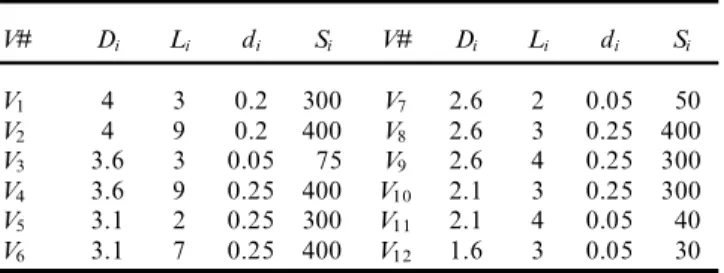
In this section, an example part is studie d which has twelve pre-spe cifie d machinable volum es as shown in figure 2 with the geom etrical data and the require d surface qualitie s given in table 1. Each machinable volum e, Vi, can be machine d by a set of cand idate tools de noted by an ope ration ± tool pair (i, j). There are six diffe rent cuttin g tool types available . Their technologi-cal param eters and the other input data are pre sented in table s 2 and 3, respe ctively.
The possible ope ration ± tool assign ments are given by the followin g 0± 1 matrix Y:
Y5 0 0 1 0 0 0 1 0 0 0 1 1 0 0 1 0 0 0 1 0 0 0 1 1 1 1 1 1 1 1 1 1 1 1 0 0 1 1 0 1 1 1 0 1 1 1 0 0 1 1 1 1 1 1 1 1 1 1 0 0 0 0 0 0 0 0 1 0 0 0 1 1 T
In the first two steps of the algorith m, the be st machining condition s for all possible operation ± tool pairs are determined for diffe rent nij value s. In table 4, this proce dure is illustrate d for the Volum e-11 and Tool-6 pair, i.e. ope ration(11, 6), as an example . At the end of step 1, n11,6 was equal to 3. In the multiple ope ration case , the optim al solution of the SMOP may 135
not corre spon d to the minim um of propose d cost measure as illustrate d in table 4 for the operation
(11, 6). We foun d a be tter solution by decreasing the numbe r of tool require ments, which slightly increase d the cost of SMO P but de crease d the overall cost measure for the multiple ope ration case . Furth ermore , we can e asily conje cture th at the propose d cost m e asure , C
±
ij, is more e ffe ctive th an th e SMO P approach es, which do not conside r the non-machining time compon ents and the tool waste cost.In step 3, the following sets are form ed by using the be st machinin g ope ration condition s for every possible pair: I35
{
1
,2
,4
,5
,6
,8
,9
,10
}
, I55{
3
}
, I65{
7
,11
,12
}
and Jp5
{
3
,5
,6
}
. Therefore, a lowe r boun d on the minim um cost value is equal to 119.84. In step 4, we che ck the tool availability constraint for every j [ Jp as follows:R3 5 n1,3
1
n2,31
n4,31
n5,31
n6,31
n8,31
n9,31
n10,35 3
1
61
61
21
41
21
31
25 28>
N35 20R5 5 n3,55 2
<
N55 4R65 n7,6
1
n11,61
n12,65 11
21
15 4>
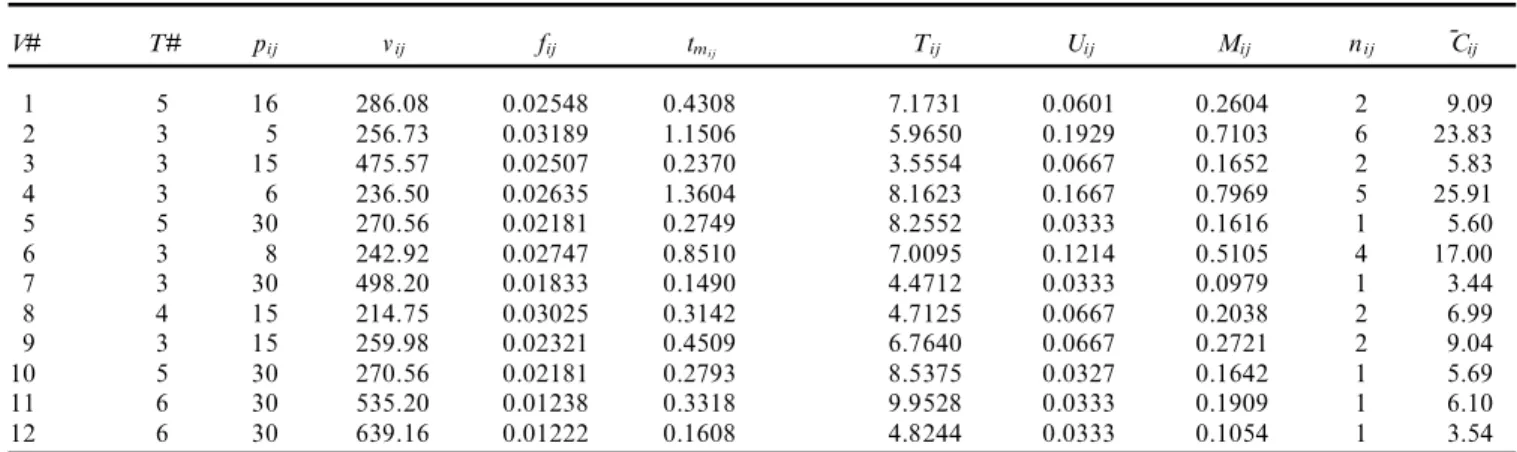
N65 2Sin ce the tool availability constraints are violate d for tools 3 and 6, we calculate the tool require ment le vels and the ir cost value s in step 5. The optim um tool allocation s with the corre spon din g machining condi-tion s found in step 6 are given in table 5, whe re the
total production cost is equal to 122.06. The final tool allocation is also represented by the following sets:
I3 5
{
2, 3, 4, 6, 7, 9}
, I45{
8}
, I55{
1, 5, 10}
, I6 5{
11, 12}
and J5{
3, 4, 5, 6}
. When we analyse the optim um solution for the allocation of Tool-6, this solution sugge sts to use Tool-1 for the manufacturin g of Volum e-7 instead of Tool-6, a reduction of a single Tool-6 in the processing of the Volum e-11, and it le aves the SMOP solution for the Volum e-12 without any reduction in the usage of Tool-6. As a sum mary, the initial solution of SMOP was inferior to the prop ose d cost measure for the m ultip le operation case as indicate d in table 4, and it was also infe asible due to tool availability con strain t resultin g from the tool conte ntion am ong the ope rations for a lim ite d numbe r of tools.5. Com p utatio nal results
The SMOP algorithm presented earlie r and the matrix ge nerator for the proble m formulation were code d in C lan guage and compile d with the Gnu C compile r. An optim al solution was foun d by using the CPLEX MIP solver on a SPARC Station 10 unde r SunOS 5.4. In th is section , the efficie ncy of the propose d exact approach for the tool allocation and machinin g condition s optim ization proble m is tested in terms of the com putation tim e to find an optim al solution .
Table 1. Machinable volume data.
V# Di Li di Si V# Di Li di Si V1 V2 V3 V4 V5 V6 4 4 3.6 3.6 3.1 3.1 3 9 3 9 2 7 0.2 0.2 0.05 0.25 0.25 0.25 300 400 75 400 300 400 V7 V8 V9 V10 V11 V12 2.6 2.6 2.6 2.1 2.1 1.6 2 3 4 3 4 3 0.05 0.25 0.25 0.25 0.05 0.05 50 400 300 300 40 30
Table 2. Technological e xponen ts and coefficients of the available tools.
T# a b c Cj b c e Cm g h l Cs T1 T2 T3 T4 T5 T6 4.0 4.3 3.7 4.1 3.7 4.2 1.40 1.60 1.28 1.26 1.30 1.65 1.16 1.20 1.05 1.05 1.05 1.20 40960000 37015056 11001020 48724925 13767340 56158018 0.91 0.96 0.80 0.80 0.83 0.90 0.78 0.70 0.75 0.77 0.75 0.78 0.75 0.71 0.70 0.69 0.73 0.65 2.394 1.637 2.415 2.545 2.321 1.706 Ð 1.52 Ð 1.60 Ð 1.63 Ð 1.69 Ð 1.63 Ð 1.54 1.004 1.005 1.052 1.005 1.015 1.104 0.25 0.30 0.30 0.40 0.30 0.32 204620000 259500000 205740000 204500000 203500000 211825000
Table 3. Tooling information .
T1 T2 T3 T4 T5 T6 trj tlj Nj Ctj 0.75 1 2 0.50 0.75 1 3 0.70 0.75 1 20 0.70 0.75 1 10 0.70 1 1.5 4 0.75 0.75 0.75 2 0.75
There are five expe rim ental factors that can affe ct the efficie ncy of the propose d algorith m, which are listed in table 6. Both the num ber of operation s and the cuttin g tool type s are most like ly to affe ct the computation times since they dire ctly affe ct the total numbe r of possible ope ration± tool pairs. The third factor de termines the assignm ent matrix, i.e . random or cluste red. At the random level, each cuttin g tool type can be assign ed to a candidate tool set of each operation with an e qual probability. But in the clustered case , 80% of the ope ration s are taken to be rough ing ope rations whe reas the remain ing 20% are taken to be finish ing ope ration s. The fourth factor dire ctly spe cifie s the tigh tness of the tool availability constraints. The numbe r of available tools on hand for tool type j , Nj, is take n as 80% or 60% of the require d numbe r of tools for each tool type at low and high
levels, respe ctively. As a result, the tool availability constrain t was always violate d in step 4 so we had to solve the IP form ulation given in step 6. Finally, the fifth factor give s the toolin g cost variability. Sin ce there are five factors and two le vels, our expe rim ent is
2
5 full-factorial de sign , which corre spon ds to 32 treat-ment combin ation s. The num ber of replication s of each combination is take n as five, that give s 160 diffe rent randomly generated runs.Other variable s in the system were treated as fixe d param eters and ge nerate d as follows:
·
Syste m re late d p ar am e te rs, B 530
p arts,Co5 $0.
5/
min, and H55
hp.·
Ope ration relate d param eters, Di and Li were sele cted random ly from the inte rval UN~
[1.5 , 3] and UN~
[4 , 8] , respectively, whe re UN stands for the uniform distribution .·
The value s of Si and di were relate d with the assign me nt matrix. For random assign m en t matrix, Si 5 UN~
[ 30 , 500] an d di 5 UN~
[0.025 , 0.3] . In the clustered case, there were two type s of ope ration s, namely rough ing and fin ish in g . Fo r ro u g h in g o p e ration s, Si 5 UN
~
[300 , 500] and di5 UN~
[0.2 , 0.3] . For finishing ope ration s, Si5 UN~
[ 30 , 70] anddi5 UN
~
[0.025 , 0.075] .·
Tool relate d technological expon ents were al-ready given in table 2. trj and tlj were sele cted137
Table 4. Finding the minimum cost measure for operation ( 11,6) .
nij pij vij fij tmij Tij Uij Mij CÅ ij 3 2 1 12 15 30 659.02 633.60 535.20 0.01655 0.01567 0.01238 0.2015 0.2214 0.3318 2.5721 3.3217 9.9528 0.0784 0.0667 0.0333 0.1595 0.1607 0.1909 6.00 5.57 6.10
Table 5. Optimum tool allocation and machining conditions.
V# T# pij vij fij tmij Tij Uij Mij nij CÅ ij 1 2 3 4 5 6 7 8 9 10 11 12 5 3 3 3 5 3 3 4 3 5 6 6 16 5 15 6 30 8 30 15 15 30 30 30 286.08 256.73 475.57 236.50 270.56 242.92 498.20 214.75 259.98 270.56 535.20 639.16 0.02548 0.03189 0.02507 0.02635 0.02181 0.02747 0.01833 0.03025 0.02321 0.02181 0.01238 0.01222 0.4308 1.1506 0.2370 1.3604 0.2749 0.8510 0.1490 0.3142 0.4509 0.2793 0.3318 0.1608 7.1731 5.9650 3.5554 8.1623 8.2552 7.0095 4.4712 4.7125 6.7640 8.5375 9.9528 4.8244 0.0601 0.1929 0.0667 0.1667 0.0333 0.1214 0.0333 0.0667 0.0667 0.0327 0.0333 0.0333 0.2604 0.7103 0.1652 0.7969 0.1616 0.5105 0.0979 0.2038 0.2721 0.1642 0.1909 0.1054 2 6 2 5 1 4 1 2 2 1 1 1 9.09 23.83 5.83 25.91 5.60 17.00 3.44 6.99 9.04 5.69 6.10 3.54
Table 6. Experimental factors.
Factors De finition Low High
A B C D E Number of operations Number of tool types
Assignme nt matrix Tool availability Tooling cost variability
50 6 Random 80% UN
~
[1.2,1.6] 100 10 Clustered 60% UN~
[0.6,2.2]randomly from the inte rval UN
~
[0.75 , 1.0] and UN~
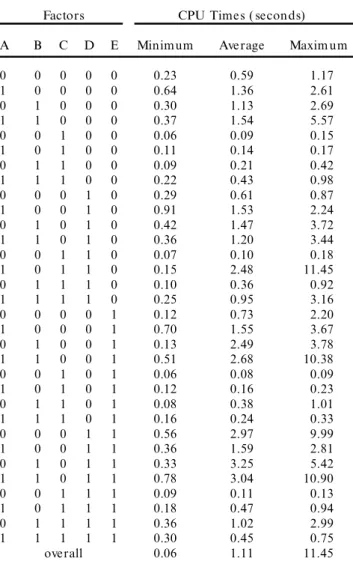
[1.0 , 1.5] , respe ctive ly.Table 7 sum marize s the CPU tim es ( in seconds) to find the optim um solution for each run, alon g with the minim um, average and maxim um CPU times ( base d on five random replications) for each factor com bin ation . In this table , low and high le vels for each factor are repre se nte d by 0 and 1, re spe ctive ly. For all 160 proble ms reported in this table , the maxim um CPU time was 11.45 s, whe reas the average tim e was 1.11 s. The maxim um CPU tim e was foun d for the factor com bin ation of ( 1 0 1 1 0) . In other words, the numbe r of ope rations and the restriction on the tool availability constrain ts were at their high le vels, and the initial toolin g cost variability and the numbe r of tool type s were at the ir low le vels. On the other han d, the minim um CPU tim e of 0.06 s foun d for a cluste red assign ment
matrix with a high initial toolin g cost variability and other factors were at their low le vels, i.e . ( 0 0 1 0 1) . As mention ed above , the le vels of the fourth factor were sele cted in a way that the tool availability constrain t was always bin din g for at le ast on e of the tool type s. The refore , we had to solve an IP form ulation in each run. In orde r to give an idea about the size of the IP formulation, the range of the num be r of 0± 1 variable s were be tween 1000 and 5000 for all runs.
Finally, a two-way analysis of variance ( ANOVA) test was applie d on two pe rform ance measure s of the optim um value of the total production cost and the computation tim e to test the equality of obse rved respon ses from the diffe rent treatm ents of the chose n factors. As expe cted, factors A, B, C and D were foun d to be sign ifican t at the 0.5% sign ifican ce le vel, whereas factor E is only sign ificant at the 25% le vel, on the total production cost. For a combin ation of factors, the interaction s AB and AC, which directly affe ct the num be r of possible operation ± tool pairs and the assign ment matrix, were foun d to be sign ificant at the 0.5% significanc e le vel. For the computation tim e crite rion , factor C was the only sign ificant one at the 0.5% sign ifican ce level. Whe n factor C was at the high le ve l, i.e . cluste red case , the ove rall proble m was de compose d into two separate proble ms for roughin g and finishin g ope rations, which reduce d the numbe r of possibilitie s. For the remain ing factors, factor D was significan t at the 10% sign ifican ce le vel and the others were not statistically sign ifican t on the computation time to find the optim um solution , which also indicate d the robustn ess of the propose d algorithm to changin g condition s of the experim ental factors.
Anothe r im portan t que stion is the sensitivity of machin ing condition s and tool allocation ± sele ction de cision s with respe ct to the technological coe fficie nts of the usual machinin g ope ration constraints. In the lite rature, the manufacturin g optim ization proble ms are solve d for a give n se t of fixe d te chn ologic al coefficie nts as indicate d earlie r in an exam ple proble m in table 2. Howe ve r, the se coe fficients are diffe rent for each change in work mate rial, tool mate rial, tool form and shape, size and shape of cut, machine tools used, and cuttin g fluid. The ir value s have be en determined empiric ally for many spe cific condition s and are given in reference books and han dbooks. The refore, we pe rform ed anoth er
2
9full-factorial design for the factor combin ation of ( 1 1 1 0 0) giving 2560 diffe rent random ly ge nerated runs for the repre se ntative range s of 9 technologic al coe fficients as sum marize d in table 8. ANO VA tests were applie d on thre e perform an ce measure s of lowe r bound, optim um value and compu-tation time. Our results indicate d that all of the factors were significan t on all three measure s as shown in tableTable 7. Re sults of th e computational expe rime nts.
Factors CPU Time s ( seconds)
A B C D E Minimum Ave rage Maxim um
0 0 0 0 0 0.23 0.59 1.17 1 0 0 0 0 0.64 1.36 2.61 0 1 0 0 0 0.30 1.13 2.69 1 1 0 0 0 0.37 1.54 5.57 0 0 1 0 0 0.06 0.09 0.15 1 0 1 0 0 0.11 0.14 0.17 0 1 1 0 0 0.09 0.21 0.42 1 1 1 0 0 0.22 0.43 0.98 0 0 0 1 0 0.29 0.61 0.87 1 0 0 1 0 0.91 1.53 2.24 0 1 0 1 0 0.42 1.47 3.72 1 1 0 1 0 0.36 1.20 3.44 0 0 1 1 0 0.07 0.10 0.18 1 0 1 1 0 0.15 2.48 11.45 0 1 1 1 0 0.10 0.36 0.92 1 1 1 1 0 0.25 0.95 3.16 0 0 0 0 1 0.12 0.73 2.20 1 0 0 0 1 0.70 1.55 3.67 0 1 0 0 1 0.13 2.49 3.78 1 1 0 0 1 0.51 2.68 10.38 0 0 1 0 1 0.06 0.08 0.09 1 0 1 0 1 0.12 0.16 0.23 0 1 1 0 1 0.08 0.38 1.01 1 1 1 0 1 0.16 0.24 0.33 0 0 0 1 1 0.56 2.97 9.99 1 0 0 1 1 0.36 1.59 2.81 0 1 0 1 1 0.33 3.25 5.42 1 1 0 1 1 0.78 3.04 10.90 0 0 1 1 1 0.09 0.11 0.13 1 0 1 1 1 0.18 0.47 0.94 0 1 1 1 1 0.36 1.02 2.99 1 1 1 1 1 0.30 0.45 0.75 overall 0.06 1.11 11.45
9. Con se que ntly, th e optim um solu tion an d th e corre spondin g com putation tim e are de pe nde nt on the operation al and toolin g param eters.
6. Conclusio ns
In this pape r, an exact approach is pre sented for solvin g the tool alloc ation and machin ing conditions sele ction proble ms sim ultane ously to find the minimum production cost, where alte rnative tools can be used for each ope ration . For this purpose , the classical SMOP formulation is exte nde d by addin g a ne w tool life constraint, which enable d us to include tooling issue s like tool wear and tool availability. Furthermore , a new cost measure is propose d to exploit the interaction be twe e n th e n um be r of tools re quire d with th e machining, tool replacin g and loadin g tim es, and tool waste cost in conjun ction with the optim um machining condition s for alte rnative ope ration ± tool pairs. Conse -quently, th e propose d algor ithm can pre ve nt any unfeasibility that may occur for the tool allocation proble m at the syste m level due to tool conte ntion and tool life restriction s through a feedback mechanism. As
indicate d in the exam ple proble m, a de cision made at a highe level without conside ring its impact on the lowe r-levels can le ad to unfeasible or infe rior results when we conside r both constrain ts and param eters of the lowe r-le ve l probr-le ms. As a final point, an effective tool manage ment is a major require ment for the im ple men-tation of an FMS, he nce the CNC machine tools as state d by several authors. In the autom ate d environ ments, soph isticate d com puterize d de cision making tools are neede d for effective operation and control of the system. In this respe ct, this study can be conside red as a part of the fully autom ate d proce ss plan ning system.
Ap pend ix
Theore m 2: The followin g cost measu re is a convex
function of the integer nij valu es:
±
Cij 5 B Mij
1
Co (nij2 1
)trj1
tlj1
Ctjb B/
pijc (1
2
pijUij)provided that pijUij
£
p¢
ijUij¢
for n¢
ij<
nij.Proo f: To prove this the ore m, the following prop er-ties of the conve x function s will be de vise d: ( i) a line ar function is convex and ( ii) the sum of convex function s is also convex. The prop ose d cost measure has three compon ents, nam ely, SMOP, ope ratin g cost due to non -machin ing events, and tool waste cost. The SMOP com pon ent is a conve x function since its Hessian matrix is positive de finite over the possible value s of vij and fij, hence the inte ge r nij value s ( Bazaraa et al. 1993) . The non -m achinin g tim e com pone nt is a line ar function of the intege r nij value s, so it is a conve x function due to the first prop erty. The third com pone nt of the measure is the tool waste cost. Let’ s conside r two consecutive inte ge r tool require ments such that n
¢ij
<
nij and nij2
n¢ij
³ 1.
We can write the following statement in ge ne ral:139
{
{
{
Table 8. Evaluation of te chnological coefficients.
Constraints Factors Low High
a UN
~
[2.8, 3.0] UN~
[3.2, 3.4] Tool life b UN~
[1.25, 1.30] UN~
[1.35, 1.40] Cj UN~
[10000000, 20000000] UN~
[30000000, 40000000] b UN~
[0.81, 0.87] UN~
[0.91, 0.97] Horsepower c UN~
[0.70, 0.73] UN~
[0.77, 0.80] Cm UN~
[1.5, 1.8] UN~
[2.3, 2.6] g UN~
[1.50, 1.55] UN~
[1.65, 1.70] Surface finish h UN~
[1.00, 1.02] UN~
[1.08, 1.10] Cs UN~
[200000000, 210000000] UN~
[220000000, 230000000]Table 9. F value s and significance levels ( p) for ANOVA
results.
Lower bound Optimum Comp. time
Factors F p F p F p a b Cj b c Cm g h Cs 86.3 4.5 21.4 68092.0 17521.1 37218.2 690.5 98.6 8.9 0.000 0.034 0.000 0.000 0.000 0.000 0.000 0.000 0.003 89.6 4.7 23.6 69585.6 17957.2 37933.6 715.6 101.1 9.4 0.000 0.030 0.000 0.000 0.000 0.000 0.000 0.000 0.002 94.7 5.3 65.6 35.5 20.5 37.1 41.1 8.1 3.0 0.013 0.022 0.000 0.000 0.000 0.000 0.000 0.004 0.086
b B
/
pijc 5nij if B
/
pij [ Z1nij
2 1
othe rwiseNow, conside r the worst case for these two consecu-tive tool require ments, such that b B
/
p¢
ijc 5 n¢
ij and b B/
pijc 5 nij2 1
. T h a t i s, nij2
n¢
ij³ 1
Þ
b B/
pijc³
b B/
p¢
ijc . Therefore the tool waste cost component isa non-de creasin g function, i.e . a convex function, if the followin g con dition is satisfie d pijUij
£
p¢
ijUij¢
forn
¢ij
<
nij. Conse que ntly, the propose d cost measure is also a convex function over the intege r value s of nij due to the second prop erty.Ref erences
AKTURK, M. S., and ONEN, S., 1997, Inte grate d lot sizing an d
tool manage me nt in automated manufacturing systems. 6th
Industrial Engineering Research Conference Proceedings, pp. 340±
345.
AVCI, S., and AKTURK, M. S., 1996, Tool magazine arran geme nt
and operations sequencing on CNC machine s. Computers
and Operations Research, 23, 1069± 1081.
ASAI, K., and TAKASHIMA S., 1994, Manu factu ring, Automation
Systems an d CIM Factories ( London: Chapman & Hall) .
BAZARAA, M. S., SHERALI, H. D., and SHETTY, C. M., 1993,
Nonlinear Programming Theory an d Algorithms, 2n d e dn
( Wiley) .
CRAMA, Y., KOLEN, A. W. J., OERLEMANS, A. G., and SPIEKSMA, F. C.
R., 1994, Minimizing the n umber of tool switches on a flexible machine. Internation al Journal of Flexible Man
ufactur-ing Systems, 6, 33± 54.
GOPALAKRISHNAN, B., an d AI-KHAYYAL, F., 1991, Machine
para-mete r selection for turning with constraints: an analytical
approach based on ge ome tric programming. International
Journal of Produ ction Research, 29, 1897± 1908.
GORCZYCA, F. E., 1987, Application of Metal Cuttin g Theory
( Industrial Press).
GRAY, A. E., SEIDMANN, A., and STECKEK. E., 1993, A synthe sis of
de cision m ode ls for tool m an age m e n t in autom ate d
manufacturing.Man agement Science, 39, 549± 567.
KOUVELIS, P., 1991, An optimal tool selection procedure for the
initial design phase of a flexible manufacturing system.
European Journal of Operational Research, 55, 201± 210.
LEUNG, L. C., MAHESHWARI, S. K., an d MILLER, W. A., 1993,
Concurrent part assignme nt an d tool allocation in FMS with
mate rial han dling considerations. International Jou rnal of
Produ ction Research, 31, 117± 138.
MAHESHWARI, S. K., and KHATO R, S. K., 1995, Simultaneous
e valuation an d selection of strate gie s for loading and controlling machine s and mate rial handling system in
FMS. International Journal of Compu ter Integrated Man
ufactur-ing, 8, 340± 356.
RAM, B., SARIN, S., and CHEN, C. S., 1990, A model and a
solution approach for the machine loading an d tool allocation problem in a flexible manufacturing system.
Internation al Journal of Produ ction Research, 28, 637± 645.
SARIN, S. C., and CHEN, C. S., 1987, The mach ine loading and
tool allocation problem in a flexible manufacturing system.
Internation al Journal of Produ ction Research, 25, 1081± 1094.
STECKE, K. E., 1983, Formulation and solution of nonline ar
integer production planning problems for flexible
manu-facturing systems.Man agement Science, 29, 273± 288.
TAN, F. P., and CREESE, R. C., 1995, A ge ne ralized multi-pass
machining model for machining parame te r selection in turning. International Journal of Production Research, 33, 1467±
1487.
TANG, C. S., and DENARDO, E. V., 1988, Models arising from a
flexible manufacturing machine, Part I: Minimization of the
number of tool switche s.Operation s Research, 36, 767± 777.
VEERAMANI, D., UPTO N, D. M., and BARASH, M. M., 1992,
Cutting-tool manage me nt in computer inte grate d manufacturing.
Internation al Jou rnal of Flexible Man ufactu ring Systems, 4, 237±