Summary
This study aimed at comparing the inhibitory effects of various decontamination agents (1% lactic acid, 2% lactic acid, 2% acetic acid, 0.1% acidified sodium chloride, 0.1% sodium acetate, and 0.1% cetylpridinium chlorine) on experimentally contaminated raw beef samples with Listeria monocytogenes being a significant pathogen microorganism for public health. The highest level of bacterial inhibition was determined in the meat samples treated with 2% lactic acid while the lowest level was in the samples treated with 0.1% acidified sodium chloride. It is very important to specify that initial bacterial load of carcases, the decontamination technique applied, and the characteristics of acids used (dissociated or undissociated, pH, amount, percentage, application temperature, and different combinations) are essential parameters to be taken into account in the process of reducing microorganism on raw meat samples.
Keywords: Listeria monocytogenes, Decontamination, Raw meat, Cetylpridinium chlorine, Acetic acid,
Acidified sodium chloride, Sodium acetate, lactic acid
Laboratuvar Koşullarında Çiğ Sığır Etlerine Deneysel
Olarak Inoküle Edilen Farklı Dekontaminasyon Ajanlarının
Listeria monocytogenes seviyesi Üzerine Baskılayıcı Etkisi
Özet
Bu çalışmada, laboratuvar koşullarında, halk sağlığı bakımından önemli bir patojen olan L. monocytogenes ile deneysel olarak inoküle edilmiş çiğ sığır etlerinde farklı dekontaminasyon ajanlarının (%1 laktik asit, %2 laktik asit, %2 asetik asit ve %0.1 asitlendirilmiş sodium klorür, %0.1 sodyum asetat ve %0.1 cetylpridinium chlorine) baskılayıcı etkisinin karşılaştırılması amaçlanmıştır. En yüksek bakteriyel inhibisyon oranı, %2 laktik asit uygulanmış et örrneklerinde belirlenmiştir, en düşük oran ise %0.1 asitlendirilmiş sodyum klorür uygulanmış örneklerde gözlemlenmiştir. Çiğ etlerdeki bakteriyel yükü azaltma sürecinde karkasların ilk bakteriyel yükü, uygulanan dekontaminasyon tekniği ve kullanılan asitlerin karakteristik özellikleri (dissosiye yada dissosiye olmamış, pH, miktarı, oranı, uygulama sıcaklığı ve kullanılan farklı kombinasyonlar) gibi gözönüne alınması gereken temel parametrelere vurgu yapmak önem arz etmektedir.
Anahtar sözcükler: Listeria monocytogenes, Dekontaminasyon, Çiğ et, Cetylpridinium klorit, Asetik Asit,
Asitlendirilmiş Sodyum Klorit, Sodyum Asetat, Laktik Asit
Inhibitory Effects of Different Decontamination Agents on the
Levels of Listeria monocytogenes in the Experimentally Inoculated
Raw Beef Samples in the Laboratory Conditions
Mehmet ELMALI *
Hilmi YAMAN ** Kemal Kaan TEKİNŞEN ***
Süleyman ÖNER * Erhan ÇEKİN ****
* ** *** ****
Mustafa Kemal University, Faculty of Veterinary Medicine, Department of Food Hygiene and Technology, TR-31040 Antakya/Hatay - TURKEY
Adnan Menderes University, Aydın School of Health Sciences, Department of Nutrition and Dietetics, TR-09100 Aydın - TURKEY
Selcuk University, Faculty of Veterinary Medicine, Department of Food Hygiene and Technology, TR-42100 Konya - TURKEY
Ministry of Food Agriculture and Animalstock, TR-36100 Kars - TURKEY
Makale Kodu (Article Code): KVFD-2012-6371
İletişim (Correspondence)
+90 326 2455845/1554INTRODUCTION
Listeria monocytogenes is one of the most important
pathogens in terms of public health all over the world. It posses an important risk for human with several food including fresh meat and meat products. It is the fact that, it can grow at +4ºC and keep vital activation in aerobic conditions as a microaerophilic bacterium 1.
Contamination of a the cattle carcass mainly starts with the removal of skin after slaughtering. During the slaughtering process; removal of the skin and internal organs, and cooling process of the carcass are the major important critical control points that extremely need to be taken care of. On the other hand, equipments used in the slaughtering process (particularly knives), physical condition of the slaughter house, and personal hygiene are significant parameters that affect the microbial profile of the meat.
In order to reduce microbial contaminations caused by the personal hygiene and improper handling, some chemicals (organic acid, cetylpridinium chlorine, trisodium phospate, acidified sodium chloride, chlorine, ozone), physical (animal washing, trimming, dehairing, steam pasteurization, hot water), and microbial (bacteriocin) applications are need to be applied to the carcasses, meat and meat products 2.
Combined ‘multi-hurdle’ techniques including several applications such as water, wash + hot water 3, steam
vacuuming + hot water + lactic acid or steam vacuuming + lactic acid + hot water 4, hot water + lactic acid 5-7, hot water
+ acidified sodium chloride, hot water + cetylpridinium chlorine, acidified sodium chloride + hot water, cetylpridinium chlorine + hot water 8, and lactic acid +
cetylpridinium chlorine along with physical and chemical techniques are used in decontamination purpose of various animal carcasses 9.
Cetylpridinium chlorine (CPC) is generally recognized as safe (GRAS), and certain chemical components including lactic acid, acidified sodium chloride, sodium acetate, and acetic acid, are suggested by the Food Safety and Inspection Services 10, United States Department of Agriculture, and
frequently applied in the decontamination processes in the food marked.
The antimicrobial activity of acidified sodium chloride is due to the oxidative effects of chlorous acid originated from the conversion of chlorite ion into acid form under acidic conditions. It is very essential that the antibacterial solution should be prepared shortly before spraying as the reactions occur immediately after mixing the sodium chloride with an acid 2.
Interaction of basic cetylpyridinium ions with acidic molecules results in antimicrobial activity on bacteria. This reaction then inhibits bacterial metabolism through constructing weak ionic compounds interfering with
bacterial respiration 2. Cetylpridinium chlorine also prevents
bacterial attachment, and potentially reducing the cross-contamination risk. Treatment of the poultry products with cetylpridinium chlorine has no effect on the physical appearance 11. Pohlman et al.12 have indicated that use
of cetylpridinium chlorine should not only enhance the microbial safety of ground beef, but also prolong the colour stability of shelf-life.
The antibacterial action of organic acids including acetic, tartaric, lactic, and citric acids is due to the effect of low pH and the degree of dissociation of the acid. Since un-dissociated organic acids are more readily soluble in the bacterial cell membrane, they have more bactericidal effects in the dissociated form. It is also known that the concentration of the acid, temperature of the solution, the method used and time of application influence antimicrobial activity of the acids 13-15.
There is no routine usage of organic acid or chemical solution for the carcass decontamination in slaughterhouses in Turkey yet, a few experimental researches have been conducted so far. Several countries in Europe and the United States of America (USA) allowed to the usage of certain chemical solutions for decontamination purpose in red meat supply chains. Carcasses are applied by either chemicals or organic acids at chilling processing stage in the USA while it is forbidden in Europe. Likewise, application of acidified salted water to the carcass after the removal of the skin is permitted in the USA, it is not allowed in the European Union. Similarly, different applications such as hot water and steam pasteurization are applied to the carcass, On the other hand, oil extracts and carbon dioxide applications are preferred at packaging and retail processing stages.
This study aimed to compare the effects of individual decontamination agents including 1% lactic acid, 2% lactic acid, 2% acetic acid, 0.1% acidified sodium chloride, 0.1% sodium acetate, and 0.1% cetylpridinium chlorine on L.
monocytogenes in the raw beef samples were contaminated
experimentally.
MATERIAL and METHODS
This study was carried out at the University of Kafkas, Veterinary Medicine Faculty, Food Hygiene and Technology Department in 2009.
Preparation of the Culture of Bacteria
L. monocytogenes was provided from the Culture
Collection Unit of Refik Saydam Laboratory (RSKK 472-1/2b) as a lyophilized stock culture and aerobically incubated in 10 ml Listeria Enrichment Broth (Oxoid CM862+Listeria selective enrichment suppl. Oxoid SR141) at 30°C for 24 h. The level of L. monocytogenes after the incubation period was adjusted to approximately 108cfu/ml by using McFarland
Preparation of the Meat Samples
Fresh beef samples (Musculus longissimus dorsi) taken after slaughtering were brought to the laboratory under cold chain conditions (4°C) within 60 min and then cut into eight pieces in the size of 6×4×1 cm (about 22-27 g each) to form different groups.
Attachment of Bacteria
As the volume of each meat sample was small, immersion technique was used for the inoculation of each sample with L. monocytogenes stock culture. Firstly, 100 ml L.
monocytogenes stock culture (108cfu/ml) was put into
sterilized aluminum foil cup and each beef sample was then immersed into the stock culture for 5 min. After that, each meat sample was placed into another aluminum foil cup and stored at +4°C for 35 min for bacterial attachment (Stage I).
Decontamination Process
Several decontamination solutions including anti-microbial agents were prepared in the individual sterilized aluminum containers at room temperature (18±1°C) and sterilized using 0.20 micro liter filters (Sartorious). In order to determine the changes of L. monocytogenes levels during the processing stage and storage period at 4ºC, different groups were conducted as; 1% lactic acid, pH 1.95±0.01, (Merck 100366.2500) in container I (Group I); 2% lactic acid, pH 1.82, (Merck 100366.2500) in container II (Group II); 2% acetic acid, pH 2.42±0.01, (Merck 818755.2500) in container III (Group III); 0.1% acidified sodium chloride, pH 2.72±0.01, (Merck 106404.1000) in container IV [Citric acid (Merck 100244.1000) was used in preparing acidified sodium chloride] (Group IV); 0.1% sodium acetate, pH 6.75, (Merck 106268.1000) in container V (Group V); 0.1% cetylpridinium chlorine, pH 6.35, (Merck 1.02340) in container VI (Group VI); distilled water (Control group), pH 6.9, in container VII (Group VII) and finally, a contaminated meat sample (pH 6.8) placed into the container VIII (Group VIII) without any chemical treatment.
After bacterial attachment (Stage I), each meat sample was dipped into the individually different treatment carrying one of the decontamination agent solutions mentioned above for 15 second at room temperature (Stage II). Then, each treated meat sample was placed on sterilized aluminum foil and all left ones at room temperature for 10 min (Stage III). Subsequently, each sample was wrapped up separately with a piece of aluminum foil and stored at +4°C for five days (Stage IV).
Microbiological Analysis
The presence and counts of L. monocytogenes were determined in the fresh beef samples at the beginning of decontamination treatments, and after the decontamination procedures on 1st, 3rd, and 5th days of storage at +4°C. Each
meat sample was individually put into a sterile polyethylene
bag and then 198-243 ml Listeria Enrichment Broth (Oxoid CM862+Listeria selective enrichment supplement Oxoid SR141) was added. After the samples were rinsed in the bags for 2 min, an amount of 0.05 ml rinse broth was taken from each bag and inoculated onto Palcam Agar media (Oxoid CM877+Palcam selective supplement Oxoid SR150) on plates by using drop plaque culture technique and incubated at 30°C for 48 h. Finally, Listeria spp. colonies with typical morphology were counted 17,18.
Measurement of Meat pH
In order to measure pH of the fresh raw meat samples, 5 g of each meat sample was homogenized in a stomacher bag with 15 ml of sterile deionized water for 2 min. The pH value of the meat samples was measured with a digitial pH meter.
Statistical Analysis
Statistical analyses of the results were performed using a SPSS 11.5 program (one way anova), and considered as statistically significant at the P<0.05 level 19.
RESULTS
No L. monocytogenes was isolated in the fresh raw beef sample after initial microbiological analysis, and the mean value of pH for the raw beef sample was measured as 6.8 before the application of any treatments. Even though the stock culture of L. monocytogenes was adjusted to around the counts of 108cfu/ml, after dipping the meat samples
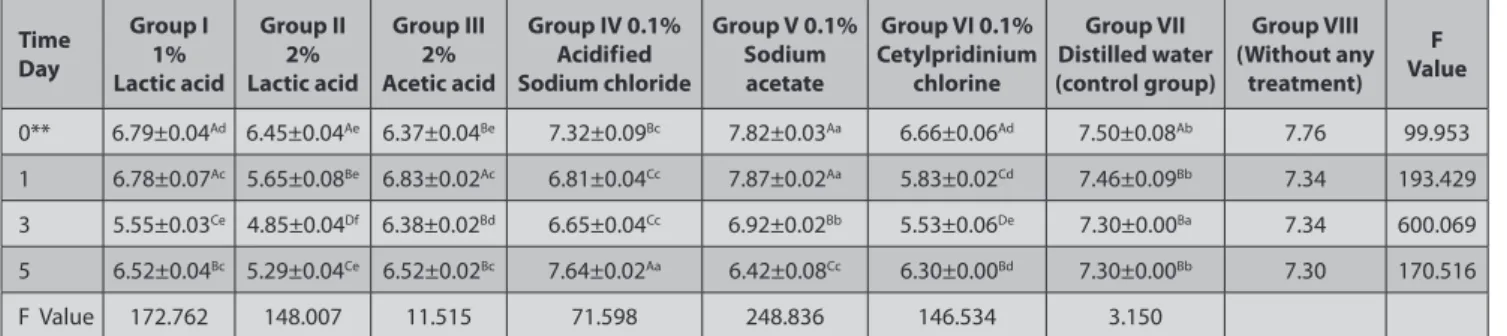
into stock culture, the attachment level of L. monocytogenes was in the range of between 6.37±0.04 and 7,82±0,03 cfu/g. After treatment of raw beef samples with 1% lactic acid, 2% lactic acid, 2% acetic acid, and 1% cetylpridinium chlorine, L. monocytogenes was counted approximately at the level of 6.0 log cfu/g. However, it was around 7.0 log in the 0.1% acidified sodium chloride, 0.1% sodium acetate and distilled water groups. The counts of L. monocytogenes in the 8th beef sample with no treatment resulted in 7.76 log
cfu/ml. As a result, the bacterial reduction level was the highest in the 2% lactic acid group, and lowest in the group treated with 0.1% acidified sodium chloride in this study (Table 1).
DISCUSSION
The counts of L. monocytogenes in the 8th meat sample
without treatment did not change considerably. At the end of 1st, 3rd and 5th days of storage at +4°C were 7.34 log cfu/ml,
7.34 log cfu/ml, and 7.30 log cfu/ml, respectively. Likewise, in the distilled water and 2% acetic acid groups, no logarithmic changes were detected in the L. monocytogenes levels during 5 days of storage at +4°C. In the study of Ikeda et al.20, beef slices (2.5x5x1 cm) from top rounds inoculated
with acid-adapted or nonadapted L. monocytogenes (4.6 to 5.0 log CFU/cm2) were grouped as either untreated
of the study, the one treated with lactic acid resulted in immediate pathogen reductions of 1.8 to 2.6 log CFU/ cm2. After storage at +10°C for 28 days, the count of L. monocytogenes on meat remained at low levels (1.6 to 2.8 log
CFU/cm2). In the study of Ikeda et al.20, there was no growth
of the pathogen on 14 and 21 days in the untreated and acid-treated samples during storage at +4°C, respectively. This difference between our and above study might be the different strains used.
In the 1% lactic acid group, there was no significant chances in the counts of L. monocytogenes between the attachment level and 1st day of sample (6.0 log cfu/ml).
However, one log decrease was observed on the 3rd day
but increased back to 6.0 log cfu/ml on the 5th day. In the
2% lactic acid group, 1.60 and 1.16 log cfu/ml reductions were determined on the 3rd and 5th days of storage at
+4°C, repectively. In the study of Ozdemir et al. 6, muscle
tissue samples inoculated with L. monocytogenes were immersed in 1% and 2% lactic acid solutions for 15 s and stored at +4°C. In the 1% lactic acid group, 1.12, 1.14, and 2.16 log cfu/ml and in the 2% lactic acid group 1.70, 1.59, and 2.54 log cfu/ml reductions were reported on the 1st,
3rd, and 5th days, respectively. Comparing our results with
Ozdemir et al.6, the treatments of 1% and 2% lactic acid
revealed similar reduction log units of 1.24 and 1.16 cfu/ ml, respectively in 3 days storage but no similarity was observed for the 1st and 5th days storage. In the study of
Ozdemir et al.6, 1.02 and 0.95 log cfu/ml recovery of L. monocytogenes was counted on the storage day 5 after 1%
and 2% lactic acid treatments, respectively but in our study the recovery of L. monocytogenes was recorded as 0.97 log cfu/ml in the 1% lactic acid treated group and 0.44 log cfu/ml in the 2% lactic acid group. These differences may have arisen due to the fact that our 1% and 2% lactic acid solutions had lower pH and temperature (1.95 and 1.82, 18±1°C) than the values of pH and temperature (2.53 and 2.40, 24-25°C) in the study of Ozdemir et al.6. It is known
that the concentration of the acid, temperature, and pH of
the solution, the method used and time of application may influence antimicrobial activity of the acids 13-15,21,22.
In our study, in the 0.1% acidified sodium chloride group, the bacterial level on the 1st and 3rd days decreased
1 log (6 log cfu/ml) but increased 1 log on the 5th day (7 log
cfu/ml) comparing to day 0. The lowest bacterial decline was observed in the group of acidified sodium chloride. In the study of Su and Morrisey 23 the antimicrobial activity
of acidified sodium chlorite against L. monocytogenes in salmon was similar to our study. Del Rio et al. 24 reported that
dipping treatments of acidified sodium chlorite, and 2% citric acid on inoculated pathogenic bacteria (L. monocytogenes) throughout storage of chicken legs (days 0, 1, 3, and 5) at 3±1°C reduced microbial populations (P<0.001) as compared with the control (untreated). Likewise, in our study, the results showed similarity with Del Rio et al.24
At present study, in the 1% cetylpridinium chlorine group, the levels of L. monocytogenes showed 0.83 and 1.13 log cfu/ml reductions on days 1st and 3rd, respectively. However,
a slight recovery (0.57 log cfu/ml) was observed on day 5th
resulting the similar counts of L. monocytogenes as it was on day 0. Dupard et al.25 reported that a soaking treatment
of cetylpridinium chlorine had a strong potential effect to eliminate or reduce L. monocytogenes on the surfaces of shrimps. In their study, the shrimp samples were treated by soaking in different concentrations of cetylpridinium chlorine (0.05, 0.1, 0.2, 0.4, 0.6, 0.8, and 1.0%) solutions for 1 min and then packed, stored at 4°C for 24 h. The counts of L.
monocytogenes on cooked shrimps were reduced by 3 log
cfu/g with 0.1% cetylpridinium chlorine treatment. However, 1 log cfu/g change was observed with 0.1% cetylpridinium chlorine treatment in our study. This might be caused by different pH levels and application periods in the studies.
In the study of Lim and Mustapha 26, 0.5% cetylpridinium
chlorine was sprayed on the beef surfaces and tray absorbent pads, and then samples were stored at +4°C for 10 days. L.
monocytogenes was reduced to undetectable levels in 2 h Table 1. The reduction effect of different chemical agents on the levels of L. monocytogenes in the experimentally inoculated raw beef samples stored at
+4°C for five days*
Tablo 1. Farklı kimyasal ajanların deneysel olarak inoküle edilerek +4°C’de beş gün muhafaza edilen çiğ et örneklerinde L. monocytogenes seviyeleri üzerine
yıkımlayıcı etkisi* Time Day Group I 1% Lactic acid Group II 2% Lactic acid Group III 2% Acetic acid Group IV 0.1% Acidified Sodium chloride Group V 0.1% Sodium acetate Group VI 0.1% Cetylpridinium chlorine Group VII Distilled water (control group) Group VIII (Without any treatment) F Value 0** 6.79±0.04Ad 6.45±0.04Ae 6.37±0.04Be 7.32±0.09Bc 7.82±0.03Aa 6.66±0.06Ad 7.50±0.08Ab 7.76 99.953 1 6.78±0.07Ac 5.65±0.08Be 6.83±0.02Ac 6.81±0.04Cc 7.87±0.02Aa 5.83±0.02Cd 7.46±0.09Bb 7.34 193.429 3 5.55±0.03Ce 4.85±0.04Df 6.38±0.02Bd 6.65±0.04Cc 6.92±0.02Bb 5.53±0.06De 7.30±0.00Ba 7.34 600.069 5 6.52±0.04Bc 5.29±0.04Ce 6.52±0.02Bc 7.64±0.02Aa 6.42±0.08Cc 6.30±0.00Bd 7.30±0.00Bb 7.30 170.516 F Value 172.762 148.007 11.515 71.598 248.836 146.534 3.150
*Average bacterial log of five repitations, **Time after bacterial attachment procedure; 1. A,B,C,D: The differences were statistically significant among the groups displayed with different letters at the same column, (P<0.05); 2. a,b,c,d,e,f: The differences were statistically significant among the groups displayed with different letters at the same line, (P<0.05)
after spraying with 0.5% cetylpridinium chlorine. Likewise, in the study of Singh et al.27, sliced (cut) and exterior (intact)
surfaces of restructured cooked roast beef were inoculated with L. monocytogenes, and treated with 1% cetylpridinium chlorine by immersion for 1 min. Then vacuum packed, and stored for 42 days at 0 or +4°C. Immediately after cetylpridinium chlorine treatment, and regardless of in-oculation levels, L. monocytogenes populations were reduced (P=0.05) about 2 log cfu/cm2 on sliced surfaces and 4 log
cfu/cm2 on exterior surfaces and remained lower (P=0.05)
than those of nontreated samples for both surface types throughout 42 days of refrigerated storage (at both 0 and +4°C).
These studies indicate that cetylpridinium chlorine is effective to reduce the numbers of L. monocytogenes but the effectiveness rate seems to be depend on concentration and time. In our study, treatment of 0.1% cetylpridinium chlorine solution caused only 1.13 log cfu/g reduction being lower than results above studies. This may be due to the lower concentration of cetylpridinium chlorine and a shorter time period treatment comparing to the cetylpridinium chlorine treatments in other related studies above.
Similar studies compared the results of bacterial reductions by single or double combinations of different chemical agents. Dubal et al.28 reported that 2% lactic acid
treatment is more effective than using 1.5% acetic acid + 1.5% propionic acid combination; on the contrary, suggesting that combined treatments are more effective in the bacterial reduction as far as the shelf life is concerned.
Pohlman et al.29 used a combination of multiple
anti-microbial intervention treatment through applying ozone, chlorine dioxide, cetylpridinium chlorine, trisodium phosphate and acetic acid on beef trimmings before grinding and found out that it could be effectively employed to decrease bacterial load. As a result of sensorial evaluation, this treatment had an insignificant effect on fresh ground beef colour and odor peculiarities. Multiple antimicrobial intervention technologies applied to the ground beef processing systems may increase the safety levels in public health without any negative effects on the sensory characteristics of the fresh product.
At the present study, in the 0.1% sodium acetate group, the bacteria levels were 7 log cfu/g on the 1st day, and 6 log cfu/g on the 3rd and 5th days, being different than day 0. Serdengecti et al.30 reported that 2.5% sodium lactate
alone, 2.5% sodium lactate and 0.2% sodium diacetate in combination were the most effective alternatives in their beef samples against total aerobic bacteria, lactic acid bacteria, coliforms and psychrotrophs amoung the different sodium compound solutions. Even though the increase is lower than that of the control group, these results have indicated that the L. monocytogenes levels have increased during the storage period in the sodium acetate, sodium lactate, and sodium diacetate applied samples. Upon performing
the decontamination process using sodium acetate at the same concentration as in the study of Serdengecti et al.30,
the bacterial reduction levels were similar with the findings of control group, indicating no bacterial inhibition at the significant level.
Serdengecti et al. 31 reported that sodium salts and their
combinations such as sodium lactate, sodium acetate, and sodium diacetate had no significant inhibitory effects on the levels of L. monocytogenes in the minced meat samples comparing with initial inoculation levels (4.70 log cfu/g). Likewise, Hwang and Beuchat 22 showed that the
combination of 0.5% lactic acid, and 0.05% sodium benzoate limited the increasing of C. jejuni, Salmonella spp., and E.
coli O157:H7 numbers and inhibited them in the chicken
wings samples, However, it did not show a significant effect on the levels of L. monocytogenes. The difference between the results of this study and our results is probably because of the solution concentrations and treatment techniques.
In conclusion, it can be drawn from the findings of this study that the highest level of bacterial inhibition was observed in the beef samples treated with 2% lactic acid while the lowest level was acquired in the samples treated with 0.1% acidified sodium chloride. Comparing our study with others, there are some similarities and differences. It is important to specify that the initial bacterial load of carcasses and the decontamination technique applied, and the characteristics of acids being used (dissociated or undissociated, pH, amount, percentage, application temperature, and different combinations) are fundamental parameters to be taken into account in the process of reducing microorganisms L. monocytogenes on raw beef meat. In further studies, using different decontaminant agent solutions and combinations against other pathogens beside
L. monocytogenes might be considered.
REFERENCES
1. Elliot TR, Elmer HM: Listeria, Listeriosis, and Food Safety, 3rd edition,
CRC Press Taylor and Francis Group, New York, 12,22 pages, 2007.
2. Midgley J, Small A: Finaly report, Food Safety, Meat &Livestock Australia
June, Review of New and Emerging Technologies for Red Meat Safety, 2006.
3. Castillo A, Lucia LM, Goodson KJ, Savell JW, Acuff GR: Use of hot water
for beef carcass decontamination. J Food Prot, 61 (1): 19-25, 1998.
4. Castillo A, Lucia LM, Goodson KJ, Savell JW, Acuff GR: Decontamination
of beef carcass surface tissue by steam vacuuming alone and combined with hot water and lactic acid sprays. J Food Prot, 62 (2): 146-151,1999.
5. Ellebracht EA, Castillo A, Lucia LM, Miller RK, Acuff GR: Reduction of
pathogens using hot water and lactic acid on beef trimmings. J Food Sci, 64 (6): 1094-1099, 1999.
6. Ozdemir H, Yıldırım Y, Küplülü O, Koluman A, Göncüoğlu M, Inat G:
Effects of lactic acid and hot water treatments on Salmonella thphyimurium and Listeria monocytogenes on beef. Food Cont, 17, 299-303, 2006.
7. Stivarius MR, Pohlman FW, McElyea KS, Waldroup AL: Effects of hot
water and lactic acid treatment of beef trimmings prior to grinding on microbial, instrumental color and sensory properties of ground beef during display. Meat Sci, 60, 327-334, 2002.
8. Ozdemir H, Koluman A, Yıldırım Y: Effects of acidified sodium
monocytogenes and Staphylococcus aureus on beef. Lett Appl Microbiol,
43, 168-173, 2006.
9. Ozdemir H, Göncüoğlu A, Pamuk S: Effects of cetylpyridinium chloride,
lactic acid, and sodium benzoate on populations of Listeria monocytogenes and Staphylococcus aureus on beef. J Food Safety, 26, 41-48, 2006.
10. FSIS: US Department of Agriculture Food Safety and Inspection Service
Directive. 6350.1. Washington, DC, 2010.
11. Breen JP, Salari H, Compadre CM: Elimination of salmonella
contamination from poultry tissues by cetylpyridinium chloride solutions. J
Food Prot, 60 (9): 1019-1021, 1997.
12. Pohlman FW, Stivarius MR, McElyea KS, Waldroup AL: Reduction of E.
coli, Salmonella typhimurium, coliforms, aerobic bacteria, and improvement
of ground beef color using trisodium phosphate or cetypyridinium chloride before grinding. Meat Sci, 60, 349-356, 2002.
13. El-Shenawy M, Marth E: Inhibition or inactivation of Listeria
monocytogenes by sodium benzoate together with some organic acids. J Food Prot, 52 (11): 771-776, 1989.
14. Smulder F: Preservation by microbioal decontamination; the surface
treatment of meats by organic acids. In, Gould GW (Ed): New Methods of Food Preservation. Blackie Academic and Professional, London, UK, 1995.
15. Tamblyn KC, Conner DE: Bactericidal activity of organic acids against
Salmonella typhimurium attached to broiler chicken skin. J Food Prot, 60
(6): 629-633, 1997.
16. Bilgehan H: Klinik Mikrobiyoloji, 2. Baskı, s. 134-136, Fakülteler Kitabevi,
İzmir, 1995.
17. Harrigan, WF: Laboratory Methods in Food Microbiology, 3rd ed., pp.
198-200, Academic Press, USA, 1998.
18. Anonymous: Mikrobiyolojik Analiz Yöntemlerinde Yeni Yaklaşımlar,
Oxoid, 1. Baskı, sayfa 65-70, Tıbbi ürünler Ticaret Ltd. Şti., İstanbul, 2005.
19. Erol H: SPSS Paket Proğramı İle İstatistiki Veri Analizi, Nobel Kitabevi,
Adana, 2010.
20. Ikeda JS, Samelis J, Kendall PA, Smith GC, Sofos JN: Acid adaptation
does not promote survival or growth of Listeria monocytogenes on fresh beef following acid and nonacid decontamination treatments. J Food Prot, 66 (6): 985-992, 2003.
21. Mulder RWAW, Van Der Hulst MC, Bolder NM: Salmonella
decontamination of broiler carcasses with lactic acid, L-cysteine and
hydrogen peroxide. Poult Sci, 66, 1555-1557, 1987.
22. Hwang CA, Beuchat LR: Efficacy of a lactic acid/sodium benzoate
wash solution in reducing bacterial contamination of raw chicken. Int
J Food Microbiol, 27, 91-98, 1995.
23. Su YC, Morrissey MT: Reducing levels of Listeria monocytogenes
contamination on raw salmon with acidified sodium chlorite. J Food Prot, 66 (5): 812-818, 2003.
24. Del Rio E, Muriente R, Prieto M, Alonso-Callege C, Capita R:
Effectiveness of trisodium phospahate, acidified sodium chlorite, citric acid, and peroxyacids against pathogenic bacteria on poultry during refrigerated storage. J Food Prot, 70 (9): 2063-2071, 2007.
25. Dupard T, Janes ME, Beverly RL, Bell JW: Antimicrobial effect of
cetylpyridinium chloride on Listeria monocytogenes V7 growth on the surface of raw and cooked retail shrimp. J Food Sci, 71 (7): M241-M244, 2006.
26. Lim K, Mustapha A: Inhibition of Escherichia coli O157:H7, Listeria
monocytogenes and Staphylococcus aureus on sliced roast beef by
cetylpyridinium chloride and acidified sodium chlorite. Food Microbiol, 24 (1): 89-94, 2007.
27. Singh M, Thippareddi H, Phebus RK, Marsden JL, Herald TJ, Nutsch AL: Efficacy of cetylpyridinium chloride against Listeria monocytogenes
and its influence on color and texture of cooked roast beef. J Food Prot, 68, 2349-55, 2005.
28. Dubal ZB, Paturkar AM, Waskar VS, Zende RJ, Latha C, Rawool DB, Kadam MM: Effects of food grade organic acids on inoculated S. aureus,
L. monocytogenes, E. coli and S. typhimuruium in sheep/goat meat stored
at refrigeration temperature. Meat Sci, 66, 817-821, 2004.
29. Pohlman FW, Stivarius MR, McElyea KS, Johnson ZB, Johnson MG:
The effects of ozone, chlorine dioxide, cetypyridinium chloride and trisodium phosphate as multiple antimicrobial interventions on microbiological, instrumental color, and sensory color, and odor characteristics of ground beef. Meat Sci, 61, 307-313, 2002.
30. Serdengeçti N, Yıldırım I, Gokoglu N: Investigation of inhibitory
effects of several combinations of sodium salts on the growth of Listeria
monocytogenens and Salmonella enterica serotype enteriditis in minced
beef. J Food Safety, 26, 233-243, 2006.
31. Serdengeçti N, Yıldırım I, Gokoglu N: Effects of sodium lactate, sodium
acetate and sodium diacetate on microbiological quality of vacuum-packed beef during refrigerated storage. J Food Safety, 26, 62-71, 2006.