i T.C.
ISTANBUL AYDIN UNIVERSITY INSTITUTE OF SOCIAL SCIENCES
ANALYSIS OF HUMAN DEVELOPMENT IN IRAN: EDUCATION AND GENDER INEQUALITY IN A COMPARATIVE PERSPECTIVE
M.A. THESIS Parisa VAHDATIAN
Department of Political Science and International Relations Political Science and International Relations Program
Thesis Advisor: Prof. Dr. Hatice DENİZ YÜKSEKER
ii T.C.
ISTANBUL AYDIN UNIVERSITY INSTITUTE OF SOCIAL SCIENCES
ANALYSIS OF HUMAN DEVELOPMENT IN IRAN: EDUCATION AND GENDER INEQUALITY IN A COMPARATIVE PERSPECTIVE
M.A. THESIS Parisa VAHDATIAN
(Y1412.110033)
Department of Political Science and International Relations Political Science and International Relations Program
Thesis Advisor: Prof. Dr. Hatice DENİZ YÜKSEKER
iv FOREWORD
I would like to take this occasion to acknowledge those who have supported and collaborated with me during my studies and the foundation of this thesis. Foremost and to begin with is my supervisor, Prof. Hatice Deniz Yükseker, who gave me an opportunity to strive toward my studies further than I had ever assumed. It has been her inspiration, support, and supervising which empowered me to improve and expand myself in many perspectives of academics as well as personal. It has been a privilege and a pleasure to learn from and work with her, and I am profoundly honored to have her as my supervisor. I also appreciate all my professors and instructors at Istanbul Aydin University, whose companionship and encouragement I count among my blessings. Dearest of all is my family, my parents and my husband. They are my greatest source of strength, with the endless love and support they have given me in all my endeavors.
v TABLE OF CONTENTS Page FOREWORD ... iv TABLE OF CONTENTS ... v ABBREVIATIONS ... vii
LIST OF TABLES ... viii
LIST OF FIGURES ... ix
ABSTRACT ... x
ÖZET ... xi
1. INTRODUCTION ... 1
2. HUMAN DEVELOPMENT, CAPABILITY APPROACH AND CRITICISMS ... 5
2.1 Human Development ... 5
2.2 Necessary Components and Aspects of Human Development ... 10
2.3 Human Development Index ... 13
2.3.1 Inequality adjusted HDI ... 15
2.4 Capability Approach ... 16
2.5 Capability Approach towards Human Rights ... 18
2.6 Critiques of capability approach ... 19
2.7 Gender Inequality Concept ... 22
2.8 Gender Inequality Measurement ... 23
2.8.1 Gender Development Index (GDI) ... 23
2.8.2 Gender Equality Index via Gender Inequality Index ... 24
2.8.3 Global Gender Gap Index ... 26
2.9 Methodology ... 28
2.10 Conclusion ... 28
3. EDUCATION ... 30
3.1 Education from different perspectives... 30
3.1.1 Education from HDI Perspective ... 30
3.1.2 Intrinsic Values of Education ... 31
3.2 The Importance of Equal Education ... 32
3.3 Methodologies to Analyze Education ... 33
3.4 The Contribution between Education and the Capability Approach ... 34
3.5 Criticism on the Competency of Capability Approach for Measuring Education36 3.6 Universal Primary Education ... 36
3.7 Higher Education and Tertiary ... 38
3.7.1 Adult literacy rate ... 38
3.8 Gender Discrimination in Education ... 38
3.8.1 Sexual harassment and gender inequality ... 39
3.9 Conclusion ... 40
4. EDUCATION IN IRAN ... 42
vi
4.2 The Impacts of Educational Policies on Supporting and Facilitating Human
Empowerment ... 48
4.3 Development Goals of Women’s Education ... 50
4.3.1 Women and men’s attainment in the universities in Iran ... 51
4.4.2 Cultural elements to close the gender gap... 53
4.4 The Influence of Women’s Educational Achievements on Improvement of Health and Poverty Removal ... 54
4.5 Education as A Human and Social Right ... 54
4.6 Improving Education System of Iran through Human Development ... 55
4.7 Conclusion ... 56
5. GENDER INEQUALITY IN HDI AMONG AZERBAIJAN, IRAN & TURKEY ... 58
5.1 Inequality-adjusted HDI ... 59
5.2 Impacts of the Gender Inequality in HDI ... 60
5.2.1 Gender Inequality and Health ... 62
5.2.1 Gender inequality, education and employment ... 65
5.3 Women’s political participation and gender crises ... 73
6. CONCLUSION ... 77
5.1 Future Research ... 80
REFERENCES ... 81
vii ABBREVIATIONS
AKP : Justice and Development Party (AK Parti) CA : Capability Approach
EFA : Education For All
EU : European Union
GDI : Gender Development Index GDP : Gross Domestic Product GEI : Gender Equality Index
GEM : Gender Empowerment Measure GGGI : Global Gender Gap Index GII : Gender Inequality Index GNI : Gross National Income HDI : Human Development Index
IHDI : Inequality-adjusted Human Development Index ILO : International Labor Organization
OECD : The Organization for Economic Co-operation and Development OPHI : Oxford Poverty & Human Development Initiative
OSCE : The Organization for Security and Co-operation in Europe UDHR : Universal Declaration of Human Rights
UN : United Nations
UNDP : The United Nations Development Programme
UNESCO : The United Nations Educational, Scientific and Cultural Organization
UNHDR : United Nations Human Development Report UNICEF : The United Nations Children's Fund
UNMDG : United Nations’ Millennium Development Goals WES : World Education Services
viii LIST OF TABLES
Page
Table 2.1: GDP per Capita and Selected Human Development Indicators ... 8 Table 2.2: Global Gender Gap Index ... 27 Table 4.1: Iran's HDI Trends Based on Consistent Time Series Data ... 42 Table 4.2: Literacy Rate of Population Aged 6 and Over by Province in the Years 2006, 2011 and 2016 ... 46 Table 5.1: IHDI of Azerbaijan, Iran and Turkey in 2015 ... 60 Table 5.2: GDI of Azerbaijan, Iran and Turkey in 2015 (Female/Male) ... 61 Table 5.3: Life Expectancy at Birth (Years), Female and Male (Health Indicator) .. 62 Table 5.4: Mean Years of Schooling, Female and Male in Azerbaijan, Iran and Turkey (Years) ... 67 Table 5.5: Labor Force Participation Rate (%), Female and Male Aged 15 and above, in Azerbaijan, Iran and Turkey (Modeled ILO Estimate) ... 70 Table 5.6: Proportion of Seats Held by Women in National Parliament (%) ... 73
ix LIST OF FIGURES
Sayfa
Figure 2.1: Human Development Components ... 10
Figure 2.2: Human Development Index (HDI) ... 14
Figure 2.3: Inequality-adjusted Human Development Index (IHDI) ... 16
Figure 2.4: The Capability Set of an Individual as Enhancer and Constrain ... 21
Figure 2.5: Gender Development Index (GDI) ... 24
Figure 2.6: Gender Equality Index (GEI)... 25
Figure 2.7: Gender Inequality Index (GII) ... 26
Figure 4.1: Human Development Indicator's Path in Iran between Years 1990-201544 Figure 4.2: Expected Years of Schooling and Mean Years of Schooling in Iran between Years 1990-2015 ... 45
Figure 4.3: Total Adult (15+) Literacy Rate of Iran between Years 1976-2015 ... 46
Figure 4.4: Women and Men Educational Attainment at Tertiary Level in Iran ... 52
Figure 5.1: Life Expectancy at Birth (Years), Female and Male (Health Indicator) 64 Figure 5.2: Literacy Rate of Adult Female and Male (% of Ages 15 and above)... 66
Figure 5.3: Mean Years of Schooling, Female and Male in Azerbaijan, Iran and Turkey ... 69
Figure 5.4: Female and Male Labor Force Participation Rate (% Ages 15+) in Azerbaijan, Iran and Turkey (Modeled ILO Estimate) ... 72
Figure 5.5: Proportion of Seats Held by Women in National Parliaments of Azerbaijan, Iran and Turkey (%) ... 75
x
ANALYSIS OF HUMAN DEVELOPMENT IN IRAN: EDUCATION AND GENDER INEQUALITY IN A COMPARATIVE PERSPECTIVE
ABSTRACT
This thesis attempts to address existing gender parities and gaps in Iran compared to Azerbaijan and Turkey in terms of human development perspective. Human development by enlarging people’s freedoms and potentials draws the attention to “ends” and insists on both intrinsic and instrumental values of development. The three main components within human development are: capabilities, free agency and achievements. Health, education and per capita income are the essential indicators of Human Development Index (HDI). Each of which has the same ratio in HDI value estimation. Gender inequality as a global phenomenon, increasingly focuses on women’s deprivation of education, health, income and social developments. This thesis discusses Iran's educational developments analytically and compares female-to-male progresses in HDI indicators of Iran with Turkey and Azerbaijan.
The main goal of human development and capability approach is equal distribution of capabilities and functionings among people. The exceptional status of education in having both intrinsic and instrumental values multiplies the significance of equal education in a global context. In addition to the direct impact of education on total health and income rates, parity in education has the capacity to empower women and make them qualified for well-paid vocations.
Iran from 1990 to 2015 has had a sustainable progress in health, education and per capita income. In case of education, Iran has proceeded remarkably in women’s access to schools. Iran has almost succeeded to close the gender gap in education, while gender inequality remains in achievements so far. In comparison, in Turkey and Azerbaijan, raising women’s capabilities has led to more achievements in terms of economic resources, labor force participation and political participation. According to human development reports, Turkey in capability distribution has experienced more gender disparity than Iran. By filtering the health indicator, Azerbaijan has the best status in gender parity rather than Turkey and Iran. Turkish women’s high life expectancy at birth is the best among the analyzed countries. Unlike Iran, educated women in Azerbaijan and Turkey have lower unemployment rates than Iranian women. That is probably why women in Iran recently have less interest to continue their education in tertiary level and this disappointment has reproduced the gender gap.
Keywords: Azerbaijan, education, employment, equality, gender, HDI, human development, Iran, inequality, Turkey.
xi
İRAN’DA İNSANİ KALKINMA ANALİZİ: EĞİTİM VE CİNSİYET EŞİTSİZLİĞİ KARŞILAŞTIRMALI BİR BAKIŞ AÇISINDAN
ÖZET
Bu tez, İran'daki mevcut cinsiyet eşitsizliklerini, Türkiye ve Azerbaycan ile karşılaştırıyor ve bu ülkeleri insani kalkınmalaın açısından analiz ediyor. İnsani kalkınma, insanların özgürlükleri ve potansiyellerini baş role koyarak, dikkati “sonuçlara” çekiyor. İnsani kalkınmada üç önemli unsur, kapasiteler, özgür irade ve kazanımlardır. Sağlık, eğitim ve ekonomik kaynaklar, insani kalkınma endeksini eşit ağırlıkla oluşturan üç unsurdur. Cinsiyet eşitsizliği küresel bir sorun olarak, artan bir şekilde kadınların eğitim, sağlık, gelir ve sosyal gelişmelerini engellemektedir. Bu tez, ilk olarak, İranın eğitim alanındaki gelişmelerini analiz etmektedir. İlaveten, İran’da kadınların ve erkeklerin insani kalkınma endeksindeki konumlarını, Türkiye ve Azerbaycan’la karşılaştırmaktadır.
İnsani kalkınma ve kapasite yaklaşımının asıl amacı, kapasiteler ve işlevselliklerin insanlar arasında (erkek, kadın veya yoksun bölgeler) eşit dağıtılmasıdır. Bu arada, eğitımi diğer kapasitelerden daha önemli kılan, esas ve enstrümental değerlere bir arada sahip olmasıdır. Eğitimin genel sağlık ve gelir üzerinde direkt etkisi vardır. Toplam sağlık ve gelir düzeyine doğrudan etkisinin yanı sıra, eğitim kadınları güçlendirme ve onları iyi ücretli işler için kalifiye hale getirme kapasitesine sahiptir.
İran 1990'dan 2015'e kadar sağlık, eğitim ve kişi başına gelir konusunda ilerleme sağlamıştır. İran, kadınların okullaşması konusunda başarı göstermiştir. Diğer yandan, İran cinsiyet eşitliğinin eğitim alanında başarı elde etmesine rağmen, eşitsizlik kadınların çalışması alanında hala mevcuttur. Azerbaycan ve Türkiye’de ise, kadınların kapasitelerinin yükselmesi, onların ekonomik gelir, işgücüne katılım ve siyasi katılımlarını arttırmaktadır. İnsani kalkınma raporlarına göre, Türkiye’de eğitim gibi kabiliyetlerin dağıtımında daha çok cinsiyet eşitsizliği vardır. Azerbaycan, sağlık hariç, cinsiyet eştliği konusunda üç ülke arasında en iyi durumdadır. Türk kadınların ömür ortalaması (sağlık göstergesi) İran ve Azerbaycan’dan daha yüksektir. Diğer taraftan, İran’da eğitimli kadınlar, Azerbaycan ve Türkiye’den daha fazla işsizliğe maruz kalıyorlar.
Anahtar Kelimeler: Azerbaycan, cinsiyet, eğitim, eşitsizlik, insani kalkınma, işgücü, İran, Türkiye.
1 1. INTRODUCTION
Human development by coming up with a plural value to human capabilities, functionings, wellbeing and human rights, has highlighted the importance of the human sectors _ nutrition, health, education and economic recourses_ for policy makers. To make a brief definition on human development, we can repeat what Amartya Sen (1999), one of the funders of the human development framework has pointed out as “it is nothing more than human capability formation” (Boni &Walker 2013). Freedom and development are interconnected directly with each other. That is why Amartya Sen (1999, p. 4) claims that “Freedom is central to the process of development for two different reasons”; first for efficiency of improvement and second due to the effectiveness of people’s “free agency” (Alkire & Deneulin 2009). In that case, the capability approach as the first component of human development has the identical motivation with human rights which the main focus of both is on the freedom and dignity of every individual equally (Deneulin 2009). Hence, the concept of capabilities intertwines with the positive freedoms. Capability approach always pursues basically the opportunities by capability building instead of underlining the outputs and products of measures (Crocker 2008). Applying for human development and capability approach framework in educational and social institutions, increases government’s stress on equalization, at the first step rather than developing them unequally which will extend the disparity gap. Hence, in a more precise view, human development pushes societies towards more democracy and parity (Boni &Walker 2013).
Capability-based attitude of human development always has paid a peculiar attention on educational expansion of the societies. This level of importance originated from the different roles that education plays in people’s life whether individually or collectively. Education positively corresponds with different aspects of the human life as productivity, efficient distribution of aggregative national income among people, altering the income and resources into distinct functionings and welbieng.
2
Besides, through education people can intelligently select between various kinds of lives that they can lead (Sen 2003). Nowadays, there are more collective efforts globally attempting to provide education in every level more equally for all children as girls and boys, rural or urban in underdeveloped, developing and developed countries (UNESCO 2015).
There are various types of hypothesized assumptions corresponding to the inequality in education at schools that reflect people’s development process, capabilities, welfare and many other aspects of their life (UNDP 2016, Burchardt & Hick 2017). This thesis is going to address, whether the inequality adjusted-human development and capability approach can help those who are struggling for less social, political, educational, gender and income inequalities in access to capabilities and functionings.
Chapter 1 describes human development and then manifestation of capabilities and human rights. Human Development Index with considering the equal values to health, education and economy wind up the instrumental perspective of the human capital theory on development (Sen 1999, 2013, Walker 2005, Alkire & Santos 2009, Katusiime 2014). The available criticisms raised on human development and capability approach mostly have been adopted and resolved (Robeynes 2005). Furthermore, capability approach introduced by Sen (2003) along with the human rights, connects to the concept of gender inequality. Gender disparity as a global phenomenon, increasingly deprives women as a half of the society, from social, political, cultural and economic development (OECD 2012). Some of the measures to analyze gender gap in societies are including Gender Development Index (GDI), Gender Inequality Index (GII) and Gender Empowerment Measure (GEM). The general objective of all aforementioned measures is to improve countries’ policies regarding narrowing the gender gap (Staveren 2013).
Chapter 2 focuses on education and its equal distribution as the most crucial capability to empower people. Education correlates with other indicators of HDI as well. Improvement in education leads a growth in health, well-being and income of society simultaneously (Saito 2003). On the other hand, education empowers women as well as attaining their independence (Nussbaum 1998, 2000). The intrinsic values of education on individual’s consciousness and enhancement of his/her different
3
abilities are the fundamental benefits of it. Education can be analyzed from three dimensions including, human rights, capabilities and human capital. However, the last method has failed due to its major problem as instrumentalist and economic vision to education (Robeyns 2006b). The most competent dimension to evaluate education is capability approach that overwhelms all other methodologies as well. However sometimes it is problematic because of children’s lack of agency to choose education as a capability and positive freedom for themselves, the expansion of children’s freedom by education is more clear-cut in future than present (Saito 2003, Walker 2005). Universal primary education and adult literacy rate have increased remarkably in many countries during the recent decades which displays the apparently triumph of UNESCO’s Education for All (EFA) agenda in some regions. Though, the stabile rate and low level of literacy in deprived regions worldwide stain the failure of UNESCO in some underdeveloped countries.
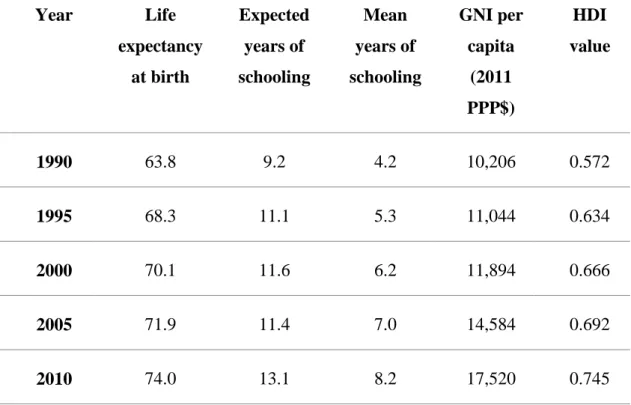
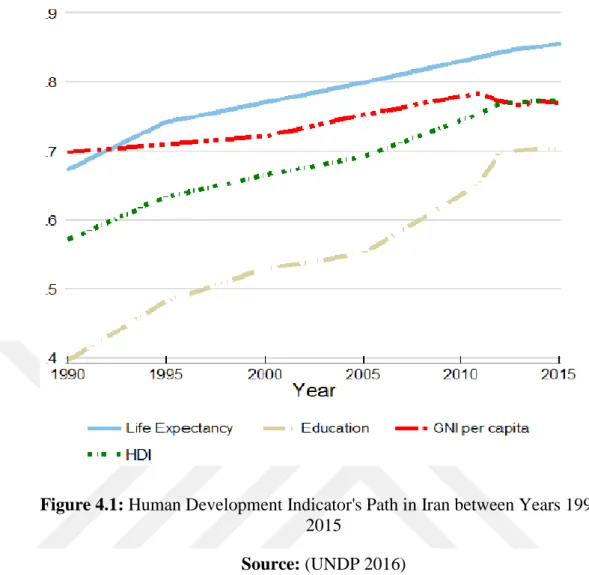
Chapter 3 is mainly about Iran and its HDI value and indicators. Iran as a developing country follows a progressive development path since 1990 and according to the UNDP report in 2015, currently is the 68th country among 187 countries. In educational arena, the considerable positive difference between expected years of schooling and mean years of schooling hopefully, points to an increase in Iran’s educational indicators in future. Such a prosperity, on one hand is the result of correct internal educational policies to support and facilitate lower classes and deprived provinces’ access to education through Social and Cultural Development Plans (Management and Planning Organization of Iran 2004). On the other hand, UN through UNDP, UNESCO and other programs has played a significant role in educational development and progress of countries, internationally. Even though, the gap in literacy rate among different provinces of Iran is increasingly high yet and there are 17 per cent more illiterate people in Sistan-Baluchistan Province of Iran than Tehran in 2016 (Statistical Center of Iran 2016). Unequal distribution of capabilities has irrecoverable consequences such as widening the social, health, well-being, resources and cultural gap between different regions of the country. In case of women’s education and empowerment, Iran, particularly after the Islamic Revelation has surpassed huge steps towards the elimination of gender inequality in education which is more obvious in women’s entrance in tertiary education (World Bank
4
2017c). However women’s unequal benefits and vocational opportunities compared to men represent an immense gender discrimination as well. These kinds of gender disparity in the society mainly originates from the lack of consciousness, cultural and social education among people that deprives women from formal and well-paid employment chances (Moghadam 1998, 2004). Indeed, Iran along with the proper and reformist policies in enhancement of gender parity will have more improvements in the future years.
Finally, in the Forth Chapter, I have tried to compare Iran with Turkey and Azerbaijan in terms of Inequality-adjusted HDI and gender-based inequality in human sectors (health, education and economic resources). These three countries belong to the high human development category and there are delicate differences among them that highlights Iran’s high levels of gender marginalization in employment and political participation. Iran’s rank by estimating through IHDI falls 19 ranks back, while, Turkey and Azerbaijan’s ranks soar relatively to the upper rankings. Such a transformation implies the need to more conduct and research on inequality in Iran. By analyzing gender-based inequality in the health and education sectors, we find out that in Iran the gender gap in life expectancy at birth and mean years of schooling is much narrower than Turkey and Azerbaijan. However, there is a larger gap between male and women’s participation in labor force and politics in Iran. Nonetheless, this gap in case of Turkey and Azerbaijan is much smaller than Iran.
To conclude, according to this thesis relatively high gender discrimination in Turkey initiates from capability distribution, however Turkey’s gender disparity in achievements is lower than Turkish women’s empowerment. Although Iran has almost eliminated the gender discrimination, in capabilities and empowerment of women, there is a gigantic gender inequality in distribution of functionings and achievements. Hence, such a paradox, first, wastes country’s half of educated and empowered labor force. Then, women’s unemployment not only increases their dependent role in societies (Nussbaum 1998, 2000), but also can contribute to increasing corruption, and emergence of informal vocations in the society.
5
2. HUMAN DEVELOPMENT, CAPABILITY APPROACH AND CRITICISMS
2.1 Human Development
Human development represents a paradigm focused on human beings’ freedom in different aspects of life and aims to guarantee their human rights. It looks at the development as enlarging the freedoms and potentials of people that draws attention to the “ends” and adds more intrinsic significance to the concept of development (Sen 1999, Walker 2005). Although at the first glance, it seems to be simple in a way, it is quite complex because the quality and equality of human life contains many components that are neither same nor commensurable by any single metric or words (Sen 1999, 2005, Nussbaum 2011). By having a quick look up the human development definition in the first UNDP report (1990), the most highlighted fact to notice is that the actual wealth of a state is its people and the main purpose of development briefly is to advantage people through an equal manner within the globalized world which calls for Universalism in every clause of it (UNDP 2016). In another word, the most crucial segment of development that makes it analyzable and intelligible is the people. Though, people are both the "means and the ends" of development, they are not exclusively remarked as tools for procreating something, as the notion of "human capital" (Sen 1999, 2013, Katusiime 2014). No one can neglect that human beings are the eventual end of development in any sphere, not a convenient promoter for the greedy materialistic process. The final target of every active evaluation is to observe how many people have engaged in it or taken profit from it. Furthermore, the criterion of development’s prosperity in social policies leads to the improvement of people's lives and welfare, not just the enlargement of production processes (Robeyns 2003). However, in most of the cases it is overlooked because of paying more attention to the short-term concerns likewise achieving to the higher levels of financial wealth through enhancing some factors of the economy (Gasper 2000). Human development is an interdisciplinary concept which provides an empowering environment for every unit of the social community “individuals” to
6
expand their available options. To gain this purpose, in the threshold it should enhance people’s capabilities through improving their health, education and skills, then turn these capabilities into the functionings (Sen 1999, Robeyns 2003, UNDP 2016).
The human development template includes every individual in a variety of scales to enjoy a healthy and long life, qualified education and equal basic social services. (Nussbaum 2011, UNDP 2016). There are some alternative development approaches that have suggested development is all about economic growth which is not a true story because development is a much broader manifestation than just income and economic growth to be evaluated just through GNI and GDP measurement indicators (Alkire & Deneulin 2009, Alkire 2010). Real Gross Domestic Product per capita (GDP) is an approximately complicated indicator among development studies which is evaluated by economists in particular periods of time. It represents countries’ correctness of process of economy and demonstrates all productions of the country including goods and services in terms of United States dollar value. Having a progress in year-to-year GDP value of a country, means a growth in the economy of that country. The growth of GDP per capita or individual income has an instrumental relationship with the expansion of human development (Walker 2005). In one condition the richness of national economy will extend people's choices in other ranges as well, if it was simultaneously along with social equality (UNDP 2016). Hence, people’s usage of national wealth is not less valuable than other elements. That is the rationality behind the most common statement of societies that states the only indigenous precious property of them is their people who recognized the existence of the state (Nussbaum 2011). The striking differentiation between economic prosperity and the human development implies that the income and economic factors illustrate particularly one fragment of the human development concept. However, the latter one encompasses all the dimensions of humanness, whether social, cultural, political or economic. It might be assumed that the overflow of people’s earning can eventuate to the maximization of the other dimensions as well. But, that is a falsifiable hypothesis which is not correct in all the times and for all the cases.
7
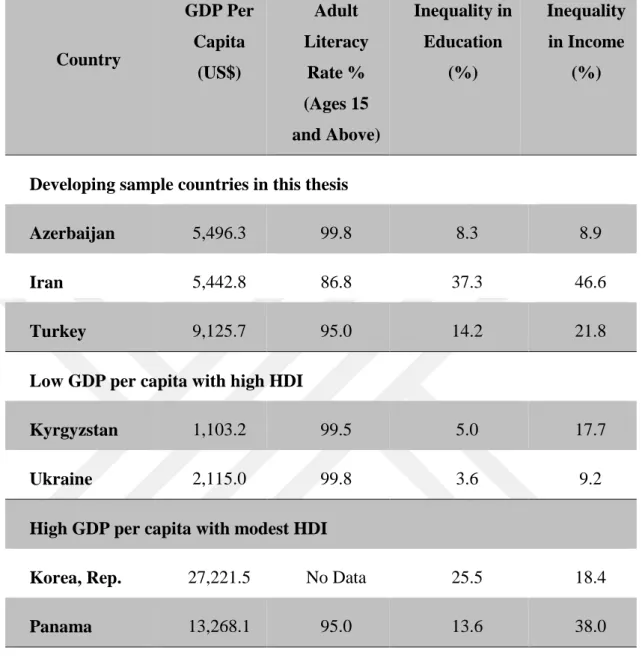
Lots of human choices can expand separately from economic circumstances. Health, knowledge, political liberty, a clean natural environment and simple delight of life are not merely, or exceedingly, subjected to income. In correspondence with the Table 2.1 drawing up by the available data released by United Nations Development Programme (2016) and World Bank (2015), countries with a lower GDP per capita than Azerbaijan, Iran and Turkey have attained better levels of human development indicators, in education and inequality. Thus, economic growth is a sub-category of human development paradigms, albeit a necessary section. On the other hand, the close and extremely improved human development rates of whole countries illustrate that during the past 25 years, human development indicators have progressed remarkably in a universal scale and people nowadays are enjoying longer lives, more social services and more efficient knowledge than before (UNDP 2016). Indeed, human development has succeeded to achieve the Millennium Declaration and The Millennium Development Goals during a quarter of the century after its outset, while it is still uneven and there are lots of human exclusion insistence evidences.
For instance, Panama’s GDP per capita (13,268.1$) in the Table 2.1 is approximately two times more than Azerbaijan’s GDP (5,496.3$), though, the percentage of income inequality in Panama (38.0) has been measured five times more than Azerbaijan (8.9). This proportion even applies to the level of “Inequality in education” in these two countries as well. In fact, the high GDP in this case has not guaranteed the development for every individual of the Panama and a striking part of people have not reaped benefits from high GDP per capita average to develop their capabilities. On the contrary, one of the other interesting cases in 2015 HDI data is Ukraine whose GDP per capita (2,115.0$) according to World Bank datasets in 2015, is remarkably lower than other developing countries in the Table 2.1 such as Iran and Turkey _respectively with 5,442.8$ and 9,125.7$ GDP per capita_ while, Ukraine has a significantly lower level of inequality either in education (3.6%) or income (9.2%) than Iran and Turkey and a higher adult literacy rate (99.8) than Iran (86.8).
8
Table 2.1: GDP per Capita and Selected Human Development Indicators
Country GDP Per Capita (US$) Adult Literacy Rate % (Ages 15 and Above) Inequality in Education (%) Inequality in Income (%)
Developing sample countries in this thesis
Azerbaijan 5,496.3 99.8 8.3 8.9
Iran 5,442.8 86.8 37.3 46.6
Turkey 9,125.7 95.0 14.2 21.8
Low GDP per capita with high HDI
Kyrgyzstan 1,103.2 99.5 5.0 17.7
Ukraine 2,115.0 99.8 3.6 9.2
High GDP per capita with modest HDI
Korea, Rep. 27,221.5 No Data 25.5 18.4
Panama 13,268.1 95.0 13.6 38.0
Source: (UNDP 2015, World Bank 2015)
A successful development policy or in the terminology of Aristotle “a good political arrangement” from social and political perspectives has to contain “human good”, that is an improvement in health, education and freedom, while a decrease in poverty and all the social, cultural and political inequalities that facilitates people’s capabilities to achieve long, healthy and innovative lives (Sen 1999, 2013, UNDP 2016). This is why human development is not considered as a novel idea. Since ancient times, the pillar of people and social policies had been centralized as the first strategy among politics (UNDP 1990). Indeed, this notion goes on evolving with the
9
idea of analyzing a country’s needs from human development perspective by social changes influencing on progress or decline of HDI (UN 1999).
A promising human development according to 2030’s agenda of UNDP, is the one that gives people the ability to achieve their whole potential capabilities by leaving no individual behind. To fulfill the vulnerabilities of the society through a persuasive document, at the first step, there is no necessity to be imposed by the force of hard power or even by economic threats in which actually they are never justified in human development agenda. If the concept is a nation in the developed world, it usually gives the priority to things like health and education; but the crucial point is just as what Martha Nussbaum (2011) argues, “no matter in what level developed or developing a country is, it should put more emphasis on its people, by giving equal life qualities and let them decide what they want to do with it with their own cogent”. She provides a template for nations to protect their accountability among people; nonetheless, attempting to convince people of something equal to the other citizens’ share, would improve their freedom and trust over policy makers.
On the other hand, however countries defend certain rights in their nations or constitutions, such as the freedom of association, the freedom of speech, the freedom of religion; it would not mean that they have enough freedom and pluralism. Indeed, the relationship between universalism and pluralism is complicated; because satisfying everyone with different concerns and demands is a kind of far-reaching plurality, particularly in a developing country with a wide range of ethnic groups. No one can dragoon people into pursuing one of the capabilities due to they are a set of opportunities. Maybe some of them hate that culture or believes and still believe in the integrity of the freedom, thus it would be beneficial for all the people who have any types of religion, language, ethnicity or culture. It is an approach that is all about opportunity and free choice (Robeyns 2016).
Development necessitates eliminating immense resources of the lack of freedom or "unfreedom". This is a well-established fact that the poverty is identical to tyranny and it exactly implies the same as organized public exclusion which fails to provide the social facilities. There is no doubt that these are the certain characteristics of an undeveloped state. What developing states can perform to improve positively satisfaction and achievement of people is affected by political liberties, social
10
facilities, economic opportunities and providing conditions of efficient health, basic and equal education for every individual to cultivate and encourage their initiatives (Ul Haq 1995, Sen 1999). Therefore, the human development and well-being of people according to the Sen should be appraised through the illumination of the measured functionings obtained by a person (Sen 1987, Saito 2003)
Freedoms do not refer to merely the fundamental "ends" of development; simultaneously, they are vital "means" of the development as well (Sen 2013). Besides acknowledging the appraising significance of freedom mainly, we should ponder over its remarkable practical and empirical conjunction that associates different types of freedoms with each other, rather than being hostile to one another. There is a formidable interdependence among political, social and economic freedoms strengthening one another. For instance, achieving to social opportunities in the form of equal and basic education or health facilities would be just a faraway dream, without economic participation, political freedom, and transparency insurance (Sen 1999, 2005, 2013).
2.2 Necessary Components and Aspects of Human Development
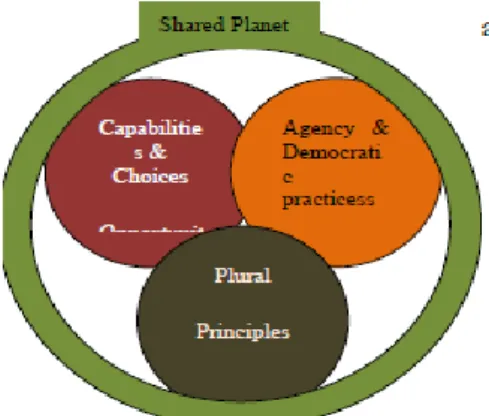
Human development has consisted of three interdependent components: capabilities (opportunity, choices or the real freedoms), process freedoms (agency, democratic practice and empowerment) and justice in functionings or achievements (Alkire & Deneulin 2009, Alkire 2010).
Figure 2.1: Human Development Components Source: (Alkire 2009)
11
First, the establishment of human capabilities, for instance, enhancement of knowledge, healthcare, and skills (UNDP 1990). The notions of capability and freedom are not separable (Walker 2005). Nonetheless, capabilities as opportunity and choice freedoms, in fact, are different from contractual freedoms; since they address people’s real abilities to attain something. Basic capabilities are consist of having chance to health services, literacy, free media, and participation in significant occasions and so on. In fact the range of valuable capabilities can change from one community to another and that is why Sen (1999, p. 242) leaves this framework open and controversial (Walker 2005). Human development elaborates people’s freedoms within the particular limitations of their specific circumstances which consist of time, political will, resources, information and transparency (Nussbaum 2011).
The second one is the preparation of people to make of their obtained capabilities functioning, along with increasing employment environments, productive and active roles, political participations (Deneulin 2009). Third, distributing these capabilities and opportunities equally between individuals of the society, regardless of their gender, ethnicity, social class and language is the last inevitable gear of human development. A society requires promoting human capabilities as well as guaranteeing the liberal and equal attainment to life opportunities (UNDP 2016). The remarkable scale of people’s disappointment will be the outcome, if the measures of human development do not scrupulously balance these two sides.
Human development is essentially ‘plural’ and ‘multi-dimensional’. It focuses on health as much as it pays attention to education and economic income. It equally considers several other aspects of human life such as culture, political participation, employment and fiscal policy as well (Alkire & Deneulin 2009).
One of the main perspectives in human development has been raised by Mahbub Ul haq in his book of Reflections on human development (1995) that describes four important principles of the human development template, which are equity, sustainability, productivity, and empowerment.
Human development has to expand people's opportunities and capabilities while they enjoy equally from them. Development without equity means the restriction of development for some strata of individuals who are living within the same society. It does not matter how equitable the development procedure is, as a result it can
12
deprive all segments of the society; in addition, in human development when we talk about parity it consists of fairness in the distribution of opportunities, not essentially in outcomes. Equity in distribution of capabilities and social and political achievements, in fact, has been considered as the main human right in the human development template.
Besides, lack of sufficient levels of equality in societies contributes to other negative consequences. The prominent example of that is the societies with high amounts of discrimination whose increasing criminality levels causes suffering for people in general and individuals’ security (Stewart & Deneulin 2002). Sustainability and security indicate a kind of responsibility toward the future generations, to guarantee them the right to achieve the identical level of development received by the current generation (Boni &Walker 2013).
In the case of empowerment, it is corresponding with the activity agent role of people. Thus, in the stage of participation and empowerment of human development, people have to be involved as agents who have the potential to follow and recognize the objectives they value and have cause to value (Alkire & Deneulin 2009, pp. 28-30).
On the other hand, productivity plays an important role in the human development framework. It demands to invest in people and provide them a deserved well-being and employment to obtain their highest potential capabilities in practice. The productivity of human capabilities has been mostly put in the center of the massive development literature. Even though, some latest development models are focused basically on the human capital context, which unfortunately, considers people exclusively as an instrument to achieve economic growth and in most of the times. Indeed, it casts doubt on the centrality of people as the eventual end of development. Therefore, the component of productivity has to be treated as only a section of the human development template, with identical significance given to equity, sustainability and empowerment. Human development guarantees a capable environment by entitling every individual to credit, productive and equally distributed advantages (Ul Haq 1995).
13 2.3 Human Development Index
As I mentioned before, Human Development Index concentrates mainly on obtaining of three parameters of human development: health, education, and living standards. So that, H indicates the life expectancy, E represents the educational accomplishments and Y indicates (GNI) Gross National Income per capita. It describes the average income of a country’s national people, which is estimated anniversary in United States’ dollar value. There is no doubt that the economic resources are essential properties for a gentle life (Alkire & Santos 2009). These parameters are normalized through the HDI formula by the values of 0 and 1. Accordingly, the value for HDI can be evaluated by using the average of the three indicators.
HDI = [H + E + Y]/3
The distribution of those parameters can be shown as h, e, and y. So, by considering that HDI is the mean of those variables, it can be written as follows (Alkire & Santos 2009):
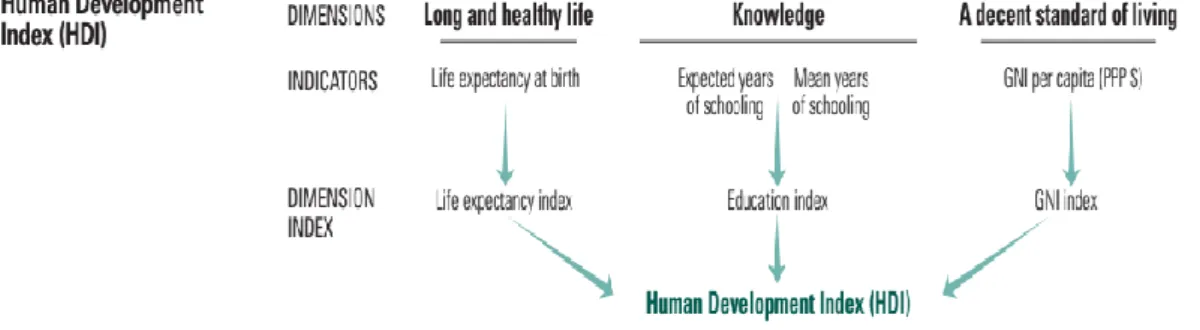
Human Development Index was influenced mainly by Sen’s viewpoint and its aim with a multidimensional and statistic essence is to guarantee human development process and to reflect the real demand and distribution of capabilities in countries and even in an international sphere (UNDP 1992, Alkire and Foster 2010, Klugman, Rodríguez & Choi, H 2011). HDI attempts to shift the attention towards human well-being rather than economic growth. To present an inclusive criterion for development progress, since 1990- the first Human Development Report- United Nations Development Program releases updated HDI values for each county universally by new data and analyses. Human Development Index ranks different countries in comparison with each other and regarding their transformation from the lowest achievement to the highest achievement in economic, social, cultural and political indicators. As the Figure 2.2 illustrates, HDI pushes the governments to target their policies towards various ends such as education and health for all individuals, through a proper environment and standard life qualities (Saito 2003).
14
Figure 2.2: Human Development Index (HDI) Source: UNDP 2016
Hence, traditional human development circulates around three basic concepts since its onset _ people’s health to guarantee them a long life, access to the preferable level of education and decent living criteria (Alkire & Foster 2010). In order to analyze the first component, life expectancy at birth is the main indicator; because according to most of the scholars’ point of view, longevity of life is a result of having enough nutrition and appropriate health. Having access to knowledge including a good quality not only empowers individuals in different aspects of life, but also, is an essential component for attaining a decent vocation and a productive life in today’s modern society. The third element lies in the required resources for decent life qualities which can be partially based on income, access to land, credit and other sources (UNDP 1999). In HDI generally income plays dual roles as means to reach the qualified level of health and education, and as an end itself. Using the years of life expectancy, mean years of schooling and adult literacy as the merely social indicators is not sufficient to conclude that a country is developed or not. In fact, it leads to cast doubt on truthfulness of HDI as a reflection of individuals’ real achievements (UNDP 1992).
How calculating HDI in different countries can address the inequalities? Or how can HDI achieve the inequality rates in distribution of capabilities, functionings and agency through the people? The challenging issue in evaluating the HDI distribution among people is that we need to have the data for each individual. Accordingly, there are multiple parameters for that purpose: H, E, and Y which are the main parameters in Human Development Index. By taking into account different groups, the first thing is to calculate the mean accomplishment for each group such as gender, age, race, religion. The problem here is that income is more fluctuated than health and
15
education, so if the value for income is greater, as a result, the inequality measurement of it will be higher than the other factors such as health and education (Alkire & Santos 2009).
To address the above-mentioned problem, another way is to consider the other factors such as expectancy instead of other health variables. Hence, the average of life expectancy, educational outcomes, and average income will be taken into consideration to calculate HDI. There are various criticisms to HDI because of its error in correct articulation of Sen’s capability approach and particularly, in the case of its ignorance of inequality and distribution process of indicators (Alkire & Foster 2010). That is the logic of this statement of UNDP’s ‘human development proceeds beyond what HDI’s choices captures’. In other words, if two countries have an identical average achievements and even same HDI level, they may enjoy very district ‘distributions of achievements’. Since 2010, HDI has added the indicators of inequality in gender, education and income (Alkire & Foster 2010). Therefore, we can say that the selection of indicators and functionings in the HDI may require to be reexamined in order to make it much more efficient (Saito 2003). By analyzing the HDI as a composite of human life’s different aspects, underestimating one aspect by preference of other is not logical.
2.3.1 Inequality adjusted HDI
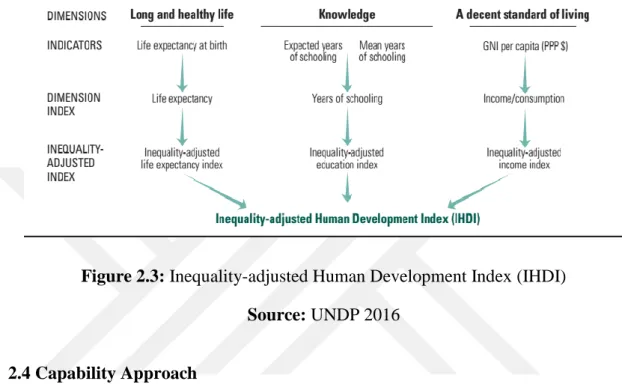
As Figure 2.3 displays, the inequality adjusted HDI method was proposed by Foster, Lopez-Calva, and Székely (2005) to calculate the HDI for the individual level data. Indeed, through IHDI human development is analyzed based on a distribution-sensitive approach. In this method, the β variable has been used to obtain the average of the distribution for every HDI parameter. The values for a β variable are 0 and -1. So, if the value for β is low, then the degree of the inequality will be higher.
By aggregating the parameters (H, E, and Y), the β-based HDI value can be obtained by using the means of means approach (Alkire & Santos 2009):
The above formulation considers the inequalities in terms of the specific costs and inconsistent development. Hence, IHDI shows country’s average functionings in education, health and income through discounting every component’s value
16
regarding its inequality level. However, it is possible that a couple of countries with different distribution path of achievements share the identical HDI value and rank. The fundamental objective behind the formation of IHDI is to illuminate the costs of inequality in society that consequently, directs policies toward inequality decline (UNDP 2016).
Figure 2.3: Inequality-adjusted Human Development Index (IHDI) Source: UNDP 2016
2.4 Capability Approach
The first appearance of this approach has been in Amartya Sen’s lecture in 1979 in Stanford University as ‘Equality of What?’ to find a competent way to evaluate equality in the society (Alkire & Deneulin 2009). According to Sen (1992, p.5) ‘An individual’s capability to attain functionings that he or she has personal causes to value it, provides a broad-spectrum approach to the assessment of social arrangements, and this yields a specific way of observing the evaluation of equality and inequality’. This approach toward human welfare attempts to ‘focus on freedom in order to attain the general capabilities then work in particular’ (Sen 1995, Saito 2003, Walker & Unterhalter 2007).The fundamental experiment of development is up to this question’s answer ‘whether people’s freedoms today are greater than what they had in the past’. Furthermore, an experiment of inequality lies in whether capability sets of people are distributed equally or unequally (Alkire & Deneulin 2009). The capability approach concentrates on three key issues: functioning, capability (Robeyns 2016) and agency (Alkire & Deneulin 2009). This approach
17
begins with a very simple question which is what people are actually able to do and be. In that case, human development is presumed to have two dimensions. First, the establishment of human capabilities, for instance, enhanced knowledge, healthcare, and skills. The second one is the utilization of people to make of their obtained capabilities functioning, in order to recruitment, productive operations, political tasks or relief. A society requires promoting human capabilities as well as guaranteeing the liberal attainment to human opportunities. The remarkable scale of people’s disappointment will be the outcome, if the measures of human development do not scrupulously balance the two hands.
There are three key terms within the capability approach:
• Capability is the actual freedom to engage in different functionings regardless of having access to a certain adequacy level of resources. Indeed, capabilities are a set of vectors toward functionings which reflect the individual’s freedom to propel one kind of living to another and give them the positive liberty to select among possible living opportunities (Sen 1992, p.40, Ul Haq 1995) (Saito 2003, Robeyns 2016).
• Functionings refer to the achievements and as Sen defines (1999, p.75) ‘the different things a person may value doing or being’. In fact, functionings are prized outcomes and declare things that provide people’s welfare– likewise being educated, being safe, being healthy and well-fed, being educated, having a good career and the several other goals (Saito 2003, Walker 2005).
• Agency includes in the process freedoms and has been defined by Alkire and Deneulin (2009, p.22), as “person’s potential to follow and recognize the objectives she or he values and has particular cause to value”. Indeed, an agent is ‘the one who acts and brings to change.’ (Sen, 1999, p19) According to Alkire (2009) human development backup people “as agents” either ‘individually’ within family and society, or ‘collectively’ in democratic practice and public discussion (Deneulin 2009).
18 2.5 Capability Approach towards Human Rights
The notion of the capability approach is a crucial threshold of the practical endorsement of a broad range of human rights’ crises such as ethnical debates along with the idea of human dignity, political and civil rights and freedoms, social and economic rights, a sufficient standard of wellbeing that consist of enough nutrition, shelter, health and education. Repeating what Sen (2000, 2005, 2013) advocates, any kinds of freedoms as ‘process’ and ‘opportunity’ have the enough capacity to be considered as human rights (Robeyns 2003, Vizard, Fukuda‐Parr & Elson 2011). Therefore, the absolute coherence between human rights and capabilities approach is undeniable (Nussbaum 2011). Besides, highlighting the notion of the human dignity and capabilities in contemporary human rights’ approach leads the claim on their close connection (Nussbaum 1997, Sen 2005, Vizard, Fukuda‐Parr & Elson 2011). According to Sen (2005), the notion of capability and human development allies mainly with ‘the freedom—a range of the choices and rights belong to a person, to decide what sort of life to live. Human rights and capability approach are circulating both on the same concepts _ substantive freedom and human dignity for every single person and group (Saito 2003). With a perspective toward public policy, the capability approach underlines the crucial significance of the self-dependent freedoms and opportunities of either individuals or groups, whereas the human rights approach calls more attention toward the values likewise dignity, respect and freedom, non-marginalization and equality, contribution and independence, and the efficient social and political arrangements that are required to preserve and advance them. Indeed, the human rights-based approach chiefly concentrates on the concepts of “accountability and obligation” (Orend 2002, Vizard, Fukuda‐Parr & Elson 2011). This might be the reason behind popularity of the distinction between rights which are legally instituted by international conventions or national legislation, and human rights originated from ‘human-ness’ or ‘humanity’ of individuals in itself. In fact, the peculiar notion of human rights to education drives to a kind of “incomplete” comprehension, and thus, the accomplishment of these entitlements (Saito 2003, Alkire 2009).
19
An application of human rights-based approach, to education, which is one of the greatest challenges in developing countries, particularly in Iran, contributes to recognizing the policy-makers as the responsible to the heaviest burden. Human rights are at the heart of every development agenda therefore no one can separate human rights and development approaches. Human rights conventions which stand in the norms’ level, should guide the policy settings because being in laws and conventions is not adequate to fulfillment its effect in all citizens’ lives. Hence, it is very clear that why every new government which comes to office, sets new policies prior to any action to translate their functioning in people’s routine life and activities that is in coherence with development processes.
2.6 Critiques of Capability Approach
The Human development and capability approach as a very general framework is open to quite a lot range of different interpretations. In this section a number of key critiques raised by different scholars regarding the capability approach will be reviewed.
First of all, what makes capability approach controversial is its lack of functioning’s index that makes the way of its operation problematic (Roemer 1996, Saito 2003). This critique has been raised by Nussbaum (2003) about the absence of “a specific list of capabilities”. Sen (2004) has responded by declaring the fact that as part of democratic procedure, selection of a particular list of capabilities should differ from case to case and presenting a predetermined capability list would be problematic. There is another response to this question by Robeyns (2005) that refuses both the aforementioned opinions. According to her Sen’s capability approach is obscure to some extent and he does not explain how public representation would occur and in fact, it is not guaranteed in Sen’s method. She criticizes the specific capability list of Nussbaum (2000, 2003) due to its generality that can create much crisis through the non-democratic local decision-making procedure (Robeyns 2005).
The second and the most frequent criticism against the capability approach link to the various ideas of individualism, groups and social structures. Hence, mostly the capability approach is condemned to be extremely individualistic which includes different claims (Robeyns 2000, 2003, 2005, 2008, Sen 2002, Stewar & Deneulin
20
2002, Stewart 2004). In that case, they denounce the capability approach because of its ignorance of the importance of groups and communities and individuals’ significant role in their social environment and society. In addition, individualism critique claims that the capability approach ignores the significance of social structures and institutions. The reason why this criticism is recurrent lies in the fact that the capability approach does have a very strong emphasis on the individual; it means that the capability approach has at its core the idea that what is the value of the lives that individuals are able to lead (Burchardt & Hick 2016). This perspective has been developed by Robeyns (2005) through her classification of two types of individualism as ontological individualism and ethnical individualism. Capability approach gives the priority to evaluate groups in themselves as well as communities, cultures, minority group peoples or any other collectivities to which people belong. Though, it is in no sense ontological individualistic; ignoring the role which communities, groups, ethnicities, families and cultures play to shape the capability sets that individuals have is not logical. Having reciprocal opinion with Robeyns and Burchardt’s persistence on the ethnical individualism dimension of capability approach, is one of the common points of contemporary approaches. Therefore, the criticism of individualism on the capability approach to some extent can be considered as true; however, there are lots of collective analyses since 1990 on human development and capability approach by Sen about households as places of cooperative conflict. He advocates the capability approach of human development as “‘people-centered’ approach which puts human agency (rather than organizations alike; governments or markets) at the center of platform” (Dre`ze & Sen 2002, p. 6). It is a well-established fact to approve that the capability approach is individualistic in terms of the holders of value or “individuals”, whereas, it is not individualistic in terms of its analysis of what shape individuals’ lives; due to there is plenty of research that compares one group with another regarding to their average capabilities. Nussbaum (1998, 2000), Robeyns (2003a) and Sen (1995) have addressed the gender inequality concept to the collectives of women and have highlighted the significance of the groups in conjunction with their capabilities and well-being (Robeyns 2005).
21
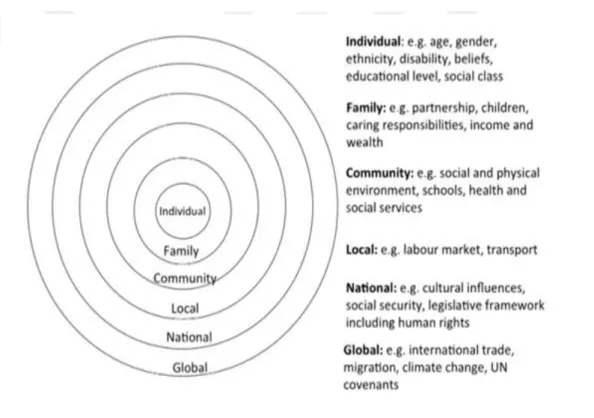
It is better described in Figure 2.4 with locating the individual in the middle. However, around them groups likewise family and society, whether religious or identity communities, that is both enabler and constraint on capabilities in different situations. On the other hand, basically the infrastructure and the local employment available to each person is a key determinant of their capabilities. Beyond that, the national and global perspective is where migration flows, trade agreements and indeed climate change examples are taken into account. Hence, the individual is nested within the all series of various stages of capability enhancers and capability constraints (Burchardt 2015).
Figure 2.4: The Capability Set of an Individual as Enhancer and Constrain Source: (Burchardt 2015)
The other criticism of human development and capability approach, as I mentioned before, is that with respect to its multidimensionality notion, sometimes, it reduces the focus on redistribution of wealth and income from the rich to the poor (Alkire 2009). Thus, one side of criticism is that it is an interruption which allows ‘wriggle room’ for policy-makers to decrease the emphasis on the hard objectives of income
22
distribution. Maybe, there is an actual risk specifically in times of severity with very significant variations in the income distribution which is important to retain a clear focus on income. Besides, the capability approach is quite beneficial in reminding us that ‘income is a tool to an end rather than an end in itself’ (Burchardt 2015).
The final two criticisms of the capability approach, argued by Burchardt (2015) are in a sense, polar contraries. The capability approach is in some cases, accused of being extremely idealistic. On the other hand, it is sometimes accused of being an apology for capitalism. In that sense, it seems to be correct that it does not automatically imply a criticism of capitalism itself. Moreover, in the other interpretations, if we take seriously an idea of equality of capability with regard to the kind of structural constraints which operate on people's capabilities, it can have really quite radical implications.
2.7 Gender Inequality Concept
Gender is a cultural and social notion which is distinct from sex or biological classification (Rubin 1975, Moghadam 1991). Gender discrimination as a global notion exists in all societies in a various forms and degrees. Men and women’s distinct responsibilities, physical and spiritual differences get ready the proper context for a kind of gender-based work distribution. Such a distribution sometimes eventuates to unequal divisions and wages. Ensuring the men and women’s equal shares in both capabilities and functionings is the main aspect of the Human development (UNDP 1995). In fact, one of the essential steps to monitor the development and progress path of countries is calculating the gender gap and women’s empowerment in them (Ferretti & Mariani 2017).
Although the gender equality phenomenon has been proposed since 1995 through the Beijing Declaration (United Nations 1996), various forms of gender marginalization are still inevitable fate in many developing countries. Besides, the significant role of the women’s attendance in country’s social, economic and cultural development is an undeniable fact (OECD 2012). It consists of many aspects such as inequality in income, inequality in access to opportunities, educational inequalities, inequality in access to the formal and well-paid vocations such as management, political positions and finally, having a decision-maker status. Attempting to close the gender gap is a
23
potential concept to remove gradually the discrimination of minorities and other deprived individuals from fundamental human development indicators. (Afshari & Kakavand 2016).
After two decades of collective efforts through multi-national organizations such as UN, World Bank, and so on, the concept of gender inequality has become to some extent measurable and usable in policy-making process (Staveren 2013). The best examples of these efforts are Gender Development Index (GDI), Gender Inequality Index (GII) and Gender Empowerment Measure (GEM) which since 2009 are developed by United Nations Human Development Reports by providing annually published indexes.
2.8 Gender Inequality Measurement
At country level there are various perspectives used, so far, to calculate the gender inequality. The important dimension of them is the involvement of social institutions in gender disparity of societies. The patrimonial system in families, labor markets and the property laws are the clear examples of that involvement. Nowadays, huge amount of the available gender indexes, on one hand, facilitates the comparison of countries during a certain time period, on the other hand, the huge number of indices calls the demand for more curiosity in policy analysts and researchers to make true choices among them (Staveren, 2013).
2.8.1 Gender Development Index (GDI)
Statistical gender studies and social indicators in developing countries and particularly in Middle East region, disclose important facts about women’s political, social and economic share within the societies (Moghadam 2004).
24
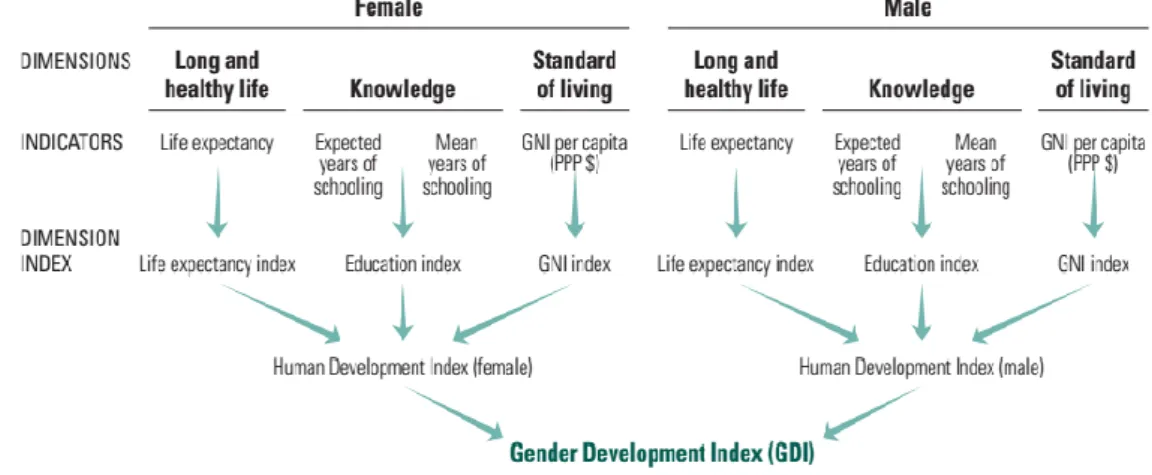
Figure 2.5: Gender Development Index (GDI) Source: UNDP 2016
As we can see in Figure 2.5, to evaluate women’s portion in non-agriculture labor market, income, and their development in literacy, health and urbanization rate, GDI is a new-organized measurement indicator, introduced by Human Development Report Office in 2014. Through the GDI, each country’s HDI value is disaggregated based on sex. Having a special ratio to represent women in comparison to the men has various advantages in the international scale. The GDI mainly focuses on gender inequalities in functionings through the same three spheres of HDI: health, education and economic recourses (UNDP 2016).
2.8.2 Gender Equality Index via Gender Inequality Index
The strong correlation between gender disparity and development is one of the hot topics in both gender studies and development. According to the Jayachandran (2015) gender discrimination favoring men, in human development indicators are consistently more prevalent in underdevelopment countries than developed ones. She argues the lesser earning of women than men is not limited to the undeveloped societies and can be observed essentially in all over the world. However, the gender inequality in education, health and bargaining power in marriage seems to be in a greater extent in undeveloped countries.
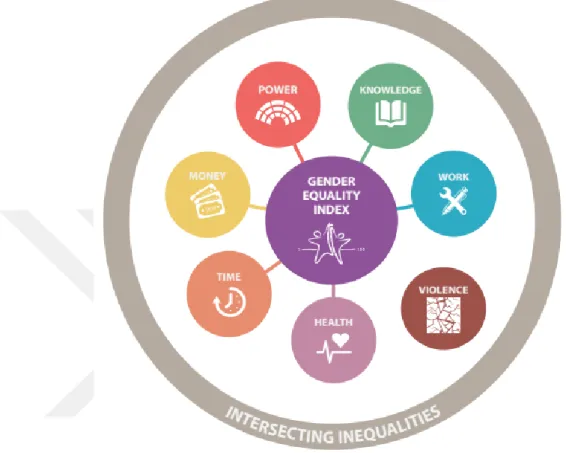
Gender Equality Index (GEI) including rights, capabilities and resources as input measures and welfare indicators and functionings as the result measures. In addition, it contains attitudinal measurements looking up social norms as gender based
25
institutions. GEI consists of international and regional sources in both qualitative and quantitative measurements. The main stream in GEI circulates on women’s social rights and their economic rights in European countries (Staveren 2013).
Figure 2.6: Gender Equality Index (GEI) Source: European Institute for Gender Equality 2017
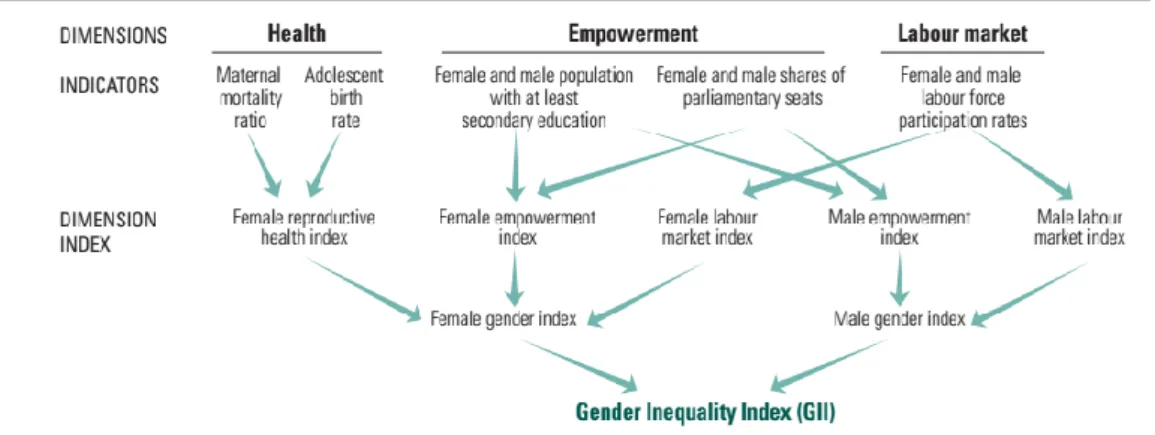
What makes GII different from GEI refers to first of all, their different domain from each other. GEI evaluates the gender equality notion exclusively across the European Union, however GII introduce by UNDP has a universal domain. In addition, GII unlike GEI focuses on outcome and functionings’ measurement. For instance, with regard to Figure 2.6 compared to Figure 2.7, it concentrates on reproductive health through maternal mortality and adolescent fertility as well as in the case of empowerment. Thus, the main focus of GII is on indicators as educational attainment (secondary and above), parliamentary representation and labor force participation. In fact, the real objective of the GII is to show the losses in national human
26
development functionings that have been eroded because of gender disparity (Staveren 2013).
Figure 2.7: Gender Inequality Index (GII) Source: UNDP 2016
2.8.3 Global Gender Gap Index
Global Gender Gap Index is another index to measure the women’s disparity in a universal scale. It evaluates the gaps in human development indicators distributed between men and women. It includes capabilities, resources and functionings. Its value almost is interpreted as percentage which manifests how much of gender inequality gap has been closed in a certain country. Economy, health, education and politics are the fundamental dimensions of Global Gender Gap Index which have 14 indicators listed in Table 2.2. (Staveren 2013).
27 Table 2.2: Global Gender Gap Index
Source: (Staveren 2013)
The interrelation between gender disparity and human development can be described in the best way by considering gender equality as both prerequisite and result of society’s progress and wellbeing. Indeed, removing the hindrances that narrow women’s opportunities, capabilities and functionings, has been proved to turn out a positive feedback loop among their circumstances, human development and growth (Kabeer & Natali 2013). Particularly, promoting gender equality leads to a growth in
Economic participation and opportunity Educational attainment Health and survival Political empowerment Female/male ratio of labor force participation Female/male ratio of wages for similar work Female/male ratio of earned income Female/male ratio of legislators, senior officials, and managers Female/male ratio of professional and technical workers Female/male ratio of literacy rate Female/male ratio of net primary school enrolment Female/male ratio of net secondary school enrolment Female/male ratio of gross tertiary school enrolment Sex ratio at birth Female/male ratio in healthy life expectancy Female/male ratio of seats in parliament Female/male ratio of ministerial level positions Female/male ratio of years with a female head of state (last 50 years)