STRATEJİK ARAŞTIRMA VE ETÜT MERKEZİ
The demise of the Soviet Union has unleashed historical sources of tension and grievances in the Black Sea area and the region has become difficult to manage. Sovyetler Birliği’nin çöküşü, Karadeniz bölgesindeki tarihsel gerilim kaynaklarını ve sorunları gün ışığına çıkarmış ve bölge idare edilmesi zor bir hâl almıştır.
CONTENDING AGENDAS FOR THE BLACK SEA
REGION:
A TURKISH ALTERNATIVE
Key Words: Black Sea Region, Great Power Rivalry, Security, Turkey Turkish Foreign Policy
KARADENİZ BÖLGESİ İÇİN ÇEKİŞEN
GÜNDEMLER:
TÜRKİYE’NİN ALTERNATİF ÖNERİSİ
Anahtar Kelimeler: Karadeniz Bölgesi, Büyük Güçler Rekabeti, Güvenlik, Türkiye, Türk Dış Politikası
Mustafa AYDIN* *Prof.Dr.
Kadir Has Üniversitesi Elmek: [email protected]
Öz
Soğuk Savaşın sona ermesi yüzlerce yıl çok sayıda çatışmaya tanıklık etmiş olan Karadeniz havzasında çok taraflı iş birliğine dayalı yeni bir siyasi çerçevenin gelişmesini mümkün kıldı. Avrasya’nın ortasındaki stratejik konumu nedeniyle geniş alanları kontrol edebilen Karadeniz coğrafyası Soğuk Savaş sonrasının değişen jeopolitiğinde önemli bir yer işgal etmeye devam etmektedir. Bölgenin kendine özgü jeopolitiği ve stratejik değeri bölge ülkeleri açısından uluslararası ilişkilerinde çeşitli avantajlar sağlamaktaysa da sıklıkla bölgesel ve uluslararası güvenlik ve istikrar için önemli riskleri de içinde barındırmaktadır. Bu çalışma büyük güçlerin (ABD, RF ve AB) son yıllarda bölgeye yönelik artan ilgileri ve özellikle güvenlik arayışlarının bölgeselleşmesinin her zaman olumlu sonuçlar doğurmayabileceği ve çatışmalara yol açabileceğini ileri sürerek; bir alternatif sunması açısından, Karadeniz vizyonunu bu güçlerden farklı olarak, küresel endişelerden ziyade bölgesel arayışlara dayandıran Türkiye’nin politikalarını değerlendirecektir.
Abstract
The wider Black Sea area has been a site of confrontation for centuries, though changes since the end of the Cold War allowed emergence of a cooperative environment. Due to its strategic location in the middle of Eurasia, controlling the region represents a unique geopolitical interest. This uniqueness at times turns into threats for regional and international peace and stability. This paper argues that the increased big power (i.e., US, EU and RF) attention might not always bring prosperity, but conflict; and offers an alternative vision by Turkey, based on more of a regional outlook than global calculations.
Contending Agendas For The Black Sea Region
- Turkish Alternative -
The demise of the Soviet Union has unleashed historical sources of tension and grievances in the Black Sea area and the region has become difficult to manage. The conflicts in Transnistria, Nagorno-Karabakh, Chechnya, Abkhazia and South Ossetia continue to cast shadows over prospects of regional cooperation. Yet, the changes since the end of the Cold War also allowed for the first time in history an emergence of a cooperative environment around the Black Sea. It enabled the Euro-Atlantic community to interact with the regional countries, triggering a gradual shift in the region towards Trans-Atlantic political/economic space (Aydın 2006: 57).
The demise of the Soviet Union has unleashed historical sources of tension and grievances in the Black Sea area and the region has become difficult to manage.
The discussion whether the Black Sea constitutes a region in the post-cold war, still continues. However, the willingness of the regional actors to be considered a unique component was quite clear at the beginning of 1990s when they came together to establish a regional organization and thus defined the emergence of a region (Aydın 2005a: 31-34). On the other hand, whether it is considered as a region academically or not, there is no doubt that it has become a unit of analysis in the last ten years as the growing body of literature attest. This paper accepts a definition of the “Black Sea Region/Area” that refers to a region stretching from southeastern Europe into western shores of Caspian Sea. As such, it is strategically located between the two ends of Eurasia.
The number of political, economic and military actors who can influence the region’s future has multiplied since the end of the Cold War. In terms of regional geopolitics, control of the region, or freedom of movement upon it, represents a prize of considerable value. This at times easily transfers itself into threats to regional and wider international peace and stability, and not always confirm with the best interests of the regional countries. This
paper will argue that the focus of bigger powers’ (the US, the EU and the RF) attention in the region might not always bring prosperity but occasional clashes; and regional alternatives might offer a better prospect for region’s future. Accordingly, it will first look at how the bigger powers’ security interests came to focus on Black Sea; and then at one of the regional alternatives (that of Turkey’s) to conflicting great power visions for the region’s future political, economic and security structures.
Great Power Competition in the Wider Black Sea
1
In the early post-cold war years, when the Euro-Atlantic community was occupied with conflicts in former Yugoslavia and trying to integrate the CEE countries, the Black Sea did not attract such outside interest. It was a low priority on the Euro-Atlantic agenda. Russia on the other hand, realizing the difficulties of maintaining global influence and an arms race with the US in the post-cold war era, chose to limit its sphere of influence to its “near abroad”, specifically South Caucasus, Ukraine and Moldova. After the successful integration of CEE countries to transatlantic structures and pacification of the southeastern Europe, the western attention shifted to further east. From the geopolitical perspective, the Black Sea gained a strategic significance when the Euro-Atlantic threat perceptions shifted after the 9/11 (in New York and Washington D.C.) and 3/11 (in Madrid) attacks. The region began to be perceived as the backdoor to the Broader Middle East and North Africa (BMENA) region (Asmus 2004). The heightened western attention to the region was further strengthened after Romania and Bulgaria became members of the NATO in April 2004. Various former Soviet states along the north and east of the Black Sea (Moldova, Ukraine, Georgia, Armenia and Azerbaijan) became strategically important to the US for securing the east-west energy corridor linking Europe with the Caspian resources, as well as controlling northern approaches to BMENA and From the
geopolitical perspective, the Black Sea gained a strategic significance when the Euro-Atlantic threat
perceptions shifted after the 9/11 (in New York and Washington D.C.) and 3/11 (in Madrid) attacks.
surrounding Iran. The US seemed decisive on extending its influence on the shores of the Black Sea, arguing that it has become a stakeholder with vital interests (Asmus & Jakson 2004).
American involvement generated other interests towards the region: Both Russia, which codified the US as an unwelcome guest, and the EU, which hitherto resisted pressures to develop a regional outlook, became more interested in regional projects. The RF felt increasingly surrounded and contained. As the US simultaneously exerted greater military and political pressure over the region via NATO enlargement, bilateral defense agreements and encouragements of pro-western opposition elites, Russian President Vladimir Putin revealed his discomfort about the “US intrusion” on 10 February
2007 at the Munich Conference on Security Policy.2
The EU, too, started to show more interest in the region from 2004 onwards, following American lead. Although both Turkey and Greece favored the “EU-ization” of the Black Sea by implanting the region within European security architecture from the 1990s onwards and the BSEC members had tried for years to convince it for years to pay more attention to the region, the EU fell short of defining an institutional relation with the region until the initiation of Black Sea Synergy in 2007, in part prompted by more active US presence. Up until then, while the EU preferred bilateral ties with the Black Sea countries instead of multilateral approach, regional countries except Russia supported direct BSEC-EU interaction (Japaridze, 2006). The EU appears to have two major interests in the region: To secure energy supply lines from the east and to prevent various security risks developing to a level that directly threatens Europe’s own security. From this perspective, stability and democratization of the former Soviet republics in the region will also strengthen the security of Europe (Aydın 2004: 12-19).
The EU appears to have two major interests in the region: To secure energy supply lines from the east and to prevent various security risks developing to a level that directly threatens Europe’s own security.
2 For Putin’s remarks, see www.securityconference.de/konferenzen/rede. php?sprache=en&id=179.
Regionalization of Great Power Securities and the Black
Sea
3The end of the cold war and the 9/11 attacks had profound effects on international relations. Among others, they forced global players to be more interested in regional developments. Despite the contrary arguments emphasizing the role of globalization in world affairs, the focus on regionalization, especially in the security field, has expanded in practice. Although regionalism is seen almost universally as a positive development in the post-cold war era (Aydın 2005b: 256-257; Lake & Morgan, 1997), since the focus on regional security issues touches big power interests, it might lead to big power tensions if not managed properly. Although one could identify the number of countries/regions that has attracted more than one power, thus rendered them prone to great power confrontation due to overlapping peripheries (Aydın & Kaptanoğlu 2007), this paper concentrates on the Black Sea, which is a subject of three regional outlooks/projects produced by the bigger players of the world politics: the “Near Abroad Policy” (NAP) of the RF, the “European Neighborhood Policy” (ENP) of the EU, and the “Broader Middle East-North Africa Initiative” (BMENA) of the US.
Near Abroad Policy of the RF
refers to the states in the non-Russian post-Soviet space, which until 1991 was part of the USSR.
Near Abroad Policy of the RF refers to the states in
the non-Russian post-Soviet space, which until 1991 was part of the USSR. It implies that these countries are not as foreign as others and therefore may be subject to different rules or treatment. Russian leaders from across the political and military spectrums have regularly asserted that Russia has “special rights” and responsibilities for maintaining
security within this region,4 which includes, among
3 Analysis in this section was previously developed in Aydın & Kaptanoğlu 2007: 763-774.
4 Former Russian President Yeltsin reiterated in September 1993 that the external borders of the near abroad countries “are essentially the borders of Russia” (O’Brien 1994: 14-18). Moreover one former Yeltsin
others, the Caucasus, Ukraine and Belarus. There have been many reasons behind the desire to have further Russian involvement in the ‘Near Abroad’, all of which has been explored in the literature in detail (Aron & Jensen 1994; Croft 1996; Kubicek 2000; Akerman 2003; Bahgat 2003; Commercio 2004; Perovic 2005; Ziegler 2006).
The birth of the Broader (or greater or wider) Middle East can be traced back to the US’ enhanced threat perception as a result of 9/11 and the understanding that many of the threats were emanating from the wider Middle East area
in general.5 This understanding led to the BMENA
initiative, which however defined, envelopes BS from the south; just as Near Abroad occupies north and east of Black Sea area. In time, BMENA also gave rise to Wider Black Sea Region (WBSR) concept. Though not much different from other regional definitions related to Black Sea, WBSR represented the transatlantic (more correctly the American) security perceptions and plans for the region. As such, it implied possible future presence of American forces in the region as well as presupposing existence of democratically elected pro-western governments in most of the regional countries.
The borders of the
European Neighborhood Policy are defined
in European Commission documents. It was originally intended to include the immediate neighbors of the EU.
The borders of the European Neighborhood Policy are defined in European Commission documents. It was originally intended to include the immediate neighbors of the EU: Algeria, Belarus, Egypt, Israel, Jordan, Lebanon, Libya, Moldova, Morocco, the Palestinian Authority, Syria, Tunisia and Ukraine;
advisor flatly declared that the Near Abroad was Russia’s sphere of influence and that the former republics had best not try to form alliances among themselves or with foreign powers. They would have to submit to Russia’s domination (Kubicek 2000: 547).
5 There were three considerations by the US: First, fundamentalism, terrorism and the spread of weapons of mass destruction were seen as the major regional threats. Second, the lack of democracy and human rights, low levels of socio-economic development and literacy were major causes for the existence of terrorist networks. Third, there was an expectation if these conditions should change in a positive direction, the new dynamics would lead to a better life quality for the Middle Eastern societies, thus alleviating American security concerns (Erhan 2005: 156-157).
and was later extended by the European
Neighborhood Policy Strategy Paper (May 2004) to
include the Southern Caucasian countries of Armenia, Azerbaijan and Georgia. As such it envelopes the Black Sea region from the west, south, north and east; in a sense it defines the region. The EU aims at improving its long-term security by shaping its near abroad through different tools and modalities, resembling the EU model itself (Lebl 2005).6
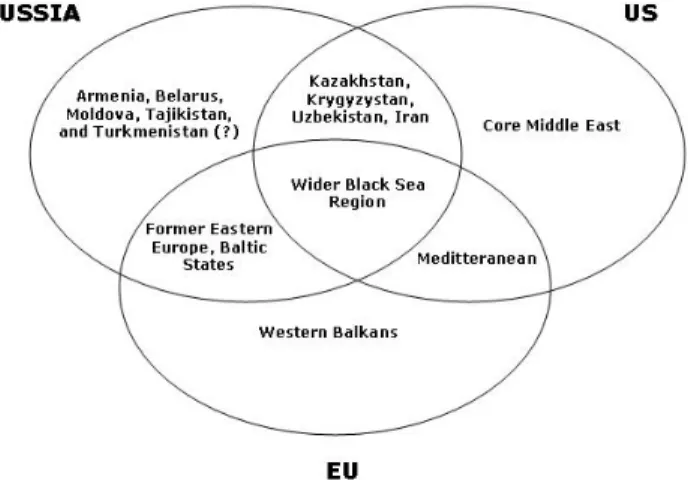
Some Black Sea countries lie at the intersection of all the three regional security concepts (NAP, BMENA+WBSR, and ENP) reviewed briefly here. For example, the South Caucasian countries, since 2004, are part of the ENP, NAP, WBSR, and even BMENA at the same time. It is obvious that these concepts are not mutually inclusive and political dynamics make it difficult for the regional countries to cooperate or reject the policies of the big powers.
Figure 1: The Intersection of Russian, European and American Regional Interests
Source: Aydin & Kaptanoglu 2007: 772.
6 The ENP was developed in relation to the EU’s 2004 enlargement, with the objective of avoiding the emergence of new dividing lines between the enlarged EU and its neighbors and instead aimed at strengthening stability, security and well-being for all concerned.
The most problematic region situated at the intersection of the NAP, BMENA (+WBSR) and ENP is the greater Black Sea area, consisting of the Caucasus, the Black Sea, and Eastern Europe, as well as areas bordering it in the west, south and the north. Due to its position at the intersection of the interests of the great powers, it has become the scene of a great power rivalry between the RF, the EU, and the US as well as regional countries. In order to avoid the trappings of big power confrontation, the assessment of the Black Sea security challenges and opportunities needs to encompass an extended regional approach as the region in recent years has come to dominate the epicenter of the projects to provide stability/security to wider Eurasia, the Europe, and the broader Middle East area. As a result of the growing regional tension (Russia-Georgia conflict in August 2008 attests to this), there is an urgent need to develop regional cooperation schemes with the participation of regional countries to avoid a possible great power confrontation. At this point, it might be meaningful to look at closely to one of the regional countries’ (Turkey’s) region-based cooperation initiatives and policies in the Black Sea area in search of alternatives to great power confrontation. In order to avoid the trappings of big power confrontation, the assessment of the Black Sea security challenges and opportunities needs to encompass an extended regional approach as the region in recent years has come to dominate the epicenter of the projects to provide stability/security to wider Eurasia, the Europe, and the broader Middle East area.
Regional Alternative to Big Power Politics: The Turkish
Case
The interplay between the regional and global powers’ political and security agendas will determine the future of politico-military issues in any given region. In the Black Sea, in addition to global players, some of the regional countries, with their narrower focuses, also have developed alternative visions. Among them is Turkey, which had put forward back in early 1990s the original regional cooperation idea: The creation of BSEC.
Throughout the cold war, as an outpost on the European periphery, Turkey’s geo-strategic value
was largely determined by its role within the Atlantic Alliance and, more narrowly, its place within NATO’s southern flank. By the end of the cold war, this was altered by the appearance of new zones of conflict on three sides of Turkey. Iran-Iraq and the Gulf wars in the Middle East, Bosnia-Herzegovina and Kosovo crises in the Balkans, and the conflicts over Nagorno-Karabakh, Chechnya and Abkhazia in the Caucasus, all took place within the immediate vicinity of the country. As the relevance of NATO in the new world order was opened up to discussion, especially by the western Europeans, Turkey suddenly found itself in a situation where it was threatened both by the lingering uncertainties regarding its immediate neighborhood and by the fact that its western security connection was fundamentally damaged by the end of the cold war. At the same time EEC’s rejection in 1989 of Turkey’s membership application of 1987 created further concerns.
At the end of the cold war, the Russian navy, tough still the most powerful in the Black Sea, lost its overwhelming supremacy, and RF ceased to be a direct threat to Turkey.
Under these conditions, Turkey, a regional player and conscious about it precarious situation, started to look for alternative connections and involvement in hitherto avoided regional politics. Historically, the Black Sea was a Turkish lake for centuries during the Ottoman Empire, but was later turned in effect to a
Russian/Soviet lake from 19th century onwards. At
the end of the cold war, the Russian navy, tough still the most powerful in the Black Sea, lost its overwhelming supremacy, and RF ceased to be a direct threat to Turkey. On the other hand, Turkey’s natural gas procurement from RF, which had started back in 1984 with the Soviet Union, was growing. Finally, emergence of newly independent states around the Black Sea as well as in the Caucasus and Central Asia presented opportunities to Turkey. In response to these challenges, the President of the time envisaged creating an economic cooperation zone in the Black Sea region. His primary intention was to cut a leadership role for Turkey by making it a model for newly independent states for their economic and political transformations. Another
political agenda of him might have been to craft an alternative to the EU should Turkey’s designs for eventual membership would not work out as planned. His efforts were rewarded by the signing the Istanbul Declaration of 1992, which called for setting up a regional economic organization. Thus, Turkey paved the way for multilateral cooperation in the Black Sea in economics sector, and followed it up with regional cooperation schemes on security matters through establishment of first the Black Sea
Naval Co-Operation Task Group (BLACKSEAFOR)
and later the Black Sea Harmony initiative, as well as several lesser noticed local projects, all of which has contributed to the peaceful transition of the region.
BSEC was one of the earliest initiatives intended at establishing cooperation between NATO members (Greece and Turkey) and former members of the Warsaw Pact.
With its heterogeneous composition of member states, the BSEC has been an interesting regional organization. It was one of the earliest initiatives intended at establishing cooperation between NATO members (Greece and Turkey) and former members of the Warsaw Pact. There were ongoing border disputes (e.g. between Armenia and Azerbaijan) and historic grievances (as between Turkey and Greece, Greece and Albania, Moldova and Russia, Turkey and Armenia, Armenia and Azerbaijan) between the members during the establishment of the organization. Nevertheless, it was an attempt towards cooperation in a region divided by power struggles for centuries and separated by one of the main fault-lines during the cold war. It was also a locally-owned and developed idea, indicating the member countries’ willingness towards cooperative regional initiatives and attempt to create a regional identity and possibilities of cooperation where it did not exist before (Aydın & Fazlıoğlu 2007).
However, after an enthusiastic start, it became clear that the member countries lacked the necessary political will to create a genuine working regional political cooperation institution. Thus, the initial vision was never fully realized, tough it served as a multinational venue for the former Soviet bloc
countries to adapt to global trading rules by transferring know-how from market economies of Greece and Turkey. In the bigger picture, the BSEC assumed the task of facilitating the structural transformation of members by contributing to the creation of a market economy led by the private sector. Thus, the former Soviet bloc countries become more private sector oriented economies and attracted considerable amount of foreign direct investment (FDI) as a result. Although still at an unsatisfactory level, the total FDI inflow towards the BSEC countries increased from $8.072 billion to $31.474 billion from 2000 to 2004 and to $80 billion in 2007 (World Bank 2007).
Another main concern of Turkey in the Black Sea region since the end of the cold war has been to increase economic cooperation and increase intra-regional trade with a view to achieve steady GDP growth for BSEC members. Despite the initial lack of a private sector capital accumulation and commercial banking in the former communist member states as well the economic ambiguity as result of dismantling of the Soviet bloc and collapsed trade flows, the BSEC was able to contribute to trade creation in the region since 1992. The region since then has been able to export threefold and its imports were more then doubled. Yet, the picture is still suffering from a lack of diversification in export goods, incomplete trade policy reforms and a poor investment climate, which hinders the region from integrating fully into the global value chain.
Another main concern of Turkey in the Black Sea region since the end of the cold war has been to increase economic cooperation and increase intra-regional trade with a view to achieve steady GDP growth for BSEC members.
Although BSEC was established as an organization aimed at increasing regional cooperation mainly in the economic field, armed conflicts and increasing political tension from the early 1990s onwards marked the region instead of expanding economic cooperation. The Transnistria problem, the Nagorno-Karabakh conflict, the Chechen issue, and the Abkhaz and South Ossetian problems emerged one after another, overshadowing regional economic cooperation in the region. Since the BSEC was, and
still is, not entrusted with a political role, let alone a peacemaking and/or peacekeeping mission, it lacks the necessary institutions for proactive diplomacy and cannot enter the picture as a capable regional actor under such an overly securitized regional setting.
It nevertheless generated a discussion of identity both within and outside the region, leading to the emergence of a sort of rudimentary regional identity through political pronouncements and expediency. The current task for the BSEC, according to Turkey, should be facilitating its members’ further integration into the global economy and advancing political cooperation capacities within the region. Thus when Turkey took the rotating Chairmanship of BSEC in May-October
2007, coinciding on the 15th anniversary of the
organization, it had another chance to revamp its original idea. However, Turkish agenda appeared mostly an economic one though some of the member countries had been complaining from a lack of political perspective. While the argument that any attempt at creating a political agenda would cloud the economic cooperation achieved so far, seems plausible, even Turkish policy makers readily admit that political considerations often times prevent the furthering of economic initiatives. Turkish agenda appeared mostly an economic one though some of the member countries had been complaining from a lack of political perspective.
Nevertheless, Turkey did not engage a widespread overhaul of the Organization during its chairmanship. One reason for this was clear opposition for the idea from within the Turkish MFA; but on the other hand, it was also doubtful whether Turkey could have achieved such a widespread change even if attempted wholeheartedly since many other members also were not interested in changing the organization to cover more than economic issues. In the mean time, changing
security environment after 9/11 attacks, Turkey’s
uneasy relations with US over Iraq and growing tensions between Russia and the EU-NATO led Turkey to follow a more cautious approach regarding Black Sea developments and highlighted
the importance of maritime security for Turkish Black Sea politics.
Maritime security in the Black Sea as Turkey’s sine qua
non
7Turkey’s reservations about US long-term objectives in the Black Sea region became apparent when the controversy erupted in the first months of 2006 over suggestions to expand activities of NATO’s
Operation Active Endeavor to the Black Sea. Turkey
and Russia jointly opposed the idea, though they differed in motives and reasoning. Russia’s opposition to Active Endeavor’s entry into the Black Sea was clear cut: Moscow was loath to see any expansion of US influence in its neighborhood. Turkey’s opposition, on the other hand, has been driven by its concern to preserve the current legal regime of the Turkish Straits established under the Montreux Convention of 1936 and thus, the political and military balances that have emerged in the region since the end of the cold war. This sui generis treaty recognizes the sovereignty of Turkey over the two straits, allows free passage of commercial ships, and limits the non-littoral states’ military ships’ entrance and stay in the Black Sea.
Turkey’s reservations about US long-term objectives in the Black Sea region became apparent when the controversy erupted in the first months of 2006 over suggestions to expand activities of NATO’s Operation Active Endeavor
to the Black Sea.
During the cold war, the US and NATO favored the agreement because it limited the ability of Soviet Navy to shift forces to the Mediterranean in a short time. However, with the changing security dynamics, Bulgaria and Romania brought about the possibility of relaxing the terms of Montreux, in favor of large US Navy presence in the Black Sea. These suggestions are strongly opposed by Turkey, fearing that this could threaten and corner Russian in the Black Sea unnecessarily, forcing it to retaliate/respond and thus end the maritime force equilibrium and stability achieved in the region for the first time in centuries. Turkey also argued against the expansion of Active Endeavor to the Black Sea by stating that there were already three NATO members and two PfP countries among the six
littorals of the Black Sea, thus they could have effectively maintained maritime security activities in cooperation with other visiting NATO ships. Therefore, there was no need to violate and thus make obsolete the long-serving Montreux Convention for no apparent gain.
The tension somewhat mollified during the second half of 2006 when the US signaled a change in its Black Sea politics, reducing potential disagreements with Turkey. In particular, the US no longer raised the issue of possible revision of the 1936 Montreux Convention. Nevertheless, the echoes of the cold war rhetoric yet again had around the Black Sea during after the August 2008 crisis between Russia and Georgia. Renewed suggestions by some countries to increase NATO presence in the Black Sea and Russian protests to Turkey for allowing US ships in to the Sea created tensions and showed that Turkey is again to some extent caught between the Euro-Atlantic community and Russia in the highly sensitive agenda of the Black Sea security.
Due to increased asymmetric risks after 9/11, BLACKSEAFOR member states has extended the area of cooperation in 2004 to cover the prevention of terrorist activities, smuggling and the spread of WMDs, and established a High Level Experts Group to monitor these issues and asses the security situation in the region.
With similar concerns in mind and in order to strengthen maritime domain security on the Black Sea, Turkey had earlier initiated the Black Sea Naval
Co-Operation Task Group (BLACKSEAFOR) in 1998. It
was formally established in April 2001 by the signature of all the littoral states to perform search and rescues operations, humanitarian assistance, environmental protection and mine counter-measures. Due to increased asymmetric risks after 9/11, BLACKSEAFOR member states has extended the area of cooperation in 2004 to cover the prevention of terrorist activities, smuggling and the spread of WMDs, and established a High Level Experts Group to monitor these issues and asses the security situation in the region. According to the
Maritime Risks Assessment in the Black Sea report
prepared by the Group and approved by the deputy foreign ministers or undersecretaries of the member countries on December 15, 2005, there was no evidence of terrorists abusing any security vacuum in the region and the maritime security
arrangements established so far was adequate in terms of dealing with terrorist threats and spread of WMDs.
One disadvantage of the BLACKSEAFOR operations is that it is not permanent and performs only on-call duties. To overcome the difficulties associated with such sporadic mechanism, Turkey also initiated the
Black Sea Harmony in March 2004, which
constituted a permanent naval operation established in accordance with the UN Security Council Resolutions 1373, 1540 and 1566. The aim of the BS Harmony is same as NATO’s Operation Active Endeavor in the Mediterranean Sea, aiming to deter terrorism and asymmetric threats. The Black Sea Harmony shares the information it gathers with NATO command in Naples.
Following its earlier multilateral approach to Black Sea security, Turkey invited other littoral states to join the BS Harmony initiative and Russia joined in on 27 December 2006, while Ukraine signed a protocol regarding its participation on 17 January 2007 AND Romania joined on March 31, 2009.
Following its earlier multilateral approach to Black Sea security, Turkey invited other littoral states to join the BS Harmony initiative and Russia joined in on 27 December 2006, while Ukraine signed a protocol regarding its participation on 17 January 2007 and Romania joined on March 31, 2009. However, Georgia seemed to be unable to join earlier because of the lack of operational ships in the Black Sea, while it is understandably reluctant to join after August 2008 debacle with the RF. Bulgaria has not joined the initiative yet. Additional initiatives on maritime security were also developed. Besides several joint naval exercises, a coordination and information exchange unit was established in Burgas/Bulgaria in 2003 on Turkey’s initiative to achieve direct communication between national Coastguards and Border Police forces. Turkey also supports confidence-building measures on Black Sea maritime domain, suggested by Ukraine in 2004. Another cooperation activity that Turkey takes place regarding the Black Sea security is the trilateral consultations mechanism established between Turkey, Bulgaria and Romania. Finally, a High Level Experts Meeting convened on 7-8 May 2009 in Ankara to further discuss the future and
content of the another new initiative by Turkey: periodic Black Sea Defense Ministerial meetings.
Recent Developments in the Caucasus and
Re-positioning of Turkish Policy
Within the greater Black Sea area, the Caucasus has always attracted proportionally higher interest in Turkey due to its strategic importance for Turkish interests. The recent developments, especially the August 2008 crisis has affected Turkish politics towards the region in multiple ways and forced it to reconsider its policies. The conflict showed clearly that the so-called frozen-conflicts were not so frozen and could ignite at any moment. Thus, given the heavy military procurements of involved parties, simply waiting the problems to solve themselves out was not an option anymore. Moreover, Russia gave a clear indication of its intentions regarding regional hotspots in case of opening a second round of warfare. Finally, Turkey realized that, unless it became active and somehow pacify the region, the Caucasus would easily succumb to instability, a situation that does not tune with Turkish interests politically, economically or security-wise.
The conflict showed clearly that the so-called frozen-conflicts were not so frozen and could ignite at any moment.
Although Turkey’s bilateral economic and political relations with Azerbaijan and Georgia continue to improve, its overall Caucasian policies seem to be convoluted by the developments beyond Turkey’s control. While economic and political relations between Turkey and Georgia continues to
improve,8 the uneasy situation in Georgia due to
Abkhazia dispute stayed unsolved and somewhat colored Turkey’s relations with Georgia. Even though Turkey continued to support the territorial integrity of Georgia, it also pushed for a peaceful resolution of the dispute. While Turkey attempted to bring to two sides together and offered
8 Turkey became both the biggest trade partner and second biggest investor in Georgia, leading to a Free Trade Agreement between the two countries in 2007. The movement of people between the two countries was enhanced by lifting visa requirement in 2007 and opening of the Batumi airport as a domestic destination for Turkish citizens.
alternative openings, the existence of both Georgian and North Caucasian origin Turkish citizens complicated Turkey’s stance, creating suspicions on both sides, thus preventing repeated Turkish attempts to create a platform for peaceful resolution to bear fruit. What is more, Turkey faced an increasingly volatile home ground as Turkish citizens with Georgian and North Caucasian ancestry have become more vocal in recent years in their demands from the successive governments to take action benefiting their kin across the border. Turkey faced an increasingly volatile home ground as both Georgian and North Caucasian Diasporas leaving in Turkey has become more vocal in recent years in their demands from the successive governments to take action benefiting their kin across the border.
The August 2008 crisis showed the weaknesses and limitations of Turkey with regard to these problems. When Georgia and Russia started exchanging fire, Turkey found its policy options limited on three grounds. First, Turkish government was lobbied by Turkish citizens of Georgian and North Caucasian origins, both sides wishing to stir Turkey towards their supported causes. Secondly, Turkey was pressed between its strategically important partner Georgia and economically and politically important neighbor Russia. Territorial integrity of Georgia was important to and was propped up by Turkey for various political, strategic, psychological and historic reasons, while Russia has become an important trade and political partner to Turkey in recent years. Thirdly, Turkey was squeezed between the demands of its newly emerging partner, Russian Federation, and long-term allies, the US and NATO countries. Faced with all these pressures, Turkey’s initial reaction to the crisis was quite mute, while it became rather active later on with Prime Minister’s direct involvement and his Platform idea. Though the idea did not make much headway, it prepared the ground for Turkish-Armenian reconnection.
Armenia has been the only Caucasian country with which Turkey’s bilateral relations, up until very recently, did not show serious improvement. While there was an understanding on both sides to develop relations in the early 1990s, it is replaced
by the mid-1990s with a suspicion and distrust as a result of regional and domestic developments on both sides and the historical baggage that the two countries bring into their current relationship. As a result, the land border between them remains closed and the diplomatic relations have not yet been established, although air connections expanded significantly in recent years and dialogue on the civil society level has lately started to develop. The already complex nature of the relations between the two countries is further complicated by the fact that third parties have a stake in the continuation of stalemate. While Armenian diaspora, having developed a group identity around the 1915 events, continue in its efforts to isolate Turkey internationally, Azerbaijan resents any move on the Turkish side to improve its relations with Armenia so long as the Nagorno-Karabakh conflict remains unsolved.
The already complex nature of the relations between Turkey and Armenia, is further complicated by the fact that third parties have a stake in the continuation of stalemate.
However, important human-to-human connections and dialogue between the Turkish and Armenian civil societies have taken place in recent years. In addition, worsening economic conditions in Armenia prompted as much as some forty thousands Armenians to search employment in the neighboring Turkey (Economist, 17 November 2006). Besides providing jobs and livelihood for the families of these workers, this illegal but “condoned” immigration has further created opportunities of contact between ordinary Armenians and Turks. Under these circumstances, the political relations has taken an interesting turn when newly elected Armenian president invited Turkish president to watch the football game between Turkish and Armenian nationals team played in Yerevan on September 6, 2008. Turkish President’s acceptance of the invitation and his travel to Yerevan in a first-ever visit of a Turkish Head of State marked an important watershed in relations, raising hopes for reconciliation and supplying necessary political push for the long time secretive talks between Turkish and Armenian officials to normalize the relationship.
The initiative paved the way towards Turkish-Armenian framework agreement for reconciliation on April 22, 2009. The brief statement, posted web sites of both Turkish and Armenian foreign ministries said that “the two parties have achieved tangible progress and … have agreed on a comprehensive framework for the normalization of their bilateral relations”. However, Azerbaijani reaction towards opening the border without improvement on Karabakh created a strong backlash in Turkey, forcing Prime Minister to put a break to developments when he visited Baku on May 13, 2009. By the time Turkey and Armenia were ready
to announce on August 31st that they agreed on
two protocols and would sign them in due time, it seemed that Turkey had been able to explain its position better to Azerbaijan. As a result the Azerbaijani reactions were muted this time and Turkey signed the protocols on October 11, 2009, though it was made clear inside the country that the government would not try to force the ratification of the protocols by the Turkish Parliament, where majority still opposes such a move unless positive developments are seen towards the solution of the Nagorno-Karabakh dispute. Although relations with Azerbaijan seem to sour recently over Turkish moves towards Armenia, the overall relationship could still be classified as strategic partnership.
Although relations with Azerbaijan seem to sour recently over Turkish moves towards Armenia, the overall relationship could still be classified as strategic partnership. Having cultural, linguistic and historical affinities as important driving forces, Turkish-Azeri relations have easily developed not only in terms of strategic, economic and military relations deriving from national interests but also in terms of cultural and social relations of the two societies. Not only BTC and BTE pipelines and currently constructed Kars-Tbilisi-Baku railroad connection makes the two countries strategically connected to each other, economic relations have also been booming, with the trade volumes recording an average yearly increase of 40% since 2003 that reached over $1.2 billion in 2007, making Turkey the biggest trade partner of Azerbaijan.
Moreover, Turkey has become the biggest investor in Azerbaijan in non-energy fields, reaching to $ 2,5 billion in 2007, while the investments in energy sector is also around those volumes which brings total Turkish investment in Azerbaijan close to $ 5
billion.9 However, as indicated above, the
relationship has increasingly came under stress from April 2009 onwards as Turkey’s opening towards Armenia started to take shape, showing once again that Turkey’s policy options in the Caucasus are rather limited and its different aspects are usually interrelated, limiting maneuverability.
Conclusion
The Black Sea area since the end of the cold war has seen creation of a multitude of intergovern-mental and non-governintergovern-mental organizations and cooperation schemes. The EU and NATO have now expanded onto the shores of the Black Sea where they face a new region with diverse problems. The BSEC, bringing together 350 million people and covering 20 million square kilometers, has been the most comprehensive and institutionalized structure within the region. Since its initiation in 1992, it has succeeded in creating an extensive cooperation scheme in one of the most conflict-prone regions in the post-cold war world. It has also been able to install among the member countries a certain sense of joint ownership and belonging to a region, where no common identity had existed.
The EU and NATO have now expanded onto the shores of the Black Sea where they face a new region with diverse problems.
At this juncture, developments surrounding August 2008 conflict between Russia and Georgia highlighted weaknesses of the regional institutions and halted regional cooperation schemes. The crises also showed the inherent dangers of the confrontation between alternative great power strategies in the region for the smaller regional countries. A further lesson has been that the regional initiatives do not have possibility of success
9 Http://www.mfa.gov.tr/turkiye-azerbaycan-ekonomik-iliskileri.tr.mfa (12.07.2008); and http://www.patronlardunyasi.com/news_detail.php?id =34674 (12.07.2008).
if they are not openly and clearly inclusive in their coverage, neo-functionalist in their approach, and regionally owned/supported. In this context, since the end of the cold war, in all the regional initiatives Turkey spearheaded, these principles are followed, which to an extent, enhanced the probability of success of the projects. On the other hand, although Turkey had some reservations in the past few years regarding some of the proposed Euro-Atlantic strategies towards the Black Sea region, it has also consistently advocated the region’s integration to Euro-Atlantic structures and to the global economy since early 1990s. However, in order to prevent the existing and performing initiatives (e.g. BSEC, BLACKSEAFOR and Black Sea Harmony) from being harmed by the rivalry between the West and Russia, Turkey defended the
status quo in the region, a position that led to thinly
wailed disagreements between 2006–2008 with the US and its regional collaborators, mainly Romania, Bulgaria and Georgia.
The crises also showed the inherent dangers of the confrontation between alternative great power strategies in the region for the smaller regional countries.
Turkey has undergone a dramatic shift away from its traditional policy of isolationism since the end of the Cold War, and Turkish foreign policy is increasingly focusing on the its surrounding regions. Even if Turkey’s initial vision towards wider Eurasia proved somewhat unrealistic, the effects it generated did set the tone for Turkish policy for the rest of the 1990s and early 2000s. While Turkey has not necessarily become the model to which the new states of Eurasia aspire, its thriving private sector, its secular approach toward religion and its functioning democracy continue to have their appeal in the region.
Turkey has undergone a dramatic shift away from its traditional policy of isolationism since the end of the Cold War, and Turkish foreign policy is increasingly focusing on the its surrounding regions.
Turkey has become one of the important players in the Black Sea rim where it had only a marginal
influence throughout the 20th century. Although
economic and political conditions in the region are unlikely to stabilize for some years, it is without doubt that Turkish policymakers will continue with their efforts to create new networks of interdependency between Ankara and the regional capitals. It is also
clear that the tensions in the region will continue to be contributing factor for Turkish security planning. There are a number of challenges that need to be tackled before any country, including Turkey, could operate fruitfully in the region. In view of continued potential for conflicts and overarching difficulties, Turkey tries to follow a multi-layered and multi-dimensional policy in the region in order to realize its stated goals. Whether Turkey will be successful in its openings is still an open question depending on various regional and international developments, it is sometimes beyond the control of Turkey or the regional countries. In this limited opportunity environment, Turkey, by creating innovative solutions to regional problems and by putting the region into a wider context, can contribute to a creation of a larger geography where stable countries cooperate with each other in multilateral conventions as well as in their bilateral relationships. Various Turkish initiatives in and around the Black Sea and the Caucasus promise to do so. Their positive results will have multiplying impact all around, just as negative results will have repercussions in much wider area. In view of continued potential for conflicts and overarching difficulties, Turkey tries to follow a multi-layered and multi-dimensional policy in the region in order to realize its stated goals.
Özet
Sovyetler Birliği’nin çöküşü, Karadeniz alanındaki tarihsel gerilim kaynaklarını ve sorunları gün ışığına çıkarmış, bölge idare edilmesi zor bir hâl almıştır. Transnistriya, Dağlık Karabağ, Çeçenistan, Abhazya ve Güney Osetya’daki çatışmalar bölgesel iş birliğinin başarı ihtimali üzerine gölge düşürmeye devam etmektedir. Yine de Soğuk Savaş sona erdiğinden bu yana meydana gelen değişimler tarihte ilk kez Karadeniz coğrafyasında iş birlikçi bir ortamın ortaya çıkmasına imkân vermiştir. Bu ortam Avrupa-Atlantik dünyasının bölge ülkeleriyle etkileşime girmesine fırsat tanımış, bölgede Trans-Atlantik siyasi/ekonomik alanına doğru kademeli bir kayış başlatmıştır.
Karadeniz’in Soğuk Savaş sonrası dönemde bir bölge oluşturup oluşturmadığı tartışması hâlen devam etmektedir. Buna rağmen, bölgenin geleceğini etkileyebilecek siyasi, ekonomik ve askerî aktörlerin sayısı Soğuk Savaşın sona ermesinden bu yana hızla artmıştır. Soğuk Savaş sonrası dönemde Amerika’nın Karadeniz’e müdahil olma çabaları diğer ülkelerin de bölgeye ilgi göstermesine yol açmıştır. Hem ABD’yi istenmeyen misafir olarak gören Rusya hem de şimdiye kadar bölgesel bir bakış açısı geliştirme baskılarına direnen AB, bölgesel projelerle daha çok ilgilenir olmuşlardır. Sovyetler Birliği’nin çöküşü, Karadeniz alanındaki tarihsel gerilim kaynaklarını ve sorunları gün ışığına çıkarmış, bölge idare edilmesi zor bir hâl almıştır.
Bu çerçevede Rusya’nın Yakın Çevre Doktrini, Karadeniz coğrafyasını da içine alan geniş bir alanda RF’nin öncül konumunu vurgulamaktadır. Büyük Orta Doğu Girişimi ve ardından gelen Geniş Karadeniz Bölgesi önerisinin doğuşu ABD’nin 11 Eylül saldırıları sonucunda artan tehdit algılayışına ve tehlikelerin büyük bir kısmının Orta Doğu’dan kaynaklandığı anlayışına dayanmaktadır. Avrupa Komşuluk Politikası ise AB’nin etrafında istikrarlı bir bölge oluşturma arayışının sonucudur.
Karadeniz coğrafyası bu üç bölgesel güvenlik anlayışının kesiştiği alanda yer almaktadır. Bu gerçek, bölgenin istikrarından ziyade gerginliğine
katkıda bulunmaktadır. Karadeniz’e Türkiye’nin getirdiği alternatif ise Karadeniz Ekonomik İş Birliği Teşkilatı ile başlayan bölgesel iş birliği modelidir. Buradaki amaç, Türkiye’yi bağımsızlığını yeni kazanmış devletlerin ekonomik ve siyasi dönüşümleri için model olarak göstermek ya da liderlik rolü kazandırmak değildir. Hedef, geniş Karadeniz alanında iş birliğini geliştirmek ve refah bölgesinin sınırlarını genişletmektir.
BLACKSEAFOR operasyonlarının sorunlarından biri sürekli olmaması ve yalnızca göreve çağrıldığı zaman faaliyet göstermesidir.
Türkiye’nin ABD’nin Karadeniz bölgesindeki uzun vadeli hedefleriyle ilgili çekinceleri, 2006’nın ilk aylarında NATO’nun Aktif Çaba Operasyonu’nu Karadeniz’i kapsayacak şekilde genişletmek istemesi üzerine belirginleşmiştir. 2006’nın ikinci yarısında ABD’nin Karadeniz politikasını değiştirerek Türkiye ile olası anlaşmazlıkları azaltması bu gerilimi azaltmıştır. Özellikle 1936 Montrö Sözleşmesi’nin dokunulmazlığı Türkiye açısından olmazsa olmazdır. Karadeniz’de denizalanı güvenliğini geliştirmek isteyen Türkiye 1998’de Karadeniz Deniz İş Birliği Görev Grubunu (BLACKSEAFOR) oluşturmuş; bu yapı tüm kıyıdaş ülkelerin imzalamasıyla resmen Nisan 2001’de kurulmuştur.
BLACKSEAFOR’un dezavantajlarından biri sürekli olmaması ve yalnızca göreve çağrıldığı zaman faaliyet göstermesidir. Bu tür zorlukların üstesinden gelebilmek için Türkiye Mart 2004’te Karadeniz Uyum Operasyonu’nu başlatmış; Rusya bu girişimine Aralık 2006’da dâhil olmuştur. Ukrayna ve Romanya’nın da yakın dönemde katılımıyla girişim daha etki bir hâle gelmiştir.
AB ve NATO artık çeşitli problemleri olan yeni bir bölgeyle karşılaştıkları Karadeniz kıyılarına genişlemiştir.
Soğuk Savaşın sona ermesinden bu yana Karadeniz alanında pek çok hükûmetler arası ve hükûmet dışı teşkilat oluşturulmuş, iş birliği planları yapılmıştır. Tüm bu mekanizmaların etkinliği, Rusya ile Gürcistan arasındaki Ağustos 2008 kriziyle test edilmiş, çatışmayı çevreleyen gelişmeler bölgesel kuruluşların zayıflıklarını bir kere daha ortaya çıkarmış ve bölgesel iş birliği planlarını sekteye uğratmıştır. Kriz aynı zamanda bölgeye yönelik alternatif büyük güç stratejileri arasındaki
gerilimlerin, küçük bölge ülkeleri açısından taşıyabileceği zararları açıkça göstermiştir.
Ortaya çıkan bir sonuç; bölgesel girişimlerin şeffaf ve yeterince kapsamlı, neo-işlevsel ve bölgesel olarak sahiplenilmiş/desteklenmiş olmaması hâlinde başarılı olma şanslarının olmayacağıdır. Bu bağlamda, Soğuk Savaşın sona ermesinden bu yana, Türkiye’nin öncülük ettiği tüm bölgesel girişimlerde bu ilkeler izlenilmiş, projelerin başarı olasılığı arttırılmaya çalışılmıştır. Diğer taraftan, Türkiye, bölgeye yönelik önerilen Avrupa-Atlantik stratejilerinden bir kısmıyla ilgili çekinceler taşısa da bölgenin Avrupa-Atlantik yapıları ve 1990’ların başlarından itibaren küresel ekonomi ile bütünleşmesi gerektiğini sürekli savunmuştur. Yine de mevcut ve işleyen girişimlerin Batı ve Rusya arasındaki rekabetten zarar görmesini engellemek için Türkiye, bölgedeki statükoyu tercih eder görünmektedir. Bu da 2006-2008 arasında ABD ve bölgedeki iş birlikçileri olan Romanya, Bulgaristan ve Gürcistan arasında hassasiyetlerin doğmasına neden olmuştur. Türkiye de dâhil olmak üzere ülkelerden herhangi birinin bölgede faaliyetlerini verimli bir şekilde sürdürebilmesi için ele alınması gereken bazı zorluklar bulunmaktadır.
Türkiye de dâhil olmak üzere, bölge ülkelerinden herhangi birinin bölgesel faaliyetlerini verimli bir şekilde sürdürebilmesi için üstesinden gelinmesi gereken bazı zorluklar bulunmaktadır. Çatışma ve gerginlik potansiyeli düşünüldüğünde Türkiye, bölgede ifade ettiği hedeflerini gerçekleştirebilmek için çok katmanlı ve çok boyutlu bir politika izlemeye çalışmaktadır. Türkiye’nin açılımlarında başarılı olup olamayacağı bölgesel ve uluslararası gelişmelere bağlı olarak değişen ve bazen Türkiye’nin kontrolünde olmayan ucu açık bir sorudur. Kısıtlı fırsat ortamında Türkiye bölgesel problemlere yenilikçi çözümler önererek ve bölgeyi daha geniş bağlamda ele alarak, geniş ve istikrarlı bir coğrafyada çok taraflı sözleşmelerin yanı sıra ikili ilişkilerle de iş birliğini artırabilir. Türkiye’nin Karadeniz ve çevresinde başlattığı çeşitli girişimler bu konuda gelecek vadetmektedir.
References/Kaynaklar
Akerman, Ella (2003), “Central Asia in the Mind of Russia”, The Review of International Relations, 2 (4).
Aron, Leon & Kenneth M. Jensen (eds.), (1994), The Emergence of Russian Foreign Policy, Washington: USIP.
Asmus, Ronald D. & Bruce P. Jackson (2004), “The Black Sea and the Frontiers of Freedom”. Oover Institution Policy Review; www.hoover.rg/ publications/ policyreview/3437816.html.
Asmus, Ronald D. (2004), Developing a New Euro-Atlantic Strategy for the Black Sea Region. Istanbul Paper #2; http://www.gmfus.org /doc/07.28_GMF_ Istanbul2_Report.pdf.
Aydın, Mustafa (2004), Europe’s Next Shore; Black Sea after the Enlargement. Paris: EU Institute for Security Studies.
Aydın, Mustafa (2005a), “Regional Cooperation in the Black Sea Area and its Intergration into Euro-Atlantic Structures”, The Role of Wider Black Sea Area in a Future European Security Space, Vol. 1. Rome: NATO Defence College.
Aydın, Mustafa (2005b), “Europe’s New Region; Black Sea in Wider Europe-Neighbourhood”, Southeast European and Black Sea Studies, 5 (2).
Aydın, Mustafa (2006), “Regional Cooperation in the Black Sea and the Role of Institutions”, Perceptions, X (3).
Aydın, Mustafa (2009), “Geographical blessing versus geopolitical curse: Great power security agendas fort he Black Sea region and a Turkish alternative”, Southeast European and Black Sea Studies, 9 (3).
Aydın, Mustafa & Neslihan Kaptanoğlu (2007), “Regionalization of Great Power Security Concerns: Intertwining between New Neighborhood, Near Abroad and Greater/Wider Middle East”. Hans G. Brauch, J. Grin, C. Mesjasz, et all. (eds.), Globalization and Environmental Challenges: Reconceptualizing Security in the 21st Century, Berlin & New York: Springer.
Aydın, Mustafa & Ömer Fazlıoğlu (2007), “Turkish Policy towards the Wider Black Sea Region and its Chairmanship of the BSEC - May-October 2007”. Panagiota Manoli (ed.), Unfolding the Black Sea Economic Cooperation: Views from the Region, Athens: ICBSS.
Bahgat, Gawdat (2003), “The Caspian Sea: Oil and Gas Export Options”. Oil, Gas & Energy Law Intelligence, 1 (2); http://www.gasandoil.com/ogel/ samples/ freearticles/article_16.htm.
Commercio, Michele E. (2004), “Exit in the Near Abroad: The Russian Minorities in Latvia and Kyrgyzstan”, Problems of Post-Communism, 51 (6).
Croft, Michael (1996), “Russia’s peacekeeping policy, part 1: Domestic imperatives and the near abroad”, Peacekeeping and International Relations, 25 (4). Erhan, Çağrı (2005), “Human Security in the Middle East: Broader Middle East and
North Africa Initiative and Beyond”, Perceptions, 10 (3).
Japaridze, Tedo (2006), “BSEC: A Road Map to Relevance”, Turkish Policy Quarterly, 5(2).
Kubicek, Paul (2000), “Russian Foreign Policy and the West”, Political Science Quarterly, 114 (4).
Lake, David A. & Patrick M. Morgan (1997), Regional Orders; Building Security in a New World, Pennsylvania: Pennsylvania State University Press.
Lebl, Leslie S. (2005), “Security beyond Borders”, Policy Review, 130.
O’Brien, Kevin (1994), “Russian Peacekeeping in the Near Abroad”, Peacekeeping and International Relations, 23 (4).
Perovic, Jeronim (2005), “From Disengagement to Active Economic Competition: Russia’s Return to the South Caucasus and Central Asia”, Demokratizatsiya, 13 (1).
World Bank (2007), World Development Indicators, 2007. Washington: IBRD.
Ziegler, Charles E. (2006), “The Russian Diaspora in Central Asia: Russian Compatriots and Moscow’s Foreign Policy”, Demokratizatsiya, 14 (1).