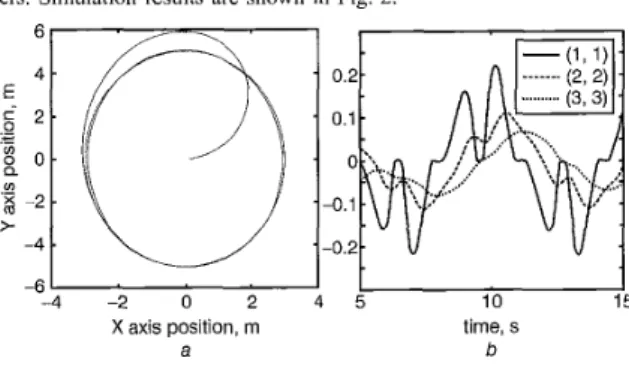
variation of the moment of inertia in the uncertain system is 1%. For easy comparison, suitable parameters are selccted such that similar asymptotic properties are obtained for different-order HOSM control- lers. Simulation results are shown in Fig. 2.
6r
1
0.2/1 -6 - -4 -2 0 2 4 55 -X axis position, m aFig. 2 Trajectory trucking und switchingjiinction a Trajectory tracking of uncertain system
b Switching function SI: ( I , I), (2, 2) and (3, 3) orders
time, s b
Simulation studies show that the controllcr is able to achieve trajectory tracking control successfully. Another point is that the higher the sliding order, the less the chattering problem. Hcnce chattering can be greatly reduced via the high order sliding mode control approach. Also, the output tracking controller has a certain robustness with respect to the initial error and parametric variation.
Conclusions: HOSM controllers of different order are dcsigned for the output tracking of a typical mobile robot with uncertain para- meters. Simulations results show that the approach tracks the desired trajectory successfully and reduces chattering greatly. It also has robustness with respcct to thc initial state error and parametric variation.
0
IEE 2002Electronics Letters Online No: 20020303 DOI: 10.1049/e1:20020303
C.K. Li and H.M. Chao (Department of Electronics and Information Engineering, The Hong Kong Polytechnic University, Hung Hom, Kowloon, Hong Kong)
I 7 September 2001
References
TARN,T.J., BEJCZY, A.K., YUN, x.P, and ~ 1 , z . F . : 'Effect of motor dynamics on nonlinear feedback robot arm control', ZEEE Truns. Robot. Autoni., 1991, 7, (I), pp. 114-121
ELDEEB, Y., and ELMARAGHY, W.H.: 'Robust adaptive COntrol of a robotic manipulator including motor dynamics', 1 Robot. Syst., 1998, 15, (1 I), pp. 661-669
LEVANT, A,: 'Sliding order and sliding accuracy in sliding mode control', Int. 1 Control, 1993, 58, (6), pp. 1247-1263
FRIDMAN, L., and LEVANT, A,: 'Higher order sliding modes as a natural phenomenon in control theory' in GAROFALO, F., and GLIELMO, L. (Eds.): 'Robust control via variable structure and Lyapunov techniques' (Springer-Verlag, London, 1996)
BARTOLINI, G., FERRARA, A,, and GIACOMINI, L.: 'A robust control design for a class of uncertain nonlinear systems featuring a second-order sliding mode', Int. 1 Control, 1999, 72, (4), pp. 321-331
Approximations in compensator design:
A duality
A. Bulent Ozguler and A. Nazli GundeS
In classical controller design, poles far to the left of dominant poles are sometimes ignored. Similarly, in somc proportional-integral compen- sation techniques, the controller zero is placed close to the origin and design proceeds after cancelling this zero with a pole at the origin. A rigorous basis for these methods is provided, it being shown that thcre
is a duality between the two.
Introduction: Most classical control textbooks include heuristic methods on low-order approximations to loop-gain transfer functions and employ such approximations in design [I-31.
One method relies on identifying dominant versus insignificant poles. The general rule is that poles having real parts at least five times as large as poles which are ncarest the j a ) axis are considered insignificant [I], provided there are no zeros nearby [4]. Such poles can be deleted from a transfer function, taking care to keep the low- frequency gain unchanged, and design can be carried out on the approximate model obtained. Although the dominant pole-based approximation is normally used on a closed-loop transfer function, occasionally such approximations are also used on the open-loop or loop-gain transfer functions ([l], p.416).
A second approximation that is used is part of a specific design method of proportional-integral (PI) controllers for plants of type equal to or greater than 1. PI controllers are usually employed to improve the steady-state (low-frequency) performance of a control system. If any transient performance specification further exists, then the controller zero is placed much closer to the origin than any other stable plant pole and the transient requirement is satisficd as if the controller is a proportional one, Le. the multiple of the PI controller and the plant transfer functions is approximated by the original plant transfer function under constant gain ([I], p.695). Since PID controllers can be designed by consecutive PI and PD design stages, thc method described becomes quite convenient, simplifying the second stage.
The connection between the two approximation methods is obscure. The two methods even seem contradictory since in the second method a pole in the dominant region is cancellcd from the loop-gain transfer function.
Our purpose in this Letter is to justify these approximation methods from the viewpoint of closed-loop stability. We also show that the two approximation procedures are dual to each other under the transforma- tion s
+
s-' in the complex plane.Main results: Throughout this Section, the set of stable proper real rational functions of s (real-rational H , functions) will be dcnoted The following Lemma is a result by Smith and Sondergeld stated in [6] for the scalar casc and for stable controllers. Although the extension is straightforward, a proof is still supplied in order to make the choice of a critical constant L o clear.
by
s
VI.
Lenzina 1: If a strictly proper transfer matrix G(s) is stabilised by a controllcr transfer matrix G,(s), then for any q 1, there exists a small enough to > 0, possibly depending on q , such that (CY
+
I)-"G(s) is also stabilised by G,(s) for all c E ( 0 , cO].Proof: Let G = D-IN be a left coprime representation of G over S, where N is strictly proper as is G. Let N,D;' be a right coprime representation of G, over S. Since G is stabilised by G,, U := DD,
+
NN,
is unimodular over S. Letfi :=
l / l l ~ ( s ) l l m
By Lemma 19 of [5], any matrix V over S that satisfies
/ /
V(s) - U(s)11
is unimodular. To show the existenceof t such that V(s) := D(s)Dc(s)
+
(cs+
I)-"N(s)N,(s) is unimodular, it is hence enough to show that there exists L > 0 for which< 1/
11
U(s)11
II[((s
+
I)-'' - l]N(.v)Nc(.~)llm < 6 (1) By strict propcrness of H :=NN,,
there exists for which6
sup 5 ( H ( j w ) ) <
5'
m?al(,
where F(H(jw)) is the largest singular value of H(jw). It follows that, for any finite c,
sup i?([(+o
+
- I ] H ( j w ) ) < 6 (2) U > I r J ,Conversely, in the interval [0, roo], we have that max,,, ~ o , ~ , j o l ~ ( ~ j ~
+
- 1I < ltw& for some k that depends on q.
Let p := max,, ,o,,,,~16(H(jw)) so that for every choice of c less than h/pkwX, it holds thatsup C([(fjw
+
1)-" - l]H(jro)) < 6 (3)( O E [ O , U I " ]
By (2) and (3), the norm equality (1) follows.
This result justifies (and generalises to the multivariable case) methods in which a stabilising controller is determined by neglecting an insignificant pole of multiplicity q in a loop-gain transfer function
(4)
and performing the design on the lower order approximation G(s). The discarded term is such that the low-frequency gain G(0) of G(s) and of (4) are the same. Note that a pole of (4) is insignijkant if it is less than
-ti'. It follows that co determined in the proof gives a rigorous
definition of an insignificant pole. The bound in the preceding proof for € 0 , however, is generally very conservative.
,sG(s)
is finite. The following result concerns such transfer matrices. We supply a proof based on Lemma 1 and the transformation s
+
s-' in the complex plane. We omit a direct proof which makes the choice of tomore explicit [7].
A transfer matrix G(s) is of type greater or equal to 1 if l h Y
Theorem I : Let a transfer matrix G(s) be of type greater than or equal to 1. If G(s) is stabilised by a controller transfer matrix G,(s), then for any q
>
1, there exists a small enough co > 0, possibly depending on q , such thatis also stabilised by G, for all t E (0, to].
Proofl This proof uses the simple*'Fact: Let U(s) be left (right) unimodular over S (see [SI). Then, U(s) := U(s-') is also left (right) unimodular over S.' We first observe that by the hypothesis on the type of G, G(s-')-' is strictly proper. Let G(s-l) = b(s)-'$(s) be a left cpprime representation over S.-Note that b ( s ) is strictly proper and N(s) is biproper. Let D(s) :=D(s-l) and N(s):=$(s-'). Then, G(s) =D(s)-IN(s), where (D(s), N(s)) is left coprime over S by the Fact. Let G&) =N,(s)D,(s)-' be a right coprime representation. Since, G, stabilises G, we have that DD,
+
NN,
=: U is unimodular over S. Substituting s-' for s, we obtain b(s)b,(s)+
h(s)hc(s) = fi(s), where D,(s) := Dc(s-'), N&) := Nc(s-'), and U(s) :=U(s-l).
Note that fic(s)b,(s)-' =C,(s-') is proper. Also by the Fact,O(s)
is unimodular over S. By :emma I , give? any>
1, there exists t g > 0 such that (1+
t ~ ) - ~ D ( s ) b , ( s ) +N(s)N,(s) = V(s) is unimodular for every c 5 t o . Substituting s-' for s, we obtainwhere V(s) =
p(sF.-')
is unimodular by the Fact.The result of Theorem 1 justifies methods of design where a loop- gain transfer matrix
is approximated by the type 2 1 function G(s) in designing a stabilising controller. The term that is discarded is such that the high-frequency gain of G(s) and that of (5) are the same, Le. a zero is always cancelled with exactly one pole at the origin. The cancelled zeros must be in the vicinity of the origin.
The proof given of Theorem 1 clarifies the relation between the two design methods: An insignificant pole term ts+ 1 under the transfor- mation s + s-' gives a PI controller
S + € S
with its zero close to the origin. The approximation procedures involved in the two methods are hence dual procedures and have the same logical foundation.
Conclusions: In Lemma 1 and Theorem 1, we have provided rigorous support and established a duality for two classical design methods from the viewpoint of closed-loop stability. The virtue of such design methods lie not only in closed-loop stability but also in their use in satisfying performance specs in an easy manner. Hence, further
rigorous support from the viewpoint of closed-loop performance is needed.
The crucial constants co of Lemma 1 and its counterpart for Theorem 1 provide a rigorous distinction between dominant and insignificant poles on one hand, and between cancellable and uncancellable PI controller zeros on the other. A closer look into the construction of cg
will yield a new approximation-based design method. This is currently under investigation.
Acknowledgment: The research was supported by the NSF Grant ECS-9905729.
0
IEE 2002Electronics Letters Online No: 20020327 DOL 10.1049/e1:20020327
A. Biilent Ozgiiler (Electrical and Electronics Engineering, Bilkent University, Bilkent, Ankara, TR-06533 Turkey)
E-mail: [email protected]
A. Nazli GundeS (Electrical and Computer Engineering, University of California, Davis, CA 9561 6, USA)
7 January 2002
References
1 KUO, B.C.: 'Automatic control systems' (Prentice Hall, NJ, USA, 1995), 7th edn.
(McGraw Hill, NJ, USA, 1993)
3 DORF, R.C., and BISHOP, R.H.: 'Modern control systems' (Prentice Hall, NJ, USA, 2001), 9th edn.
4 OGATA, K.: 'Modem control cngineering' (Prentice Hall, NJ, USA, 1997), 3rd edn.
5 VIDYASAGAR, M.: 'Control system synthesis: a factorization approach' (The MIT Press, MA, USA, 1985)
6 SMITH, M.C., and SONDERGELD, K.P.: 'On the order of stable compensators', Automaticu, 1986, 22, (l), pp. 127-129
7 Ozguler, A.B. and Gundev, A.N.: 'Common controllers for plants with fixed zeros', Preprint, Electrical and Electronics Engineering Department, Bilkent University, Bilkent, Ankara, TR-06533, Turkey, 2001
2 ROHRS, C.E., MELSA, J.L., and SCHULTZ, D.G.: 'Linear control systems'
Proof for effective and efficient web
caching
D.N.
Serpanos and G. Karakostas
Perfect-LFU, the optimal replacement policy for Web caches, achieves high performance (cache hit-rate) exploiting Zipf's law, but is very expensive to implement. It is proved that an alternative policy, called Window-LFU, achieves equivalent performance at a significantly lower cost.
Introduction: Web caches take advantage of Zipf's law, which governs user requests, in general. The optimal replacement policy is perfect-LFU (P-LFU) [ 11, which replaces Web objects based on their popularity. P-LFU is expensive to implement, because correct calcu- lation of popularity requires statistics on all objects accessed in the whole past.
One can make replacement decisions based on Web object popularity in the recent past, called the recent time window. This policy, called window-LFU (W-LFU), clearly has a significantly lower implementa- tion cost. In this Letter, we prove that W-LFU achieves high hit rates, equivalent to P-LFU, for small window sizes. Our only assumptions are Zipf's law and statistical independence among user requests.
Model and notation: We consider an enterprise network (or LAN) connected to the Internet through a gatewith with a cache, as shown in Fig. 1. User (client) requests are either served by the cache, if the requested objects are cache-resident, or forwarded to the Internet.