arXiv:0902.0773v2 [hep-ph] 9 Feb 2011
A comparative study on
B → K
∗ℓ
+ℓ
−and
B → K
0∗(1430)ℓ
+ℓ
−decays in the Supersymmetric
Models
V. Bashiry1∗, M. Bayar2†, K. Azizi3‡,
1 Engineering Faculty, Cyprus International University,
Via Mersin 10, Turkey
2 Department of Physics, Kocaeli University, 41380 Izmit, Turkey 3 Physics Division, Faculty of Arts and Sciences, Do˘gu¸s University,
Acıbadem-Kadık¨oy, 34722 Istanbul, Turkey
Abstract
In this paper, we compare the branching ratio and rate difference of electron channel to muon channel of B → K∗
0(1430)ℓ+ℓ− and B → K∗ℓ+ℓ−decays, where
K0∗(1430) is the p–wave scalar meson, in the supersymmetric models. MSSM with R parity is considered since considerable deviation from the standard model predictions can be obtained in B → Xsℓ−ℓ+. Taking CQ1 and CQ2 about one which is consistent
with the B → K∗µ+µ−rate at low dileptonic invariant mass region(1 ≤ q2≤ 6GeV2). It is found that, firstly, the B → K∗
0(1430)ℓ+ℓ− (ℓ = µ, τ ) decay is measurable at
LHC, secondly, in comparison with B → K∗ℓ+ℓ− decay a greater deviation in the
B → K0∗(1430)ℓ+ℓ− decay can be seen. Measurement of these observables for the
semileptonic rare B → K∗
0(1430)ℓ+ℓ−, in particular, at low q2region can give valuable
information about the nature of interactions within Standard Model or beyond.
PACS numbers: 12.60.-i, 12.60.Jv, 13.25.Hw
∗e-mail: [email protected]
†e-mail: [email protected] ‡e-mail: [email protected]
1
Introduction
The Standard Model (SM) is in perfect agreement with all confirmed collider data, but there is a missing ingredient. The SM is not regarded as a full theory, since it can not address some issues i.e., gauge and fermion mass hierarchy, matter- antimatter asymmetry, number of generations, the nature of the dark matter, the unification of fundamental forces and so on. For these reasons, the SM can be considered as an effective theory of some fundamental theory at low energy.
Supersymmetry (SUSY) is regarded as the most plausible extension of the SM in order to shed light on some of the issues as mentioned above [1]. It is an essential ingredient in string theory and the most-favoured candidate for unifying all the known interactions including gravity. It would help stabilize the hierarchy of mass scales between mW and
the Planck mass, by canceling the quadratic divergences in the radiative corrections to the mass-squared of the Higgs boson [2].
Two types of study can be conducted to explore supersymmetric particles (sparticles). In the direct search, the center of mass energy of colliding particles has to be increased to produce SUSY particles at the TeV scale, and hence be accessible to the Large Hadron Col-lider(LHC). On the other hand, we can indirectly investigate SUSY effects. The sparticles can contribute to the quantum loop. As a result, flavor changing neutral current (FCNC) transition induced by quantum loop level can be considered as a good tool for studying the possible effects of sparticles (there are many studies in this regard, for the most recent studies see Ref. [3] and the references therein).
The FCNC processes induced by b → s(d) transitions are forbidden in SM at tree level [4, 5]. However, they can provide the most sensitive and stringiest test for the SM at one loop level. Despite smallness of the branching ratios of FCNC decays, quite intriguing results have been obtained in ongoing experiments. The inclusive B → Xsℓ+ℓ− decay is observed
in BaBaR [6] and Belle collaborations. Also these collaborations measured exclusive modes B → Kℓ+ℓ− [7–9] and B → K∗ℓ+ℓ− [10]. The experimental results on these decays are in
good agreement with theoretical estimations [11–19] which can be used to constrain new physics (NP) effects.
There is another class of rare decays induced by b → s transition, such as B → K∗
02(1430)ℓ+ℓ− in which B meson decays into p–wave scalar meson. The decays B →
K∗
2(1430)ℓ+ℓ− and B → K0∗(1430)ℓ+ℓ− are studied in [20–22].Transition form factors of
these decays in the framework of light front quark model [23] and 3–point QCD sum rules are estimated in [24], [25] and [21], respectively.
In the present work we investigate the possible effects of sparticles on the branching ratio of B → K∗
0(1430)ℓ+ℓ− decay.
The paper is organized as follows: In section 2, we calculate the decay amplitude of the B → K∗
0(1430)ℓ+ℓ− decay within SUSY models. Section 3 is devoted to the numerical
analysis and discussion of the considered decay and our conclusions.
2
Decay amplitude of the
B → K
0∗(1430)ℓ
+ℓ
−decay in
the SUSY models
The exclusive B → K∗
0(1430)ℓ+ℓ−decay is described at quark level by b → sℓ+ℓ−transition.
The effective Hamiltonian, that is used to describe the b → sℓ+ℓ−transition in SUSY models
(see, for example, Ref. [26]), is:
Hef f = GFαVtbVts∗ 2√2π " C9ef f(mb)¯sγµ(1 − γ5)b ¯ℓγµℓ + C10(mb)¯sγµ(1 − γ5)b ¯ℓγµγ5ℓ − 2mbC7(mb) 1 q2siσ¯ µνq ν (1 + γ5)b ¯ℓγµℓ + CQ1s(1 + γ¯ 5)b → ellℓ + C¯ Q2¯s(1 + γ5)b ¯ℓγ5ℓ # , (1) SUSY introduces several additional classes of contributions: I. gluino, down-type squark loop, II. chargino, up-type squark loop, III. chargino, up-type squark loop, (Higgs field attaching to charginos) and IV. neutralino down-type squark loop[27] accordingly. The neutral Higgs couplings SUSY contributions are mainly involved via the terms proportional with CQ1,2. These additional terms with respect to the SM come from the neutral Higgs
bosons (NHBs) exchange diagrams, whose manifest forms and corresponding Wilson coeffi-cients can be found in[28–32]. The effects of new scalar and pseudoscalar type interactions on physical observables come through the terms which are proportional to the mass of fi-nal state leptons. The effects of the other contributions come through the modification of known SM Wilson coefficients. The Wilson coefficients C7, C9ef f and C10 are already exist
in the SM. C9ef f(ˆs) = C9+Y (ˆs), where Y (ˆs) = Ypert(ˆs)+YLDcontains both the perturbative
part Ypert(ˆs) and long-distance part YLD(ˆs) (see Ref. [11–13]). The explicit expressions of
C7, C9per and C10 in the SM can be found in [4]. YLD is usually parameterized by using
Breit–Wigner ansatz, YLD = 3π α2C (0) X Vi=ψ(1s)···ψ(6s) æi Γ(Vi → ℓ+ℓ−)mVi m2 Vi− q 2− im ViΓVi , where α is the fine structure constant and C(0) = 0.362.
The phenomenological factors æi for the B → K(K∗)ℓ+ℓ− decay can be determined
from the condition that they should reproduce correct branching ratio relation B(B → J/ψK(K∗
) → K(K∗)ℓ+ℓ−
) = B(B → J/ψK(K∗
))B(J/ψ → ℓ+ℓ−) ,
the right–hand side is determined from experiments. Using the experimental values of the branching ratios for the B → ViK(K∗) and Vi → ℓ+ℓ− decays, for the lowest two J/ψ
and ψ′ resonances, the factor æ takes the values: æ
1 = 2.7, æ2 = 3.51 (for K meson),
and æ1 = 1.65, æ2 = 2.36 (for K∗ meson). The values of æi used for higher resonances
are usually the average of the values obtained for the J/ψ and ψ′ resonances. In order to
determine the branching ratio for the B → K∗
0(1430)ℓ+ℓ− decay with the inclusion of long
distance effects, the measured branching ratio of B → K∗
0(1430)ψ is necessary. However,
the mentioned decay has not been measured yet. Therefore, we assume that the values of æi are in the order of one. In accordance, we chose æ1 = 1 and æ2 = 2 and performed
numerical calculations with these values.
The Wilson coefficients in the framework of the SUSY can be different from the their SM values. While the SUSY effects on C7, which is proportional to the product of the top
and bottom Yukawa coupling constant, mtmbtan β/ sin2β, is sizable for large tan β. There
are no such effects in the calculation of C9 and C10[27].
One has to sandwich Eq. (1) between initial meson state B(p) and final meson state K∗
0(1430)(p′) in order to obtain the amplitude for the B → K0∗(1430)ℓ+ℓ− decay. Thus,
the matrix elements hK∗
0|¯sγµ(1 − γ5)| Bi and hK0∗|¯siσµνqµ(1 + γ5)| Bi are needed. These
matrix elements are parameterized in terms of the form factors as follows: hK∗ 0(1430)(p′) |¯sγµγ5b| B(p)i = f+(q2)Pµ+ f−(q2)qµ , (2) hK∗ 0(1430)(p′) |¯siσµνqνγ5b| B(p)i = fT(q2) mB+ mK∗ 0 [Pµq2− (m2B− m 2 K∗ 0)qµ] , (3)
where Pµ = (p + p′)µ and qµ = (p − p′)µ. By multiplying both sides of Eq. (2) with qµ the
expression in terms of form factors for hK∗
0(1430)(p′) |¯sγ5b| B(p)i can be obtained.
hK∗
0(1430)(p′) |¯sγ5b| B(p)i = −
1 mb− ms
[f+(q2)P.q + f−(q2)q2] , (4)
Using above Hamiltonian and definitions of form factors, the decay amplitude for B → K∗
0ℓ+ℓ− can be written as follows:
M(B → K∗ 0ℓ+ℓ−) = GFαVtbVts∗ 2√2π " − A1Pµℓγ¯ µℓ − A2Pµℓγ¯ µγ5ℓ − A3ℓγ¯ 5ℓ − A4ℓℓ¯ # , (5) where A1 = C9f++ 2mbC7fT mB + mK∗ 0 A2 = C10f+ A3 = 2C10mℓf−+ CQ2 mb− ms [(m2B+ m2K∗ 0)f++ q 2f −] A4 = CQ1 mb− ms [(m2B+ m 2 K∗ 0)f++ q 2 f−].
Using Eqs. (1)–(5), we get the following expression for the differential decay width: dΓ dq2 = G2 Fα2 8192mBπ5 |V tbVts∗| 2 υqλ(1, r, ˆs) ( 4 3(|A1| 2 + |A2|2)(−3 + υ2) " q4 − 2q2(m2 B+ m2K∗ 0) + (m 2 B− m2K∗ 0) 2 # + 16 |A2|2m2ℓ " q2− 2(m2 B+ m2K∗ 0) # − 4q2|A3|2+ 4 |A4|2(4m2ℓ − q 2 ) − 6mℓ(A2A∗3 + A∗2A3)(m2B− m 2 K∗ 0) ) , (6) where ˆs = mq22 B, v = r 1 − 4m 2 ℓ q2 , r = m2K∗ 0/m 2 B, and λ(1, r, ˆs) = 1 + r2+ ˆs2− 2ˆs − 2(1 + ˆs).
Author's Copy
3
Numerical results
In this section, we present the branching ratio for the both B → K∗
0(1430) and B → K∗
channel for muon and tau leptons. We investigate the rate difference of electron channel to muon channel. The main input parameters are the form factors for which we use the results of three-point QCD sum rules [21].
The values of the form factors at q2= 0 are [21]
f+(0) = 0.31 ± 0.08 ,
f−(0) = −0.31 ± 0.07 ,
fT(0) = −0.26 ± 0.07 , (7)
where the errors are due to the variation of Borel parameters.
The best fit for the q2 dependence of the form factors can be written in the following
form: fi(ˆs) = fi(0) 1 − ais + bˆ isˆ2 , (8) where i = +, − or T and ˆs = q2/m2
B. The values of the parameters fi(0), ai and bi are
specified in Table 1.
fi(0) ai bi
f+ 0.31 ± 0.08 0.81 −0.21
f− −0.31 ± 0.07 0.80 −0.36
fT −0.26 ± 0.07 0.41 −0.32
Table 1: Form factors for B → K∗
0(1430)ℓ+ℓ− decay in a three–parameter fit.
The full kinematical interval of the dilepton invariant mass q2 is 4m2
ℓ ≤ q2 ≤ (mB −
mK∗
0)
2 for which the long distance effects (the charmonium resonances) can give substantial
contribution by the two low lying resonances J/ψ and ψ′, in the interval of 8 GeV2 ≤ q2 ≤
14 GeV2. In order to minimize the hadronic uncertainties we discard this subinterval by
dividing the kinematical region of q2 for muon:
I 4m2 ℓ ≤ q2 ≤ (mJ ψ − 0.02 GeV )2 , II (mJ ψ+ 0.02 GeV )2 ≤ q2 ≤ (mψ′ − 0.02 GeV )2 , III (mψ′ + 0.02 GeV )2 ≤ q2 ≤ (mB− mK∗ 0) 2 .
and for tau:
I 4m2 ℓ ≤ q2 ≤ (mψ− 0.02 GeV )2 , II (mψ+ 0.02 GeV )2 ≤ q2 ≤ (mB− mK∗ 0) 2.
Author's Copy
The new Wilson coefficients CQ1 and CQ2 are described in terms of masses of sparticles i.e.,
chargino-up-type squark and NHBs, tan(β) which is defined as the ratio of the two vacuum values of the 2 neutral Higgses and µ which has the dimension of a mass, corresponding to a mass term mixing the 2 Higgses doublets. Note that µ can be positive or negative. Depending on the magnitude and sign of these parameters, many options in the parameter space can be considered. However, experimental results i.e., the rate of b → sγ and b → sℓ+ℓ− constrain us to consider the following options:
• SUSY I: µ takes negative value, C7 changes its sign and contribution of NHBs are
neglected.
• SUSY II: tan(β) takes large values while the mass of superpartners are small i.e., few hundred GeV.
• SUSY III: tan(β) is large and the masses of superpartners are relatively large, i.e., about 450 GeV or more.
The numerical values of Wilson coefficients used in our analysis are referenced from [26, 33, 35]. In fact, according to the experimental results obtained by BELLE collaboration[34]. Refs. [35, 36] indicate that for SUSY II in the case of muon channel CQ1 and CQ2 should not
be greater than 0.5. In addition to this, in the absence of real experimental constraints on the FCNC modes in the case of tau channel, we may employ much larger Wilson coefficients (hence, SUSY effects) than we presented in Tables 2, and 3. Because the Yukawa-driven Higgs coupling implies that Cτ
Q = mτ/mµC µ
Q. The numerical values of Wilson coefficients
are collected in Tables 2, and 3.
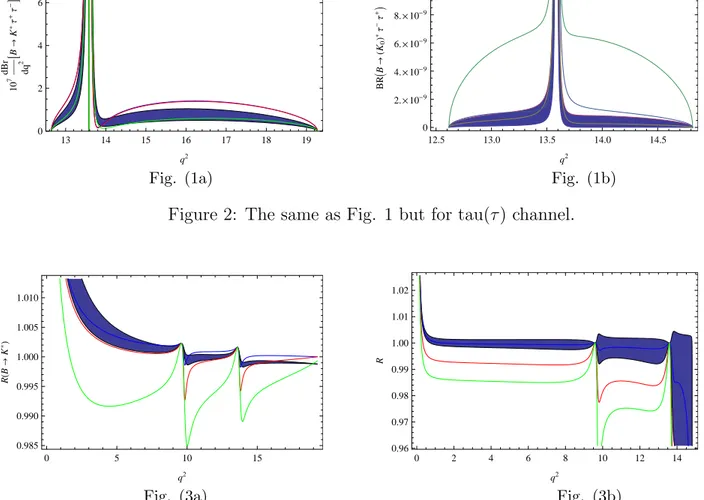
In Fig. (1) and (2) we present the dependence of the differential branching ratio for the B → K∗
0(1430)ℓ+ℓ− and B → K∗ℓ+ℓ− decays, where ℓ = µ, τ , on q2.
Wilson Coefficients C7ef f C9 C10
SM −0.313 4.334 −4.669
SUSY I +0.3756 4.7674 −3.7354
SUSY II +0.3756 4.7674 −3.7354
SUSY III −0.3756 4.7674 −3.7354
Table 2: Wilson Coefficients in SM and different SUSY models but without NHBs contri-butions[26].
Taking into account the q2 dependence of the form factors given in Eq. (8), performing
integration over q2, and using the total lifetime τ
B = 1.53×10⁻¹²s [37], we get the following
results for the branching ratios by considering short distance contribution:
B(B → K∗ 0(1430)µ+µ−) = 1.05 × 10⁻⁷ SUSY I , 2.08 × 10⁻⁷ SUSY II , 1.10 × 10⁻⁷ SUSY III ,
Author's Copy
Wilson Coefficients CQ1 CQ2
SM 0 0
SUSY I 0 0
SUSY II 0.5[35] (16.5)[33] −0.5[35] (−16.5)[33]
SUSY III 1.2 (4.5) −1.2 (−4.5)
Table 3: Wilson coefficients corresponding to NHBs contributions within SUSY I, II and III models [26]. The values in the bracket are for tau channel. Note that the values for SUSY I and III are taken from Ref. [33] and for SUSY II the values taken from [33] and [35]. B(B → K∗ 0(1430)τ+τ−) = 9.54 × 10⁻¹⁰ SUSY I , 1.25 × 10⁻⁸ SUSY II , 2.69 × 10⁻⁹ SUSY III .
By considering long distance effects in the above–mentioned kinematical regions, we get the following branching ratios for muon:
B(B → K0∗(1430)µ+µ − ) = 1.05 × 10⁻⁷ region I ,
8.98 × 10⁻⁹ region II , for SUSY I,
1.56 × 10⁻¹⁰ region III , B(B → K∗ 0(1430)µ+µ−) = 1.73 × 10⁻⁷ region I ,
3.71 × 10⁻⁸ region II , for SUSY II,
3.25 × 10⁻⁹ region III , and B(B → K0∗(1430)µ+µ−) = 1.08 × 10⁻⁷ region I ,
1.02 × 10⁻⁸ region II , for SUSY III.
2.83 × 10⁻¹⁰ region III ,
and for tau: B(B → K∗ 0(1430)τ+τ−) = 5.77 × 10⁻¹⁰ region I ,
3.43 × 10⁻¹⁰ region II , for SUSY I,
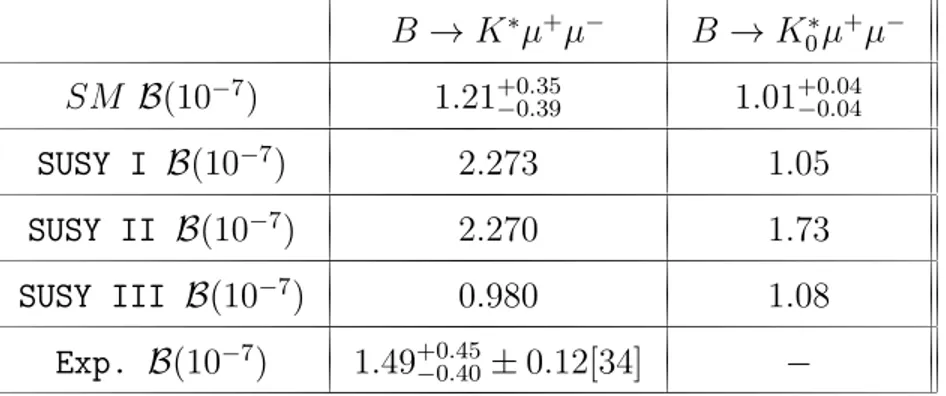
B → K∗µ+µ− B → K∗ 0µ+µ− SM B(10−7) 1.21+0.35 −0.39 1.01+0.04−0.04 SUSY I B(10−7) 2.273 1.05 SUSY II B(10−7) 2.270 1.73 SUSY III B(10−7) 0.980 1.08 Exp. B(10−7) 1.49+0.45−0.40± 0.12[34] −
Table 4: Experimentally measured values and integrated values of branching ratio at low dileptonic invariant mass region.
B → K∗µ+µ− B → K∗ 0µ+µ− B → K∗τ+τ− B → K0∗τ+τ− SM B(10−7) 0.158+0.004 −0.0004 0.015+0.002−0.002 0.11+0.01−0.01 0.023+0.015−0.015 SUSY I B(10−7) 0.181 0.0156 0.083 0.0342 SUSY II B(10−7) 0.184 0.0325 0.086 0.0584 SUSY III B(10−7) 0.173 0.0283 0.12 0.0115
Table 5: Integrated values of branching ratio at high dileptonic invariant mass region(q2 ≥
14.5GeV2). B(B → K∗ 0(1430)τ+τ−) = 4.67 × 10⁻⁹ region I ,
5.84 × 10⁻⁹ region II , for SUSY II,
and B(B → K0∗(1430)τ+τ − ) = 1.21 × 10⁻⁹ region I ,
1.15 × 10⁻⁹ region II , for SUSY III.
at fK∗
0 = 340 MeV .
Our results for low and high q2 regions are shown in the tables 4 and 5.
These results depict that the dominant contribution comes from term proportional to C7 in region I (low invariant mass region), and this can be attributed to the existence
of the factor 1/q2. At LHCb 1011–1012 pairs are expected to be produced, the expected
number of events for the B → K∗
0(1430)µ+µ− decay in the low invariant mass region is the
order of 104–105. Since this region is sensitive to the sign of C
7 in the SUSY I model, the
study of branching ratio in this region can provide valuable information about the SUSY
effects. In particular, SUSY I and SUSY II can be distinguished by B → K∗
0(1430) channel
much better than B → K∗ channel(see table 4). When value of the branching ratio for
the B → K∗
0(1430)µ+µ− decay is considered both with and without long distance effects,
valuable results to check structure of the effective Hamiltonian can be achieved. The small value of B(B → K∗
0(1430)τ+τ−) can be attributed to the small phase volume of this decay.
Furthermore, SUSY models can enhance the branching ratio up to one order of magnitude with respect to the SM values for both µ and τ cases. The significant discrepancy in the non-resonance regions (low q2 and high q2 regions) can be studied for the effects of not only
NHBs but also for NP effects.
Fig. 3 illustrates the dependency of R in terms of q2 for various SUSY scenarios for
q2 ≥ 4m2
ℓ region, where R is defined as follows:
R(q2) = (dΓ/dq 2)(B → K∗ 0(1430)µ+µ−) (dΓ/dq2)(B → K∗ 0(1430)e+e−) (9) Finally, the study of rate difference of muon channel to electron channel is complimen-tary work to the studies of other observables. While SUSY II and SUSY III approximately coincide with each other in the study of branching ratio, referred models can be distin-guished by studying the R (see fig. 3). Furthermore, SUSY I lies in the theoretical error bounds of SM when considering both at branching ratio (see fig. 1) and R (see fig. 3).
To sum up, we study the semileptonic rare B → K∗
0(1430)ℓ+ℓ− and B → K∗ℓ+ℓ−decays
in the supersymmetric theories. The results show that the branching ratio is very sensitive to the SUSY parameters. The branching ratio is enhanced up to one order of magnitude with respect to the corresponding SM values. It is also realized that in the low q2 region
the study of B → K∗
0(1430)ℓ+ℓ− decay is better than B → K∗ℓ+ℓ− decay if we try to
distinguish SUSY I and SUSY II models. It is also recognized that while studying the rate difference of electron channel to muon channel, R can be complimentary to the studies of branching ratio. The results can be used for indirect search of the SUSY effects in future planned experiments at LHC.
Acknowledgments
The authors thank T. M. Aliev for his useful discussions. Special thanks go to Mehmet Toycan for his fruitful contributions to the outline of the paper.
References
[1] J. Ellis, Nucl. Phys. A 827, 187C (2009) [arXiv:0902.0357 [hep-ph]]. [2] E. Witten, Phys. Lett. B 105 267 (1981).
[3] R. N. Hodgkinson, AIP Conf. Proc. 1078, 375 (2009) [arXiv:0810.0034 [hep-ph]]. [4] G. Buchalla, A. J. Buras and M. E. Lautenbacher, Rev. Mod. Phys. 68, 1125 (1996). [5] A. Ali, Int. J. Mod. Phys. A 20, 5080 (2005).
[6] B. Aubert et. al, BaBaR Collaboration, Phys. Rev. Lett. 93, 081802 (2004). [7] M. I. Iwasaki et. al, BELLE Collaboration, Phys. Rev. D 72, 092005 (2005). [8] K. Abe et. al, BELLE Collaboration, Phys. Rev. Lett. 88, 021801 (2002). [9] B. Aubert et. al, BaBaR Collaboration, Phys. Rev. Lett. 91, 221802 (2003). [10] A. Ishikawa et. al, BELLE Collaboration, Phys. Rev. Lett. 91, 261601 (2003).
[11] P. Colangelo, F. De Fazio, P. Santorelli and E. Scrimieri, Phys. Rev. D 53, 3672 (1996). [12] A. Ali, P. Ball, L. T. Handoko and G. Hiller, Phys. Rev. D 61, 074024 (2000).
[13] A. Ali, E. Lunghi, C. Greub and G. Hiller, Phys. Rev. D 66, 034002 (2002). [14] T. M. Aliev, H. Koru, A. ¨Ozpineci, M. Savcı, Phys. Lett. B 400, 194 (1997). [15] T. M. Aliev, A. ¨Ozpineci, M. Savcı, Phys. Rev. D 56, 4260 (1997).
[16] D. Melikhov, N. Nikitin and S. Simula, Phys. Rev. D 57, 6814 (1998). [17] G. Burdman, Phys. Rev. D 52, 6400 (1995).
[18] J. L. Hewett and J. D. Walls, Phys. Rev. D 55, 5549 (1997). [19] C. H. Chen and C. Q. Geng, Phys. Rev. D 63, 114025 (2001).
[20] S. Rai Choudhury, A. S. Cornell, G. C. Joshi and B. H. J. McKellar, Phys. Rev. D 74, 054031 (2006).
[21] T. M. Aliev, K. Azizi and M. Savci, Phys. Rev. D 76, 074017 (2007). [22] M. J. Aslam, C. D. Lu and Y. M. Wang, Phys. Rev.D 79, 074007 (2009). [23] H. Y. Cheng, C. K. Chua, and C. W. Huang, Phys. Rev. D 69, 074025 (2004). [24] H. Y. Cheng, C. K. Chua, Phys. Rev. D 69, 094007 (2004).
[25] C. H. Chen, C. Q. Geng, C. C. Lih and C. C. Liu, Phys. Rev. D 75, 074010 (2007).
[26] M. J. Aslam, Y. M. Wang and C. D. Lu, Phys. Rev. D 78, 114032 (2008). [27] Y. Wang and D. Atwood, Phys. Rev. D 68, 094016 (2003).
[28] C. S. Huang, Nucl. Phys. Proc. Suppl. 93 (2001) 73.
[29] C. Bobeth, T. Ewerth, F. Kruger, J. Urban, Phys. Rev. D 64 (2001) 074014. [30] Y. B. Dai, C. S. Huang, H. W. Huang, Phys. Lett. B 390 (1997) 257.
[31] C. S. Huang, X. H. Wu, Nucl. Phys. B 657 (2003) 304.
[32] J. F. Cheng, C. S. Huang, X. H. Wu, Nucl. Phys. B 701 (2004) 54.
[33] Q. S. Yan, C. S. Huang, L. Wei and S. H. Zhu, Phys. Rev. D 62 (2000) 094023. [34] J. T. Wei et al. [BELLE Collaboration], Phys. Rev. Lett. 103, 171801 (2009). [35] C. Bobeth, G. Hiller and G. Piranishvili, JHEP 0712, 040 (2007).
[36] V. Bashiry and K. Azizi, JHEP 1001, 033 (2010).
[37] C. Amsler et al. [Particle Data Group], Phys. Lett. B 667, 1 (2008).
0 5 10 15 0 2 4 6 8 q2 10 7 dBr dq 2 AB ® K *Μ + Μ -E 0 2 4 6 8 10 12 14 0.0 0.5 1.0 1.5 2.0 2.5 q2 10 8BR IB ® HK0 L *Μ + Μ -M
Fig. (1a) Fig. (1b)
Figure 1: Branching ratio of the B → K∗µ+µ− decay and the B → K∗
0(1430)µ+µ− decay.
Black, blue, red and green lines correspond to SM, SUSY I, SUSY II, SUSY III models, respectively. Blue bound of the SM is created by the theoretical errors among the formfac-tors. 13 14 15 16 17 18 19 0 2 4 6 8 q2 10 7 dBr dq 2 AB ® K *Τ + Τ -E 12.5 13.0 13.5 14.0 14.5 0 2.´ 10-9 4.´ 10-9 6.´ 10-9 8.´ 10-9 1.´ 10-8 q2 BR IB ® HK0 L *Τ -Τ +M
Fig. (1a) Fig. (1b)
Figure 2: The same as Fig. 1 but for tau(τ ) channel.
0 5 10 15 0.985 0.990 0.995 1.000 1.005 1.010 q2 R HB ® K *L 0 2 4 6 8 10 12 14 0.96 0.97 0.98 0.99 1.00 1.01 1.02 q2 R
Fig. (3a) Fig. (3b)
Figure 3: The rate difference of the electron channel to the muon channel for the B → K∗
Fig. (3a) and the B → K∗
0(1430) Fig. (3b) transitions when q2 ≥ 4m2µ region. Blue bound
of the SM is created by the theoretical errors among the formfactors.
![Table 2: Wilson Coefficients in SM and different SUSY models but without NHBs contri- contri-butions[26].](https://thumb-eu.123doks.com/thumbv2/9libnet/4044039.56886/6.918.258.654.657.775/table-wilson-coefficients-different-models-contri-contri-butions.webp)
![Table 3: Wilson coefficients corresponding to NHBs contributions within SUSY I, II and III models [26]](https://thumb-eu.123doks.com/thumbv2/9libnet/4044039.56886/7.918.224.636.368.481/table-wilson-coefficients-corresponding-nhbs-contributions-susy-models.webp)