International Forum of Educational Technology & Society
The Impact of Motivation and Personality on Academic Performance in Online and Blended
Learning Environments
Author(s): Nurcan Alkış and Tuğba Taşkaya Temizel
Source: Journal of Educational Technology & Society , Vol. 21, No. 3 (July 2018), pp. 35-47
Published by: International Forum of Educational Technology & Society
Stable URL: https://www.jstor.org/stable/10.2307/26458505
REFERENCES
Linked references are available on JSTOR for this article:
https://www.jstor.org/stable/10.2307/26458505?seq=1&cid=pdf-reference#references_tab_contents
You may need to log in to JSTOR to access the linked references.
JSTOR is a not-for-profit service that helps scholars, researchers, and students discover, use, and build upon a wide range of content in a trusted digital archive. We use information technology and tools to increase productivity and facilitate new forms of scholarship. For more information about JSTOR, please contact [email protected].
Your use of the JSTOR archive indicates your acceptance of the Terms & Conditions of Use, available at https://about.jstor.org/terms
International Forum of Educational Technology & Society is collaborating with JSTOR to digitize, preserve and extend access to Journal of Educational Technology & Society
Alkış, N., & Taşkaya Temizel, T. (2018). The Impact of Motivation and Personality on Academic Performance in Online and Blended Learning Environments. Educational Technology & Society, 21 (3), 35–47.
The Impact of Motivation and Personality on Academic Performance in
Online and Blended Learning Environments
Nurcan Alkış
1*and Tuğba Taşkaya Temizel
21Department of Technology and Knowledge Management, Başkent University, Ankara, Turkey // 2Department
of Information Systems, Middle East Technical University, Ankara, Turkey// [email protected] // [email protected]
*Corresponding author
(Submitted October 9, 2016; Accepted April 10, 2017)
ABSTRACT
This study investigates the impact of students’ motivation and personality traits on their academic performance in online and blended learning environments. It was conducted with students attending a mandatory introductory information technology course given in a university in Turkey. The Big Five Inventory and Motivated Strategies for Learning Questionnaire were completed by a total of 316 students. A learning management system (LMS) was used for online collaboration and accessing course materials. At the end of the course, information on the accessibility of LMS and students’ academic performance including their exam results was obtained. The Bayesian Structural Equation Modeling was used to examine academic performance in terms of its relationship with motivation and personality. In the online learning environment, the results showed that the conscientiousness trait was significantly related to LMS use whereas in blended learning, there were no significant relations between personality traits and LMS use. Self-efficacy was found to be the predictor of LMS use in the online environment while task value and test anxiety were the predictors in the blended learning environment. Conscientiousness and LMS use were significantly related to course grades in both learning environments. Finally, self-efficacy for learning performance was also associated with course grades in the online learning environment.
Keywords
LMS Use, Personality, Big five, Motivation, Bayesian estimation, Academic performance
Introduction
Online instruction provides learners with the opportunity of gaining learning experience any time anywhere and thus students can control their learning path, pace and contingencies of instruction (Graham, 2006; Hannafin, 1984). On the other hand, blended learning combines the conveniences of both online and face-to-face instruction. In both learning environments, many factors affect academic performance. For example, personality traits (Noftle & Robins, 2007; O’Connor & Paunonen, 2007) and academic motivation (Brackney & Karabenick, 1995; Credé & Phillips, 2011) have a significant role in the success of students.
Training materials, delivery medium of instruction and learning styles are among other significant predictors of academic performance (Akkoyunlu & Soylu, 2008; Kim, 2013). Educational materials can be provided in a variety of technological media. For example, tools facilitating real-time online collaboration through video calls and mobile phones increase social presence thus positively affecting students’ engagement and learning experience (Graham, 2006; Lim, Morris, & Kupritz, 2007; López-Pérez, Pérez-López, & Rodríguez-Ariza, 2011). In the literature, the value of online support materials has been investigated in both online and blended courses (Baugher, Varanelli, & Weisbord, 2003; Biktimirov & Klassen, 2008; Wilson, 2003). The authors suggested that having a higher access to lecture notes increases the course grades of the students. Educational materials can be also provided in learning management systems (LMS). These systems additionally play a facilitator role in communication between the instructor and students. LMS may influence students’ confidence and motivation for learning positively (Coates, James, & Baldwin, 2005). There is also a positive correlation between the achievements of course objectives/learning outcomes and students’ online activities in LMS (Huang, Lin, & Huang, 2012).
In recent years, the role of motivation in online learning has received considerable attention due to the high attrition rates of students in online classes (Chen & Jang, 2010). It was argued that high attrition rates are negative indicators of motivation. In addition, since the interaction between students and instructors are different in both online and blended learning environments, students may have different motivators which affect their academic performance. For example, motivation created by face-to-face activities positively predicts final grades (López-Pérez et al., 2011). In a blended learning context, a significant positive correlation was found between self-efficacy and course grades (Lynch & Dembo, 2004). Rovai and Jordan (2004) stated that online learning is not suitable for all students, thus their academic performance could change according to the type of the learning
environment. The study conducted by Ginns and Ellis (2007) revealed that students opposed to the idea that teaching in an e-learning context was supportive of learning.
The aim of this study was to identify and compare the impact of personality and motivation in online and blended environments on the academic performance of students. Although a number of studies have partially investigated some of these factors in specific learning environments, to our knowledge, no study has, so far, examined these factors together to compare the two environments in terms of their capability to predict the use of a learning management system (LMS) and course grade. Therefore, in the current study, we particularly focused on motivation and personality since these are significant predictors of students’ choice of these environments and achievement of high grades from a course. To this end, we used the same training materials and LMS in the online and blended environments with the sole difference being the weekly lectures organized with the participation of students and an instructor in the blended learning environment. Furthermore, blended learning, and in particular LMS use, has been reported to improve students’ final grades (López-Pérez et al., 2011) and thus in this study, we also determined whether LMS use can predict course grades in both online and blended learning environments. We used Bayesian Structural Equation models to investigate the causal relationships between the variables.
Big Five Personality and academic performance
Personality traits describe individual differences in behavior, cognitions and emotions. The Big Five Personality model contains five dimensions of personality. The characteristics of these traits are described below (Costa & McCrae, 1992; McCrae & Costa, 1987):
Extraversion refers to being talkative, energetic, assertive and social.
Agreeableness is characterized with being good-natured, cooperative and trustful.
Conscientiousness covers the characteristics of being organized, disciplined, responsible and achievement-oriented.
Neuroticism refers to being worried or insecure, and is related to the degree of emotional stability and anxiety.
Openness demonstrates a high degree of intellectuality, imagination and independent-mindedness.
Of the Big Five traits, conscientiousness has been reported to be positively related to course grades and grade point average (GPA) in several studies (Chamorro-Premuzic & Furnham, 2003; Duff, Boyle, Dunleavy, & Ferguson, 2004; Lounsbury, Sundstrom, Loveland, & Gibson, 2003; Nguyen, Allen, & Fraccastoro, 2005; Paunonen & Ashton, 2001; Poropat, 2009; Rosander, Bäckström, & Stenberg, 2011). Furthermore, the meta-analysis conducted by O’Connor and Paunonen (2007) and the literature review conducted by Noftle and Robins (2007) revealed that compared to other traits, conscientiousness has the strongest and most consistent association with academic success. However, in the literature, there are contradictory results in terms of the relationship between the remaining four personality traits and academic performance. For example, neuroticism was found to be negatively correlated to course grades or GPA (Chamorro-Premuzic & Furnham, 2003) but this relation was not reported as significant in certain studies (Duff et al., 2004). Furthermore, while Rosander et al. (2011) found a positive significant relation between neuroticism and academic performance, the extraversion trait was reported to have a negative relation with course grades or GPA (Nguyen et al., 2005; Noftle & Robins, 2007; O’Connor & Paunonen, 2007). A positive but weak relation between openness and course grades has been demonstrated (Lounsbury et al., 2003; Noftle & Robins, 2007; O’Connor & Paunonen, 2007; Paunonen & Ashton, 2001); however, the study by Rosander et al. (2011) reported that a significant relationship was only observed in language and practical disciplines which are associated with the characteristics of the openness trait related to being curious and imaginative. There is one study that found a significant positive correlation between agreeableness and GPA (Gray & Watson, 2002).
Academic motivation
Academic motivation is one of the important predictors of academic success and has a significant impact on student behavior and learning (Fairchild, Horst, Finney, & Barron, 2005). In educational studies, researchers have used different motivational theories to examine academic motivation (Fortier, Vallerand, & Guay, 1995) such as expectancy-value theory (Berndt & Miller, 1990); goal theory (Meece & Holt, 1993); self-efficacy theory (Zimmerman, Bandura, & Martinez-Pons, 1992) and intrinsic motivation (Deci & Ryan, 1985).
There are different motivational factors and scales to measure students’ motivation for a specific course; such as Achievement Motivation Inventory (Schuler, Thornton III, Frintrup, & Mueller-Hanson, 2004) and Motivated Strategies for Learning Questionnaire (MSLQ). In the current study, MSLQ was chosen since it covers a wide range of theories given above (Pintrich, 1991). MSQL was designed to measure college students’ motivation and self-regulated learning related to a specific course (Artino Jr, 2005). It measures six motivational factors under three constructs:
Value construct
Intrinsic Goal Orientation refers to students’ perceptions of engaging in a learning task for challenge, curiosity or mastery. A high score of intrinsic goal orientation for an academic task indicates that the students participate in the task for themselves. Students with high intrinsic motivation have higher course grades (Brackney & Karabenick, 1995; Credé & Phillips, 2011) or a higher level of intrinsic value is correlated with a higher level of student achievement (Pintrich & De Groot, 1990).
Extrinsic Goal Orientation represents the extrinsic reasons for participating in a task such as achieving good grade, rewards or gaining competitive advantage over peers. Students with high extrinsic goal orientation do not participate in academic tasks for the task itself. This is supported by the research of Lin, McKeachie and Kim (2001) reporting that students with medium or high extrinsic motivation achieved higher course grades. Task Value refers to students’ perception of to what extent the task is important and useful. A positive
correlation between task value and course grades has been reported by Brackney and Karabenick (1995).
Expectancy construct
Control of Learning Beliefs refers to the extent to which the students believe that they can manage their efforts to learn and this process will result in positive outcomes. It has been found to be positively correlated with course grades (Lin et al., 2001).
Self-Efficacy for Learning and Performance refers to the expectancies of the ability to accomplish a task. Self-efficacy positively predicts students’ course grades (Brackney & Karabenick, 1995; Credé & Phillips, 2011).
Affect construct
Test Anxiety is related to students’ negative thoughts that prevent their performance. Test anxiety was found to be negatively associated with course grade (Brackney & Karabenick, 1995; Credé & Phillips, 2011).
The current study
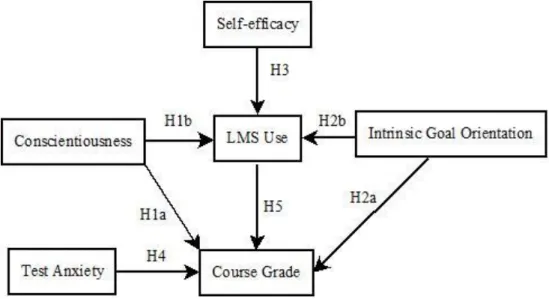
The originality of the current study is to show the impact of motivation and personality traits of students on their course grades and LMS use. Furthermore, online and blended learning environments were compared in an introductory information technology (IT) course in terms of predicting academic performance. Considering the previous studies in the literature, five main hypotheses were proposed.
The literature review showed that the conscientiousness trait has the most significant relation to academic performance and the relations between the remaining four personality traits and academic performance vary. We expected to obtain similar results to the literature in terms of the association between the conscientiousness traits and academic performance. Furthermore, due to the conflicting results obtained from earlier studies in relation to the remaining four personality traits, we proposed the following hypothesis regarding only the conscientiousness trait:
Hypothesis 1a: The conscientiousness trait predicts course grades in both online and blended learning
environments.
Hypothesis 1b: The conscientiousness trait predicts LMS use in both online and blended learning environments.
Various studies have shown that students’ motivation is an important predictor of their academic success and it is related to the individuals. Among the six motivation factors measured by MSLQ, the one that is most significantly related to academic performance is intrinsic motivation. Other significant factors include
self-efficacy and test anxiety. Most of the earlier studies have been conducted in traditional learning environments. Therefore, we used the results from both online and blended environments to fill the gap in the literature. To this end, the following hypotheses were proposed:
Hypothesis 2a: Intrinsic goal orientation predicts course grades in both online and blended learning
environments.
Hypothesis 2b: Intrinsic goal orientation predicts LMS use in both online and blended learning environments. Hypothesis 3: Self-efficacy predicts course grades and LMS use in both online and blended learning
environments.
Hypothesis 4: Test anxiety predicts course grades in both online and blended learning environments.
No other hypotheses were proposed for the remaining three motivation factors. However, all the relations were tested during the analysis. Furthermore, this study also investigated whether there is a relationship between LMS use and course grades based on the following hypothesis:
Hypothesis 5: LMS use predicts course grades in both online and blended courses.
All hypotheses are represented in the proposed research model in Figure 1. This proposed structural model was tested separately for online and blended course participants’ data.
Figure 1. Proposed research model
Method
Participants
The participants of this study were a total of 316 undergraduate students who enrolled in an introductory IT course in the Middle East Technical University (METU). Of these participants, 189 (109 female, 80 male) attended the online class and 127 (76 female, 51 male) attended the blended class. The average ages of the participants in the online and blended classes were 22.27 (SD = 2.17) and 22.03 (SD = 1.78), respectively. The subject area of students was diverse ranging from social sciences to engineering. In the online course setting, students do not attend face-to-face lectures but use LMS to access the lecture notes, upload assignments and follow the announcements. In the blended course setting, students attend face-to-face lectures conducted in computer laboratories. The classes last 12 weeks each semester and each week, students in the blended class attend two-hour laboratory sessions carried out by the instructors. Therefore, they access the materials at least once a week. Blended and online class students take the same exams in a laboratory at the same time. The exams comprise multiple choice and true false questions. This course has been given to all university students more than sixteen years each semester. The lecture notes are updated as technology develops. The exam questions are revised carefully each year by a committee.
Procedure
To conduct the study with human participants, the ethics approval was obtained from the METU Research Center for Applied Ethics. The online class participants were sent a link to the online survey using their school e-mail addresses. The blended class participants completed the survey in the classroom environment. A total of 658 students were reached, but 381 students participated in the study (59% response rate). 65 entries were excluded from the analysis due to incomplete or invalid responses. The participation in the study was totally voluntary and it took 20 minutes to complete the survey.
Instruments and measures
Personality traits
The Big Five Inventory (BFI) of 44 items (John & Srivastava, 1999) was used to measure the personality traits since it has been reported to be highly reliable despite having fewer items than the NEO Personality Inventory-Revised and NEO-Five Factor Inventory (Gosling, Rentfrow, & Swann Jr, 2003). Furthermore, BFI is more established and validated than Ten Item Personality Inventory (Gosling et al., 2003; John, Naumann, & Soto, 2008).The items were rated on a 5-point Likert scale from 1-Strongly disagree to 5-Strongly agree.
Motivated Strategies for Learning Questionnaire (MSLQ)
MSLQ prepared by Pintrich (1991) can be broken down into two main parts: motivation and learning strategies. However, in this study, only the motivation part was used. There were 29 items rated in a seven point scale from 1-not all true of me to 7-very true of me.
Measures on grades and LMS use
The average grade of participants was computed using the scores from their midterm and final exams and assignments. The students used NetClassR LMS which had been developed by METU to provide the instructors with a platform to distribute lecture notes, give assignments, make announcements, send e-mail to students, announce students’ grades and conduct exams. During the semester when the study was conducted, the LMS logs of the participants of the study were recorded. At the end of the semester, an aggregated LMS use score was computed based on the total number of LMS accesses. It was assumed that the students used the system every time they accessed it. In addition, the system automatically logged the students out when they were not active for a certain period; therefore, the number of access indicated the level of system use. However, the exact duration of the LMS access use was not available in the system.
Analysis approach
Bayesian Structural Equation Modeling (BSEM) was used to analyze the casual relationship between personality traits, motivation, LMS use and course grades. BSEM is an alternative to the general applications of Structural Equation Modeling (SEM) to handle the assumptions of them like normality, sample size and missing data (Lee, 2007). Different from the two forms of traditional SEM, BSEM depends on Markov Chain Monte Carlo algorithm (Muthén & Asparouhov, 2012) and has many advantages over SEM (Dunson, Palomo, & Bollen, 2005). It allows nonlinearity, interactions, missing data, mixed categorical variables and can be implemented with a smaller sample size. One of the distinguishing features of BSEM is using priors which are the specifications of prior distribution for model parameters (Kaplan & Depaoli, 2013). Prior information is important since the inference of the model is based on the posterior distributions of model parameters, which rely on prior distributions.
Model Convergence in BSEM can be checked with the Gelman-Rubin convergence diagnostics, convergence statistics (CS) in Amos (Arbuckle, 2012; Gelman, Carlin, Stern, & Rubin, 2004). Model fit in BSEM is simply assessed with a posterior predictive p value (Kaplan & Depaoli, 2013). Having a p value around 0.5 indicates a very good fit of the model to data (Dunson et al., 2005). However, models are acceptable when the p is between 0.3 and 0.7 (Song & Lee, 2006). A zero value of p indicates that the model does not represent the data (model misfit).
Data analysis and results
Preliminary analysis
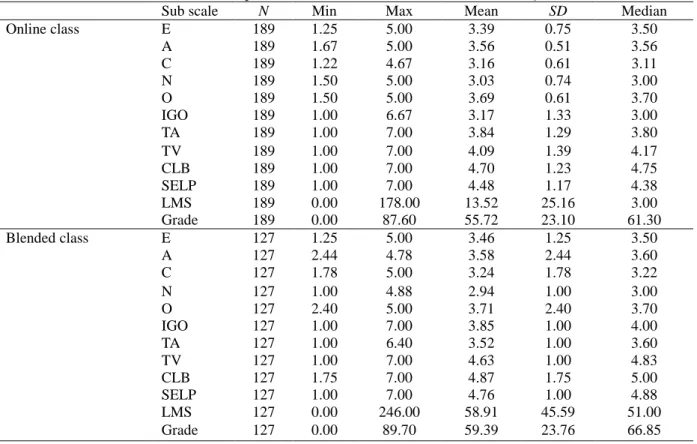
To examine the internal consistency of the questionnaire, the Cronbach’s alpha (coefficient alpha) was checked. The Cronbach’s alpha was computed for each subscale under BFI and MSLQ for online and blended classes separately (Table 1). Extrinsic goal orientation under the motivation scale was excluded from the analysis since it got a low alpha score for both online and blended class participants. This could be caused by the extrinsic goal orientation items being related to getting good grades or higher grades than their peers and thus referring to the students’ concern about their total grade. Since the participants of this study were from a noncredit course, these items were not applicable. After the reliability analysis, a composite score was computed by taking the average of the corresponding items in each personality trait and motivation factor. Table 2 presents the descriptive statistics of the scores.
Table 1. Coefficient alpha scores for BFI and MSLQ
Sub scale Number of
items
Coefficient alpha Online class Blended class
Extraversion (E) 8 0.836 0.785
Agreeableness (A) 9 0.597 0.639
Conscientiousness (C) 9 0.763 0.760
Neuroticism (N) 8 0.806 0.814
Openness (O) 10 0.805 0.767
Intrinsic Goal Orientation (IGO) 3 0.662 0.582
Test Anxiety (TA) 5 0.681 0.650
Task Value (TV) 6 0.889 0.884
Extrinsic Goal Orientation (EGO) 3 0.102 0.141 Control of Learning Beliefs (CLB) 4 0.682 0.672 Self-efficacy for Learning Performance (SELP) 8 0.872 0.891
Table 2. Descriptive statistics of all variables of BFI and MSLQ
Sub scale N Min Max Mean SD Median Online class E 189 1.25 5.00 3.39 0.75 3.50 A 189 1.67 5.00 3.56 0.51 3.56 C 189 1.22 4.67 3.16 0.61 3.11 N 189 1.50 5.00 3.03 0.74 3.00 O 189 1.50 5.00 3.69 0.61 3.70 IGO 189 1.00 6.67 3.17 1.33 3.00 TA 189 1.00 7.00 3.84 1.29 3.80 TV 189 1.00 7.00 4.09 1.39 4.17 CLB 189 1.00 7.00 4.70 1.23 4.75 SELP 189 1.00 7.00 4.48 1.17 4.38 LMS 189 0.00 178.00 13.52 25.16 3.00 Grade 189 0.00 87.60 55.72 23.10 61.30 Blended class E 127 1.25 5.00 3.46 1.25 3.50 A 127 2.44 4.78 3.58 2.44 3.60 C 127 1.78 5.00 3.24 1.78 3.22 N 127 1.00 4.88 2.94 1.00 3.00 O 127 2.40 5.00 3.71 2.40 3.70 IGO 127 1.00 7.00 3.85 1.00 4.00 TA 127 1.00 6.40 3.52 1.00 3.60 TV 127 1.00 7.00 4.63 1.00 4.83 CLB 127 1.75 7.00 4.87 1.75 5.00 SELP 127 1.00 7.00 4.76 1.00 4.88 LMS 127 0.00 246.00 58.91 45.59 51.00 Grade 127 0.00 89.70 59.39 23.76 66.85
Correlation analysis
In order to examine the interrelatedness of the variables in the dataset, correlation coefficients were computed. The effect sizes (r) were evaluated by following the rule of thumb interpretation of Cohen (1992): r = 0.1-small,
r = 0.3-medium and r = 0.5-large. Table 3 presents the correlations between personality traits, motivation factors,
LMS use and course grades among the online participants. A weak to moderate correlation was found among the subscales of the personality traits. Of all the measured personality traits, conscientiousness was weakly correlated with both LMS use and course grades. Moreover, weak to high correlations were found among the subscales of MSLQ. Intrinsic goal orientation and task value were weakly correlated to course grades whereas self-efficacy was weakly correlated to both course grades and LMS use. Finally, LMS use was weakly correlated to course grades.
Table 4 illustrates the correlations between personality traits, motivation factors, LMS use and course grades among the blended course participants. There are weak to high correlations within the subscales of motivation. Task value and test anxiety were weakly correlated to LMS use. In addition, weak to moderate correlations were found within the subscales of personality traits. The conscientiousness trait was weakly correlated to course grades. A moderate correlation was found between LMS use and course grades.
Table 3. Correlation among all variables for online class participants
TA TV CLB SELP E A C N O Grade LMS IGO .354** .668** .337** .372** .039 .171* .179* -.180* .028 .169* .134 TA .253** .003 -.029 -.038 .019 .177* .158* .018 .124 .015 TV .480** .466** .069 .208** .121 -.186* .067 .178* .104 CLB .511** .091 .11 -.059 -.112 .04 .057 .095 SELP .068 .052 .159* -.154* .215** .217** .201** E .257** .303** -.375** .523** .051 -.041 A .142 -.295** .244** .094 .066 C -.248** .218** .205** .163* N -.195** .03 .047 O -.092 -.008 Grade .160* Note. *p < .05; **p < .01.
Table 4. Correlation among all variables for blended class participants
TA TV CLB SELP E A C N O Grade LMS IGO .256** .647** .253** .046 -.064 .059 .038 .131 -.011 .044 .126 TA .082 .01 -.360** -.126 .066 -0.04 .180* -.109 -.047 .208* TV .430** .350** -.01 .087 .117 .069 .035 .064 .174* CLB .359** -.084 .189* -.025 -.048 .112 -.019 -.06 SELP .195* -.071 .14 -.239** .227* .03 -.098 E .018 .292** -.331** .362** .004 -.06 A .205* -.142 .230** .024 .032 C -.289** .227* .244** .082 N -.067 -.005 .095 O .082 .036 Grade .383** Note. *p < .05; **p < .01.
Course grade prediction: BSEM
To identify the casual relations between all the variables and test the hypotheses, two structural models were created in Amos Graphics 21 and analyzed with BSEM; one for online course and one for blended course. In BSEM, a CS value smaller than 1.002 indicates model convergence (Gelman et al., 2004). Therefore, during the analysis, when CS was below 1.002, the model was considered acceptable. Table 5 presents the CS of both models. During analysis, weakly informative priors were used and the means of model parameters were set to a bounded uniform distribution (Dunson et al., 2005; Hoyle, 2012). In this study, means of the coefficients of the observed variables were set to a uniform distribution having lower bound 1 and upper bound 5 or 7, since it was suggested that defining priors with upper and lower bounds for Likert type scales is appropriate when informative priors are lacking (Arbuckle, 2012). Since uniform priors could result in improper posterior, the
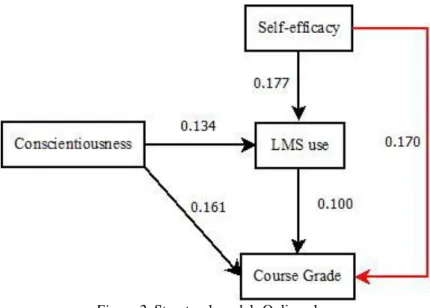
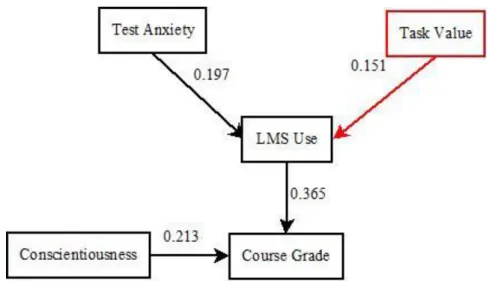
admissibility test was used to prevent them. Model fit was tested based on the posterior predictive p value. A p value around 0.5 gives the best model fit (Dunson et al., 2005) and models are acceptable when p is between 0.3 and 0.7 (Song & Lee, 2006). In this study, online and blended course models were considered acceptable since they had a predictive p value of 0.29 and 0.48, respectively (Table 5). The graphical representations of the models are given in Figure 2 and 3. All significant paths are represented in the figures with the standardized direct effects of predictor variables over the dependent variables. Table 6 presents the parameter estimates obtained from BSEM.
Table 5. Model statistics
Online course Blended course
Posterior predictive p 0.29 0.48
Convergence statistics 1.0018 1.0018
R2 0.100 0.200
Table 6. Parameter estimates of course grade
Parameter estimates (Estimation of course grade)
Parameter Mean Std. Error 95% Credibility interval Lower bound Upper bound Online course (a) GradeLMSUse 0.095 0.003 -0.037 0.221
LMSUseSELP 3.835 0.058 0.840 6.843 GradeSELP 3.401 0.059 0.519 6.129 GradeC 6.190 0.162 0.537 11.936 LMSUseC 5.544 0.151 0.031 11.086 Blended Course (b) GradeLMSUse 0.189 0.002 0.108 0.274 LMSUseTA 7.399 0.128 0.876 13.662 LMSUseTV 5.188 0.112 -0.599 11.055 GradeC 8.630 0.144 2.426 15.058 In the online course model (Figure 2), the predictors of course grades are LMS use, self-efficacy and conscientiousness (R2 = 0.100). The conscientiousness trait has a positive path to LMS use and course grades,
which supports Hypothesis 1a and Hypothesis 1b. Hypotheses 2a and 2b are not supported since there is no significant path from intrinsic goal orientation to course grades or LMS use. There is a positive path from self-efficacy to course grades and LMS use supporting Hypothesis 3. Hypothesis 4 is not supported, since there is no significant path between test anxiety and course grades. Finally, the significant path between LMS use and course grades supports Hypothesis 5.
Figure 2. Structural model- Online class
When the blended class model is examined (Figure 3), test anxiety, task value, conscientiousness trait and LMS use are found to be the predictors of course grades (R2 = 0.200). The conscientiousness trait has a positive path to
course grades supporting Hypothesis 1a. Hypothesis 1b is not supported since there is no significant path from conscientiousness to LMS use. Hypotheses 2a and 2b are also not supported due to the lack of a significant path from intrinsic goal orientation to course grades or LMS use. Similarly, Hypotheses 2 to 4 are not supported since
there is no significant path between the parameters. However, a significant path is observed between text anxiety and LMS use, which was not hypothesized. Finally, the significant path between LMS use and course grade supports Hypothesis 5.
Figure 3. Structural model- Blended class
Conclusion and discussion
This study contributes to the literature by providing a comparative analysis with respect to the relationship between individual differences and academic performance in online and blended environments using BSEM analysis. More specifically, we examined the effects of personality and motivation over academic performance in both online and blended learning settings. Many of the previous studies analyzed these constructs only partially and in one environment. The participants of this study were also from different subject areas from social sciences to engineering unlike other studies. Another important contribution of this study was to investigate the impact of motivation and personality factors on the frequency of access to lecture notes.
The results indicate that personality is a predictor of academic performance in both online and blended course settings. A significant positive relation was found between the conscientiousness trait and course grades in both settings. This implies that students with the characteristics of the conscientiousness trait are more successful in exams. This is not surprising considering that conscientious individuals are considered to be organized, disciplined and responsible (McCrae & Costa, 1987). This result confirms the results of previous studies by Noftle and Robins (2007), Poropat (2009) and Nguyen et al. (2005). Moreover, the conscientiousness trait was found to be positively and significantly related to LMS use in the online course setting. Online environment has a limited capacity to engage learners in learning events unless the learners are self-motivated and active learners (Daniels & Moore, 2000). Conscientious individuals exhibit these characteristics. However, this relation was not observed in the blended course setting. This may be due to the nature of the course as the students in the blended course regularly used online materials in laboratory sessions. Hence, LMS access does not directly show how active a particular student is in a face-to-face class.
Self-efficacy was found significantly related to both LMS use and course grades in the online course setting. Students with higher self-efficacy are more likely to work harder and achieve more tasks than their peers (Linnenbrink & Pintrich, 2002). In the online course setting, students do not attend face-to-face lectures and activities and therefore they usually study by themselves, which requires higher self-efficacy and discipline. Furthermore, studies have shown that self-efficacy positively predicts students’ course grades (Brackney & Karabenick, 1995; Credé & Phillips, 2011). The findings of the current study are in parallel with these studies. Although self-efficacy was found significantly related to LMS use and course grades in the online environment, no significant relation was found in the blended course setting. The reason could be attributed to regular support provided to these students. This reduced the need for individual studying without solely relying on online materials. This finding is in agreement with the results reported by Lynch and Dembo (2004).
Previous studies have reported a negative relation between test anxiety and course grades (Brackney & Karabenick, 1995; Credé & Phillips, 2011). However, in the current study, we did not find any direct relation between the two in both settings. This could have resulted from the context of our study, in which the
participants attended a course that did not contribute to their GPA. This may have reduced their level of anxiety concerning the exams. On the other hand, we found a positive significant relation between test anxiety and LMS use in the blended course. This may be due to these students feeling the need to study lecture notes more than their peers, which can also explain their higher use of LMS compared to others. Although test anxiety was found related to LMS use in the blended course setting, no significant relation was found between the two parameters in the online course setting. It may be due to the students who have a familiarity with the course content preferring to register for the online course.
A significant positive relation was found between task value and LMS use in the blended course setting. This implies that if students found the course content useful, they studied the lecture notes more. Similarly, in the study by Brackney and Karabenick (1995), a positive correlation was found between course grades and task value. In the current study, task value has indirectly affected course grades through its effect on LMS use in the blended course setting. It can be concluded that students are more successful when they find the course content useful and important.
LMS use was found to positively affect course grades in both online and blended class settings. This result implies that students, who study lecture notes more, are more likely to receive higher grades in a course. Similarly, in a self-reported survey, Swan (2002) found that students who had higher levels of interaction with the content had higher reported levels of satisfaction and learning. However, contradicting results were revealed by Biktimirov and Klassen (2008), who reported no correlation between content hits and course grades, and Grandzol and Grandzol (2010), who showed that student participation was a significant inverse predictor of course completion. Grandzol and Grandzol (2010) explained this with the fact that they could not be sure whether the students were actively engaged with the materials or just left the web page open. Since the course materials are well established meaning that they have been regularly revised according to instructors and students’ feedbacks, this argument does not prevail for our study.
The implications of this study can be summarized as follows: in the online course setting, students who are conscientious and have higher self-efficacy are more likely to succeed in a course. However, others may require support from their instructors. Test anxiety and task value constructs are only observed in the blended course setting. Providing students with sample exams and previous years’ questions or organizing a mock up exam may decrease their anxiety about the course. Furthermore, students can be provided with the choice of taking the online or blended version of the class if the course supports both settings. Those with lower self-efficacy or conscientiousness can be encouraged to take the blended rather than the online course since they may struggle more in the latter. Furthermore, instructors can observe the access patterns of their students to the lecture notes to have an idea about how they will perform at the end of the course.
Future work
This study contributed to the literature by investigating the relationship between the individual differences, LMS use and course grades in the online and blended course settings. One limitation of this study is that the results cannot be generalized across different disciplines and cultures since the data was collected from an introductory IT course given in a university in Turkey. In the future, different courses can be evaluated to observe the differences in different disciplines. In the context of this study, LMS use was represented as a total score of students’ access to the LMS lecture materials. It was assumed that students used the lecture notes in LMS during their access. However, since the system does not provide details regarding actual use, the students may have only logged into the system but left without reading or giving their full attention to the materials. The duration of LMS use, the number of forum accesses to read and leave messages, and access details with respect to individual files may affect the results.
References
Akkoyunlu, B., & Soylu, M. Y. (2008). A Study of student’s perceptions in a blended learning environment based on different learning styles. Journal of Educational Technology & Society, 11(1), 183-193.
Arbuckle, J. L. (2012). IBM SPSS Amos 21 user’s guide. Chicago, IL: Amos Development Corporation.
Artino Jr, A. R. (2005). Review of the Motivated Strategies for Learning Questionnaire. Online Submission. Retrieved from https://eric.ed.gov/?id=ED499083
Baugher, D., Varanelli, A., & Weisbord, E. (2003). Student hits in an internet-supported course: How can instructors use them and what do they mean? Decision Sciences Journal of Innovative Education, 1(2), 159-179.
Berndt, T. J., & Miller, K. E. (1990). Expectancies, values, and achievement in junior high school. Journal of Educational Psychology, 82(2), 319-326.
Biktimirov, E. N., & Klassen, K. J. (2008). Relationship between use of online support materials and student performance in an introductory finance course. Journal of Education for Business, 83(3), 153-158.
Brackney, B. E., & Karabenick, S. A. (1995). Psychopathology and academic performance: The Role of motivation and learning strategies. Journal of Counseling Psychology, 42(4), 456-465.
Chamorro-Premuzic, T., & Furnham, A. (2003). Personality predicts academic performance: Evidence from two longitudinal university samples. Journal of Research in Personality, 37(4), 319-338.
Chen, K.-C., & Jang, S.-J. (2010). Motivation in online learning: Testing a model of self-determination theory. Computers in Human Behavior, 26(4), 741-752.
Coates, H., James, R., & Baldwin, G. (2005). A Critical examination of the effects of learning management systems on university teaching and learning. Tertiary education and management, 11(1), 19-36.
Cohen, J. (1992). A Power primer. Psychological bulletin, 112(1), 155-159.
Costa, P. T., & McCrae, R. R. (1992). Revised neo personality inventory (neo pi-r) and neo five-factor inventory (neo-ffi) (Vol. 101). Odessa, FL: Psychological Assessment Resources.
Credé, M., & Phillips, L. A. (2011). A Meta-analytic review of the Motivated Strategies for Learning Questionnaire. Learning and Individual Differences, 21(4), 337-346.
Daniels, H. L., & Moore, D. M. (2000). Interaction of cognitive style and learner control in a hypermedia environment. International Journal of Instructional Media, 27(4), 369-384.
Deci, E. L., & Ryan, R. M. (1985). Intrinsic motivation and self-determination in human behavior. New York, NY: Springer Science & Business Media.
Duff, A., Boyle, E., Dunleavy, K., & Ferguson, J. (2004). The Relationship between personality, approach to learning and academic performance. Personality and individual differences, 36(8), 1907-1920.
Dunson, D. B., Palomo, J., & Bollen, K. (2005). Bayesian structural equation modeling. Technical Report. Research Triangle Park, NC: Statistical and Applied Mathematical Sciences Institute.
Fairchild, A. J., Horst, S. J., Finney, S. J., & Barron, K. E. (2005). Evaluating existing and new validity evidence for the academic motivation scale. Contemporary Educational Psychology, 30(3), 331-358.
Fortier, M. S., Vallerand, R. J., & Guay, F. (1995). Academic motivation and school performance: Toward a structural model. Contemporary educational psychology, 20(3), 257-274.
Gelman, A., Carlin, J. B., Stern, H. S., & Rubin, D. B. (2004). Bayesian data analysis. Texts in statistical science series. Boca Raton, FL: Chapman & Hall/CRC.
Ginns, P., & Ellis, R. (2007). Quality in blended learning: Exploring the relationships between on-line and face-to-face teaching and learning. The Internet and Higher Education, 10(1), 53-64.
Gosling, S. D., Rentfrow, P. J., & Swann Jr, W. B. (2003). A Very brief measure of the Big-Five personality domains. Journal of Research in personality, 37(6), 504-528.
Graham, C. R. (2006). Blended learning systems: Definition, current trends, and future directions. In C.J. Bonk & C.R. Graham (Eds), The handbook of blended learning: Global perspectives, local designs (pp.3-21). San Francisco, CA: Pfeiffer. Grandzol, C. J., & Grandzol, J. R. (2010). Interaction in online courses: More is not always better. Online Journal of Distance Learning Administration, 13(2), 1-18.
Gray, E. K., & Watson, D. (2002). General and specific traits of personality and their relation to sleep and academic performance. Journal of Personality, 70(2), 177-206.
Hannafin, M. J. (1984). Guidelines for using locus of instructional control in the design of computer-assisted instruction. Journal of instructional development, 7(3), 6-10.
Hoyle, R. H. (2012). Handbook of structural equation modeling. New York, NY: Guilford Press.
Huang, E. Y., Lin, S. W., & Huang, T. K. (2012). What type of learning style leads to online participation in the mixed-mode e-learning environment? A Study of software usage instruction. Computers & Education, 58(1), 338-349.
John, O. P., Naumann, L., & Soto, C. (2008). Paradigm shift to the integrative Big Five trait taxonomy. In Handbook of Personality: Theory and Research (pp. 114-158). New York, NY: Guilford Press.
John, O. P., & Srivastava, S. (1999). The Big Five trait taxonomy: History, measurement, and theoretical perspectives. Handbook of personality: Theory and research, 2(1999), 102-138.
Kaplan, D., & Depaoli, S. (2013). Bayesian statistical methods. In Todd D. Little (Eds), Oxford handbook of quantitative methods (pp. 407-437). New York, NY: Oxford University Press.
Kim, J.-Y. (2013). Effects of personality traits and Kolb Learning Styles on learning outcomes in a blended learning environment. International Journal of Digital Content Technology and its Applications, 7(13), 261-267.
Lee, S.-Y. (2007). Structural equation modeling: A Bayesian approach. England: John Wiley & Sons.
Lim, D. H., Morris, M. L. & Kupritz, V. W. (2007). Online vs. Blended learning: Differences in instructional outcomes and learner satisfaction. Journal of Asynchronous Learning Networks, 11(2), 27-42.
Lin, Y.-G., McKeachie, W. J., & Kim, Y. C. (2001). College student intrinsic and/or extrinsic motivation and learning. Learning and Individual Differences, 13(3), 251-258.
Linnenbrink, E. A., & Pintrich, P. R. (2002). Motivation as an enabler for academic success. School Psychology Review, 31(3), 313-327.
Lounsbury, J. W., Sundstrom, E., Loveland, J. M., & Gibson, L. W. (2003). Intelligence, “Big Five” personality traits, and work drive as predictors of course grade. Personality and Individual Differences, 35(6), 1231-1239.
Lynch, R., & Dembo, M. (2004). The Relationship between self-regulation and online learning in a blended learning context. The International Review of Research in Open and Distributed Learning, 5(2), 1-16.
López-Pérez, M. V., Pérez-López, M. C., & Rodríguez-Ariza, L. (2011). Blended learning in higher education: Students’ perceptions and their relation to outcomes. Computers & Education, 56(3), 818-826.
McCrae, R. R., & Costa, P. T. (1987). Validation of the five-factor model of personality across instruments and observers. Journal of personality and social psychology, 52(1), 81-90.
Meece, J. L., & Holt, K. (1993). A Pattern analysis of students’ achievement goals. Journal of educational psychology, 85(4), 582-590.
Muthén, B., & Asparouhov, T. (2012). Bayesian SEM: A more flexible representation of substantive theory. Psychological Methods, 17(3), 313-335.
Nguyen, N., Allen, L. C., & Fraccastoro, K. (2005). Personality predicts academic performance: Exploring the moderating role of gender. Journal of Higher Education Policy and Management, 27(1), 105-117.
Noftle, E. E., & Robins, R. W. (2007). Personality predictors of academic outcomes: Big Five correlates of GPA and SAT scores. Journal of personality and social psychology, 93(1), 116-130.
O’Connor, M. C., & Paunonen, S. V. (2007). Big Five personality predictors of post-secondary academic performance. Personality and Individual differences, 43(5), 971-990.
Paunonen, S. V., & Ashton, M. C. (2001). Big Five predictors of academic achievement. Journal of Research in Personality, 35(1), 78-90.
Pintrich, P. R. (1991). A Manual for the use of the Motivated Strategies for Learning Questionnaire (MSLQ). Ann Arbor, MI: National Center for Research to Improve Postsecondary Teaching and Learning.
Pintrich, P. R., & De Groot, E. V. (1990). Motivational and self-regulated learning components of classroom academic performance. Journal of educational psychology, 82(1), 33-40.
Poropat, A. E. (2009). A Meta-analysis of the five-factor model of personality and academic performance. Psychological bulletin, 135(2), 322-338.
Rosander, P., Bäckström, M., & Stenberg, G. (2011). Personality traits and general intelligence as predictors of academic performance: A Structural equation modelling approach. Learning and Individual Differences, 21(5), 590-596.
Rovai, A. P., & Jordan, H. (2004). Blended learning and sense of community: A Comparative analysis with traditional and fully online graduate courses. The International Review of Research in Open and Distributed Learning, 5(2), 1-13.
Schuler, H., Thornton III, G., Frintrup, A., & Mueller-Hanson, R. (2004). Achievement motivation inventory test manual. Goettingen, Germany: Hogrefe.
Song, X.-Y., & Lee, S.-Y. (2006). Bayesian analysis of structural equation models with nonlinear covariates and latent variables. Multivariate Behavioral Research, 41(3), 337-365.
Swan, K. (2002). Building learning communities in online courses: The Importance of interaction. Education, Communication & Information, 2(1), 23-49.
Wilson, A. H. (2003). Evidence of the effectiveness of course management software and asynchronous communication in a first finance course. Journal of Financial Education, 29, 40-54.
Zimmerman, B. J., Bandura, A., & Martinez-Pons, M. (1992). Self-motivation for academic attainment: The Role of self-efficacy beliefs and personal goal setting. American educational research journal, 29(3), 663-676.