Published online 2014 November 17. Research Article
Epidemiological and Cost Analysis of Self-Poisoning Cases in Ankara, Turkey
Gulsum Kavalci
1,*; Filiz Banu Ethemoglu
1; Asli Batuman
1; Dilber Kumral
1; Cengizhan Emre
1;
Meltem Surgit
1; Alev Akdikan
1; Cemil Kavalci
21Department of Anesthesiology and Reanimation, Yenimahalle State Hospital, Ankara, Turkey 2Department of Medicine Emergency, University of Baskent, Ankara, Turkey
*Corresponding Author: Gulsum Kavalci, Department of Anesthesiology and Reanimation, Yenimahalle State Hospital, Ankara, Turkey. Tel: +90-3125085026, Fax: +90-3123125346, E-mail: [email protected]
Received: February 18, 2013; Revised: November 22, 2013; Accepted: October 1, 2014
Background: Poisoning is a global public health problem. Self-poisoning has potentially serious consequences. Follow-up studies have
found that 3-10% of self-harm patients eventually succeed.
Objectives: This study was designed to investigate the epidemiological, clinical and economical aspects of deliberate self-poisoning
patients admitted to Yenimahalle State Hospital Intensive Care Unit.
Patients and Methods: The study was carried out retrospectively in Ankara Yenimahalle State Hospital. It included Seventy-one patients
over 16 years of age who were admitted to the hospital due to poisoning during 2012. Exposed poisons were classified into one of three categories; pharmaceuticals, pesticides, and alcohols. Cost account was based on the medical invoices at patient discharge. Data were compared using Student’s T test and chi-square test. A P value of less than 0.05 was considered significant.
Results: The female/male ratio was 2.55. The mean age of the 71 poisoned patients was 28.92 ± 11.51 years. Most of the poisoning agents were
pharmaceuticals (68 cases). Among the pharmaceuticals, antidepressants were involved most often, followed by analgesics. There was no statistically significant difference between pharmaceutical agents in terms of hospital cost (P > 0.05). The mean length of hospital stay was 6.4 ± 4.3 days. There was a statistically significant difference between the lengths of stay of patients in terms of hospital cost (P < 0.05).
Conclusions: The patient cost increased as the length of stay increased due to the policy of bundle pricing.
Keywords:Poisoning; Cost; Intensive Care Unit
Copyright © 2014, Iranian Red Crescent Medical Journal. This is an open-access article distributed under the terms of the Creative Commons Attribution-NonCom-mercial 4.0 International License (http://creativecommons.org/licenses/by-nc/4.0/) which permits copy and redistribute the material just in noncomAttribution-NonCom-mercial us-ages, provided the original work is properly cited.
1. Background
Poisoning is a global public health problem. Deliber-ate self-harm (DSH) is a major health problem in devel-oping countries (1, 2). Deliberate self-harm is common among young people, especially in certain subpopula-tions. It may be associated with depression, suicide at-tempt and some other psychiatric disorders (2). Deliber-ate self-poisoning is one of the commonest reasons for general hospital admissions in the UK, and it represents a considerable economic burden (3-5). Self-poisoning has potentially serious consequences; follow-up studies have found that 3- 10% of self-harm patients eventually succeed (4, 5).
2. Objectives
This study aimed to investigate the epidemiological, clinical and economic aspects of deliberate self-poison-ing patients admitted to Yenimahalle State Hospital In-tensive Care Unit (ICU).
3. Patients and Methods
This study was cross-sectional and retrospectively
car-ried out at Ankara Yenimahalle State Hospital, Turkey. There were no ethical issues associated with this study. The authors worked according to the Helsinki declara-tion. We included 71 patients, who were admitted to the hospital’s ICU due to self-poisoning during 2012. Deliber-ate self-poisoning is defined as the deliberDeliber-ate ingestion of substances intended to cause harm. Characteristics such as age and gender of the patients, poisoning agents, outcomes (discharged, referred, admitted, death etc.), and cost were recorded. Inclusion/exclusion criteria are shown in Table 1. Exposed poisons were classified into one of the three categories: pharmaceuticals, pesticides, and alcohols. Pharmaceuticals were subcategorized into an-tidepressants, analgesics, other psychotropic agents (in-cluding antipsychotics, benzodiazepines, lithium, etc.), antiepileptics, antibiotics, antihypertensives, others (in-cluding vitamins, antihistamines, antiemetics, antidys-peptic drugs, anti-ulcer drugs, hormones, antidiabetics, skeletal muscle relaxants, warfarin, drugs for the com-mon cold, etc.), and unidentifiable. The number of in-gested pharmaceuticals was also recorded. Cost account was based on the medical invoices at patient discharge.
For statistical analysis, patients’ data were assessed by the SPSS version 18.0 software. Quantitative variables were expressed as mean ± standard deviation. Frequency and percentage distribution were used for the evaluation of data. The chi-squared test was used for comparison of the categorized variables. Distribution of the invoices was evaluated with the Kolmogorov-Smirnov test and normally distributed invoices were compared using Stu-dent’s T test and ANOVA test. For the determination of fac-tors effective on patient cost, logistic regression analysis was done. A P value of less than 0.05 was accepted as sig-nificant.
4. Results
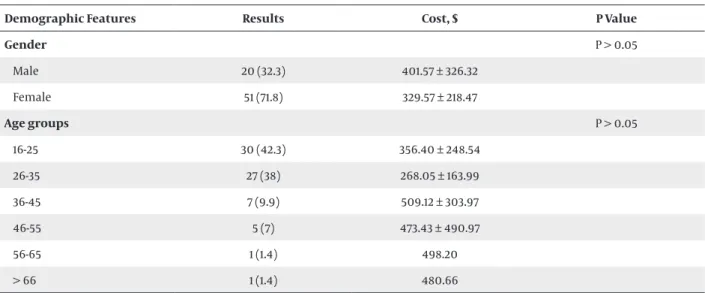
Of the 1291 patients admitted to the critical care unit during this one-year period, 71 (5%) had poisoning. Among these cases, 71.8% were female. The female/male ratio was 2.55. There was no statistically significant difference be-tween the two genders in terms of hospital cost (P > 0.05) (Table 2). The mean age of the 71 poisoned patients was 28.92 ± 11.51 years. Most of our patients (42.3%) were un-der 26 years of age (Table 2). There was no statistically sig-nificant difference regarding the hospital cost of differ-ent age groups (P > 0.05) (Table 2). Mean systolic blood pressure was 116.96 ± 14.2 mmHg, mean diastolic blood pressure was 76.49 ± 7.85 mmHg, and mean heart rate
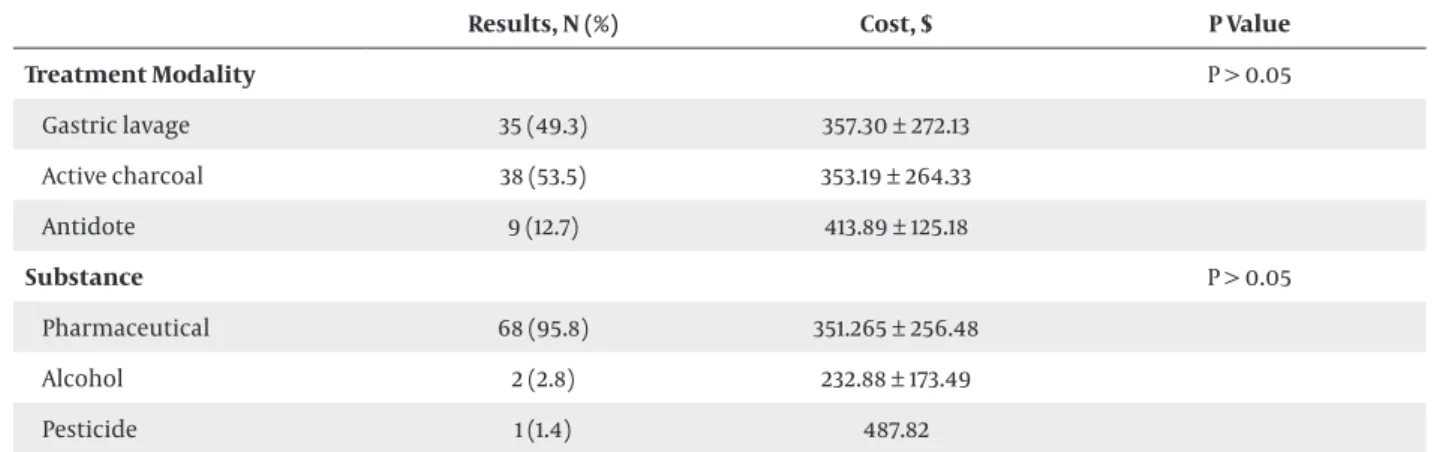
was 90.27 ± 2.56 bpm. Gastric lavage was performed in 49.3% of patients. Treatment modalities are summarized in Table 2. There was no statistically significant difference between treatment modalities in terms of hospital cost (P > 0.05) (Table 3). Furthermore, 67.6% of patients were intoxicated by a single agent, and 14.1% were intoxicated by two agents (Table 4). There was a statistically signifi-cant difference between hospital costs according to the number of type of agents (P < 0.05) (Table 4).
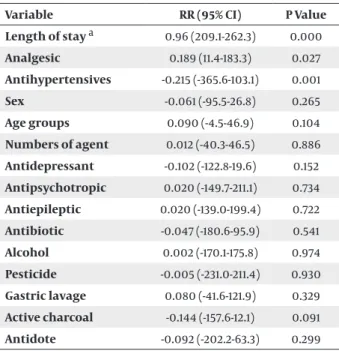
Most of the poisoning agents were pharmaceuticals (68 cases). The distribution of poisoning agents is shown on the Table 3. There was no statistically significant differ-ence between the poisoning agents in terms of hospital cost (P > 0.05) (Table 3). Among the pharmaceuticals, antidepressants were most often involved, followed by analgesics (Table 4). There was no statistically significant difference between pharmaceutical agents in terms of hospital cost (P > 0.05) (Table 4). All patients were evalu-ated, treevalu-ated, and discharged from the critical care unit (100%). The mean length of hospital stay was 6.4 ± 4.3 days. There was a statistically significant difference be-tween the lengths of stay in terms of hospital cost (P < 0.05) (Table 5). No patient died due to poisoning. For the determination of factors effective on patient cost, logistic regression analysis was done. Length of stay, analgesics and antihypertensive poisonings were determined as fac-tors influencing patient costs (Table 6).
Table 1. Inclusion/Exclusion Criteria
Inclusion Criteria Exclusion Criteria
Patients over 16 years of age patients under 16 years of age
Patients who were admitted to the hospital’s ICU with deliber-ate self-poisoning
Table 2. Demographic Features of Patients a
Demographic Features Results Cost, $ P Value
Gender P > 0.05 Male 20 (32.3) 401.57 ± 326.32 Female 51 (71.8) 329.57 ± 218.47 Age groups P > 0.05 16-25 30 (42.3) 356.40 ± 248.54 26-35 27 (38) 268.05 ± 163.99 36-45 7 (9.9) 509.12 ± 303.97 46-55 5 (7) 473.43 ± 490.97 56-65 1 (1.4) 498.20 > 66 1 (1.4) 480.66
Table 3. Poisoning Agents and Treatment Modalities a
Results, N (%) Cost, $ P Value
Treatment Modality P > 0.05 Gastric lavage 35 (49.3) 357.30 ± 272.13 Active charcoal 38 (53.5) 353.19 ± 264.33 Antidote 9 (12.7) 413.89 ± 125.18 Substance P > 0.05 Pharmaceutical 68 (95.8) 351.265 ± 256.48 Alcohol 2 (2.8) 232.88 ± 173.49 Pesticide 1 (1.4) 487.82
a Data are Presented as No. (%) or Mean ± SD.
Table 4. Pharmaceutical Agents (one or multiple) Involved in Poisoning a
Results Cost, $ P Value
Numbers of Agent P < 0.05 1 48 (67.6) 320.11 ± 198.6 2 10 (14.1) 557.52 ± 468.50 3 6 (8.5) 295.65 ± 124.35 4 7 (9.9) 303.51 ± 93.13 Pharmaceuticals P > 0.05 Antidepressant 31 (43.7) 318.59 ± 247.64 Analgesic 28 (39.4) 365.08 ± 221.05 Other psychotropic 3 (4.2) 827.06 ± 668.83 Antiepileptic 2 (2.8) 266.90 ± 24.69 Antibiotic 6 (8.5) 306.48 ± 201.73 Antihypertensives 4 (5.6) 558.28 ± 520.65 Others 16 (22.5) 435.62 ± 298.17 Unidentifiable 9 (12.7) 270.71 ± 185.41
a Data are Presented as No. (%) or Mean ± SD.
Table 5. Cost and Length of Stay a
Length of Stay Results Cost, $ P Value
1 8 (11.3) 61.41 ± 52.36 < 0.05 2 31 (43.7) 236.72 ± 85.86 3 24 (33.8) 423.65 ± 128.87 4 5 (7) 648.70 ± 103.02 5 2 (2.8) 1150.98 ± 4.88 7 1 (1.4) 1300
Table 6. Factors Effective on Patient Cost
Variable RR (95% CI) P Value Length of stay a 0.96 (209.1-262.3) 0.000 Analgesic 0.189 (11.4-183.3) 0.027 Antihypertensives -0.215 (-365.6-103.1) 0.001 Sex -0.061 (-95.5-26.8) 0.265 Age groups 0.090 (-4.5-46.9) 0.104 Numbers of agent 0.012 (-40.3-46.5) 0.886 Antidepressant -0.102 (-122.8-19.6) 0.152 Antipsychotropic 0.020 (-149.7-211.1) 0.734 Antiepileptic 0.020 (-139.0-199.4) 0.722 Antibiotic -0.047 (-180.6-95.9) 0.541 Alcohol 0.002 (-170.1-175.8) 0.974 Pesticide -0.005 (-231.0-211.4) 0.930 Gastric lavage 0.080 (-41.6-121.9) 0.329 Active charcoal -0.144 (-157.6-12.1) 0.091 Antidote -0.092 (-202.2-63.3) 0.299 a Logistic regression analysis.
5. Discussion
Poisonings are important causes of mortality and morbidity. Suicide is the second most common cause of death among adolescents and young adults (6). In a study of adult poisoning cases carried out in Canada, acute intoxications accounted for 0.7% of admissions (7). Hanssens et al. showed that acute poisoning cases were 0.18% of all hospital admissions (8). Another study on poisonings carried out in England revealed that 1.2% of hospital visits were due to acute poisonings (6). Kapur et al. reported that self-poisoning accounted for 0.31% of hospital admissions (3). Mashreky et al. reported that poi-soning cases were 0.073% of hospital admissions (9). Cen-giz et al. reported that acute poisoning cases were 0.18% of all hospital admissions (10). According to our results, our patient population had an acute poisoning ratio of 0.05% which is less than that reported from other parts of Turkey (0.004-2.4%) (11-16). Our results were consistent with the literature. In previous reports, the female/male ratio varied between 1.7 and 3 (12-20). The female/male ra-tio in our patients was 2.55. Interestingly, this rara-tio has been reported to be lower (approximately 1/1) in various developed countries (7, 21-23). As in other reports, the majority of our patients were young, where 42.3% were under 26 years old; similar to proportions in two inter-national studies and in two studies from Turkey (7, 8, 17, 18). Our results were consistent with the literature. We suggest that economical and social issues, such as unem-ployment and marriage, more commonly affect this age group. The substances involved in most of the poisonings in our study were pharmaceutical agents (95.8%), which is in agreement with reports from other regions in
Tur-key (12-16). In studies from other countries, pharmaceu-ticals were also found to be the most common agents involved in acute poisoning (21-24). Cengiz et al. reported that pharmaceutical agents were the cause of 51.2% of intoxications in patients admitted to the intensive care unit (10). Differences between developmental and socio-cultural levels of the regions in which the study was con-ducted may have affected and changed the study results. Regarding the type of pharmaceutical agents involved in poisonings of Turkey, analgesics were reported to be the most frequently ingested agents in some studies (27.6% in our study) (12-15), whereas antidepressants were most commonly used in the study reported by Baydin et al. (18). Antidepressants were most commonly used in our study (43.7%). Antidepressants are easily available without a prescription in Turkey. Alcohols were the second most common toxic substance in our study (2.8%) (Table 2).
The ratio of alcohol to all other poisoning agents was 3.1-18% in previous studies (1, 22-25). White et al. reported that alcohol poisoning increased in young adults between 1999-2008 (26). Our results were in accordance with the literature. In Islamic communities alcohol consumption is less than western communities, thus poisoning rates might be lower in Turkey. Pesticides were the third most common toxic agent (1.4%). Cengiz et al. reported that pesticide poisoning rate was 10% (10). Khurram and Mah-mood reported that pesticide poisoning rate was 21.3% (27). Studies from non-agricultural areas in Turkey re-ported a much lower percentage of poisonings involving pesticides, ranging between 0.9% and 1.6% (15, 28), while studies from agricultural areas reported a rate of pesti-cide involvement of 12-26% (18, 29). In such regions, pes-ticides are often sold in local markets and kept at home (27, 28). We think that the rate of pesticide poisoning in our study was low due to a low ratio of agricultural areas in the studied region. Mortality rate of 0-5.8% has been re-ported in the literature (8-17, 19). Our mortality rate (0%) was consistent with the literature. Early intervention decreased the mortality rate. The ratio of poisoning by a single agent was reported as 55-74% in previous studies (16, 17, 24), while 67.6% of our patients were intoxicated by a single agent. Our results are similar to the literature. Suicidal attempts are commonly impulsive and patients ingest a single agent that is easily reachable rather than multiple agents. The duration of the intensive care stay ranged between 1.6 and 6.4 days (2, 5, 10, 30) in the lit-erature. The duration of the intensive care stay in our study was 6.4 ± 4.3 days. Increased defensive medicine approaches and malpractice law may have increased the length of stay. Costs of poisoning cases treated at the intensive care unit have been scarcely studied. Serinken et al. reported a hospital cost of $144.06 for patients ad-mitted for suicide (2). Kapur et al. reported that the cost of intensive care unit ranged between £217 and £432 (3). Shadid et al. reported that the average hospital cost of a poisoning patient was $255 (31). D’Mello et al. reported that the cost of hospital treatment for patients who
over-dosed on tricyclic antidepressants was four times greater than the cost of treatment for patients who overdosed on selective serotonin reuptake inhibitors (29). Yeo et al. re-ported that mean cost of a poisoning patient was £425.64 (5). The average cost in our study was $349. We think that the difference between the costs is a result of varying policies of charging of services. Serinken et al. from Tur-key reported a cost of $144.06 (2) while we determined a cost of $349. We observed a difference in hospital cost that was associated with the number of ingested agents and length of hospital stay. We feel that our average cost has been increased by the bundle pricing that was put into effect in our country during an intervening period of six years. Poisoning is common in adults in our stud-ied region; the risk being highest in females and younger adults. The patient cost increases as the length of hospi-tal stay increases due to the policy of bundle pricing.
5.1. Limitation of the Study
The major limitation of this study was its retrospective nature and small number of patients included in the study due to late establishment of ICU in 2012.
Authors’ Contributions
Gulsum Kavalci: study concept and design. Filiz Banu Et-hemoglu and Asli Batuman: acquisition of data. Gulsum Kavalci, Dilber Kumral and Cengizhan Emre: drafting of the manuscript. Meltem Surgit: administrative, technical and material support. Cemil Kavalci: analysis and inter-pretation of data, and critical revision of the manuscript for important intellectual content.
References
1. Eddleston M. Patterns and problems of deliberate self-poisoning in the developing world. QJM. 2000;93(11):715–31.
2. Serinken M, Karcioglu O, Sengul C, Turkcuer I, Keysan MK. Hospi-tal costs of managing deliberate self-poisoning in Turkey. Med Sci
Monit. 2008;14(3):CR152–8.
3. Kapur N, House A, Creed F, Feldman E, Friedman T, Guthrie E. General hospital services for deliberate self-poisoning: an expen-sive road to nowhere? Postgrad Med J. 1999;75(888):599–602. 4. Hawton K, Fagg J. Trends in deliberate self poisoning and self
in-jury in Oxford, 1976-90. BMJ. 1992;304(6839):1409–11.
5. Yeo HM. The cost of treatment of deliberate self-harm. Arch Emerg
Med. 1993;10(1):8–14.
6. Wax PM. History. In: Goldfrank LR, Flomenbaum NE editors.
Toxi-cologic Emergency. 6th ed. New York: McGraw-Hill; 1998. pp. 1–14.
7. Chow P, Tierney MG, Dickinson GE. Acute Intoxications: Cases presenting to an adult emergency department. Can Fam
Physi-cian. 1992;38:1379–82.
8. Hanssens Y, Deleu D, Taqi A. Etiologic and demographic char-acteristics of poisoning: a prospective hospital-based study in Oman. J Toxicol Clin Toxicol. 2001;39(4):371–80.
9. Mashreky SR, Rahman F, Rahman A. Suicide kills more than 10,000 people every year in Bangladesh. Arch Suicide Res. 2013;17(4):387–96.
10. Cengiz M, Baysal Z, Ganidagli S, Altindag A. Characteristics of
poisoning cases in adult intensive care unit in Sanliurfa, Turkey.
Saudi Med J. 2006;27(4):497–502.
11. Greydanus DE, Calles J, Jr.. Suicide in children and adolescents.
Prim Care. 2007;34(2):259–73.
12. Deveci A, Taskin EO, Erbay Dundar P, Demet MM, Kaya E, Ozmen E, et al. [The prevalence of suicide ideation and suicide attempts in Manisa City Centre]. Turk Psikiyatri Derg. 2005;16(3):170–8. 13. Devrimci-Ozguven H, Sayil I. Suicide attempts in Turkey: results
of the WHO-EURO Multicentre Study on Suicidal Behaviour. Can J
Psychiatry. 2003;48(5):324–9.
14. Akkose S, Bulut M, Armagan E, Cebicci H, Fedakar R. Acute poi-soning in adults in the years 1996-2001 treated in the Uludag University Hospital, Marmara Region, Turkey. Clin Toxicol (Phila). 2005;43(2):105–9.
15. Tufekci IB, Curgunlu A, Sirin F. Characteristics of acute adult poi-soning cases admitted to a university hospital in Istanbul. Hum
Exp Toxicol. 2004;23(7):347–51.
16. Kavalci C, Demir A, Arslan ED, Yilmaz F, Durdu T, Yel C, et al. Adult Poisoning Cases in Ankara: Capital City of Turkey. Int J Clin Med. 2012;3(7):736–9.
17. Avsarogullari L, Senol V, Akdur O, Akin A, Durukan P, Ozkan S. Characteristics of acute adult poisonings in a university hospital emergency department in central Turkey: a three-year analysis. J
Pak Med Assoc. 2012;62(2):129–33.
18. Baydin A, Yardan T, Aygun D, Doganay Z, Nargis C, Incealtin O. Retrospective evaluation of emergency service patients with poisoning: a 3-year study. Adv Ther. 2005;22(6):650–8.
19. Boshehri B, Salimi S, Ranjbar S. Mortality from acute poisoning in urmia: a three- year retrospective study. Iran Red Crescent Med
J. 2012;14(12):838–9.
20. Seghatoleslam T, Mirghaed OR, Sajadfar F, Sadr S, Zahiroddine A. A study on psycho-social factors related to children’s suicide.
Iran Red Crescent Med J. 2010;12(6):660–3.
21. Bjornaas MA, Hovda KE, Mikalsen H, Andrew E, Rudberg N, Eke-berg O, et al. Clinical vs. laboratory identification of drugs of abuse in patients admitted for acute poisoning. Clin Toxicol
(Phi-la). 2006;44(2):127–34.
22. Hawton K, Fagg J, Simkin S, Mills J. The epidemiology of at-tempted suicide in the Oxford area, England (1989-1992). Crisis. 1994;15(3):123–35.
23. Islambulchilar M, Islambulchilar Z, Kargar-Maher MH. Acute adult poisoning cases admitted to a university hospital in Tabriz, Iran. Hum Exp Toxicol. 2009;28(4):185–90.
24. Xu Y, Phillips MR, Wang L, Chen Q, Li C, Wu X. Retrospective iden-tification of episodes of deliberate self-harm from emergency room registers in general hospitals: an example from Shanghai.
Arch Suicide Res. 2013;17(4):345–59.
25. Lund C, Teige B, Drottning P, Stiksrud B, Rui TO, Lyngra M, et al. A one-year observational study of all hospitalized and fatal acute poisonings in Oslo: epidemiology, intention and follow-up. BMC
Public Health. 2012;12:858.
26. White AM, MacInnes E, Hingson RW, Pan IJ. Hospitalizations for suicide-related drug poisonings and co-occurring alcohol over-doses in adolescents (ages 12-17) and young adults (ages 18-24) in the United States, 1999-2008: results from the Nationwide Inpa-tient Sample. Suicide Life Threat Behav. 2013;43(2):198–212. 27. Khurram M, Mahmood N. Deliberate self-poisoning: experience
at a medical unit. J Pak Med Assoc. 2008;58(8):455–7.
28. Ozkose Z, Ayoglu F. Etiological and demographical characteris-tics of acute adult poisoning in Ankara, Turkey. Hum Exp Toxicol. 1999;18(10):614–8.
29. D'Mello DA, Finkbeiner DS, Kocher KN. The cost of antidepressant overdose. Gen Hosp Psychiatry. 1995;17(6):454–5.
30. Adams RH. An accident and emergency department's view of self-poisoning: a retrospective study from the United Norwich Hospitals 1978-1982. Hum Toxicol. 1986;5(1):5–10.
31. Shahid M, Khan MM, Naqvi H, Razzak J. Cost of treatment of de-liberate self-harm. A study from Pakistan. Crisis. 2008;29(4):213–5.