296 Leonardo, Vol. 45, no. 3, pp. 296–297, 2012 © 2012 ISAST Tr An S Ac TI o n S
G
LINT: A
UDIOVISUALG
LITCHESFunda Senova Tunali, Bilkent University, Institute of Fine Arts, Department of Graphic Design, Bilkent, 06800, Ankara, Turkey E-mail: <[email protected]>. See <www.mitpressjournals.org/toc/leon/45/3> for supplemental files associated with this issue.
Submitted: 14 July 2010
Abstract
This paper explores the idea of glitch through an audiovisual project called Glint and how the con-cept of glitch can be marked as a manifestation of digital culture.
Glint is a 3-minute video project that
combines digital typography and sound design via the concept of “glitch,” con-ducted as a part of an ongoing PhD study [1]. The study researches occurring pat-terns between two domains that would imply an existing ideology of digital culture. Glitch as a malfunction and a drawback occurring in the system mani-fests the existence of technology, media used and the implemented interface. It occurs as a common ground and an intermediary in both visual and aural domains.
The essential motive for choosing a theme that resonates with the idea of error and malfunction is to trace a possi-ble pattern occurring in both domains. The project was conducted in a digital environment by using image editing software, motion graphics and composit-ing software, music production software, audio editor and various plug-ins.
Naming the project Glint has several purposes. The name Glint carries mul-tiple connotations with it, glint’s mean-ing bemean-ing “a glimpse, glance or gleam,” “a tiny quick flash of light” and “a brief or slight manifestation or occurrence” indicate more than just a phonetical re-semblance with the word glitch [2]. A glitch occurs as a momentary manifesta-tion within the system and disappears afterwards; it is unexpected, unpredicta-ble and has a shocking effect. The video
Glint suggests such an experience—a
narrative that is shaped by assigning glitch-alikes, which give significance and contribute to the context of the com-posed audio and visual materials. Glitch as a manifestation does not effect the content and its organization; however, it affects the viewing experience intensely. A glitch creates momentary alienation while creating an uncanny effect and conveying information about the media that it is manifested on. A glitch that occurs in a system diverts the attention of the user/viewer/participant, troubles him/her and results in a discomforting experience. Glint’s aim is to produce an audiovisual experience that is stimulat-ing and intrigustimulat-ing via the use of con-structed glitch-alikes, which would not cause such a discomforting experience.
The number of artists exercising the concept of glitch in visual and aural do-mains is increasing. Some artists work with pure glitches by forcing the tools to generate them, while others work with glitch-alikes mainly by synthesizing them. Iman Moradi stated that "[i]n forc-ing a visual glitch, there is an element of unpredictability that makes experimenta-tion worthwhile and rewarding" [3]. In such manner, it is worth noting that there are various ways of achieving glitches and glitch-alikes; furthermore, both pure glitches and glitch-alikes demand exces-sive experimentation. The designers who are working with the concept of glitch should be very well aware of the processing tools, such as computer hardware and software, and should have a clear grasp of the significance and op-eration of these structures not just as tools but also as materials that enhance the interactivity of the user/viewer/ participant.
The Glint project was composed by
using glitch-alikes. Although glitches are undesired occurrences, the video project tries to challenge this understanding by adding the concept of intentionality, thus transforming the notion of glitch into a design element. In a designed piece, every element consistently carries inten-tionality. Since design is a problem-solving activity, accident or coincidence within a work are not acceptable in terms of design decisions. Design is a con-scious activity, since the whole process is shaped by those decisions made by the designer. Moreover, if the objective within a work is to achieve an expression that looks accidental, then it is solely based on the pure consciousness of the designer. Hence, considering Glint, us-ing glitches as design elements within the project brings a variant viewing ex-perience that forms the audiovisual con-tinuity and consistency throughout the video. Selecting a common theme such as glitch that can be applied and has al-ready manifested itself in both domains serves as a relating aspect that forms a common audiovisual language, which is based on same principles. Thus, Glint is also based on the intentionality of the designer, although it tries to create a sense of ghost in the machine that has its own logic, operating system and out-of-control feeling.
When visual glitches are generated by designers, they are considered glitch-alikes because of their mimicry of pure glitches and their production methods [4]. They are the calculated, designed, formed, synthesized, faked and inter-preted forms of malfunctions that are generated by the system accidentally. So
Glint becomes absolutely not a project
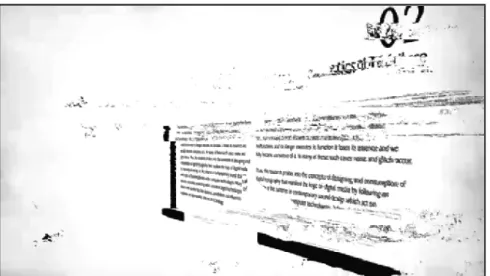
that is formed by the compilation of pure glitches. It imitates the visual and the auditory characteristics of glitches on a Fig. 1. Screenshot from the title sequence
of Glint video. (© Funda Senova Tunali.)
Transactions 297 Tr An S Ac TI o n S
conscious level to present an alternative viewing and listening experience.
Glint tries to address the
representa-tional status quo of technology, digital media and the culture’s reception and reflection of it. It attempts to represent the signifiers of digital media by imple-menting hypermediacy, by which the user/viewer/participant is always re-minded of the existence of the medium that the content is offered through. In-stead of creating an immersive and im-mediate experience, it is constructed upon the principle of hypermediacy, where the user is always made aware of the technology—in a sense made aware of the window/display with which s/he uses to reach out to the content by reme-diating the data as a conscious decision made, using a fault, a drawback of that very same digital technology. The glitches act as actualizations of many possible manifestations, which the user of digital technologies can encounter any time.
The analysis of Glint is aimed at re-vealing similar patterns of production, development, distribution, and consump-tion. When the project is broken up into pieces and analyzed, each part can be considered as a system with which as-sumptions can be made about a larger system that encompasses the relatively small ones.
The analysis of the project consists of the study of the preparation, growth of research, accessing and processing knowledge, generation of ideas, making of sketches and storyboards, transforma-tion of such ideas into visual and audio materials, the software and hardware used in this process, the association of these software, the GUI that the designer and the viewer are confronted with throughout the process, compilation of the audio and video tracks, distribution
channels and means, the distributed sig-nifiers, the relationship between these signifiers and the status quo, people who consume this project by accessing, watching and reflecting on it, and the culture that is originated by these con-sumers. The analysis of each of these stages and elements is aimed at manifest-ing the digital culture, which has its own rules and ideology—thus, has an opera-tional logic.
Digital culture is shaped by the role of the designer; the assumed responsibility that s/he undertakes, the equipment used in achieving this goal, the distribution channels and the ways in which the pro-duction is utilized and consumed are different indicators of digital culture. So the process from the production to the consumption of the project indicates what Manovich calls a cultural interface, where people can interact with data through the use of computers [5]. Al-though the video itself is a complete, closed form where no additional data can be used once it is finished and rendered, the way that is produced, distributed and
accessed are designations of open forms and they welcome feedback mechan-isms. Thus, it also has implications of interactivity and participation. To this extent, Glint manifests itself not just as an audiovisual project but also as a project pinpointing the continuum from production to consumption of digital outputs.
References and Notes
1. An extended version of this paper appears as a chapter of a PhD dissertation that will be sub-mitted to Bilkent University, Institute of Fine Arts, Department of Graphic Design.
2. Dictionary.com <www.dictionary.com>, ac-cessed July 2010.
3. I. Moradi, A. Scott, J. Gilmore & C. Murphy
Glitch: Designing Imperfection (New York: Mark
Batty Publisher, 2009) p. 9.
4. I. Moradi, Glitch Aesthetics (UK: University of Huddersfield, 2004) p. 8.
5. C-O. Wong, K. Jung and J. Yoon, “Interactive Art: The Art that Communicates,” Leonardo 42, No: 2, 180-181 (2009).
6. L. Manovich, The Language of New Media (Cambridge, Massachusetts, 2001). Fig. 3. Screenshot from the Glint video. (© Funda Senova Tunali.)
Leonardo Codex ($5,000 and above) College of extended Learning, San Francisco State University roger Malina The Malina Trust Sonya rapoport rockefeller Foundation The San Francisco art Institute al Smith darlene Tong University of Texas at dallas Sforza Monument (The Bronze Horse) ($1,000 to $4,999) Martin anderson art Science research Lab Banff new Media Institute Lisa Bornstein Calarts Caldas University arts and Humanities Concordia University deMontfort University Institute for Creative Technologies emily Carr University of art & design donna Cox Creative disturbance The daniel Langlois Foundation Char davies The exploratorium Penny Finnie Steve Forestieri Gregory Harper John Hearst Intel Corporation LaBoral Centro de arte y Creacion Industrial The LeF Foundation alan Malina Marjorie Malina Jacques Mandelbrojt Christine Maxwell-Malina ontario College of art & design University Sheila Pinkel Michael Punt rhode Island School of design Itsuo Sakane School of the art Institute of Chicago Scottsdale Center for the Performing arts Martin Segal SFSU International Center for the arts Sonia Sheridan Srishti School of art, design and Technology swissnex San Francisco Symbiotica Marcia Tanner Makepeace Tsao UCLa art / Sci Center UC Santa Barbara, Media arts and Technology Program UC Santa Cruz, digital arts and new Media dept. Universidad autonoma de occidente, engineering department Universidad de San Buenaventura, Multimedia engineering Program Universidade de Caldas Universidade do Minho University of Calabria evolutionary Systems Group University of denver School of art and art History University of Évora, CHaIa University of Florida digital Worlds Institute University of Illinois edreaM Institute University of Leiden University of Plymouth, U.K. University of Washington dXarTS UTS Creativity and Cognition Studios ZKM | Center for art and Media
La Gioconda (Mona Lisa) ($500 to $999) roy ascott Lars ole Belhage Martha Blassnigg anna Campbell Bliss Leif Brush James d. Burke richard Clar Una dora Copley Bryony dalefield Michele emmer William Fawley arana Greenberg Michael Joaquin Grey dene Grigar rosemary Jackson Larry Larson Lynn Hershman Leeson Guy Levrier Isabel Maxwell Merrill Lynch Foundation emanuel nadler nessim & associates Sam okoshken Steve oscherwitz Trudy reagan david rosenboom Jack Sarfatti Joel Silverman Christian Simm Tami Spector Meredith Tromble Flying Machine ($250 to $499) Loren Basch ray Bradbury Bettina Brendel Shawn Brixey david Carrier eva Craig Holly Crawford eugene epstein Lawrence Fane Herbert Franke doreen Gatland Pamela Grant-ryan oliver Grau Linda dalrymple Henderson robert Hill Curtis Karnow Melinda Klayman Kathleen Laziza Thomas Mercer Gianluca Mura Frieder nake Barbara nessim Jack ox ed Payne and Liss Fain nancy Perloff Frank Popper Harry rand Beverly reiser Mark resch eric roll edward Shanken Leonard Shlain Jesse Tischler Joan Truckenbrod Kelvin Tsao Jonathan Willard Barbara Lee Williams richard a. Wilson Stephen Wilson Gary Zellerbach Angel ($249 and under) anonymous, aaron alpar, Charles ames, Craig anderson, art Science Collaborations Inc. (aSCI), Yasuhiro asoo, Bret Battey, Marc Battier, Mark and Lauren Beam, Patricia Bentson, Timothy Binkley, The Birse Family, Marc Böhlen, deborah Branton, robert a. Brown, ronald Brown, Willi Bruns, annick Bureaud, James Burke, david Carter, rosa Casarez-Levison, Webster Cash, Katherine Casida, Joel Chadabe, alison Chaiken, John Chowning, richard Clar, Computer art Studio/Gunter Schulz, Ivo Cristante, elizabeth Crumley, Mary & Michael Cunningam, danish Film Festival, Bob davis, derrick de Kerckhove, Goery delacote, Lily diaz, agnes denes, emma Lou diemer, Steve dietz, augus dorbie, Hubert duprat, elmer duncan, ann elias, Sherban epure, Theodosia Ferguson, John Fobes, Tim Fox, alan & Mickey Friedman, ryozo Fujii, Kai-hung Fung, david Gamper, Jonathan & donna r. Gennick, George Gessert, Ken Goldberg, Yusef Grillo, Karen Guzak, Craig Harris, Isabel Hayden, Margaret Hermann, doris Herrick, estate of dick Higgins, Kathy High, anthony Hill, Toshiyuki Hiruma, Gerald Holton, Hungarian University of Crafts & design, amy Ione, Susan Joyce, raymond Jurgens, eduardo Kac, robert Kadesch, Marshall Kaplan, Ken Knowlton, Zdenek Kocib, Kenji Kohiyama, Thomas Kostusiak, Kathleen Laziza, Levi Family Foundation, Frederick Loomis, Carl Machover, James Maher, William Marchant, delle Maxwell, elliot Mazer, Kevin Meehan, Minneapolis College of art & design, Mit Mitropoulos, Moët Hennessy-Louis Vuitton, Jason Monberg, roger Mulkey, Geetha narayanan, alex nicoloff, Greg niemeyer, Hiroshi ninomiya, elaine Petschek, anne Brooks Pfister, Glenn r. Phillips, Victor a. Pickett, otto Piene, ann Pizzorusso, Herbert & Joan Webster Price, Patric Prince, Wolf rainer, Peter richards, ron rocco, Peter rudolfi, david M. russell, Mr. and Mrs. robert russett, Colin Sanderson, Piero Scaruffi, Patricia Search, allan Shields, Gregory C. Shubin, Joel Slayton, John Slorp, avril Sokolov, Kirill Sokolov, Christa Sommerer, rejane Spitz, anait Stephens, robert Strizich, The Sun Microsystems Foundation, Inc., robin and Barbara Tchartoff, Tamiko Thiel, rodrigo B. Toledo, Heinz Trauboth, Mark Tribe, Karen Tsao, roman Verostko, alexandre Vitkine, annette Weitraub, natalie & Mark Whitson, alan Thompson & Sharon a. Widmayer, Ioannis Yessios, robert Zimmerman
A word oF THAnkS
Thanks to our Supporters
Leonardo/ISAST is a nonprofit organization that serves the international arts community by documenting work at the intersection of the arts, sciences and technology and by encouraging and stimulating collaboration
through its programs and activities. Donations and grants are integral to the future of Leonardo. Contact <[email protected]> or visit <http://leonardo.info> for more information.