137
PHYSICS, CHEMISTRY AND APPLICATION OF NANOSTRUCTURES, 2007
ELECTROMODULATION OF PHOTOLUMINESCENCE FROM
CdSe NANORODS FILM
A. LUTICH
Institute of Molecular and Atomic Physics, NASB Nezavisimosti Ave. 70, 220072 Minsk, Belarus
M. ARTEMYEV, E. USTINOVICH
Institute for Physico-Chemical Problems, Belarusian State University Leningradskaya 14, 220080 Minsk, Belarus
I. M. SOGANCI, H. V. DEMIR
Department of Physics, Department of Electrical and Electronics Engineering Nanotechnology Research Center, Bilkent University
Bilkent, 06800 Ankara, Turkey
We studied photoluminescence (PL) properties of CdSe nanorods integrated in a thin film sandwiched between transparent electrodes to which an electric field applied. Nearly 20 % of PL quenching accompanied with the weak Stark shift have been observed. This effect is proposed to be used for PL modulation, in particular in the wavelength range beyond the range that traditional optoelectronic devices may cover.
1. Introduction
Optoelectronic nanodevices that rely on electric field effects in optical absorption and emission provide the ability to be controlled conveniently using integrated electronic platforms. Semiconductor quantum dots are theoretically expected as an excellent candidate for such optoelectronic nanomaterials to show optical properties strongly dependent on electric field [1]. In the general class of quantum dots, chemically synthesized semiconductor nanocrystals also exhibit electric field effects, for example, as demonstrated in their optical absorption (e.g. the quantum confined Stark effect [2,3]) and in their optical emission as the Stark shift and luminescence quenching [4,5]).
In the present paper, we investigate the influence of external electric field onto luminescence properties of chemically synthesized CdSe nanorods. Unlike quantum dots, the nanorods exhibit quantum confinement only in two dimensions. It is suggested that the electric field applied along the nanorods axis may provide an effective exciton dissociation resulting in the strong quenching of PL.
Copyright @ 2007. World Scientific. All rights reserved. May not be reproduced in any form without permission from the publisher, except fair uses permitted under U.S. or applicable copyright law.
EBSCO : eBook Academic Collection (EBSCOhost) - printed on 6/17/2019 12:24 PM via BILKENT UNIVERSITY
AN: 203932 ; Gurin, V. S., Gaponenko, S. V., Borisenko, V. E..; Physics, Chemistry And Application Of Nanostructures: Reviews And Short Notes To Nanomeeting 2007 - Proceedings Of The International Conference On Nanomeeting 2007
138
2. The samples
CdSe/ZnS core-shell nanorods with size ca. 4×25 nm were synthesized according to published procedures [6]. The polymeric polymethylmetacrylate (PMMA) film with CdSe nanorods was placed between two transparent indium-tin oxide (ITO) electrodes sealed with epoxy glue. The electric field influence on the nanorods PL was studied by applying a constant dc voltage between transparent ITO electrodes. The PL was excited by 488 nm Ar-ion laser. The PL spectra at different voltages were measured by a combination of inverted microscope and liquid nitrogen (LN)-cooled CCD camera based spectrometer.
3. Results
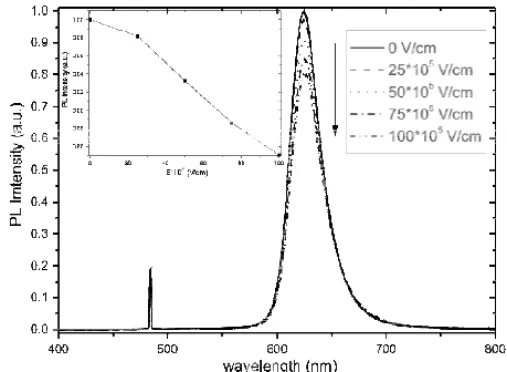
Fig. 1 shows PL spectra of CdSe nanorods in PMMA film at different applied voltages.
Figure 1. Photoluminescence spectra of CdSe nanorods film at different applied voltages. Inset shows the integrated PL intensity vs. the applied electric field.
There is a decrease in PL intensity (quenching) and red shift with the voltage increased. At E=107 V/cm the magnitude of PL quenching reaches 20 % with respect to the signal measured with no voltage applied (Fig. 2, inset). Differential PL spectra at various electric fields applied with respect to zero field are shown in Fig. 3a. Both the negative differential PL signal at λ=620 nm (PL quenching) and positive signal at λ=670 nm (Stark shift) rise with the voltage increase. In order to demonstrate the Stark shift in PL spectra of the nanorods in strong electric field the differential spectra normalized to zero-field PL spectrum are presented in Fig. 3b. The character of normalized differential spectra is Copyright @ 2007. World Scientific. All rights reserved. May not be reproduced in any form without permission from the publisher, except fair uses permitted under U.S. or applicable copyright law.
EBSCO : eBook Academic Collection (EBSCOhost) - printed on 6/17/2019 12:24 PM via BILKENT UNIVERSITY
AN: 203932 ; Gurin, V. S., Gaponenko, S. V., Borisenko, V. E..; Physics, Chemistry And Application Of Nanostructures: Reviews And Short Notes To Nanomeeting 2007 - Proceedings Of The International Conference On Nanomeeting 2007
139
typical for those observed earlier in CdSe quantum dots ensemble and attributed to the quantum-confined Stark effect [3].
(a) (b) Figure 2. Differential PL (a) and normalized differential PL (b) spectra of CdSe nanorods vs. electric
field applied.
4. Conclusions
We observed the sensitivity of PL properties of CdSe nanorods to applied electric field. This effect may find applications to make a luminescence modulator in which the incoming beam optically pumps the active part of the device (nanorods) and the resulting PL is electrically switched on and off with an applied voltage (input RF signal).
Acknowledgment
This work is partially supported by PHOREMOST Network of Excellence and INTAS (05-109-4204).
References
1. S.Gaponenko. Optical Properties of Semiconductor Nanocrystals (Cambridge University Press, 1998).
2. G.W.Wen, J.Y.Lin, H.X.Jiang, Z.Chen, Phys. Rev. B 52, 5913 (1995). 3. V.L.Colvin, K.L.Cunningham, A.P.Alivisatos, J. Chem. Phys. 101, 7122
(1994).
4. M.V.Artemyev, G.P.Yablonski, Yu.P.Rakovich, Acta Phys. Polon. A 87, 523 (1995).
5. A.W.Achtstein, H.Karla, B.Stritzker, Appl. Phys. Lett. 89, 061103 (2006). 6. T.Mokari, U.Banin, Chem. Mater. 15, 3955 (2003).
Copyright @ 2007. World Scientific. All rights reserved. May not be reproduced in any form without permission from the publisher, except fair uses permitted under U.S. or applicable copyright law.
EBSCO : eBook Academic Collection (EBSCOhost) - printed on 6/17/2019 12:24 PM via BILKENT UNIVERSITY
AN: 203932 ; Gurin, V. S., Gaponenko, S. V., Borisenko, V. E..; Physics, Chemistry And Application Of Nanostructures: Reviews And Short Notes To Nanomeeting 2007 - Proceedings Of The International Conference On Nanomeeting 2007