Correspondence to: Özgür KORKMAZ Kaptan Arif sok. No: 44/9 Suadiye Kadıköy İstanbul Turkey
SUMMARY
Introduction Carpal tunnel syndrome (CTS) is the most commonly seen peripheral nerve compression syndrome and CTS surgery is the most common surgery done for peripheral nerve compression syndromes. Type 2 diabetes mellitus (DM) is a systemic disease with a component of peripheral neuropathy.
Objective We aimed to investigate the effects of type 2 DM on functional results in type 2 DM patients who underwent carpal tunnel surgery.
Methods The study included 39 patients with carpal tunnel syndrome which was confirmed by electromyography. Twenty-one patients did not have DM, 18 patients had type 2 DM that were treated for DM and had regulated blood glucose levels. Assessments were done with the Boston scale. All operations were done by the same surgical team using the same surgical technique. Functional and symptomatic scores between the two groups were compared with the Mann-Whitney U test which is the non-parametric version of the Student’s t test, and 95% confidence interval p<0.05, which is considered as statistically significant.
Results In patients with type 2 DM, preoperative mean Symptom Severity Score was 3.6±0.35 (2.9 to 4.2) in the last control mean Symptom Severity Score was 1.2±0.16 (1.0-1.7), and preoperative mean functional status score was 3.3±0.56 (2.3 to 4.5) and in the last control mean functional status score was 1.3±0.36 (1.0 to 2.4). The patients without DM, preoperative mean Symptom Severity Score was 3.5±0.45 (2.8 to 4.2) in the last control mean Symptom Severity Score was 1.2±0.19 (1.0 to 1.6), and preoperative functional status score was 3.2±0.47 (2.4 to 4.6) in the last control mean functional status score was 1.3±0.35 (1.0 to 2.5). There was no statistically significant difference between the two groups.
Conclusion Type 2 DM patients with regulated blood glucose levels can be operated without additional procedure during and after surgery for carpal tunnel syndrome like in carpal tunnel syndrome patients without DM.
Keywords: carpal tunnel; type 2 diabetes mellitus; Boston scale
Surgical Treatment Results of Carpal Tunnel
Syndrome in Patients with and without Type 2
Diabetes Mellitus
Melih Malkoc1, Özgür Korkmaz1, Ismail Oltulu1, Ali Seker1, Ferhat Say2, Ahmet Murat Bulbul1
1Orthopedics and Traumatology, School of Medicine, Istanbul Medipol University, Istanbul, Turkey; 2Orthopedics and Traumatology, Samsun, 19 Mayıs University School of Medicine, Istanbul, Turkey
INTRODUCTION
Carpal tunnel syndrome (CTS), due to com-pression of the median nerve in the carpal tun-nel at the wrist, is the best known and the most common upper extremity compression neu-ropathy [1, 2]. The transverse carpal ligament has a compression on the median nerve on the wrist palmar surface in carpal tunnel syndrome. As a result of this compression the patient has hypoesthesia on the first, second, third and ra-dial side of the forth finger of the hand.
Type 2 diabetes mellitus (DM) is a systemic disease with component of peripheral neuropa-thy. Conventional electrophysiological studies are widely used for the objective diagnosis of diabetic neuropathy. The physiological func-tion of nerves can be evaluated quantitatively by nerve conduction study (NCS) [3, 4]. NCS abnormalities occur early in the course of type 2 DM, and the pattern of progression of pe-ripheral neuropathy shows dependence on the length of the nerve fibers [5]. NCS shows complicated abnormalities of sensory, motor, and autonomic nervous systems [6]. In addi-tion, NCS shows a mildly slow nerve
conduc-tion velocity and low amplitude in diabetic polyneuropathy, suggesting that the peripheral neuropathy of type 2 DM is primarily caused by axonal degeneration [7, 8].
There are two treatment modality for CTS, these are conservative and surgical treatment. Conservative treatment is an option for pa-tients with early CTS. Splinting, local steroid injections, ultrasound, and the use of oral ster-oids are the methods of conservative treatment. Patients with evidence of median nerve dener-vation and in cases where conservative treat-ment has failed, surgical treattreat-ment is indicated [9]. Surgical treatment is release surgery for the transverse carpal ligament that compresses the median nerve. CTS is most commonly seen peripheral nerve compression syndrome and CTS surgery is most common surgery done for peripheral nerve compression syndromes.
OBJECTIVE
We aimed to investigate the effects of type 2 DM on functional results in type 2 DM patients who underwent carpal tunnel surgery and to
compare the results of surgeries between diabetic CTS patients with non-diabetic CTS patients.
METHODS
Preoperatively, all patients were confirmed with the clini-cal examination and electromyography (EMG) that they had CTS. The patients were evaluated with the Boston scale pre-and postoperatively (Tables 1 and 2). All op-erations were performed by the same surgical team with the mini-open carpal tunnel release technique.Two-3 cm of longitudinal incision was done above the wrist flexor skin-fold and reached transverse carpal ligament and then release was done.
Thirty-nine patients were evaluated in our study. Eight-een patients had DM that were treated for DM and had regulated blood glucose levels. There were 7 male and 11 female patients. The mean age was 59.0 (51-68) years. Four patients were insulin dependent, while 14 patients were treated with oral anti-diabetic drugs. The duration of the type 2 DM was mean 5.4 (2-10) years. Five patients had CTS in both upper extremities but according to the EMG non-operated sides had mild involvement. One of the patients with DM had obesity. There was no additional pathology in DM patients. There were 21 patients in the other group with no additional pathology. There were 8 male and 13 female patients. The mean age was 56.3 (44-65) years. No problem was detected in both groups in postoperative follow-up period.
The Boston scale (BS) consists of 19 questions. There are multiple choice answers for each question. Every question is evaluated between 1 to 5 points. Point 1 is the best point for the functional capacity and represents mild symptoms, 5 points is the worst for the functional capac-ity and represent most severe symptoms. If a patient has a higher mean score it indicates insufficiency in functional capacity and severe symptoms. Symptom Severity Score is the total point of 11 questions. The average Symptom Severity Score is obtained by dividing Symptom Severity Score by the number of current question. Functional status score is the total point of 8 questions. The average func-tional status score is obtained by dividing the funcfunc-tional status score by the number of the current question.
Functional and symptomatic scores between the two groups were compared with the Mann-Whitney U test which is the non-parametric version of the Student’s t test, and 95% confidence interval p<0.05 is considered as statistically significant.
RESULTS
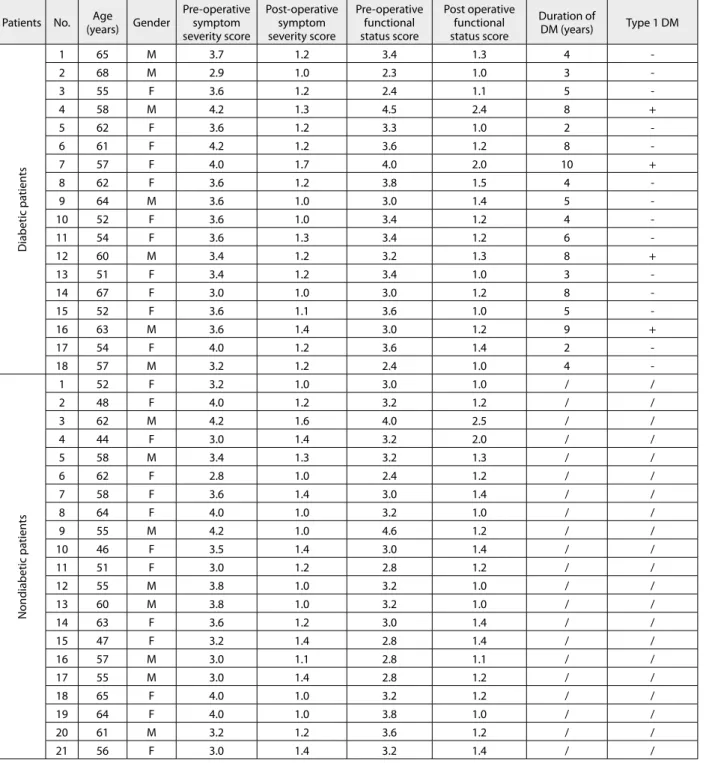
Preoperative mean Symptom Severity Score was 3.6±0.35 (2.9 to 4.2) in the last control mean Symptom Severity Score was 1.2±0.16 (1.0-1.7), and preoperative mean func-tional status score was 3.3±0.56 (2.3 to 4.5) and in the last control mean functional status score was 1.3±0.36 (1.0 to 2.4) in the type 2 diabetic group. Preoperative mean
Table 1. Symptom Severity Scale (CTS)
The following questions refer to your symptoms for a typical 24-hour period during the last 2 weeks (circle one answer to each question).
1. How severe is the hand or wrist pain that you have at night?
I do not have hand or wrist pain Mild pain
Moderate pain Severe pain Very severe pain 2. How often did hand or
wrist pain wake you up during a typical night over the past two weeks?
Never Once
Two to three times Four or five times More than five times 3. Do you typically have
pain in your hand or wrist during the daytime?
I never have pain during the day I have mild pain during the day I have moderate pain during the day I have severe pain during the day I have very severe pain during the day 4. How often do you have
hand or wrist pain during the daytime?
Never
Once or twice a day Three to five times a day More than five times a day The pain is constant 5. How long, on average,
does an episode of pain last during the daytime?
I never get pain during the day Less than 10 minutes 10 to 60 minutes Over 60 minutes
The pain is constant throughout the day
6. Do you have numbness (loss of sensation) in your hand?
No
I have mild numbness I have moderate numbness I have severe numbness I have very severe numbness 7. Do you have weakness
in your hand or wrist?
No weakness Mild weakness Moderate weakness Severe weakness Very severe weakness 8. Do you have tingling
sensations in your hand?
No tingling Mild tingling Moderate tingling Severe tingling Very severe tingling 9. How severe is
numbness (loss of sensation) or tingling at night?
I have no numbness or tingling at night
Mild Moderate Severe Very severe 10. How often did hand
numbness or tingling wake you up during a typical night during the past two weeks?
Never Once
Two or three times Four or five times More than five times 11. Do you have difficulty
with the grasping and using small objects such as keys or pens?
No difficulty Mild difficulty Moderate difficulty Severe difficulty Very severe difficulty
Table 2. Functional Status Scale (CTS)
On a typical day during the past two weeks have hand and wrist symptoms caused you to have any difficulty doing activities listed below? Please circle one number that best describes your ability to do the activity.
Activity No difficulty Mild difficulty Moderate difficulty difficultySevere hand or wrist symptomsCannot do at all due to
Writing 1 2 3 4 5
Buttoning clothes 1 2 3 4 5
Holding a book while reading 1 2 3 4 5
Gripping a telephone handle 1 2 3 4 5
Opening jars 1 2 3 4 5
Household chores 1 2 3 4 5
Carrying grocery bags 1 2 3 4 5
Bathing and dressing 1 2 3 4 5
Table 3. Preoperative and postoperative data of patients with and without diabetes mellitus (DM) Patients No. (years)Age Gender Pre-operative symptom
severity score Post-operative symptom severity score Pre-operative functional status score Post operative functional status score Duration of DM (years) Type 1 DM Diabetic pa tien ts 1 65 M 3.7 1.2 3.4 1.3 4 -2 68 M 2.9 1.0 2.3 1.0 3 -3 55 F 3.6 1.2 2.4 1.1 5 -4 58 M 4.2 1.3 4.5 2.4 8 + 5 62 F 3.6 1.2 3.3 1.0 2 -6 61 F 4.2 1.2 3.6 1.2 8 -7 57 F 4.0 1.7 4.0 2.0 10 + 8 62 F 3.6 1.2 3.8 1.5 4 -9 64 M 3.6 1.0 3.0 1.4 5 -10 52 F 3.6 1.0 3.4 1.2 4 -11 54 F 3.6 1.3 3.4 1.2 6 -12 60 M 3.4 1.2 3.2 1.3 8 + 13 51 F 3.4 1.2 3.4 1.0 3 -14 67 F 3.0 1.0 3.0 1.2 8 -15 52 F 3.6 1.1 3.6 1.0 5 -16 63 M 3.6 1.4 3.0 1.2 9 + 17 54 F 4.0 1.2 3.6 1.4 2 -18 57 M 3.2 1.2 2.4 1.0 4 -Nondiabetic pa tien ts 1 52 F 3.2 1.0 3.0 1.0 / / 2 48 F 4.0 1.2 3.2 1.2 / / 3 62 M 4.2 1.6 4.0 2.5 / / 4 44 F 3.0 1.4 3.2 2.0 / / 5 58 M 3.4 1.3 3.2 1.3 / / 6 62 F 2.8 1.0 2.4 1.2 / / 7 58 F 3.6 1.4 3.0 1.4 / / 8 64 F 4.0 1.0 3.2 1.0 / / 9 55 M 4.2 1.0 4.6 1.2 / / 10 46 F 3.5 1.4 3.0 1.4 / / 11 51 F 3.0 1.2 2.8 1.2 / / 12 55 M 3.8 1.0 3.2 1.0 / / 13 60 M 3.8 1.0 3.2 1.0 / / 14 63 F 3.6 1.2 3.0 1.4 / / 15 47 F 3.2 1.4 2.8 1.4 / / 16 57 M 3.0 1.1 2.8 1.1 / / 17 55 M 3.0 1.4 2.8 1.2 / / 18 65 F 4.0 1.0 3.2 1.2 / / 19 64 F 4.0 1.0 3.8 1.0 / / 20 61 M 3.2 1.2 3.6 1.2 / / 21 56 F 3.0 1.4 3.2 1.4 / / M – male; F – female
Symptom Severity Score was 3.5±0.45 (2.8 to 4.2) in the last control mean Symptom Severity Score was 1.2±0.19 (1.0 to 1.6), and preoperative functional status score was 3.2±0.47 (2.4 to 4.6) in the last control mean functional status score was 1.3±0.35 (1.0 to 2.5) in the non-diabetic group. 2 of the patients who were insulin dependent in the type 2 diabetic group had mild improvement after surgical intervention in their last control (Table 3).
The values of the two groups were compared statistical-ly. There was no significant difference between the results of two groups. Average follow-up period was 7 months (6-12) in the type 2 diabetic group. Mean follow-up period was 8 months (6-14) in the non-diabetic group. Prophy-lactic antibiotics were not given to the patients in both groups after surgery. Infection was not detected during the follow-up time. There was no other complication that was detected in the patients after surgery.
DISCUSSION
All open surgical techniques with different sizes of inci-sions and arthroscopic interventions remove the pressure on the median nerve by release are effective in sympto-matic relief and functional improvement [10-14].
Zyluk et Puchalski [15] performed carpal tunnel sur-gery in 345 patients without DM and 41 DM patients in their study. They mentioned that all patients in both groups benefited from surgery in similar proportions over the 6-month controls after surgery. According to the re-sults of our study there was no statistically significant dif-ference between the results of two groups. The patients in both groups benefited from surgery in similar proportions according to our study. Our results are similar with the results of Zyluk et Puchalski [15].
Gamstedt et al. [16] demonstrated 20% of patients who had CTS, Dupuytren’s contracture, flexor tenosynovitis and limitation of the range of motion (ROM) in a cross-sectional study with 100 diabetic patients. There is a signif-icant relationship between the duration of diabetes hand anomalies. There is no significant relationship between other diabetic complications, metabolic control and hand anomalies. The prevalence of hand anomalies are high in DM and this prevalence increases with duration of diabe-tes [16]. The patients operated for CTS with type 2 DM
had no additional hand pathology in our study. Only CTS release surgeries were done in patients with type 2 DM; for this reason our study is limited in regard to offering infor-mation about other hand pathologies in diabetic patients. According to the study of Tosti et al. [17] 4 most com-monly performed procedures involving the hand were car-pal tunnel release, trigger finger release, mass excision, and first dorsal compartment release. The overall infection rate was 0.66%. All infections were considered superficial, and none required surgical management. In patients who re-ceived antibiotic prophylaxis (n=212), the infection rate was 0.47%. In those who did not receive prophylaxis (n=388) the infection rate was 0.77%. These differences were not statis-tically significant (p=1.00) [17]. In our patient we applied a single dose of preoperative antibiotic prophylaxis. Post-surgical antibiotic prophylaxis was not applied in any of the patients reported in this study. Deep and superficial infec-tion was not detected during the follow-up period. As the number of patients in our study was lower, this restricted us from determining infection rates between the two groups.
The most commonly used questionnaire for treatment results is the Boston scale which was defined by Levine et al. [18]. Akman et al. [19] evaluated their patients in whom CTS surgery was performed with electrophysiologi-cal study and Boston selectrophysiologi-cale before and after surgielectrophysiologi-cal treat-ment. They reported that EMG examination after surgery provided no additional benefit; for this reason the Boston scale is sufficient for the follow-up evaluation [19]. We evaluated our patients with the Boston scale which con-tained functional status and symptom severity scale in post-operative follow-ups. We detected a statistically sig-nificant improvement in both groups of patients. No EMG was done in the patients during the postoperative period.
CONCLUSION
There was no statistically significant difference between the functional and clinical outcome scores between the two groups after surgery. All patients in both groups stated that they benefited from surgery but 2 of the insulin de-pendent diabetic patients had mild improvement. Diabetic patients with regulated blood glucose levels can be op-erated on without additional procedure during and after surgery for carpal tunnel syndrome.
1. Brown RA, Gelberman RH. Compression neuropathy. In: Blair WF, editor. Techniques in Hand Surgery. Baltimore: Williams and Wilkins; 1996. p.703-64.
2. Beek BUY. Management of painful neuromas and nerve compression syndromes. In: McCarthy JG, editor. Plastic Surgery. Philadelphia: W. B. Saundres Company; 1990. p.4817-46.
3. Bril V. NIS-LL: the primary measurement scale for clinical trial endpoints in diabetic peripheral neuropathy. Eur Neurol. 1999; 41(Suppl 1):8-13.
4. Dyck PJ, Lais A, Karnes JL, O’Brien P, Rizza R. Fiber loss is primary and multifocal in sural nerves in diabetic polyneuropathy. Ann Neurol. 1986; 19:425-39.
5. Said G. Diabetic neuropathy – a review. Nat Clin Pract Neurol. 2007; 3:331-40.
6. Karsidag S, Morali S, Sargin M, Salman S, Karsidag K, Us O. The electrophysiological findings of subclinical neuropathy in patients with recently diagnosed type 1 diabetes mellitus. Diabetes Res Clin Pract. 2005; 67:211-9.
7. Abu-Shakra SR, Cornblath DR, Avila OL, Chaudhry V, Freimer M, Glass JD, et al. Conduction block in diabetic neuropathy. Muscle Nerve. 1991; 14:858-62.
8. Viader A, Sasaki Y, Kim S, Strickland A, Workman CS, Yang K, et al. Aberrant Schwann cell lipid metabolism linked to mitochondrial deficits leads to axon degeneration and neuropathy. Neuron. 2013; 77:886-98.
9. Szabo RM. Entrapment and compression neuropathies. In: Green DP, Hotchkiss RN, Pederson WC, editors. Green's Operative Hand Surgery. Philadelphia: Churchill Livingstone Company; 1999. p.1404-22.
10. Bromley GS. Minimal-incision open carpal tunnel decompression. J Hand Surg Am. 1994; 19:119-20.
11. Avci S, Sayli U. Carpal tunnel release using a short palmar incision and a new knife. J Hand Surg Br. 2000; 25:357-60.
12. Klein RD, Kotsis SV, Chung KC. Open carpal tunnel release using a 1-centimeter incision: technique and outcomes for 104 patients. Plast Reconstr Surg. 2003; 111:1616-22.
13. Lee H, Jackson TA, Wood DJ. Carpal tunnel release through a limited skin incision under direct visualization using a new instrument, the carposcope. Plast Reconstr Surg. 2002; 109:2471-2.
14. Serra JM, Benito JR, Monner J. Carpal tunnel release with short incision. Plast Reconstr Surg. 1997; 99:129-35.
15. Zyluk A, Puchalski P. A comparison of outcomes of carpal tunnel release in diabetic and non-diabetic patients. J Hand Surg Eur Vol. 2013; 38(5):485-8.
16. Gamstedt A, Holm-Glad J, Ohlson CG, Sunstrom M. Hand abnormalities are strongly associated with the duration of diabetes mellitus. J Internal Medicine. 1993; 234:189-93.
17. Tosti R, Fowler J, Dwyer J, Maltenfort M, Thoder JJ, Ilyas AM. Not necessary is antibiotic prophylaxis in elective hand surgery soft tissue? Orthopedics. 2012; 35(6):e829-33.
18. Levine DW, Simmons BP, Koris MJ, Daltroy LH, Hohl GG, Fossel AH, et al. A self-administered questionnaire for the assessment of severity of symptoms and functional status in carpal tunnel syndrome. J Bone Joint Surg (Am). 1993; 75:1585-92.
19. Akman S, Ertürer E, Celik M, Aksoy B, Gur B, Oztürk I. The results of open surgical release of the carpal tunnel syndrome and evaluation of follow-up criteria. Acta Orthop Traumatol Turc. 2002; 36(3):259-64.
КРАТАК САДРЖАЈ Увод Син дром кар пал ног ту не ла (СКТ) је нај че шћа ло ка ли-зо ва на ком пре сив на ле зи ја пе ри фер ног нер ва, а опе ра ци ја СКТ је нај че шћа хи рур шка ин тер вен ци ја у ле че њу син дро ма ком пре си је пе ри фер ног нер ва. Ди ја бе тес ме ли тус (ДМ) тип 2 је си стем ско обо ље ње с ком по нен том пе ри фер не не у ро-па ти је. Циљ ра да Циљ ис тра жи ва ња је био да се ис пи та ути цај ДМ тип 2 на функ ци о нал не ре зул та те хи рур шки ле че них бо ле-сни ка са СКТ и ДМ тип 2. Ме то де ра да Ис пи ти ва њем је об у хва ће но 39 бо ле сни ка са СКТ ко ји је ди јаг но сти ко ван елек тро ми о гра фи јом. Код 21 бо ле сни ка ни је за бе ле жен ДМ тип 2, док је 18 ис пи та ни ка ле че но од овог обо ље ња и има ло ре гу ли са не вред но сти глу ко зе у кр ви. Про це на обо ље ња је из вр ше на при ме ном Бо стон ског те ста. Опе ра ци ју свих бо ле сни ка из вео је исти хи рур шки тим при ме ном исте хи рур шке тех ни ке. У ана ли зи упо ре ђи ва ња ско ра функ ци о нал ног и симп то мат ског ста ња из ме ђу две гру пе ис пи та ни ка при ме њен је Ман–Вит ни јев (Mann–Whit ney) U-тест, ко ји је не па ра ме триј ска вер зи ја Сту-ден то вог t-те ста. Утвр ђен је 95-про цент ни ин тер вал по ве ре-ња на p<0,05, што се сма тра ста ти стич ки зна чај ним. Ре зул та ти Код бо ле сни ка са ДМ тип 2 сред ња вред ност ско ра те жи не симп то ма пре опе ра ци је би ла је 3,6±0,35 (ра-спон 2,9–4,2), а на по след њем кон трол ном пре гле ду 1,2±0,16 (ра спон 1,0–1,7). Сред ња вред ност ско ра функ ци о нал ног ста ту са пре опе ра ци је би ла је 3,3±0,56 (ра спон 2,3–4,5), а на по след њем пре гле ду 1,3±0,36 (ра спон 1,0–2,4). Код бо-ле сни ка без ДМ сред ња вред ност ско ра те жи не симп то ма пре опе ра ци је би ла је 3,5±0,45 (ра спон 2,8–4,2), а на по след-њем кон трол ном пре гле ду 1,2±0,19 (ра спон 1,0–1,6). Сред ња вред ност ско ра функ ци о нал ног ста ту са пре опе ра ци је код ових ис пи та ни ка би ла је 3,2±0,47 (ра спон 2,4–4,6), а на по-след њем кон трол ном пре гле ду 1,3±0,35 (ра спон 1,0–2,5). Ста ти стич ки зна чај на раз ли ка из ме ђу две по сма тра не гру пе ис пи та ни ка ни је утвр ђе на. За кљу чак Бо ле сни ци са ДМ тип 2 и ре гу ли са ним вред но-сти ма глу ко зе у кр ви мо гу да се опе ри шу без при ме не до-дат них по сту па ка то ком или на кон опе ра ци је СКТ, а исто ва жи и за бо ле сни ке без ДМ. Кључ не ре чи: кар пал ни ту нел; ди ја бе тес ме ли тус тип 2; Бо стон ски тест