www.internationaljournalofcaringsciences.org
Original Article
Investigating the Stress Level of Nurses Working at Emergency Care Services: A
Pilot Study
Sevban Arslan, PhD, RN
Assistant Professor Department of Surgical Nursing, Adana Health School, Çukurova University, Adana, Turkey
Zeynep Karaman Özlü, MSc, PhD, RN
Assistant Professor, Department of Surgical Nursing, Faculty of Health Sciences, Atatürk University, Erzurum, Turkey
Nadiye Özer, PhD, RN
Associate Professor, Department of Surgical Nursing, Faculty of Health Sciences, Atatürk University, Erzurum, Turkey
Evşen Nazik, PhD, RN
Assistant Professor Department of Obstetrics Nursing, Adana Health School, Çukurova University, Adana, Turkey.
Kenan Gümüs
Assistant, Department of Surgical Nursing, Faculty of Health Sciences, Atatürk University, Erzurum, Turkey.
Ibrahim Özlü, MD
Emergency Doctor, Emergency department, Atatürk University, Erzurum, Turkey
Correspondence: Zeynep Karaman Özlü, Assistant Professors, Department of Surgical Nursing, Faculty of Health Sciences, Atatürk University, Erzurum, Turkey e-mail: [email protected]
Abstract
Objectives: The purpose of this descriptive study is to determine the stress level of nurses working at emergency care services.
Methods: 49 nurses working at the Emergency Care Services of four hospitals in Erzurum participated in the descriptive
study that was conducted between April-May 2008. A questionnaire and Artan’s (1986) Organisational Stress Resources
Scale was used to gather data for this study. Percentage, Mann-Whitney U and Kruskal-Wallis variance analysis were used to conduct data analysis. In terms of ethical principles, this study adhered to the information and volunteerism principles.
Results: 69.4% of nurses participating in this study were women, 55.1% were married, 51.0% were Medical vocational high school graduates, and 87.8% had 0-5 years of Emergency Care Nursing experience. The average age of nurses was 30.1± 5.80. The “Organisational Role” sub-scale had the highest score mean of “Organisational Stress Resources (OSR)” and Organisational Discomfort (OD) (OSR: 18.67± 4.61; OD 18.79±7.60), the “Nature of the Job” sub-scale had the highest score mean of Organisational Stress (OS) (OS 10.14±6.74), the “Organisational Relations” sub-scale had the lowest score mean of “Organisational Stress Resources (OSR)” (OSR: 8.38±4.06), the “Career Development” sub-scale determined the OS score mean (OS 1.20±5.64), and the “Nature of the Job” sub-scale determined the OD score mean (OD 12.18±4.53).
Conclusions: Study results concluded that stressors caused by organisational roles and stressors caused by the nature of the job (work load, information load, and time limitation) create more stress for emergency care nurses.
www.internationaljournalofcaringsciences.org
Introduction
Stress is the emotional tension and stress caused by the interaction between an individual and their surroundings, which generally affects the physiological and psychological health structure of the individual (Polat, 2006). In other words, it is the adverse effect the exterior environment has on the organism (Aytürk, 2000). Stress is the unspecified physiological and psychological reaction portrayed by individuals when they are faced with a sign that threatens their well-being and serenity and events that are handled inadequately as they are perceived as a warning. According to another definition, stress incorporates signs that arise from events and situations in the workplace or in the environment that may threaten the health of the individual (Güçlü, 2001). The main factors that lead to stress are organisational situations that are caused by personal characteristics, physical environmental conditions, and the workplace. Every job is a natural stress factor as it comes with responsibility and risk. These factors may arise from both characteristics of the individual and characteristics of the job. The sources of stress in professional careers are extreme workloads, having a boring job, insufficient pay, no promotion opportunities, inadequate working conditions, not agreeing with made decisions, unjust evaluations, time pressure, insufficient equipment, an unhappy working environment, gossip in the workplace, individuals that do not fit job specifications and having a low status in the workplace (Karahan et al., 2007). Hospitals are organisations that have a high level of organisational complications, and emergency care services of these organisations are units that are exposed to uncertainty, tension and work pressure. The fact that nurses working at Emergency Care Services (ECS) have to make rapid and crucial decisions in acute situations may cause work stress (Lateef, 2001).These conditions may increase stress caused by environmental factors even more for nurses. Work stress decreases job satisfaction, and gives rise to desensitisation and exhaustion (Adeb-Saeedi, 2002).6; it may also have an adverse effect on
the care provided by emergency care nurses as it disrupts their physical or psychological balance, or cuts down the amount of time they have to make decisions. Therefore, it is important to determine the stress level of nurses working at Emergency Care Services in order to plan interventions that will minimize situations that cause stress for emergency care nurses.
The purpose of this study is designed to determine the stress level of nurses working at Emergency Care Services.
Method
The population of this study comprised of nurses working at the Emergency Care Services of Aziziye Research Hospital, Regional Training and Research Hospital, Palandöken State Hospital, and N. Kitapçı Chest Diseases Hospital, a total of 57 nurses all located in Central Erzurum. 49 nurses participated in the study; nurses on annual leave, sick leave, and those unwilling to participate in the study were excluded. A questionnaire formed of two sections was used to gather data for this study; section 1 included questions regarding descriptive characteristics of nurses (their age, gender, marital status, education level, years of service, years of service at emergency care, status, working conditions, the number of nurses, working hours, and number of shifts per month), and section 2 comprised of Artan’s Organisational Resources Scale, used to measure stress levels. Artan’s Organisational Resources Scale includes items related to situations that incorporate five organisational stress resources. Every organisational stress resource takes into account a couple of situations faced during an individual’s professional career. There are 25 items related to situations which cause organisational stress resources, presented in a certain order. Every item has three questions; a, b, and c. An “ordinal scale” was used to evaluate answers. 7 points for every question ranged between 0 (none) and 6 (very much). Three separate types of measurements are taken using the stress scale; the degree to which stress resources are present, the amount of stress the individual is under, and the amount of discomfort experienced by the individual (Artan, 1986).
Answers given to question “a” under all 25 items of the scale determine the “organisational stress resource (OSR) score; high scores indicate that the presence of these resources are significantly high. The difference between answers given to question “a,” which asks the degree of a certain stressful situation, and question “b,” which asks what level the stress should be, determine the “organisational stress (OS)” score. Answers given to question “c” determine the “organisational discomfort (OD)” score; an increase in score indicates an increase in discomfort. Some of the questions are presented as positive statements, while some are presented as
www.internationaljournalofcaringsciences.org
negative statements in the stress questionnaire. While scoring given answers, those answered “very much” for negative statements were equalised to the weight of the step used; for example, an answer marked “6” was scored as 6. However, scoring for positive statement was the reverse.
In the event that a positive situation is answered as “very much,” this indicates that the presence of the asked stressful situation is low; therefore, answers were scored inversely (for example, an answer marked “6” was scored as 0). When scoring answers, organisational stress resources were assessed in terms of five dimensions (sub-scales). The following dimensions (sub-scale) were established by grouping questions of the Organisational Stress Resources Scale in groups of five and six.
a) Stressors caused by the nature of the job; workload, information load, and time limitation. b) Stressors caused by organisational role; being responsible for people, and uncertain role specifications.
c) Stressors caused by career development; professional capability and skills, success, and just-unjust promotions.
d) Stressors caused by organisational relations; relationships between staff members (junior-supervisor-same level team members), and issues experienced when handing over authority.
e) Stressors caused by the structure and climate of the organisation; not agreeing with made decisions, workplace discipline outside the individual’s expertise, consulting with junior staff, and issues related to adopting the job.
The size of each source of stress, work experience various situations that may be encountered in are discussed in. Therefore scale to be understood by the readers a lot easier and with the size of Organizational Stress Resources is evaluating. Percentage, Mann-Whitney U and Kruskal-Wallis variance analysis was used to conduct data analysis. In terms of ethical principles, this study adhered to the information and volunteerism principles. For research ethics committee and permission was
obtained from official institutions. Results
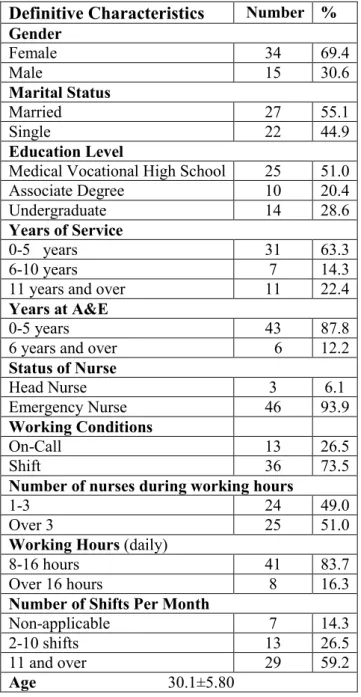
A 69.4% of the participating in this study nurses were women, 55.1% were married, 51.0% were Medical vocational high school graduates, and 87.8%
had 0-5 years of Emergency Care Nursing experience. The average age of nurses was 30.1± 5.80 (Table 1).
The “Organisational Role” sub-scale had the highest score mean of “Organisational Stress Resources (OSR)” and Organisational Discomfort (OD) (OSR: 18.67± 4.61; OD 18.79±7.60), the “Nature of the Job” sub-scale had the highest Organisational Stress (OS) score mean (OS 10.14±6.74), the “Organisational Relations” sub-scale had the lowest “Organisational Stress Resources (OSR)” score mean (OSR: 8.38±4.06), the “Career Development” sub-scale determined the OS score mean (OS 1.20±5.64), and the “Nature of the Job” sub-scale determined the OD score mean (OD 12.18±4.53) (Table 2).
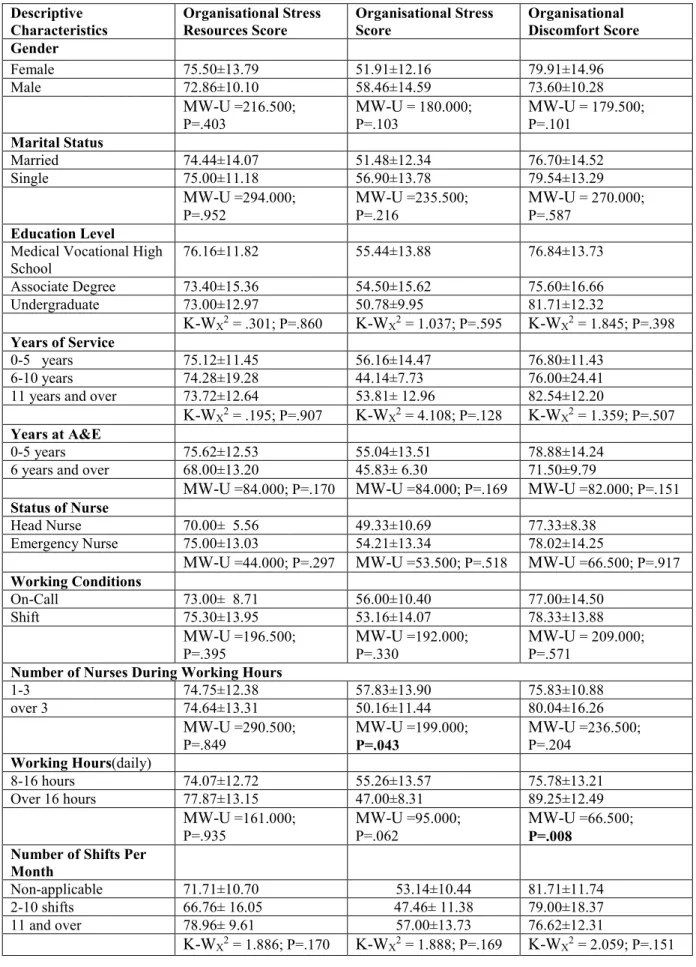
In terms of OSR, OS, and OD score mean based on descriptive characteristics of nurses, OSR and OD score mean were higher for women in comparison to men, and the OS score mean was higher in men in comparison to women; the difference between two groups was not statistically significant.
There was no statistically significant difference between OSR, OS, and OD score means based on the marital status and education level of nurses. OSR, OS, and OD score means were higher for nurses with 0 to 5 years at emergency care services in comparison to nurses with experience exceeding six years.
There was no statistically significant difference between OSR, OS, and OD score mean based on the experience, status, and working conditions of nurses. Additionally, there was no statistically significant difference between OSR, OS, and OD score means based on the number of shifts. Nurses with more than 11 shifts per month had the highest OSR and OS score means.
There was a statistically significant difference in OS score mean based on the number of nurses working the same shift, and in OD score based on working hours (OS p= 0.043; OD p= 0.008) (Table 3).
Discussion
Study results concluded that nurses working at Emergency Care Services had high “organisational role” and “the nature of the job” sub-scale score; there was a statistically significant difference between their OS and OD score means based on the number of nurses on the same shift and daily working hours. There was no statistically significant difference between OSR, OS, and OD score means based on descriptive variables such as gender, marital
www.internationaljournalofcaringsciences.org
status, education level, years of service, years of experience at emergency, working conditions, and number of shifts. There was a statistically significant
difference in OS score means based on the number of nurses working the same shift, and in OD score means based on working hours ( p=.043, p=.008).
Table 1. Definitive Characteristics of Nurses (S= 49)
Definitive Characteristics
Number % Gender Female 34 69.4 Male 15 30.6 Marital Status Married 27 55.1 Single 22 44.9 Education LevelMedical Vocational High School 25 51.0 Associate Degree 10 20.4 Undergraduate 14 28.6 Years of Service
0-5 years 31 63.3
6-10 years 7 14.3
11 years and over 11 22.4 Years at A&E
0-5 years 43 87.8
6 years and over 6 12.2 Status of Nurse Head Nurse 3 6.1 Emergency Nurse 46 93.9 Working Conditions On-Call 13 26.5 Shift 36 73.5
Number of nurses during working hours
1-3 24 49.0
Over 3 25 51.0
Working Hours (daily)
8-16 hours 41 83.7
Over 16 hours 8 16.3
Number of Shifts Per Month
Non-applicable 7 14.3
2-10 shifts 13 26.5
11 and over 29 59.2
www.internationaljournalofcaringsciences.org
Table 2. The score means for Organisational Stress Resources, Organisational Stress, and Organisational Discomfort based on Subscales of Organisational Stress Resources.
Subscales of
Organisational Stress
Resources
Organisational
Stress Resources
Score Mean
Organisational Stress
Score Mean
Organisational
Discomfort
Score Mean
Mean
SD
Mean
SD
Mean
SD
The Nature of the Job
17.55
5.09
10.14
6.74
12.18
4.53
The Structure and
Climate of the
Organisation
14.73
3.10
3.02
4.21
15.16
4.00
Organisational Role
18.67
4.61
4.04
5.21
18.79
7.60
Career Development
15.34
5.48
1.20
5.64
16.04
5.69
Organisational
Relations
8.38
4.06
1.69
3.02
13.57
4.80
www.internationaljournalofcaringsciences.org
Table 3. A Comparison of Score Means of Organisational Stress Resources, Organisational Stress, and Organisational Discomfort based on the Descriptive Characteristics of Nurses
Descriptive Characteristics Organisational Stress Resources Score Organisational Stress Score Organisational Discomfort Score Gender Female 75.50±13.79 51.91±12.16 79.91±14.96 Male 72.86±10.10 58.46±14.59 73.60±10.28 MW-U =216.500; P=.403 MW-U = 180.000; P=.103 MW-U = 179.500; P=.101 Marital Status Married 74.44±14.07 51.48±12.34 76.70±14.52 Single 75.00±11.18 56.90±13.78 79.54±13.29 MW-U =294.000; P=.952 MW-U =235.500; P=.216 MW-U = 270.000; P=.587 Education Level
Medical Vocational High School 76.16±11.82 55.44±13.88 76.84±13.73 Associate Degree 73.40±15.36 54.50±15.62 75.60±16.66 Undergraduate 73.00±12.97 50.78±9.95 81.71±12.32 K-WX2= .301; P=.860 K-WX2= 1.037; P=.595 K-WX2= 1.845; P=.398 Years of Service 0-5 years 75.12±11.45 56.16±14.47 76.80±11.43 6-10 years 74.28±19.28 44.14±7.73 76.00±24.41
11 years and over 73.72±12.64 53.81± 12.96 82.54±12.20
K-WX2= .195; P=.907 K-WX2= 4.108; P=.128 K-WX2= 1.359; P=.507
Years at A&E
0-5 years 75.62±12.53 55.04±13.51 78.88±14.24
6 years and over 68.00±13.20 45.83± 6.30 71.50±9.79
MW-U =84.000; P=.170 MW-U =84.000; P=.169 MW-U =82.000; P=.151
Status of Nurse
Head Nurse 70.00± 5.56 49.33±10.69 77.33±8.38
Emergency Nurse 75.00±13.03 54.21±13.34 78.02±14.25
MW-U =44.000; P=.297 MW-U =53.500; P=.518 MW-U =66.500; P=.917
Working Conditions On-Call 73.00± 8.71 56.00±10.40 77.00±14.50 Shift 75.30±13.95 53.16±14.07 78.33±13.88 MW-U =196.500; P=.395 MW-U =192.000; P=.330 MW-U = 209.000; P=.571 Number of Nurses During Working Hours
1-3 74.75±12.38 57.83±13.90 75.83±10.88 over 3 74.64±13.31 50.16±11.44 80.04±16.26 MW-U =290.500; P=.849 MW-U =199.000; P=.043 MW-U =236.500; P=.204 Working Hours(daily) 8-16 hours 74.07±12.72 55.26±13.57 75.78±13.21 Over 16 hours 77.87±13.15 47.00±8.31 89.25±12.49 MW-U =161.000; P=.935 MW-U =95.000; P=.062 MW-U =66.500; P=.008 Number of Shifts Per
Month
Non-applicable 71.71±10.70 53.14±10.44 81.71±11.74
2-10 shifts 66.76± 16.05 47.46± 11.38 79.00±18.37
11 and over 78.96± 9.61 57.00±13.73 76.62±12.31
www.internationaljournalofcaringsciences.org
Even though there was no statistically significant difference between score means based on gender, OSR and OD score means were higher for women in comparison to men. Similar results were reported by previous studies (Adeb-Saeedi, 2002; Önsüz et al., 2008).
Even though there was no statistically significant difference between OSR, OS, and OD score means based marital status, single nurses had higher OSR, OS, and OD score means in comparison to married nurses. In their study, Kalemoğlu and Keskin (Kalemoğlu and Keskin, 2002) identified that exhaustion syndrome based on stress was seen more often in singles. This could be because married individuals have more social support.
In terms of years of experience at Emergency Care services, OSR, OS, and OD score means were higher for nurses with 0 to 5 years at emergency care services in comparison to nurses with experience exceeding six years. Our results are similar to those of Önsüz et al (Önsüz et al., 2008).8
There was no statistically significant difference between OS score means for nurses working at Emergency Care Services based on the number of nurses working the same shift. While the OS score mean was 57.83±13.90 for the group with 1-3 nurses working the same shift, the mean was 50.16±11.44 for the group with more than three nurses working the same shift. In their study, Kalemoğlu and Keskin (Kalemoğlu and Keskin, 2002)9 identified that
among the top five major stressors of nurses working at A&E, staff shortages ranked third; this result supports our result. This could be due to the fact that work load increases due to shortage of nurses.
There was a statistically significant difference between OD score mean based on daily working hours of emergency care nurses. While the OD score mean was 75.78±13.21 for nurses working between 8 and 16 hours a day, the mean was 89.25±12.49 for nurses working more than 16 hours a day. In a study conducted on intensive care nurses, nurses stated that a cutback on their working hours was “what they desired the most regarding their job.” In their study, conducted on junior doctors, Önsüz et al (Önsüz et al., 2008)8 reported that those with longer working
hours had a higher stress level.
Various stress-related study results related to certain working groups and clinics are parallel to results of this study(Dede and Çınar, 2008; McFarlane et al., 2004). Study results concluded that stressors caused
by organisational roles (being responsible for people and uncertain roles), and stressors caused by the nature of the job (work load, information load, and time limitation) create more stress for emergency care nurses related to working environment. Every step taken towards improving working conditions of nurses, and every precaution taken to nurses away from stress and help them cope with stress will increase the quality of patient care.
References
Adeb-Saeedi J. (2002), Stress among emergency nurses. Australian Emergency Nursing Journal, 5:19-24.
Artan I. (1986), An application on the organizational
sources of stress and administrators. Original Printing Istanbul, Turkey
Aytürk N. (2000), Effective management skills. Yargı
Publisher, Ankara, Turkey
Cavalheiro AM, Mouro Junior DF, Lopes AC. (2008),
Stress in nurses working in intensive care units. Latin
American Journal of Nursing, 16(1), 29-35
Dede M, Çınar S. (2008), Determine the job difficulties
and job satisfaction in intensive care nurses, Maltepe University Journal of Nursing Science and Art, 1(1), 1-13.
Güçlü N. (2001), Stress Management, Gazi University
Journal of Faculty of Education, 1: 91-109.
Karahan A, Gürpınar K, Özyürek P. (2007),
Intra-organizational sources of stress in the business services sector: identifying sources of stress of surgical nurses working in hospitals in Afyon province. Journal of Economic and Social Research Studies, 3(3):27-44.
Kalemoğlu M, Keskin Ö. (2002), Stress and burnout in the
emergency department. Journal of Trauma, 8: 215-219.
Lateef F, Anantharaman V. (2001), Stress among nurses in the emergency department. Singapure Nursing Journal 28:22-26.
McFarlane D, Duff EM, Bailey EY. (2004), Coping with occupational stress in an accident and emergency department. West Indian Med J, 53(4):242-247.
Önsüz MF, Hıdıroğlu S, Gürbüz Y, et al. (2008),
Physician assistants working in a university hospital in the evaluation of organizational stress levels. New Symposium, 46: 23-34.
Polat I. (2006) Effect on workplace ergonomics of
organizational stress: a study on bank employees in Erzurum. Master's thesis, Ataturk University, Institute of Social Sciences, Business Administration Department, Erzurum, Turkey