T.C.
KADİR HAS UNIVERSITY INSTITUTE OF SOCIAL SCIENCES
DEPARTMENT OF AMERICAN CULTURE AND LITERATURE
SEXUALITY ON THE COVERS OF COSMOPOLITAN MAGAZINE IN THE TURKISH AND AMERICAN VERSIONS FOR 2006
M.A. THESIS IN AMERICAN STUDIES BY
ZEYNEP KAYNAKLI
ADVISOR
ASSIST.PROF. MARY LOU O’NEIL
ABSTRACT
Cosmopolitan is a transnational magazine of women and it is published in 59 countries including the United States and Turkey with a similar content. The ideology in Cosmopolitan magazine is women should be in the position of attracting and sexually satisfying men; but the quantity of sexuality on the headlines of the covers change from United States to Turkey.
Women find themselves and their world; tell their aims and desires in particular ways in women’s magazines. In this thesis, sexual themes in the headlines on the covers, the depiction of sexuality, sexual attractiveness and sexual practice of women in the Cosmopolitan magazine’s Turkish and the American version issues of 2006 are compared. History of Sexuality in diverse cultures is examined .In addition to these the answer to the question why American version contains more sexual content than the Turkish one and acknowledges the sexual focus is investigated. The reason that American version of Cosmopolitan have more sexuality of women than Turkish one is the cultural, ethnic values are different from America.
ÖZET
Cosmopolitan 59 ülkede basılan kadın dergisidir. Amerika ve Türkiye’de benzer içerikle buna dahildir. Cosmopolitan, daima kadının erkeği etkileyen olmasını ve cinsel olarak tatmin etmesi gerektiğini savunur. Fakat kapak başlıklarındaki cinselliğin ölçütü Türkiye ve Amerika arasında farklılık gösterir.
Kadınlar, kadın dergilerinde kendi dünyalarını bulup belli ölçüde amaç ve arzularını belirtirler. Bu tezde, Cosmopolitan 2006 Amerikan ve Türk versiyonlarındaki kapak başlıklarındaki cinsel temalar, cinselliğin tasviri, kadının cinsel çekiciliği karşılaştırıldı. Farklı kültürlerdeki cinsellik tarihi incelendi. Bunlara ek olarak Amerikan versiyonunun Türk versiyonuna göre neden fazla cinsellik içerdiği araştırıldı. Bunun sebebinin de kültürel ve etnik değerlerin Amerika’dan farklı olduğudur sonucuna varıldı.
ACKNOWLEDGEMENT
I would like to acknowledge my advisor Assist. Prof. Mary Lou O’Neil Şimşek for her vital encouragement and support. I also thank Harper Bazaar’s fashion editor Melis Ağazat and Cosmopolitan Turkey’s editor Leyla Melek Çiftçi for the collection of the Cosmopolitan 2006 for the American and Turkish issues. My husband Ömer Kaynaklı for his understanding and assistance. My brother Ergün Sevim, his wife Gülben Sevim and my sister Gülay Yıldız for all their advice and encouragement. I also thank my father and mother for financial assistance and support.
CONTENT
ABSTRACT... i ÖZET ... ii ACKNOWLEDGEMENT... iii CONTENT... iv LIST OF TABLES ... v LIST OF FIGURES ... vi 1. INTRODUCTION ... 1 2. WOMEN’S MAGAZINES... 4 3. SEXUALITY ... 83.1 The Concept of Sexuality ... 8
3.2 The History of Sexuality in America... 10
3.3 The History of Sexuality in Turkey ... 12
4. COSMOPOLITAN ... 17
4.1 The Cosmopolitan Magazine ... 17
4.2 Helen Gurley Brown and the History of American Cosmopolitan Version ... 18
4.3 The History of Turkish Cosmopolitan Version ... 19
5. COVERS OF COSMOPOLITAN ... 21
5.1 Characteristics of Cover Models... 31
6. RACE ... 37
7. CONCLUSION ... 40
LIST OF TABLES
Table 5.1. Distribution over age category of Cosmopolitan Magazine readership and models in America.
LIST OF FIGURES
Figure 5.1.The American and Turkish versions of November issue 2006 Figure 5.2. Examples from the booklet
CHAPTER I
INTRODUCTION
Women’s magazines are the broad social context of women’s lives; they are popular, mass produced and publicly shared media form that speaks to women in particular ways. Women magazines are a source of culture as the way they talk and think with the women.
Cosmopolitan, which is the subject of this thesis, is a popular women’s magazine sold widely all over the world. Even, in Turkey monthly circulation of Cosmopolitan is more than 20.000 and generally being the first three in best selling (www.yaysat.com.tr). In addition to these the price of both versions is considerable to buy. When we look at the covers of the magazines it is evident that women are the central point of the magazines. They appeal to women both visually and emotionally. Cosmopolitan magazine’s American and Turkish versions are chosen to see how a fantasy world of women changes from one to another; and to see how heavily sex is used in the magazines in diverse cultures.
Cosmopolitan addresses women and it is a life style magazine. In the American version there is a construction of sexuality for women and it promotes the idea that women should be in position of attracting and sexually satisfying men. It gives advice regarding sex and sexual practice. There is a definition of sexual attractiveness in the magazines. In the American and Turkish versions of Cosmopolitan the messages for women are how to act when they want to satisfy their partners sexually. However these messages are not as dense as in Turkish issues. In the American version the idea is the aim of leading life ‘sex is important’. It is like a guide for the women. The gender role of the woman in Cosmopolitan magazine is depicted with their sexuality.
The aim of this thesis is a discussion of sexual themes in the magazine articles, the depiction of sexuality, sexual attractiveness and sexual practice of women in the Cosmopolitan magazine’s Turkish and the American version issues of 2006. The sexuality of women is depicted differently in diverse cultures and the American version contains more sexual content than the Turkish one and this acknowledges the sexual focus on the covers. We will get a better understanding of how sexuality is portrayed and the extent of the differences and changes between the American and Turkish version. Every issue of Cosmopolitan is filled with articles in fashion, beauty, health, sex and more.
There are more sex advices and sex tips in Cosmopolitan American version as this kind of advice is not appropriate in Turkey since the consumers of the magazines are not accustomed to. The headlines have interconnections with sexuality, gender and sexuality and their relationships to each other. In Cosmopolitan the thoughts can collide with traditional values of a country. What exactly difference between two magazines is the depiction of sexuality on the covers and the content. In the American version the content and the visuals are sexier than the Turkish version. In content of the magazines there is localization besides having a standardization strategy. The models on the covers are standard domestic American women; but the headlines on the covers are not giving the same messages. The restrictions of the media in editorial content limit the words in the headlines which are related with the governmental regulations and social values. This is why in Turkey the headlines on Cosmopolitan magazine are restricted.
There are some differences and similarities between the two versions. We will look at the differences in the magazines. Cosmopolitan American and Turkish issues give the similar messages as finding the right guy but American version’s aim is great sex to satisfy the partner. This study is vital to see how a popular woman magazine Cosmopolitan does not have the same attitude towards presenting the sexuality of women on the covers.
Firstly, the most important point on the covers is cover girls. The cover girls on the cover of the magazines attract the target reader. There is racism on the covers. Only one woman presents the African –American women. Secondly, Sexuality of women
presented on the covers are assertive and independent. The headlines on the covers are determined by the society, it changes from the United States to Turkey since the approach to sexuality changes. The ideology of Cosmopolitan is to create a fantasy world using sex in all the headlines. In the chapters the role of women in magazines, Cosmopolitan Turkish and the American version’s history, covers, sexuality and race will be mentioned.
Then in Cosmopolitan covers you do not see a celebrity with bikini; they are always fully-clothed but the facial expressions, make up, the poses they give (hands on hip or buttocks) make them sexually available.
Finally, there are some differences of culture between Turkey and America. These cultural values reflect the covers and the headlines. Nelson and Paek state that these sociocultural and political obstacles may dictate local standards for dealing with sexuality. Although the magazine editorial content focuses on the shared interests of young women: relationships, careers, female sexuality, fashion and beauty, fitness, and coverage of popular culture local differences in cultural values related to sexuality and equality of the sexes suggest that the sexual content of the magazine may differ (372). Having compared the two versions of Cosmopolitan the most striking point is the headlines about the sexuality on the covers. As the ethic values and social norms of Turkey are different from the United States; there is a reflection of these on the covers.
Women magazines help women to create their own world. The culture of the society determines the content and the headlines of the magazines. In this study Cosmopolitan American and Turkish versions are compared with the presentation of sexuality.
CHAPTER II
WOMEN’S MAGAZINES
Women magazines are style of being mature. The advices about house and family gave their place to liberal feminism in women’s magazines. The readers are encouraged for a better career and to be economically independent. Magazines are the things that women find themselves and their world. Kehily states that Hermes’ study of readership of women’s magazines develops an analysis based on interviews with women who identify themselves as readers of women’s magazines. Her audience research indicates that the reading practices of women are mediated by the context of their everyday lives. (69) The pickupable and putdownable quality of magazines fit in with daily domestic routines women describe and participate in. This contributes to the magazines’ popular appeal as an appropriate companion for women in moments of ‘relaxation’ signifying demarcation of personal space within a busy day. The Cosmopolitan magazine’ content beauty, health, sex and fashion make women relax their minds after a tiring day. Cosmopolitan is a pickupable magazine that entertains the women, it is not so poorly written to be putdownable.
Women magazines are special form of media in that many women find out for knowledge and advice related to relationships and health among other topics. Women’s lifestyle magazines frequently include sexual content and determine broad themes within this content, including the reinforcement of sexual and gender-role stereotypes and the presence of sex advice (Menard and Kleinplatz 5). Sex is like a power in Cosmopolitan magazine. Besides it entertains, Cosmopolitan also has an educational function especially in the American version the articles make people learn new things about sexuality or sexual health.
Sexual expression, although partly biologically determined, is largely socially constructed. Girls learn what it means to be a sexual woman through friends, romantic and sexual partners. In addition to these the media has an educational function for many young people (Taylor 693). The articles in the magazines help people to find the answers of their questions that are on their mind. There are some questions that a person can not ask to someone else; but the articles in the magazines can solve this problem easily.
Brown states that a related idea is that the media provide cognitive scripts for sexual behavior that people may not be able to see anywhere else (Gagnon and Simon, 1973). Sexually inexperienced people especially may use the media to fill in the gaps in their understanding about how a particular sexual scenario might work (e.g. kissing goodnight at the end of a date, having sex with a new or multiple partners) (5).
People learn about and see sexual behavior by the media. The media may be especially important for young people as they are developing their own sexual beliefs and behaviors on the other hand parents and schools remain reluctant to discuss sexual topics.
Kırca states that the sophisticated use of language allows the women magazines and thus, the reader, to deal with ‘serious’ issues in more relaxed way and to explore female fantasy, fun and pleasure more freely. It also creates the language of a shared knowledge among a young generation of women which can be seen as an attempt to cross the boundaries of the male-dominated language (105). The language of Cosmopolitan is easy to understand.
Ménard and Kleinplatz state that both men’s and women’s magazines regularly offered readers contradictory advice or addressed them from contradictory perspectives. Activities deemed inappropriate in one issue of a magazine might be suggested in another issue as a pathway to achieving ‘‘great sex’’ (e.g., watching porn). Proper anatomical terms (e.g., clitoris, penis, pubic hair) were sometimes used in reference to sexuality and anatomy; coy/euphemisms were also frequently used (e.g., hot button,
body-image and feel better about themselves in order to let loose and have ‘‘great sex’’. However, items regarding pre-sex preparation suggested that women need to be perfectly attired and groomed prior to engaging in sex. Occasionally, both men’s and women’s magazines would remind readers that being too goal-oriented and focused on orgasms could interfere with sexual pleasure. On the other hand, most magazines regularly featured articles devoted to “Pleasure Maxing Positions” designed to facilitate and maximize readers’ orgasms (15).
Besides entertaining, women are always seen as sex objects. Women’s magazines may be seen as ‘a bit of fun’ or even as helpful to some women, but some feminists maintain that these magazines represent only a partial view of the world. (Farvid and Braun 296).
Some argue that the reality represented is largely based on the interests of advertises and masculine desires that sexualize women’s submissiveness and objectification (Farvid and Braun 297). Furthermore many feminists have continued to critique the ongoing relentless focus on heterosexual relationships and the limited perspective in the coverage of sex and sexual practices in women’s magazines (Farvid and Braun 296).
Women magazines are to speak to relatively affluent groups of young, middle class women. Expressive, individual looking models appear on the cover of Cosmopolitan magazine. The magazines use images to provide readers with cues about sexuality and sexual practice. Besides these the headlines are all important to impulse purchasing of magazines at newsstand.
Menard and Kleinplatz state that sexual editorial content presented in women’s magazines revealed the pervasive presence of sexual and gender-role stereotypes (3). Women tend to be portrayed as sexual objects, whose goals should be to attract and please a male partner, both sexually and otherwise. There is a strong emphasis on female readers being sexually active in the service of men. Female readers are cautioned not to be too, overtly sexual (e.g. take obvious pleasure in sex) or be excessively
sexually active. Women are encouraged to dress and interact with men in a way that promotes their sexual desirability but are discouraged from showing desire themselves.
In Cosmopolitan the presentations of women on the covers are like sex objects, they are fully clothed but the body images one hand on the leg other on the buttock, make up combine with the color the clothes and skin color. Everything is perfect about their beauty; besides these the poses they give make them sexually attractive.
Women magazines help women to find answers to the questions about beauty, health, sex and fashion. Cosmopolitan is a transnational woman magazine which is published in the United States and Turkey. The degree of sexuality in the headlines changes from the United States and Turkey.
CHAPTER III
SEXUALITY
3.1 The Concept of Sexuality
Human sexuality is seen a social and a historical construct. There are products of many influences and social interventions which do not exist outside of people’s interpretations and understanding of sexual practices. This means that ‘what counts as sex; where, when and with whom one has sex’ are all socially and culturally produced (Farvid and Braun 297).
There are some differences in gender role equality related to sexual norms. Masculinity and femininity also offers information. In masculine cultures, achievement and accumulation of wealth is valued and strongly encouraged (Ulukan 3). Men should be assertive, sex roles are clearly differentiated (Ulukan 7).
Most women tend to have sex later in the relationship and expected to be sexually active. Such moralistic attitudes probably translated into norms about what is appropriate to discuss or show in the media. Hofstede pointed out that despite the sexual revolution “culturally masculine countries continue to manifest a stronger taboo on addressing sexual issues openly than culturally feminine ones”(Nelson and Paek 376).
In Turkey as if it seems there is gender equality but there is also inequality between man and women in eastern parts of Turkey. Women are not allowed to have sex before marriage because of the social norms. On the other hand the social changes, the masculinity of Turkish culture may require successful and work-oriented women to show masculine traits (e.g. assertiveness) in addition to traditional feminine traits. Hence, modern Turkish women are expected to endorse both masculine and feminine characteristics (Özkan and Lajunen 109)
Sexuality is an issue that follows a person from birth till death and is constantly shaping one’s identity. When a person enters the world he/she is given a label; a boy or a girl. Girls are sexualized in the teenage years by being taught by parents and the media to make themselves attractive to the opposite sex.
The beliefs and understanding about male and female sexuality impact women’s sexuality according to heterosexual relationships. These understandings are seen to result from a range of messages that emanate from the cultural and institutional contexts in which a person is located and from expectations of, and experiences of pressures from men. Thus it appears that cultural values and social practices of heterosexuality today still divert much of women’s agency, energy, identity toward meeting men’s needs rather than their own (Farvid and Braun 298).
Magazines have a prominent role in the sexual socialization. The covers, articles and advertisements in the magazines shape women’s beliefs about sexuality. Women’s magazines are a major source of (sexual) information for adolescent girls and (young) women. In the magazines there are representations of sexual identities that can be a practice for women.
From the early 1970s, according to feminists the source of women’s oppression is male sexual domination. For feminists sexual relations oppress women. Certain type of representations should be prohibited legally. Leidholt and Raymond (1990) argue that society is so structured by male supremacy that concepts like choice, consent, equality and freedom are suspect as far as women are concerned, the place sexuality at the centre of women’s oppression (Few 619).
Hollway (1989) referred to ‘have/hold’ discourse what magazines worked on and reiterated that women desire or in other words should desire men as sexual partners, boyfriends and eventually husbands. Since men’s sexuality was located in a ‘male sexual drive’ discourse, once in relationship, (great) heterosex was represented as vital for a ‘healthy relationship and ensure men’s fidelity through sexual fulfillment (Farvid and Braun 301).
In the analysis of ‘female look’ Rosalind Coward (1985) notes that in contemporary culture, female body appearance is linked to sexuality, health and personal power. The cultural obsession with the female body makes woman the bearers of a whole series of preoccupations about sex and health (Few 619).
Sexuality, sexual attractiveness and sexual practice are often defined by the mass media. The media prescribe how we should look, with whom we should have sex, and how important sex should be in our lives. In magazines, these messages are given in a variety of ways: through the stories told in articles, the photos and the advertisements. The thoughts about sexuality and its history are important to analyze the sexuality in the United States and Turkey.
3.2 The History of Sexuality in America
Women have not been generally understood to be as ‘naturally’ sexual as men. Traditionally, ‘female sexuality’ has been characterized as ‘both different and the same as male sexuality, on the one hand, less easily aroused, more emotional, and more diffuse, while on the other hand, stemming from the same biological drive. While some of these change today but most of them remain the same.
Marriage was taken as a proper place for sexuality in the colonial period in addition to this procreation regarded as sex’s proper function. Puritans had harsh punishments for premarital sex and homosexuality. They gave death penalty to punish and ostracize it socially. In early America premarital sex was a fear of pregnancy and this resulted in social ostracization. Sexual desire for both men and women was in the hands of family and the mores of the society.
During the seventeenth century, the church, courts and community all shared a responsibility to monitor sexual behavior and punish illicit behavior. By the mid eighteenth century familial and community regulation of sexuality had declined, manifest in rising rates of illegitimacy and premarital pregnancy, the abolition of many church courts, and declining legal prosecution of sexual offenses. The late nineteenth
and early twentieth centuries, the period generally known as the sexual revolution (Taylor 461).
By the mid-nineteenth century, as a growing acceptance of contraception loosened the link between sex and reproduction, the discourse on sex increasingly associated sexuality with mutuality, personal intimacy, and spiritual transcendence. Since the late nineteenth century, the tie between sexuality and marriage weakened further as the growth of cities undermined small town behavioral controls and sexual norms, as young people gained increasing autonomy, as the dislocations of war increased opportunities for sexual relations outside of marriage, and as a growing consumer culture encouraged ‘an acceptance of pleasure, self gratification and personal satisfaction (D’Emilio and Freedman 1988).
Recent histories have shown that nineteenth century sexual ideology was not uniform; they do suggest that a set of common concerns about the meaning of non procreative sexuality prevailed. Procreation remained the most highly valued goal of sex, while erotic desire evoked ambivalence at best and fear of disease and social anarchy at worst. Recent investigations of sexuality in nineteenth century America raise as many new questions about sexual behavior, ideology and politics as they begin to answer. Historians have focused large on women’s sexual behavior and on middle class sexual ideas. Most women and men living in nineteenth century America were not conscious of the growing importance of non reproductive sexuality while many of those who were resisted the separation of reproduction and sexuality (Freedman 204).
Discourses and representations of sex and sexuality abound, and the media are a key site for (re)production and contestation of discourses about sex and sexuality. The West can currently be seen as predominantly ‘liberal’ pro-(hetero) sex environment for both women and men. Here the ‘societal message is that you have to be sexual, you have to want to be sexual, you have to be good at being sexual, and you have to be normally sexual’ (Farvid and Braun 297).
that almost all Americans have sex before marrying (73). Their attitudes toward premarital sex are normal. Finer adds that the increase seen beginning with the 1964-73 the reason may be the pill (76).
According to Foucault sexuality was never suppressed. Although it is believed that before 1970s sexuality was forbidden and shameful, Foucault, in fact, argues that it is an obsession in western countries. The position of sexuality is strengthened because of the fact that it is not mentioned everywhere. As a consequence of this, sexuality is seen everywhere. If sexuality is seen as a natural event, it won’t have importance as it has now. For Foucault it is “repressive hypothesis” that sex is considered private; takes place only between husband and a wife.
Sex is not prohibited but repressed. Discourse is important to Foucault as the language and knowledge are closely linked to power. The discourse on sexuality is more important than sex itself. We should analyze the sexuality in the culture we live in. Dominant discourses have constructed male sexuality as driven by a strong biological ‘need’ for (coital) sex for its own sake. Male sexuality has been framed in opposition to female sexuality, with a strong emphasis on the man’s sexual ability, performance and competence (Farvid and Braun 297). Generally it is valid for all man especially in societies which have patriarchy like Turkey; man wants to be dominant and powerful in all fields including sexuality.
3.3 The History of Sexuality in Turkey
Women and sexuality remain a strong taboo in Turkey. Most women have access to little or no information as the issue is not addressed in either the formal education system or informal systems such as the family or the community. The closest any adult education program comes to addressing the topic is in a technical manner through reproductive health education, without the social and the cultural perspectives of control and oppression, much less psychological and individual perspectives of desire and pleasure. What little most women know about sexuality is based on misinformation
and social myths all of which serve to support the strict codes of conduct which severely limit women’s sexual experience (Ilkkaracan 187).
Turkey has the attitudes of the East and the West because of its geographical place. As a consequence of these social values of both properties can be seen. Turkish culture has taken the modern Western values and the traditional values of the East. One of these traditional values is the attitude towards premarital sex. Premarital sex is viewed acceptable for men not women. Islamic traditional values have a great effect on people. Women still can be disrespected or punished with death in eastern parts of Turkey because of premarital sex.
While promoting women’s human rights, there is always a confrontation with the patriarchal control over women’s sexuality. In propagation, legitimization and reproduction of gender discrimination there is an inequality in numerous fields including the public sphere. Patriarchal mechanisms play a crucial and a defining role. They have rules presented as uncontestable taboos. For controlling of women’s sexuality human rights violations are legitimized.
Conservative political forces reinforce the taboos around sexuality. They continue to generate and maintain oppressive constructs and misconceptions about women’s sexuality. This does not prevent many women from having an affirmative approach to sexuality and opportunity to enjoy positive sexual experiences. They reinforce to control over women’s sexuality with increasing resolve. The main point of intense conflict is women’s bodies and sexuality.
According to George Murdock, societies fall into two groups with respect to the manner in which they regulate the sexual instinct. One group enforces respect of sexual rules by a ‘strong internalization of sexual prohibitions during the socialization process’, the other enforces that respect by ‘external precautionary safeguards such as avoidance rules’ because these societies fail to internalize sexual prohibitions in their members (Ilkkaracan 21).
sexual desires and these are contradictory to Islamic social order. External precautionary safeguards such as avoidance rules prevent the women to express herself sexually. Islamic laws prohibit women to engage in premarital sex. When a woman engages in premarital sex in the east she is punished with death. Marriage is seen as an act of virtue. Suppression of sexual urges is not permitted rather than it tells to fulfill it in a responsible way.
The perception of female aggression is directly influenced by the theory of women’s aggression. Different social orders have integrated the tensions between religion and sexuality in different ways. In the Western Christian experience, sexuality itself was attacked, degraded as animality and condemned as anti-civilization. The individual was split into two antithetical selves: the sprit and the flesh, the ego and the id. The triumph of civilization implied the triumph of soul over flesh, of ego over id, of the controlled over the uncontrolled, of sprit over sex (İlkkaracan 30).
The Muslim theory of sublimation is entirely different from the Western Christian tradition as represented by Freudian psychoanalytic theory. Freud viewed civilization as a war against sexuality. Civilization is sexual energy “turned aside from its sexual goal and diverted towards other ends, no longer sexual and socially more valuable. The Muslim theory views civilization as the outcome of satisfied sexual energy. Work is the result not of sexual frustration but of a contented and harmoniously lived sexuality (İlkkaracan 33).
Islam as a religion is quite different from Christianity in its approach to human sexuality. Sexual activity is considered legitimate not only for the purpose of procreation but as a means of psychological satisfaction. It is treated as a pleasure that should be enjoyed within the legitimate union of marriage. Thus sexual activities are not treated as “sins” as long as they are proper, and improper conduct induces “shame” rather than “sin”. Similarly the body “the flesh,” is as so not perceived as “sinful” as it is in the Christian formulation (Arat 254). Having premarital sex is improper and sinful but having sex after marriage is proper in Islamic culture.
Ergun states that, the Turkish culture, similar to many other cultures, inhibits sexual experimentation and practice prior to marriage (which is constructed as the benchmark of permitted sexual activity). In the Turkish context, woman’s sexuality is defined in terms of marriage. Regardless of one’s sexual attitudes, premarital sex for women is considered to be wrong or inappropriate in Turkey. In addition, religion is a crucial social force negatively affecting sexual norms and rules in the Turkish society, especially through its obsession with virginity. In short, the participants who were affected more by the Islamic sexual taboos tended to have less permissive attitudes toward women’s premarital sexuality (2).
Regarding Turkey, the concepts sin and good works are considered between creator and creature in Islam religion, and societal shame comes first than sinful label. Generally, Turkey is in this dilemma between religious laws, cultural background, societal norms and western life conditions. This dilemma makes people confused about women and sex.
The women’s movement in Turkey started in 19th century in Ottoman society. The reason was the educated urban women. At that time the educated urban women started to discuss and write about women’s right. The source of family law was Islamic law. Women and their status in society were central to the reform agenda of the Turkish Republic which emerged in 1923.With the declaration of the Turkish Republic; Turkey has adopted some values which belong to the West. One of the concepts was sexuality. Then there is segregation between the roles of male and female while liberating.
Turkey’s family pattern is predominantly patriarchal. Turkey is a secular state according to constitution. Religious and ethnic factors are linked to each other through the centuries and it is not possible to distinguish them.
The “woman question” was dealt with within an eclectic formula of modernizing ideology combined with an extremely conservative, puritan sexual morality. While sexuality is central to the meanings and values related to gender roles and relations, the traditional sexual morality was not ever radically questioned within Kemalist ethic.
marriage, was preserved, the social conduct of women with men was controlled and female sexuality was repressed without much direct intervention. This old morality was preserved by Kemalist reformers, the “emancipators” of Turkish women; because they felt that they might lose control of their women if the women discovered their own potential emancipation. This threat was much more viable than what the men of traditional patriarchal families had felt (Arat 149).
Nowadays, this point of view is not as dense as in new generation and especially educated ones. According to a recent survey carried out by newspaper of Hürriyet, in Turkey approximately 1 to 3 premarital sexual partners is considered normal behavior for males and females. Moreover, in eastern part of Turkey, which has relatively low level education and more conservative type of family practices, the importance of virginity reaches up to 90% on the other hand it falls %58 in western parts of Turkey that can be considered relatively more modern (Hürriyet, 2005).
In Muslim culture virginity is a vital point. In Turkey mostly in eastern parts on her wedding day a new bride wears a red ribbon belt on her waist to symbolize the virginity. In addition to these the word “girl” is synonym of virgin in Turkish.
Consequently, the approach to sexuality changes from the United States to Turkey. Turkey has the effects of the west and the east in the society.
CHAPTER IV
COSMOPOLITAN
4.1 The Cosmopolitan Magazine
As a transnational magazine, Cosmopolitan relies on a global strategy, with 50-page manual, which dictates criteria in selection of cover models and editorial focus. Cosmopolitan is a worldwide publication appearing in 59 countries printed in 36 different languages. The woman on the Cosmo cover—it is always a woman—should have large hair, remarkable features and not too much clothing. In this way, Cosmopolitan advances a universal sexy image and ideal, whereby women create identity through sexuality and through commodity exchange (Nelson and Peak 372).
Cosmopolitan magazine has its own global promoter “Fun, Fearless, Females” and there are representations of great sex in the content of the magazine.
Cosmopolitan magazine is a guide for young women, who strive to meet their professional as well as personal aspirations. Dealing with beauty and fashion tips, it gives deep insights into the world of career women.
In Gough-Yates (2003), it is stated that the results of Cosmopolitan’s research prompted them to redesign and reorient the magazine both to differentiate it from the other titles on the market, and to make it more ‘in tune’ with the life styles and aspirations of affluent target readers. A more luxurious feel was given to the magazine through the introduction of heavier paper and extra pages of fashion editorial. In Cosmopolitan, the number of color pages was doubled a long time ago to give a magazine more designed feel.
Cosmopolitan is a magazine for females who care about their appearance, health, and recreation. The covers of the magazines depict an appealing female. The
independent, and successful woman. The celebrity on the cover is someone who they admire; someone they subconsciously want to be like. Cosmopolitan has a role of depicting a sexy female how she should look and act like.
4.2 Helen Gurley Brown and the History of American Cosmopolitan Version Cosmopolitan women magazine, in other words “Cosmo”, has a history of itself for more than a century. In 1886 it began as a family magazine by Schlicht and Field as the Cosmopolitan. In 1905 William Randolph Hearst purchased the magazine but it changed at the time that Helen Gurley Brown became the chief editor in 1965. Brown’s aim was to show “single woman” that they were not alone in pre-marital sex and put female sexuality on the cover.
Cosmopolitan gives knowledge about how to be beautiful, what a woman should do or not to do in the relation with the man. It implies the message that she should be desired by a man.
Cosmopolitan, which originated in the United States., flourished under Editor Helen Gurley Brown (author of the influential Sex and the Single Girl, 1962), who championed the use of sex as a feminist activity in the 1960s. Because of the editorial emphasis on sex and independence rather than on home and family, the magazine is regarded as transformational by feminist historians (Nelson and Paek 372).
Farvid and Braun state that many researchers argued that women are continuously portrayed as sex objects within the women’s magazines. However, since the so-called sexual revolution, women’s magazines have openly described and celebrated an ‘active’ female sexuality; Cosmo, in particular, has pushed the notion of ‘egalitarian ‘and ‘emancipated’ sex and constructed the ‘fun, fearless, female’ as the embodiment of a desirable feminine sexuality (296). On the cover of Cosmopolitan’s this idea is given in the headline ‘How to Heat up Sex’ and in the content makes the couples to free themselves. Another headlines ‘Orgasms Unlimited’, ‘Naughty Sex’,
‘Indefinite Pleasure in Sex’, ‘Sex with Positives and Negatives’, ‘Don’t be Shy during Sex’ are both males and females.
“Fun Fearless Female” is the motto of Cosmopolitan and is printed on the spine of each issue. The American version of Cosmopolitan grew in a way parallel with the editor Helen Gurley Brown’s public image. She challenged traditional boundaries of female sexuality.
In her book ‘Sex and the Single Girl’ Helen Gurley Brown talked in an inducing way. The book is for women who desire an entertaining life. It tells what to do and how to behave to lead a merry life. In the book it is stated that women should live for themselves not for anybody. It is implied that for sexuality marriage is not needed. Marriage and giving birth are not obligatory they are just choices of a female. Working and earning money give women independence.
These are the same attitudes and themes of the American version that continue today. In today’s the American Cosmopolitan’s content there are advices about sex in cover stories.
In Turkish version, there are interviews with celebrities, shopping, fashion and beauty, career part with a successful person, information about films and books to fill in the gap.
4.3 The History of Turkish Cosmopolitan Version
Cosmopolitan has been published in Turkey since 1992. The content is mainly focused on female-male relationships, beauty and fashion. Due to its content Cosmopolitan made a revolution in Turkey. Cosmopolitan can be said the first magazine which used the language of sex in a magazine. In its first issue in Turkey it used the word ’sex’. Cosmopolitan Turkish version used the word sex and orgasm on the cover in the first issue. There was no other woman magazine like this in Turkey discussing sexuality so clearly.
The Turkish version of the magazine states that the Cosmopolitan is the common language of the world’s women. Cosmopolitan woman’s monthly magazine is loaded with sexuality whether there may be pages about cooking, child care, housekeeping, needle work. In the example of “sexual harassment,” since the intent of such articles was to raise women’s awareness in dealing with sexual harassment (including interacting with relatives, friends, colleagues or strangers), articles are coded under the topic of “sex” rather than “work”.
In Turkey people are not free about sex. It is something that is hidden and talked in silence. People are repressed about sex; and a magazine like this is both educational and entertaining for them. The forbidden is really an obsession there is an absence of sexuality in Turkish Cosmopolitan there is not a discourse of sexuality.
The American editions contain more articles on sex, sexual techniques, exotic sexual encounters, sexual experimentation and homosexuality. These topics simply do not appear in Turkish edition.
The readership figures can be expected to be even larger than the sales figures, because it is very likely that many more people have a chance to read Turkish Cosmo while waiting in a hairdresser, somewhere which is open to people such as clinics, hospitals, via their friends.
Cosmopolitan magazine has been published for more than a century in America. In Turkey it started being published in 1992. Cosmopolitan gives knowledge and educate women from fashion to sex. Women create their identities by the help of Cosmopolitan.
CHAPTER V
COVERS OF COSMOPOLITAN
Covers have a lot of importance for a magazine. The front covers of the magazine have more importance than the other contents of the magazines because the readers initially get affected from the covers as they want something to fulfill their needs. On the covers up date images are represented and also there is an editorial focus on celebrity culture. The women‘s glossies offered interviews and cover shots with Hollywood film stars, popular singers and supermodels. The qualities such as desirable visage, physique and success of a celebrity are put forward to be chosen as a cover girl.
Covers make the title of the magazines, the fonts used, the layout, the colors, the texture of the paper, the language used are all important. Women’s magazines communicate their mythic meaning by means of signs, thus their representations of the imaginary are dependent on the symbolic, the sign which do the communicating. Women’s magazines help create a culture of femininity where a common experience of girlhood is shared (Davies 2002). The magazines become a woman’s friend as if they talk with each other, it advises her and speaks to her in away that the reader can understand easily. In these magazines reader can understand the world of the woman and learn how to be a particular kind of her, in other words sexy and an attractive woman.
In particular, fashion and beauty magazines have been accused of leading the charge in disseminating the thin ideal. The mass media has long been criticized for presenting unrealistic appearance ideals that contribute to the development of negative body image for many women and girls. A growing number of experimental studies have demonstrated a causal link between acute exposure to “thin-ideal” images (i.e., images of impossibly thin and attractive female beauty) and increased body dissatisfaction
magazines revealed that 94% displayed an image of a thin-idealized model or celebrity on the cover (Harper and Tiggemann 1). By failing to present a diverse range of body types, fashion magazines promote thinness as both the desired, and more insidiously, the prevailing norm for women. Implicit is the suggestion that a deviation from this thin ideal is abnormal. It is therefore not surprising that thin-idealized images featured in fashion magazines can stimulate body image disturbance in girls and women.
Cosmopolitan advocates the thin ideal models with its covers. Cosmopolitan Turkish and the American versions have the thin-ideal models on the cover of the magazines except Beyonce. Thin woman attracts men visually more than an overweight
woman. The weight of the models is so important too. They are always in ideal size that
a woman wants to be. They are presented as choice to be sexually available. They subconsciously take a place in women’s mind that they have to be like them. If they are taken as an example this may give harm to the consumers. Because of the fact that cover girls are so thin the consumers may develop disorder eating habits. The same body image is presented to women in the American and Turkish versions.
Ménard and Kleinplatz state that the messages in men’s and women’s lifestyle magazines were found not only in the explicit prescriptions of how to have better or ‘‘great sex’’ but also in the manner in which this advice was delivered (13). In Cosmopolitan magazine of the American version, prescriptions are given how to achieve “great sex”, maximize pleasure, and reach orgasm with messages on the covers. In Turkish, however, the headline includes innocent sex expressions and prescribes how you can be a happy couple.
The headlines are so important to get the attraction of the person who will consume it. In the American version the headlines are at the right and left and the cover girl in the middle hands are on the leg and buttock having a sexy pose. In Turkish version the headlines are mostly on the left and easy to be seen in the newsstand.
A woman was defined as a sex object if her sexuality was being used to sell a product. Whether or not a woman or a woman’s body parts were coded as “sex object” was determined by facial expression (e.g., a woman’s looks suggested sexual desire),
posture (e.g., a woman was positioned with her legs spread open), activity (e.g., a woman caressed another person in a sexually suggestive manner), make-up (e.g., a women wore bright red lipstick), camera angle (e.g., the camera angle emphasized a woman’s breasts, hips, buttocks, lower abdomen, or inner thighs), and the amount of skin shown (Stankiewicz and Rosselli 583).
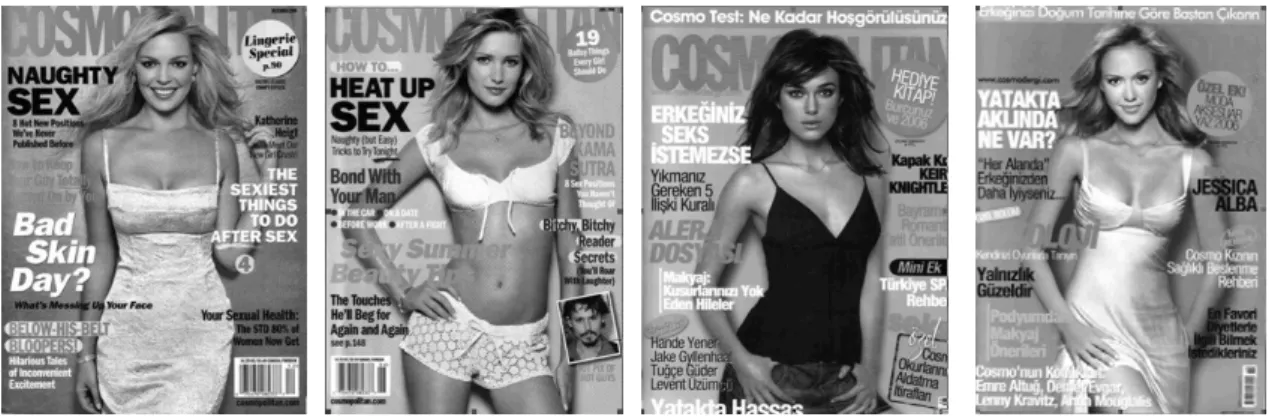
As an example issue of November 2006 the American and Turkish versions shown in Figure 5.1 are compared.
In Turkish issue ‘The striking Sex Idea’ the headline includes sex but that is all, nothing educational is given in the content. On the other hand in the American version the headline ’10 Shocking Truths about Guys and Sex’ gives ideas about men’s innermost sexual thought and behaviors.
The messages given in the headlines are particular type of body and particular weight and these equal being sexy. On the cover of Turkish version ‘Find your Perfect Diet’ as beauty and slimness is important for Turkish woman. The messages about sexuality given in both versions are different from each other. The messages in Turkish version aren’t as brave as the ones in the American version.
In the American version readers are presented with advice on how to kiss, touch, perform oral sex and perform manual sex, usually orgasm inducing , sexual intercourse positions. The importance of orgasm and suggestions for how to improve the experience of orgasm (making it stronger or longer) are the frequent titles in American version of Cosmopolitan. Many suggestions are given to maximize the woman experiencing orgasm. The other title which is frequent in the American version is “great sex” which gives advice about duration of sex, intercourse …etc. Sexual health to improve the readers’ sex lives. This kind of advice is not on the cover of Turkish version as it is in the American version.
Sometimes at the same issues same cover girls are presented with different clothes or the same cover girl may appear in different months in the United States and Turkey. In both versions the pictures on the cover of the magazines are stand alone models or celebrities of American culture.
In Turkish versions there aren’t any Turkish models on the cover. The reason may be that the models are chosen by the fashion and beauty editors of the magazine and a Turkish model can not attract the reader as much as the American model does. In Cosmopolitan American and Turkish version covers there is no celebrity with short hair; all of them have long hair. They wear dress or shorts; no one wears bikinis.
In addition to these it was not necessary for the woman in the advertisement to meet any particular number of the stated criteria to be defined as a sex object. Instead, it was the overall impression of the coder assisted by the listed criteria that determined whether the woman was coded as a sex object. It was important to allow subjectivity into the ratings because a scantily-clad woman is not always sexualized, and often fully-clothed women are sex objects. Therefore, it was possible that a woman wearing a
bikini might not be coded as a sex object, whereas a fully-dressed woman with a sexually suggestive posture might be defined as a sex object (Stankiewicz and Rosselli 583).
Baker states that Cosmopolitan displayed similar ideas about sexuality and women’s sexual attractiveness (14).
The Cosmo Girl’s characteristics features are sexy, successful, having her own style. She persuades the readers that they have the potential to be a Cosmo Girl and they may do if they desire.
The color of the magazine covers and the color of the logo Cosmopolitan changes in each issue. They are not the same in each country. The colors used on the cover of the magazine are blue, red, yellow, purple, brown, pink, white, green and also every color has a meaning.
There are 27 headlines related with sex on the cover of Cosmopolitan American version ; on the other hand there are 13 headlines related with sex on the cover of Turkish version , almost half of it. The depiction of female sexuality is only a part of the headlines. Female sexuality exists more in relation to male sexuality in the American version. The headlines are obsessed with man’s sexuality. It is the reason of producing man’s sexual pleasure. The headlines give ideas how women should behave, dress and engage in sexual practices in order to please their mates. The ideology is, women exist to satisfy men’s sexual fantasies.
We don’t see the same headlines about sexuality in Turkish version as it is in the American version. For example in June, 2006 American issue the headlines are Heat up Sex (naughty but easy tricks to try tonight), Bond with your man, Sexy summer beauty tips, the touches he‘ll beg for again and again, Beyond Kama Sutra (8 sex positions you haven’t thought of) Bitchy, bitchy reader secrets. On the other hand in June 2006 Turkish issue the headlines are Questions about Love, Boundless pleasure in sex, Prepare yourself for summer, Cosmo’s guests, Pregnancy in Hollywood style, the things that you should know about the sun. As you see the headlines in Turkey are
conservative because of the society. There aren’t any slang words on the cover. In addition to these the magazine reminds us the special days for instance father’s day.
The difference in the headline means the attitudes toward sexuality change from Turkey to the United States. Turkey is in a bridge between the east and west. This situation results in taking the modernism of west and the traditions of east. Social values and norms limit the headlines of the Turkish issue; Turkish issues have headlines about sexuality but not as much as the American issues.
The titles in the content are same but the article, the density of sex is different from each other. In Turkish version there are not headlines about sexual techniques, new positions and games related with sex to enhance the experiences In American version there is a headline saying 60 Sex Skills with an interpretation saying that the most mind-blowing moves women have ever tried. We can never see a headline on the cover of Turkish one, the reason is that the society we live in and the patriarchal values. In the American versions there are headlines ‘Your Sexiest Haircut Ever’ and ‘Sexy Summer Beauty Tips’ sex is linked with the beauty of the women. Another headline about health ‘Sex Special’ which is about birth control there is not a headline about birth control in the American version since this problem was come over years ago. Besides these Turkish version is not the translation of the American version.
In Cosmopolitan magazine as it is understood from the headline of the article sexual performance is depicted more important than everything. Men are situated as loving women who are good in bed and enjoy sex. There are some tricks given about keeping the men satisfied. In the American version the headlines are to please the men. The subject ‘he’ is always used in the headline of the American version like ‘Discover the Sex Fantasy 68% of Men Have’, ‘What sex is Like For Him’.
In addition to these in Cosmopolitan men are portrayed as potentially and actually desiring sex all the time. Orgasm being the part of the pleasure, portrayed as the aim of both women and men. They are described in the headlines ‘Never Lose Your Orgasm Again’, ‘Orgasms Unlimited’.
In Turkish version the headlines are simple questions about sex; they are not educational like the ones in the American version. When a man or a woman looks at the headline he/she may think there are a lot of educational things in the content about sex in the magazine but not as explicit as the American version. In Turkish issue the headline is ‘Sex for Sex with Positives and Negatives’ it is striking and gets the interest of the reader but in the content it is not as striking as the headline.
In love relationships, the theme of romantic love still remains a significant role on the pages of women’s magazines. Cosmopolitan focuses on the benefits of independence however being single is more featured theme. It is not because they defend the romantic love, they use it as a tool for their aim.
In the American version the headline is “How to teach him to be more tender” this message tells about to be tender during sex. “What falling in love feels like for him?” the headline is about how a man falls in love. It says that there are four phases that every male goes through on his way uttering the “L” word how they can be ready to say “I Love You. In Turkish version there are some tricks about ‘How to make your love live’ tells about how to lead the life as a honeymoon. There are formulas about happy love by the therapists. It says that couples go to therapists to make their relationship more qualified.
“What you should do to have your love always new?” The advices given in Turkish version always be yourself; don’t neglect your sexual problems and know the meaning of relationship. “The ways to decrease the happiness” gives the same ideas known by everybody.
In Cosmopolitan another issue of October they are not on the cover but in the content the headlines are 10 ways to interrupt the romantic moment it is said that how can you interrupt a man’s romantic situation, simply focus on man, other headline love advices –gives information. How can you take a help from a professional person? What can a long term relationship need? Everything starts wonderful but later changes what does the relationship need? How can a person take the relationship to the end gives
clues about to be aware of whether it is true relationship or not. Ideas given about sex help to boost their creativity or at least provide some insight.
Cosmo women were encouraged to be as ‘sexual’ as possible, but primarily in ways that made them available to satisfy men’s purported (and reported) sexual fantasies and desires (which form a constructionist perspective, are ‘produced’ and not ‘natural’). Although providing men with sexual pleasure and power to women, ‘women are also [positioned as] naïve and vulnerable …relying on the reaction of men for their self image and power (Farvid and Braun 300).
In health part, diet in Turkish version and sexual health in the American version are mentioned. In Turkish version there is a guide for Cosmo’s girl to have a healthy eating with including the most favorite diets, gives the Cosmo girl’s fitness guide, find your perfect diet, do detox are all about the problems about beauty and weight.
Bessenoff and Del Priore state that because women are depicted in the current media as extremely thin, self comparison to such images can lead to various negative consequences and added that women who see a discrepancy between themselves and media images (i.e., thin –ideal is seen as better than the self) are likely to feel less satisfied with their bodies and their weight (215). The same body image is used for the American and Turkish versions. Even, especially Turkish women are obsessed with their physical appearance. For that reason, diets are given in Cosmopolitan Turkish version more than the American version.
Health theme is given with sexual health the headline “The Std 80% of women now get”. There is a part “Cosmo Gyno” gives knowledge about unexplained pelvic pain, a change in your daily discharge, how your period impacts your pair. It is like an advisor or a doctor near you. In health part of the American version there is always a word to make people aware of a problem “Before your guy puts on a condom, check to see if it has any tears or has become brittle” as a warning. Another” Women who drink four cups of caffeinated tea per day reduce the risk of breast and ovarian cancers.
Turkish version Cosmopolitan the theme health is mentioned as the right and the wrongs in backaches, the exercises for headaches, what to do to prevent sleeplessness,
the time to quit smoking, cholesterol, and the presentation of medical centers in Turkey. What do I have to do to prevent the scent of a mouth, things to be careful before getting into swimming pool, how you can wash the baby clothes in a healthy way …etc these are the titles in the articles in Turkish version. It is not about the sexual health like the American version because of the social norms that determine the headlines and the content.
The questions were in the American version that can’t be seen in Turkish version is that “Can I get a yeast infection from oral sex?”, “Can the pill hurt your sex drive?” There is a Q&A part which means Question and Answer. In this part the questions are like “How to make your period easier?” in order to prevent a menstrual misery and “Why do I get a headache after orgasm?”
In health check part the question is “Can the abortion pill kill you? Is such a warning about the drug being taken after abortion? There is another warning that since some risks are not visible to the naked eye a person should be careful in oral sex. This kind of titles can not be seen in Cosmopolitan Turkish issue because of Turkish culture’s social norms and rules.
Such kinds of warnings are not in Turkish version of Cosmopolitan since the readers are far from the titles. If a woman is planning to become pregnant in the next few years, she should avoid eating some kind of fish as they contain high levels of mercury, a chemical that lingers in body and may harm the developing nervous system. Cancer warning of women of color that people’s ethnic background can determine one’s odds. It is written that researchers have long been puzzled as to why premenopausal African –American women have a lower incidence of breast cancer than do women of other ethnicities and age groups.
In Ménard and Kleinplatz state that Duran and Prusank identified three distinct themes within the sexual content of three women’s lifestyle magazines, Cosmopolitan, Glamour and Self (1997). Firstly, “great sex”, as defined by the authors of the magazine articles, can only occur within the context of an intimate, caring and long-term
touching, stage management, new positions, forbidden games), which will enhance the experience of sexual and erotic intimacy between partners. Thirdly, ‘‘great sex’’ contains chemical or magical elements inherent to it which are beyond the individual’s control. Although some of their findings relate to ‘‘great sex’’, Duran and Prusank were primarily concerned with relational themes and advice. Their study focused on more general sexual content rather than on ‘‘great sex’’ specifically or on advice related to the attainment of ‘‘great sex’’ (4).
The reason of a big difference between the issues was the readers. They determine the headlines and the titles of the magazines. The American version has more details than the Turkish version. Sexuality is combined with health but in Turkish version nothing about sex related with health are mentioned. Turkish version does not give importance to sexual health as the American version does. When a person looks at the covers it seems that everything is same .What is same between two versions is the cover girls on the cover of Cosmopolitan.
Another headline Never Lose Your Orgasm Again. Something about orgasm is not mentioned on the cover of Turkish version but in the American one we can easily see this subject nearly almost all the covers.
While describing a person or a place it does not matter there is always a connection between sex. In Turkish version of Cosmopolitan there is a headline saying having sex with the ex. This is the only headline in this issue dealing with the sex. There is always a part in Turkish version saying Cosmo’s guests there are always interviews with at least three popular people (actress, actor, singer or writer, etc.) in Turkey. It may be to fill the gap between other versions as we can not talk about sex as free as the American ones this is the way being used.
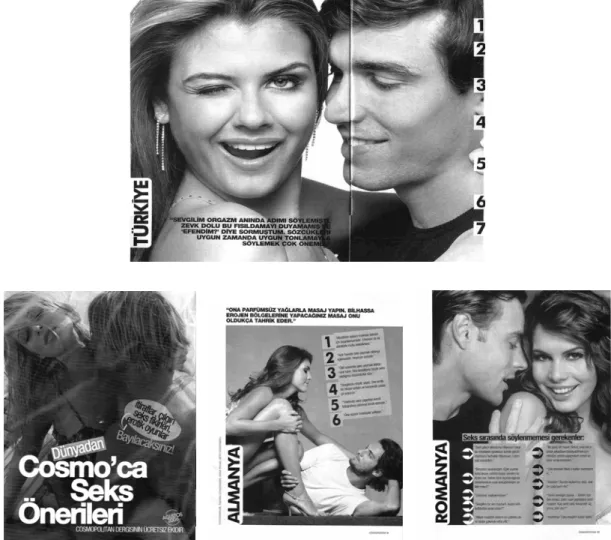
Cosmopolitan Turkish version gives a booklet extra about sex instead of using the word sex as brave as the American issue. Booklet of Cosmopolitan Turkish version women’s magazines depict a happy, attractive, heterosexual couple, women’s gaze was towards the camera with eyes shut when the partner’s gaze is fixed on her. The pictures in the booklet show the women sexually available. The people in the pictures are not the
people of the country mentioned. On the cover of the booklet the headline is ‘Cosmo’s sex Advices from All Over the World’. The picture used for Turkey does not have a sign of sexuality. Because of the fact that this booklet is given to readers of Turkey, it is not contrary to the social values of the country.
Figure 5.2 Examples from the booklet
5.1 Characteristics of Cover Models
perfect women on the covers. On the other hand women reading this magazine can feel insecure and unhappy with themselves.
The body position variable measured whether the models in the photos were standing, sitting, reclining or contorting. Goffman observed that women were more likely to be placed in the reclining or contorting positions that depict ‘sexual availability’ (Krassas et al. 105). It is not true for Cosmo but the body position on the covers of Cosmopolitan make the readers think that the cover girls have sexual availability.
The models on the covers make the audience think that they are dependent, submissive and available with sexuality as seen in Figure 5.3. The cover models on the magazine are always standing. Messages of sexuality are conveyed through the pose the model has given on the cover of the magazine. The body pose gives the message of submissiveness or domination. They look submissive because they are not giving poses including wildness. They are wearing clothes, jeans not underwear or naked. Their hands are on the legs, hair, hip and buttocks or on their waist; they are looking right at the camera, inviting the readers to look at her. They are the American models or celebrities on the covers in the American and Turkish versions of Cosmopolitan.
Models’ gestures, facial exposure have importance in the photographs. What is the role of that she is depicting? A partner, sex object, a business woman.
They are always in ideal size that a woman wants to be. They are presented as choice to be sexually available. The same body image is presented to women in the American and Turkish version.
Bessenoff and Del Priore state that magazines aimed at younger women depict younger and thinner models than do those magazines with a larger percentage of older readers (215). The ages of the model or celebrity on the covers are between 23 and 26. Models should be younger than the target reader because always a person wants to be young not old, there should be a sign of attraction in their looks, reader should admire them. They are famous. They are models, singers or actresses. The model on the cover must be attractive and interesting because it will appeal to women. Sometimes when you see the magazine on newsagents’ shelves you can’t see the full cover you may see the headlines on the left or right(mostly on the left in Turkish version) this will make it you decide whether to buy it or not. On the Cosmopolitan cover the lines are standing out individually without overwhelming the others. The color of the headlines sometimes in contrast to the background of the cover to attract the consumer. New columns are presented with new flashes.
Table 5.1.
Distribution over age category of Cosmopolitan Magazine readership and models in America. (Bessenoff and Del Priore 217)
Age category 18-24 25-34 35-44 45-54 55-64 65 +
Readership 32% 26% 22% 2% 4% 4%
Model 51% 49% - - - -
As the same models are on the covers of Turkish version the age category of models is valid for Turkey too.
Women with blonde hair were disproportionately featured. It is argued that these depictions contribute to a construction of the beauty ideal which is unattainable for most women because they are not blonde or do not have pencil thin features. Another study of Krassas et al. cover models found that the weight and body type of most cover models was remarkably similar and unattainable for most women. The photography of women cover models, like most advertisements featuring women reflected the male gaze, tending to portray what women should look like and what women should look for (102).
However the models on the covers are mostly having blonde, brown or fair long hair. They are slim girls. There is not an overweight model on the covers. They have a facial expression suggesting a desire of sex, the position sometimes their hand on their legs, make up always with bright lipsticks, the photo is focused whether on breasts or buttocks etc and their skin is not shown so much. They never wear a bikini on the cover.
The models on the covers are slim girl with perfect complexion and perfect features. The images and ideologies presented within the magazine covers become the stereotypical norm for the teenage girl. Good-looking women are described in terms of their physical attractiveness, their beauty, and their thinness. Girls worried more about their figure and weight than did boys, who—in turn—were more concerned with money and looks. This indicates that, for girls, body image concerns are of greater importance relative to other concerns than they are for boys. Thinness has become almost-synonymous with beauty body dissatisfaction in women (Hargreaves and Tiggemann 543).
The mass media have long been criticized for presenting unrealistic appearance ideals that contribute to the development of negative body image for many women and girls. A growing number of experimental studies have demonstrated a causal link between acute exposure to “thin-ideal” images (i.e., images of impossibly thin and attractive female beauty) and increased body dissatisfaction. Overall, these studies consistently demonstrate a small, negative, immediate effect of exposure to such thin-ideal images (Hargreaves and Tiggemann 539).
Girls develop eating disorders because mass media images of beauty and sexual desirability can not be obtained through healthy eating. The female obsession with body image and physical attractiveness has been linked to several factors, such as adolescent turmoil, family history and pubertal timing which in turn, have been associated with anorexia or bulimia nervosa. However, chronic dieting has also been directly attributed to the social pressure on females to achieve nearly impossible thinness, constantly reinforced by the female images portrayed in the media and advertising (Napoli et al. 60).
As stated in Krassas et al., media presentations of weight and sexual attractiveness are particularly harmful to young women and girls, according to research by Pipher (1994), who argues that girls develop eating disorders because mass media images of beauty and sexual desirability could not be obtained through healthy eating (753). There is a link between being sexy and thin. It is same in Turkish version as the American that magazines affect the body ideal of a country. The pictures of the models, the diets given in the magazines urge women to be thinner.
In women’s magazines women are presented in decorative functions they are not only sex objects but also as objects of identification. Women’s magazines have a stereotyping gender role, unrealistic beauty standards, and thinness. Gauntlett (2002) argued that almost all women’s magazines operate within boundaries that perpetuate the “hetero-sexy” ideal. These magazines offer a one-dimensional “popular feminism” to
be independent, but they must also be attractive; thus, the magazines “would never encourage women to step outside their carefully imagined boundaries of the ‘sexy,’ the ‘stylish,’ and ‘the fashionable’ ” (Hardin et al. 108).
Women magazines depict the ideal women in beauty standards and thinness, focus on young career woman. Their hand is on the hip or buttock and looking right at the camera and the focus on their breasts.
CHAPTER VI
RACE
When we look at the skin color of the cover girls we can only see one African -American woman on the cover of the magazines. In addition to these when we look at the hair color of the models they are fair or blonde .Whiteness, fair skin and thinness make the woman sexual since it is an accepted idea. Beyonce a black woman is on the cover she is the exception that proves the rule.
Only one woman a popular African American singer Beyonce is given on the cover Cosmopolitan American and Turkish versions. Beyonce is portrayed with more European like features such as fair skin, straight hair instead of kinky hair and a thin figure conform to mainstream beauty standards. In both covers, she is wearing the similar dress which is low-necked, and her hand on her leg in whole sex appeal. Her hair is wavy not kinky like other black women.