γ> ^ч'р'-.-уΌ А ^ * ί г . T-, ,-', γ.*Α ϊ. 7> --*■·*«. * Τ " . ■**«·“ «■ ■* " Γ % · - .*·,./.? Г-Ѵ,4 0 . ■'<# ·ι, .^ » -,*í»*w ·■. ■. Γ ι . .■ . · · · . '· <«>ί· - · ^
•«, 'ÍN . . 'S ' . * . Î V Д •%.;' .-Г* Γ - ' * r w w u ·. -m im -.i! I»· ^ 1 ^»Ѵ Г’ іч^ ·* , · * * ι ^ . > ϋ < Λ ι ί ^ -erfírvi·».·*; .miî«·*.···. .я», Т‘*г -, Τ. '' .} г . /-Ѵ ,4 ' -J Г.
-.Η*,*» ,» « -» < '-'« •'■ 4 » ''. ;W i W Λ · ι^ — .„.чія...·· -ι·’. ; «ν· — ■ oW'^.·Л ч Л ' 4 * ’ * '
COMPARISON OF STUDENT MOTIVATION, INTERACTION, PARTICIPATION AND COMMUNICATION
IN THE STRUCTURAL APPROACH AND THE COMMUNICATIVE APPROACH:
A DESCRIPTIVE STUDY
A THESIS
SUBMITTED TO THE FACULTY OF LETTERS
AND THE INSTITUTE OF ECONOMICS AND SOCIAL SCIENCES OF BILKENT UNIVERSITY
IN PARTIAL FULFILLMENT OF THE REQUIREMENTS FOR THE DEGREE OF MASTER OF ARTS
IN THE TEACHING OF ENGLISH AS A FOREIGN LANGUAGE
BY
ALEV y e m e n i c i AUGUST 1992
r¡
1 1
BILKENT UNIVERSITY
INSTITUTE OF ECONOMICS AND SOCIAL SCIENCES MA THESIS EXAMINATION RESULT FORM
August 31, 1992
The examining committee appointed by the Institute of Economics and Social Sciences for the
thesis examination of the MA TEFL student
ALEV y e m e n i c i
has read the thesis of the student. The committee has decided that the thesis
of the student is satisfactory.
Thesis Title
Thesis Advisor
Comparison of Student Motivation,
Interaction, Participation, and
Communication in the Structural Approach and Communicative
Approach: A Descriptive Study.
Dr. Eileen Walter
Bilkent University, MA TEFL Program Committee Members: Dr. James C. Stalker
Bilkent University, MA TEFL Program Dr. Lionel Kaufman
We certify that we have read this thesis and that in our combined opinion it is fully adequate, in
scope and in quality, as a thesis for the degree of Master of Arts.
~~fy( 1 -tc,., I Eileen Walter (Advisor) n )iim^ James C. Stalker (Committee Member) c^yu.·'C ___ Lionel Kaufman (Committee Member)
Approved for the
Institute of Economics and Social Sciences
Ali Karaosmanoglu Director
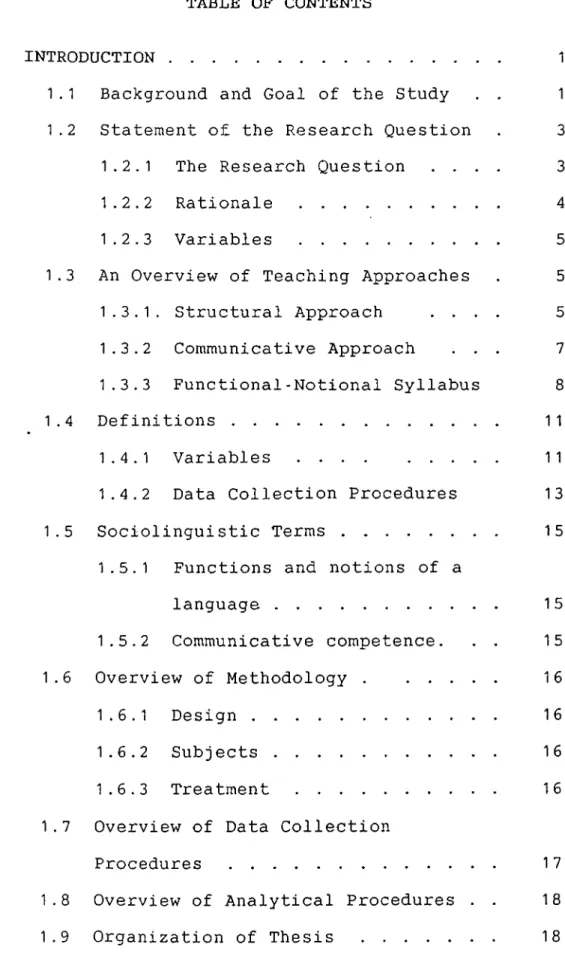
TABLE OF CONTENTS
I INTRODUCTION ...
1.1 Background and Goal of the Study
1.2 Statement of the Research Question
1.2.1 The Research Question . . .
1.2.2 Rationale ...
1.2.3 Variables ...
1.3 An Overview of Teaching Approaches
1.3.1. Structural Approach . . .
1.3.2 Communicative Approach . .
1.3.3 Functional-Notional Syllabus
1.4 Definitions ...
1.4.1 Variables . . . . . . . .
1.4.2 Data Collection Procedures
1.5 Sociolinguistic Terms ...
1.5.1 Functions and notions of a
language ... 1.5.2 Communicative competence. 1.6 Overview of Methodology . . . . . 1.6.1 Design ... 1.6.2 Subj e c t s ... 1.6.3 Treatment ...
1.7 Overview of Data Collection
Procedures ...
1.8 Overview of Analytical Procedures .
1.9 Organization of Thesis ... 1 1 3 3 4 5 5 5 7 8 11 11 13 15 15 1 5 16 16 16 16 1 7 18 18
2.1 Introduction... 20
2.2 Sociolinguistics in Language Teaching 21 2.3 Two Approaches for Language Teaching 25 2.4 Classroom-Actiork R e s e a r c h ... 31 2.5 C o n c l u s i o n ... 33 III M E T H O D O L O G Y ... 3 4 3.1 I n t r o d u c t i o n ... 34 3.2 S u b j e c t s ... 35 3.3 T r e a t m e n t ... 36
3.3.1 The Structural Approach . . . 37
3.3.2 The Communicative Approach . . 40 3.4 Data Collection Procedures and M a t e r i a l s ... 44 3.4.1 C h e c k l i s t ... 45 3.4.2 Questionnaires ... 46 3.4.3 Anecdotal N o t e s ... 47 3.4.5 Student Journals ... 48 3.5 V a r i a b l e s ... 48 3.6 Analytical Procedure ... 49 IV ANALYSIS OF THE D A T A ... 51 4.1 I n t r o d u c t i o n ... 51 4.2 Checklist Analysis ... 52 4.2.1 Structure-based Approach . . . 52 4.2.2 Communication-based Approach . 55 4.2.3 Comparison of Two Approaches . 57 4.3 Student-Questionnaire Analysis . . . 58
4.3.1 Structure-based Approach . . . 4.3.2 Communication-based Approach . 4.3.3 Comparison of Two Approaches .
4.4 Analysis of the Teacher Journals . .
4.4.1 Student Participation in
Structure-based Lessons . . .
4.4.2 Student Participation in
Communication-based Lessons
4.4.3 Teacher's Introspection on
Student Behavior in Structure-
based Lessons ...
4.4.4 Teacher's Introspection on the
Student Behavior in
Communication-based Lessons
4.5 Analysis of Student Journals . . .
4.5.1 Structure-based Lessons . .
4.5.2 Communication-based Lessons 4.6 Discussion of Results ...
4.6.1 The Structural Approach . .
4.6.2 The Communicative Approach . 4.7 Conclusions ...
V CONCLUSIONS ...
5.1 Introduction ...
5.1.1 Review of the Study . . . .
5.1.2 Conclusions ...
5.2 Assessment of the Study ...
5.3 Pedagogical Implications ... 5.4 My Experience as a Teacher/Researcher. 59 63 67 70 70 72 V I 73 75 76 77 80 83 83 85 87 89 89 89 90 92 93 96
BIBLIOGRAPHY ... 98 APPENDIX A ... 102 HANDOUT A 1 ... 104 HANDOUT A 2 ... 105 HANDOUT A 3 ... 106 APPENDIX B ... 107 APPENDIX C ... 109 HANDOUT C l ... Ill HANDOUT C 2 ... 112 APPENDIX D ... 113 APPENDIX E ... ’ ... 115
Vlll
LIST OF TABLES Table 4.1
Results of Analysis of Checklist for
Structure-based Lessons: Tasks, Activities
and Teacher's Attempts to Stimulate
Students' Motivation ... 54
Table 4.2
Results of Analysis of Checklist for Communication-based Lessons: Tasks, Activities and Teacher's Attempts to
Stimulate Students' Motivation 56
Table 4.3
Frequency and Percentage of Students'
Responses to the Questionnaire for
Structure - based Lessons... 61
Table 4.4
Frequency and Percentage of Students' Responses to the Questionnaire for
Communication-based Lessons . . . . 65
Table 4.5
Percentages of Student Responses on Questionnaires Given at the End of
Structure-based Lessons and Communication-
based L e s s o n s ... . 68 Table 4.6 Frequency and Participation Lessons . . . Percentage of Student in the Structure-based 71
ACKNOWLEDGEMENTS
I would like to express my deepest gratitude to my thesis advisor Dr. Eileen Walter whose guidance,
excellent suggestions and most kind words of
encouragement have made this thesis possible. I am
indebted throughout my studies to her knowledge and patience.
I am most grateful to Dr. James C. Stalker from whom I have received vast amount of help in clarifying
my ideas. I would like to thank Dr. James C. Stalker
for his kind assistance and being so generous with his time.
I would also like to thank Dr. Lionel Kaufman for his kind assistance.
I owe special thanks to Prof. Dr. Unal Aytur at Ankara University who encouraged me and gave me the permission to attend the Bilkent MA TEFL program and to complete this thesis.
ABSTRACT
The second language classroom has long been a
center of research interest. Researchers have
attempted to examine the second language classroom to find out in what ways classroom experience differs from the experience a speaker has in the target
language environment, and why and how language
classrooms differ among themselves. Furthermore, they have tried to identify the factors which lead to different results in a classroom and cause classroom activities to change from one class to another. Classroom-centered research focuses on the c.lassroom and investigates what is taking place in the classroom so that the rich and descriptive data collected during the observation periods help describe many problems that students face while learning and internalizing the target language.
The concern of this thesis was to find out the influence of using different teaching approaches (function-based Structural Approach versus function- based Communicative Approach) on student motivation, participation, interaction, and communication in the
EFL classroom. Action - research was carried out to
investigate this research question. The assumption
behind the present study was that learners in the EFL environment are very likely to be motivated to the highest degree and to benefit from learning functions and notions of language communicatively rather than
Communicative Approach would enable them to distinguish among the various functions of structures under different contexts more than they would do from a course which was solely based on drills as in a
function-based Structural Approach. It is believed
that EFL students learn and use the language far better if they are provided with the circumstances that facilitate their language use.
The results of the study indicate that students enjoyed English class most when they used their language to interact/communicate with each other in a
real-life situation. Moreover, they felt that they
needed to learn the grammar of the language. But they did not want to learn grammar rules in their abstract
forms. Instead, they wanted to play language games
whose focus was on content not on linguistic forms. In other words, they wanted to combine grammar with communicative activities.
Based on the results drawn from the study, teaching grammar without context is not advisable.
Students enjoy studying language in meaningful
contexts through communicative activities. When they enjoy the language learning process, then they became
motivated and, thus, they learn better. They need to
know various functions of language, how, when and
where they are used. They need to know how to
distinguish between formal and informal language.
atmosphere working with a teacher who does not operate as the sole authority but as a guide, a friend in the
classroom so that they can work in a relaxed
INTRODUCTION
1.1 Background and Goal of the Study
The second language classroom has long been a
center of research interest. Researchers have
attempted to examine the second language classroom to find out in what ways classroom experience differs from the experience a speaker has in the target
language environment, and why and how language
classrooms differ among themselves. Furthermore, they try to identify the factors which lead to different results in a classroom and cause classroom activities
to change from one class to another. Classroom-
centered research focuses on the classroom and
investigates what is taking place in the classroom so that the rich and descriptive data collected during the observation periods help describe many problems that students face while learning and internalizing the target language.
For instance, motivation is one of the most important factors that makes it possible for students of a foreign/ second language to learn a language and
to improve their language. Dulay, Burt, and Krashen
(1982) describe motivation as "the need, or the desire that the learner feels to learn the foreign/second
language" (p. 47) . Classroom-action researc.. helps
arise from lack of motivation and may shed light on how and when students are motivated the most to participate in class discussions and activities. Although motivation is assumed to lead to successful
learning, the most common approach in language
teaching in Turkey, the Structural Approach, has not
taken student interest and motivation into
consideration. A newer approach being tried in
Turkey, the Communicative Approach, requires that
teachers motivate students so that they will actively
participate in language learning. Moreover, this
approach personalizes learning, providing the student with the chance to share his ideas and opinions with
his class-mates. The functional-notional syllabus,
according to Wilkins (1973), "takes the communicative facts of the language into account from the beginning
without losing sight of the grammatical and
situational factors" (ctd. in Dobson, 1979, p.32-33).
Therefore, students are very likely to communicate,
interact with each other and become motivated when
they use language effectively in meaningful
communicative situations.
This study investigated what happened inside a classroom, treating the classroom as the object of investigation as well as the setting for language
learning and teaching. The main purpose of designing
this research was to observe the differences, if any,
and communicative approaches. Furthermore, the main aim was to find ways to improve student learning which has obvious weaknesses due to a lack of motivation and to provide an opportunity for increased practice and
interaction in the classroc a . in this descriptive
classroom-centered research, classroom processes
became the main focus. This study included library
research, questionnaires, introspection, anecdotal
notes and observation using checklists. Such a study
has not been done in Turkey and it is hoped that it will be beneficial to all EFL teachers.
1.2 Statement of the Research Question
1.2.1 The Research Question
The concern of this thesis was to find out the influence of using different teaching approaches (function-based Structural Approach versus function- based Communicative Approach) on student motivation, participation, interaction, and communication in the
EFL classroom. The assumption behind this research
was that learners in the EFL environment are very likely to be motivated to the highest degree and to
benefit from learning functions and notions of
language by communicative means rather than by
structural means. In other words, a function-based
Communicative Approach would enable them to
under different contexts more than they would do from a course which was solely based on drills as in a
function-based Structural Approach. It is believed
that EFL students learn and use the language far better if they are provided with the circumstances that facilitate their language use.
1.2.2 Rationale
It has long been observed by the researcher that the first year students in the Faculty of Letters at Ankara University have great difficulty in taking part in class discussions due to the fact that grammar
classes are very large and crowded. Therefore,
students can hardly find a chance to practice their
English in pairs or in groups. Since there cannot be
much interaction and effective and challenging class
discussions, a lot of students get demotivated.
Another factor that demotivates students is the
constant focus on the structure of the language. Since the primary concern of the Structural Approach is the structures of the language, the students cannot
produce appropriate language in situations that
require particular register and speech acts. For this
reason, this s = '.'.dy aimed to examine a group of first
year repeat students in an environment which provided every one of them the opportunity to practice the
language and to interact with each other, using
different situations. The study aimed to control certain factors that lead to lack of motivation, such as crowded classes, and to deal with when and why the students feel certain ways. In order to observe this, the researcher attempted to do a descriptive study,
classroom-centered action research in which the
researcher collected data through observation,
anecdotal notes, introspection, checklists,
questionnaires and student journals to learn the
students' reaction towards the teaching/learning
process and differences in student behavior.
1.2.3 Variables
Dependent Variables; Student motivation,
interaction, communication, and participation in class discussions.
Independent Variables: Two different teaching
approaches (function-based Structural Approach versus function-based Communicative Approach)
1.3 An Overview of Teaching Approaches
1.3.1. Structural Approach
This approach assumes that language learning is
habit formation. As Hammerly (1 985) puts it, "This
approach emphasized development of habitual (that is, internalized) control of language structure" (p. 16). The patterns of the language need to be over-learned
by students. It is believed that over-learning leads to the acquisition of habits which produce correct
utterances. In other words, some educators maintain
that, although meaningless, repetition of correct
forms is valuable. Moreover, since the native
language of the students will interfere with the target language, intensive exposure to the correct forms of the target language through drills and pattern practice will help students overcome this
difficulty. The courses based on pattern practice,
drills and structural teaching focus on the grammar of the language.
There are some disadvantages of the Structural Approach which prevent students from engaging in
active and communicative tasks. First of all, in the
Structural Approach, the teacher controls and directs the language behavior of the students. Although there is student-to-student interaction, this interaction is teacher directed. In other words, the teacher controls and guides the interaction. He provides substitution drills and chain drills for students to interact with each other or with the teacher. That is to say, there
is no real communication. Another point is that the
context and the situations are limited to what '’an be done in the classroom. Thus, vocabulary is limited to
the classroom context. The next point is that the
structures are emphasized more than the other areas of
Disadvantages of the Structural Approach have been remedied by the Communicative Approach.
Larsen-Freeman (1986) defines some of the
principles operating in this approach as follows:
1 . The structures of the language are emphasized
over all the other areas. The syllabus is a
structural syllabus. Vocabulary and structures
are presented in a dialog but since the emphasis is on the acquisition of the patterns of the language, contextualization is limited.
2. Student errors are avoided.
3. There is student-to-student interaction in chain
drills or when students take different roles in
dialog practices, but this interaction is
teacher-directed.
1.3.2 Communicative Approach
This approach regards communication as a process and believes it is insufficient for students to learn
just target language grammar and vocabulary. This
approach emphasizes the importance of the students' applying their knowledge about the target language to
negotiate meaning. The interaction between the
speaker and the listener makes meaning clear. When
the listener gives feedback to the speaker, the
speaker finds the opportunity to revise what he has
(1986) and Finocchiaro and Brumfit (1983) define some of the principles operating in this approach as follows:
1. Language is used in a real context.
2. The focus is on different linguistic forms and
real language.
3. Errors are tolerated and regarded as the natural
outcome of the developing communication skills.
4. While communicating, the speaker has a choice
about what to say and how to say things.
5. Students are provided with opportunities to
develop strategies for interpreting language.
6. Meaning is primary.
7. To achieve effective communication, language
is taught in a meaningful context.
8. The teachers aim to teach students to achieve
communicative competence.
9. It i.s believed that since students become
interested in what is being communicated through the language, they have integrative motivation;
this is a major factor that leads to
communication.
While some communicative syllabi are task-oriented, some are based on functions and notions.
8
1.3.3 Functional-Notional Syllabus
The functional - notional syllabus takes
people choose when they want to accomplish a task
through speech. Function-based courses present
natural language in realistic contexts and make
communicative practice possible. Wilkins (1976)
explains the notional syllabus as a syllabus
"organized in terms of the purposes for which people are learning language and the kinds of language performance that are necessary to meet those purposes"
(1976, p.16). In other words, a notional syllabus
puts emphasis on particular communicative situations and perceives how the learner should use the language
to get meaning across. Some of the educational
principles that functional-notional syllabi have
assumed are presented by Finocchiaro (1979) as
follows:
1 . The individual learner is at the center of the
learning process. We can give learno'rs the
potential ability and motivation to continue their studies, to generalize from the grammatical rules or sociocultural insights they have gained
in one sociocultural situation to other
appropriate ones.
2. A spiral or cyclical approach is recommended. In
this approach the same sociocult\iral theme,
linguistic item, or language function is studied
learning. The material studied previously is integrated with the new learning.
At present, the functional-notional syllabus is only
a syllabus but not an approach. An approach is "a
general pedagogical orientation based on one or a few assumptions related to an explicit or implicit theory"
(Hammerly, 1985, p. 112). Since a functional-notional
syllabus is "a body of ideas which reflect and
synthesize much contemporary thought about language
teaching" (Finocchiaro and Brumfit, 1983, p. 10),
these ideas come to form syllabus specifications. On
the whole, this syllabus aims to teach students
language in an environment where they are "made" to struggle to communicate, to interact with one another by which they gain the ability to use the linguistic system effectively and communicatively.
The functional - notional syllabus can be used both with the Structural Approach and the Communicative Approach since it "takes the communicative facts of language into account without losing sight of the grammatical and situational factors" (Wilkins, 1973,
ctd. in Dobson, 1979, p. 32-33). The functional-
notional syllabus provides the structures that need to
be used to carry out certain functions in
communication. In the Structural Approach, these
structures are focused on and practiced in drills. In
the Communicative Approach the focus is on
communication where different functions of language
are carried out. The students learn the structures to express certain functions as they need them.
1.4 Definitions
1.4.1 Variables
Motivation: Motivation is a major factor that
makes it possible for EFL/ESL students to learn and
improve a language. According to Dulay, Burt and
Krashen (1982), motivation is "the need, or the desire that the learner feels to learn the foreign/second
language" (p. 47). Integrative motivation may be
defined as the motive that leads the learners to learn
a foreign language just because they want to
participate in the social life of the host country. Dulay, Burt and Krashen define integrative motivation
as "the desire to achieve proficiency in a new
language in order to participate in the life of the
community that speaks the language" (p. 47). On the
other hand, instrumental motivation is the motivation that leads the learners to learn a language as they
want to get a job in the host country. In Dulay, Burt
and Krashen instrumental motivation is defined as "the desire to achieve proficiency in a new language for utilitarian reasons" (p. 47).
Interaction; Classroom interaction can be
defined as mutual influence between the teacher and
the students or between the students. Malamah-Thomas
(1988) defines classroom interaction as
acting reciprocally, acting upon each other. The teacher acts upon the class, but the
class reaction subsequently modifies his
next action, and so on. The class reaction
becomes in itself an action, evoking a
reaction in the teacher, which influences his subsequent action, (p. 7)
In other words, classroom interaction is more than just an action and a subsequent reaction that take place in the class. The teacher plans actions and the students react to him in certain ways but if there is a mutual influence which leads to a chain of actions and reactions, then interaction takes place.
Communication; In the Communicative Approach the teacher provides the students with a purpose so that
they can exchange ideas, and thus communicate. The
teacher acts as a facilitator in the classroom so that interaction and communication takes place. According
to Malamah-Thomas (1988) in order to achieve
communication, "the plan of action must be carried out
in a context of interaction. The teacher must engage
in the sort of interaction with the learners which
will enable communication to take place" (p. 10). In
other words, if there is co-operation between the
students and the teacher, effective communication
takes place.
Participation: For the purposes of this study,
participation is defined as learners' expressing their views and feelings in class in the foreign language to
handle social relationships. Moreover, they answer
teacher questions. Above all, they agree or disagree
and try to persuade others. In other words, they
carry out exchanges with the teacher and other students in order to accomplish certain purposes.
1.4.2 Data Collection Procedures
Action-Research ; Action research is the
systematic st : ly of what is happening in the classroom
and the researchers aim to improve the learning process taking place in the classroom with the help of
the data collected during their observations.
According to Burton (1986), there are two
psychological processes underlying action research:
"action and reflection" (p. 720) . Action should be
"purposeful". Burton defines action in action
research as "a type of behavior that is ritualistic,
a habitual response" (p. 720). Reflection, on the
other hand, helps teachers "thoughtfully and
critically find educational meaning in the lives of children as well as in their own pedagogy" (p. 421). Burton regards reflection as the "soul" of action
research since it "strengthens and gives our
intentions sustenance and elevates our impressions" (pp. 7-23).
Observation ; Observation is a procedure for "the
purpose of identifying, classifying, quantifying, and
analyzing specific classroom behaviors and
interactions by the teacher and researcher" (Ober,
Bentley and Miller, 1971, p. 15). It almost always
classroom, usually in the form of anecdotal notes and checklists.
Introspection ; This term refers to a research
technique that involves, according to Allwright
(1983), "asking people to answer questions rather than asking them to allow themselves to be observed in
action" (p, 193). In other words, a person who
introspects reflects on his own experience. Keeping
journals on classroom matters enables the
teacher/researcher and the students to look back to see when and why they reacted in certain ways during
the teaching process. Some implications of research
on teachers' reflective thinking are described by Sparks-Langer and Colton (1991) as follows:
*Critical reflection may be promoted through close examination of cases that illustrate particular aspects of context, pedagogy, content, ethical/moral dilemmas, and other elements of teaching and learning that will
help teachers develop a rich, flexible
repertoire of ideas, attitudes and skills. (p. 43)
^Teachers need opportunities to construct their own narrative context-based meaning
from information provided by research,
theoretical frameworks, or outside experts. (p. 43)
*Teacher educators can foster growth in cognitive reflection through micro-teaching
with post-teaching reflection journals,
teaching with self-analysis of video/
audiotapes, action research observation and analysis of selected teaching episodes, coacbing, and assessment and discussion of student learning, (p. 43)
1.5 Sociolinguistic Terms
1.5.1 Functions and notions of a language
People use language to communicate their
intentions and to get meaning across. People
introduce themselves and others, express likes and
dislikes, agree and disagree, make requests and
apologize. These are called speech acts or functions
of a language. However, this functional language
"must also incorporate specific notions" (Finocchiaro and Brumfit, 1983, p. 14); that is, the vocabulary items that are used to express functions of language. In other words, notions co-occur with the functional expressions and are expressed through nouns, verbs, adjectives, prepositions, adverbs, and conjunctions. For instance, in a functional unit where students
learn how to express opinions, they need to use
notions such as "to be convinced, to be certain, to be
reluctant, to emphasize" (Dobson, 1979, p. 34). [For
more information see Findley & Nathan (1980) and Carpenter & Hunter (1981).]
1.5.2 Communicative competence
Communicative competence is the ability to
produce and understand utterances that are appropriate to the context in which they are used (see Hymes, 1971) .
1.6 Overview of Methodology
1.6.1 Design
This was a descriptive study and the intention
was to examine, compare and contrast motivation,
classroom participation, interaction and communication
of the subjects who took courses based on two
different approaches. The courses were based on
structural and communicative approaches both of which were designed according to a functional syllabus.
1.6.2 Subjects
The fourteen subjects in this study (5 males and 9 females) were all students in the first year, upper-
intermediate level of the American Culture and
Literature Department and the English Language and Literature Department at Ankara University in the
Faculty of Letters in Turkey. The students
volunteered to take the course designed for them by the researcher as a practice course.
16
1.6.3 Treatment
Tasks; The subjects attended an English course
designed for practice purposes for 10 weeks. There
were two sessions a week and each session lasted for 45 minutes.
Procedure; Teaching procedure in this study was
divided into two sessions. In the first one, a
and taught, employing the structural approach. These
sessions lasted for five weeks. This course aimed to
focus on the use of language in context but did not
include communicative activities. The drills used
were "meaningful", that is, the drills focused on
meaning (see section 3.3.1). The practice activities
were both guided and controlled but free (open-ended) practice did not take place. In other words, the main point of focus was practicing functional-notional structures.
The second section consisted of a function-based course that aimed to teach the students purposes for using language through communicative activities that
provided information gap, choice and feedback. The
drills were communicative (see section 3.3.2). The
students were provided with communicative drills that aimed to help them manipulate, comprehend and use the
language for a purpose. The practice activities were
both guided and free.
1.7 Overview of Data Collection Procedures
During the research, various data collection procedures were used to observe student motivation, interaction, communication and participation in the
class discussions. Anecdotal notes were taken by the
researcher. In addition, the students kept journals
in which they commented on their learning experiences.
motivation of the students. At the end of the
structure-based and communication-based courses
questionnaires were distributed to the students to learn about their overall views on the nature of the courses and activities.
1.8 Overview of Analytical Procedures
While conducting the research, a variety of data
was collected, this information was analyzed and
organized into findings. The data were analyzed in
four steps. First, the checklists designed to observe motivation of the students who were taking courses taught with two different approaches were analyzed and
compared. Second, students' responses to the
questionnaires were analyzed and compared. As a third step, the researcher's anecdotal observations were
compared. And as a last step, students' views on
their own experience were analyzed and compared. Patterns of behavior, similarities and differences in student interaction, participation in class activities and discussions and their motivation were noted.
1 8
1.9 Organization of Thesis
Chapter 2 presents the review of the literature of sociolinguistics, the two approaches for language teaching and classroom action research.
Chapter 3 describes the data collection procedures and the kind of instruments used in the study.
Chapter 4 presents the data and gives the
analytical procedures in detail. Moreover, in this
chapter, interpretations of the data are provided. Chapter 5 gives a summary of the study and
conclusions. Then, in this chapter, general
implications for teaching and further research are discussed.
REVIEW OF THE LITERATURE
CHAPTER II
2.1 Introduction
This chapter is divided into three sections.
First, the place of sociolinguistics in language
teaching is discussed. Since this study focuses on
the interactive aspect of classroom behavior, it takes a sociological viewpoint and brings classroom research on language teaching nearer the sociological tradition represented by such researchers as Hymes.
Second, structural and communicative approaches
to language te.ching are discussed. In addition, the
books by Finocchiaro and Brumfit (1983), Larsen-
Freeman (1986), and Finocchiaro (1974) play a leading role in the formation of this thesis since the information they provide about methodology, teaching strategies, and techniques formed the basis of the lessons designed by the researcher.
And finally, literature on classroom-centred
research and investigations of language classrooms are
reviewed. Since this study is a descriptive study
which focuses on what is taking place in the
classroom, the review of the literature on classroom research, action research and ethnographic research formed the basis for data collection in the study.
2.2 Sociolinguistics in Language Teaching
Students of a foreign or second language need to know the functional system of the target language as
well as its grammar and vocabulary. However, this
knowledge is hardly sufficient for them to develop
their ability to communicate in appropriate
situations. In other words, though grammar rules
constitute an integral part of a learner's grammatical competence, he has to know the multi-functional use and different meanings of various structures in
different contexts in a foreign language. Otherwise,
communication breakdowns are very likely to occur between non-native speakers and native speakers as
well as between non-native speakers. In addition to
this lack of communication, if a nonnative speaker misuses or misinterprets certain speech-acts, native speakers appear to be less forgiving and tend to regard these misuses as rudeness.
Functions of language employed to express and find out emotional attitudes, moral attitudes, suasion and socializing, however, provide the learner with the
social uses of the utterance. A child acquiring his
native language acquires not only the grammar of his language but also learns the appropriate situations in which certain expressions to get the meaning across
are employed. In other words, the child "acquires
competence as to when to speak, when not, and as to what to talk about with whom, when, where, in what
manner" (Hymes, 1971). Therefore, the foreign language learner is very likely to distinguish between the degrees of formality, the situations in which he identifies who is speaking to whom, where and why and under which circumstances if he is exposed to a
natural, acquisition rich, language environment. The
"functional" knowledge that enables the language
learner to accomplish various speech acts, to get across meaning, and to take part in various speech acts, helps him choose among a variety of structures the appropriate ones that are used and understood by
the native speakers in the natural environment. This
functional knowledge, therefore, proves useful since it illustrates sociolinguistic features of social interaction and communication (Berns, 1990).
Hymes (1971) has been concerned mainly with the language components within the context of the speech
community. He is very much interested in
communicative competence, the creative aspect of
language that is the ability to use novel sentences
appropriate to situations. According to Hyraes,
acquisition of linguistic competence is totally
dependent of sociocultural factors. However, with
social interaction, a child is very likely to develop
his communicative competence, which requires
production and use of appropriate language in a social
context. Therefore, Hymes believes that "the
competency of users of language entails abilities and
judgements relative to, and inter-dependent with,
sociocultural features" (Hyraes, 1971, p. 277). In
other words, a child's acquisition of the
communicative c.mpetence is dependent on "social
experience, needs, and motives, and issues in action that is itself a renewed source of motives, needs, experience" (p. 278).
The studies carried out by some researchers aim to stress the importance of communicative competence
in language teaching and sociolinguistics. For
instance, Ervin-Tripp (1969) categorizes
sociolinguistic rules of address in American English.
Ervin-Tripp examined various rules operating
especially in the " status-marked" situations and while
shifting address forms. Berns (1990) gives a brief
survey that aims to account for the goals and concerns of language teaching in terms of sociolinguistics which is very likely to provide a theoretical basis
for teaching Englisli. Paulston (1974) examined the
notion of communicative competence and its
implications for language teaching. According to
Paulston, if Hymes' notion of communicative competence
is accepted, then "it follows that a model for
teaching language must also be designed with a face
toward communicative conduct and social life" (p.
350) . Paulston underlines the fact that if the
speakers do not share the same decoding of meaning, then the same surface structure having different
social meanings will definitely lead to
misunderstandings. Furthermore, Paulston suggests
several classroom techniques to teach communicative
competence. As Paulston puts it:
. . . the implications for language teaching
that we can draw from the notions of communicative competence apply primarily to situations where the learners live in the country of the target language, whether they are second language speakers or foreign
students... what we need to do is
incorporate a systematic contrast of
situational constraints on grammatical
patterns, (p. 354)
According to these researchers, then, there are important implications for language teaching when the concept of communicative competence is taken into
consideration. Teaching within the framework of the
notion of communicative competence is very likely to
bring about communication in the target language. As
a matter of fact, when the students are provided with the opportunity to interact with each other using the language in its social setting they will be highly motivated to carry out linguistic tasks to attain communication.
The above mentioned studies provide insights into how students internalize grammatical as well as communicative knowledge and emphasize the important role situational teaching plays in the realization of effective communication.
2.3 Two Approaches for Language Teaching
Foreign language teaching develops as people from different social and educational backgrounds and from different age groups continue to learn a second
language. Foreign/second language teachers have been
trying to find answers for questions such as, "Which teaching method is the most effective method", and "How can students be motivated enough to learn a
language." During the twentieth century, many
different methodological approaches that tried to provide answers for these questions have influenced language teachers and researchers.
Techniques and Principles in Language Teaching by Larsen-Freeman (1986) is a valuable reference book
which discusses eight language - teaching methods. The
book provides information about the methods, and gives major principles of each of the teaching-methods. For instance, Larsen-Freeman stresses the importance of motivation in the communicative approach and states that students will be motivated when they feel that
they have a reason to use the language. Moreover,
they will feel secure since the teacher lets them "share their ideas and their opinions on a regular
basis" (p. 133). Larsen-Frc.eman points to the nature
of student-student and stu■ent-teacher interaction,
also. In the communicative approach, the teacher is
a facilitator, the initiator of the activities.
interact with their teacher. So, the teacher is "a
C O-communicator, but more often he establishes
situations that prompt communication between and among the students" (p. 133).
Larsen-Freeman talks about the principles of the
structural approach as well. She emphasizes the
important role the teacher plays in this approach. She points to the fact that the teacher is like an orchestra -leader who controls the language production
of the students. In other words, the teacher directs
student-student interaction which takes place during
chain drills. And most of the time interaction takes
place between the teacher and the students. In
addition, this approach does not deal with the
students' feelings; therefore, the students are not very likely to get motivated as much as they are in the communicative approach.
The Functional-Notional Approach Finocchiaro and
Brumfit (1983), on the other hand, describe a
Functional- Notional Approach in terms of methodology,
• curriculum content and syllabus design. Their
approach gives primary importance to meaning,
contextualization and communication. They aim to
attain effective communication. Moreover, the
teachers "help learners in any way that motivates them
to work with the language" (p. 92) . It is assumed
that "intrinsic motivation will spring from an
interest in what is being communicated by the
language" (p. 93). During the learning process, students interact with each other in. pair or group work. And content, function or meaning are thought to maintain the interest of the students so that they get motivated and get involved in the effective learning process.
It can clearly be seen that the functional-
notional syllabus is more applicable to the
communicative approach since it gives primary
importance to contextualized language teaching that aims to attain effective communication and allows
teachers to develop communicative activities.
However, it is possible to concentrate on the
structures of the functions and notions of the language and employ the structural approach while teaching functions and notions.
Studies have been carried out to determine the effectiveness of integrating formal (structural) and
communicative approaches to language teaching. An
experimental study designed by Day and Shapson (1991) evaluated the effect of an integrated formal and functional communicative approach on French language
proficiency in French immersion classes. In the
immersion approach, the target language is used as the language of instruction and means of communication at school (p. 26). This research and others as indicated in Day and Shapson (1991) demonstrated that immersion children have weaknesses in grammar whereas they
achieve fluency in the language. This study provided the students with opportunities to use conditionals in
a natural environment. Moreover, it provided the
students with systematic linguistic games. The
findings of the study suggest that the integration of formal (structural) and communicative approaches to language teaching results in the improvement of the written and oral skills of the French immersion
children.
In his study, Nunan (1991) provides the reader with theoretical and empirical bases and features of
the communicative approach. Moreover, he states the
findings of his latest research. In his recent study,
Nunan investigates the different interactional
patterns that occur in open and closed tasks. An open task is "one in which there is no single correct answer, while a closed task is one in which there is
a single correct answer" (p. 289). Nunan summarizes
his findings as follows:
In addition to the fact that the different
task types stimulated different
interactional patterns, the research also indicated that some task types might be more appropriate than others for learners at
particular levels of proficiency. In the
above study, it was found that with lower- intermediate to intermediate learners, the
relatively closed tasks stimulate more
modified interaction than relatively more
open tasks... The important thing is that
program planners and teachers should select a mix of tasks to reflect the pedagogic goals of the curriculum, (p. 289)
The central issue in this study is the classroom tasks and patterns of interaction that lead to the greatest amount of comprehensible input and output.
Doughty and Pica (1986) report their findings of the study that was conducted to find out the effects of task type and participation pattern on language
classroom interaction. "Information gap" is defined
as "the existence of a lack of information among participants working on a common problem" and "two-way information gap tasks" are defined as "those tasks which require the exchange of information among all participants, each of whom possesses some piece of information not known to, but needed by, all other
participants to solve the problem" (p. 307) .
According to Long (1981) information exchange tasks that are characteristic of the communicative approach facilitate language acquisition since they "promote optimal conditions for students to adjust their input to each other's levels of comprehension" (Doughty and
Pica, p. 307) . The results of the study show that
two-way information gap activities lead to a great
deal of modification in the classroom. Doughty and
Pica underline the fact that the teacher must plan group interaction very carefully so that two-way information gap tasks may lead to effective infor mation exchange.
Another important factor that contributes to the
"motivation." A study done by Strong (1984) examines
the relationship between the second language
proficiency level of Spanish kindergartners and
integrative motivation in the second language
environment. The findings of the study do not support the idea that integrative motivation enhances language
acquisition. The fast learners appeared to progress
without identifying themselves with Anglo children.
Furthermore, those who tended to play with Anglo
children did not seem to develop their linguistic/
communicative competence. However, the children who
were fluent in English tended to associate with Anglo
children. Therefore, Strong suggests that
"integrative motivation does not play the same role in the second language learning of young children that it
might for adults" (p. 11). However, the studies done
by Gardner and Lambert (1959) showed that oral
language performance of high school students who were
learning French correlated with integrative
motivation. In addition to this, Lukmani (1972) found that integrative and instrumental motivations were
related to each other and to EFL/ESL learning. He
also found that in India, instrumental motivation was related to achievement of language proficiency more than integrative motivation did.
The studies mentioned so far shed light on the
methodology, teaching strategies, techniques and
psychological factors that play an important role in
language teaching. The literature review on the classroom-centered research will throw light on the
role that observation and reflection play in
classroom-oriented research.
2.4 Classroom-Action Research
Allwright (1983) defines classroom research as "research that treats the language classroom not just
as the setting for investigation but, more
importantly, as the object of investigation" (p. 191). Second language classroom research concentrates on the direct observation of what takes place in a classroom
and on the factors that determine the rate and
quality of second/foreign language acquisition.
Gaies (1983) examines recent studies that
attempted to characterize second language teaching. His study aims to specify what is common to second language teaching and to identify the factors that play an important role in changing the classroom activities from one classroom setting to the other.
Furthermore, his study emphasizes that since
researchers have started to concentrate on the nature of interaction between native speakers and second
language learners, the studies of patterns of
participation by Seliger (1977), Sato (1981), and Schinke (1981) throw considerable light on the actual nature of the second language experience.